

In the fast-paced world of home services like plumbing, HVAC, or electrical, every phone call is a high-stakes opportunity. A fumbled call is not just a missed conversation; it's a lost job, a potential negative review, and a win for your competitor down the street. While many businesses rely on generic, one-size-fits-all scripts, these often fall flat. They can sound robotic and fail to address the specific, often urgent, needs of homeowners facing a problem.
This guide moves beyond simple templates to provide 8 powerful, specialized customer service scripts examples designed for the unique challenges of the home service industry. We will break down strategic frameworks that empower your team to handle everything from scheduling calls to de-escalating complaints with confidence and empathy.
You will learn not only what to say but why it works. We will analyze the tactics behind effective communication, show you how to adapt these scripts to your specific brand, and provide actionable takeaways. The goal is to transform every customer interaction into a chance to build lasting trust and secure business, turning your customer service representatives into an indispensable engine for growth.
1. The HEART Framework Script
The HEART framework is a structured methodology designed to guide customer service representatives through challenging interactions with empathy and efficiency. It stands for Halt, Empathize, Apologize, Respond, and Thank. This approach ensures that agents address both the emotional and practical needs of a customer, making it one of the most effective customer service scripts examples for de-escalating frustration and building trust.
This method moves beyond a simple script, providing a reliable process for handling upset customers. For instance, when a homeowner calls because a plumbing repair failed, an agent using HEART would first halt any other task to listen fully. They would then empathize ("That must be incredibly frustrating to deal with a leak again") before offering a sincere apology and moving toward a resolution.
How the HEART Framework Works
The power of this framework lies in its logical and emotional progression. It forces the agent to pause and connect with the customer before jumping to a solution, which is a common mistake that can make customers feel unheard.
- Halt: Stop what you are doing and give the customer your full attention. Actively listen to their entire story without interruption.
- Empathize: Acknowledge the customer’s feelings. Use phrases like, “I can understand why you’re upset,” or “That sounds like a very difficult situation.”
- Apologize: Offer a sincere apology for the inconvenience or frustration they have experienced. This isn't about admitting fault but validating their negative experience.
- Respond: Take action. Propose a clear and actionable solution to resolve the issue. This is where you might schedule a priority follow-up visit or offer a discount.
- Thank: Thank the customer for bringing the issue to your attention and for their patience. This ends the call on a positive and appreciative note.
The following infographic illustrates the core emotional and problem-solving flow of this customer service approach.
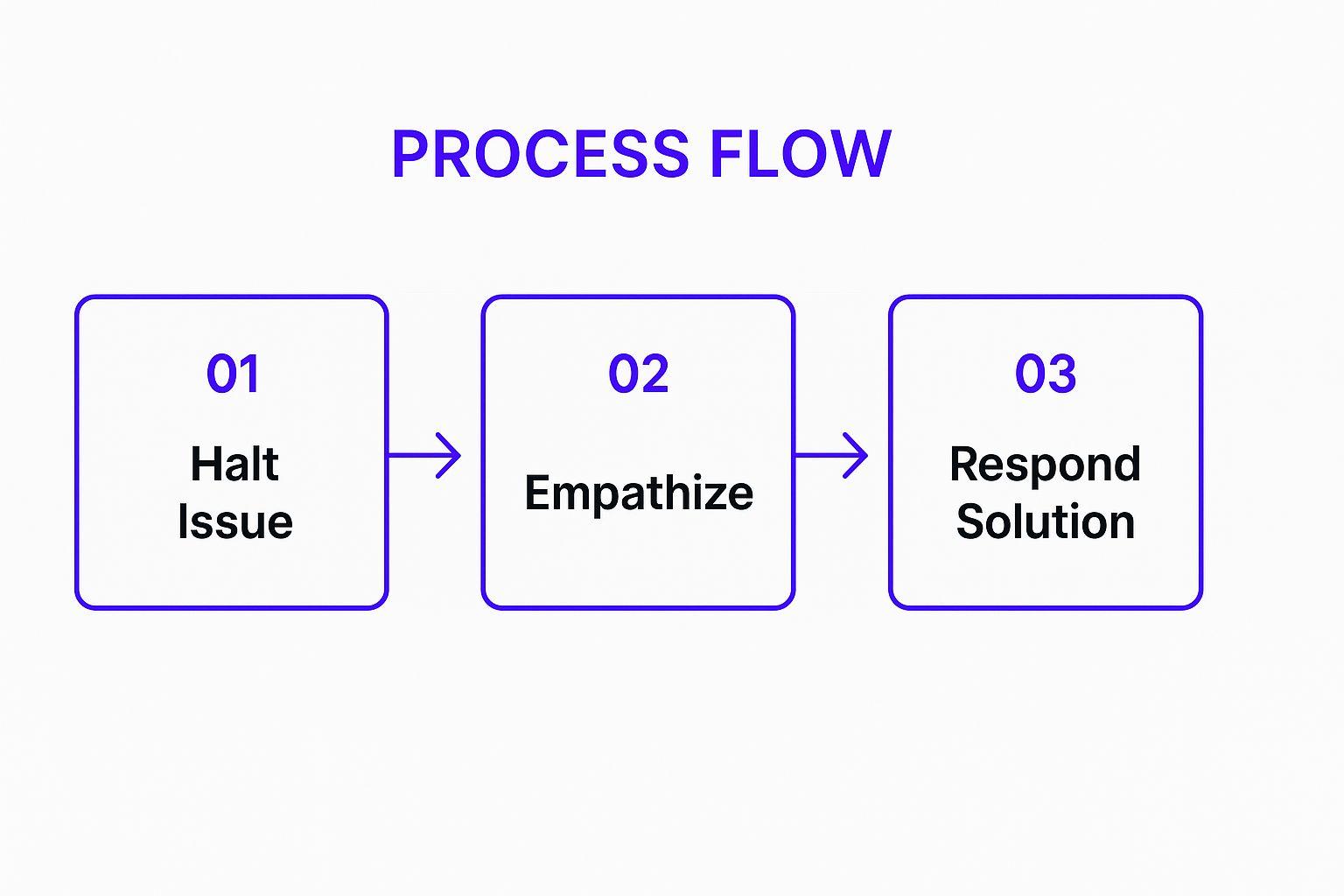
This visual shows that resolving an issue effectively begins with pausing to listen, followed by genuine empathy, before a solution is ever presented.
2. The LAST Method Complaint Resolution Script
The LAST method is a streamlined framework for complaint resolution that helps agents manage difficult customer interactions with clarity and purpose. Standing for Listen, Apologize, Solve, and Thank, this approach provides a direct path to de-escalating tension. It is one of the most practical customer service scripts examples for turning a negative experience into a satisfactory one, focusing on efficient problem-solving.
This framework is exceptionally useful in fast-paced environments where quick, effective resolutions are key. For example, if a customer calls a cleaning service because the crew missed a room, an agent using LAST would first listen to the full complaint without interruption. They would then sincerely apologize for the oversight before immediately offering a solution, like dispatching a team to correct the mistake at no charge.
How the LAST Method Works
The strength of the LAST method is its simplicity and directness. It guides agents to validate the customer's complaint and move swiftly toward a concrete solution, preventing the conversation from spiraling into further frustration. This focus on action builds customer confidence.
- Listen: Let the customer explain their issue completely. Avoid interruptions and take notes to understand the core problem.
- Apologize: Offer a genuine apology for the problem. Phrases like, "I'm so sorry to hear about your experience," or "I apologize for the frustration this has caused," show accountability.
- Solve: Propose a clear, actionable solution. Empower agents to offer resolutions like a complimentary follow-up service, a partial refund, or a discount on future work.
- Thank: Conclude by thanking the customer for their feedback and patience. This simple step reinforces that their business is valued and ends the interaction on a respectful note.
3. Product Knowledge Inquiry Script
A Product Knowledge Inquiry Script is a structured guide for agents handling customer questions about specific products or services. Its primary goal is to ensure representatives provide accurate, consistent information while uncovering the customer's underlying needs. This approach transforms a simple Q&A session into a consultative experience, making it one of the most valuable customer service scripts examples for driving sales and customer satisfaction in home services.
This script moves beyond just listing features. For example, if a customer asks about a new high-efficiency HVAC system, the agent uses the script to ask qualifying questions like, "What are you hoping to improve over your current system?" This helps them frame the product's benefits, such as lower energy bills or better air quality, in a way that resonates with the customer's specific goals.

How the Product Knowledge Inquiry Script Works
This script’s effectiveness comes from its dual focus: educating the customer and understanding their needs simultaneously. It prevents agents from overwhelming callers with technical jargon and instead guides them toward a solution that feels tailored to them. This method is popularized by tech giants like Apple and retail leaders who excel at consultative selling.
- Listen & Qualify: Begin by actively listening to the customer’s initial question. Then, ask open-ended questions to understand their situation, budget, and desired outcome.
- Connect Features to Benefits: Instead of just stating what a product does (a feature), explain how it helps the customer (a benefit). For instance, "This water heater has a larger tank (feature), which means your family won't run out of hot water during peak usage times (benefit)."
- Provide Clear, Accurate Information: Use a well-maintained knowledge base to provide consistent and correct details. If unsure, have a clear process for escalating the query to a senior technician or product specialist.
- Guide to the Next Step: After answering their questions, guide the customer toward a logical next action. This could be scheduling an in-home consultation, sending a detailed quote, or finalizing a service appointment.
This visual shows that a successful product inquiry conversation involves more than just reciting facts; it's about understanding needs to provide relevant solutions.
4. Proactive Service Recovery Script
The Proactive Service Recovery Script is a forward-thinking framework used to contact customers about an issue before they notice it or complain. It stands for Acknowledge, Provide Context, Solve, and Follow Up (APSF). This preemptive approach turns a potential negative experience into an opportunity to demonstrate reliability and build immense customer loyalty, making it one of the most powerful customer service scripts examples for high-trust home service brands.
This script moves your business from a reactive to a proactive stance. For example, if a supplier notifies an HVAC company that a batch of capacitors is faulty, the company can use this script to call all customers who had one installed. Instead of waiting for air conditioners to fail on a hot day, the company contacts them first, explains the situation, and schedules a free replacement, transforming a future crisis into a present act of exceptional service.
How the Proactive Service Recovery Script Works
The strength of this script is its ability to control the narrative and show that your company is looking out for its customers even after the job is done. It disarms potential frustration by addressing a problem head-on, often before the customer is even aware one exists.
- Acknowledge: Immediately state that you've identified a potential issue with a service or product they received. Be direct and transparent from the first sentence.
- Provide Context: Briefly and honestly explain what happened without placing blame. For instance, "We've learned from our supplier that a part used in your recent water heater installation may not meet our quality standards."
- Solve: Present a clear, no-cost, and convenient solution. This must be a firm resolution, not just an offer to "look into it." For example, "We've already set aside a replacement part for you and would like to schedule a technician to install it for free at your earliest convenience."
- Follow Up: After the solution is implemented, follow up to confirm the customer is satisfied. This final step reinforces your company’s commitment to quality and long-term care.
5. Technical Support Troubleshooting Script
A Technical Support Troubleshooting Script provides a systematic, step-by-step guide for representatives to diagnose and resolve technical issues. This structured approach ensures all necessary diagnostic questions are asked and potential solutions are explored logically, from simplest to most complex. It is one of the most essential customer service scripts examples for any home service business dealing with smart home technology, complex HVAC systems, or internet-connected appliances.
This script prevents agents from jumping to conclusions or missing critical details. For example, when a customer reports their smart thermostat is offline, the script would guide the agent to first check basic issues like Wi-Fi connectivity and power before moving to more advanced steps like a factory reset or discussing a potential hardware failure. This methodical process increases first-call resolution rates and builds customer confidence.

How the Technical Support Troubleshooting Script Works
The effectiveness of this script lies in its logical flow, which simplifies complex problems into manageable steps. By standardizing the diagnostic process, it empowers even junior technicians to handle sophisticated issues confidently, ensuring consistent service quality.
- Identify & Clarify: Begin by asking open-ended questions to understand the exact nature of the problem. Repeat the issue back to the customer to confirm your understanding.
- Gather Information: Ask specific diagnostic questions to gather key details. For an appliance, this could be the model number, error codes, and when the problem started.
- Guided Troubleshooting: Walk the customer through a sequence of troubleshooting steps, starting with the most common and simple solutions first.
- Confirm & Verify: After each step, ask the customer to verify if the action resolved the issue. This prevents wasted time on ineffective solutions.
- Escalate or Conclude: If the problem is solved, document the solution and conclude the call. If not, follow a clear protocol for escalating the issue to a senior technician or scheduling an on-site visit.
The following video demonstrates the importance of a structured approach in a technical support context, highlighting how clear communication and a logical process lead to better outcomes.
This structured approach transforms a potentially chaotic interaction into a controlled and efficient problem-solving session.
6. First Call Resolution (FCR) Maximization Script
A First Call Resolution (FCR) maximization script is a framework designed to fully resolve a customer's issue during their initial contact. It focuses on equipping agents with the knowledge, authority, and processes needed to prevent follow-up calls. This structured approach combines deep information gathering with decisive action, making it one of the most valuable customer service scripts examples for boosting efficiency and customer satisfaction.
This method is more than just a script; it’s an operational philosophy. For example, when a customer calls an HVAC company because their new thermostat isn't working correctly, an FCR-focused agent is empowered to not only diagnose the issue but also access scheduling, offer a direct credit for the inconvenience, and book a priority technician visit all in one interaction, without needing a manager's approval.
How the FCR Maximization Script Works
The strength of this script lies in its proactive and comprehensive nature. It empowers the agent to own the customer's problem from start to finish, preventing the frustrating experience of being transferred or told to call back later.
- Gather All Information: The script prompts the agent to ask clarifying and diagnostic questions upfront to understand the full scope of the problem. This avoids discovering new details late in the call.
- Access Knowledge & Authority: Agents use a comprehensive knowledge base to find solutions quickly. Crucially, they are given the authority to make decisions like scheduling, issuing credits, or dispatching technicians.
- Provide a Complete Solution: The agent provides a definitive resolution, not just a temporary fix. This might involve walking the customer through a self-repair, scheduling a service, or processing a refund on the spot.
- Confirm & Recap: Before ending the call, the agent confirms the customer understands the solution and recaps the next steps. They ask, "Have I fully resolved your reason for calling today?" to ensure complete satisfaction.
This framework is highly effective for home service businesses, as it builds immense customer confidence and loyalty. Companies like American Express and Progressive Insurance have championed this model, training agents to handle claims and complex inquiries in a single contact, which dramatically reduces operational costs and improves the customer experience.
7. Empathy-Driven Emotional Support Script
The Empathy-Driven Emotional Support script is a specialized approach for handling highly emotional customer interactions. It prioritizes emotional intelligence and validation over immediate problem-solving, making it one of the most crucial customer service scripts examples for sensitive situations where a customer is distressed, frustrated, or facing a significant personal issue related to your service. This method trains agents to listen, acknowledge feelings, and offer support before anything else.
This script moves beyond standard apologies, equipping agents to manage conversations that are emotionally charged. For example, if a homeowner calls in a panic because a newly installed HVAC system failed during a heatwave, putting an elderly family member at risk, the agent's first priority is to calm the customer. They would use reflective listening ("It sounds like this is an incredibly stressful and dangerous situation for your family") to show they understand the gravity of the issue before discussing dispatching an emergency technician.
How the Empathy-Driven Emotional Support Script Works
The power of this script lies in its focus on human connection during a crisis. It acknowledges that some problems are more than just an inconvenience; they are emotionally impactful. By addressing the customer's emotional state first, agents can de-escalate tension and build a foundation of trust that makes problem-solving much smoother.
- Acknowledge and Validate: Start by recognizing the customer's emotional state. Use phrases like, “I can only imagine how upsetting this must be,” or “It’s completely understandable that you feel this way.”
- Use Reflective Listening: Paraphrase what the customer has told you to confirm you understand their situation and feelings. For example, "So, what I'm hearing is the new electrical work is malfunctioning, and you're concerned about safety. Is that correct?"
- Show Genuine Empathy: Express sincere care and concern. Avoid generic responses and connect with the human element of their problem.
- Offer Reassurance: Once the customer feels heard, provide reassurance that you are there to help them and will take the situation seriously.
- Transition to Action: After establishing an emotional connection, gently pivot to resolving the issue. Say something like, “Thank you for sharing that with me. Let’s work together to find a solution right now.”
This approach ensures the customer feels supported on a personal level, not just processed as another ticket. It transforms a potentially negative brand experience into a moment of genuine human support, reinforcing customer loyalty under the most challenging circumstances.
8. Omnichannel Consistency Script Framework
An Omnichannel Consistency Script Framework is a unified approach designed to provide a seamless and consistent customer experience across all communication channels. It ensures that whether a customer contacts your home service business via phone, email, live chat, or social media, they receive the same brand voice, quality of care, and core information. This framework is one of the most vital customer service scripts examples for modern businesses that interact with clients on multiple platforms.
This method goes beyond a single script by creating a core set of principles, phrases, and procedures that are adapted for each channel's unique format. For example, a customer inquiring about an HVAC installation quote should receive the same key qualifying questions and service details whether they call your office or use the chat widget on your website. This consistency builds trust and reinforces a professional, reliable brand image.
How the Omnichannel Consistency Script Framework Works
The power of this framework lies in creating a centralized "source of truth" for customer interactions that is then tailored to the specific context of each channel. It prevents conflicting information and ensures every touchpoint reinforces your company's values.
- Establish Core Principles: Define the non-negotiable elements of every interaction. This includes your brand's tone (e.g., friendly and professional), key empathy statements, and the standard procedure for handling common requests like scheduling or complaints.
- Adapt for Each Channel: Modify the core script for the nuances of each platform. Phone scripts can be more detailed, while chat and social media scripts should be more concise and use shorter sentences. Email scripts can include more formal language and detailed links.
- Centralize Customer Data: Use a CRM or similar system to give agents access to a customer's history across all channels. This allows an agent on the phone to see a customer's previous chat conversation, providing a truly seamless experience.
- Train and Audit: Train all representatives on the core principles and channel-specific adaptations. Regularly audit interactions across all platforms to ensure consistency and identify areas for improvement.
Developing a unified communication plan is crucial for success. You can learn more about building effective customer communication strategies to support your omnichannel framework.
Customer Service Script Comparison Guide
| Script Framework | Implementation Complexity 🔄 | Resource Requirements ⚡ | Expected Outcomes 📊 | Ideal Use Cases 💡 | Key Advantages ⭐ |
|---|---|---|---|---|---|
| The HEART Framework Script | Medium – Requires significant training | Moderate – Training investment needed | Improved customer satisfaction and emotional connection | Handling varied customer issues requiring empathy | Consistent experience; reduces agent stress |
| The LAST Method Complaint Resolution | Low – Simple four-step process | Low – Easy to train and implement | Effective complaint de-escalation and resolution | Managing straightforward complaints and disputes | Easy to remember; increases loyalty |
| Product Knowledge Inquiry Script | Medium – Needs frequent updates | Moderate – Product updates and training | Higher sales conversion and consistent info delivery | Product inquiries and consultative selling | Enhances revenue; helps new agents |
| Proactive Service Recovery Script | High – Requires monitoring systems | High – Sophisticated systems and compensation | Prevents churn and builds trust | Preemptive issue resolution before complaints | Builds loyalty; shows accountability |
| Technical Support Troubleshooting | Medium to High – Technical training required | Moderate to High – Expertise and updates | Faster resolution of technical issues | Technical problem diagnosis and resolution | Ensures thorough diagnosis; supports KB development |
| First Call Resolution Maximization | High – Requires robust training and systems | High – Knowledge management systems | Reduced repeat contacts and lower operational costs | Complex issues needing single-contact resolution | Improves efficiency; lowers costs |
| Empathy-Driven Emotional Support | High – Extensive emotional intelligence training | Moderate – Support for agent wellbeing | De-escalates emotional situations; reduces burnout | Emotionally charged or sensitive interactions | Strong customer relationships; call de-escalation |
| Omnichannel Consistency Script | Very High – Complex multi-channel integration | Very High – Tech investment across channels | Seamless experience across channels | Serving customers via multiple communication channels | Consistent brand voice; flexible agent deployment |
Turn Scripts into Revenue: Your Next Steps
We've explored a powerful arsenal of customer service scripts examples, from the HEART Framework for building relationships to the LAST Method for resolving complaints. Each script is more than just a set of words; it's a strategic tool designed to navigate specific customer interactions with precision and empathy. The goal is to move beyond reactive problem-solving and into proactive, relationship-building communication.
Mastering these scripts isn't about creating robotic, impersonal interactions. Instead, it’s about providing your team with a reliable foundation. This structure empowers them to handle any situation confidently, freeing them up to inject genuine personality and empathy into the conversation. For a home service business, this is the key to turning a simple inquiry into a booked job and a potential complaint into a glowing five-star review.
From Theory to Actionable Growth
The true value of these frameworks is unlocked when they are consistently implemented, refined through training, and adapted to your unique business needs. The difference between a company that struggles with customer retention and one that thrives on repeat business often comes down to this very discipline.
Here are your key takeaways and actionable next steps:
- Audit Your Current Processes: Review your existing call handling procedures. Where are the gaps? Are you consistently missing opportunities to upsell, gather feedback, or de-escalate issues effectively? Compare your current state to the structured approaches in the scripts provided.
- Select and Customize: You don't need to implement all eight scripts at once. Start with the one that addresses your biggest pain point. Is it negative reviews? Focus on the LAST Method. Is it low booking rates? Start with the FCR Maximization Script. Customize the language to fit your brand's voice and your specific services.
- Train, Role-Play, and Refine: Implementation is an active process. Schedule regular training sessions with your team to role-play different scenarios using these customer service scripts examples. This builds muscle memory and helps your team internalize the core principles, so they can deliver the lines naturally and effectively, even under pressure.
- Measure and Optimize: Track key performance indicators (KPIs) like First Call Resolution rates, customer satisfaction scores (CSAT), and booking conversion rates. Use this data to see how your new scripts are performing and identify areas for further refinement.
The Real Value: Consistency and Professionalism
Ultimately, exceptional customer service is a non-negotiable driver of growth. For home service companies, every phone call represents a direct line to revenue and reputation. Having the right scripts is the first step, but ensuring they are delivered flawlessly, every single time, is what truly separates market leaders from the competition. This level of consistency builds trust, fosters loyalty, and creates a powerful engine for customer acquisition through word-of-mouth referrals. By investing in a structured, professional approach to customer communication, you aren't just improving service; you are building a more resilient and profitable business.
Ready to implement these powerful scripts without the burden of hiring, training, and managing an in-house team? Phone Staffer provides expertly trained, remote CSRs who specialize in the home service industry and are ready to delight your customers from day one. Let us turn your phone calls into booked jobs and five-star reviews. Learn more and get started at Phone Staffer.