
Hiring remote employees isn't just about posting a job and hoping for the best. I’ve learned from experience that success hinges on a clear, deliberate strategy. It all starts with defining the role specifically for a remote environment, then sourcing talent without geographical blinders, and finally, tweaking your interview process to pinpoint essential remote work skills like self-motivation and stellar communication.
You're not just filling a vacancy; you're building a distributed team, and that requires a different mindset.
The New Reality of Remote Hiring
The way we work has changed for good. Knowing how to hire remote employees has shifted from a "nice-to-have" skill to a fundamental business requirement. The competition for top remote talent is fierce, and there's a huge gap between the number of people wanting remote jobs and the number of companies offering them.
Just look at the numbers. Recent data reveals that remote and hybrid roles pull in a staggering 60% of all job applications but only account for 20% of total job postings. This tells us there's a massive, untapped pool of talent hungry for flexibility. We see this especially in sectors like Professional Services (making up 24.3% of remote jobs) and Technology (18.3%). You can dig deeper into these remote hiring trends to see how they affect various industries.
The takeaway here is simple: companies that get remote hiring right gain a massive competitive edge. They get their pick of high-performers who now see flexibility and autonomy not as perks, but as standard expectations.
A Structured Approach Is Non-Negotiable
Trying to "wing it" just doesn't cut it when you're up against global competition for the best people. You need a thoughtful, structured process for every single step, from crafting the initial role to welcoming your new hire on their first day.
This is the kind of flow that sets you up for success.
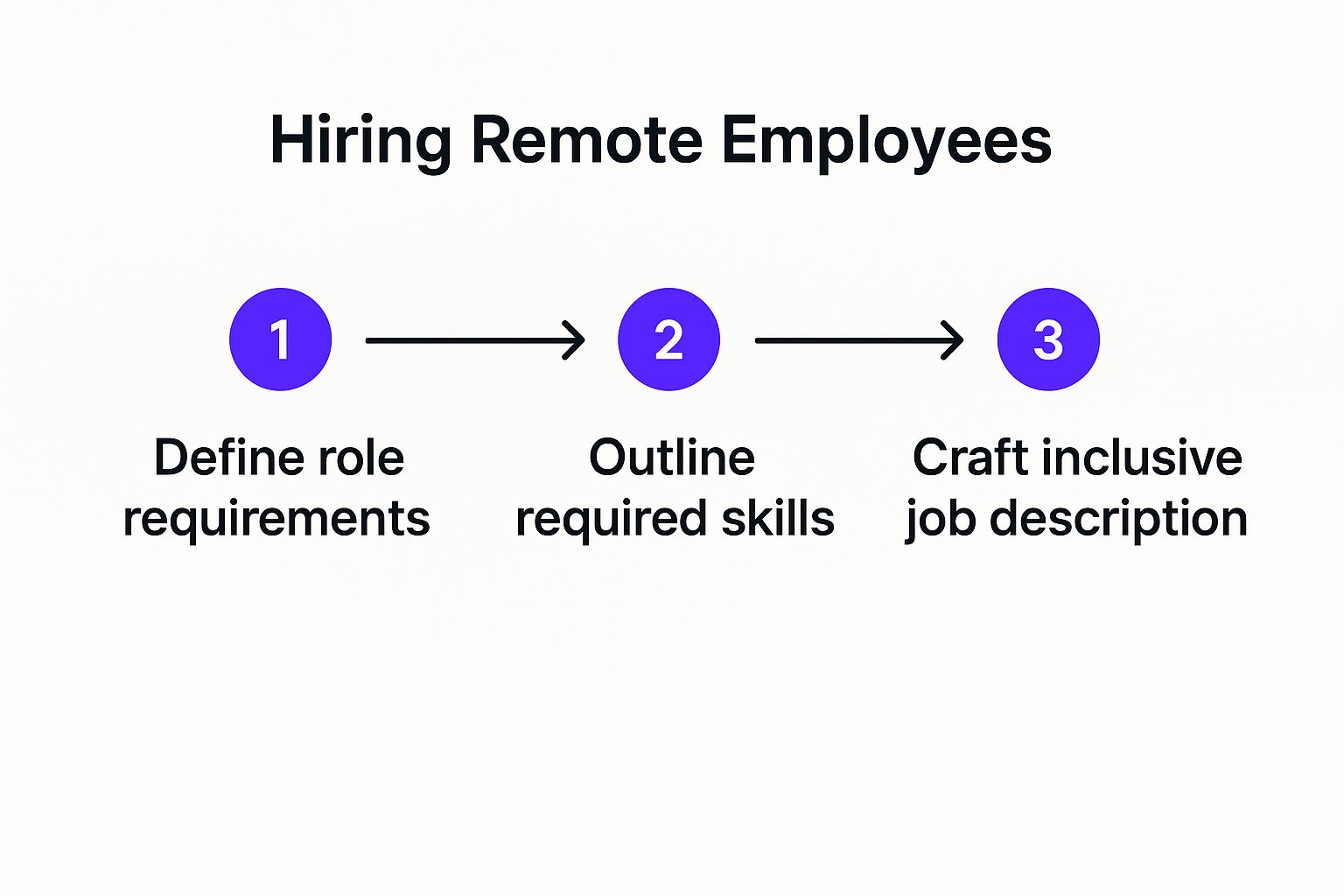
What I love about this visual is that it drives home a critical point: defining the actual requirements and necessary skills before you even start writing the job description is the secret to attracting the right people from the very beginning.
To get this right, you need a modern playbook. The old, in-office recruiting methods simply don't work anymore. You have to adapt to a world where your next superstar hire could be on the other side of the planet.
This guide is designed to give you that framework. To provide a bird's-eye view, here's a quick breakdown of the core stages we'll be walking through.
Core Stages of the Remote Hiring Lifecycle
| Hiring Phase | Primary Goal | Key to Success |
|---|---|---|
| 1. Role Definition | Create a precise profile for the ideal remote candidate. | Focus on outcomes, communication needs, and autonomy. |
| 2. Sourcing | Attract a diverse, global pool of qualified applicants. | Build a remote-first employer brand and post on niche job boards. |
| 3. Interviewing | Assess skills and cultural fit effectively from a distance. | Use video interviews, practical work-sample tests, and behavioral questions. |
| 4. Onboarding | Integrate the new hire smoothly into the team and company culture. | Structure the first week with clear goals, tools, and social introductions. |
Mastering these stages will put you in a powerful position to not only attract but also retain the best talent out there, regardless of where they call home. Let's dive in.
Defining Roles for Remote Success
You can’t find the right person if you don’t know who you’re looking for. A successful remote hire starts long before you even think about posting a job ad. The entire foundation rests on how clearly you define the role specifically for a distributed team. This isn't about listing tasks; it's about defining the outcomes you need and identifying the kind of person who can deliver them without someone watching over their shoulder.
Before you even dream of interviewing candidates, you have to get crystal clear on what success looks like in this position, far from the structure of a physical office. For example, a home service business like Phone Staffer hiring a remote customer service rep needs more than just a friendly voice. They need someone who is fiercely self-disciplined and takes the initiative to solve problems on their own.

Identifying Core Remote Competencies
While standard job skills are a given, certain behaviors are the real make-or-break factors for remote success. These are the soft skills that allow someone to thrive when given autonomy. Pinpointing these traits from the start helps you filter for the right mindset throughout the entire hiring process.
- Proactive Communication: Remote work simply falls apart without it. I always look for people who naturally over-communicate, give updates without being asked, and are comfortable hopping between chat, email, and video calls to stay in sync.
- Self-Discipline and Time Management: When there's no office to go to, employees have to create their own structure. The best remote hires can manage their own schedules, juggle priorities, and hit deadlines without any hand-holding.
- Resourcefulness: When a question pops up, does the person immediately ask for help, or do they first try to find the answer in the company’s documentation? That resourcefulness is pure gold in a remote setting.
I've seen so many companies make this mistake: they just take an old in-office job description and tack on the word "remote." A true remote-first role is built on outcomes and trust, not tasks and oversight. Getting this right from the beginning is the secret to attracting top-tier talent.
Crafting a Compelling Remote Job Description
Think of your job description as your #1 marketing tool. It’s your first and best shot at selling your company culture and attracting people who will actually excel in a remote setup. Here, transparency is your best friend.
A vague job post just invites a flood of applications from people who aren't a good fit, wasting everyone’s time. A specific, honest, and compelling description, on the other hand, acts as a powerful filter. It’s a critical step when you want to hire remote employees who are already wired to work the way your company does.
What to Include for Maximum Clarity:
- Time Zone Expectations: Be direct. If the role needs to overlap with a team in a specific window (e.g., 9 AM – 1 PM EST for collaboration), say so. If it’s truly flexible, shout that from the rooftops—it’s a huge perk.
- Tools and Technology: Don’t be shy about listing the core software stack. Mentioning tools like Slack, Asana, or Google Workspace lets candidates see if their tech skills match up and shows you have a thought-out remote process.
- Performance Metrics: How will you measure success? Ditch vague phrases like "handle customer inquiries." Get specific: "Maintain a customer satisfaction (CSAT) score of 95% or higher and a first-response time under 30 minutes."
- Cultural Cues: Give them a feel for the day-to-day. Are you an async-first company? Do you have virtual coffee chats? These details paint a picture of what it’s actually like to work with you.
By being brutally honest about your expectations, you don't just attract better candidates—you start building trust from the very first click. That transparency is what paves the way for a successful, long-term working relationship.
Sourcing Talent Beyond Your Zip Code

When you decide to hire remotely, you're no longer fishing in a local pond. Suddenly, the entire world is your talent pool. This is a game-changer, but it also brings up a pretty big question: with so many options, where do you even start?
The secret is to stop being reactive. Don't just post a job and hope for the best. You need to get proactive and go to the places where top remote professionals are already hanging out. It’s about leaving the generic platforms behind and focusing on the channels built specifically for a distributed workforce.
Go Where the Remote Talent Lives
Sure, the big-name job boards will get you a ton of applications, but quantity rarely equals quality. I've found that to find candidates who already know how to thrive in a remote setup, you have to be much more deliberate. You need to tap into the digital town squares of the global remote community.
Here are a few places that have consistently delivered for me:
- Remote-First Job Boards: Forget the generalist sites. Places like We Work Remotely and Remote.co are absolute goldmines. The people there aren't just open to remote work; they're actively seeking it out and usually have the experience to back it up.
- Industry-Specific Communities: Think about your niche. Hiring a developer? The jobs section on Stack Overflow is a fantastic resource. Looking for a marketer? You'd be surprised by the talent you can find in specialized Slack or Discord channels. These are the spots where passionate pros go to talk shop and find their next big thing.
This targeted approach does more than just get your job ad in front of the right eyeballs. It filters for intent right from the get-go, saving you a ton of time.
The job market has fundamentally shifted. A recent analysis found that a staggering 31.4% of professionals are only looking for remote jobs. If you're still stuck on local-only sourcing or demanding everyone be in the office, you're slamming the door on a massive chunk of top-tier talent.
This isn't just a trend; it's the new reality. Flexibility has gone from a "nice-to-have" perk to a core requirement for a huge part of the workforce. You can dig deeper into this data in the 2025 report on the state of remote jobs.
Build an Employer Brand That Resonates Remotely
Your company’s reputation is one of your most powerful recruiting tools. For remote candidates, that reputation is built on trust, transparency, and a real commitment to remote work. They can't just drop by the office to get a feel for the culture, so you have to project it digitally.
Start by showcasing how your remote culture actually works. Talk about your communication rhythms, the collaboration tools you rely on, and any perks that genuinely support a distributed team—things like a home office stipend or truly flexible hours. This paints an authentic picture of what it’s really like to be part of your team.
When your employer brand speaks the language of remote professionals, you’ll naturally attract people who are already on your wavelength.
Master the Art of Proactive Outreach
Let's be honest: the absolute best person for your role might not even be looking. This is where proactive outreach, especially on platforms like LinkedIn, becomes your superpower.
But please, don't be that person sending a generic, "I saw your profile and was impressed" message. It’ll get deleted instantly. Your outreach has to be personal and show you've actually done your homework.
A Simple Outreach Template That Actually Gets Replies:
Instead of a canned message, try an approach that shows genuine interest.
Hi [Candidate Name],
I came across your work on [mention a specific project, article, or GitHub repo]. I was really impressed with [mention one specific detail that stood out to you].
At [Your Company], we're tackling [briefly describe a relevant challenge or project]. With your background in [mention a relevant skill], I thought our [Job Title] role might be a great fit. We're a fully remote team that puts a big emphasis on [mention a key cultural value like autonomy or async-first communication].
Would you be open to a quick, no-pressure chat next week to hear a bit more?
See the difference? This approach cuts through the noise. It shows you respect their work and frames the opportunity as a compelling next step, not just another job offer. By combining a strong remote-first brand with thoughtful, personalized outreach, you'll be able to attract and hire incredible talent, no matter where they are in the world.
Running an Effective Virtual Interview Process
Interviewing someone you might never meet in person is a completely different ballgame. It’s not just about flipping on a webcam; you have to redesign the entire experience to get a real sense of their skills and personality from afar. Done right, a smooth virtual interview process becomes a powerful magnet for top talent, showing them you’ve got your remote culture dialed in.
The move to remote work has thrown a few curveballs at hiring managers. We now rely heavily on video calls and virtual assessments to figure out who’s got the right stuff. This means your process needs to be intentional, using technology to really gauge a candidate's ability to fly solo. You can find more great tips on how to hire remote employees on GoodHire.
Nail the Tech and Candidate Experience
First things first: make the technology disappear. Nothing sours an interview faster than tech glitches, confusing links, or terrible audio. This is the candidate’s first real window into how your company operates remotely—so make sure the view is a good one.
A few days before the interview, send over a clear and simple email with everything they need:
- A direct link to the video call (like Zoom or Google Meet).
- The names and job titles of everyone they’ll be talking to.
- A quick agenda so they aren’t flying blind.
- A point of contact on your team they can reach out to if they run into trouble.
This small gesture shows you respect their time and that you’re a professional, organized outfit. It sets a positive, calm tone and lets everyone focus on the conversation, not the connection. For a small business, a seamless process is critical—it’s just as important as a great virtual receptionist for a small business in creating that stellar first impression.
Ask Questions That Reveal Remote Readiness
Your standard interview questions just won’t cut it here. To find someone who will thrive in a remote role, you need to dig deeper with behavioral questions that reveal how they handle autonomy. You’re not just screening for job skills; you’re looking for evidence of self-discipline, resourcefulness, and proactive communication.
A candidate's past behavior is the best predictor of their future performance. When hiring remotely, you have to be absolutely sure they can deliver without the daily structure of a physical office. Ask questions that require them to share specific stories from their past.
Sample Behavioral Questions for Remote Roles:
- "Tell me about a time you hit a major roadblock on a project while working remotely. How did you figure out what was wrong, and what steps did you take to solve it yourself?"
- "Walk me through your system for managing your workload and prioritizing tasks when you have competing deadlines and no one looking over your shoulder."
- "Describe a miscommunication that happened with a remote colleague. How did you catch it, and what did you do to clear the air and get the project back on track?"
These questions force candidates to move beyond saying, "I'm a great communicator" and actually show you. Their answers will give you a much clearer picture of how they truly operate when they're on their own.
Go Beyond Talk with Practical Skills Assessments
A great conversation is one thing, but a practical skills test is where the rubber meets the road. For any role that involves creating something—whether it's code, a marketing plan, or a design—a work-sample test is your best friend. It’s the most reliable way to confirm they can do what their resume says they can do.
The trick is to design a test that closely mimics a real task they’d be doing on the job.
Work-Sample Test Best Practices:
| Role | Bad Test | Good Test |
|---|---|---|
| Software Engineer | "Solve this abstract algorithm puzzle." | "Here's a small, self-contained bug in our codebase. Fix it and submit a pull request with your explanation." |
| Content Marketer | "Write a 1,000-word blog post on our industry." | "We're launching a new feature. Draft a 300-word announcement email and two social media posts for LinkedIn and Twitter." |
| Customer Support | "What is good customer service?" | "Here are three real (but anonymized) customer support tickets. Draft your responses to each." |
Always be respectful of the candidate's time. The test should be focused, clear, and take no more than 1-3 hours. If you need something more involved, you should seriously consider paying them for their time. This gesture not only shows you value their expertise but also opens your talent pool to fantastic candidates who can't afford to do days of free work.
From Offer Letter to First-Day Onboarding
You’ve finished the interviews and found your person. It feels like the race is over, but honestly, the most important part is just kicking off. The way you guide a candidate from the offer to their first day sets the entire tone for their time with you.
Getting this right is especially critical when you hire remote employees. This is your first real shot to prove what your company culture is all about when you can't rely on office vibes. A clunky, disorganized experience plants seeds of doubt. A smooth, welcoming one? That builds trust and loyalty from day one.
Structuring a Compelling Remote Offer
An offer letter is so much more than a salary. It's a physical (well, digital) representation of your company's values and your commitment to this new person. In a remote-first world, that means you have to think beyond just the base pay and consider what truly supports someone working from home.
When you're pulling from a global talent pool, a one-size-fits-all approach to compensation just doesn't cut it. You have to be thoughtful and competitive, which usually means blending standard benefits with remote-specific perks that show you get it.
Here’s what a great remote offer package often includes:
- Localized Compensation: Do your homework. Research salary benchmarks for the candidate’s specific city or region to make sure your offer is not just fair, but genuinely competitive in their local market.
- Home Office Stipend: This is a big one. A one-time payment of $500 to $1,000 for a quality chair, desk, or monitor is a powerful gesture. It shows you're invested in their long-term comfort and productivity.
- Monthly Allowances: Think about recurring costs. A regular stipend for high-speed internet or a co-working space membership can be a hugely appreciated perk.
- Localized Health Benefits: If you're hiring internationally, you can't just offer your domestic plan. You'll need to partner with platforms that can provide compliant health insurance and benefits in their home country.
Putting these pieces together shows you’re not just slapping a "remote" label on old, office-based policies. You're building a company that’s intentionally designed to support a distributed team.
Your Remote Onboarding Checklist
Onboarding starts the moment they say "yes" to your offer. The whole point is to wipe out any uncertainty and make them feel like they're already part of the team, well before they ever log on for day one. A messy start can feel isolating and incredibly stressful for a new hire.
A world-class remote onboarding experience is your first and best chance to combat the isolation that can come with remote work. It’s a deliberate process of integrating someone not just into your systems, but into your culture and your community.
Don't wing this. A clear, structured checklist guarantees that no detail gets missed and every new person gets the same consistent, positive welcome.
Pre-Day One Logistics and Setup
The time between the "yes" and the first day is your golden opportunity to get all the administrative and tech headaches out of the way. When you handle this proactively, your new hire can spend their first week focused on learning and meeting people, not wrestling with login issues.
- Ship Equipment Early: Get a "welcome kit" out the door at least a week before their start date. This should have their laptop, mouse, keyboard, and maybe some company swag like a t-shirt or coffee mug. It creates a real, tangible connection to the company.
- Create All Accounts: Go ahead and set up their email, Slack, project management tools—everything they'll need. Send their login details in a secure, consolidated document the day before they start.
- Share the First-Week Schedule: Nothing calms first-day jitters like knowing what to expect. Email them a detailed schedule for their first week, including key meetings, introductions, and even blocks of time for self-guided learning.
The Human Element of Week One
With all the logistics handled, you can make their first week about people. The goal is to build connections and guide them toward their first small win.
- Assign an Onboarding Buddy: Pair them up with a friendly, seasoned team member who isn't their direct manager. This buddy is their go-to for all the informal, "silly" questions about company culture, how people communicate, or where to find stuff.
- Schedule Virtual Meet-and-Greets: Don't just announce them in a team-wide message. Set up a series of short, 15-minute one-on-one video calls with the key people they'll be working with. Spread these out over the first week.
- Plan a Structured Kickoff: The first call with their manager is huge. It should be a warm welcome that lays out their 30-60-90 day plan, explains how their role makes an impact, and sets clear, achievable goals for the first week.
This kind of thoughtful, structured process turns onboarding from a boring administrative task into a powerful tool for retention. It's how you make sure your new hire doesn't just feel prepared—they feel like they truly belong.
Even with a great plan, the details of remote hiring can feel like uncharted territory.Even with a great plan, the details of remote hiring can feel like uncharted territory. I’ve talked with countless managers who all wrestle with the same questions about productivity, legal snags, and keeping the team culture alive. Let's tackle these common concerns so you can build your distributed team with confidence.
How Do You Ensure Productivity and Accountability?
This is the big one, the question I hear more than any other. The answer is actually simpler than you might think: shift your focus from activity to outcomes.
Trying to mimic in-office supervision by watching online status indicators is a fast track to micromanagement and a total breakdown of trust. Real productivity in a remote setup isn't about screen time; it's about clarity and empowerment.
The best thing you can do is establish crystal-clear goals and key performance indicators (KPIs) for every single role. When your team knows exactly what they need to deliver, how they manage their time to achieve it becomes their responsibility.
- Project Management Tools: Platforms like Asana, Trello, or Jira are non-negotiable. They create a central, transparent place where everyone can see project progress and who’s doing what, all without needing another status meeting.
- Structured Check-ins: Keep your check-ins regular but brief—daily or weekly works well. The goal isn't to ask, "What are you doing?" but to ask, "What are you working on, and are there any roadblocks I can help you remove?" This is about support, not suspicion.
At the end of the day, performance should always be measured by the quality and timeliness of the work itself, not the hours someone appears to be online.
I've learned that when you hire the right people—those with strong self-discipline and a proactive mindset—and give them clear goals, you don't need to worry about productivity. They will hold themselves accountable because they are driven by the results they produce.
What Are the Legal and Tax Considerations?
This is where things can get tricky. Hiring people in different states, or especially in different countries, adds a serious layer of legal and tax complexity. This is one area where you absolutely cannot afford to just "wing it." Every location has its own specific rules for labor laws, tax obligations, and required benefits.
Get this wrong, and you could face some painful legal and financial penalties. You have to get a handle on your responsibilities for things like:
- Local Labor Laws: This covers everything from minimum wage and overtime pay to termination rules and leave policies.
- Payroll and Taxes: You're on the hook for correctly withholding income taxes and social security contributions based on your employee’s location.
- Mandatory Benefits: Many countries have laws requiring you to provide health insurance, pension contributions, and specific amounts of paid time off.
It sounds like a lot, but thankfully, there’s a straightforward solution that many companies rely on.
Using an Employer of Record Service
For most businesses, particularly small to medium-sized ones, the most practical approach is using an Employer of Record (EOR) service. Companies like Deel, Remote.com, or Papaya Global act as the legal employer on your behalf in whatever country you're hiring in.
An EOR takes care of all the local HR stuff, including:
- Compliant employment contracts
- Payroll and tax administration
- Benefits management
Using an EOR dramatically cuts down your administrative workload and legal risk. It lets you hire the best person for the job, wherever they live, with complete confidence and compliance.
How Can You Build a Strong Company Culture?
A great company culture doesn't just happen, especially when your team is spread out. You have to be deliberate and consistent in building the connections that would otherwise form naturally around the office coffee machine.
It all starts with your communication tools. Use something like Slack or Microsoft Teams not just for work, but for social connection, too. A dedicated channel for #hobbies, #pets, or #random-chatter does wonders for building those informal bonds.
Beyond just chat, you need to schedule regular virtual events. These don't have to be complicated. Think about virtual team-building games, a monthly "lunch and learn" where someone shares a skill, or even a team lunch where everyone gets a voucher for a meal delivery service. It’s all about creating shared experiences.
Don’t underestimate the power of public recognition. Celebrating wins, big and small, in team channels and reinforcing company values during all-hands meetings constantly reinforces the culture you want to build. It makes people feel seen and appreciated.
And if you have the budget, planning periodic in-person meetups or an annual retreat can be a game-changer. These events solidify the personal connections that are much harder to build through a screen, supercharging your remote culture for the long haul.
What Tools Are Essential for a Distributed Team?
A successful remote team runs on a well-chosen tech stack. While there's an endless sea of tools out there, they generally fall into a few core categories that form the backbone of your virtual office. Getting this foundation right is a critical step when you hire remote employees.
Here’s a breakdown of the core tool categories you’ll need:
| Tool Category | Purpose | Popular Examples |
|---|---|---|
| Communication | For real-time chat and video meetings. | Slack, Microsoft Teams, Zoom, Google Meet |
| Project Management | To track tasks, projects, and deadlines. | Asana, Trello, Monday.com, Jira |
| Document Collaboration | For real-time co-editing and file sharing. | Google Workspace, Microsoft 365 |
| Knowledge Management | A central hub for processes and company info. | Notion, Confluence, Slab |
Investing in these four areas gives your team a single source of truth for information, clear channels for talking, and transparent workflows for getting work done. This isn't just a list of software; it's the very infrastructure that allows your remote culture to thrive.
Are you tired of the hiring headache and just want top-tier remote talent placed in your home service business? Phone Staffer does the heavy lifting for you. We hire, train, and manage skilled remote CSRs and VAs, ensuring your phones are answered, your leads are converted, and your business grows. Learn more about how we can build your remote team at Phone Staffer.