

In the home service world, a sales lead is simply any potential customer who's shown they're interested in what you do. It could be someone calling for a quote, filling out a form on your website, or even just downloading a simple maintenance checklist. Think of it as the very first sign that a new job might be on the horizon.
Understanding the Foundation of Your Sales Pipeline

Picture every phone call, email, or website form submission as a seed. Not every single one will grow into a towering oak tree, but each one has that potential. That’s exactly what a sales lead is—a seed that could blossom into a loyal, paying customer. It's so much more than a name and phone number; it's a specific homeowner or property manager who has raised their hand, signaling they might need your help.
This initial show of interest is what separates a genuine lead from the general public. For any plumber, electrician, or HVAC pro, getting a firm handle on what a lead is—and what it isn't—is the foundation of predictable business growth. It’s the difference between just hoping the phone rings and actively building a reliable pipeline of future work.
From Vague Interest to Concrete Opportunity
At its heart, a lead is just a person who has taken a small step toward your business. Their interest could show up in a bunch of different ways, like visiting a specific service page on your website, replying to one of your marketing emails, or picking up the phone and calling you directly.
Spotting these signals is the first step. For instance, a lead could be:
- A homeowner who fills out your "request a quote" form for a new water heater.
- A property manager who calls to ask about your routine HVAC maintenance contracts.
- A local resident who gives you their email address to download your "Top 5 DIY Plumbing Fixes" guide.
Each of these actions shows a different level of urgency, but they're all valuable starting points. Your job is to capture that initial flicker of interest and start a conversation.
Decoding Your Incoming Leads
The table below breaks down the common terms you'll hear. Understanding these labels helps you quickly figure out who you're dealing with and how close they are to making a decision.
| Lead Term | What It Means for Your Business |
|---|---|
| Hot Lead | This person needs you now. They have a pressing problem (like a burst pipe) and are ready to hire. |
| Warm Lead | They're interested and actively looking for a solution but might still be comparing options or timelines. |
| Cold Lead | Someone who has shown minimal interest, maybe by downloading a guide. They're not ready to buy yet. |
| MQL (Marketing Qualified Lead) | Marketing has identified them as a good potential fit, but they haven't asked to speak to sales directly. |
| SQL (Sales Qualified Lead) | This person has been vetted and is ready for a direct sales conversation or an on-site estimate. |
Getting a feel for these different types is crucial because it tells you exactly how to approach each one.
Not All Leads Are Created Equal
It's absolutely critical to understand that not every inquiry has the same immediate value. A homeowner calling about an emergency leak is a much "hotter" lead than someone who just browsed your blog last week. Some leads might be for small, quick repairs, while others, like a full HVAC system installation, represent a huge payday.
Learning to tell the difference is a game-changer. As you can see in these examples of new power washing leads, the type and quality of incoming requests can vary wildly. This initial understanding is what allows you to start qualifying, prioritizing, and ultimately turning that raw interest into confirmed, paying jobs for your business.
The Different Kinds of Leads You Will Encounter
Let's be honest: not every phone call or form submission is a homeowner ready to hand you a check. Learning to spot the difference between a curious browser and a serious buyer is the secret to working smarter, not harder. It lets you pour your time and energy into the leads that will actually turn into paying jobs.
Think of it like fishing. Some fish are practically jumping into the boat, ready to bite. Others are just nibbling at the bait, testing the waters. You need to know which is which so you don't waste your best bait on the lookers. This same idea applies directly to your sales process.
Marketing Qualified Leads vs. Sales Qualified Leads
Two of the most important categories you’ll hear about are Marketing Qualified Leads (MQLs) and Sales Qualified Leads (SQLs). They might sound similar, but they represent completely different stages of a customer's journey. Nailing this distinction will change how you organize your day and prioritize who you call back first.
A Marketing Qualified Lead (MQL) is someone who's shown interest because of your marketing, but they aren't ready for a sales pitch just yet. They're still in the research phase, gathering information.
- For example: A homeowner downloads your free guide, "How to Choose the Right Water Heater." They're definitely thinking about it, but they haven't asked for a quote. They’re just doing their homework.
This is a warm lead. Calling them with a high-pressure sales pitch will only scare them off. Instead, a gentle follow-up email with more helpful tips—maybe a blog post comparing tankless vs. traditional models—is the right move.
Key Insight: With an MQL, your goal is to build trust and prove you're the expert. You're guiding them, not pushing them.
A Sales Qualified Lead (SQL), on the other hand, is past the research stage. They've taken a specific action that screams, "I'm ready to buy!" This is a hot lead, and your cue to spring into action.
- For example: That same homeowner now fills out your "Request an Emergency Repair" form because their water heater just burst. Their intent couldn't be clearer—they need a pro, and they need one now.
This is the person you call back within minutes. They’ve raised their hand and are literally asking for your help with an urgent problem. This is a true sales-ready lead.
Taking a Lead's Temperature
Beyond MQLs and SQLs, it’s useful to think about leads in terms of temperature. This simple analogy helps your whole team quickly categorize incoming requests and decide what to do next.
Hot Leads (Ready to Buy)
These are your SQLs. They have an immediate need and are actively looking for a service provider to solve it.
- Signal: A phone call asking, "Can you get a plumber over here this afternoon? My main drain is totally backed up."
- Action: Jump on it. This is your top priority, no questions asked.
Warm Leads (Thinking About It)
These are your MQLs. A project is on their mind, but they don't have a firm timeline yet.
- Signal: An email asking about the general cost of replacing an old electrical panel.
- Action: Follow up quickly with the information they asked for. Answer their questions thoroughly to start building a relationship.
Cold Leads (Just Looking)
These are folks at the very beginning of their journey. They’ve interacted with your business in a minor way but haven't shown any real intent to buy.
- Signal: Someone followed your company's Facebook page after seeing one of your posts.
- Action: No direct follow-up is necessary here. Just keep posting great content to stay on their radar for when they eventually need you.
Proven Ways to Generate High-Quality Home Service Leads
Alright, so you know what a sales lead is and the different flavors they come in. That's a great start, but it's only half the battle. Now it’s time to roll up our sleeves and put that knowledge to work with some practical, field-tested strategies.
Think of a steady flow of great leads as the engine that powers your home service business. Without it, you're dead in the water. This means you can't just sit around and wait for the phone to ring. You need a smart mix of modern digital tactics and good old-fashioned methods to make sure you're catching a homeowner's attention from every possible angle.
Let's dive into the most effective ways to fill your pipeline.
Dominate Your Local Digital Footprint
Let’s be honest: when a pipe bursts or the AC dies on a hot day, the first thing a homeowner does is grab their phone and start searching. If you're not showing up in that moment of need, you might as well be invisible.
- Master Local SEO: Getting your website and Google Business Profile tuned for local search is absolutely critical. This starts with making sure your business name, address, and phone number (NAP) are identical everywhere online. Seriously, consistency is king. Then, get your happy customers to leave reviews—this directly bumps you up in local search results.
- Run Targeted "Near Me" Ads: With Google Ads, you can get hyper-specific, targeting people searching for exactly what you do, right in your service area. Focus on keywords like "plumber near me" or "emergency AC repair [Your Town]" to connect with homeowners who have an urgent problem. This is one of the fastest ways to generate truly hot leads.
- Leverage Community Platforms: Don't sleep on sites like Nextdoor. They are digital goldmines for home service pros. Homeowners are constantly on there asking neighbors for recommendations. If you build a helpful, active presence, you can quickly become the go-to expert in your local community.
The shift to digital isn't just a hunch; it's a massive economic trend. The global lead generation market is on track to hit a valuation of around USD 6.38 billion by 2025. What’s fueling that? Businesses just like yours using digital marketing to find and connect with every potential customer.
Harness Powerful Online Engagement Tools
Your website is your digital storefront, but it needs to do more than just look pretty. It should be a lead-capturing machine. One great way to do this is by implementing an effective chatbot for lead generation to engage with visitors right on your site.
These bots are fantastic. They can answer basic questions, help schedule appointments, and grab contact info 24/7. This means you never miss a lead, even if it comes in at 2 AM.
Pro Tip: One of the simplest yet most powerful things you can do is put a big, obvious "Get a Free Estimate" button on every single page of your website. Make it incredibly easy for a potential customer to take that next step, no matter where they are on your site.
Never Underestimate Traditional Methods
While digital is essential, don't throw out the playbook that worked for decades. These classic, offline methods are amazing for building local trust and brand recognition.
Your Truck is a Mobile Billboard
A clean, professionally wrapped truck is one of the best marketing tools you own. As your crew drives around town, they're advertising your business to hundreds of potential customers every single day. Make sure your company name, phone number, and website are big, bold, and easy to read at a glance.
Build Strategic Partnerships
Start building relationships with other local businesses that also serve homeowners. A strong referral network can become a steady, reliable source of high-quality leads.
- Real Estate Agents: They are always looking for reliable contractors to handle pre-sale repairs or help new homeowners with updates.
- Property Managers: These folks manage tons of units and are constantly in need of maintenance and emergency services.
- Other Contractors: Get to know the best roofers, painters, and electricians in your area. A roofer can refer you for gutter work, and a painter might spot a problem that needs your expertise.
For example, a power washing business can land a ton of jobs from real estate agents who need to boost a home's curb appeal before listing it. You can see how one of these opportunities is documented in this example of a new lead: https://phonestaffer.com/new-a-lead-power-washing-antioch-9/.
The real key here is to make every single part of your operation—from your website to your work truck—a tool for generating your next sales lead.
How to Qualify Leads from Interest to Opportunity
A ringing phone feels great, but let's be honest—it doesn't always lead to a paid invoice. An incoming call is just the first step. The real work is figuring out if that person is a genuine customer or just kicking the tires. This is lead qualification: the critical process that separates casual inquiries from real, winnable jobs.
If you don't have a solid way to qualify people, your team can waste countless hours writing detailed quotes for homeowners who were never serious about hiring you. By asking the right questions upfront, you can focus your valuable time and energy on the leads who are actually ready to say "yes." It's all about making sure every estimate you write has a real shot at turning into a job, which is key to protecting your bottom line.
Using the BANT Method for Home Services
One of the most effective frameworks for qualifying a lead is BANT. It’s a simple acronym that stands for Budget, Authority, Need, and Timeline. It might sound like something for big corporate sales teams, but it works perfectly for any home service business. Think of it as your four-point inspection for every new inquiry.
Let's break down how you can use this on that first crucial phone call:
- Budget: You don’t need to ask for their bank statements. The goal here is just to see if their expectations are realistic. A great way to do this is by giving them a typical price range for the service they're asking about.
- Authority: Is the person you're speaking with the one who actually writes the check? If you’re talking to a renter or just one partner, you need to know who the final decision-maker is to move forward.
- Need: How urgent is their problem? A homeowner with a burst pipe has a powerful and immediate need. Someone thinking about a bathroom remodel for "sometime next year" is on a completely different level of urgency.
- Timeline: When do they want the work done? "As soon as possible" signals a hot, sales-qualified lead. "Sometime in the next six months" tells you this lead will require more long-term follow-up.
This simple flow chart captures the essence of a strong qualification process.
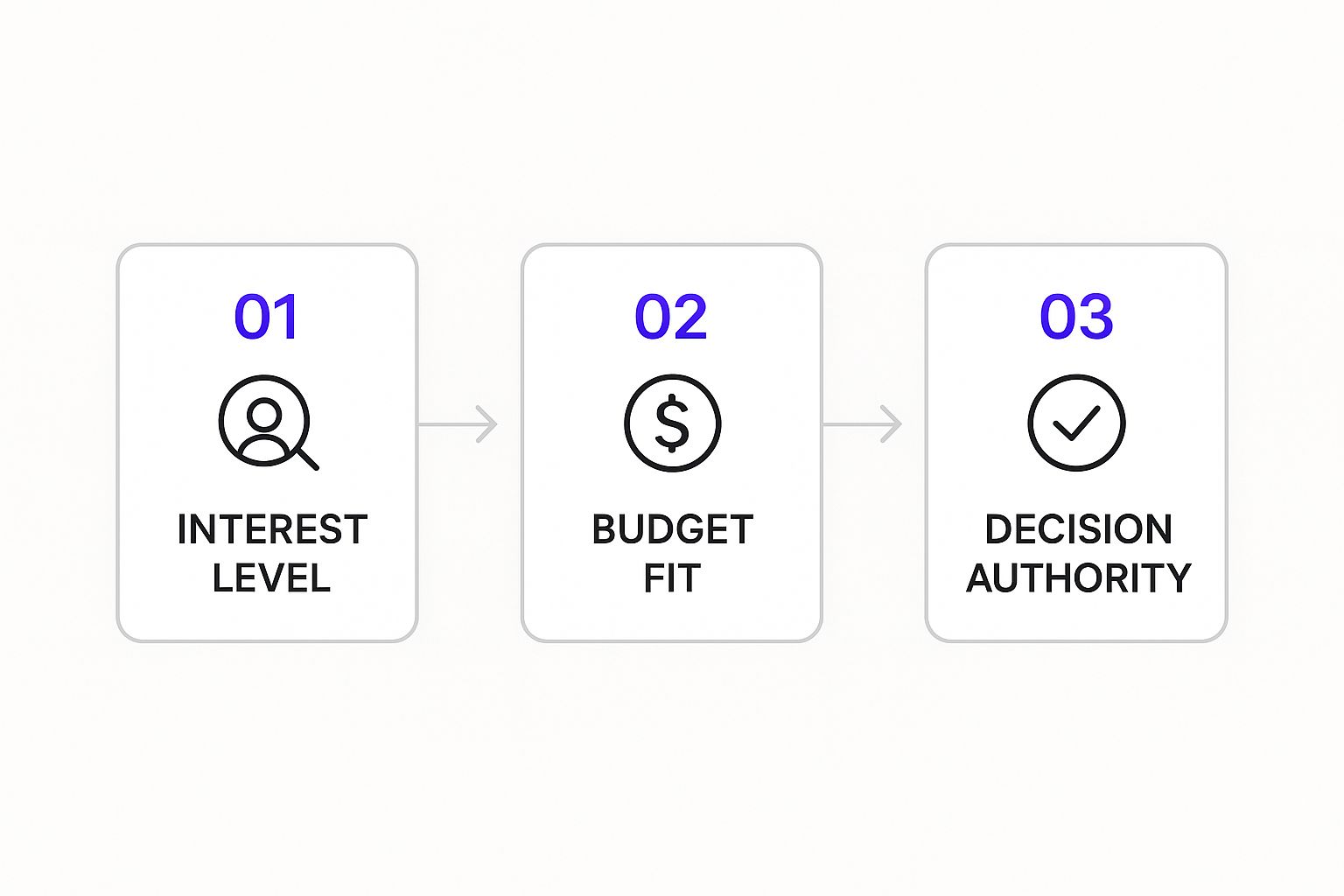
As you can see, a lead has to clear hurdles related to their interest, budget, and authority before they become a true, qualified opportunity worth your full attention.
Your Lead Qualification Checklist
You don't need fancy software to start prioritizing leads. A simple checklist can guide your team during that first call or email, helping them ask the right questions to gauge how serious a prospect is.
Here’s a practical table you can adapt for your own process.
| Qualification Factor | Key Question to Ask Them | What a 'Ready-to-Buy' Answer Sounds Like |
|---|---|---|
| Authority | "Are you the homeowner and the one who'll be making the final decision on this project?" | "Yes, it's my house and my decision." |
| Need | "What's prompting you to get in touch about this right now?" | "My AC just died, and it's going to be 95 degrees this weekend." |
| Timeline | "Ideally, when were you hoping to have this work completed?" | "As soon as possible. Can you come out this week?" |
| Budget | "Just so you have an idea, projects like this typically fall between $X and $Y. Does that sound like what you were expecting?" | "Yes, that sounds reasonable." |
A lead who gives you those "ready-to-buy" answers is a 10/10. They're a hot prospect, and you should do everything you can to get them an estimate immediately. Someone who is vague on their timeline or budget might be a 4/10—still worth keeping in touch with, but not your top priority for the day.
Lead qualification isn't about turning people away. It’s about sorting and prioritizing so you can give the right amount of attention to the right people at the right time.
This structured approach transforms your sales from reactive to proactive. You’re no longer just answering the phone; you’re strategically guiding conversations to find the best opportunities. To get even better at spotting good prospects, you can learn more about how to qualify sales leads and move them closer to a signed contract. By putting these steps into practice, you’ll build a more predictable and profitable sales engine for your business.
Best Practices for Managing and Nurturing Your Leads

Getting a new sales lead is an exciting moment, but it’s just the starting whistle—not the finish line. The real money is made in what happens next. How you manage and nurture that lead is what ultimately turns a flicker of interest into a signed contract and a happy, long-term customer.
Without a solid process, even the most promising leads can go cold, lost in a messy inbox or on a forgotten sticky note. But with a few smart habits, you can build a reliable system that gets the most out of every single opportunity that comes your way.
Respond with Urgency Every Time
In the home service world, speed is king. When a homeowner has a problem—a leaky pipe, a broken AC, a faulty garage door—they want a solution, and they want it now. This is where the concept of speed-to-lead comes in, and it’s probably the single biggest factor in whether you win the job.
Responding within five minutes versus five hours can mean the difference between closing a deal and finding out they already hired your competitor. A fast response doesn't just get you in the door first; it sends a powerful signal that your business is professional, attentive, and ready to get to work.
Key Takeaway: Treat every new lead notification like an emergency call. The first contractor to make meaningful contact dramatically increases their odds of winning the business. Make immediate follow-up a non-negotiable part of your team's daily routine.
Track Every Interaction Systematically
You can't manage what you don't measure. It’s nearly impossible to build a relationship with a potential customer if you can’t remember what you talked about last time. This is why tracking every touchpoint is so critical.
When you're starting out, this can be as simple as a well-organized spreadsheet. Just create columns for the basics: the lead's name, contact info, service needed, the date of each contact, and notes from the conversation. This simple log ensures no one slips through the cracks.
As your business grows, though, you'll want to look into an affordable Customer Relationship Management (CRM) tool. A good CRM automates this entire process, keeping all customer history in one clean, accessible place and even reminding you when it's time to follow up.
Nurture Leads with Helpful Follow-Ups
Not every lead is ready to pull the trigger today. Many warm leads are still weighing their options, doing research, or just waiting for the right moment. Lead nurturing is the art of staying on their radar by offering value, not by applying pressure.
Here are a few simple but effective ways to nurture those "not-yet" leads:
- The Post-Quote Follow-Up: A day after sending a quote, email them a helpful tip, like "3 Things to Check Before a New Water Heater Installation."
- Seasonal Reminders: Send a friendly email in the fall to anyone who got an HVAC quote, reminding them it's the perfect time for a furnace tune-up.
- Showcase Your Work: If a lead was interested in a specific service, like a new garage build, send them a photo of a similar project you just finished. You can see how we discuss this in our article about new garage leads in Durham.
These small, consistent touchpoints build trust and establish you as a helpful expert. When their "maybe" finally turns into a "yes," your business will be the first one they call.
Frequently Asked Questions About Sales Leads
When you're out on a job, the last thing you want to worry about is marketing jargon. But getting a handle on a few key concepts, like what a "sales lead" really is, can make a huge difference in keeping your schedule full.
Let's clear up some of the most common questions that come up for home service pros. Think of this as the practical, no-fluff guide to turning interest into actual jobs.
What Is the Difference Between a Lead and a Prospect?
This is a big one, and the distinction is super important. Imagine a sales lead as someone who just walked by your booth at a local home show and glanced at your sign. They’ve shown a tiny spark of interest—maybe they downloaded a free guide from your website or liked your Facebook page. They're at the very top of your list, but you don't know much about them yet.
A prospect, on the other hand, is the person who stopped at your booth, asked about your pricing, and told you their air conditioner is on the fritz. You’ve had a conversation and qualified them. You know they have a real problem you can solve, they're the homeowner who can say "yes," and they're a good fit for the services you offer.
Every prospect starts as a lead, but not every lead becomes a prospect. Knowing the difference helps you focus your energy on the people most likely to hire you.
How Much Should I Pay for a Single Lead?
Honestly, there's no single price tag. The "Cost Per Lead" (CPL) is all over the map depending on your trade and where you operate. A lead for an emergency plumber in downtown Chicago is naturally going to cost more than a lead for lawn mowing in a quiet suburb.
Instead of chasing a magic number, think about it this way: is the lead profitable? If a lead costs you $50 but turns into a $500 repair job, that’s a win. The key is to track what you're spending on different marketing efforts—like Google Ads versus a neighborhood flyer campaign—and see which ones deliver the best bang for your buck.
The real metric to watch isn’t the cost of the lead itself; it’s the return on investment. A more expensive lead that reliably becomes a high-ticket job is always better than ten cheap leads that never pan out.
Do I Really Need a CRM to Manage Leads?
When you’re just starting out? Nope. A well-organized spreadsheet can do the trick just fine. You can easily keep track of a handful of names, numbers, and when you need to follow up.
But once your phone starts ringing more consistently and you're juggling a dozen or more inquiries at a time, a spreadsheet can get messy fast. That's when a Customer Relationship Management (CRM) tool becomes a game-changer. It’s designed to make sure no one falls through the cracks. It can automate follow-up reminders, keep every customer's history in one spot, and prevent a hot lead from getting lost in your email inbox. There are plenty of simple, affordable CRMs out there built just for service businesses like yours.
Stop letting valuable leads slip through the cracks. Phone Staffer can provide you with trained, remote CSRs to answer your phone, call every lead instantly, and book jobs directly on your calendar. Let us handle the follow-up so you can focus on the work. Learn how we can help you convert more leads today.