
Customer service excellence isn't just about meeting expectations. It’s about consistently exceeding them in a way that people remember. This is the crucial difference between getting a job done and creating an experience that builds real, lasting trust.
Going Beyond Good Enough in Home Services
Think about it this way. You hire a plumber to fix a leaky pipe. Standard service is when they show up, fix the leak, and leave. The problem is solved, and the transaction is over. Simple.
But what does customer service excellence look like? It’s the plumber who calls ahead to confirm their arrival time, slips on boot covers at your door, and clearly walks you through what’s wrong and how they'll fix it. Then, a week later, they send a quick text just to make sure everything is still running smoothly.
That proactive, considerate approach transforms a basic transaction into a genuine human connection. In the home services industry, where your team is literally entering a customer's personal space, that higher standard isn't just a nice-to-have. It’s your biggest competitive advantage. It's how you turn a one-time fix into a customer for life.
Customer service excellence is less about a single grand gesture and more about the consistent execution of small, thoughtful details that show you value the customer's time, home, and peace of mind.
This focus on the entire customer journey is becoming more important every day. Why? Because customer expectations are going up while the quality of service they receive is often going down.
In fact, research shows that in the United States, 25% of brands saw their customer experience quality decline for two straight years as of 2025. During that same period, only 7% actually got better. You can read the full research on evolving customer expectations to see just how critical it is to stand out from the crowd.
So, what's the difference between doing the bare minimum and truly excelling? Let's break it down.
Standard Service vs. Customer Service Excellence
| Aspect | Standard Customer Service | Customer Service Excellence |
|---|---|---|
| Approach | Reactive (solves problems as they arise) | Proactive (anticipates needs and prevents issues) |
| Goal | Complete the transaction | Build a long-term relationship |
| Communication | Functional and necessary | Clear, empathetic, and consistent |
| Focus | The immediate task or job | The entire customer journey |
| Outcome | Satisfied with the result | Delighted with the experience |
The table above makes it clear: one path leads to a completed job, while the other leads to a loyal advocate for your business.
The image below really nails down the core outcomes you get when you achieve this level of service: higher satisfaction, stronger loyalty, and, ultimately, better retention.
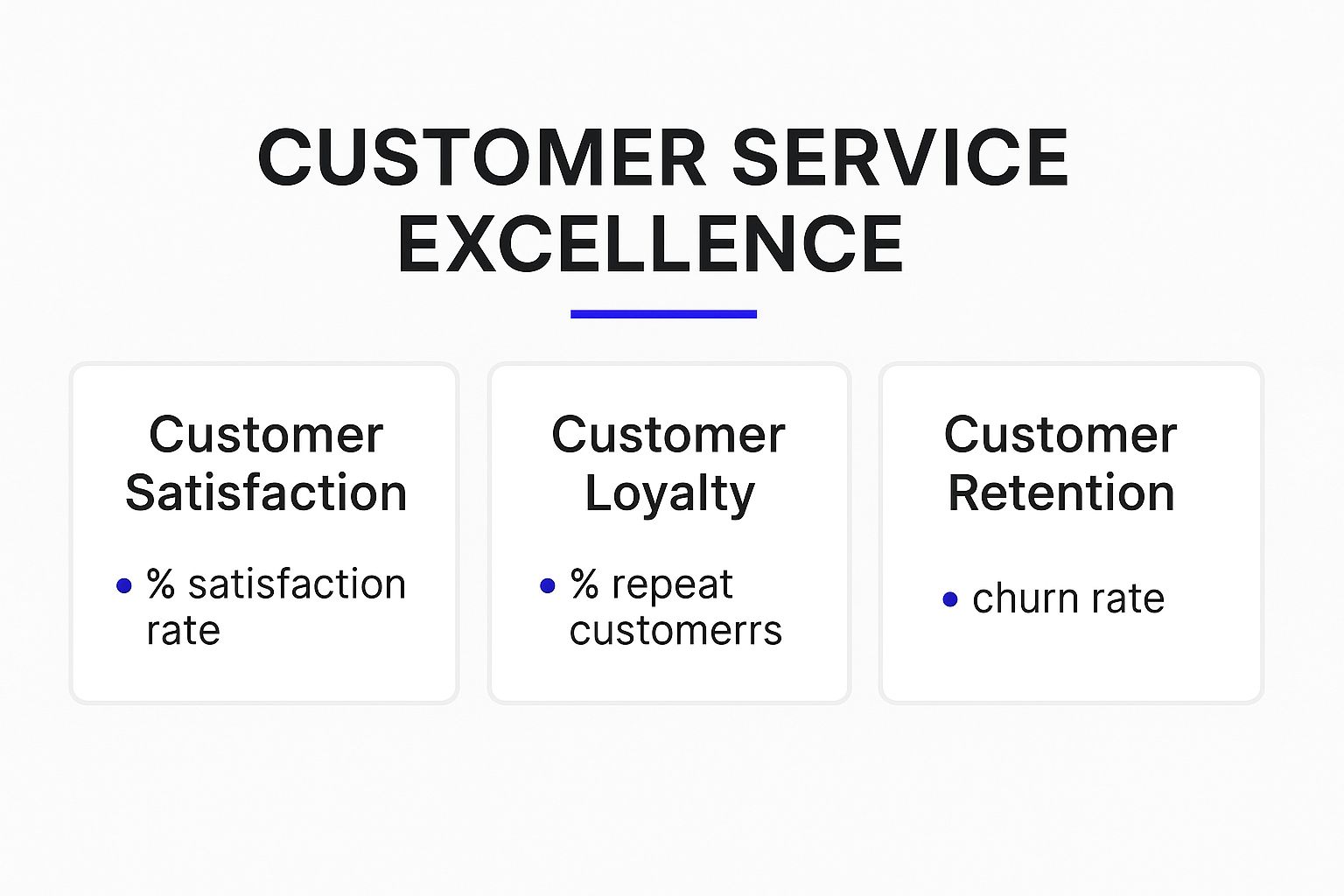
These three results are completely intertwined. When you deliver exceptional service, you create happy customers. And happy customers are the ones who stick around, building the loyalty you need for long-term success.
The Three Pillars of Memorable Service
Excellent service doesn't happen by accident. It's a deliberate strategy built on three core pillars that work together to create genuinely memorable experiences. When you master these fundamentals, you stop just completing jobs and start building real, lasting relationships with your clients.
Think of these pillars as Personalization, Proactivity, and Problem Resolution. Each one plays a critical role in the customer's journey, making them feel seen, cared for, and supported every step of the way.

Personalization: Making Customers Feel Seen
Personalization is all about remembering the little things that make each customer unique. It’s what turns a generic service call into a genuine conversation. Imagine your HVAC technician is out for a furnace check-up and asks the homeowner how their AC unit has been running since he fixed that tricky issue last summer.
That simple gesture shows you see them as a person, not just an invoice. It's an incredibly powerful way to build the kind of trust that keeps customers coming back.
“When an electrician remembers a customer's concern about child-proofing outlets from a previous visit, that small detail transforms a routine job into a trusted partnership. That is the essence of personalization.”
Proactivity: Solving Problems Before They Start
Being proactive means you’re always one step ahead, anticipating what your customers need before they even have to ask. Instead of waiting for a frantic call about a broken furnace in the dead of winter, you send a friendly reminder in the fall to schedule their annual maintenance. It’s about being a helpful partner, not just a reactive repair service.
This approach proves you're looking out for their best interests. For a cleaning service, this might mean offering a pre-holiday deep clean, knowing clients will soon be hosting guests and want their homes to shine.
Problem Resolution: Turning a Bad Day into a Great Experience
Let's face it—mistakes happen. The true test is how you handle them. When a scheduling mix-up occurs, you don't make excuses. You own it, offer a sincere apology, fix it fast, and then follow up to make sure the client is truly happy.
Handled well, fixing a mistake can actually make a customer relationship stronger than if nothing had gone wrong in the first place. It demonstrates integrity and reinforces your commitment to their satisfaction. This is where a well-trained team is absolutely essential, as their ability to navigate these tough spots directly impacts loyalty. Keeping your best problem-solvers on the team is crucial, which is why it's always smart to think about how to reduce employee turnover.
Why Excellence Is Your Strongest Marketing Tool
In the home services game, your reputation is everything. You can pour money into Google Ads and local flyers, but nothing—and I mean nothing—beats the power of a real, heartfelt recommendation from a happy customer. This is where top-notch customer service stops being a nice-to-have and becomes your single most powerful marketing weapon.
Think about it. A customer who’s just “satisfied” probably won’t bring you up in conversation. But one who is genuinely wowed by their experience? They’ll tell their neighbors over the fence, rave about you on the local Facebook group, and leave glowing online reviews. That kind of word-of-mouth advertising is pure gold because it’s built on trust, something no ad can ever buy.
Turning One Job into Lifelong Value
Great service does more than just bring in new faces; it dramatically boosts your Customer Lifetime Value (CLV). A simple, one-off plumbing repair, when handled with real professionalism and care, can easily turn into a lucrative long-term maintenance contract. That customer will remember the peace of mind you gave them, making you their first and only call from then on.
This kind of loyalty is how you build a more profitable business. Instead of constantly chasing and paying for new leads, you cultivate a solid base of repeat customers. That steady, predictable revenue gives you a foundation to stand on and grow your business the right way.
The trust you earn through excellent service is more valuable than any tool in your truck. It pays you back over and over again through loyalty, referrals, and a rock-solid reputation that your competitors can't touch.
Ultimately, delivering this high standard of care lets you charge what you're worth. When customers know they can count on you for a reliable, seamless experience, they are more than willing to pay a premium. They aren't just buying a fixed furnace; they're buying confidence and a solution without the headache. It all starts with that first positive interaction, which is why a deep understanding of what is appointment setting is so crucial to the entire process.
How to Measure What Truly Matters to Customers
You can't improve what you don't measure. While "customer service excellence" might sound a bit fuzzy, you can absolutely track it with a few simple, practical metrics. This isn't about getting lost in complicated spreadsheets; it’s about asking the right questions to get answers you can actually use.
Think of these metrics—also known as Key Performance Indicators (KPIs)—as the gauges on your business dashboard. Each one gives you a clear reading on a different part of your service quality, helping you make smart decisions based on real data instead of just guessing what customers want.

Essential Customer Service Excellence KPIs
For a home service business, you don't need dozens of metrics. Focusing on a handful of core KPIs will give you the most valuable insights without overwhelming your team or your customers. The table below breaks down the most important ones.
| Metric (KPI) | What It Measures | Why It Matters for Home Services |
|---|---|---|
| Customer Satisfaction (CSAT) | The customer's immediate happiness with a single, specific interaction (e.g., a completed repair or a phone call). | Instantly tells you if a job went well or if there’s a problem you need to fix right now. A simple 1-5 scale survey after service works great. |
| Net Promoter Score (NPS) | Overall customer loyalty and their likelihood to recommend your business to others. | This is your word-of-mouth engine. It separates your biggest fans ("Promoters") from unhappy customers ("Detractors") who might be hurting your reputation. |
| First Contact Resolution (FCR) | The percentage of customer issues (e.g., booking, questions) resolved on the very first phone call or email. | A high FCR means your team is efficient and your processes are smooth. It saves everyone time and prevents customer frustration from building up. |
By tracking these KPIs, you get a well-rounded view of your service quality, from individual job performance to long-term brand health.
Putting Metrics Into Action
So, how do you actually gather this information?
-
Customer Satisfaction (CSAT): This is your real-time report card. CSAT measures how happy a customer was with a specific interaction, like a freshly finished plumbing repair. A simple text after the job asking, "How satisfied were you with your service today?" on a 1-5 scale gives you instant feedback.
-
Net Promoter Score (NPS): This one is all about long-term loyalty. Instead of asking about a single job, NPS asks how likely a customer is to recommend your entire company to a friend. It’s the ultimate loyalty question and helps you identify your biggest champions.
-
First Contact Resolution (FCR): This metric is a gut check on your team's efficiency. FCR tracks how often your team can solve a customer's problem—whether it's booking a new job or answering a billing question—on the very first try. A high FCR is a sign of a well-oiled machine.
You don't need a complicated system to capture this feedback. Automated text messages or simple email surveys after a job is marked complete can create a steady flow of incredibly valuable data.
To get the full picture, it helps to look into a few different methods for measuring customer satisfaction. Combining a couple of these approaches will give you a much clearer, more accurate view of where you’re knocking it out of the park and where you have room to grow.
Using Technology to Power Human Connection
Let's get one thing straight: great tech doesn't replace great people. It superpowers them. The whole point of bringing in modern tools is to make your human interactions smarter, faster, and more meaningful. Think of technology as the support system that lets your team's talent shine.
A solid Customer Relationship Management (CRM) system is the perfect place to start. It’s the difference between a generic, "How can I help you?" and a personal, "Hi, Mrs. Jones! How has that new water heater been working since we installed it last spring?"
That one small detail, pulled from her customer history, instantly shows you see her as a valued client, not just another job on the schedule. It builds real rapport.
Smarter Operations Mean Better Service
Technology is also your key to being proactive. Tools like automated scheduling and appointment reminders do more than just cut down on no-shows—they create a smoother experience for everyone. When your day runs like a well-oiled machine, your team isn't scrambling to put out fires.
This efficiency frees up your people to focus on what they do best: solving tricky customer problems and building relationships that last.
Even artificial intelligence (AI) has a role to play here. By 2025, the use of AI tools like chatbots is set to continue its sharp rise from 2023. Companies that embrace this tech are seeing faster resolutions and big wins in customer satisfaction and operational flow. You can discover more insights about customer service trends on deloittedigital.com.
When technology handles the routine tasks—like scheduling or answering basic questions—your team has more time and energy to deliver the empathetic, high-value service that creates loyal customers.
Finding the right tools makes all the difference. The best call center software for a small business will bundle these features together, giving your team everything they need to knock it out of the park on every single call.
Your Questions on Service Excellence Answered
Knowing what service excellence is and actually pulling it off are two different things. In the world of home services, you’re dealing with unique hurdles—from coordinating technicians in the field to earning trust inside a customer’s home. Let's tackle some of the most common questions that pop up.
How Can a Small Business Compete with Larger Companies?
As a small business, you have a secret weapon that big corporations just can't match: genuine personal connection. You’re nimble enough to build real, lasting relationships with your customers.
Lean into the little things that show you truly care. Remember a customer’s specific concern from last year, offer a bit more flexibility on scheduling, or have the owner make a personal call to smooth over a problem. That personal touch is what sets you apart, building rock-solid loyalty and generating powerful word-of-mouth referrals.
What Is the Single Most Important Skill for a Service Technician?
Technical skill is a given, but the most critical skill is active listening. This isn't just about hearing what a customer says; it's about tuning into their stress, asking smart questions to get the full picture, and showing you genuinely understand their frustration.
A technician who truly listens can diagnose both the broken appliance and the customer's anxiety. This allows them to deliver a solution that doesn't just provide a technical fix but also gives the customer complete peace of mind—and that's what people remember long after the truck pulls away.
"A customer doesn't just want their problem solved; they want to feel heard and respected throughout the process. Active listening is the bridge between a simple transaction and a lasting, positive experience."
How Long Does It Take to See Results from Improving Customer Service?
You’ll see some immediate wins. A single amazing interaction can spark a glowing online review or a heartfelt thank-you on the spot. These small victories are fantastic for team morale and build momentum.
But for the big stuff—like building an ironclad reputation and seeing a real jump in customer retention and referral rates—you’re typically looking at three to six months of consistent effort. Consistency is everything. Each and every interaction is a brick in the foundation of your brand.
Achieving customer service excellence starts with making sure every call and every lead is handled with care. Phone Staffer can hire, train, and place expert remote CSRs and VAs right into your business, ensuring you never miss a chance to make a fantastic first impression. Learn more about our solutions.