
Think of customer service quality assurance (QA) as the head chef in a five-star restaurant. Before any dish leaves the kitchen, they taste it to make sure it's perfect. That’s exactly what QA does for your customer conversations—it’s a proactive strategy to guarantee consistency and quality every single time.
What Is Quality Assurance in Customer Service?

At its heart, customer service quality assurance is about building a system that turns good service into a reliable, brand-defining experience. It's not about catching your team making mistakes. Instead, it’s a strategic process for making sure every single interaction—phone calls, emails, live chats—meets your company's highest standards.
This system is designed to pinpoint what your team is already doing well, find powerful coaching opportunities, and lift the entire customer experience. It works by evaluating conversations against a clear set of criteria, which turns "good service" from a vague idea into something you can actually measure.
A Proactive Approach to Service Excellence
Customer satisfaction surveys are reactive; they tell you how you did after the fact. A QA program, on the other hand, is proactive. It lets you spot potential issues, trends, and training gaps before they turn into bigger problems.
By consistently monitoring interactions, you’re not just checking if problems are being solved. You're ensuring your team embodies your brand’s values in every conversation. This is more important than ever. The impact of service quality on retention is massive—recent stats show that 57% of customers will jump to a competitor after just one bad experience. You can find more data on how experience impacts customer loyalty from Giva Inc.
A strong QA process transforms your customer service from a cost center into a powerful loyalty-building engine. It's the mechanism that ensures the promises your brand makes are kept during every single interaction.
It’s More Than Just a Scorecard
While scorecards are a key part of the process, effective QA goes much deeper. It’s about digging into the why behind the numbers.
- Spotlight Your Stars: QA helps you identify what your top performers are doing differently. You can then take those winning behaviors and turn them into best practices for the whole team.
- Find Systemic Cracks: Are lots of customers calling about the same confusing billing issue? QA data can uncover root causes that have nothing to do with agent performance, pointing instead to problems with your products, services, or internal processes.
- Fuel Agent Growth: When done right, QA is a fantastic coaching tool. It gives agents specific, evidence-based feedback that helps them build skills, grow their confidence, and feel more invested in their work.
Ultimately, a solid quality assurance program builds a foundation of trust and loyalty. It creates a consistent, high-quality service experience that customers learn they can count on, which directly boosts everything from team morale to your bottom line.
The Real Business Impact of a Strong QA Program

A good customer service quality assurance program isn't just about ticking boxes on a checklist. Far from it. When done right, it's a powerful engine for business growth that delivers real, measurable results you can see on your bottom line.
Think of it this way: every single customer interaction is a moment of truth for your brand. QA is your insurance policy. It's what ensures those moments build trust instead of chipping it away. This systematic review is how you transform customer service from a cost center into a genuine revenue-driver.
Boosting Customer Retention and Loyalty
The first place you'll feel the impact of quality assurance is in customer loyalty. It’s simple, really—when customers consistently get high-quality support, they have every reason to stick around. Preventing a bad experience is infinitely more valuable than trying to win back a frustrated customer.
Today's customers have very little patience for poor service. We've all been there. It’s no surprise that 70% of customers will walk away from a brand after just two bad experiences. Even something as basic as a long hold time is enough for 53% of customers to take their business somewhere else. That’s a thin margin for error. You can get more details on shifting customer expectations in recent Webex experience management studies.
A solid customer service quality assurance process tackles this head-on by:
- Cutting Down on Customer Churn: By finding and fixing service issues, you stop the negative interactions that push customers out the door.
- Building Real Brand Trust: Consistency is everything. When customers know they can count on you, their loyalty deepens.
- Increasing Customer Lifetime Value: A loyal customer doesn't just stay longer; they buy more and recommend you to others.
Uncovering Financial and Operational Efficiencies
Beyond making customers happy, a QA program is a goldmine of data for making your business run smoother. It gives you a clear window into how your team operates, revealing hidden inefficiencies that cost you money. The goal isn't just better service—it's a smarter, more profitable business.
By systematically analyzing interactions, you stop guessing what's wrong and start knowing. QA data provides the evidence needed to make informed decisions that cut costs and improve performance.
This process helps you spot those recurring problems that quietly drain your resources. For instance, if several agents are fumbling with the same scheduling software, the problem isn't your agents—it's a training gap or a clunky tool. For a home service business, where every call counts, a specialized home services answering service can be a part of this efficiency puzzle, ensuring that first point of contact is flawless.
Empowering Your Team and Fostering Growth
Finally, don't underestimate the impact on your team. A QA process built on constructive coaching—not just pointing out mistakes—creates a culture of continuous improvement. When your agents get specific, evidence-based feedback, they feel supported and become invested in their own growth.
This leads directly to a few key outcomes:
- Sharpened Agent Skills: Agents learn exactly where they can improve, from their phone manner to their technical knowledge.
- Higher Employee Engagement: When you invest in your team's development, it shows you value them. That's a huge morale booster.
- Reduced Employee Turnover: Happy, successful employees are far less likely to leave, saving you the steep costs of hiring and training new staff.
Ultimately, a strong QA program creates a positive feedback loop. Better-trained, more engaged agents deliver fantastic service. This leads to happier, more loyal customers—and a much healthier bottom line.
Measuring What Matters in Service Quality
To get a real handle on your customer service quality, you have to move beyond just a "gut feeling." We've all had those moments where we think things are going well, but without solid data, it’s all just guesswork.
True quality assurance isn’t about subjective opinions. It's about having a clear, objective way to measure what’s working and what isn’t. To do that, you need to look at performance through two different but equally important lenses: quantitative and qualitative metrics.
Think of it like inspecting a new plumbing installation. The quantitative metrics are the hard numbers—like water pressure and flow rate. They tell you if the system is functioning. The qualitative metrics are about the craftsmanship—the clean soldering, the properly secured pipes, and the fact that the technician didn't leave a mess. You need both to know you got a high-quality job.
Quantitative Metrics: The “What” of Your Service
Quantitative metrics are the numbers. They’re the black-and-white data points that tell you what happened during a customer interaction. These are essential for spotting trends and measuring efficiency at a glance.
Here are a few of the big ones:
- Average Handle Time (AHT): This is simply the average length of a customer interaction, from "hello" to goodbye. A low AHT might look good on a report, but you have to be careful it isn't coming at the cost of rushing customers off the phone.
- First Contact Resolution (FCR): This tracks the percentage of customer problems solved in a single touchpoint—no follow-up calls, no transfers, no headaches. A high FCR is a massive win for both customer happiness and your team's efficiency.
- Customer Satisfaction (CSAT): This is your direct line to customer sentiment, usually captured through a quick post-interaction survey asking something like, "How satisfied were you with our service today?"
For a home service business, FCR is pure gold. Imagine a customer calls because their appointment window was missed. A one-call resolution means your agent apologizes, immediately finds a new slot with the dispatch team, and sends a confirmation text before hanging up. The alternative is a frustrated customer calling back three times—a scenario we all want to avoid.
Qualitative Metrics: The “How” of Your Service
While numbers tell you what happened, qualitative metrics tell you how it happened. This is where the human element comes in. These metrics dig into the actual experience and are crucial for building the kind of trust that creates customers for life.
These are typically measured by having a manager or QA specialist review interactions using a scorecard.
Qualitative analysis is all about the nuances that numbers can't capture. It’s the difference between an agent who just follows a script and one who genuinely makes a customer feel heard and taken care of.
Key qualitative areas to look at include:
- Empathy and Tone: Did the agent sound like they actually cared? Was their tone friendly and professional, or did they sound like they were just going through the motions?
- Accuracy of Information: Nothing breaks trust faster than bad information. Did your agent provide correct details about services, pricing, and scheduling?
- Active Listening: Was the agent truly listening, or just waiting for their turn to talk? Did they ask good follow-up questions to make sure they understood the customer's real problem?
It’s one thing to collect data, but it’s another to know which customer satisfaction metrics that drive growth are the most important for your business. The best QA programs combine the what with the how to get the full story.
A Practical Toolkit for Evaluation
To put this all together, you need a way to track these different data points side-by-side. A balanced scorecard helps you avoid common traps, like chasing a low call time at the expense of happy customers.
The table below breaks down some of the most essential metrics for a well-rounded customer service quality assurance framework.
Essential Customer Service QA Metrics
| Metric | Type | What It Measures | How to Track It |
|---|---|---|---|
| First Contact Resolution (FCR) | Quantitative | The percentage of issues solved on the first try. | CRM tags, post-call surveys asking "Was your issue resolved?" |
| Average Handle Time (AHT) | Quantitative | The average duration of an interaction. | Phone system or contact center software reports. |
| Agent Empathy | Qualitative | The agent's ability to understand and share customer feelings. | Scorecard reviews of call recordings or chat transcripts. |
| Information Accuracy | Qualitative | Whether the agent provided correct and complete information. | Scorecard reviews, cross-referencing with knowledge base. |
| Adherence to Procedure | Both | If the agent followed required steps (e.g., identity verification). | Automated checks and manual scorecard reviews. |
By tracking both types of metrics, you get a powerful feedback loop. You might see an agent has a high AHT, but after listening to their calls, you realize they’re phenomenal at calming down anxious customers and building rapport. That’s a skill you want to celebrate, not punish. This balanced view is the real secret to building a team that delivers exceptional service every single time.
How to Build Your QA Process from Scratch
Putting together a customer service quality assurance program can feel like a massive undertaking, but it's really just a series of logical steps. Think of it like building a custom piece of equipment for your business—each part needs to be chosen and fitted perfectly for the whole thing to run smoothly and efficiently.
This blueprint will walk you through creating a QA process that actually works. We'll turn the fuzzy idea of "quality" into a concrete, measurable system that starts with defining your destination and ends with giving your team the tools to get there.
Step 1: Define Your Quality Standards
Before you can measure anything, you have to decide what “good” actually looks like for your brand. This is the bedrock of your entire QA process. Without a clear definition of quality, scoring becomes subjective, inconsistent, and ultimately, useless.
Your quality standards are your brand's promise to customers, broken down into specific actions your agents can take. They should be a direct reflection of your company's values and what your customers genuinely care about. A standard isn't just "be friendly"—it’s "greet the customer by name and offer a genuine, unscripted opening."
To get started, ask yourself a few key questions:
- What three words do we want customers to use when they describe our service?
- What are the non-negotiable actions an agent must take on every single call (like verifying the address or confirming the next steps)?
- What specific behaviors separate a good interaction from a great one (like proactively solving a potential future problem or showing real empathy)?
Step 2: Design a Balanced Scorecard
Once you know what you're measuring, you need a tool to measure it with. That's your scorecard. This is the central document of your QA program, turning your standards into a checklist of objective, yes-or-no questions. A great scorecard avoids vague criteria and focuses on specific, observable actions.
A balanced scorecard should cover a few different areas. For a home service business, this might include:
- Process Adherence: Did the agent accurately capture the customer's address and the exact service they needed?
- Soft Skills: Did the agent listen actively without interrupting? Did they match the customer's tone?
- Problem Resolution: Was the issue fully handled on the first call, or will the customer need to call back?
- Compliance: Did the agent provide the correct information about service pricing and scheduling windows?
Getting this right matters. Poor customer service costs U.S. companies an astonishing $75 billion every year, often from simple service failures that a solid QA process would have caught. And while tech can help, only about 25% of call centers have effectively integrated AI into their operations, which shows there's a huge opportunity for improvement. You can see more stats on the financial impact of customer service at AmplifAI.com.
This simple infographic gives you a great visual of how an effective customer service QA program flows.
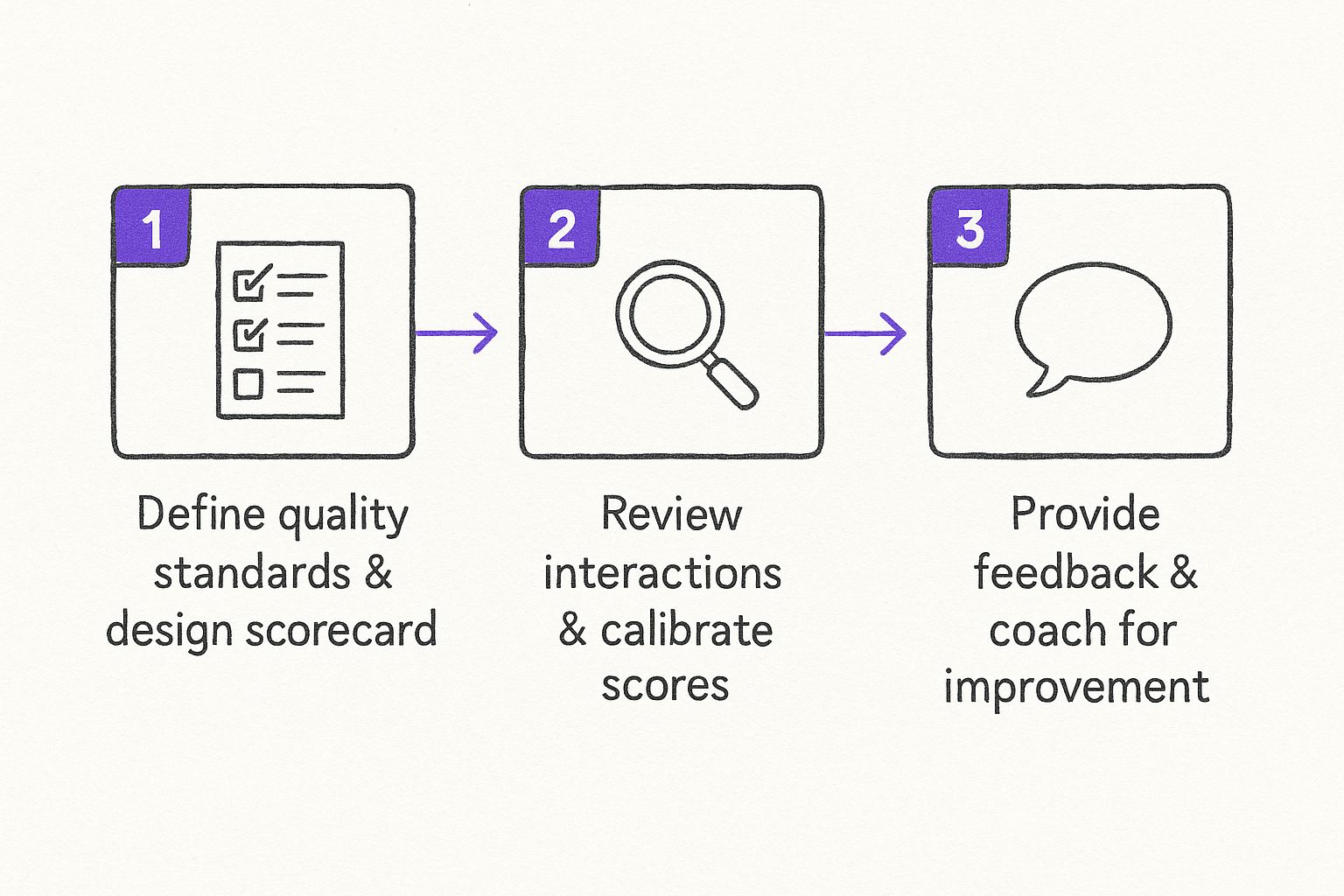
As you can see, it's a clear, repeating cycle: defining your standards leads to consistent reviews, and those reviews fuel continuous improvement for your agents.
Step 3: Review Interactions and Calibrate Scores
With your scorecard ready, it's time to start the actual review process. The number one goal here is consistency. It shouldn't matter if you, a team lead, or a dedicated QA specialist reviews a call—the score should be the same.
This is where calibration sessions become absolutely critical.
Calibration is simply the process of getting all your reviewers on the same page. In these meetings, the team listens to the same customer interaction, scores it on their own, and then discusses any differences to align on exactly what each scorecard item means in practice.
This step is your best defense against the "it depends on who scores you" problem. It ensures every review is fair and objective. Remember to review a random, representative sample of interactions, not just the calls where something went wrong. That’s the only way to get a true picture of your team’s performance.
Step 4: Turn Feedback into Actionable Coaching
This is it—the final and most important step. A score is just a number. It's completely meaningless until you use it to have a constructive coaching conversation that helps your agents grow.
Feedback has to be specific, based on evidence from the call, and focused on behavior—not personality. Don't just say, "You need to be more empathetic." Instead, try something like, "On that call with Mrs. Jones, when she mentioned her frustration with the leak, that was a perfect opportunity to show empathy. You could have said something like, 'I can definitely understand why that's so frustrating; let's get this sorted out for you right away.'"
By following these four steps, you're building more than a monitoring system. You’re creating a framework for continuous improvement that empowers your team, delights your customers, and strengthens your entire business from the inside out.
Best Practices for an Effective QA Program

Starting a quality assurance program is a great first step. But turning it into a real engine for growth? That comes down to building the right habits from the ground up.
Truly effective customer service quality assurance is much more about mentoring than it is about monitoring. It's about transforming a simple checklist into a strategic tool that lifts your entire team's performance. The practices below are what separate a QA program that just points out problems from one that actually solves them and fosters a culture of constant improvement.
Hold Regular Calibration Sessions
Consistency is everything. If two different reviewers can listen to the same call and come back with completely different scores, your agents will quickly lose trust in the whole process. That's why calibration sessions are an absolute must.
Think of it as getting your entire review team to sing from the same song sheet. In these meetings, everyone listens to the same customer interaction, scores it on their own, and then comes together to talk through any differences. The goal is to make sure that a score of "excellent" for empathy means the exact same thing to everyone, every single time.
This alignment doesn't just build trust—it ensures every bit of feedback is objective and standardized, removing any hint of personal bias from your evaluations.
Frame Feedback as Coaching, Not Criticism
Let's be clear: the goal of QA is to help your agents grow, not to punish them. If your team starts to see QA as a "gotcha" system designed to catch their mistakes, you’ll be met with defensiveness and disengagement. The best QA programs are always positioned as supportive coaching tools.
The trick is to shift the conversation from what went wrong to how things can be even better next time.
- Be Specific and Evidence-Based: Don't just say, "You sounded rushed." Instead, try something like, "When the customer asked about scheduling, I noticed the pace of the call picked up. Let's try adding a small pause there to make sure they feel fully heard."
- Balance Strengths and Opportunities: Always kick off a feedback session by highlighting something the agent did well. This reinforces good habits and makes the constructive feedback much easier to digest.
- Focus on Behavior, Not Personality: The feedback should always be about specific, observable actions—not about who the agent is as a person.
When agents view QA as a genuine investment in their professional development, they become eager partners in their own success. A big piece of this is helping agents connect with customers on a human level. For some practical advice on this, check out our guide on how to build rapport with customers and turn every call into a positive interaction.
An effective QA program doesn't create fear; it builds confidence. It shows your team that you are committed to helping them succeed, which in turn leads to better performance and lower employee turnover.
Use QA Data to Identify Systemic Issues
Individual agent feedback is only one piece of the puzzle. The real magic happens when your QA program gets mature enough to spot the bigger, systemic trends that are impacting your whole business.
For example, if you notice several different agents are fumbling when explaining a new service policy, the problem probably isn't the agents. It's more likely a gap in your training, a flaw in your process, or an issue with your tools. These insights allow you to stop treating individual symptoms and start curing the underlying business problem.
Making sure your program is in line with industry standards will help you truly elevate your service. It's always a good idea to review established customer support best practices to get new ideas. Ultimately, this data turns QA from a simple monitoring tool into a source of strategic intelligence, giving you the information you need to make smarter decisions for the whole company.
Common QA Pitfalls and How to Sidestep Them
So, you’re ready to roll out a quality assurance program. That's a great move, but even the best-laid plans can go sideways. I've seen it happen time and again—QA programs that start with a bang but fizzle out because they fall into a few common, completely avoidable traps.
Knowing what these pitfalls are from the get-go is your best defense. It helps you build a system that actually helps your team, instead of one that just adds frustration.
One of the biggest mistakes? A vague, subjective scorecard. I’m talking about questions like, "Was the agent friendly?" That sounds good on paper, but "friendly" to one reviewer might be "barely polite" to another. This kind of ambiguity breeds inconsistency, and your agents will quickly lose faith in the fairness of the whole process.
Another classic blunder is focusing only on the bad calls. When QA becomes a witch hunt for mistakes, you create a punitive, "gotcha" culture. Agents get defensive, morale plummets, and you completely miss the chance to learn from your top performers. Celebrating what works is just as crucial as fixing what doesn't.
Avoiding the Dreaded "Gotcha" Culture
The secret to getting agent buy-in is simple: frame QA as a tool for growth, not a weapon for discipline. The goal isn't to catch people messing up. It's to give them the specific, targeted coaching they need to get better at their jobs. That single shift in perspective changes everything.
Here’s how you can steer clear of these common issues:
- Build a Rock-Solid, Objective Scorecard: Ditch the subjective fluff. Replace it with clear, yes-or-no questions about things you can actually observe. Instead of "Was the agent helpful?" try "Did the agent confirm the customer's service address before dispatching?" See the difference? No room for interpretation.
- Review a True Cross-Section of Calls: Don't just cherry-pick the calls that went south. You need a random, representative sample of all interactions—the good, the bad, and the just plain average. A small or biased sample will only give you a skewed picture of reality.
- Celebrate the Wins (Loudly!): Make it a habit to share clips of fantastic calls during team meetings. When your agents see QA being used to highlight and reward great work, they’ll be far more open and engaged with the feedback they receive.
The best QA programs feel like a career development resource, not a disciplinary hearing. This positive framing is the absolute key to building a quality system that your team respects and that drives real, lasting improvement.
At the end of the day, a successful QA program is a partnership. It’s built on clear standards, fair and consistent reviews, and a shared commitment to making every customer interaction better than the last. By keeping these potential pitfalls in mind, you can build a framework that truly empowers your team to deliver exceptional service.
Got Questions About QA? We've Got Answers.
Even with the best plan in hand, you're bound to have a few questions when you start putting a customer service quality assurance program into action. Let's tackle some of the most common ones I hear from business owners.
Think of this as your final walkthrough before starting the project—a chance to get clear, straightforward answers so you can move forward with confidence.
How Many Calls Should We Actually Listen To?
This is probably the number one question people ask. A good, solid rule of thumb is to review 3-5 interactions per agent, every single week.
That number hits the sweet spot. It’s enough to spot real patterns and find coaching moments, but not so many that it becomes an overwhelming chore for your reviewer. Remember, consistency is far more important than quantity. You can always dive deeper into specific calls—like one with a really low customer satisfaction score or a tricky service problem—when you need more context.
Who Should Be Doing the Reviews?
Typically, you'll want a dedicated QA specialist or a team lead handling the reviews. Having someone who is a step removed from the day-to-day grind ensures they can be more objective and consistent. Their main job is to evaluate fairly based on the scorecard you've created.
But that's not the only way to do it. Other approaches work wonders, too.
- Peer-to-Peer Reviews: This can be a game-changer for team culture. Agents learn from each other and build a stronger sense of shared responsibility.
- Self-Reviews: Have agents score their own calls with the official scorecard. It's a fantastic way to build self-awareness and help them see where they can grow.
At the end of the day, the reviewer's job title doesn't matter nearly as much as their training. Whoever is doing the scoring needs to know that scorecard inside and out and join regular "calibration" meetings to make sure everyone is on the same page.
Quality assurance isn't an all-or-nothing game. A small shop can start with a simple scorecard in a spreadsheet and a team lead who spends a couple of hours a week on it. The core ideas deliver value, no matter how big your company is.
Can a Small Business Really Pull This Off?
Absolutely. You don't need a fancy software subscription or a whole new department to see the benefits of QA. The power of quality assurance is in the process itself, not the price tag.
A small home service business can get started with a simple scorecard in Google Sheets or Excel. The owner or a lead CSR can block off a few hours a week to listen to call recordings and give helpful feedback. The simple act of defining what a "good call" looks like, reviewing interactions, and coaching your team is what creates massive value.
Ready to ensure every lead is handled with five-star quality? Phone Staffer can hire, train, and place expert CSRs and VAs directly into your business, making sure every call is answered and every opportunity is captured. Learn more and book your appointments at https://phonestaffer.com.