

On the surface, calculating your cost per acquisition (CPA) seems straightforward: divide your total campaign cost by the number of new customers acquired. But if you're only looking at your ad spend, you're getting a dangerously incomplete picture of your marketing's real performance.
Defining Your True Cost Per Acquisition
Before plugging numbers into a calculator, we need to get clear on what CPA actually means for your home service business. It’s so much more than what you pay Google or Facebook for clicks. The metric that truly matters is your fully loaded CPA, which accounts for all the costs that go into winning a new customer.
I see it all the time—home service business owners track their ad spend religiously but completely miss the indirect expenses. This mistake leads to thinking a campaign is a huge success when it might barely be breaking even.
Beyond The Ad Spend
To get the full financial story, your CPA calculation needs to include those often-overlooked costs. Think about everything that supports your marketing and sales efforts.
This usually includes things like:
- Team Salaries: A portion of the salaries for your marketing staff, sales team, or even the office admin who fields new customer calls.
- Software Subscriptions: The monthly fees for your CRM, email marketing platform, scheduling software, and any other tools you use.
- Creative and Agency Fees: The money you spend on a marketing agency, a freelance graphic designer for your ads, or video production.
This infographic does a great job of visualizing how all these pieces fit together.
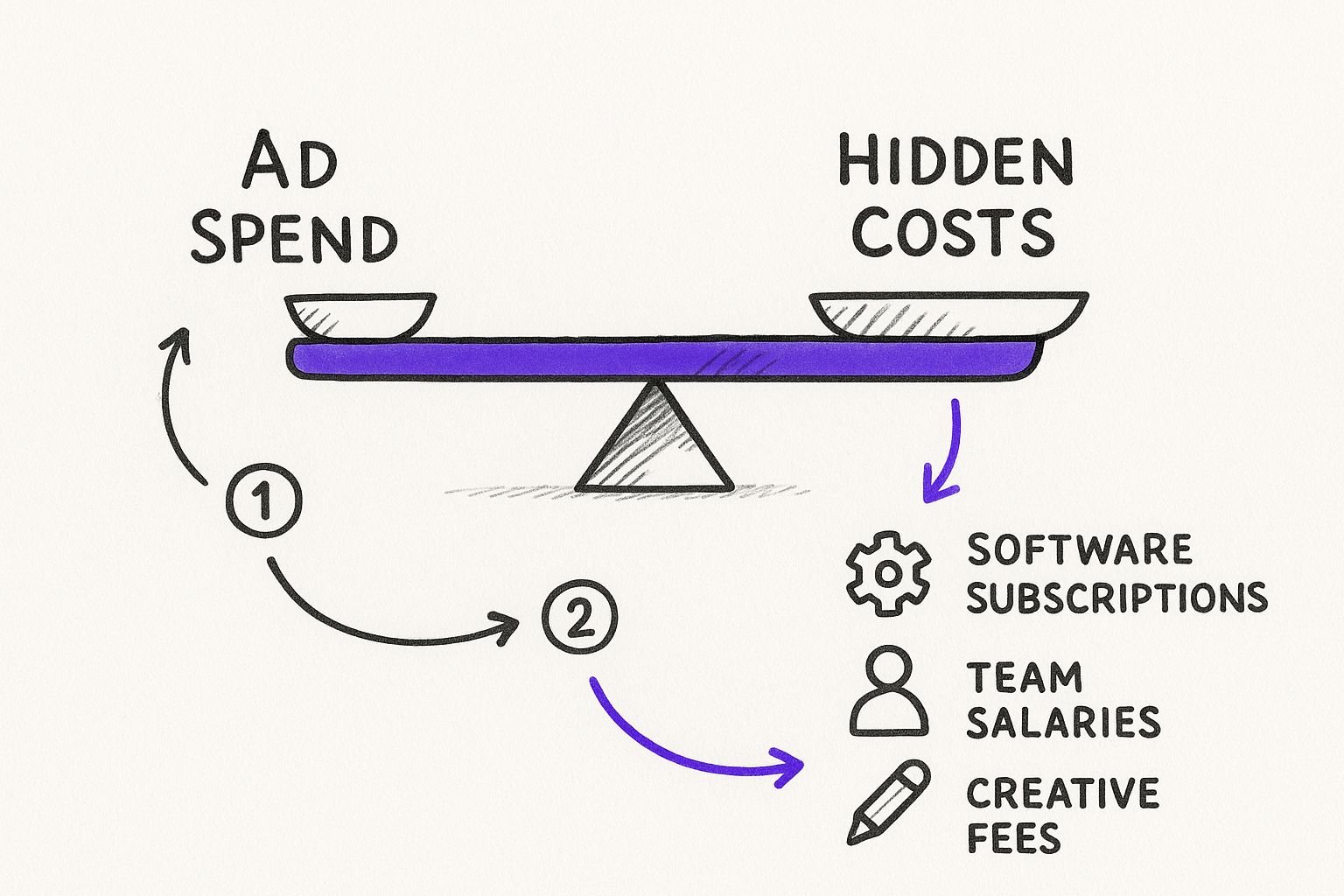
As you can see, a true CPA calculation gives weight to every contributing expense, not just the most obvious one.
When you ignore these additional costs, you might think a campaign is profitable when it's actually losing you money. This is a critical distinction that can make or break your entire marketing budget.
To illustrate this, let's compare the two approaches for a local HVAC company that gained 100 new customers last month.
Basic CPA vs. Fully Loaded CPA
| Expense Category | Basic CPA Calculation | Fully Loaded CPA Calculation |
|---|---|---|
| Google Ads Spend | $5,000 | $5,000 |
| Marketing Staff Salary (portion) | $0 | $1,500 |
| CRM & Scheduling Software | $0 | $300 |
| Marketing Agency Retainer | $0 | $2,000 |
| Total Costs | $5,000 | $8,800 |
| New Customers | 100 | 100 |
| Calculated CPA | $50 | $88 |
See the difference? The basic calculation makes it seem like they're acquiring customers for just $50. But the fully loaded CPA of $88 reveals the true, more accurate cost. That's a huge gap and completely changes how you'd evaluate the success of your marketing.
For a deeper dive, this guide to a Customer Acquisition Cost Calculator is a fantastic resource. Getting this metric right provides incredible insight. In one case study, a company found that properly accounting for their 60-day sales cycle and all related expenses dropped their perceived CPA from $148 all the way down to $84, totally shifting their perspective on what was working.
Calculating Your CPA for Each Marketing Channel
Alright, let's get down to brass tacks. Knowing your overall CPA is a decent starting point, but the real magic happens when you break it down by each marketing channel. This is where you separate the winners from the money pits.
You don’t need a fancy tool for this; a simple spreadsheet will do the trick. The whole idea is to tie the specific costs of a single marketing effort directly to the customers it brought in over a certain period.
Let's imagine a local business, "Cool Comfort HVAC," just wrapped up a big seasonal promotion last month. We'll walk through their numbers.
Rounding Up the Right Numbers
First things first, the owner of Cool Comfort needs to pull together all the spending and the results for each channel last month. Getting these numbers right is non-negotiable.
Here’s what they found:
- Google Ads:
- Total Spend: $2,500
- New Customers Acquired: 30
- Local Mailers:
- Total Spend (Printing & Postage): $1,500
- New Customers Acquired: 15
Once you have this data, the math is simple: Total Channel Cost / New Customers from Channel = Channel CPA. This basic formula is your best friend for making smarter budget choices. If you want to get more granular, you can learn how to calculate customer acquisition cost effectively with more advanced examples.
Putting the CPA Formula to Work
Now, Cool Comfort just needs to plug in their numbers to see how each channel actually performed. The results are often eye-opening.
Google Ads CPA: $2,500 / 30 Customers = $83.33 per customer
Local Mailers CPA: $1,500 / 15 Customers = $100 per customer
Instantly, the picture becomes crystal clear. Both channels generated new business, which is great, but Google Ads was a whole lot cheaper at bringing in each new customer during this promotion.
Armed with this insight, the owner of Cool Comfort can now make a data-backed decision for the next season. Instead of just guessing and splitting the budget 50/50, they might shift more money into their Google Ads campaign to get more of those $83 acquisitions. This is how you stop throwing money away and start investing it where it truly counts.
Setting Smart CPA Benchmarks with Your Own Data
https://www.youtube.com/embed/FRw-5Gb67tw
A single Cost Per Acquisition number doesn't tell you the whole story. It's just a snapshot. The real magic happens when you start tracking this metric over time, using your own history to set benchmarks that actually mean something for your business.
Forget generic industry averages for a moment. Your past campaigns are a goldmine of information, showing you the unique rhythm of your business. This is how you discover things like seasonal cost swings and see which marketing channels are your true workhorses.
Think about it: a plumbing company might see their CPA for "emergency repair" ads go through the roof in the winter. If they've been tracking their data, they can see this coming a mile away and tweak their bidding strategy before costs get out of hand, not after.
Creating Your Performance Baseline
To build your own benchmark, start by pulling your monthly or quarterly CPA from the last year. This historical view is the cornerstone of optimizing your ad spend because it shows you what’s normal and what’s an outlier.
Applying the CPA formula to past campaigns can reveal everything from predictable seasonal shifts to which channels give you the most bang for your buck. If you want to dig deeper, you can see how a cost per acquisition calculator uses historical data to help with forecasting.
Once you establish this baseline, you have an incredibly powerful tool for making future decisions.
Tracking your CPA over time moves you from reactive spending to confident, data-driven budget allocation. You're no longer guessing what a 'good' CPA is; you're defining it based on your actual business performance.
With this historical context, you'll spot problems instantly. Did your CPA suddenly jump 20% last month? Now you can investigate. Was it a new competitor driving up bids, a weak ad creative, or something else entirely?
This long-term perspective helps you ask better questions and find the right answers, building a marketing strategy that’s resilient and profitable all year round.
Turning Your CPA Number into Actionable Insights
Alright, you've crunched the numbers and you have your CPA. Now what? That number by itself is just data. The real magic happens when you use it to make smarter decisions for your business.
This means putting your CPA into context. You need to weigh the cost of getting a new customer against what that customer is actually worth to you over the long haul.
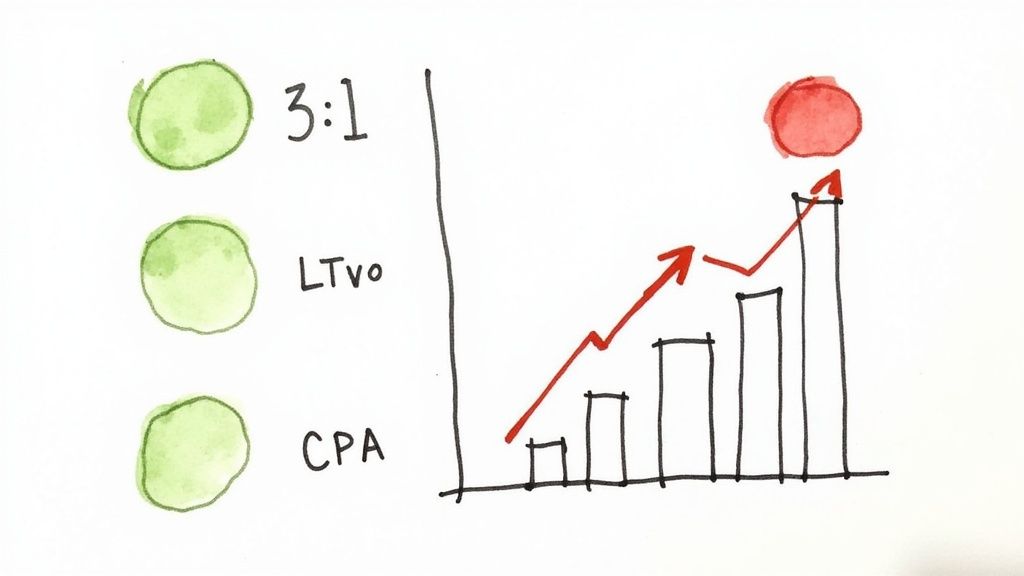
The most powerful way to do this? By comparing your CPA to your Customer Lifetime Value (LTV). This simple comparison is the ultimate health check for your business model.
Understanding the LTV to CPA Ratio
The LTV to CPA ratio is a straightforward look at the total value a customer brings in versus what you spent to get them through the door. For any home service business, this is a non-negotiable metric.
Let's take a real-world example. A local landscaping company finds their CPA is $200. They also know that the average customer sticks with them for two years, generating about $800 in profit (that's their LTV).
This gives them an LTV to CPA ratio of 4:1. That’s a fantastic return on their marketing spend.
A good rule of thumb is to aim for an LTV to CPA ratio of at least 3:1. This means for every dollar you spend bringing in a new customer, you’re getting three dollars back over their lifetime with you. If you’re dipping below that, it might be a red flag that you're spending too much.
Know Your CPA Payback Period
Here's another crucial piece of the puzzle: the CPA payback period. This tells you exactly how long it takes to recoup the money you spent to acquire a customer. The shorter this period is, the healthier your cash flow will be.
Imagine your CPA is $300 and a new HVAC maintenance contract brings in $100 a month in profit. Your payback period is just three months. Keeping this window as short as you can is key to sustainable growth.
These metrics are more important than ever. In the last five years alone, the average Cost Per Acquisition has shot up by nearly 60% thanks to more and more businesses competing online.
A high CPA isn't automatically a bad thing, but only if you have a high LTV and a short payback period to back it up. When you get a handle on these concepts, you're no longer just calculating costs—you're making strategic moves that drive real growth and improve how you follow up with your leads to maximize value.
Watch Out for These Common CPA Calculation Mistakes
On the surface, calculating your CPA feels straightforward. But I've seen countless business owners get tripped up by a few common mistakes that completely skew their numbers and lead to some seriously bad marketing decisions. Getting this right is about more than just crunching numbers; it's about getting data you can actually trust to grow your business.
One of the biggest traps is misattributing conversions. Think about it: a homeowner clicks one of your Google Ads, browses your site, and then joins your email list. A week later, they get a promotional email, click the link, and book a $2,000 HVAC installation. So, where does the credit go? If you only look at that last click from the email, you’re completely ignoring the ad that brought them to you in the first place.
Overlooking Hidden Costs and Mismatched Timelines
Another classic blunder is forgetting to factor in all the costs. As we’ve discussed, your fully loaded CPA is the only number that tells the true story. If you’re only looking at your raw ad spend, you're getting a dangerously optimistic number that can make a failing campaign look like a winner.
It's also surprisingly easy to mess up your timelines, which can make your data useless.
- The Mistake: You take one month of marketing spend but then count all the new customers you landed over an entire quarter.
- The Result: Your CPA will look fantastic—and completely wrong. You'll think your marketing is far more efficient than it really is.
- The Fix: Always, always, always match your timeframes. If you're looking at costs from March, only count the customers you acquired in March. Keep it apples-to-apples, whether you’re analyzing monthly, quarterly, or yearly data.
But here’s the most critical mistake I see: looking at CPA in a vacuum. A high CPA isn't automatically a bad thing if those customers have a massive lifetime value (LTV). On the flip side, a rock-bottom CPA is a vanity metric if all you're getting are low-spending, one-and-done clients.
At the end of the day, remember that your CPA isn't a static number. It's going to fluctuate with seasonality, what your competitors are doing, and even your own new campaigns. By steering clear of these common pitfalls, you can get a clear, accurate picture of what it really costs to win a new customer—and use that insight to build a more profitable business.
Common CPA Questions Answered
When home service business owners first start digging into their numbers, a few key questions always seem to come up. Let's clear the air on these so you can start using cost per acquisition with confidence.
CPA vs. CAC: What's the Real Difference?
You’ll often hear these two terms—Cost Per Acquisition (CPA) and Customer Acquisition Cost (CAC)—used as if they're the same thing. And while they're very similar, there's a small but important distinction.
CPA is a bit broader. It can track the cost of any important action, like someone filling out a contact form (a lead) or signing up for your email list. CAC, on the other hand, is laser-focused on one thing: the total cost to get a new, paying customer.
For our purposes here, and for most home service businesses, we're using CPA to mean the cost of getting a new paying customer, so it lines up perfectly with CAC.
How Often Should I Be Calculating This?
For the vast majority of home service companies, calculating your CPA on a monthly basis is the sweet spot. It gives you a regular pulse on your marketing performance, letting you see trends and make quick adjustments without getting bogged down in data every single day.
That said, you should always run the numbers after a big marketing push, too. Did you launch a spring cleaning special or send out a big batch of mailers? Calculate the CPA for that specific campaign to see exactly what your return was. If your sales cycle is particularly long (think large-scale renovation projects), you might find a quarterly check-in works better.
Think of your CPA calculation as a regular health check for your marketing budget. It's not a one-time task, but an ongoing habit that helps you stay nimble and put your money where it's actually working.
Can I Figure Out the CPA for Each Marketing Channel?
Not only can you, but you absolutely should. This is where the magic really happens.
Calculating a separate CPA for each of your marketing channels—Google Ads, Facebook, local SEO, mailers, you name it—is how you find your winners. You might discover that your SEO efforts bring in customers for $75 each, while a recent print ad campaign cost you $300 per customer.
This is the kind of insight that lets you stop guessing. You can confidently shift your budget away from the expensive channels and double down on the ones that are actually bringing you profitable work.
Ready to stop guessing and start winning more profitable jobs? Phone Staffer can hire, train, and manage dedicated remote CSRs and VAs for your business, ensuring every lead is handled professionally to lower your acquisition costs. Book a discovery call to learn more.