
When you're trying to figure out the after hours answering service cost for your home service business, you'll find prices can range anywhere from $50 to over $1,200 per month. What you'll actually pay boils down to your call volume, how much you need the service to do, and the type of pricing plan you pick.
Your Guide To Answering Service Costs
Let’s be honest. When a customer's AC unit dies on a sweltering Saturday night, they aren't going to leave a voicemail. They’re just going to call the next HVAC company on their list. For any home service business, a missed call is a lost job—plain and simple.
This guide cuts right to the chase. We’ll break down what you can realistically expect to spend on a professional phone answering service so you can set a budget from day one.
Understanding the Investment
What an answering service costs really depends on the size of your business and what you need. A small operation just starting out might get by with a pay-as-you-go plan, spending maybe $50 to $200 a month for 20 to 50 calls. The catch? You have to keep a close eye on overage fees, which can sneak up on you.
On the other hand, a mid-sized company with a steady stream of calls might look at plans between $300 and $1,200 monthly. These packages typically bundle 100 to 500 calls and often include discounts for the higher volume.
To make sense of these figures, it helps to think of them like cell phone plans. Some are pay-as-you-go, some give you a set bucket of minutes or calls, and others are a simple flat rate.
The real goal isn't just to find the cheapest option. It's about finding the most cost-effective partner that ensures you never miss a lead and that protects your reputation—even at 2 in the morning.
Comparing Common Pricing Models
To kickstart your search, let’s look at the main ways these services charge. The table below gives you a quick snapshot of the most common pricing models, helping you see which one might fit your call patterns and business needs before we get into the nitty-gritty.
Common Pricing Models At A Glance
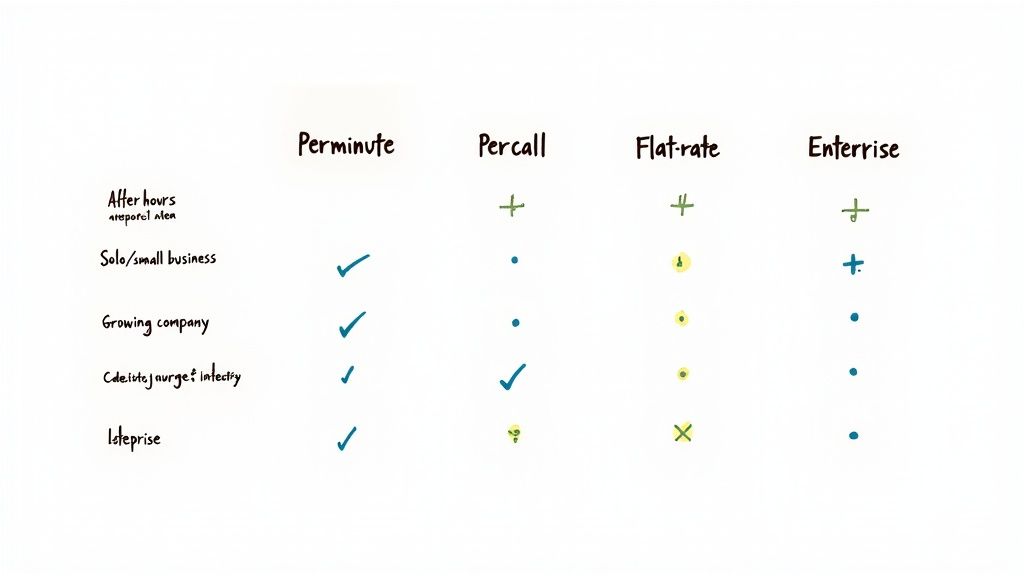
| Pricing Model | Typical Cost Range | Best For |
|---|---|---|
| Pay-Per-Minute | $1.25 – $2.50 per minute | Businesses with predictable, short call durations. |
| Pay-Per-Call | $2.00 – $5.00 per call | Companies with varied call lengths but consistent volume. |
| Flat-Rate / Tiered | $200 – $1,500+ per month | Businesses wanting predictable monthly costs and high volume. |
Each of these models has its pros and cons. A per-minute plan can be great if your calls are quick and to the point, but it can get expensive if customers like to chat. A tiered plan offers predictability, which is perfect for budgeting. Let's explore each one a bit more.
Breaking Down The Pricing Models
Trying to choose an answering service plan can feel a lot like picking out a mobile phone plan. You’ve got pay-as-you-go options, bundled deals, and everything in between. The first step to finding a service that fits your business without causing sticker shock is to really understand how they charge.
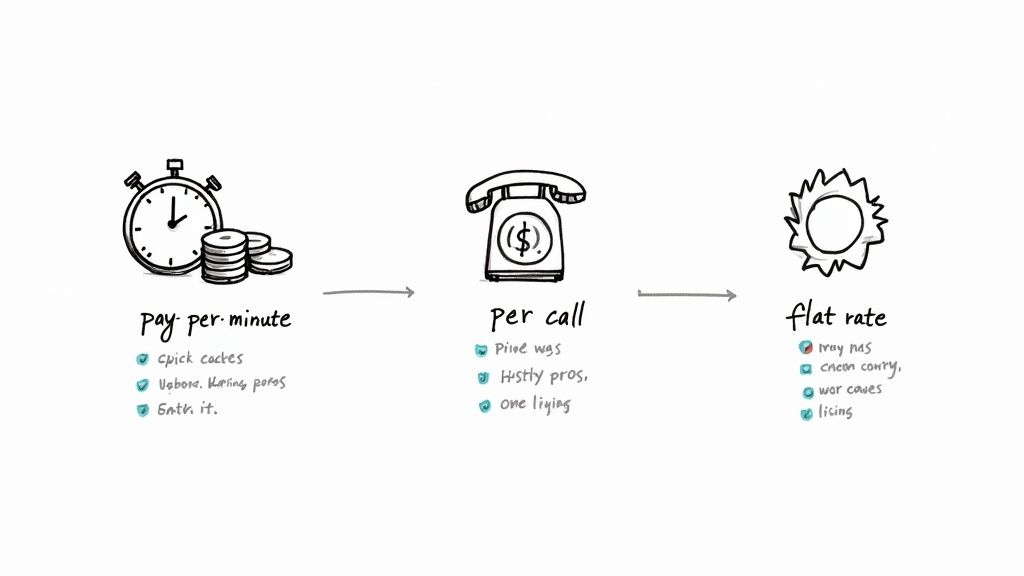
When it comes to after hours answering service cost, you'll almost always run into one of three structures: pay-per-minute, pay-per-call, or a flat monthly rate. Each one has its pros and cons, and the right choice really depends on how many calls you get, what those calls are usually about, and how predictable you need your monthly bill to be.
Let's break down how each of these works so you know what to look for.
The Pay-Per-Minute Model
This is the old-school, classic way of billing. Just like the name says, you’re charged for the total time an agent is dedicated to your call. That clock starts ticking from "hello" and keeps going through the message taking, appointment booking, and the final "goodbye."
The big win here is that you only ever pay for exactly what you use. If your after-hours calls are mostly quick—someone leaving a name and number for a callback—this model can be incredibly budget-friendly.
But here’s the catch: one long, complicated call can throw your whole budget off. Think of a panicked homeowner with a burst pipe who needs detailed troubleshooting. That single interaction could cost more than ten simple calls combined. You also have to be clear on whether they bill for hold time or transfers, as those little things add up.
- Best For: Businesses where calls are consistently short and to the point, like basic lead capture or message-taking.
- Watch Out For: Complex customer service issues or in-depth scheduling that can make your costs unpredictable.
The Pay-Per-Call Model
With a pay-per-call (sometimes called "per-incident") plan, you pay a set price for every single call they answer for you. It doesn’t matter if the conversation is 30 seconds or 10 minutes long—the cost is the same.
This approach gives you a great mix of flexibility and predictability. You don't have to sweat it if a customer wants to chat or has a complex problem because it won’t send your bill through the roof. If you know you get about 100 calls a month, you know exactly what to budget for.
The main downside? It's not always the most efficient for businesses that get tons of super-short calls. Paying the same rate for a 15-second wrong number as you do for a 15-minute emergency dispatch can feel a little wasteful.
Key Insight: The pay-per-call model takes the guesswork out of call duration. It’s often a safer bet for home service companies where a call could be anything from a simple question to a full-blown emergency.
The Flat-Rate and Tiered Models
If you love a predictable bill, this model is for you. You pay a set monthly fee that gets you a specific bundle of minutes or calls. For instance, a provider might have a plan that includes up to 200 minutes or 150 calls for one flat price.
The peace of mind is the biggest benefit here. You know what you're paying every month, which makes budgeting a breeze. These plans usually offer a lower cost-per-call or per-minute if your call volume is consistently high, and upgrading to higher tiers often unlocks better features like CRM integrations or detailed analytics.
Of course, there’s a trade-off. You pay for the whole package, even if you have a slow month and don't use all your minutes. And if you go over your limit? Get ready for some pretty steep overage fees, which are almost always priced at a premium. The trick is to choose a tier that comfortably covers your average and your busiest months.
So, What Really Determines Your Final Bill?
It’s easy to glance at a proposal and think the base rate tells the whole story. That's a classic mistake. The monthly fee for an after-hours answering service is just the starting point. Several other factors can quietly inflate your final bill, turning what looked like a great deal into a budget-buster if you’re not paying attention.
To get a contract that actually works for your business, you need to understand these variables. It’s a bit like buying a new truck; the sticker price is one thing, but the final cost really depends on the engine you choose, the tow package, and all the other add-ons. Let’s peel back the layers and see what really drives the price.
How Much You Actually Use The Service
The biggest and most direct impact on your after hours answering service cost boils down to two simple things: how many calls you get and how long they last.
- Call Volume: This is the raw number of calls the service handles for you each month. Answering services use this to place you in a pricing tier. If you go over your plan’s limit, you can get hit with some pretty steep overage fees.
- Call Duration: This is the big one for per-minute plans. A plumber who just needs quick, two-minute lead captures will pay way less than an HVAC company that needs agents to handle detailed, ten-minute emergency dispatch calls—even if they get the exact same number of calls.
Before you even start shopping, pull up your own call logs. A solid grasp of your typical call volume and average call length is your best defense against overpaying for a huge plan you don’t need or, worse, getting hammered with penalties on a plan that’s too small.
The Complexity Of The Job
Let’s be honest, not all phone calls are created equal. A major cost driver is what you're actually asking the agents to do. Simple message-taking? That’s the cheapest option. But for most home service businesses, that’s just not enough.
Think of it this way: asking someone to just write down a name and number is simple. Asking them to troubleshoot a leaking water heater, book a specific technician based on their skills, and process a payment is a multi-step, high-value interaction that demands more skill and, therefore, costs more.
Answering services have to factor in the level of agent training and responsibility needed. Here are a few common tasks that will bump up the price:
- Appointment Scheduling: Getting the service to plug directly into your calendar (like ServiceTitan or Housecall Pro) involves technical setup and takes the agent more time on each call.
- Emergency Dispatching: This is a mission-critical service. Following a complex, multi-step protocol to get ahold of your on-call techs is always a premium feature.
- Lead Qualification: If you need agents to ask specific questions to vet callers and weed out tire-kickers, that requires extra training and adds a lot of value—and cost—to the service.
Add-On Features And Customization
Beyond the calls themselves, a bunch of other features can add to your monthly invoice. These are often sold as optional add-ons, so you have to be crystal clear on what’s included in the base package versus what costs extra.
Bilingual Support
If you work in a diverse area, having agents who can speak Spanish is a massive advantage for winning more business. But it almost always costs more, since you're paying for specialized, higher-paid agents. Expect this to raise your per-minute or per-call rate.
CRM Integration
Having call details, new leads, and appointments pushed automatically into your CRM is a huge time-saver. But this convenience usually comes with a one-time setup fee and can sometimes increase the monthly cost. Optimizing integrations like this is a great way to trim your phone answerer costs.
Holiday and Weekend Surcharges
Think about your busiest times—it's often a holiday weekend when a furnace finally gives out. Ironically, these are the exact times when answering services often charge a premium. You should always ask if there are surcharges for holidays or even specific weekend hours, as these can be a nasty surprise on your bill. In 2025, the standard cost for these services typically falls between $0.80 and $1.17 per minute, but you can bet that holiday rates will push that number higher.
Estimating Your True Monthly Answering Service Cost
Moving from a price list to a real-world budget is where the rubber meets the road. To get an accurate forecast of your after-hours answering service cost, you have to stop guessing and start calculating. It takes a little homework, but it’s the only way to find a plan that fits your business perfectly instead of one that doesn’t quite work for anyone.
The first move is to put on your detective hat and dig into your own phone records. Pull your call logs from the last three to six months and zero in on calls that came in after 5 PM, on weekends, or during holidays. This data is the key to understanding your actual needs.
Step 1: Analyze Your Call Data
Before you can nail down future costs, you need a crystal-clear picture of your past activity. Don't go with your gut feeling on call volume; let the data tell the real story.
Gather these key details from your call logs:
- Total After-Hours Call Volume: Get a hard count of the calls you received outside of business hours each month.
- Average Call Duration: Figure out the average length of these calls. This is a non-negotiable metric for evaluating any per-minute plan.
- Peak Call Times: Pinpoint your busiest moments. Is it Saturday mornings? Late Friday nights? Knowing this helps you prepare for those predictable spikes.
This infographic breaks down how these factors—volume, complexity, and features—stack up to determine your final monthly bill.
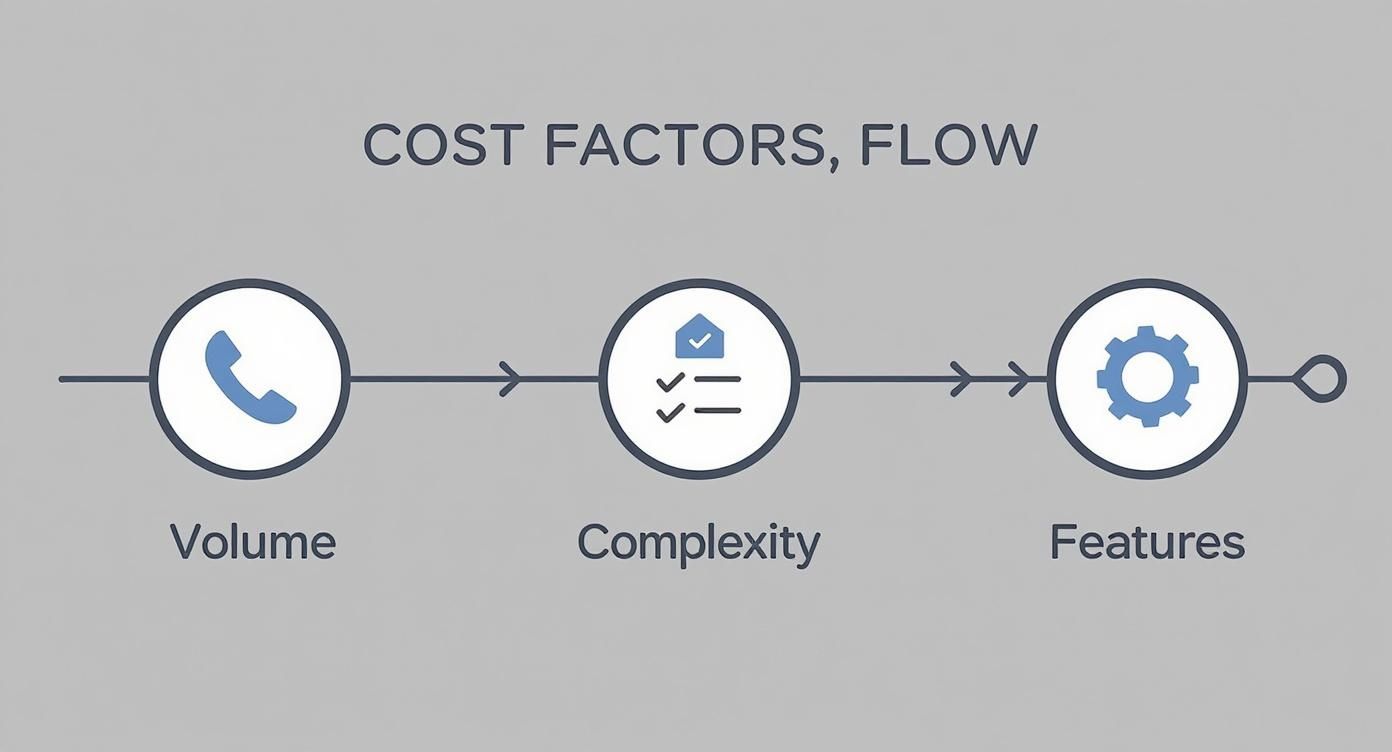
As you can see, everything starts with your call volume. From there, the price builds as you layer on more complex tasks and specialized features.
Step 2: Define Your Service Needs
Next up, make a checklist of exactly what you need the answering service to handle for you. There's a world of difference—and a significant price gap—between simply taking a message and dispatching an emergency plumber at 2 AM.
Get specific. Do you need the agents to:
- Qualify new leads using a specific script?
- Book appointments directly into your scheduling software?
- Take credit card payments for emergency call-out fees?
- Follow a detailed, multi-step protocol for dispatching your on-call team?
Each of these jobs adds a ton of value, but also complexity, which naturally influences the price. A clear list keeps you from overpaying for features you'll never use or, just as bad, underestimating the cost of the services you absolutely can't live without.
Step 3: Run Cost Simulations
Okay, let's put this all together. Imagine you run an electrical business. After digging into your call logs, you discover you get about 120 after-hours calls a month, and they typically last around three minutes.
Scenario: An electrical company needs lead qualification and emergency dispatch services for its 120 monthly after-hours calls. Let’s compare two common pricing models.
Simulation 1: Pay-Per-Minute Plan
- Total Minutes: 120 calls x 3 minutes/call = 360 minutes
- Cost at $1.50/minute: 360 minutes x $1.50 = $540 per month
Simulation 2: Tiered Plan
- Plan: A package offering up to 150 calls for a flat rate.
- Cost: $450 per month
In this situation, the tiered plan is the clear winner. It provides predictable billing and saves the business a cool $90 every month.
This kind of side-by-side comparison is the best way to make a smart decision. For most home service businesses, these numbers are pretty standard. Basic plans covering 50 to 100 calls often run $150 to $300, while mid-tier packages for 100 to 300 calls typically land between $300 and $600 per month. You can learn more about these small business cost benchmarks to see how your needs stack up against the industry average.
What's the Real ROI on an Answering Service?
It's easy to look at an after-hours answering service as just another monthly bill. That’s a mistake. This isn't just an expense; it's a revenue-generating machine. The whole perspective changes when you stop asking, "What does it cost?" and start asking, "What's my return?"
Think about it. When you realize that capturing just one good after-hours job can pay for the entire month's service, the value becomes crystal clear. The real math has nothing to do with the monthly fee—it’s about the massive gap between a captured lead and a lost one. When a pipe bursts at 10 PM, that homeowner isn't leaving a voicemail. They're dialing the next plumber on their Google search, and the first one to pick up the phone gets the job. Period.
The True Cost of a Missed Call
A missed call isn't a neutral event. It's revenue you gift-wrapped and handed directly to your competition.
Let's put some numbers on it. Say you're a home service contractor, and an average emergency repair job brings in anywhere from $500 to $1,500. If your answering service plan is $450 a month, landing a single one of those calls means the service just paid for itself.
Every other call that comes in that month—every new lead your service qualifies, every appointment they book—is pure profit you otherwise would have never seen. The ROI isn't just a number on a spreadsheet; it’s immediate and it's big.
Answering every call is the simplest way to capture leads that would otherwise vanish. Investing in a reliable after-hours service is a direct investment in your bottom line, plain and simple.
But that immediate cash injection is just the start. The long-term benefits, while a bit harder to track on an invoice, are where the real magic happens.
Beyond the First Call: Building Long-Term Value
The true return from an answering service snowballs over time. A professionally handled emergency call doesn't just secure one job; it cements your reputation as the reliable pro who shows up when it counts.
Here’s how that value multiplies:
- A Rock-Solid Reputation: When you're the one who answers the phone while your competitors are sleeping, you become the go-to expert in your area. That kind of dependability is priceless.
- Glowing Customer Reviews: A panicked homeowner who gets a calm, helpful voice on the line at midnight is your best source for a 5-star review. Those testimonials are marketing gold, attracting more high-quality customers.
- Greater Customer Lifetime Value: That emergency call for a leaky pipe can easily turn into a long-term relationship. The same customer might call you back for a new water heater next year, a full bathroom remodel down the road, and will definitely recommend you to their neighbors.
When you look at it this way, the after-hours answering service cost is a tiny price to pay for the compounding returns it delivers. It turns a customer's crisis into your opportunity to build loyalty, polish your reputation, and lock in a steady stream of future work. It’s not an expense—it’s a growth strategy.
How to Choose the Right Answering Service Partner
https://www.youtube.com/embed/MFv5gqRHVXs
Understanding the numbers behind an after hours answering service cost is a great start, but picking the right provider is where the rubber really meets the road. A rock-bottom price is always tempting, but it means absolutely nothing if the service quality ends up costing you customers. Your goal should be to find a partner who acts like a genuine extension of your business, not just some anonymous call center.
This means you have to look past the base rate and really dig into what makes a provider a good fit for a home service company. A cheap service that can’t tell the difference between a leaky faucet and a flooded basement isn't a bargain; it's a liability. You need a team on the other end of the line that gets the urgency and speaks the language of your trade.
Look For Industry-Specific Experience
The best answering services out there have deep, hands-on experience with trades like plumbing, HVAC, and electrical. They get it. They know that a call at 2 AM isn't just a casual question—it's often a homeowner in the middle of a crisis. A partner with this background ensures their agents are trained to handle high-stress situations with both empathy and accuracy.
Don't be shy about asking potential providers about their experience with businesses just like yours. Do they know how to properly qualify a lead for an emergency furnace repair versus a routine maintenance check? Their answer will tell you everything you need to know about whether they're truly set up to support you or just offering a one-size-fits-all package. To find the optimal solution for your after-hours needs, it can be helpful to review options for integrated phone and internet bundles for small businesses, which often include features crucial for managing client calls efficiently.
The right partner doesn't just take messages; they protect your reputation. Their agents are the first impression a new customer has of your company, and that interaction needs to be professional, knowledgeable, and reassuring.
Vet Their Agent Training and Technology
A great answering service invests heavily in two things: its people and its platform. The quality of their agents has a direct impact on your customer experience, so you have to understand how they hire and train their team.
Here are the critical questions you should be asking any provider you're considering:
- Agent Training: What specific training do your agents get for handling home service calls? Do they learn to follow complex emergency dispatch protocols?
- Technical Integration: Can your system talk to our CRM or scheduling software (like ServiceTitan or Housecall Pro)? Is there an extra fee for that?
- Call Monitoring: How do you make sure your agents are doing a good job? Can we listen to call recordings to make sure our brand standards are being met?
- Customization: How much can we customize your call scripts? Can we build out detailed workflows for different call types, like new leads versus existing customers?
Choosing a provider is about building a long-term partnership. By asking these tough questions upfront, you can be confident you’re picking a service that will deliver real value and help your business grow. For a deeper look at what this partnership should entail, explore our comprehensive guide on 24/7 phone answering for home services.
Got Questions About Answering Service Costs? We've Got Answers.
Even with all the numbers laid out, you probably still have a few questions rolling around in your head about the real cost of an after-hours answering service. That’s completely normal. This is a big decision for your business, and you need straight answers before you move forward.
Let's dig into the most common questions we hear from home service pros just like you. Think of this as the final check-in before you find the right partner to help you grow.
Are There Hidden Fees I Should Watch Out For?
Absolutely, and this is probably the most critical question you can ask a potential provider. The monthly rate you see on a pricing page is often just the starting point. Many services have a whole menu of extra charges that can easily double your bill if you're not paying attention.
Always, always ask for a complete, itemized fee schedule before you even think about signing a contract. Specifically, keep an eye out for these common "gotchas":
- One-time setup fees: For getting your account running and building out your call script.
- Holiday surcharges: An extra fee for calls that come in on days like Christmas or Thanksgiving.
- Bilingual services: If you need Spanish-speaking agents, this often costs more.
- Call patching/transfer fees: A charge for the service of connecting a live call to your on-call tech.
- Overage penalties: Steep fees for going over your plan’s allotted minutes or calls.
The best way to avoid a nasty surprise on your first invoice is to be direct and ask about these costs from day one.
A transparent provider will be more than happy to walk you through their entire fee structure. If they get cagey or avoid giving you a straight answer, consider that a major red flag.
How Does This Compare To Just Hiring An Employee?
When it comes to after-hours coverage, an answering service is almost always the smarter financial move. Think about it: hiring even a part-time employee means paying a salary, payroll taxes, benefits, and costs for training and equipment. On top of that, they can only handle one call at a time, and you’re on the hook for covering their sick days, vacations, and breaks.
A professional answering service, on the other hand, gives you an entire team of trained agents for a fraction of that cost. You get guaranteed 24/7 coverage, the power to handle a sudden flood of calls without a single one going to voicemail, and you completely sidestep the hassles of managing another staff member. It's a clear win—you get better reliability and the ability to scale for a much smaller investment.
Can I Change My Plan If My Call Volume Changes?
Any answering service worth its salt knows that business isn't a flat line. This is especially true in home services—an HVAC company is slammed in July but might be slow in October. A good partner gets this and builds flexibility into their plans.
Before you sign anything, get clear on their policy for scaling your plan up or down. You should have the freedom to jump to a higher-minute plan during your peak season and then scale back when things cool off. Ask if there are fees for making these changes and how much notice you need to give. The right partner will work with you, making it simple to adjust your service so it always matches your real-world needs.
Ready to stop missing after-hours calls and start capturing every single lead? Phone Staffer provides highly trained, US-based virtual receptionists who know the home service industry inside and out. We handle your calls, book your jobs, and help you grow your business—all for a fraction of the cost of a full-time hire. Discover how Phone Staffer can work for you.