

Getting a steady stream of high-quality plumbing leads all starts with a rock-solid digital foundation. Before you even think about spending a dollar on ads, your online presence has to scream "trustworthy" and make it dead simple for a stressed-out homeowner to get in touch.
Building Your Digital Foundation for Local Leads
Think of your website and online profiles as your digital storefront. When a pipe bursts at 2 AM, the first thing that homeowner does is grab their phone and search "emergency plumber near me." If you don't show up in that split-second search, that job is already going to your competitor. It’s that simple.
Building this foundation isn't just some marketing fluff; it's a core part of staying in business and growing. The plumbing industry is massive—the global market for fixtures and fittings is projected to hit $153.95 billion by 2034, up from $114.31 billion in 2025. Plumbers who really lean into digital marketing are seeing a 20-30% higher lead conversion rate compared to guys still relying on old-school methods. You can find more details on this industry shift over at ServiceTitan.com.
Your Website Is Your Best Salesperson
Your website has one job: turn a panicked visitor into a booked appointment in under 60 seconds. Since most emergency searches are happening on a smartphone, it has to work flawlessly on a small screen.
Here’s what every high-converting plumber website needs:
- Big, Bold "Click-to-Call" Buttons: Your phone number should be plastered at the top of every single page. On mobile, it must be a tappable button that instantly opens their phone's dialer. Don't make them copy and paste.
- Simple Contact Forms: For the non-emergencies, keep your contact form short and sweet. All you need is a name, phone number, and a quick note about their problem.
- Trust Signals Everywhere: Show off real customer reviews, testimonials, and photos of your team and branded vans. This social proof instantly tells people you're a legitimate, professional outfit they can trust in their home.
- A Clear Service Area: Don't make people guess. Use a map or a simple list to show the exact towns and zip codes you cover. This cuts down on wasted calls from people you can't even help.
This chart breaks down where your efforts can really pay off.
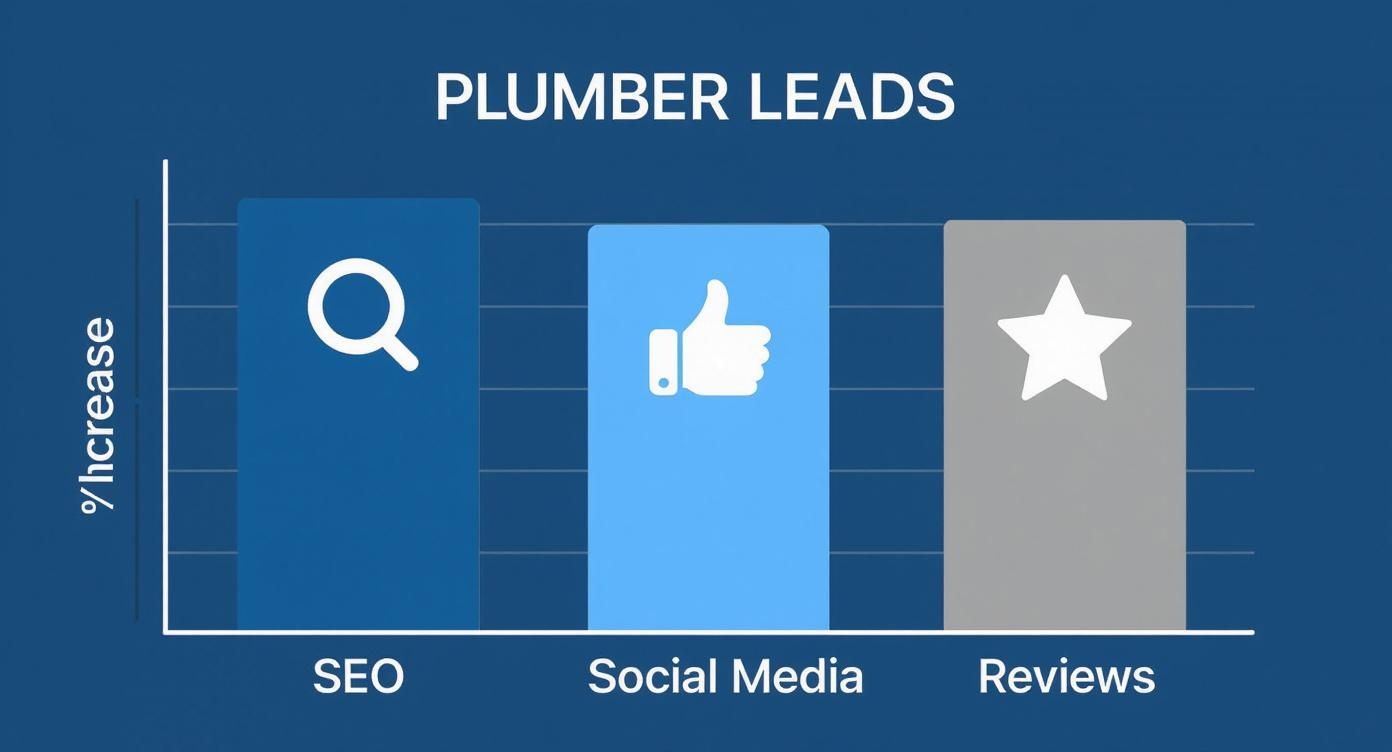
As you can see, putting real effort into your SEO and online reviews is what moves the needle the most when it comes to landing new customers.
Lead Generation Channel Comparison for Plumbers
Choosing where to invest your marketing dollars can be tough. Some channels deliver leads fast but at a high cost, while others are a slow burn that pays off in the long run. This table breaks down the most common options to help you decide what's right for your business.
| Channel | Average Cost Per Lead | Typical Lead Quality | Implementation Speed |
|---|---|---|---|
| Google Local Services Ads | $25 – $100+ | Very High | Fast |
| SEO | $5 – $30 (long term) | Very High | Slow |
| PPC (Google Ads) | $20 – $75 | High | Fast |
| Angi / HomeAdvisor | $30 – $120 | Medium to Low | Fast |
| Referrals | $0 | Highest | Varies |
| Facebook Ads | $15 – $50 | Medium to Low | Fast |
Ultimately, the best strategy is a mix. SEO is your long-term asset, while Google's Local Services Ads can get your phone ringing tomorrow. Don't put all your eggs in one basket.
Master Your Google Business Profile
If your website is your salesperson, your Google Business Profile (GBP) is your billboard. It’s the single most powerful free tool for pulling in local plumbing leads. This is what gets you into Google’s coveted "map pack"—that little box with three businesses that shows up at the top of local search results.
For many potential customers, your GBP is your first impression. A well-managed profile can get you calls without them ever needing to click through to your website.
Optimizing your profile is absolutely non-negotiable. First, claim your listing. Then, fill out every single section with complete and accurate information: business name, address, phone, hours, and a detailed list of your service areas. The same logic applies to pretty much any home service, as we break down in our guide to getting leads for a power washing business. A complete profile is your ticket to outranking the competition and grabbing those high-intent searches.
Using Paid Ads When You Need Leads Right Now
SEO is a long game, and that’s great for building a sustainable business. But let's be real—sometimes you just need the phone to ring today. When you have an empty slot on the schedule or a customer has a pipe gushing water at 2 a.m., paid advertising is your direct line to homeowners who are actively looking for help. This is how you get in front of people who are ready to hire, immediately.
The demand is massive and it's not slowing down. The global plumbing services market was valued at around $105.2 billion in 2023 and is projected to hit $153.4 billion by 2032. Think about it: platforms like Angi and HomeAdvisor consistently show plumbing as one of their most requested services. The customers are out there.
Winning the Urgent Jobs with Google Ads
When a pipe bursts under the sink, people don't browse Facebook. They grab their phone and search Google. This is your moment. Running Google Ads puts your company right at the top of the results page for those high-stakes, urgent keywords.
You have to get inside the head of a panicked homeowner. Your ad needs to speak directly to their emergency.
- Weak Ad Copy: "ABC Plumbing. Call for a Quote." (This is passive and unhelpful.)
- Strong Ad Copy: "24/7 Emergency Plumber in [Your City]. Burst Pipes & Leaks Fixed Fast. Call Now!"
See the difference? The second ad shows empathy, promises a quick solution, and uses urgent language. It connects with the searcher’s problem, which is why it gets the click. Concentrate your ad spend on keywords that scream "I need help now," like "emergency plumber near me" or "water heater repair [zip code]."
Should You Use Paid Lead Services?
Beyond running your own campaigns, you've got services like Angi (what used to be Angie's List) and HomeAdvisor that can send leads straight to your inbox. But be warned: you need a solid strategy to make these platforms profitable.
Here's the catch: they sell the same lead to a handful of your competitors. The plumber who calls first, usually within minutes, is the one who books the job. It's not just about buying leads; it's about having a system in place to pounce on them instantly.
Treat every paid lead like a race. If you aren't on the phone within five minutes, you've probably already lost the job to someone faster. This is where having a dedicated person answering the phones gives you a huge advantage.
Before you sign on the dotted line, do your homework. Talk to other plumbers in your area to see what their experience has been. Try to negotiate your terms so you have control over the types of leads and specific zip codes you get. The last thing you want is to pay for jobs you can't or don't want to do.
A Smarter Paid Lead Strategy
Throwing money at ads without a plan is just a good way to lose money. A truly successful paid strategy is built on precision and knowing your numbers cold.
- Get Hyper-Local with Targeting: Don't pay to show ads to people outside your service area. Use tight zip code targeting to make sure every dollar is spent on clicks from potential customers you can actually get to quickly. This is non-negotiable for emergency calls.
- Track Everything: You have to know your Cost Per Lead (CPL) and your Cost Per Acquisition (CPA). If a campaign costs you $50 per lead but those jobs bring in an average of $500 in profit, that’s a winning formula. If your CPL is eating up your profit margin, it's time to pause that campaign and figure out what’s wrong.
- Build Dedicated Landing Pages: Never send ad traffic to your generic homepage. It’s too distracting. Instead, create simple, focused landing pages for each service you're advertising—one for drain cleaning, one for water heaters, etc. Each page should have a clear headline, a strong call-to-action (like "Get Help Now!"), and your phone number plastered everywhere.
If you really want to go deep on setting up and optimizing campaigns built specifically for capturing leads, check out a modern guide to PPC for lead generation. It's a fantastic resource. By combining sharp targeting with a lightning-fast response system, paid ads can become one of your most reliable and scalable lead sources.
How to Win High-Value Commercial Plumbing Leads
While a steady stream of residential service calls keeps the lights on, landing high-value commercial contracts can completely change the game for your plumbing business. We're talking about bigger jobs, recurring maintenance agreements, and the kind of stability that comes from building long-term B2B relationships. But attracting a facilities manager is a whole different beast than marketing to a homeowner with a leaky faucet.

The market data is screaming this opportunity from the rooftops. We've seen a massive shift in the industry, with nonresidential projects now driving most of the revenue. In fact, the U.S. plumbing market was valued at $169.8 billion in 2025, and commercial work accounted for the lion's share of new leads and income for contractors. I've seen it firsthand: the plumbers who specialize in these projects have more consistent work and way more predictable income. You can dig into more of this data over at Cognitive Market Research.
Identify Your Ideal Commercial Client
You can't just target "commercial businesses." It's too broad. You have to get granular and figure out exactly who holds the keys to the contracts you want. Knowing your audience lets you craft a message that actually resonates.
-
Property Managers: These folks are your golden ticket to multi-unit properties like apartment complexes or retail centers. They need a go-to plumber who is reliable, responsive, and can handle everything from tenant emergencies to preventative maintenance across their portfolio.
-
General Contractors (GCs): If you want in on new construction or major renovation projects, you need to be in a GC's rolodex. Building a solid relationship with even one or two GCs can lead to a steady pipeline of large-scale installation jobs.
-
Facilities Directors: These are the decision-makers at large institutions—think hospitals, schools, and manufacturing plants. Their world revolves around compliance, safety, and minimizing operational downtime. They aren't looking for cheap; they're looking for a partner who understands their high-stakes environment.
Position Your Business as a Commercial Expert
Your marketing has to speak the language of your ideal client. A property manager doesn't care about the same things a homeowner does. Your website, brochures, and sales pitches need to ditch the residential talk and focus on solving commercial-scale problems.
Winning commercial work is less about being the cheapest option and more about being the most reliable partner. Your ability to guarantee uptime, ensure compliance, and respond instantly to emergencies is your greatest selling point.
Zero in on what truly matters to them:
- 24/7 Emergency Response: Show them you understand that a plumbing emergency can shut down their entire operation. Highlight your after-hours availability.
- Preventative Maintenance Plans: Frame these as a strategic tool to help them budget effectively and avoid catastrophic, un-budgeted repairs.
- Regulatory Compliance: Talk about your expertise in commercial codes, backflow prevention, and ADA compliance. This shows you're a professional who can keep them out of trouble.
Networking and Direct Outreach Tactics
Unlike residential marketing, where you wait for the phone to ring, commercial leads often come from putting in the work to build direct relationships. This is a B2B sales game, and you need to be proactive.
For example, a great starting point is to identify the property management companies for the top five commercial buildings in your service area. Do a little homework on their portfolio, then prepare a pitch that speaks directly to the needs of their specific properties. It’s worlds more effective than a generic ad. This B2B mindset is just as critical when https://phonestaffer.com/new-b-lead-roofing-broomfield/, where success hinges on your connections with builders and property managers.
If you're looking for more strategies for commercial lead generation, that guide from the HVAC world has some fantastic insights that apply directly to plumbing. The core principles are the same: identify the decision-maker and solve their business-specific problems. Start attending local B2B networking events or join an organization like BOMA (Building Owners and Managers Association). Getting in the right rooms and methodically building these connections is how you create a powerful, sustainable pipeline of high-value commercial work.
Building Your Unstoppable Referral Engine
While ads and SEO are great for bringing in new faces, the absolute best plumbing leads almost always come from a source you already own: your happy customers. A solid referral isn’t just another lead. It's practically a pre-sold job, coming from someone who already trusts you because their friend, neighbor, or family member put their name on the line for you.
The secret is to stop waiting for referrals to happen by chance and start actively building a system that churns them out consistently.
Systematize Your Referral Process
Hope isn't a business strategy. You need a formal, structured program that makes it worthwhile for people to send business your way. This is how you turn referrals from a happy accident into a predictable, reliable source of revenue. Just asking, "Hey, can you refer us?" as you're packing up your tools simply doesn't cut it.
A powerful referral program really only needs a few key things:
- Clear Incentives: Figure out what you'll give for a referral that turns into a booked job. This could be anything from a $50 discount on a future service to an Amazon gift card or even a cash bonus for a big-ticket project like a repipe.
- Make It Easy: Don't make people jump through hoops. Have simple referral cards your techs can leave behind after a job, or set up a dedicated page on your website where they can plug in a friend's info in under a minute.
- Constant Promotion: Weave your referral program into everything. Mention it in your follow-up emails, print it at the bottom of your invoices, and post about it on social media. You have to keep it top-of-mind.
The single best moment to ask for a review and mention your referral program is right after you've solved a customer's problem and they're thrilled with your work. Their positive emotions are at their peak, making them way more likely to act.
Incentivize Beyond Just Customers
Don't stop with your past clients—your referral engine can have multiple gears. Your own team and other local businesses can become some of your most powerful allies in the hunt for more plumbing leads.
Think about offering different levels of incentives for different types of referrers. A simple gift card might be perfect for a customer, but a business partner who sends you high-value jobs deserves a more significant reward.
Sample Referral Program Incentives
Here are a few proven ideas to get you started. The key is to match the incentive to the person providing the referral to get the best results.
| Referrer | Incentive Type | Example | Best For |
|---|---|---|---|
| Past Customers | Service Credit | $50 off their next plumbing service | Encouraging repeat business and customer loyalty. |
| Your Technicians | Cash Bonus | $25 cash bonus for each referral that becomes a booked job. | Motivating your team to actively listen for new opportunities on-site. |
| Strategic Partners | Commission | 10% of the first job's value (up to $250). | Building strong B2B relationships with high-volume referrers. |
| New Referred Client | Introductory Discount | 15% off their first service call. | Making it a no-brainer for the new customer to give you a try. |
A small investment here can pay for itself many times over by bringing in a steady stream of high-quality, high-trust leads that are far more likely to convert.
Leverage Strategic Partnerships
Building genuine relationships with other businesses in the home services world is like striking gold. These folks are in front of homeowners with plumbing problems all the time, and they need a plumber they can trust to recommend.
Start by identifying non-competing businesses that serve the exact same customers you do:
- Real Estate Agents: They're constantly dealing with new homeowners who need inspections, quick fixes, or major plumbing updates.
- HVAC Companies: Heating, cooling, and plumbing issues are often discovered together. A faulty furnace might reveal a gas line issue, for example.
- General Contractors: They need a go-to plumber for every kitchen remodel, bathroom addition, and new construction project.
- Property Managers: These professionals manage entire portfolios of properties that need constant maintenance and emergency repairs.
Reach out and propose a true partnership. The best arrangements are reciprocal—you send them leads, they send you leads. This creates a powerful, mutually beneficial network that feeds everyone. This B2B approach is a core skill, just as it is for generating garage door leads through contractors, where trust and mutual benefit are everything. A systematic plan for networking can transform your business from relying on one-off jobs to having a steady flow of high-value projects.
Turning More Calls into Booked Jobs
Getting the phone to ring is a huge win, but let's be honest, it's only half the job. A flood of incoming calls doesn't mean much if you can't consistently turn those conversations into profitable, booked appointments. This is where your marketing efforts meet the real world of operations, and it’s a spot where a lot of plumbing businesses spring a leak in their revenue.
The process of turning a curious caller into a paying customer has to be dialed in. You need a solid script, a smooth scheduling process, and a sharp eye on your numbers. Without these pieces in place, you're just paying for ads to warm up leads for your more organized competitors.
Crafting a Script That Actually Works
The first voice a potential customer hears can make or break the entire deal. Whether it's you, an office manager, or a remote CSR answering the phone, that first conversation has to be handled with purpose. A script isn’t about sounding like a robot; it’s about making sure you get the right info, qualify the lead, and steer the conversation every single time.
Your intake script really only has three goals to hit, and you need to hit them fast:
- Lock in the Contact Info: First thing's first—get the caller's name, phone number, and the full service address. This is non-negotiable. If the call drops for any reason, you can call them right back. I've seen this simple step save countless leads.
- Figure Out the Problem: Ask direct questions to get a handle on the issue. Is it a simple clogged drain, a leaking water heater, or an all-out emergency with a burst pipe? Understanding their urgency helps you prioritize the call and know which tech to send.
- Qualify, Qualify, Qualify: This is where the money is made or lost. You have to figure out if this is the right job for your company—one you can actually service profitably.
A great script doesn't just collect data; it guides the customer toward making a decision. It builds their confidence by showing them you're a pro who has a clear process for handling their exact problem.
Your qualifying questions are your best defense against wasted trips. Politely confirm the service address is in your territory. It’s also smart to be upfront about your dispatch fee or diagnostic charges. This quickly filters out the tire-kickers who are just shopping for the cheapest price and aren't serious about hiring a professional.
Make Booking an Appointment Effortless
Once you know they're a good fit, the next move is to get them on the calendar with zero hassle. A clunky, slow scheduling process will kill your conversion rate. People today expect things to be fast and easy. If you make them wait, they'll just hang up and call the next plumber on the list.
This is where scheduling software becomes your best friend. Tools like Jobber, Housecall Pro, or ServiceTitan give your team a real-time view of every technician's availability. This completely eliminates the old "uh, let me check and call you back," which is basically an invitation for the customer to call your competitor.
Here’s how to make booking a breeze:
- Offer Tight Appointment Windows: Don't say "we'll be there sometime Tuesday." That's a huge turn-off. Instead, offer a specific two-hour window, like "between 1 PM and 3 PM." It shows you actually respect their time.
- Automate Your Reminders: Set up your software to automatically send a text and email reminder 24 hours before the appointment, and then another one an hour beforehand. This one simple thing drastically cuts down on no-shows.
- Confirm Immediately: The moment an appointment is booked, fire off a confirmation email or text. It should recap the details: date, time window, and even the name of the tech you're sending. It’s a small touch that screams professionalism.
Track the Numbers That Actually Move the Needle
You can't fix what you don't measure. If you want to build a system that squeezes every drop of value out of your leads, you have to track a few key metrics. These numbers will tell you exactly where your process is humming and where it’s falling apart.
Forget the vanity metrics and focus on these three:
- Lead-to-Booking Rate: What percentage of your qualified leads actually turn into a scheduled job? If you get 100 qualified calls in a month and book 75 jobs, your booking rate is 75%. If this number is low, something is likely wrong with your phone script or scheduling process.
- Cost Per Acquisition (CPA): How much are you paying to land one customer from a specific marketing channel? If you spend $1,000 on Google Ads and it brings you 20 booked jobs, your CPA for that channel is $50. You have to know this to make smart decisions about your ad budget.
- Average Job Value: What’s the average revenue you bring in from a single booked job? When you put your CPA next to your average job value, you get a perfectly clear picture of your ROI. If your CPA is $50 and your average ticket is $450, you’ve found a winning formula you can scale.
Your 90-Day Lead Generation Action Plan
Alright, let's turn all this theory into a practical, step-by-step roadmap. A consistent flow of good plumbing leads doesn't just happen; you have to build the machine that creates it. This 90-day plan is designed to get you there without the overwhelm, breaking everything down into manageable chunks.
Forget the guesswork. This is your path to a booked-solid schedule.
Months 1-2: Building Your Foundation and Going Live
The first 30 days are all about getting your house in order. Your entire focus should be on two things: optimizing your website for conversions and fully building out your Google Business Profile.
That means adding sharp, high-quality photos of your team and work, actively chasing those first few customer reviews, and making absolutely sure every single service you offer is listed out. This is the bedrock of your local visibility.
Once you hit month two (days 31-60), it's time to light the fuse on your first paid ad campaigns. I always recommend starting with a small, controllable budget on Google Local Services Ads to capture those high-intent, "my pipe just burst" searches. At the same time, make your referral program official. Get simple cards printed for your techs to hand out and draft a quick follow-up email template to send to happy clients.
The goal of the first 60 days isn't perfection; it's progress. Get your core digital assets dialed in and start testing the channels that bring in the fastest, most qualified leads.
Month 3: Time to Optimize and Scale
In the final 30-day stretch, your role shifts from builder to analyst. It’s time to dig into the performance of your ad campaigns. Be ruthless—cut what isn't working and double down on what is.
This is also the perfect time to refine your lead intake process now that you have real call data to work with. Are there common questions you can add to your scripts? Is your booking system smooth? Use this period to scale the winners and make sure your internal systems are ready for the increased volume of plumbing leads you’re about to handle.
Frequently Asked Questions
When you're diving into lead generation, it's natural to have a lot of questions. We get it. Let's break down some of the most common things plumbers ask when they're ready to get serious about growth.
How Much Should I Spend on Getting Plumbing Leads?
There’s no magic number, but a solid rule of thumb is to dedicate 5-10% of your gross revenue to your entire marketing budget. When it comes to paid ads, though, the real focus should be your Cost Per Acquisition (CPA).
Let’s make it real. If your average plumbing job brings in $450 and you're aiming for a 5x return on your ad spend, you can't afford to pay more than $90 to get that customer. A great way to test the waters is to start with a modest daily budget on a platform like Google Ads, maybe $25-$50 a day, and only increase it once you know it's making you money.
The most important metric isn't how much you spend, but what your return on that spend is. A high-cost lead that turns into a profitable repipe job is always better than a cheap lead that goes nowhere.
What's the Fastest Way to Get Leads?
If you need your phone ringing by this afternoon, your best move is paid advertising. Specifically, Google Local Services Ads (LSAs).
These are the "Google Guaranteed" listings you see right at the top of the search results. The best part? You only pay when a homeowner actually calls you directly from the ad. Forget clicks—you're paying for a real contact.
LSAs are built for speed and are perfect for catching those high-intent local searches. You can usually get your profile approved and running in just a few days, opening up an almost instant stream of calls from people who need a plumber, now.
SEO vs. PPC: Which Is Better for Plumbers?
Thinking of it as a competition is the wrong approach. The real power comes from using them together. SEO and PPC are two different tools for two different jobs, and they complement each other perfectly.
- PPC (Paid Ads): This is your sprinter. It’s for getting immediate results, like renting a billboard at the top of Google to capture urgent calls for burst pipes and clogged drains.
- SEO (Search Engine Optimization): This is your marathon runner. It's a long-term investment in owning your spot on Google. It takes time and consistent effort, but the payoff is a steady flow of high-quality, low-cost organic leads for years.
The smartest strategy is to launch a PPC campaign for those quick wins while you simultaneously invest in a solid SEO foundation. This gives you immediate cash flow and builds a sustainable pipeline of leads for plumbers down the road.
At Phone Staffer, we don't just talk about leads—we help you capture and convert them. Whether you need a done-for-you cold calling service to book appointments or a highly-trained remote CSR to manage your inbound calls, we provide the people and systems to grow your home service business. Learn how we can fill your calendar at phonestaffer.com.