

For any home service business owner, figuring out how to reduce labor costs isn't just about trimming the fat—it's about survival. It's about growth. The best way to tackle this is to stop hiring reactively and start proactively optimizing your entire operation.
Think about it in terms of flexible staffing, smart automation, and performance-driven management. This approach turns labor from a heavy, fixed cost into a flexible asset that actually fuels your profitability.
The Real Reason Labor Costs Are Squeezing Your Profits
If you're in the home service game, you know the pressure from rising labor costs is real. It's a constant battle trying to find good techs while keeping payroll in check, and it's probably one of your biggest headaches. It often feels like the only way out is to keep hiring, but that's a strategy that just isn't sustainable anymore.
The problem runs deeper than just hourly wages. The entire home service industry is grappling with a massive worker shortage. We're talking an estimated 439,000 additional workers needed just to keep up with today's demand.
This scarcity naturally drives wages through the roof and pushes your project timelines out, putting a serious dent in your margins. The economic fallout is huge, adding up to around $10.8 billion annually in lost work and higher operating costs. You can dig deeper into the home service market landscape to see the full financial picture.
This guide is designed to get past the generic advice. We're going to dive into real, actionable strategies that attack the root of high labor expenses. This isn't about cutting corners; it's about building a smarter, more resilient business.
Here's a quick overview of the core strategies we'll be breaking down. The most successful home service businesses aren't just doing one of these things; they're building a system that combines all three.
Three Pillars of Labor Cost Reduction
| Strategy Pillar | Primary Goal | Key Actions |
|---|---|---|
| Flexible Staffing Models | Reduce fixed overhead and boost team efficiency. | Integrate remote talent for admin tasks; free up in-house techs for billable work. |
| Smart Automation | Eliminate wasted time and maximize technician output. | Implement tools for route optimization, automated scheduling, and call handling. |
| Performance-Driven Ops | Increase revenue per employee and job ticket size. | Develop training playbooks, track performance KPIs, and create upselling systems. |
By building your operations around these pillars, you start to change the fundamental question you're asking.
Instead of asking, "How can we spend less?" you'll start asking, "How can we get a better return on every single dollar we spend on labor?" That mindset shift is the key to building a business that lasts.
Rethinking Your Team Structure for Maximum Efficiency
When you're trying to figure out how to reduce labor costs, the knee-jerk reaction is often to freeze hiring or even cut back your technicians' hours. But what if the biggest opportunity for savings isn't with your crew in the field? For many home service businesses, the traditional setup—an in-house office manager juggling every single administrative task—is a quiet but constant drain on the budget.
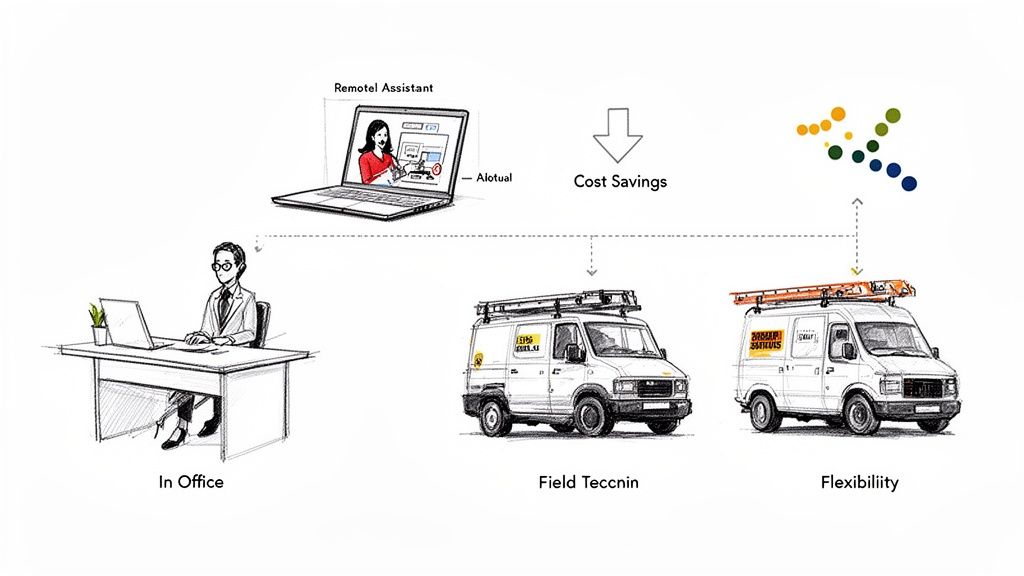
The real key to unlocking efficiency is to completely rethink that structure. It’s time to move past the old-school idea that every role needs to be filled by a full-time employee sitting in your office. By shifting to a more flexible, blended staffing model, you can slash overhead and let your core team focus on what they do best: generating revenue.
The Power of a Blended Team Model
A blended team model is all about combining the strengths of your in-house experts with the cost-effective support of specialized remote professionals. Picture this: your skilled office manager is no longer stuck answering basic inquiry calls or chasing down appointment confirmations. Instead, they're zeroed in on high-value tasks like complex dispatching, optimizing technician schedules, and building relationships with your most important clients.
How is this possible? By bringing in remote talent, like Virtual Assistants (VAs) or Customer Service Representatives (CSRs), who are trained specifically to handle that administrative workload. They become your business's front line, managing inbound calls, qualifying new leads, scheduling jobs, and handling all the follow-ups.
This approach takes what was once a major fixed expense—a full-time salary plus benefits—and turns it into a flexible, scalable asset. You get access to top-tier administrative help without the associated costs of office space, equipment, insurance, and paid time off.
Key Takeaway: The goal isn’t to replace your in-house team, but to supercharge them. By delegating the routine administrative work to remote pros, you empower your local staff to focus on their most critical, revenue-driving activities.
How Remote Support Directly Cuts Your Labor Costs
Let's get specific about how this model delivers real, tangible savings. The average salary for an in-house CSR is a serious financial commitment for a growing home service business. But when you factor in all the "hidden" costs, that number gets a whole lot bigger.
A traditional hire comes with a lot of extra baggage:
- Salary and Benefits: The base pay is just the start. You also have to cover health insurance, retirement contributions, and payroll taxes, which can easily tack on an extra 20-30% to their salary.
- Overhead Costs: An in-house employee needs a desk, a computer, a phone, and their share of the office rent and utilities. These costs add up fast.
- Training and Downtime: You invest significant time and money into training a new hire. On top of that, you're paying for their full eight-hour day, even during slow periods when the phone isn't ringing.
A specialized remote CSR or VA service gets rid of these burdens. You pay only for productive time, turning a fixed liability into a variable expense that grows or shrinks right along with your business. For a deeper dive into the numbers, check out our guide on how hiring offshore virtual assistants can work for your business.
Practical Scenarios for Your Business
To see how this plays out in the real world, let's look at a couple of all-too-common scenarios for home service companies.
Scenario 1: The Overwhelmed Owner
Many small business owners wear every hat, including "receptionist." Every single time the phone rings, you're pulled away from quoting a big job or managing your crew on-site. A remote CSR can screen all your inbound calls, qualify the real leads, and book appointments directly into your calendar. You only need to step in for high-priority issues, instantly winning back hours of your day.
Scenario 2: The Growing HVAC Company
Your in-house dispatcher is a rockstar, but they're spending half their day on routine follow-ups and scheduling annual maintenance calls. By offloading those tasks to a remote VA, your dispatcher can now focus entirely on optimizing technician routes and handling emergency service calls—activities that directly boost daily revenue and make for happier customers.
In both cases, the business gets a massive efficiency boost and avoids having to hire another expensive full-time employee. This kind of strategic delegation is one of the most powerful moves you can make to control expenses while improving your service quality.
Using Automation to Optimize Technician Productivity
Every minute your technician spends stuck in traffic, digging for paperwork, or driving to an unqualified lead is a direct hit to your bottom line. To really get a handle on labor costs, you have to reclaim those lost hours and make sure your team’s time is spent on billable work. This is where smart automation stops being a "nice-to-have" and becomes a total game-changer for your field operations.
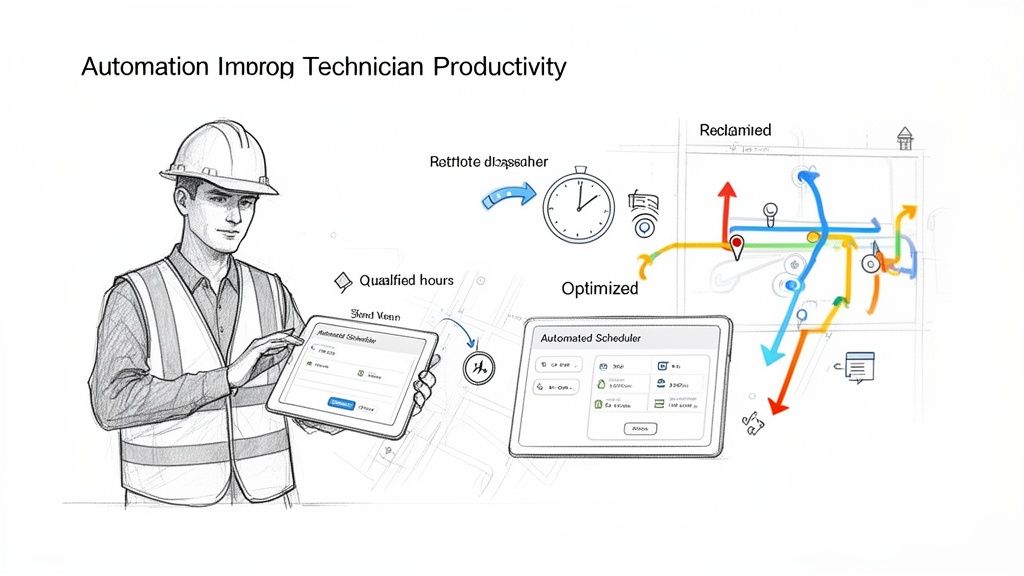
We're not talking about some overly complex, enterprise-level software here. I'm talking about specific, proven tools built for home service businesses that handle scheduling, dispatch, and route planning automatically. Think of this tech as the intelligent core for your entire field team, going way beyond a simple digital calendar.
This kind of system can intelligently assign the right technician to the right job based on their specific skill set, current location, and even the customer's service history. But more importantly, it calculates the most efficient travel route between jobs, which drastically cuts down on that dreaded "windshield time."
Intelligent Scheduling and Dispatch in Action
Picture this: an urgent HVAC repair call comes in. Instead of your dispatcher scrambling to read a messy whiteboard, the software instantly identifies the certified technician who is closest to the customer and has the necessary parts stocked in their van.
The job gets assigned, the route is optimized, and the customer receives an automated text with an accurate ETA. In that one seamless workflow, you've accomplished several things at once:
- Faster Response Times: Getting the right tech to the job quicker leads to much happier customers.
- Reduced Fuel Costs: Optimized routes mean less gas burned and less wear and tear on your vehicles.
- Increased Job Capacity: Less time spent driving means more time for billable work. That allows each tech to fit more jobs into their day.
This strategic approach does more than just shave a few minutes off here and there; it fundamentally makes your field operations more profitable from the ground up. A great starting point is learning how to automate repetitive tasks, which frees up your team for the work that actually makes you money.
Connecting Your Front Office to the Field
True optimization happens when your tools talk to each other. The real power move is connecting a professional remote call handling service directly with your automated scheduler. This creates a seamless pipeline from the first phone call to a completed, profitable job.
When a potential customer calls, a trained remote CSR doesn't just take a message. They follow a script to pre-qualify the lead, gather all the critical job details, and book the appointment directly into your scheduling software.
This simple integration ensures your technicians are only sent to high-value, fully-vetted appointments. You completely eliminate wasted trips to unqualified leads, a hidden but significant drain on your labor costs.
This blend of human expertise on the front end and smart automation on the back end is delivering real, measurable returns. In fact, industry research shows that AI and automation can save a stunning $720,000 in administrative labor costs for planning and scheduling alone. These are real savings that come from streamlining data entry and backend operations, allowing businesses to significantly lower their overhead. You can dig into more of these home services industry statistics to see the full impact.
Moving Beyond Manual Paperwork
The final piece of the productivity puzzle is getting rid of manual paperwork in the field. Modern field service software lets technicians handle everything from a tablet or smartphone.
- Digital Invoices and Payments: They can create and send invoices on the spot and take credit card payments immediately.
- Job Notes and Photos: It’s easy to document the work completed with notes and photos, which are automatically attached to the customer's permanent record.
- Service History Access: Techs get instant access to a customer's full service history, allowing them to spot upsell opportunities for system upgrades or new maintenance plans.
This doesn't just save hours of administrative time back at the office. It professionalizes your entire service and dramatically speeds up your cash flow. By embracing these automation strategies, you empower your technicians to be more productive, more efficient, and ultimately, more profitable for your business.
Boosting Revenue Per Technician Without Adding Headcount
When we talk about reducing labor costs, most people think of cutting hours or freezing hires. But that's only half the story. A much smarter, more sustainable strategy is to flip the script and focus on maximizing the revenue each person on your team brings in.
Think about it: when every technician generates more money per hour, your labor cost percentage naturally drops. Your bottom line gets stronger, and you don't have to go through the painful process of downsizing. This approach is all about turning your field techs from simple service providers into genuine, trusted advisors for your customers. You're giving them the training and confidence to spot real needs and offer valuable solutions—ethically boosting your average ticket on every single job.
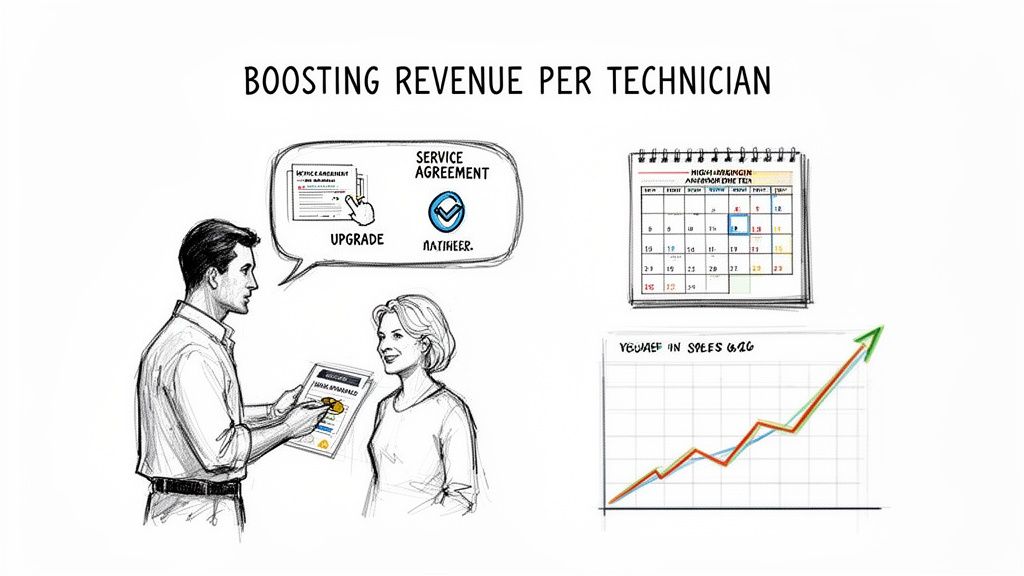
This shift from a volume-based to a value-based model isn't just a theory; it's already working wonders for shops across the country. Recent home service economic findings show a fascinating trend: median revenue is growing even while the total number of new jobs is declining. What does that tell us? The most profitable companies are mastering the art of capturing bigger margins through smarter offerings and building long-term client relationships.
Training Techs to Identify and Present Upsell Opportunities
Your technicians on the ground have a level of trust with homeowners that no salesperson could ever hope to achieve. They're right there, in the home, looking at the equipment. They can spot potential issues or opportunities for an upgrade long before they become expensive emergencies. The secret is training them to communicate what they see, confidently and without any high-pressure tactics.
This isn’t about turning your techs into pushy salespeople. It’s about equipping them to serve the customer better.
- Service Agreements: Train your techs to simply explain the real-world value of a maintenance plan. An HVAC tech could say something like, "Your system is running fine today, but a regular tune-up would prevent those surprise breakdowns we always see during the first big heatwave. Our service plan actually saves you money on future repairs and keeps you at the front of the line."
- System Upgrades: When a piece of equipment is getting old, teach them to frame an upgrade as a smart financial move. For example, a plumber could say, "We can definitely patch up this water heater, but at 15 years old, it's living on borrowed time. A new energy-efficient model would likely cut your utility bill by 15-20%, so the upgrade starts paying for itself right away."
The whole idea is to frame every recommendation as a clear benefit to the customer, whether it’s about saving money, improving safety, or just making their life more convenient.
When your team genuinely believes they are helping the customer by offering additional services, it stops feeling like selling and starts feeling like expert consulting. That authenticity is what really drives a higher ticket average.
Proactively Filling Schedule Gaps with High-Margin Work
Every home service business deals with slow periods and last-minute cancellations. An empty time slot on a technician's schedule is just lost money—pure and simple. Instead of just waiting for the phone to ring, a proactive outbound calling campaign can turn that downtime into one of your most profitable activities. This is where a specialized remote team can be a game-changer.
Imagine having dedicated remote callers whose only job is to fill those gaps. They aren’t making random cold calls; they’re reaching out to your existing customer base with timely, high-value offers that people actually want.
This strategy is incredibly effective for booking preventative maintenance jobs, which are usually high-margin and easy to slot in. Your remote team can call customers whose HVAC systems are due for a seasonal tune-up or reach out to plumbing clients who haven't had an inspection in over a year.
By handing this outbound effort to a service like Phone Staffer, you can build a consistent stream of profitable jobs to fill your technicians' calendars, especially during those historically slow seasons. You turn a major liability—unbilled technician time—into a reliable revenue engine, all without adding a single person to your in-house payroll. This proactive approach ensures every hour is maximized for profitability, directly driving down your overall labor cost percentage.
Building a Hiring and Training System That Reduces Turnover
High employee turnover is one of the biggest—and sneakiest—drains on a home service business. It’s a costly cycle: you place ads, screen candidates, run interviews, and then pour weeks into training, only to have that new hire walk out the door a few months later.
Every time that happens, you’re not just losing a person. You're losing all the time, money, and energy you invested, which directly inflates your labor costs.
The only way to break this expensive habit is to stop treating hiring like a fire you have to put out and start building a repeatable, strategic system. A solid playbook doesn't just help you find better candidates; it helps you weed out the wrong ones early, get new hires up to speed faster, and create a company culture that makes your best people actually want to stick around.
Start with a Job Description That Sells
Think of your job description as your first and most important sales pitch to a potential A-player. Too many businesses just list a bunch of duties and call it a day, but that’s a huge missed opportunity. You need to write a compelling ad that speaks directly to the exact person you want to hire.
- Highlight Your Culture: What makes your company a great place to work? Talk about your focus on teamwork, your commitment to helping people grow, or how you value work-life balance.
- Define What Success Looks Like: Don't just say "must be a team player." Instead, try something like, "You'll succeed here if you thrive on collaborating with a tight-knit crew to deliver 5-star customer experiences."
- Be Brutally Honest About the Role: Clearly lay out the day-to-day realities of the job—the good, the bad, and the ugly. Getting real upfront prevents mismatched expectations and frustration down the road.
This approach immediately filters out applicants who are just looking for any job and attracts those who are looking for the right job. You’ll spend far less time sifting through resumes and more time talking to people who are a genuine fit.
Implement a Structured Interview and Onboarding Process
Once you have good applicants in the door, a structured process is the only way to make a smart hiring decision. Relying on "gut feeling" is a recipe for disaster and turnover. When you have a consistent interview process, you're evaluating every single candidate on the same core skills and values.
From there, a standardized onboarding plan is non-negotiable. Don't just hand a new tech a tablet and send them on a ride-along. A formal plan should map out their first few weeks, setting them up for success from day one. To truly get a handle on labor costs, your focus should be on proven strategies for reducing employee turnover that keep your best people engaged and productive.
A great training system isn't just about teaching someone how to do a task. It's about instilling your company's values and standards, ensuring that every single team member delivers a consistently excellent customer experience.
Standardize Everything with SOPs and Scripts
The backbone of any scalable training system is a set of Standard Operating Procedures (SOPs). These are your company's playbooks for everything, from how your team answers the phone to how they handle an unhappy customer. SOPs eliminate guesswork and empower your team to act confidently and consistently.
For any customer-facing role, scripts are a game-changer. A well-written script doesn’t make your team sound like robots; it gives them a proven framework to handle conversations successfully.
Picture this scenario: An angry customer calls to complain.
- Without a Script: An inexperienced CSR might get flustered, become defensive, or make a promise the company can't keep. That one interaction could lose you a customer for life.
- With a Script: The CSR has a clear roadmap. They know how to listen, empathize, gather the right information, and offer a pre-approved solution. The situation gets de-escalated professionally, and the customer feels heard.
Developing these resources takes some effort upfront, but the payoff is huge. It dramatically shortens the learning curve for new hires and ensures a high standard of quality across your entire operation. This leads to happier customers and employees who feel supported and capable in their roles. And if you're thinking about bringing on administrative support, you can learn more about how to hire a virtual assistant in our detailed article.
Your Action Plan for Lowering Labor Costs
We've covered a lot of ground, and you're now armed with a full playbook of proven strategies. But here's the thing: you don't need to tackle everything at once. Real, sustainable change comes from making smart, incremental improvements that build on each other over time. It’s all about building a leaner, more efficient operation one step at a time.
The end goal is to create a business that truly thrives, not just one that gets by. That means making strategic moves—investing in systems and support that pay you back for years to come.
Charting Your Path Forward
So, where do you start? A practical and highly effective first step is to get inbound call handling off your plate.
When you hand this task over to a professional remote CSR service, you immediately free up your in-house team to focus on what they do best. It’s a simple change that delivers an instant productivity boost without disrupting your core business.
Take a look at this breakdown. It visualizes the key pieces of a system designed to crush employee turnover and the high costs that come with it.
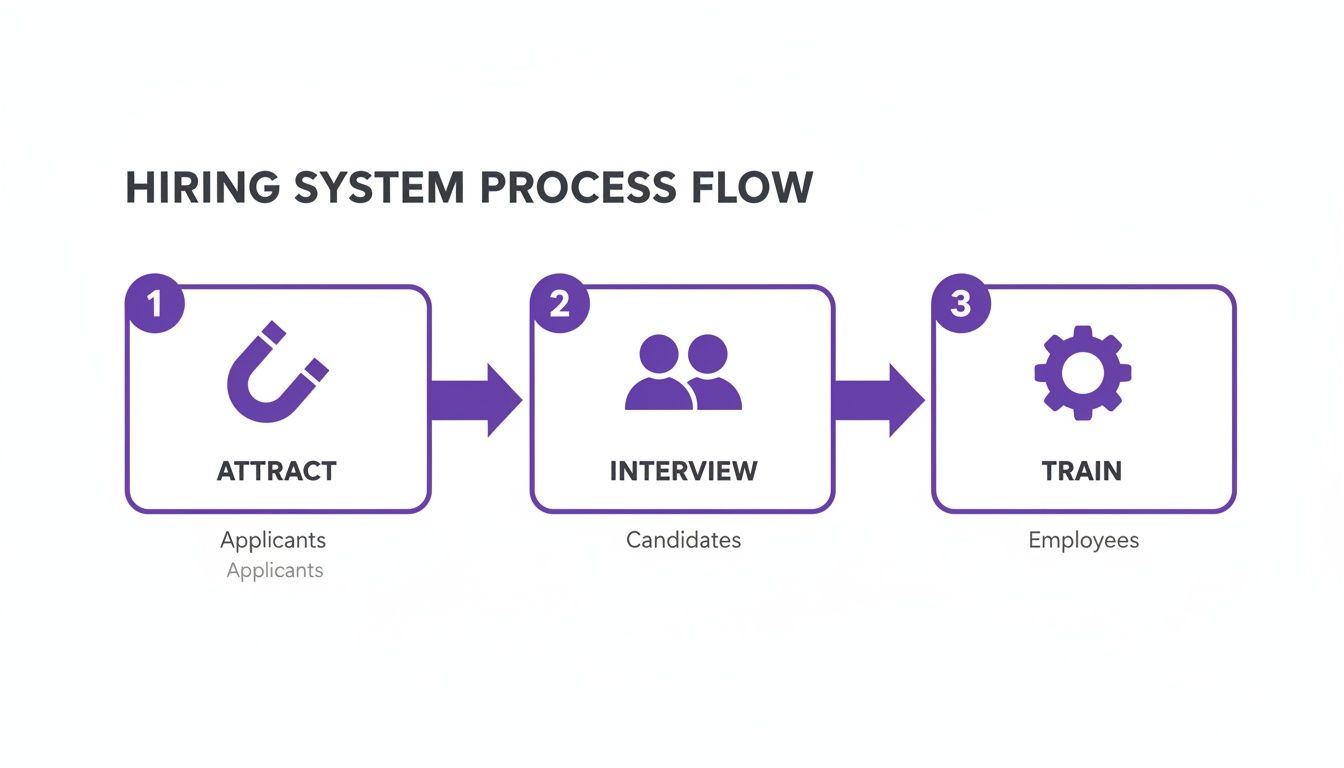
This process shows why a structured approach to hiring—from attracting the right people to training them effectively—is the foundation of a stable and cost-effective team. Nailing this flow is non-negotiable.
Ultimately, managing labor expenses is about creating a resilient, profitable business. Each strategy—from flexible staffing to optimized training—works together to strengthen your bottom line and build a sustainable future.
As you think about your next move, check out our deep dive into the real savings of a remote phone answering service.
Frequently Asked Questions
Even with a perfect plan on paper, questions are bound to come up when you start making real changes to your business. Let's tackle some of the most common things I hear from home service owners as they work on trimming down their labor costs.
What's the Very First Thing I Should Do to Cut Labor Costs?
Before you change anything, you need a clear picture of where your team's time is actually going. Start tracking it. Seriously. How many hours are burned on non-billable tasks? Think driving between poorly routed jobs, endless administrative paperwork, and time wasted on unqualified leads.
Your timesheets will tell you a story, and that story will point you to your biggest opportunities. Often, the quickest win is offloading tasks like answering the phone to a remote professional. This one move can immediately free up your expensive in-house team to focus on the work that actually makes you money.
Won't Automating My Scheduling Feel Cold and Impersonal to My Customers?
Not if you do it right. The truth is, many customers today prefer the convenience of booking online and getting automated reminders. The trick is to pair smart automation with a great human touch for when it matters.
Let technology handle the simple, repetitive stuff like booking an appointment or sending a confirmation text. But make sure a well-trained person—whether they're in your office or working remotely—is ready to jump in for complex questions or unique situations. This hybrid approach gives you the best of both worlds: efficiency and fantastic customer service.
My Two Cents: Think of automation as the tool that handles the routine so your team can focus on the relationships. When your crew isn't bogged down by scheduling calls, they have more energy to deliver the kind of personal service that earns five-star reviews and referrals.
I'm Trying to Cut Costs, So How Can I Afford a Remote CSR Service?
This is a classic case of shifting your perspective. Don't see it as another expense; see it as an investment in efficiency.
First, do the math on what it really costs you to handle calls in-house. What's your time worth? Or your office manager's? Now, add the cost of every single lead you lose when a call goes to voicemail because you were on another line or out on a job. It adds up fast.
When you weigh the costs of salary, benefits, training, and overhead for a full-time hire, a specialized remote CSR service is almost always the more economical choice. You're turning a fixed, heavy labor cost into a flexible, operational one that directly helps you capture more revenue.
Ready to stop missing calls and start turning more leads into booked jobs? Phone Staffer can place a professionally trained remote CSR right into your business to handle your phones, qualify every lead, and schedule appointments directly on your calendar.