
If you're spending money on marketing but don't know which campaigns are actually making your phone ring, you're flying blind. Learning how to track phone calls isn't just about tallying up incoming calls; it's about drawing a straight line from every dollar you spend on Google Ads, flyers, and Facebook posts directly to a booked job.
Why You Are Losing Money by Not Tracking Calls
For any home service business, the phone is the ultimate cash register. When a customer calls, they aren't just browsing—they have an urgent problem. A burst pipe, a dead AC unit, or a leaky roof demands immediate attention. If you can't trace that inbound call back to the specific marketing piece that triggered it, you’re just guessing where your best leads are coming from.
This isn't just a small gap in your data; it's a massive financial leak.
Let's say you're spending $2,000 per month on a Google Ads campaign. Without call tracking, you see clicks and impressions, but you have no hard proof that it’s generating profitable phone calls. You could be pouring money into keywords that sound great but only attract tire-kickers, while a simple, cheap yard sign campaign is quietly bringing in your most valuable clients.
The Real Cost of Unanswered Phones and Unseen Data
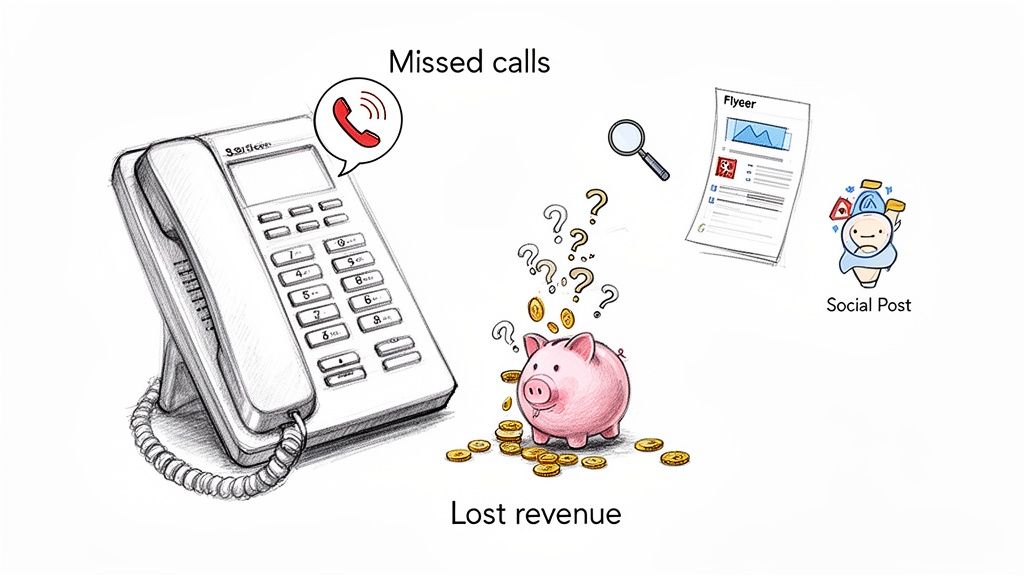
Every single missed call is more than just a missed opportunity—it's revenue you’re handing directly to your competitor. A homeowner with a plumbing emergency isn't going to leave a voicemail and wait patiently. They'll just dial the next company on the list.
This problem gets even worse during your busiest hours when your whole team is out on jobs and can't get to the phone. To get a better sense of this impact, you might be interested in learning more about the benefits of a professional missed call service in our article.
Call tracking removes the guesswork. It transforms your marketing from a blind expense into a measurable investment. You can finally answer the crucial question: "Which ad just made my phone ring with a $1,500 repair job?"
Without this clarity, you're stuck making decisions based on gut feelings instead of real data. You might slash the budget for a flyer campaign that's secretly your top performer or double down on a digital ad that only brings in low-value, time-wasting inquiries.
Connecting Marketing Spend to Actual Jobs
This is where tracking becomes a complete game-changer. By assigning a unique phone number to each of your marketing campaigns, you can see exactly which channels are driving calls.
Suddenly, you can:
- Optimize Your Ad Budget: Shift your money away from underperforming campaigns and pour it into the ones that actually deliver high-intent leads.
- Improve Customer Service: Pinpoint your peak call times and schedule staff accordingly, dramatically reducing missed calls and lost jobs.
- Calculate Your True ROI: Finally connect the dots between what you spend on a specific ad and the actual revenue it generates.
Knowing this information stops the financial drain. It empowers you to make sharp, strategic decisions that directly grow your bottom line, turning your marketing budget into a predictable engine for booking more jobs.
Choosing the Right Call Tracking Method
Before you can track anything, you have to decide how you're going to track it. This is the first and most important step. When it comes to tracking phone calls, you've got two main tools in your toolbox: Dynamic Number Insertion (DNI) and good old-fashioned static tracking numbers.
Each has its place, and honestly, most home service businesses I've worked with end up using a mix of both. It's not an either-or decision; it's about picking the right tool for the right job.
Dynamic Numbers for Your Digital Marketing
Think of Dynamic Number Insertion (DNI) as your high-tech solution for everything you do online. It's a slick piece of code you (or your web developer) add to your website. This code magically swaps your regular business number with a unique tracking number based on where a visitor came from.
So, if someone finds you by searching "emergency plumber near me" on Google, they see one number. If another person clicks on your Facebook ad for a new AC installation special, they see a completely different number. When they call, you know exactly what prompted them to reach out. It's that granular.
DNI is a must-have if you're spending any real money on digital ads. It connects a person's specific online journey directly to their phone call.
Here’s where it really pays for itself:
- Google Ads (PPC): Finally, you can see which keywords are actually making the phone ring versus just costing you money. No more guessing.
- Social Media Ads: Find out if that Facebook campaign is generating valuable calls or just a bunch of empty likes.
- SEO & Organic Traffic: Learn which blog posts or service pages are convincing people to pick up the phone.
DNI gives you undeniable clarity. It stops you from blindly throwing your $2,000 monthly Google Ads budget at the wall and hoping something sticks. Instead, it shows you precisely which campaigns are worth doubling down on.
Static Numbers for Everything Offline
Now, for everything that isn't digital, you’ll want to use static tracking numbers. It’s as straightforward as it sounds: you get a unique phone number and assign it to a single marketing source. It’s simple, effective, and perfect for the real world.
You can't dynamically change a phone number that’s already been printed, which is why static numbers are the only way to go for traditional marketing.
Here are a few classic examples for home service pros:
- Truck Wraps: Put one tracking number across your entire fleet. You’ll be surprised how many leads your trucks generate just by being out on the road.
- Yard Signs: Use a specific number for the signs you leave behind at a happy customer's house to see how many neighbors call.
- Flyers & Door Hangers: Print a different number on flyers for different neighborhoods to test which areas respond best to your offers.
- Business Cards: A dedicated number on your cards tracks how effective your direct networking is.
We've seen it time and time again: for a roofer, an electrician, or a pest control expert, a phone call is pure gold. A caller is almost always a higher-intent lead than someone who fills out a web form, and we often see a 50% higher close rate on calls. The entire call center software market, which is on track to hit USD 41.7 billion in 2025, is built around technology that makes this kind of tracking possible. You can dive deeper into these kinds of numbers and learn more about valuable call tracking metrics on Nimbata.com.
Comparing Call Tracking Methods for Home Services
To make it even clearer, let's break down the two methods side-by-side. This should help you visualize where each one fits into your marketing plan.
| Feature | Dynamic Number Insertion (DNI) | Static Tracking Numbers |
|---|---|---|
| Best For | Digital Channels: Website traffic, Google Ads, SEO, social media ads, online directories. | Offline Channels: Truck wraps, yard signs, direct mail, flyers, print ads, radio, and business cards. |
| Data Granularity | Very High: Tracks individual user sessions, keywords, ad campaigns, and referral sources. | Source-Level: Tracks the overall performance of a single marketing asset (e.g., "all calls from yard signs"). |
| How It Works | A code snippet on your site swaps numbers for each unique visitor. | A dedicated phone number is assigned to one specific marketing piece. |
| Example Use Case | Knowing that a specific Google Ad for "AC repair in Phoenix" generated 15 high-quality calls this month. | Knowing that your fleet of branded trucks brought in a total of 25 calls over the last quarter. |
| Primary Goal | To optimize digital ad spend and understand the online customer journey. | To measure the ROI of specific offline marketing campaigns and physical assets. |
At the end of the day, you're not choosing one over the other. The goal is to build a complete 360-degree view of your marketing. By using DNI for your online efforts and static numbers for your offline ones, you ensure that no lead ever falls through the cracks. This comprehensive approach gives you the data you need to make smarter decisions and grow your business more profitably.
Getting Your Call Tracking System Up and Running
Alright, you get the difference between dynamic and static numbers. Now it’s time to roll up our sleeves and put this into practice. The good news is that setting up a call tracking system is often a lot faster and less technical than most people think. It’s really about picking the right partner and taking a few logical steps to get that sweet, sweet data flowing.
First things first, you need to choose a call tracking provider. You'll find dozens out there, but for a home service business, the best choice really comes down to a handful of key features. Don't let yourself get distracted by a million bells and whistles; just focus on the fundamentals that will actually help you book more jobs.
Look for a platform with a simple, clean dashboard. The last thing you need is another complicated piece of software to learn. You want to see your call data at a glance, without needing a PhD in analytics to understand what’s going on.
Must-Have Features in a Call Tracking Platform
When you're checking out different providers, make sure they offer these non-negotiables. These features are the foundation of a solid system that will grow with your business and give you real insights, not just a pile of numbers.
- Call Recording: This is an absolute goldmine. It's hands-down the best tool for training your CSRs and tightening up your sales scripts. Hearing exactly how your team handles incoming leads is the fastest way I’ve seen to improve booking rates.
- CRM Integration: Your call tracking data needs to talk to your Customer Relationship Management (CRM) software. Automatically pushing call details into your CRM creates a complete picture of every customer interaction, from the first ad they saw to the final invoice.
- Dynamic Number Insertion (DNI): As we covered, this is the magic behind accurately tracking your online marketing. It's a must-have for figuring out your ROI from things like Google Ads and SEO.
- Whisper Messages: This is a neat little feature that gives your team a massive advantage. A "whisper message" is a short audio cue that plays only for your staff right before a call connects. Hearing something like, "Call from Google Ads," gives them instant context to nail the greeting.
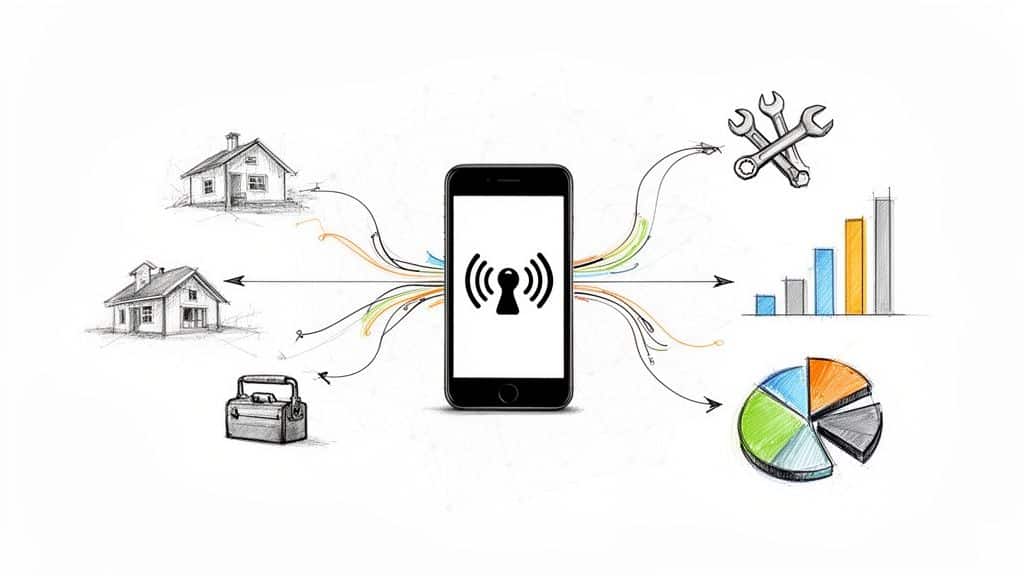
This diagram breaks down how both online and offline ads funnel customers to your business, with call tracking capturing the critical data at every step.

It makes it clear that whether a customer finds you through an online search or a flyer on their door, a tracking number ensures you know exactly where they came from.
Buying and Assigning Your First Tracking Numbers
Once you’ve settled on a provider, it’s time to grab your numbers. Most platforms make this dead simple—you can usually buy local or toll-free numbers right from their dashboard in just a few clicks.
Think of it as building your marketing toolkit. You’ll want to purchase a small block of numbers to get started. A good rule of thumb is one unique number for each offline campaign you're running, plus a pool of numbers for your website's DNI.
The core idea is simple: one marketing source, one unique tracking number. This one-to-one relationship is what gives you undeniable clarity on what’s working and what’s not.
Let’s walk through a real-world example for a plumbing company:
- Google Business Profile: Assign one static number only to your GBP listing. This is crucial for measuring how many calls are coming directly from the local search map pack.
- Newspaper Ad: You’re running a coupon in the local paper for a seasonal special. Give that ad its own unique static number. Now you'll know precisely how many people called from that specific print run.
- Door Hangers: For a drop of 500 door hangers in a new subdivision, use a third static number. This isolates the performance of that hyperlocal campaign and tells you if it's worth doing again.
This one-to-one approach eliminates all the guesswork.
Installing the Tracking Code on Your Website
For DNI to work its magic on your website, you need to install a small snippet of JavaScript code. If that sounds intimidating, don't sweat it. It’s usually a simple copy-and-paste job that takes less than five minutes.
Your call tracking provider will give you this unique code snippet. All you have to do is add it to the header or footer of your website. If you're on WordPress, there are often plugins that make this even easier. And if you have a web developer, they can get this done for you in no time at all.
Once that code is live, the system automatically starts swapping the main number on your site with the tracking numbers from your pool. That’s it. From that moment on, you can see exactly which online channels—organic search, paid ads, social media—are making the phone ring.
Look, this setup takes a little bit of effort upfront, but the long-term payoff is huge. You’ll go from making marketing decisions based on gut feelings to making them based on cold, hard data. You’ll also have a system that helps your team perform at their best. As you grow, many businesses find it helpful to bring in specialists, and you might want to learn more about how to hire a virtual assistant to manage these valuable leads. Getting your system running is the first real step toward building a more profitable and predictable business.
Connecting Call Data with Your Business Tools
Getting call data is a great first step, but that data is pretty useless if it just sits in a silo. The real magic happens when you pipe that information directly into the software you use to run your business every day, like your CRM and Google Analytics.
When your call tracking platform "talks" to your other tools, you're no longer looking at isolated reports. You're bridging the gap between a marketing click and a paying customer, giving you a complete, unified view of the entire customer journey.
Unifying Data with Your CRM
For any home service company, the CRM is mission control. It’s where every customer interaction lives. Pushing your call data directly into your CRM isn't just a nice-to-have feature; it fundamentally improves how your team operates.
Think about it. A potential customer calls after seeing one of your Facebook ads. Without an integration, your office staff has to manually ask, "So, how'd you hear about us?" and then scramble to create a new lead, hoping they type everything in correctly.
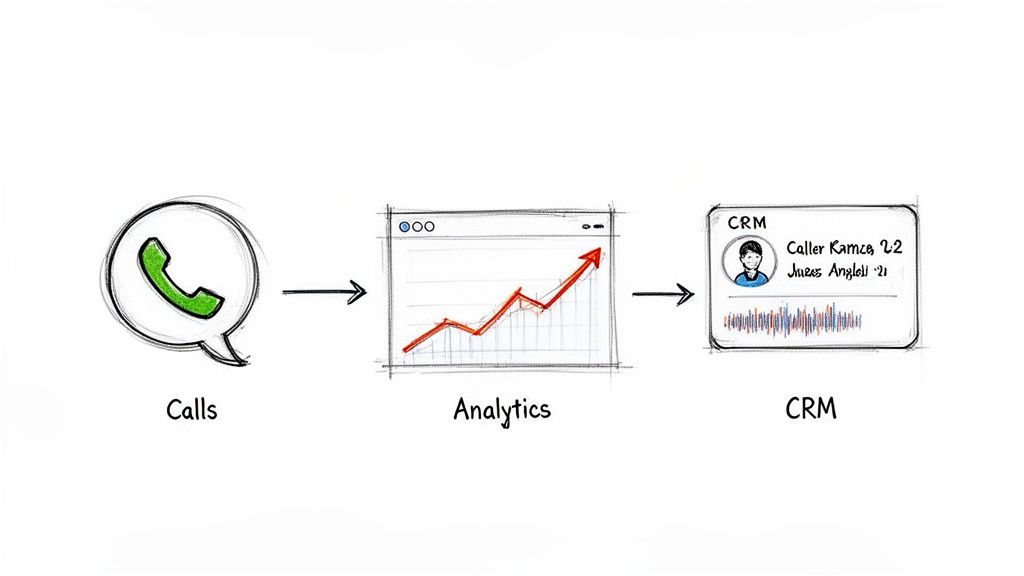
With a proper integration, the whole process is automatic. A call comes in from the tracking number on your "Spring AC Tune-Up" Facebook campaign, and your CRM instantly creates a new lead. It automatically tags the lead source as "Facebook Ads – Spring AC Tune-Up" and logs all the call details—date, time, duration, and even attaches the call recording.
This simple automation saves a ton of time and kills human error. More importantly, it gives your team incredible context. They can see the lead’s history and listen to the initial call before they even follow up, which is how you turn a warm lead into a booked job.
Seeing Calls as Conversions in Google Analytics
Integrating with Google Analytics (GA4) is how you prove your marketing is actually working. This setup lets you treat phone calls as official conversion events, putting them on the same level as form submissions or online bookings.
If you don't connect these dots, your GA4 reports are telling you a half-truth. You might see a Google Ads campaign with a low on-page conversion rate and think about axing it. But what you can't see is that this "underperforming" campaign is actually your number one source of high-value phone calls.
By sending call data to GA4, you can finally attribute phone conversions back to the specific keyword, ad, or landing page that drove them. This gives you the full ROI picture and stops you from making expensive decisions based on incomplete data.
This integration helps you answer the really important questions:
- Which blog posts are actually making the phone ring for emergency repairs?
- Is our "Request a Quote" page better at getting form fills or phone calls?
- What’s our true cost-per-acquisition on paid search once we factor in phone leads?
Answering these questions is how you optimize your marketing budget and pour fuel on the channels that are actually delivering customers.
Practical Steps for a Seamless Integration
The good news is that setting this all up is usually pretty straightforward. Most modern call tracking providers have built-in connectors for the big platforms. The whole process typically happens right inside your call tracking software's dashboard.
- For your CRM: You'll find an "Integrations" menu, pick your CRM (like Jobber, Housecall Pro, or Salesforce), and authorize the connection. From there, you just set up a few simple rules, like, "When a first-time caller rings, create a new lead in our system."
- For Google Analytics (GA4): This is just as easy. You'll connect your call tracking account to your GA4 property. Once linked, the software automatically starts sending call "events" to GA4, which you can then flag as official conversion goals inside your reports.
Connecting these systems is a crucial part of learning how to track phone calls the right way. It takes you beyond just counting calls and into a world where your data works for you. For companies ready to scale, integrating a dedicated business phone service can centralize communications even further and make this data ecosystem even more powerful.
Using Call Data to Win More Jobs
Getting your call tracking set up is a huge first step, but collecting the data is really just the start. The real magic happens when you start digging into those numbers to make smart decisions that actually lead to more booked jobs and a healthier bottom line. For a home service company, this isn't about chasing abstract metrics; it's about finding out what works and doing more of it.
Your first instinct might be to just look at total call volume, but that can be misleading. A hundred calls don't mean much if none of them turn into paying customers. The goal is to figure out which marketing efforts are delivering qualified, ready-to-buy leads.
For example, your call tracking dashboard might show that your Google Ads campaign for "emergency plumbing repair" gets half the calls of your Facebook ads. But when you dig deeper, you see those Google Ads calls convert to jobs at a 90% higher rate. That’s a game-changing insight. It tells you exactly where to put your money to get the best bang for your buck.
Pinpoint Your Most Profitable Channels and Times
One of the most powerful things your new setup can do is show you not just where your calls are coming from, but when. Most call tracking platforms have a heat map or a simple report that highlights your peak call hours and days of the week.
This is gold for managing your team. Let's say you discover that 80% of your most valuable calls—the big-ticket installations or emergency repairs—come in between 7 AM and 10 AM. If your office staff doesn't get in until 9 AM, you're literally letting money walk out the door every single morning. Just by adjusting your CSR's schedule to cover those peak hours, you can dramatically cut down on missed opportunities.
Once you have this data, the guesswork is over. You can finally line up your resources—both your ad budget and your team's time—with the exact moments your customers are trying to hire you.
By looking at your call data, you can make strategic moves that pay off immediately:
- Smarter Budgeting: Confidently pull money from that newspaper ad that only brought in two tire-kickers all month and put it into the yard signs that are consistently generating new installation leads.
- Better Staffing: Make sure you have enough people ready to answer the phone during your busiest periods so every potential customer gets a voice, not a voicemail.
- In-Demand Services: Notice a huge spike in calls for duct cleaning after running a small promotion? That's a clear signal from the market telling you what services people want right now.
Uncover Coaching Opportunities in Call Recordings
I can't stress this enough: call recordings are probably the most underrated growth tool for any home service business. They give you an unfiltered look at how your team is interacting with potential customers, and that's where you'll find incredible opportunities for training.
Listening to calls lets you hear firsthand how your CSRs and dispatchers handle inquiries. Do they sound confident? Are they building rapport? Most importantly, are they consistently asking for the job? You can't fix what you can't hear.
Imagine you listen to a few calls and notice your newest CSR fumbles when asked about your HVAC maintenance plans. That’s a perfect coaching moment. You can sit down with them, use that specific recording as a training example, and walk them through the key benefits so they can nail the pitch next time.
Improving how your team handles that first conversation is everything. A key metric here is First Call Resolution (FCR)—solving the customer's need on the very first call. Industry benchmarks show a strong FCR is around 80% or higher. For home service pros, hitting that number means fewer people hanging up to call your competitor, and it's been shown to boost customer satisfaction by 20-30%. You can dive deeper into these powerful call center statistics with Giva's research.
Refine Your Scripts and Improve Your Close Rate
Beyond one-on-one coaching, call recordings are your secret weapon for improving your company-wide phone scripts and procedures. As you listen to both won and lost opportunities, you'll start to see patterns emerge.
What specific questions or phrases consistently lead to a booked appointment? What are the most common objections, and how are your top performers getting past them?
Let's say you're a roofing contractor. After reviewing a dozen calls, you might realize that whenever your CSRs mention your "10-year workmanship warranty" early in the conversation, the booking rate jumps by 15%. That's a simple, powerful tweak you can immediately add to the official script for the whole team.
This is how you create a continuous feedback loop. You analyze real-world conversations to improve your process, which in turn improves your booking rate. This is how learning how to track phone calls goes from a simple measurement task to a powerful engine for growing your business.
Answering Your Top Questions About Call Tracking
I get it. Even after seeing the benefits, you probably still have a few questions swirling around before you dive in. That’s smart. Getting these answers is the last step to feeling confident that you're adding a system that will actually grow your business.
Let's walk through the big questions I hear most often from other home service pros.
Will Tracking Numbers Wreck My Local SEO?
This is always the first question, and for good reason. You’ve worked hard to build your local rankings, and the last thing you want to do is jeopardize them.
The short answer is no, it won't hurt your local SEO, but there's a big "if"—if you do it correctly.
The whole game with local SEO is keeping your Name, Address, and Phone Number (what we call NAP) consistent everywhere. So, your main, hard-coded business number needs to stay put on your website’s footer, contact page, and in the site's code. To track website calls, you'll use something called Dynamic Number Insertion (DNI). This technology swaps the number for visitors based on how they found you, but it doesn't change that core business number that search engine crawlers see. They still see your main line, so your NAP consistency stays intact.
For your big online business listings—think Google Business Profile, Yelp, Angi—stick with your primary business number. You don't want to mess with those. But for things like PPC ads, direct mail flyers, or the wrap on your truck? That's the perfect place to use a separate, static tracking number. Google isn't cross-referencing your truck wrap with your online listings to rank you.
The Bottom Line: Your real business number is the anchor for your local SEO. Tracking numbers are just a layer you put on top for your marketing channels, so you can measure what's working without confusing Google.
What’s This Going to Cost Me?
The cost can vary, but it’s more affordable than most people think. Most call tracking providers have a similar pricing model: a base monthly fee plus usage fees for the numbers and minutes.
Here’s a typical breakdown:
- Monthly Subscription: Usually runs from $30 to $100+ per month. The price depends on what features you need, like call recording, deep CRM integrations, or how many team members need access.
- Phone Numbers: Each tracking number will cost about $1 to $5 per month.
- Minute Usage: You'll also pay a few cents per minute for the calls you receive.
For a small or medium-sized home service business running a few different marketing campaigns, a realistic budget is usually somewhere between $50 and $200 a month. Try not to see it as just another expense. It’s an investment that pays for itself almost immediately by showing you which $1,000 ad spend is bringing in jobs and which one is a total dud.
How Much Time Will I Spend Managing This?
The initial setup is where you'll spend the most time, but once you're up and running, it's pretty low-maintenance. Getting started—picking your provider, buying a handful of numbers, and getting the code on your website—can honestly be done in a single afternoon.
From there, it's all about checking in. I recommend spending 20-30 minutes a week just looking at your dashboard. You’re looking for trends: Which channels are driving not just calls, but good calls? Maybe listen to a few call recordings to see if your team needs any coaching. The software does all the heavy lifting and data collection for you. Your job is just to use those insights to make smarter marketing decisions.
And remember, tracking is only half the battle. Following up is key. Research actually shows that making three call attempts is the sweet spot, leading to a conversation 93% of the time. After five attempts, the return drops off a cliff. You can find more practical stats like this to optimize your call strategies from Trellus.ai.
That little bit of time you spend analyzing the data will save you countless hours and thousands of dollars you would have otherwise wasted on marketing that just wasn't working. It's easily one of the highest-return activities you can do for your business.
At Phone Staffer, we don't just help you track your leads—we help you convert them. Whether you need a done-for-you cold calling service to book appointments or a highly-trained remote CSR to ensure no call goes unanswered, we provide the people and processes to grow your home service business. https://phonestaffer.com