

Look, great pest control advertising isn't just about plastering your name everywhere. It's about showing up at the exact moment someone is having a full-blown pest crisis. Your entire strategy needs to connect with both the homeowner freaking out over ants in the pantry and the commercial property manager trying to stay ahead of problems. Get that right, and every dollar you spend on ads becomes a smart investment instead of a shot in the dark.
Building Your Advertising Foundation
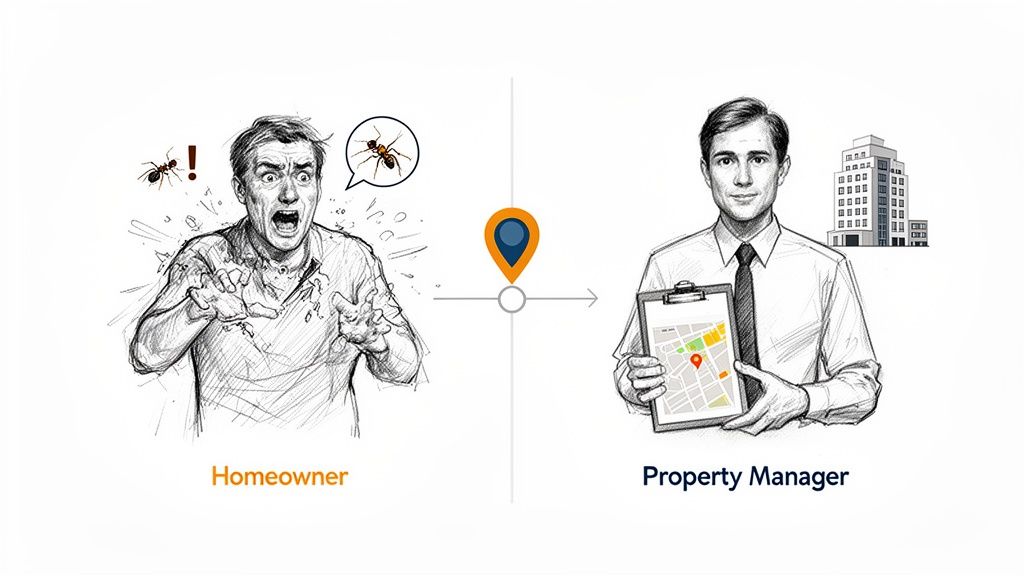
Before you even think about launching a campaign, you have to get inside your customers' heads. Generic ads are just noise. The ones that get calls are those that speak directly to a specific, urgent problem. This means going way beyond basic demographics and mapping out exactly who you’re trying to reach.
Just think about the different mindsets. A parent who finds a wasp nest hanging over their kid's swing set is in a completely different headspace than a restaurant manager who needs a discreet, monthly rodent inspection. The parent needs a hero—fast. The manager needs a reliable partner who understands compliance.
Crafting Your Customer Personas
The best way to nail this is by creating customer personas. This simple exercise will guide your ad copy, your targeting, and even the services you decide to feature.
Here are a couple of examples to get you started:
-
Residential Rachel (The Urgent Need): She’s a homeowner, maybe in her 30s or 40s, living out in the suburbs. Her biggest fear is the immediate "yuck" factor and the safety of her family and pets. She's looking for speed and someone who can clearly explain the process. Her Google search is probably something like, "emergency ant exterminator near me."
-
Commercial Chris (The Proactive Planner): This is your property manager, likely in his 50s, juggling multiple buildings. His job is to prevent disasters, protect tenants, and dodge health code violations. He’s looking for professionalism, solid reporting, and a long-term service agreement. His search is more like, "commercial rodent control services."
Once you define these personas, you stop shouting into a void. You start having real conversations with the people who are actually going to hire you. Your ads for "Residential Rachel" will scream "Same-Day Service," while your ads for "Commercial Chris" will talk about "Scheduled Preventative Maintenance."
A solid advertising foundation is built on knowing what your local customers are actually searching for. This is where comprehensive Localised Keyword Research comes in. It’s the only way to uncover the exact phrases your ideal customers are typing into Google, letting you build campaigns that meet them right where they are.
Choosing the Right Advertising Channels
When it comes to advertising your pest control business, there’s no magic bullet. The real key is building a smart mix of channels, so you’re showing up wherever your ideal customer is looking. You need a strategy that blends long-term, foundational work with quick-win campaigns that make the phone ring right now. This ensures you're not just getting leads today, but building a pipeline that will keep you busy for years to come.
This multi-channel approach is absolutely critical. The global pest control market is exploding, projected to hit USD 42.79 billion by 2032. Just in the U.S., termites alone cause over $5 billion in property damage every single year. That number tells you everything you need to know about the urgency people feel when they find a pest problem. You can dig deeper into these market trends to see what it means for your local area.
To make sense of it all, let's look at the main channels and where they fit into your strategy.
Pest Control Advertising Channel Comparison
Each channel has a different job to do. Some are for grabbing immediate, high-intent leads, while others are about building your brand name over time. This table breaks down the heavy hitters.
| Channel | Primary Goal | Best For Targeting | Cost Model |
|---|---|---|---|
| Local SEO | Long-term visibility, free organic leads | Geographic location (city, neighborhood) | Sweat equity, agency fees |
| Google Ads (PPC) | Immediate lead generation, urgent jobs | Keywords, location, demographics | Pay-per-click (PPC) |
| Facebook/Meta Ads | Brand awareness, seasonal promotions | Demographics, life events, interests | Pay-per-impression/click (CPM/CPC) |
| Direct Mail | Hyper-local targeting, brand recall | Specific zip codes, neighborhoods, new movers | Per-piece cost (design, print, mail) |
| Local Partnerships | Referral generation, community trust | Customers of related businesses (realtors, roofers) | Time, relationship building |
Ultimately, a winning strategy uses a combination of these. You might lean heavily on Google Ads during peak swarm season while your SEO and local partnerships steadily build your reputation year-round.
Dominate Local Search with SEO and Google Business Profile
Think about it. A homeowner finds a trail of ants marching across their kitchen counter. What's the very first thing they do? They grab their phone and search "pest control near me."
This is why Local SEO is your most powerful, non-negotiable tool. It’s a long game, for sure, but it pays off with a steady stream of free, high-intent traffic.
The absolute heart of your local SEO strategy is your Google Business Profile (GBP). A perfectly optimized profile is what gets you into that coveted "map pack" at the top of local search results. It's prime real estate.
Make sure your profile is dialed in:
- Accurate NAP: Your Name, Address, and Phone number must be identical everywhere online. Consistency is king.
- Service Areas: Get specific. List the exact towns and zip codes you cover.
- Real Photos: Upload pictures of your team, your branded trucks, and your office. Stay away from generic stock photos.
- A Flood of Reviews: Actively ask for reviews and—this is crucial—respond to every single one, good or bad.
Your GBP is your digital storefront on Google. Neglecting it is like locking your front door and hoping customers climb through a window. Keep it fresh, active, and overflowing with social proof.
Capture Urgent Leads with Google Ads
While SEO is your foundation, Google Ads (PPC) is your SWAT team. This is how you capture leads who need a solution right now.
We're talking about people searching for "emergency wasp nest removal" or "rodent exterminator same day." These folks aren't casually browsing for next month; they're in a full-blown panic and ready to book the first reputable company they find.
Focus your Google Ads campaigns on specific, high-urgency services. A well-built campaign can put you at the very top of the search results, often generating calls within hours of going live. It's an essential part of any strategy aimed at driving immediate revenue.
Build Brand Awareness with Facebook and Meta Ads
Here's the difference: people don't usually go on Facebook to look for an exterminator. But that doesn't mean it's not valuable. Meta Ads are incredibly effective for proactive marketing and building your brand. This is where you get in front of potential customers before they even know they have a problem.
Here are a few scenarios where Facebook really shines:
- Targeting New Homeowners: Run an ad for a "New Mover Pest Inspection" special, targeting people who just bought a home in your service area. It’s a perfect foot-in-the-door offer.
- Seasonal Campaigns: As spring rolls in, start promoting your mosquito control services. When the first cold snap hits, run ads for rodent-proofing.
- Becoming a Local Name: Share helpful tips (e.g., "3 Ways to Keep Ants Out of Your Kitchen"), introduce your technicians, and run local contests. This keeps you top-of-mind, so when they do have a pest issue, you're the first company they think of.
By weaving these digital channels together, you create a powerful net that catches leads at every possible stage—from just thinking about pests to having a full-blown emergency.
Designing Ads That Convert Panic Into Phone Calls
Think about the moment someone decides to search for a pest control company. They're probably stressed out, maybe even a little disgusted or worried. Your ad is their first point of contact in that moment of need. The goal isn't just to get a click; it's to turn that frantic energy into a confident phone call to your business.
This is about building trust in a split second.
The best pest control ads I’ve seen all have one thing in common: they tap directly into the customer's urgent problem. This isn't the time for a clever, punny slogan. It’s the time for a clear, direct promise that you are the solution they’re desperately looking for. Your message has to scream speed, reliability, and professionalism.
Crafting a Message of Trust and Speed
When a homeowner spots a line of ants marching across their kitchen counter, their first thought isn't "I need integrated pest management." It's "Get them out now." Your ad copy has to match that same level of urgency with direct, action-focused language.
Here's a simple framework for a message that consistently gets results:
- Lead with the Solution, Not the Problem: Instead of a generic "We Kill Bugs," get specific. "Fast & Reliable Ant Extermination" speaks directly to their pain point and what you'll do about it.
- Emphasize Immediacy: Words are powerful, and in this business, speed sells. Phrases like "Same-Day Service," "Emergency Response Available," or "Call Now for a Free Inspection" are your best friends. They tell a panicked customer that help is just a phone call away.
- Build Credibility Instantly: A quick mention of being "Licensed & Insured" or a "Local, Family-Owned Business" offers a massive dose of reassurance when they need it most.
The secret to great pest control ad copy is simple: promise a fast, professional fix for their immediate problem. Make it crystal clear that one call to you is all it takes to make their nightmare disappear.
Why Professional Images Outperform Scary Bugs
I know it’s tempting. A big, scary, close-up photo of a spider or a termite definitely grabs attention. But you have to resist the urge. While it's eye-catching, it also attaches a very negative, creepy-crawly feeling to your brand. That's the last thing you want.
Instead, your visuals should reinforce the solution you're promising.
Here’s what works far better:
- Your Team and Trucks: A clean, branded van parked in a driveway. A smiling technician in a professional uniform. These images project trustworthiness and show you're a real, local company ready to get to work.
- Clean Action Shots: A photo of a technician carefully treating the exterior foundation of a home shows competence and professionalism without having to show a single bug.
This strategy positions your company as the hero arriving to save the day, not just another reminder of the disgusting problem they're facing. This approach is more important than ever. The U.S. pest control sector is set to generate USD 3.4 billion in 2024, and with over 70% of revenue coming from residential services, your ads have to connect with homeowners on a human level. You can learn more about the pest control industry’s projected growth to see just how big the opportunity is.
Managing Your Budget and Measuring Real ROI
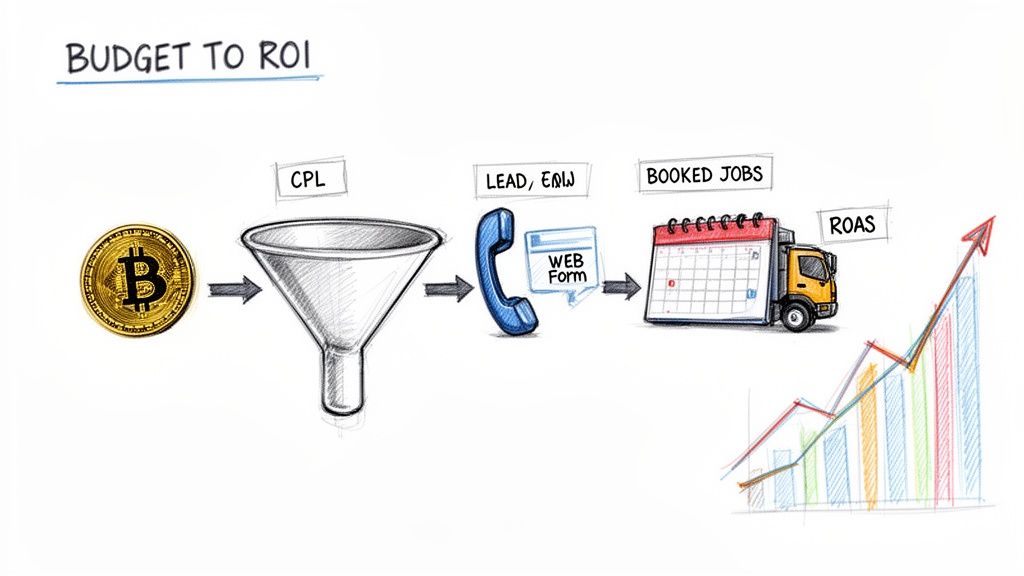
Throwing money at ads is easy. The hard part? Knowing if that cash is actually turning into paying customers and a healthier bottom line. If you're not tracking your advertising spend against real-world results, you're just guessing.
Let's start with your budget. It shouldn't be a number you just pull out of thin air. Tie it directly to your business goals. For most pest control companies, a good rule of thumb is to allocate 5-10% of revenue to your marketing efforts.
Are you trying to aggressively expand into a new town or launch a new service line? You'll need to be more assertive. In that case, pushing your budget up to 12-15% can give you the momentum needed to make a splash.
Tracking the Metrics That Actually Matter
It’s tempting to get caught up in metrics like clicks and impressions. They look good on a report, but they don't tell you much about your business's health. To see what's really working, you need to laser-focus on two key performance indicators (KPIs).
-
Cost Per Lead (CPL): This is your total ad spend divided by the number of actual leads you got (phone calls, form fills, etc.). Your CPL shows you how efficiently each channel is generating opportunities. Is Google Ads bringing in leads for $50 while Facebook is costing you $150? That's what CPL tells you.
-
Return on Ad Spend (ROAS): This is the big one—the ultimate measure of profitability. It shows you exactly how much revenue you’re making for every single dollar you spend on ads.
Learning to calculate Return on Ad Spend (ROAS) is non-negotiable. This is the metric that tells you, without a doubt, whether you should pour more fuel on a campaign or cut it loose.
Key Takeaway: A low CPL and a high ROAS are your north stars. If you’re spending $40 to get a lead from Google Ads and that lead turns into a $400 termite job, your ROAS is an incredible 10:1. That’s a loud and clear signal to double down on what’s working.
Building a System for Success
To get these numbers, you absolutely must have conversion tracking set up correctly. This means getting small snippets of code (pixels or tags) onto your website to monitor what people do after they click your ad. Did they fill out your "Free Inspection" form? Did they click the "Call Now" button on their phone?
Without proper tracking, you're flying completely blind. You can't tell which ads are bringing in the money and which are just burning through your budget.
The pest control industry is booming, with projections showing it could hit USD 32.8 billion globally by 2028. That kind of growth attracts a ton of competition. Having a sharp, data-driven approach to your budget and ROI isn't just a good idea anymore—it's essential for survival and growth.
Turning Hot Leads Into Booked Appointments
Let's be blunt. All your hard work—the killer ad copy, the perfectly optimized landing page, the carefully planned budget—goes straight down the drain if the phone rings and hits voicemail. Getting a hot lead is only half the job. The real money is made the second a potential customer reaches out, and your single greatest advantage is speed.
When someone finds a mouse in their kitchen or a wasp nest by their door, they’re not casually browsing for solutions. They want that problem gone, and they're looking for the first competent professional who can make it happen. Industry data consistently shows that 35-50% of sales go to the very first business that responds.
If you're not the one answering that call, you're not just losing a lead. You're literally handing a paying customer, and the money you spent to get them, directly to your competitor down the street.
The High Cost of a Missed Call
Think about it this way: every unanswered ring is a direct punch to your return on ad spend. You paid for that click. You paid for that call. Letting it go to voicemail is like setting that cash on fire.
The customer isn’t going to leave a message and patiently wait. They're just going to hang up and call the next name on the Google results page. This is exactly where so many pest control businesses leak profit without even knowing it. They pour money into getting the phone to ring but have a leaky bucket when it comes to actually catching the calls.
A missed call isn't just a missed opportunity; it's a paid advertisement for your competition. That customer is ready to buy right now, and the first company to offer a solution wins. Period.
Building an Airtight Lead Capture System
To stop throwing your ad money away, you need a bulletproof process for handling every single inquiry, whether it's a phone call or a form fill on your website. Relying on yourself or your techs to grab calls between jobs just isn't going to cut it. It’s not a real strategy.
Here’s how you build a system that actually converts leads into jobs.
-
Bring in a Professional Answering Service: Partnering with a 24/7 answering service is a great first step. It guarantees a live, professional human answers every call, even at 10 PM on a Saturday when a raccoon gets stuck in someone's chimney. They can screen the call, gather the essential info, and reassure the customer that help is on the way.
-
Hire Dedicated Remote CSRs: For a more powerful, integrated approach, a remote Customer Service Representative (CSR) is a total game-changer. A trained CSR from a service like Phone Staffer isn't just a message-taker. They can plug directly into your scheduling software and book the appointment right on that first call. The lead goes from problem to booked job in one conversation.
-
Attack Web Forms Immediately: Leads from your website's contact form are just as hot. As soon as someone hits "submit," they should get an automated text and email confirming you received their request. More importantly, your internal process should ensure a real person calls them back within five minutes. The chances of converting a lead plummet after that tiny window closes.
This kind of disciplined follow-up turns your advertising from a game of chance into a predictable revenue machine. When you ensure every single lead is handled with speed and professionalism, you squeeze every last drop of value out of your ad spend and build a reputation for being the most reliable pest control company in town.
Common Questions About Pest Control Advertising
Stepping into the world of advertising can feel overwhelming. How much should you spend? Where should you spend it? Are Google Ads better than SEO? It's a lot to sort through. Let's break down some of the most common questions I hear from pest control owners and get you some clear, practical answers.
First, let's look at the goal of all this. Your ads make the phone ring, but what happens next is what really counts.
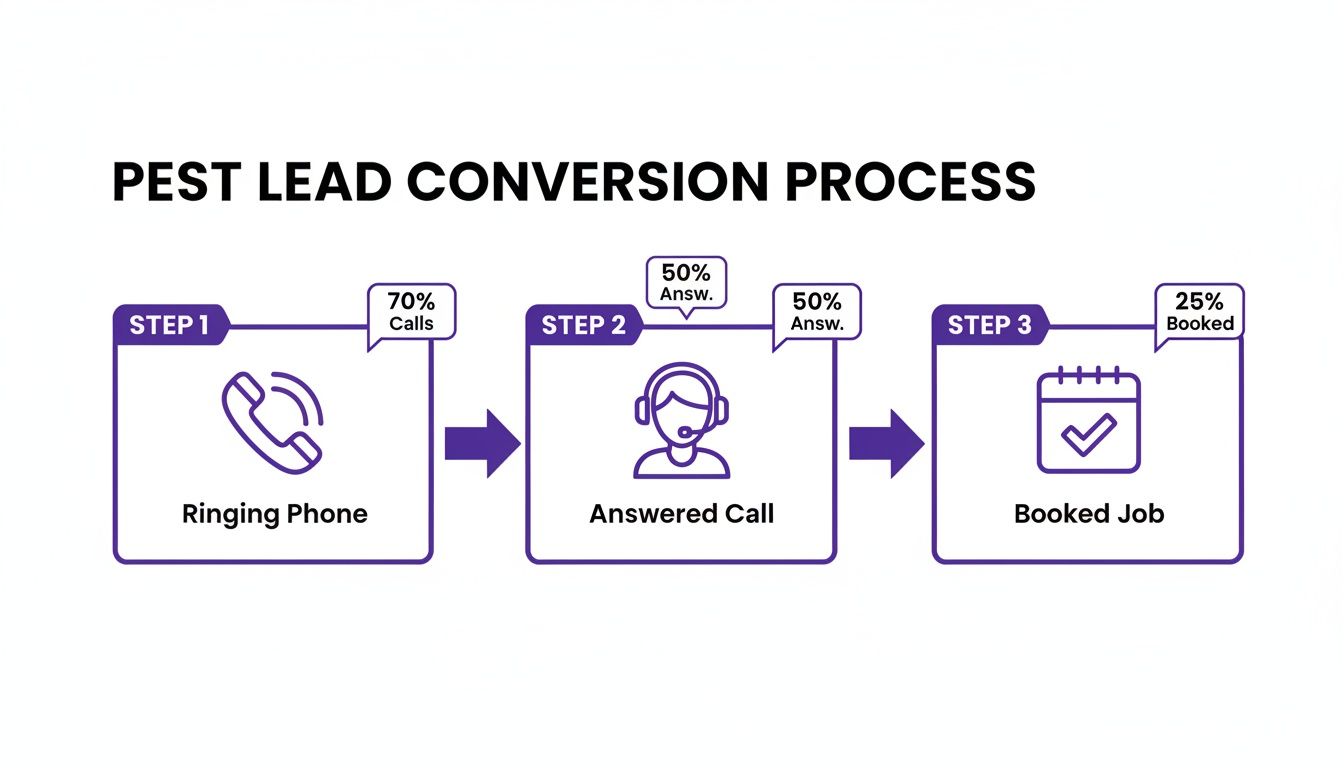
That middle step—actually answering the call—is where most marketing efforts either succeed or fail. It’s the critical link between a lead and a paying customer.
How Much Should a Pest Control Company Spend on Advertising?
There’s no magic number, but a solid rule of thumb is to dedicate 5-10% of your total revenue to your marketing budget. If you're really looking to expand and grab market share from competitors, you might need to push that closer to 10-15%.
The key is to stop thinking of it as a "cost" and start seeing it as an investment. Begin with a budget that doesn't make you lose sleep at night, but track your results relentlessly. Pay close attention to your Cost Per Acquisition (CPA). Once you know it costs you, say, $50 in ad spend to land a $500 job, you can pour more money into your campaigns with confidence.
Are Google Ads or SEO Better for Pest Control?
This isn't an either/or situation. The most successful companies use both because they solve two very different problems. Think of it like a one-two punch.
-
Google Ads is your sprinter. It gets you immediate results for those "I need help NOW" situations, like a homeowner searching for "emergency rat removal near me." You pay to play, but your phone can start ringing the same day you launch your ads.
-
SEO is your marathon runner. It’s all about building a powerful, long-term presence. Good SEO earns you free, organic traffic over time, establishing your company as the local authority. This creates a sustainable pipeline of leads that actually gets cheaper and more effective the longer you do it.
The winning strategy? Use both. Let Google Ads bring in the cash flow you need today while you steadily invest in SEO to dominate local search for years to come.
Can You Really Get Pest Control Leads from Facebook?
You absolutely can, but you have to use it correctly. Nobody wakes up with a termite problem and immediately scrolls through their Facebook feed to find a solution. That’s what Google is for.
Facebook is where you build your brand and create future demand, not capture existing urgent demand.
Think of it this way: Facebook is for staying top-of-mind. You can run highly targeted ads to new homeowners in your zip codes, promote a seasonal mosquito treatment right before summer, or share useful content that positions you as the friendly local expert. When they eventually do have a pest problem, your company is the first one they think of.
Answering the phone is the single most critical step in turning your ad spend into actual revenue. At Phone Staffer, we provide trained, remote CSRs who answer every call, follow up on every web form, and book jobs right into your calendar. Stop letting good leads go to your voicemail. See how we can help at https://phonestaffer.com.