

That sinking feeling you get when your phone rings while you're elbow-deep in a job? That's the sound of money walking out the door. For busy home service owners, appointment setting companies are the answer. They act as your professional frontline, making sure every single lead gets captured, qualified, and booked.
They turn those potential losses into actual, scheduled jobs.
Is It Time to Hire an Appointment Setting Company?
Look, deciding to outsource isn't about being lazy. It’s a strategic play to get your time back and stop revenue from slipping through the cracks. It's so easy to tell yourself you're just "too busy" to get help. But is that busyness actually productive, or is it just creating a bottleneck that’s killing your growth?
When your best HVAC tech is stuck on the phone scheduling a routine tune-up instead of finishing a $10,000 system installation, you have a problem. That's a serious drag on your operations.
The same goes for that pile of unread web form submissions in your inbox. That’s not just a messy to-do list; it represents real customers who got tired of waiting and have already called your competitor. A delay of just a few hours in following up can tank your conversion rates. The breaking point usually comes when you finally admit you can't personally answer every call and still run the business.
Key Signs Your Business Is Ready
The first step is just recognizing the symptoms. If any of these sound painfully familiar, it’s a pretty strong signal that you could use some professional help.
- Inconsistent Follow-Up: Leads from your website or Facebook ads are sitting for hours—or even days—before anyone reaches out.
- High Rate of Missed Calls: Your voicemail is always full. You know for a fact you're losing calls during the morning rush and late afternoons.
- Technicians Handling Scheduling: Your highly-paid, skilled techs are pulled off revenue-generating jobs to play dispatcher and book appointments.
- Poor Lead Qualification: You or your team waste time and gas driving out to a job only to find out the lead wasn't a good fit in the first place.
The real value of an appointment setting service isn't just about booking calls. It’s about putting a system in place that guarantees a fast, professional response to every single prospect, building a reliable pipeline you can count on.
Diagnosing Your Lead Handling Process
Let’s be honest for a second. Take a hard look at how you handle leads right now. Do you actually have a dedicated person whose only job is to answer every single call during business hours? A skilled home service receptionist can be the difference between a booked job and a lost lead. It’s that simple. When a potential customer calls, they expect a human to pick up the phone, not your voicemail.
When you bring in a specialized team, you're not just hiring people to answer the phone. You're investing in a proven process built to squeeze every last drop of value out of your marketing dollars and make your company look good. It frees you up to focus on what you do best—delivering great service—while they make sure your calendar stays packed.
How to Vet and Select the Right Partner
Picking an appointment setting company isn't just about outsourcing a task; it's like hiring a key employee who becomes the first voice of your brand. The right partner feels like an extension of your own team. The wrong one? They can sour a customer's experience before your technicians even have a chance to do their great work.
You have to look past the slick sales pitches and get a real feel for how their agents will sound on the phone. Will they represent your company with confidence and care, or will they sound like they're reading a generic script from a call center a thousand miles away?
Getting this right is a game-changer. One study found that a staggering 65% of businesses rated their outsourced appointment setting as effective. That's a huge leap from the 16% who felt the same about their in-house efforts. Even better, 55% of the appointments these specialized firms book actually move forward to the next stage in the sales process. You can dig into more of this data in BAO's post about the state of appointment setting.
When you're constantly swamped, the path forward becomes pretty clear. It's less a question of if you need help, and more a question of what kind of help you need.
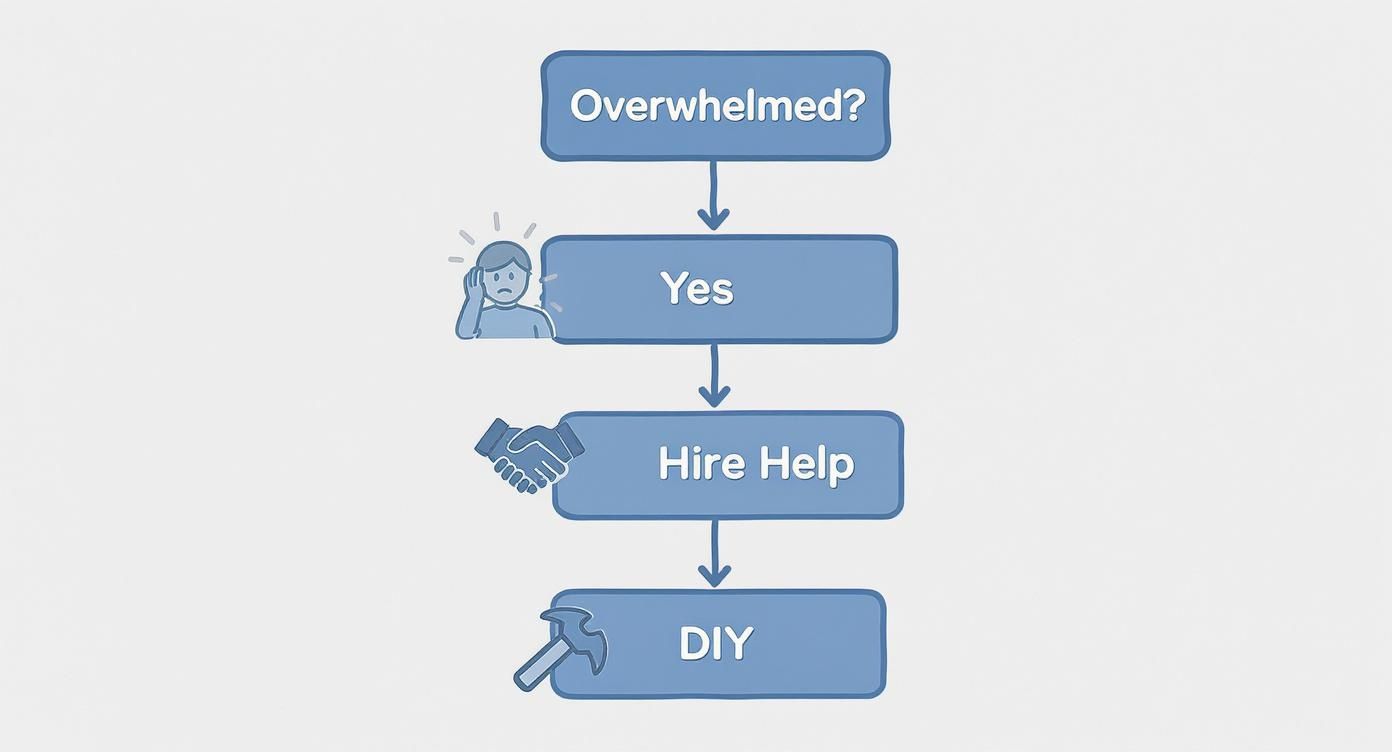
This simple chart really nails it. Admitting you're overwhelmed is the first step. From there, you can decide whether to go all-in with a full-service partner or start with a more focused virtual assistant role.
Look for Home Service Experience
This one's a dealbreaker. An agent who spends their days booking software demos just won't get the urgency of a homeowner with a burst pipe. They won't know the difference between an HVAC tune-up and a no-cool emergency. You need a partner whose team already speaks the language of home services.
When you're talking to potential companies, press them on their experience with businesses like yours.
- Ask for case studies. Don't just take their word for it. Ask for specific examples of their work with other plumbing, HVAC, or electrical contractors.
- Request sample call recordings. This is the ultimate litmus test. Hearing how they handle a real call for another home service business tells you everything you need to know.
- Drill down on their training. How do they get agents up to speed on the difference between a routine maintenance call and a critical service request?
Vet Their Agents and Training Process
The quality of their agents directly translates to the quality of your customer interactions, so don’t be afraid to get into the weeds here. A solid training program is the bedrock of a good partnership. Many of the principles for finding great remote staff are universal, whether you're hiring a VA or vetting a whole company. Our guide on how to hire a virtual assistant covers these fundamentals in detail.
A great appointment setting partner doesn’t just hire people who can talk; they hire people who can listen. They train for empathy, problem-solving, and the ability to represent your brand's values on every call.
Ask them some pointed questions about how they operate:
- Hiring Criteria: What are the top three things you look for when recruiting agents specifically for a home service account?
- Onboarding: Walk me through what a new agent's first week of training looks like when they're assigned to my business.
- Quality Assurance: How do you monitor calls, give agents feedback, and make sure the quality stays high six months from now?
This kind of scrutiny helps you find a partner who truly invests in their people. That investment pays dividends for you in the form of happier customers and more booked jobs.
Breaking Down Pricing and Calculating Your True ROI
Cost is always a huge factor, but if you're only looking at the price tag, you're missing the point. The real question is about value. When you find the right appointment setting companies, you’re not just adding another expense to your books; you’re making an investment that should directly generate more revenue.
To figure out if it’s a smart investment for your business, you first have to get a handle on the different ways these services charge. Most of them stick to one of a few common pricing structures, and each has its own upsides and downsides for a home service company like yours.
Common Pricing Models
You're almost certain to run into one of these three options. Getting familiar with them will help you match the cost structure to your company's cash flow and growth plans.
- Monthly Retainer: This is just a flat fee you pay every month for a dedicated agent or a block of hours. It’s predictable, which makes budgeting a breeze. This model is a great fit if you have a pretty steady stream of leads coming in and need someone consistently there to handle them.
- Pay-Per-Appointment: This one’s simple: you only pay when they successfully book a qualified appointment for your team. It’s a performance-based model, which feels a lot less risky when you're starting out. The catch? The cost per appointment is usually higher to make it worthwhile for them.
- Hybrid Model: Just like it sounds, this is a mix of the two—a smaller monthly retainer plus a lower fee for each appointment they book. This setup strikes a nice balance, giving you some cost stability while still motivating the company to keep your calendar full.
The best model for you really depends on where your business is at. A pay-per-appointment plan can be a fantastic way to test the waters with a new service. But once you have a lead generation system that's working, a monthly retainer is often better for scaling up.
Calculating Your Potential Return on Investment
Beyond the pricing structure, the most critical number you need to figure out is your potential ROI. You’ve got to see exactly how this service is going to make you money, not just cost you money.
It’s actually simpler than it sounds.
Start with your average ticket value. Let’s say you run an HVAC company and your average service call brings in $350. Next, you need your closing rate—what percentage of the qualified appointments you run actually turn into paying jobs? If you land 60% of them, you’ve got your magic numbers.
Now, let's connect that to what you're paying. If a service charges $50 per booked appointment, the math is pretty clear. For every 10 appointments they book for you, your cost is $500. Out of those 10 appointments, you can expect to close 6 jobs. At $350 a pop, that's $2,100 in new revenue from a $500 investment. That's a 4.2x return.
To get a really precise look at your numbers, a good customer acquisition cost (CAC) calculator can help you understand the true investment behind every customer you win.
And a return like that isn't unusual. Industry data often shows home service businesses hitting a 3x to 5x ROI within the first 90 days of working with a solid partner. When you focus on your own numbers, you quickly see how an appointment setting service stops being an expense and starts becoming a profit-driving part of your business.
How to Onboard Your New Team for a Seamless Handoff
The goal is pretty straightforward: you want your new appointment setters to sound like they've been working in your office for years, not like they just read a manual yesterday. A clumsy or rushed handoff is the quickest way to create a terrible first impression on a potential customer.
That's why a solid onboarding process isn't just a "nice-to-have." It’s the very foundation of a successful partnership with any of the top appointment setting companies.

This process makes sure the agents don't just know what to say, but why they're saying it. They need to get a real feel for your company’s personality, what makes you special in your market, and the exact problems your customers are trying to solve.
Put Together a "Brand Bible"
Think of this as the ultimate cheat sheet for your business. It’s a single, go-to document that gives the outsourced team everything they need to represent you confidently and accurately. This simple tool eliminates guesswork and empowers them to handle calls like a seasoned pro.
Here's what your Brand Bible should cover:
- Company Tone and Voice: Are you all business or more friendly and casual? Be specific. For instance, "We always say 'no problem' instead of 'you're welcome'."
- Your Unique Selling Points: What makes you the obvious choice? Is it your 24/7 emergency service, your money-back guarantee, or the fact you’ve been family-owned for three generations?
- Answers to FAQs: Get ahead of the curve by documenting clear answers to the questions you hear all the time about pricing, service areas, warranties, and technician qualifications.
- How to Handle Objections: Give them proven responses for common pushback like, "That sounds a little expensive," or "I need to check with my spouse first."
Develop Practical Script Frameworks, Not Rigid Scripts
Nobody wants to talk to a robot. That’s why static, word-for-word scripts often backfire. Instead, build flexible frameworks that guide the conversation without sounding stiff.
A customer calling about a burst pipe needs a totally different approach than someone scheduling a routine HVAC tune-up. Your scripts have to account for that.
For an emergency leak, the script should prioritize getting the critical info—name, address, and the nature of the emergency—right away. A maintenance call, on the other hand, allows for a more relaxed, conversational tone where the agent can build rapport and maybe even mention your service plan. This is all about asking the right discovery questions, a skill we dive into in our guide on questions for hiring a virtual assistant.
The best scripts don't just tell agents what to say. They teach them how to listen for keywords and customer emotions, giving them the confidence to adapt the conversation on the fly.
Securely Share Access to Your Tools
To do their job, your new partner needs to get into your systems. This usually means setting up a dedicated user profile with limited permissions in your CRM or scheduling software.
One of the most valuable things these teams can do is set up automated text message reminders to drastically cut down on no-shows. Getting them access to these tools is a critical part of the integration.
It’s also important to remember that technology has totally changed the game. The best firms now blend human agents with smart AI tools that can analyze calls, automate follow-ups, and even handle scheduling. Their chatbots can engage potential customers 24/7, capturing leads long after you’ve closed for the day. Making this tech work requires clear communication and secure access right from the start.
Tracking Performance With Metrics That Actually Matter
When you first bring on an appointment setting company, it’s exciting to watch the new bookings roll in. Your calendar starts looking fuller, and it feels like a big win. But the real test isn't just about a busy schedule; it's about whether those appointments are actually making you money.
You have to look beyond the raw number of bookings and dig into the metrics that show you what's really happening. A simple dashboard or a weekly report is non-negotiable. It’s what keeps you and your partner honest and lets you make decisions based on cold, hard data instead of just a gut feeling.

When you have the right numbers in front of you, your weekly meetings become incredibly productive. You're not just getting a status update; you're spotting trends, fixing small problems before they become big ones, and fine-tuning your entire process for better results.
Key Performance Indicators to Watch
To get a clear picture of how things are going, you need to zero in on a few core KPIs. These are the numbers that tell you the real story of how well your outsourced team is turning phone calls into profitable work.
Here are the metrics I live by:
- Call-to-Booking Conversion Rate: This is the big one. It directly answers the question, "For every qualified lead they talk to, how many actually get on the schedule?" If this number is low, it’s a red flag that something might be off with the scripts or agent training.
- Lead Source Tracking Accuracy: You need to know where your best customers are coming from. Are they finding you on Google? A Facebook ad? A referral from a neighbor? Your agents must be accurately tagging every single call. This data is pure gold for deciding where to spend your marketing dollars.
- Average Job Value from Booked Appointments: Are the agents booking high-ticket installs or small-fry repair jobs? Tracking the average revenue per booked appointment tells you if the service is attracting the kind of work that truly moves the needle for your business.
- Show-Up Rate: A booked appointment means nothing if your tech shows up to an empty house. This metric, sometimes called a "stick rate," tells you how solid the appointments are and how well the confirmation process is working.
Running Efficient Weekly Check-ins
Your weekly meeting with the appointment setting company needs to be more than just reading off a spreadsheet. Think of it as a focused, 30-minute strategy session where you work together to improve.
The point of a check-in isn't to point fingers; it's to find opportunities. Use the data to start a conversation. For example, you could say, "Hey, I noticed our booking rate for web form leads dropped by 10% this week. Can we pull a few of those call recordings and listen together to see what's going on?"
Show up to that meeting prepared. Have your KPIs ready and be ready to share feedback from your side of the operation. Maybe your technicians mentioned that the notes on a few jobs were a little thin last week. Sharing that creates a tight feedback loop, allowing the agency to make quick adjustments and ensure their team is consistently booking the kind of jobs that help you grow.
Got Questions About Outsourcing Your Calls? You're Not Alone.
Taking the leap to outsource something as vital as your front line of customer contact can feel daunting. I get it. It’s natural to have a few questions before you hand over the phone lines. Let's walk through some of the most common concerns I hear from business owners just like you.
Lots of owners worry about losing control, especially over how their company comes across to a potential customer. That's not just a valid concern; it's one you absolutely need to address head-on with any potential partner.
"How Much Say Do I Get in the Scripts?"
You should have 100% control. Period.
The best appointment-setting services don't just hand you a cookie-cutter script. They should be working with you to build one from the ground up that sounds exactly like your brand. Think of them as collaborators, not just a vendor you hired.
It's standard practice for you to approve every single word of the initial scripts. But a truly great partner goes further—they'll have a rock-solid process for you to give feedback and make changes based on what your techs are reporting from the field or what you're seeing in your booking rates.
Your scripts should be living documents. A top-notch partner will even bring ideas to you, suggesting small tweaks based on what their agents are hearing on the calls. But at the end of the day, the final word is always yours. That's how you make sure your company's personality shines through on every call.
"Should I Hire a VA or Go With a Company?"
This one really boils down to your call volume and how much you can risk a missed call.
A virtual assistant (VA) can be a fantastic, budget-friendly option, especially if your lead flow is fairly steady and predictable. They can become deeply integrated into your business and feel like a true extension of your in-house team.
But a dedicated company brings a level of scale and reliability that a single person just can't match. You get a managed team, which means you're never scrambling to cover a shift because someone is sick, on vacation, or quits unexpectedly. That built-in backup is a massive stress reliever. On top of that, these companies live and breathe this stuff—they provide specialized training and management focused on one thing: booking solid appointments for home service businesses.
"How Do They Even Connect to My Scheduling Software?"
This is one of the easiest parts of the whole process, believe it or not. Any reputable firm in this space is already an expert with the major platforms like ServiceTitan, Jobber, or Housecall Pro. They’ve done this setup a hundred times.
Typically, it’s as simple as creating a new user login for them with very specific, limited permissions. This lets their agents see your schedule and book jobs directly into your system without ever having access to sensitive financial reports or customer payment information.
Make sure you ask them about their experience with your specific software during the interview process. It’s also smart to ask to see their data security protocols. Getting this sorted out from the beginning ensures everything runs smoothly and securely right from the get-go.
Ready to stop missing calls and start booking more profitable jobs? The team at Phone Staffer can provide you with expertly trained, US-based virtual receptionists who know the home service industry. Learn how we can fill your calendar and grow your business.