
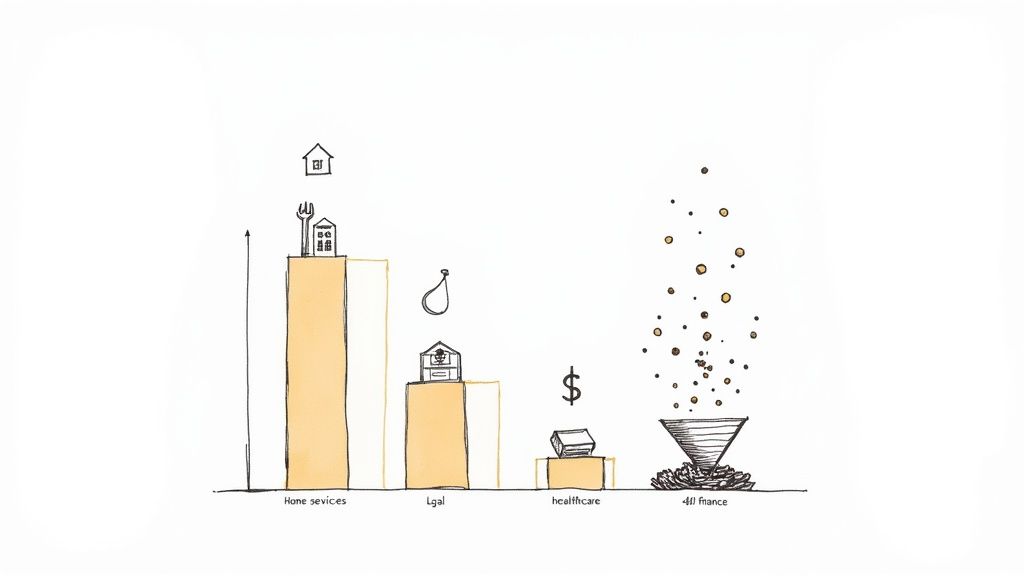
You'll see a wild swing in the average cost per lead by industry—it can be as low as $31 for non-profits or soar past $650 for legal services. For home service businesses like HVAC, plumbing, or roofing, the CPL usually settles into a more moderate range, typically between $25 and $75. Knowing where you fall on that spectrum is the first step toward getting your marketing spend right.
Why Your Cost Per Lead Matters
Think of your Cost Per Lead (CPL) as the price you pay to get a potential customer to raise their hand. It's a straightforward calculation: take your total marketing spend for a campaign and divide it by the number of new leads you got from it.
But knowing your CPL isn't just a number-crunching exercise. It's about making smarter financial decisions that fuel your growth. Understanding what's "normal" for your industry gives you a baseline to set realistic budgets and figure out if your marketing is actually working.
This guide will go beyond the generic averages. We'll dig into why a lead in one industry can cost ten times more than in another, and more importantly, what levers you can pull to get your own costs in line.
Setting Realistic Expectations
CPL numbers without context can be dangerous. A high CPL isn't automatically a red flag, just as a low CPL doesn't guarantee success. The real goal is to strike a profitable balance where the money you spend to get a customer is a fraction of the revenue they bring in.
A “good” cost per lead means your acquisition cost is significantly lower than the revenue that the lead will generate. The ultimate goal isn't just a low CPL, but a high return on investment (ROI) from every marketing dollar spent.
To get a true sense of how your own CPL stacks up, you need to compare it to reliable industry data, like these Google Ads industry benchmarks. This kind of data gives you an objective yardstick to measure whether your campaigns are on track, overperforming, or costing you too much.
To show you just how much CPLs can vary, here's a quick snapshot of what businesses in different sectors are paying.
Average Cost Per Lead At A Glance
This table gives you a quick look at the typical CPL ranges across several key industries. It’s a great starting point for understanding where your own business fits into the bigger picture.
| Industry | Average CPL Range |
|---|---|
| Home Services (Plumbing, HVAC) | $25 – $75 |
| Retail | $30 – $40 |
| Education | $50 – $65 |
| Healthcare | $160 – $170 |
| Technology | $200 – $215 |
| Finance | $155 – $165 |
| Legal Services | $320 – $784 |
As you can see, the differences are massive. A home service company paying $60 for a lead is likely in a good spot. But for a competitive law firm, a $350 lead might be considered a bargain. Throughout this guide, we'll break down the reasons for these numbers and what you can do about yours.
Breaking Down Lead Costs Across Key Industries
It can be a real head-scratcher when you first look at lead costs across different industries. Why can a plumbing company get a new lead for around $50, while a law firm might have to shell out $650 or more for just one?
The answer isn't random; it all comes down to the core economics of each business. It’s about the potential dollar value that a single lead can bring in.
Think of it this way: a lead is an investment, not just an expense. What you’re willing to pay is tied directly to what you expect to get back. For a home service pro, a new lead could become a $500 repair job or even a $10,000 roof replacement. But for a lawyer, that one lead could turn into a legal case worth hundreds of thousands.
That simple difference in potential return completely changes the game for marketing and advertising, which is what really drives up the cost.
High-Value Leads Mean High-Stakes Competition
Industries where a single customer is worth a lot of money—what we call high customer lifetime value (LTV)—are always going to be hyper-competitive. Think about sectors like legal services, finance, and high-end software. They deal in high-value, low-volume sales, so they can justify spending a ton to land a single new client because the payoff is so huge.
The legal field is a perfect example. The average cost per lead for lawyers is one of the highest out there, often landing somewhere between $320 and $784. Some reports put the average at a staggering $650, with paid search ads driving costs as high as $784 because firms are bidding fiercely on keywords like 'personal injury lawyer.' You can explore more B2B benchmark insights to see how these costs change by channel.
This chart really puts the CPL difference into perspective.
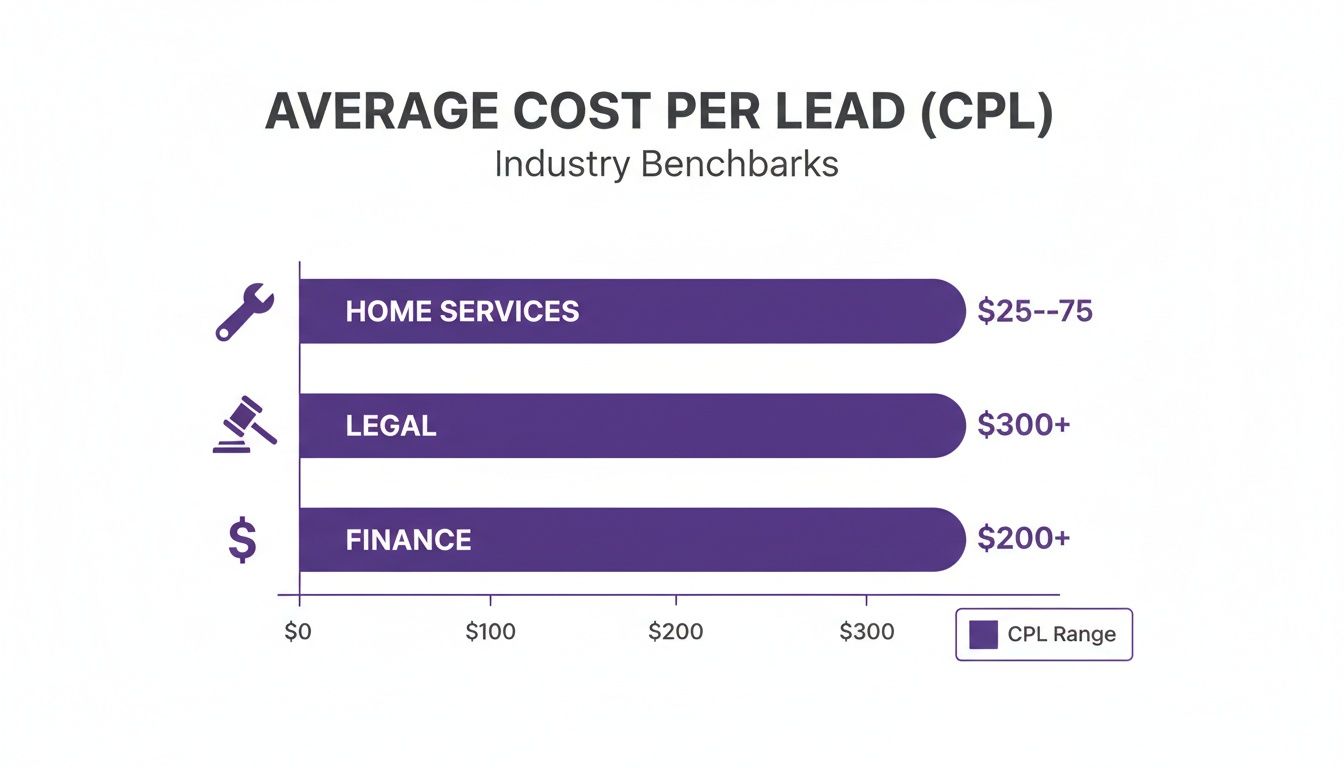
As you can see, home service businesses operate in a much more reasonable lead-cost environment compared to the sky-high prices in legal and finance.
Detailed CPL Comparison: Home Services vs Other Industries
To see the numbers side-by-side, it helps to break them down by the source of the lead—whether it came from a paid ad or from organic marketing efforts like SEO.
| Industry | Paid Channel CPL (e.g., Google Ads) | Organic Channel CPL (e.g., SEO) | Blended Average CPL |
|---|---|---|---|
| Home Services | $40 – $150 | $10 – $40 | $25 – $75 |
| Legal | $300 – $784+ | $100 – $300 | $320 – $650 |
| Finance | $200 – $500+ | $50 – $150 | $150 – $400 |
| Healthcare | $150 – $400+ | $40 – $120 | $100 – $300 |
This comparison highlights just how cost-effective the home services sector is, especially when you focus on organic channels that deliver high-quality leads for a fraction of the cost of paid ads.
Home Services: Finding The Sweet Spot
If you run an HVAC, plumbing, or landscaping company, your business model is built on volume. You aren't closing one massive deal a year; you're serving hundreds, maybe thousands, of customers.
That’s why your CPL "sweet spot"—usually between $25 and $75—makes perfect sense. It's a price that keeps your profit margins healthy on typical jobs while still letting you compete for attention. The goal isn't to spend a fortune on one lead. It's to create a reliable system that brings in a steady stream of affordable leads that you can turn into profitable work.
The key takeaway is this: Your industry’s CPL is shaped by market forces, not arbitrary numbers. It's a direct reflection of what your competitors are willing and able to pay based on the potential revenue a new customer represents.
Once you understand this, you can set realistic marketing budgets and stop worrying about why your $50 plumbing lead costs so much less than a $500 financial services lead. You're playing two completely different games with different rules.
Why The Length Of The Sales Cycle Matters
There's one more piece to this puzzle: the sales cycle. How long does it take to turn a lead into a paying customer? The longer it takes, the more time and money you sink into follow-ups and nurturing, which quietly drives up your real acquisition cost.
Just look at these two scenarios:
- An Emergency Plumbing Lead: A homeowner's pipe just burst. They need someone now. The sales cycle here is just a few minutes long. They call, you give a price, and you send a truck. The journey from lead to revenue is incredibly fast.
- A Corporate Legal Lead: A company searching for a law firm might take months to decide. The process will involve multiple meetings, detailed proposals, and back-and-forth negotiations. That long sales cycle demands a much bigger investment to keep the lead warm and eventually close the deal.
Because so many home service leads are driven by urgent needs, the sales cycle is naturally short. That urgency means there's less risk of the lead going cold, which allows for a lower, more efficient CPL. Your marketing dollars pay off faster, and you can reinvest that money right back into getting the next lead. It's a huge advantage that keeps lead costs in our industry relatively low and predictable.
The Key Factors That Influence Your Cost Per Lead
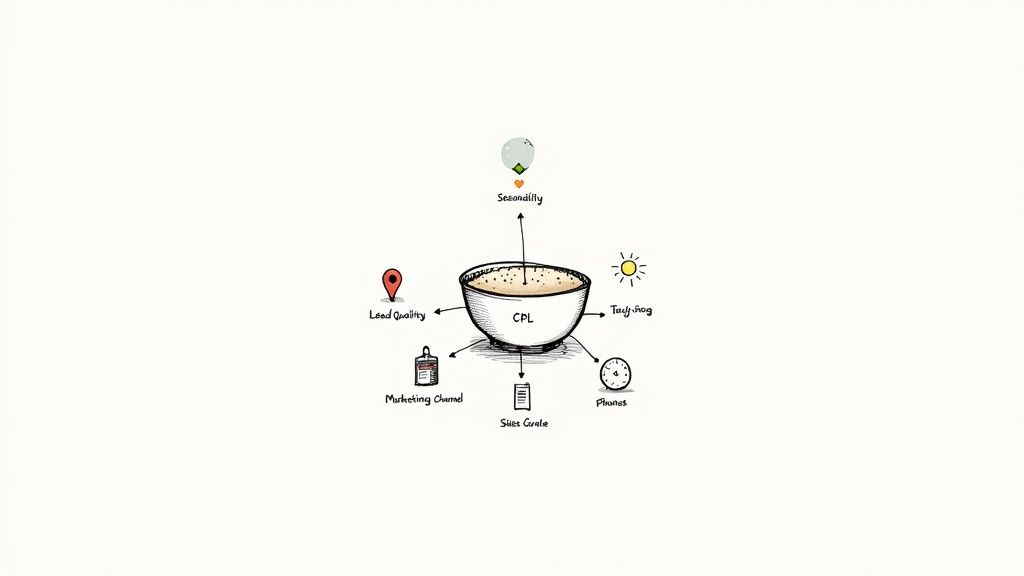
If you've ever looked at your marketing reports and wondered why your CPL bounces around so much, you're not alone. The reality is that Cost Per Lead is a moving target, not a fixed price. It's influenced by a handful of powerful variables that can send it soaring or bring it back down to earth.
Think of it like this: knowing the average cost per lead by industry is a good starting point, but it's just a landmark. To really get a handle on your own marketing spend, you need to understand the levers you can actually pull. Let's break down what's really driving your costs.
Marketing Channel: The Cost of Attention
Where you choose to find your customers is probably the single biggest factor determining your lead cost. Every marketing channel is like a different fishing spot—some are crowded and expensive, while others can deliver a great return if you know what you're doing.
-
Google Ads (PPC): This is the fast lane. You can get leads almost immediately, but you're paying a premium for that speed. You’re in a bidding war with every other competitor for valuable keywords like "emergency plumber near me," which naturally drives up the price.
-
SEO (Search Engine Optimization): SEO is the long game. It takes time and effort to build your website's authority and create helpful content. But once the engine gets going, it can deliver a steady flow of high-quality organic leads at a fraction of the cost of paid ads.
-
Social Media Ads: Platforms like Facebook let you reach a massive audience, but the leads are often "colder." They might not be actively looking for your service right now. The CPL can look tempting, but be prepared to put more work into nurturing these leads before they’re ready to book.
The key is to find the right blend. Relying solely on one channel is risky. A smart strategy combines the immediate results of paid ads with the sustainable, low-cost lead flow that comes from a solid, long-term SEO effort.
Geographic Location: Where You Work Matters
The cost of doing business is different everywhere, and that’s especially true for lead generation. A lead in a dense, competitive city will almost always cost more than a lead in a quieter suburb or rural area.
It all comes down to simple supply and demand. In major metro areas, you have more companies all bidding on the same keywords and advertising to the same pool of homeowners. This fierce competition jacks up the price. For example, a plumbing lead in New York City could easily cost 2-3x more than the exact same lead for a homeowner just a hundred miles away. Your service area sets the baseline for your CPL.
Seasonality: The Ebb and Flow of Demand
For any home service business, the calendar is a huge driver of lead costs. Demand for specific services spikes at different times of the year, and when demand goes up, so does the competition to capture those leads.
- HVAC: AC repair leads are a hot commodity during the first summer heatwave. On the flip side, furnace leads become gold during the first cold snap of winter.
- Landscaping: The phone starts ringing off the hook in the spring when people want to get their yards ready for summer, with another peak for fall cleanups.
- Roofing: Lead costs often jump right after a big hailstorm or windstorm rolls through, as homeowners scramble to get inspections and repairs.
Savvy business owners plan for this. They strategically increase their marketing budgets during peak season to capture the rush, and might shift their focus or scale back during the slower months. Understanding these natural cycles is crucial to making your marketing dollars work smarter all year round.
Actionable Strategies to Lower Your CPL
Knowing the average CPL in your industry is like having a map. It shows you where you are, but you still need to plot a course to a more profitable destination. The good news? You have more control over your CPL than you think. Lowering it isn't about a massive budget overhaul—it's about a smarter, more focused approach.
The real goal isn't just getting cheaper leads. It's about getting better leads for less money. This means plugging the leaks in your marketing funnel and making sure every single dollar you spend is working as hard as it possibly can. Let's walk through some of the most effective tactics you can put into action right away.
Sharpen Your Ad Targeting
Paying for clicks from people who will never become customers is one of the fastest ways to burn through your budget and inflate your CPL. When your ad targeting is vague, it's like casting a huge net in the middle of the ocean—you’ll catch a lot of stuff you don’t want. You need precision.
Instead of broad-stroke targeting, get granular. Platforms like Google Ads and Facebook have powerful tools that let you zero in on the specific demographics and locations that match your ideal customer profile.
- Geographic Targeting: Don't just target an entire city. Get specific. Narrow your ads down to the zip codes or even the neighborhoods where your best, most profitable customers live.
- Negative Keywords: This is a game-changer for a roofer. Add negative keywords like "free," "jobs," or "DIY" to your Google Ads campaigns. This simple trick stops your ads from showing up for people looking for a job or a how-to guide, saving you a fortune on wasted clicks.
Optimize Your Landing Pages for Conversion
You could have the most brilliant ad in the world, but if it sends people to a confusing, slow, or untrustworthy website, you’re just throwing money away. Your landing page has one job and one job only: convince the visitor to take that next step and become a lead.
Every single element on that page should be pushing them toward that one goal. Think of your landing page as your best digital salesperson—it needs to be clear, persuasive, and build instant trust.
A landing page isn't just another page on your website; it's a purpose-built conversion machine. Its sole focus should be to capture lead information by making a compelling offer and providing a simple way for the user to act on it.
To start getting more leads from the traffic you already have, make sure your landing pages include:
- A Clear, Bold Headline: It has to match the promise you made in your ad. No bait-and-switch.
- Visible Contact Information: Your phone number and a simple contact form should be impossible to miss.
- Social Proof: Nothing builds trust faster. Showcase customer reviews, testimonials, and industry awards right where people can see them.
- A Single, Obvious Call to Action (CTA): Use clear, action-oriented buttons like "Get a Free Estimate" or "Schedule Your Service Now."
Invest in Long-Term SEO
Paid ads get you traffic today, but Search Engine Optimization (SEO) is your engine for sustainable, low-cost leads tomorrow and beyond. Think of SEO as building an asset. It takes time, but the payoff is a steady stream of highly qualified people who are actively searching for the exact services you offer.
For any home service business, local SEO is especially powerful. A great place to start is by creating content that answers your customers' most urgent questions. For instance, a plumbing company could write a blog post on "5 Signs Your Water Heater is About to Fail." This attracts homeowners who already have a problem and are much closer to making a buying decision. If you want to go deeper on improving lead acquisition, you can explore these proven B2B lead generation strategies.
Test and Measure Everything
You can't improve what you don't measure. It's that simple. The only way to know for sure which of these strategies are actually lowering your CPL is to track your results relentlessly. Marketing isn't a "set it and forget it" activity; it's a science of continuous improvement.
Start by A/B testing different elements of your campaigns. This just means running two versions of an ad or landing page at the same time to see which one performs better. You can test almost anything:
- Ad Headlines: Does a headline that creates urgency get more clicks than one focused on saving money? Find out.
- Images: Does a real picture of your team outperform a generic stock photo? Probably.
- Button Colors: It sounds minor, but does a green "Submit" button convert better than a blue one? Test it.
Even small, seemingly minor changes can lead to huge improvements in your conversion rates, which directly drives down your cost per lead. By constantly testing and refining, you can systematically lower your acquisition costs while bringing in more and better leads.
The Hidden Costs Your CPL Report Doesn't Show
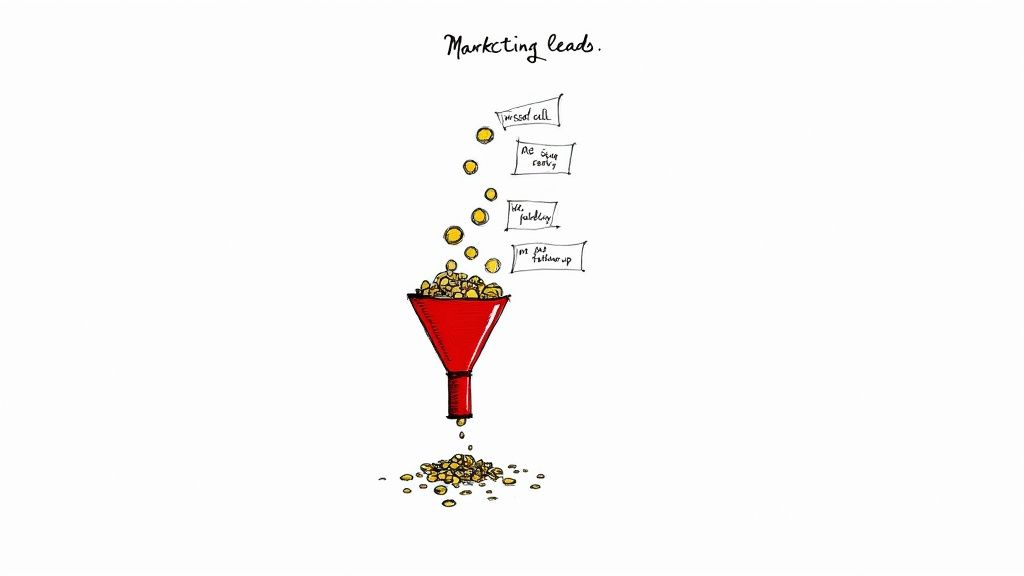
It’s easy to look at a Cost Per Lead report, see a low number, and feel like you've won the marketing game. You might see a $40 CPL and think your campaigns are firing on all cylinders. But that number only tells you the price of getting a potential customer to raise their hand—it says nothing about what happens next.
The reality is, your true cost to acquire a customer is almost always much higher than what your marketing dashboard shows. That initial CPL only tracks the ad spend. It completely ignores the operational hiccups and, more importantly, the cost of lost opportunities that happen when your follow-up process breaks down.
A great-looking CPL is dangerously misleading if those leads are left to wither on the vine. This is where hidden costs start piling up, quietly turning a smart marketing investment into wasted cash.
The Real Cost Of A Missed Call
Every time your phone rings with a new lead, a stopwatch starts. For a home service business, this is doubly true. A customer with a flooded basement or a dead furnace isn't going to leave a voicemail and patiently wait for you to call back. They're hanging up and immediately calling the next company on the list.
That $40 you spent to make the phone ring? Poof. It’s gone.
But the actual loss is much, much bigger. You didn’t just lose a lead; you lost the $500 repair job, the potential $5,000 system replacement, and every future referral that happy customer might have sent your way.
When a lead calls, they are at their absolute peak interest. If you fail to connect right then and there, you’ve not only paid for that lead but you’ve effectively paid to send a ready-to-buy customer straight to your competitor.
This operational gap—the failure to answer every single call—is what secretly torpedoes your CPL. If you miss half your calls, you have to spend twice as much on ads just to land the same number of jobs. Suddenly, your effective CPL for a booked appointment isn't $40; it's $80, $100, or even more.
Slow Follow-Up Is Just As Deadly
The same logic applies to web forms and online quote requests. A customer who takes the time to fill out a form on your website expects a quick response. The odds of actually converting that lead plummet with every minute that ticks by.
Think about these two all-too-common scenarios for a roofer:
- Company A: A homeowner submits a request for a roof inspection. The lead lands in an email inbox and sits there for six hours before anyone calls. By that time, the homeowner has already talked to two other roofers and booked an appointment.
- Company B: The same lead comes in. An automated text goes out instantly, and a team member calls within five minutes. They answer a few questions and get the inspection booked right on the spot.
Company B didn't spend a dollar more on marketing than Company A, but their operational speed turned that lead into a real, tangible opportunity. Company A, on the other hand, paid for a lead that was dead on arrival simply because they were too slow. Their real cost for that failure includes the marketing spend plus the payroll cost for making a pointless callback.
At the end of the day, your CPL report shows you the cost of an opportunity, not the cost of a customer. The gap between those two numbers is where your profit is either made or lost. Inefficient appointment setting, missed calls, and delayed follow-ups are the silent killers that inflate your true customer acquisition cost far beyond what any marketing report will ever tell you.
Turn More Leads Into Jobs By Fixing Your Follow-Up
Chasing a lower CPL by tweaking your ad campaigns is a great start, but it's only half the battle. You can spend a fortune generating leads, but all that effort goes down the drain if your follow-up process is slow, clunky, or just plain broken.
Profit doesn't happen when a lead form gets submitted. It happens when you capture that lead and turn it into a booked job. This is where your internal operations become your most powerful lever for lowering your real cost per lead.
A homeowner with a burst pipe or a dead AC unit in the middle of July isn’t going to wait. If they call and get voicemail, they're not leaving a message—they're already dialing the next name on the Google results page.
The True Cost of Inefficiency
Every missed call isn't just a lost lead; it's a customer you paid to acquire and then handed directly to your competition. This forces you to spend even more on marketing to replace them, effectively doubling or tripling your true cost to land a new customer.
Think of it this way: if you only manage to book one out of every four leads you generate, your actual cost for that single job is 400% higher than what your CPL report says.
The fastest way to grow your bottom line isn't always to spend more on ads. It’s to make sure every lead you’re already paying for has the best possible chance of becoming a customer.
From Lead to Booked Job Instantly
The solution is to build a system where no opportunity can slip through the cracks. It all comes down to mastering two critical moments that make or break your profitability.
-
24/7 Professional Answering: Problems don't care about business hours. Having a professional voice ready to answer every call—day, night, or weekend—means you capture those urgent, high-intent leads no matter when they come in.
-
Instant Appointment Booking: Speed is the name of the game. When you can answer a customer's questions and get them booked on the schedule in one smooth interaction, you eliminate their need to call anyone else.
Perfecting your follow-up is the key to sustainable growth. When you back every marketing dollar with an ironclad conversion process, you stop the bleeding and start turning more of those hard-earned leads into profitable jobs.
Your Top Cost Per Lead Questions, Answered
Getting a handle on your lead generation costs can feel like trying to nail Jell-O to a wall. You see the industry averages, but how do those numbers actually apply to your business? It's one thing to know the data, but it's another thing entirely to use it.
Let's break down some of the most common questions we hear from home service business owners about Cost Per Lead. We'll give you clear, no-nonsense answers you can put to work right away.
What’s a Good Cost Per Lead for a Small Home Service Business?
For most local home service businesses, a "good" CPL lands somewhere between $25 and $75. But honestly, that's just a starting point. The real answer depends entirely on your specific trade and local market.
The number you should really obsess over isn't just CPL—it's your Return on Ad Spend (ROAS). Think about it: if you pay $75 for a lead that turns into a $500 plumbing repair, you'll take that deal all day long. That's a fantastic CPL. The goal isn't just to get cheap leads; it's to get profitable ones. Start by tracking what you're spending now, then focus on bringing that cost down without sacrificing the quality of the lead.
How Do I Calculate My Own Cost Per Lead?
This part is refreshingly simple. To figure out your CPL, you just divide the total amount you spent on a marketing campaign by the number of new leads you got from it.
The formula looks like this: CPL = Total Marketing Cost / Total New Leads.
So, if you put $1,000 into a Google Ads campaign and it brought in 40 new customer inquiries, your CPL for that campaign is $25. It's that easy ($1,000 / 40 = $25). Just make sure you're only counting new, unique leads from that specific campaign to keep your numbers clean.
Besides Answering Calls, What Else Affects Lead Conversion?
Getting the phone answered quickly and professionally is a huge piece of the puzzle, but it’s not the whole game. Turning a lead into a booked job requires a smooth, trustworthy customer experience from the very first click to the final handshake.
The journey from a curious lead to a paying customer has a lot of steps. If you strengthen every single one, you build a conversion machine that gets the most out of every marketing dollar you spend. That’s how you lower your true cost to acquire a customer.
Here are a few other critical factors that can make or break your conversion rate:
- Follow-Up Speed: When a web form comes in, the clock is ticking. If you're not making contact in under five minutes, you're likely losing that job to a faster competitor.
- Professionalism: A sloppy, confusing quote or estimate screams "amateur." Clear, professional-looking documents build confidence and help close the deal.
- Online Reputation: What do your reviews say? Homeowners check. A string of positive reviews on Google and other sites provides instant social proof and builds trust before they even call you.
- Ease of Booking: Don't make potential customers jump through hoops. A simple, easy scheduling process gets them on your calendar with minimal friction.
Phone Staffer helps you nail that first, critical step. We capture and convert every lead with professional 24/7 call answering and instant appointment booking. Stop letting good leads and profitable jobs slip through the cracks.
See how we can help you turn more calls into customers at https://phonestaffer.com.