
In the competitive home service industry, excellent customer service isn't just a goal; it's a critical driver of growth. But how do you know if your team is truly delivering? Simply hoping for the best won't cut it. To build a loyal customer base and streamline operations, you must measure what matters. This guide dives deep into the essential customer service performance indicators that provide a clear roadmap to success. We'll go beyond simple definitions, offering specific formulas, industry benchmarks tailored for home service businesses, and actionable strategies to not only track these KPIs but significantly improve them.
We will explore a comprehensive list of metrics, including:
- Customer Satisfaction Score (CSAT)
- Net Promoter Score (NPS)
- First Call Resolution (FCR)
- Average Response Time
- Customer Effort Score (CES)
- Average Handle Time (AHT)
- Service Level Agreement (SLA) Compliance
- Customer Retention Rate
By the end of this article, you'll have a data-driven framework to evaluate your team's effectiveness, identify friction points, and turn your customer service from a cost center into a powerful profit engine. Let's explore the metrics that will define your success.
1. Customer Satisfaction Score (CSAT)
The Customer Satisfaction Score (CSAT) is one of the most direct and widely used customer service performance indicators. It measures a customer's satisfaction level with a specific interaction, service, or product. The metric is captured through a straightforward survey question, typically asking, "How satisfied were you with the service you received?"

Customers respond using a numbered scale, such as 1 to 5. A positive CSAT score is calculated by dividing the number of satisfied customers (those who answered 4 or 5) by the total number of responses and then multiplying by 100. For home service businesses, this means you can instantly gauge customer sentiment after a job is completed, from HVAC repairs to plumbing installations.
How to Implement CSAT Effectively
CSAT's strength lies in its simplicity and immediacy, providing a real-time pulse on your service quality. For example, after an electrician finishes a rewiring job, an automated SMS or email can be sent with a one-click CSAT survey.
- Calculation:
(Number of Satisfied Customers / Total Number of Survey Responses) x 100 = % CSAT Score - Best Practice: Aim to send the survey within an hour of service completion while the experience is still fresh in the customer's mind.
Pro Tip: Don't just collect scores. Pair the rating question with an open-ended follow-up like, "What did we do well, and where can we improve?" This provides invaluable qualitative context behind the numbers.
Actionable Tips for Home Service Businesses
To make CSAT a truly impactful metric, integrate it deeply into your operations.
- Segment Your Data: Analyze CSAT scores by technician, service type (e.g., emergency repair vs. routine maintenance), or geographic area. This helps pinpoint high-performers and identify specific areas needing improvement.
- Close the Loop: Establish a process to immediately follow up with customers who leave a low score (e.g., a 1 or 2). A personal call from a manager to understand the issue and offer a resolution can turn a negative experience into a positive one, a practice known as service recovery.
2. Net Promoter Score (NPS)
The Net Promoter Score (NPS) is a crucial customer service performance indicator that measures long-term customer loyalty and the likelihood of advocacy. It assesses this by asking a single, powerful question: "On a scale of 0 to 10, how likely are you to recommend our company/service to a friend or colleague?" This metric, popularized by Fred Reichheld of Bain & Company, helps businesses understand not just customer satisfaction, but their potential for word-of-mouth growth.
Based on their responses, customers are segmented into three categories: Detractors (0-6), Passives (7-8), and Promoters (9-10). The final score is calculated by subtracting the percentage of Detractors from the percentage of Promoters. For a home service business, this reveals how many of your clients are actively championing your brand versus how many might be discouraging others.
How to Implement NPS Effectively
NPS is powerful because it correlates directly with business growth; Promoters buy more, stay longer, and refer new customers. For instance, a landscaping company can send an NPS survey after a seasonal contract ends to gauge overall loyalty, rather than just satisfaction with a single visit.
- Calculation:
(% of Promoters) - (% of Detractors) = NPS Score - Best Practice: Send NPS surveys periodically, such as quarterly or semi-annually, to track trends over time rather than after every single interaction.
Pro Tip: Your Promoters are your biggest marketing asset. Create a formal process to ask them for online reviews, testimonials, or to participate in a referral program. This activates your most enthusiastic customers to drive new business.
Actionable Tips for Home Service Businesses
To leverage NPS for tangible improvements, you must act on the feedback from all three customer groups.
- Segment Your Analysis: Don't just look at the overall score. Analyze NPS by customer segment (e.g., new vs. repeat clients), service type (e.g., HVAC installation vs. plumbing repair), and even by technician to identify specific strengths and weaknesses.
- Create Action Plans: Develop distinct strategies for each group. Immediately contact Detractors to perform service recovery, engage with Passives to understand what it would take to turn them into Promoters, and empower your Promoters to become active advocates for your business.
3. First Call Resolution (FCR)
First Call Resolution (FCR) is a crucial metric among customer service performance indicators that measures the percentage of customer issues resolved entirely during the first contact. It gauges your team's ability to provide a complete solution without requiring follow-up calls, emails, or additional technician visits, directly impacting operational efficiency and customer satisfaction.

For home service businesses, FCR extends beyond the initial phone call. It can mean a technician successfully diagnosing and fixing a plumbing leak on the first visit, without needing to return for parts. Achieving a high FCR, like industry leaders such as USAA and T-Mobile, demonstrates competence and builds immense customer trust.
How to Implement FCR Effectively
FCR highlights your team's expertise and problem-solving capabilities, reducing customer effort and frustration. A high FCR score indicates your processes, training, and resources are well-aligned.
- Calculation:
(Total Number of Issues Resolved on First Contact / Total Number of Customer Issues) x 100 = % FCR - Best Practice: Define "resolved" from the customer's perspective. An issue is only truly resolved when the customer agrees it is, not just when your team marks a ticket as closed.
Pro Tip: Empower your agents and technicians. Give them the authority and tools, such as access to customer history and parts inventory, to make on-the-spot decisions. This autonomy is key to resolving issues immediately.
Actionable Tips for Home Service Businesses
To elevate your FCR, focus on preparing your team for success before they ever interact with a customer.
- Invest in Knowledge: Develop a comprehensive, easily searchable knowledge base with troubleshooting guides, parts lists, and common issue resolutions. This equips both office staff and field technicians with the information they need to solve problems quickly.
- Balance with Quality: Avoid pressuring staff to resolve issues so fast that it sacrifices quality. Use follow-up surveys to confirm the issue was truly fixed and the customer is satisfied, ensuring your FCR metric reflects genuine resolution.
4. Average Response Time
Average Response Time (ART) is a critical customer service performance indicator that measures the average time it takes for your team to provide a first response to a customer inquiry. For home service businesses, a quick response to a leaky pipe or broken AC unit isn't just good service; it's a necessity that builds immediate trust and prevents further damage. This metric is crucial for gauging operational efficiency and directly shapes the customer's perception of your reliability.
The following bar chart illustrates typical response time goals across different communication channels, which home service companies can use as a benchmark.
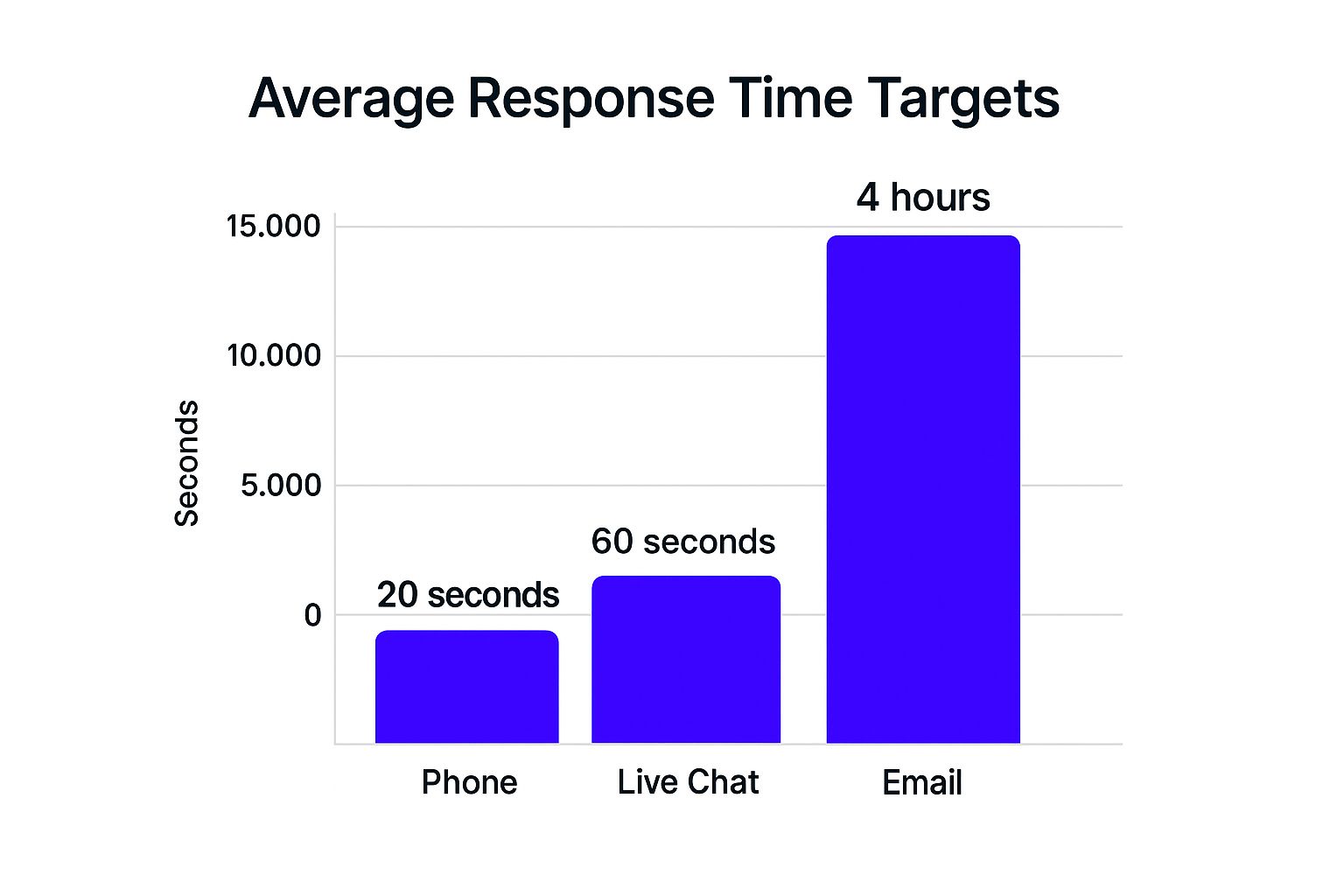
This visualization highlights the immediacy expected from phone and chat compared to the slightly longer, yet still prompt, window for email responses.
How to Implement Average Response Time Effectively
ART's value is in setting clear expectations and measuring your team's agility. A low ART signals to customers that their urgent needs are a top priority, a key differentiator in the home services industry. For instance, a homeowner with a failing furnace in winter expects a near-instant acknowledgment.
- Calculation:
Total Time Taken to Respond to Inquiries / Total Number of Inquiries = Average Response Time - Best Practice: Set distinct ART goals for different channels. For example, aim for under 60 seconds for live chat and under 4 hours for non-urgent email inquiries.
Pro Tip: Use automated acknowledgments for emails and online forms. A simple message like, "We've received your request and will get back to you within 2 hours," provides immediate reassurance and manages customer expectations effectively.
Actionable Tips for Home Service Businesses
To leverage ART as a tool for growth, it must be integrated with your daily dispatching and communication workflows.
- Implement Escalation Rules: Create clear procedures for inquiries that breach your target ART. If a request about a major water leak isn't answered within 15 minutes, it should automatically escalate to a senior manager or on-call technician.
- Balance Speed with Quality: A fast response is important, but it must be followed by a quality interaction. Ensure your team is equipped to not just answer quickly but also to solve the problem efficiently. Improving your team’s communication is key; you can learn more about effective customer communication strategies on phonestaffer.com.
5. Customer Effort Score (CES)
The Customer Effort Score (CES) is a powerful customer service performance indicator that measures how easy it is for a customer to get their issue resolved or request fulfilled. Popularized by the book "The Effortless Experience," this metric operates on the principle that reducing customer effort is a more reliable driver of loyalty than delighting them. The survey question is simple: "To what extent do you agree or disagree with the following statement: The company made it easy for me to handle my issue?"
Customers typically respond on a 7-point scale from "Strongly Disagree" to "Strongly Agree." The score is the average of all responses. For a home service business, this could mean measuring the ease of booking a plumbing appointment online or how simple it was to get a quote for a new HVAC system. High-effort experiences, like multiple phone calls to confirm a service time, are strong predictors of customer churn.
How to Implement CES Effectively
CES excels at identifying friction points in your customer journey. For instance, after a customer uses your online portal to schedule a pest control visit, a CES survey can immediately gauge the ease of that specific digital interaction.
- Calculation:
Sum of All CES Scores / Total Number of Survey Responses = Average CES Score - Best Practice: Deploy CES surveys immediately following key interactions like scheduling, issue resolution, or payment to get targeted, actionable feedback.
Pro Tip: Combine CES with process mapping. When a customer reports high effort, map out the exact steps they took. This helps you visually identify and eliminate the specific roadblocks causing friction.
Actionable Tips for Home Service Businesses
To leverage CES, focus on making every customer interaction as seamless as possible.
- Identify Friction Points: Use CES data to pinpoint high-effort processes. Is it difficult for customers to get a quote? Is your payment process confusing? Focus your improvement efforts on the areas with the lowest CES scores.
- Empower Your Team: Train technicians and office staff to recognize and reduce customer effort during service calls and communications. This includes proactively providing information, offering clear next steps, and owning the resolution of a problem from start to finish.
6. Average Handle Time (AHT)
Average Handle Time (AHT) is a crucial metric among customer service performance indicators, measuring the average duration of a complete customer interaction. This includes all aspects from the initial call, talk time, hold time, and any after-call work (ACW) an agent performs to resolve the customer's query. It’s a key indicator of operational efficiency in your customer service department.

For home service businesses, AHT helps you understand how long it takes your team to schedule an appointment, troubleshoot a problem over the phone, or handle a billing question. While a lower AHT can suggest efficiency, it must be balanced with quality; rushing a customer off the phone can lead to unresolved issues and lower satisfaction. The goal is to be efficient, not abrupt.
How to Implement AHT Effectively
AHT’s value comes from its ability to help you optimize staffing, identify process bottlenecks, and spot training needs. For instance, if calls about a specific plumbing service consistently have a high AHT, it might signal that your team needs more information or better tools to handle those requests efficiently.
- Calculation:
(Total Talk Time + Total Hold Time + Total After-Call Work) / Total Number of Calls = AHT - Best Practice: Don't chase a low AHT at the expense of quality. Use it in tandem with CSAT and First Contact Resolution (FCR) to get a complete picture of agent performance.
Pro Tip: Set different AHT benchmarks for different types of interactions. A new installation query will naturally take longer than a simple appointment confirmation, and your targets should reflect that complexity.
Actionable Tips for Home Service Businesses
To leverage AHT for tangible improvements, integrate it thoughtfully into your performance management.
- Analyze Trends: Monitor AHT trends to detect emerging problems. A sudden spike across the team could indicate a system outage or a confusing new marketing promotion that is generating complex calls.
- Balance with Quality: Create a balanced scorecard for agents that weighs AHT alongside metrics like CSAT and FCR. Reward agents who resolve issues effectively and efficiently, not just quickly. This prevents them from cutting corners to meet an AHT target. Comprehensive customer service representative training is essential for achieving this balance.
7. Service Level Agreement (SLA) Compliance
Service Level Agreement (SLA) Compliance is a critical customer service performance indicator that measures your team's ability to meet predefined service commitments. SLAs establish clear, measurable expectations for service delivery, such as guaranteed response times for emergency calls or specific windows for scheduled maintenance. They serve as both an internal benchmark for your team and a formal commitment to your customers.
For a home service company, an SLA might promise a response within one hour for a plumbing emergency or a resolution within 24 hours for an HVAC system failure. Tracking compliance ensures you are upholding your brand promises and delivering the reliable service customers expect.
How to Implement SLA Compliance Effectively
The power of SLA compliance lies in its ability to turn service promises into measurable targets, fostering accountability and customer trust. For instance, you could establish an SLA that guarantees a technician will arrive within a two-hour window for all scheduled appointments.
- Calculation:
(Number of Interactions Meeting SLA / Total Number of Interactions) x 100 = % SLA Compliance - Best Practice: Implement automated monitoring through your CRM or field service management software to track timestamps for key actions, like initial customer contact, technician dispatch, and job completion.
Pro Tip: Don't just set internal SLAs; communicate them to your customers. Highlighting your commitment to a "2-Hour Arrival Window Guarantee" on your website or in your marketing can be a powerful differentiator that builds confidence and justifies premium pricing.
Actionable Tips for Home Service Businesses
To transform SLAs from a simple metric into a driver of operational excellence, integrate them into your daily workflow.
- Set Realistic Targets: Base your SLA commitments on historical performance data, not just aspirational goals. If your data shows an average response time of 45 minutes for urgent calls, an SLA of 30 minutes may be achievable, while a 10-minute promise might set your team up for failure.
- Define Clear Criteria: Be specific about what constitutes a success or failure. Clearly define when the clock starts (e.g., when the customer call ends) and stops (e.g., when the technician is dispatched or arrives on-site). Also, define valid exclusions, such as delays caused by extreme weather or customer unavailability.
8. Customer Retention Rate
The Customer Retention Rate (CRR) is a vital customer service performance indicator that shows the percentage of customers who remain loyal to your business over a specific period. While satisfaction scores measure sentiment at a single point in time, CRR reveals the long-term impact of your service quality on business stability and profitability. For home service businesses, high retention means fewer resources spent on acquiring new customers and more predictable revenue from repeat business.
A high CRR is a clear sign that your customer service is successfully building lasting relationships. For example, an HVAC company that consistently delights customers with reliable service and clear communication is more likely to be called back for annual maintenance, creating a stable, recurring revenue stream. This metric directly ties service excellence to financial health.
How to Implement CRR Effectively
CRR's power comes from its ability to measure loyalty, which is the ultimate goal of great customer service. Tracking this metric helps you understand if your efforts are translating into repeat business. For instance, a plumbing company can track how many first-time customers call back for a different service within the next year.
- Calculation:
((Number of Customers at End of Period - Number of New Customers Acquired) / Number of Customers at Start of Period) x 100 = % Customer Retention Rate - Best Practice: Calculate CRR on a quarterly and annual basis to identify long-term trends and the impact of specific service initiatives.
Pro Tip: Don't just track the overall retention rate. Segment your data by the customer's initial service type. You might discover that customers who first called for an emergency repair have a lower retention rate than those who started with a planned installation, revealing an opportunity to improve your emergency service follow-up.
Actionable Tips for Home Service Businesses
To use CRR to drive growth, you must actively manage it as a core business objective.
- Correlate with Service Metrics: Analyze how CRR changes in relation to other metrics like CSAT and First Contact Resolution. If you see high CSAT scores but low retention, it could signal issues with pricing, scheduling, or follow-up communication.
- Implement Proactive Programs: Identify your most valuable repeat customers and create a loyalty program. This could include priority scheduling, exclusive discounts on annual maintenance plans, or a simple thank-you call from the owner. This reinforces their value and encourages continued business.
- Conduct Exit Analysis: When a customer doesn't return, try to understand why. A brief, friendly "we miss you" email with a one-question survey can provide critical insights into service gaps you may not have known existed, helping you prevent future customer churn.
Customer Service KPIs Comparison
| Metric | Implementation Complexity 🔄 | Resource Requirements ⚡ | Expected Outcomes 📊 | Ideal Use Cases 💡 | Key Advantages ⭐ |
|---|---|---|---|---|---|
| Customer Satisfaction Score (CSAT) | Low 🔄 (simple scale surveys, quick setup) | Low ⚡ (short surveys, minimal data processing) | Immediate feedback on specific interactions; identifies problem areas | Evaluating service/product satisfaction at touchpoints | High response rates; easy to understand and communicate |
| Net Promoter Score (NPS) | Low-Medium 🔄 (single-question, standardized scale) | Low ⚡ (simple surveys, periodic measurement) | Measures customer loyalty and advocacy; predicts business growth | Tracking overall customer loyalty and brand advocacy | Industry comparability; identifies promoters for marketing |
| First Call Resolution (FCR) | Medium 🔄 (data tracking across channels) | Medium ⚡ (training, knowledge systems required) | Higher operational efficiency; reduced repeat contacts; improved satisfaction | Enhancing operational efficiency and reducing customer effort | Directly correlates with customer satisfaction and cost saving |
| Average Response Time | Medium 🔄 (channel-specific tracking and integration) | Medium ⚡ (monitoring tools, workforce mgmt) | Faster customer acknowledgment; improved perception of service quality | Managing customer expectations across multiple communication channels | Easy to track; supports proactive staffing and escalation |
| Customer Effort Score (CES) | Medium 🔄 (effort-focused survey design needed) | Low-Medium ⚡ (targeted surveys and analysis) | Predicts loyalty; identifies friction points; guides process improvements | Identifying and reducing customer friction in service processes | Strong predictor of loyalty; focuses on process optimization |
| Average Handle Time (AHT) | Medium 🔄 (comprehensive time tracking systems) | Medium ⚡ (real-time monitoring and reporting) | Balances efficiency and quality; aids workforce planning and training | Optimizing staffing and training; cost management | Provides detailed insight into interaction complexity |
| SLA Compliance | High 🔄 (complex multi-dimensional monitoring) | High ⚡ (automated monitoring, alerting infrastructure) | Ensures service commitments met; supports accountability and transparency | Managing contractual obligations; premium service guarantees | Proactive service management; builds customer trust |
| Customer Retention Rate | Medium 🔄 (period-based tracking and cohort analysis) | Medium ⚡ (data integration with CRM/LTV tools) | Measures long-term loyalty and revenue impact; strategic business planning | Monitoring overall customer loyalty and lifetime value | Direct link to profitability; supports segmentation strategies |
From Measurement to Mastery: Supercharge Your Service Team
Moving beyond simply understanding customer service performance indicators is where genuine growth begins. You've explored the critical metrics that form the backbone of a successful home service operation, from the immediacy of Average Response Time to the long-term loyalty measured by Customer Retention Rate. Each KPI offers a unique lens through which to view your business, revealing insights into customer happiness, operational efficiency, and team effectiveness.
However, the true power of these metrics is unlocked when they are used in concert. A high Customer Satisfaction Score (CSAT) is fantastic, but if it's coupled with a low First Call Resolution (FCR) rate, it might indicate your team is friendly but inefficient, requiring multiple interactions to solve a single problem. This creates unnecessary friction and increases operational costs. The goal is to weave these data points together to form a comprehensive narrative about your customer journey.
Turning Insights into Actionable Strategy
Mastering these concepts means moving from passive data collection to active, data-driven decision-making. The real challenge for many home service business owners isn't just knowing what to measure, but having the bandwidth to act on the results. Your data might tell you that response times are slipping or that too many calls are being missed after hours, but if your team is already stretched thin, how do you fix it?
Here are the actionable next steps to transform your approach:
- Establish a Baseline: If you haven't already, begin tracking these eight key performance indicators immediately to understand your current standing.
- Set Realistic Goals: Use industry benchmarks and your baseline data to set clear, achievable improvement targets for your team.
- Integrate KPIs into Reviews: Make these metrics a core part of regular one-on-one meetings and team performance reviews to foster a culture of accountability and continuous improvement.
- Empower Your Team: Don't just present the numbers; discuss what they mean. Solicit feedback from your Customer Service Representatives (CSRs) on how to improve processes that impact metrics like Average Handle Time (AHT) and Customer Effort Score (CES).
By diligently tracking and acting upon these customer service performance indicators, you are not just managing a call center; you are building a strategic asset for your business. You are creating a predictable, scalable system for generating customer loyalty, which in turn drives positive reviews, referrals, and sustainable growth. Taking control of your customer service is taking control of your business's future.
Struggling to meet your response time goals or finding that your team is too busy to provide the detailed, empathetic service that boosts CSAT and NPS scores? Phone Staffer provides dedicated, US-based virtual receptionists and CSRs trained specifically for the home service industry, ensuring every call is answered and every customer feels valued. Learn how Phone Staffer can help you not just meet, but exceed your performance goals today.