

When you get a sales objection, it's easy to feel like you've hit a wall. But the best salespeople I know don't see it that way. They reframe the whole thing. It’s not a confrontation; it’s a conversation. To do this, you need a solid framework: truly Listen to what they're saying, Acknowledge their point of view, Explore what’s really behind it, Respond with a solution that actually helps, and Confirm you’ve nailed it. This simple process can turn a hard "no" into a real dialogue.
The Real Reason Customers Raise Objections
Let’s get one thing straight: an objection is almost never a final rejection. It’s a request for more information.
Homeowners aren't trying to give you a hard time. When they raise an objection, it's because there's a disconnect between what you're offering and what they need to feel comfortable moving forward. Think of it less like a roadblock and more like a signpost pointing you exactly where you need to go.
When a customer says, "Your price is too high," what they're often really saying is, "I don't see enough value to justify this cost." That "I need to think about it" line? It’s usually code for, "I'm not convinced this is the right solution for me yet." The first step to mastering objections is treating these moments as opportunities, not obstacles.
Shifting from Defense to Discovery
Whatever you do, don't get defensive. That's a surefire way to lose the sale. Instead, get curious. Your job is to figure out the real hesitation hiding behind their words. To do that, you need a consistent process that puts empathy and understanding first, not a quick comeback.
Sales teams that have a structured way of handling common issues like budget concerns always do better. They use customer stories, show genuine understanding, and know how to manage resistance before it derails the conversation. If you're looking to build out your own process, you can learn more about developing a solid sales strategy here.
A framework I’ve seen work wonders time and time again is LAERC.
- Listen: Let the customer finish their thought completely. No interrupting.
- Acknowledge: Validate their concern. Something as simple as, "I can certainly understand why you'd feel that way," goes a long way.
- Explore: Ask open-ended questions to get to the root of the issue. Try, "Could you tell me a bit more about what’s causing that concern?"
- Respond: Now, address the real problem you’ve uncovered, not just the words they first used.
- Confirm: Make sure you've resolved it. A simple, "Does that help clear things up for you?" is perfect.
This approach ensures you're solving the right problem. This flow chart breaks down how to identify, analyze, and respond to any objection that comes your way.
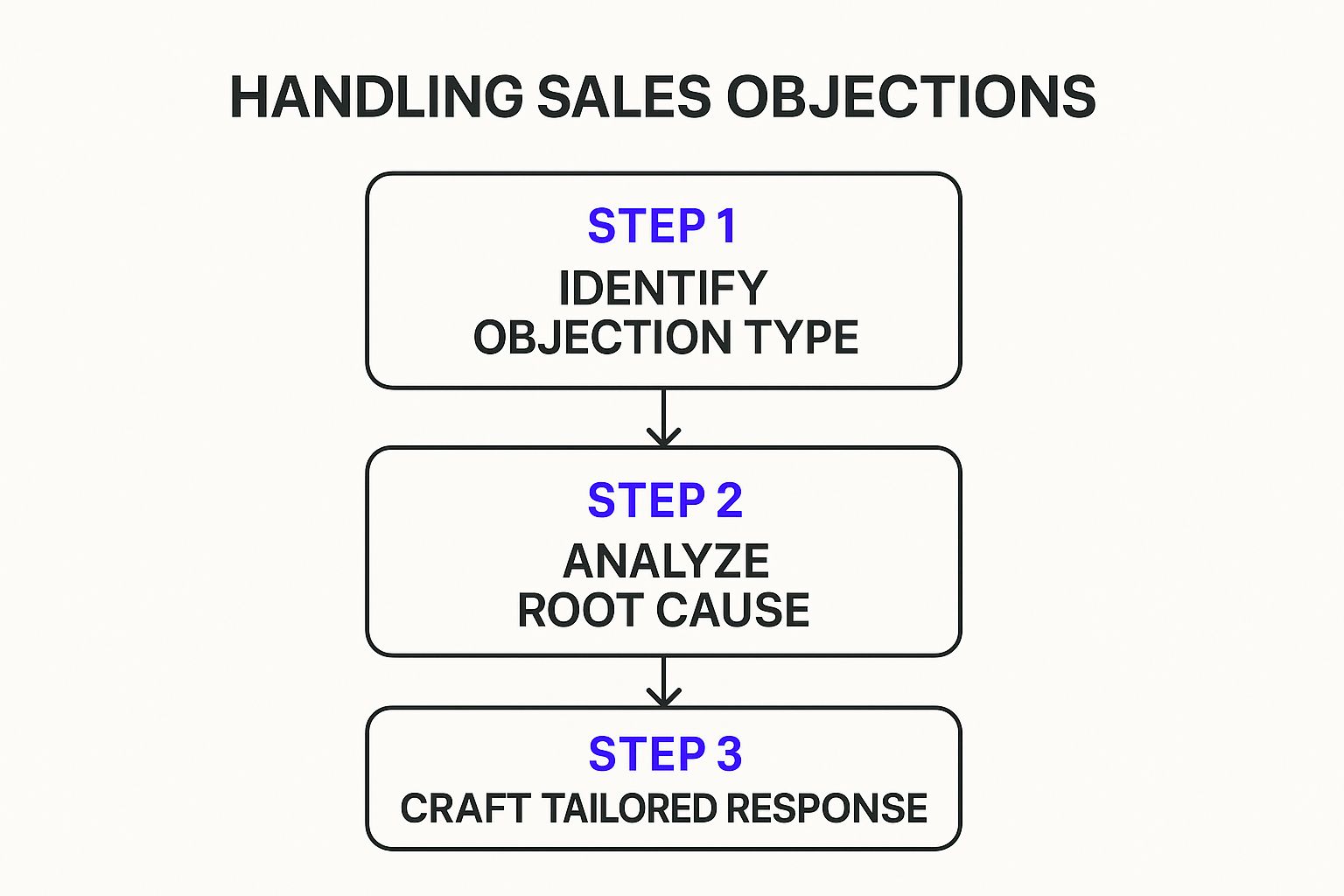
As you can see, a great response isn't a guess. It’s the direct result of carefully figuring out what the customer actually needs.
For a quick-reference guide, this table breaks down the entire LAERC method. Keep it handy for your team.
The LAERC Objection Handling Framework at a Glance
| Step | Action | Why It's Critical |
|---|---|---|
| Listen | Actively listen without interrupting until the customer has finished speaking. | Shows respect and allows you to hear the full context of their concern, not just the first few words. |
| Acknowledge | Verbally validate their feeling or perspective. Use phrases like, "I understand." | Builds rapport and lowers their defenses. It shows you're on their side, not against them. |
| Explore | Ask open-ended questions to uncover the true, underlying issue. | The initial objection is often a symptom. This step helps you diagnose the real problem so you can solve it. |
| Respond | Address the root cause you've identified with a specific, value-based solution. | Provides a relevant solution that directly resolves their core hesitation, rather than a generic rebuttal. |
| Confirm | Ask if your response has fully addressed their concern and if they are satisfied. | Ensures you've closed the loop and gives you permission to move forward with the sale. |
This five-step process transforms a potential conflict into a collaborative problem-solving session.
Why This Approach Works in Home Services
In our industry, trust is everything. Think about it. You're asking for permission to enter someone's most personal space—their home—to do important work. An aggressive or dismissive answer to a concern, no matter how small, can shatter that trust in an instant.
The moment you start arguing, you've already lost. The goal isn't to win an argument; it's to win the customer's confidence.
By guiding the conversation with empathy, you build a foundation for a confident "yes" that's based on mutual respect and understanding. This method doesn't just put out a fire; it strengthens the entire relationship. It proves to the homeowner that you’re a partner in solving their problem, not just another salesperson trying to make a buck.
Decoding Common Home Service Objections

Spend a little time in the home services world, and you’ll start to hear the same refrains over and over. It can feel like every homeowner has the same four or five reasons for not booking a job right away. And you know what? You're not imagining it.
But here’s the secret seasoned pros know: the first objection a customer gives you is rarely the real one. Think of it as a smokescreen for a deeper, more specific worry. Getting good at handling sales objections isn't about having a snappy comeback; it's about learning to hear what the customer isn't saying and responding to that.
The Price Objection is Really About Value
"Your quote is higher than the other guys." We've all heard it a thousand times. The impulse is to jump to your own defense or, even worse, start slashing your price. Don't do it. A price objection is almost never about the money itself. It's a value problem.
When a homeowner balks at the cost, what they’re actually saying is, "I don't see why you're worth so much more." They haven't made the connection between your price and the top-tier materials you use, your ironclad warranty, or the simple peace of mind that comes from a job done right the first time.
Your job isn’t to lower the price; it’s to increase the perceived value.
Instead of caving on that HVAC install quote, try shifting the focus. You could say, "I completely understand, it’s a big investment. Can I take a minute to show you the specific high-efficiency unit we use? While it costs more upfront, it saves our customers an average of $300 a year on their energy bills. It actually pays for itself."
The Timing Objection Signals a Lack of Urgency or Trust
"I need to think about it." "Give me a call next month." These are the worst, right? They feel like a soft "no." But these vague delays usually come from one of two places:
- No Sense of Urgency: The problem just doesn't feel painful enough for them to act on it today. That tiny drip under the sink is an annoyance, not a catastrophe—at least, not until it ruins their brand-new cabinets.
- Not Enough Trust: They aren't quite sold that you're the right company for the job. They want to poke around online, check your reviews, and maybe get another quote or two.
When you get hit with a timing objection, you need to gently dial up the stakes or build more confidence. You can create urgency by explaining the real risks of waiting—how a small electrical glitch can become a serious fire hazard. To build trust, you can lean on your rock-solid guarantees or mention your hundreds of five-star reviews from people right in their neighborhood.
The Trust Objection is a Cry for Reassurance
"I've never heard of your company before." "The last contractor I hired really burned me." This one is pure fear. The homeowner is terrified of making a bad choice, throwing money away, or dealing with another nightmare project.
An objection based on trust isn’t an accusation; it’s a request for proof. The homeowner is essentially asking you, "How can I be sure I can count on you?"
Social proof is your best friend here. This is the time to share testimonials from their happy neighbors, talk up your "Done Right Guarantee," and mention that every single one of your technicians is background-checked and fully licensed. Each piece of proof you offer chips away at their perceived risk, making it that much easier to say yes.
The "I Need to Talk to My Spouse" Objection
This objection feels like a brick wall, but it’s actually a huge clue. It often means you haven't fully convinced the person you're speaking with. If they were 100% sold that you were the absolute best solution, they'd be racing to convince their partner, not hesitating.
The best move here is to arm them for that conversation. Make them your champion.
Help them make the case for you:
- "That makes perfect sense. When you chat with them, be sure to bring up the 10-year parts and labor warranty we include—most of our competitors can't match that."
- "I'd be happy to jump on a quick call with both of you to answer any questions your partner might have."
Suddenly, it’s not a roadblock; it’s a team effort. Understanding these hidden meanings is the first step. In fact, research analyzing over 300 million sales calls shows that nearly half of all objections are these kinds of knee-jerk, dismissive reactions. By digging into the data on these top objections and how to handle them, you can get a clearer picture of what you're really up against.
Your Playbook for Responding With Confidence

Understanding why a customer is pushing back is half the battle. Now, let’s get practical and turn that understanding into action. This is your go-to playbook for handling the most common objections you'll face in the field.
These aren't meant to be rigid, word-for-word scripts. Think of them as frameworks you can adapt to your own style and the specific homeowner you're talking to. The real goal is to have a strategy in your back pocket so you can respond with confidence instead of getting defensive.
Overcoming the Price Objection
When a homeowner says, "Your price is too high," our first instinct is often to get defensive and start justifying our costs. Don't do it. The better move is to reframe the entire conversation around long-term value and the very real costs of going with a cheaper, less proven option.
Scenario: You've just quoted $7,500 to install a new high-efficiency furnace. The homeowner counters, saying another company offered to do it for $6,000.
Weak Response: "Well, our materials are better, and our technicians are certified."
This is a dead end. It’s generic, doesn’t connect with the customer's very real budget concerns, and basically asks them to just take your word for it.
Confident Response: "I understand completely; that's a significant difference in price, and it’s smart to compare. Could I quickly show you where that difference comes from? The unit we're installing is a high-efficiency model that saves our clients an average of 25% on their heating bills. Over the 15-year life of the furnace, that's thousands of dollars back in your pocket."
This response does a few things right. It validates their concern, immediately pivots to a tangible financial benefit, and shifts their thinking from short-term cost to long-term investment. You're giving them the data to see the value for themselves. Going beyond just a confident reply, learning powerful strategies of persuasion for sales teams can really sharpen your ability to navigate these conversations.
Tackling "I Need to Get Other Quotes"
This one can feel like a polite "no," but it's usually just a sign of uncertainty. The customer isn't sold on you being the safest, best choice. Your job isn’t to pressure them into a decision, but to make the idea of going elsewhere feel just a little bit riskier.
Scenario: After you present your proposal for a full plumbing repipe, the homeowner says they have two more companies coming out to give estimates.
Weak Response: "Okay, just let me know what you decide."
With that, you've just handed over complete control of the sale and put yourself in a passive waiting game.
Confident Response: "That's a great idea; you should feel 100% confident in who you hire. While you’re getting those other quotes, would it be helpful if I left you a checklist of things to ask? For instance, make sure you ask if they are fully licensed and insured for this specific type of work and what kind of warranty they offer on their labor. We stand behind our work with a 10-year guarantee, and I want to make sure you’re comparing apples to apples."
Suddenly, you’re not a salesperson; you’re a helpful expert. You’re building trust by encouraging them to do their homework while subtly pointing out your own company's biggest strengths.
Neutralizing "I Need to Think About It"
Ah, the ultimate smokescreen. This vague objection could mean anything from "I'm not interested" to "I'm worried about making the wrong call." Your job is to gently probe and figure out what the real issue is so you can actually address it.
Scenario: You’ve laid out all the benefits of a new electrical panel upgrade. The customer pauses, then says, "Let me think it over and I'll get back to you."
Weak Response: "No problem, here’s my card."
You might as well watch that potential sale walk right out the door. You never even found out what the real hesitation was.
Confident Response: "Of course, it’s an important decision. Usually when my customers say they need to think about it, it’s because I haven’t fully explained something, or they still have a specific concern about either the price or the process. Do you mind if I ask what’s on your mind?"
This is direct but still respectful. It opens the door for them to share what’s really holding them back and shows you genuinely want to resolve their concerns, not just make a sale.
The key to handling any sales objection is to stay calm, listen more than you talk, and focus on solving the customer's underlying problem. Your confidence comes from knowing you have a plan.
Objection Response Quick-Reference Guide
To help your team remember these approaches in the heat of the moment, a simple reference guide can make all the difference. It cuts through the noise and reminds them of the core strategy for each common objection.
| Objection Type | What the Customer Says | Your Strategic Goal |
|---|---|---|
| Price | "Your quote is too high." | Shift the focus from cost to long-term value and return on investment. |
| Competition | "I'm getting other quotes." | Build trust and highlight your unique value proposition, like guarantees or expertise. |
| Stalling | "I need to think about it." | Uncover the real, hidden objection by asking clarifying questions. |
| Trust | "I've never heard of your company." | Provide social proof through reviews, testimonials, and local success stories. |
Ultimately, this playbook isn't about winning an argument; it's about building a bridge. When a customer raises an objection, they are essentially handing you a roadmap to what they need to feel secure. By following it with empathy and confidence, you can turn their hesitation into the very reason they choose to hire you.
Preventing Objections Before They Even Start
The best way to handle an objection? Make sure it never comes up in the first place.
While you absolutely need a plan for when a homeowner pushes back, a proactive strategy is what separates the pros from the pack. It saves time, builds real trust, and just makes the whole sales conversation feel less like a battle. It’s all about weaving the answers to common concerns—price, trust, timing—into your conversation before the customer even thinks to ask.
Think of it as shifting from defense to offense. Instead of bracing for the "your price is too high" comment, you build such a powerful case for your value from the second you step on their property that the price feels like a natural conclusion. You're controlling the narrative and positioning your service as the only logical, safe choice.
This isn’t just about closing more deals; it’s about creating a better experience. When you anticipate and address a homeowner's unspoken worries, you show them you get it. That's the bedrock of a relationship that lasts for years.
Anchor Your Value Early and Often
Here’s the biggest mistake I see technicians make day in and day out: they save their best stuff for last. They diagnose the problem, present the solution, drop a big number on the table, and then scramble to justify it when the customer gets sticker shock.
You have to flip that script. Your mission is to establish undeniable value long before a price is ever mentioned. This starts the moment you walk through the door.
- Lead with Your Guarantees: Don't wait to be asked. As you're getting started, say something like, "Just so you know, before we even dig in here, all of our work is backed by a 10-year parts and labor warranty. We want you to have total peace of mind no matter what we find."
- Talk Up Your Team: Casually mention the expertise in your truck. For example, "You're in good hands—all of our electricians are fully licensed and background-checked, so you can be confident you have a real professional in your home."
- Showcase Premium Materials: As you're diagnosing the issue, point out the quality. "See this? We only use this specific brand of copper wiring. It's proven to last about 30% longer than the standard stuff most guys use."
When you sprinkle these value points into the conversation naturally, the final price isn't a shock. It's simply a reflection of the premium quality and security you've already demonstrated.
Leverage Social Proof Immediately
In the home service world, trust is everything. Homeowners are on high alert, terrified of being ripped off, especially if they’ve had a bad experience before. The fastest way to melt that fear away is to show them that people just like them—their own neighbors—have already trusted you and loved the result.
Your reviews don't just belong on your website. Bring them into the living room.
A customer’s biggest fear is making the wrong choice. Social proof is the antidote. It’s a powerful signal that they’re making a safe, smart decision that their community has already approved.
Picture this:
You're at a home in the "Maple Creek" neighborhood. Instead of a generic pitch, try this: "You know, we do a ton of work here in Maple Creek. We actually just finished a big project for the Hendersons over on Oak Street—just two blocks away. They were thrilled with their new AC unit and even left us a five-star review about how quiet it is now."
That one simple statement accomplishes three crucial things instantly:
- It positions you as the go-to local expert.
- It gives them a real, relatable story of a happy customer.
- It dramatically lowers their feeling of risk.
It's infinitely more powerful than just saying, "We have great reviews online." You're making the proof local, relevant, and immediate.
Practice Radical Price Transparency
The final piece of this proactive puzzle is presenting your price with complete, unapologetic clarity. A lot of pushback happens simply because the pricing feels like a random number pulled out of thin air. When you break it down and explain the "why" behind the cost, you eliminate the confusion and build a massive amount of trust.
Don't just slide a single number across the table. Present clear options. If it makes sense for the job, show them a "good, better, best" scenario and walk them through what they get with each level.
A Transparent Breakdown Looks Like This:
| Option | What's Included | Why It Matters For You |
|---|---|---|
| The Repair | We'll replace the faulty capacitor. | This is a quick, budget-friendly fix to get your system back up and running today. |
| The Upgrade | We'll install a new high-efficiency unit. | This will lower your energy bills by an average of $400/year and comes with our full 10-year warranty. |
| The Premium System | You get the high-efficiency unit, plus a smart thermostat and whole-home air purifier. | This delivers maximum savings, total comfort, and dramatically improved air quality for your family. |
By laying it all out like this, you completely change the conversation. It shifts from, "Why does this cost so much?" to, "Which of these options makes the most sense for my family?"
Suddenly, you're not a salesperson pushing a service. You're a trusted advisor helping them make the best possible decision. That's the mark of a true home service pro.
Building a Team That Handles Objections Consistently

We've all had that one "all-star" technician who just gets it. They can turn any "I need to think about it" into a signed deal. While that's great for business, you can't build a company on the back of one person. True, sustainable growth happens when you systemize that success across your entire team.
Every single person who talks to a customer—from the CSR answering the phone to the tech standing in the living room—needs to be on the same page.
Consistency is the bedrock of a strong brand. When a customer gets the same professional, understanding response no matter who they talk to, it builds immense trust. This turns random wins into a reliable process that keeps revenue flowing and customers coming back. The goal is to create one seamless, expert experience.
Creating a Shared Objection Playbook
The cornerstone of a consistent team is a shared resource—what I call a company "objection playbook." This isn't about handing out rigid scripts that make your team sound like robots. Not at all.
Think of it as a living document, a guide that gives your team proven frameworks to work from. It should be easy for everyone to access and needs to include a few key things:
- The Top 5 Roadblocks: List out the most common objections you hear day in and day out (price, timing, a competitor's quote, etc.).
- The Real "Why": For each objection, briefly explain the customer's likely underlying fear or concern. Is "it's too expensive" really about the budget, or is it about a fear of not getting their money's worth?
- Core Response Strategies: Offer clear, adaptable talking points—not word-for-word lines—that guide the conversation.
- Your Arsenal of Proof: Arm your team with key stats, powerful testimonials, and warranty details they can pull from to build value and confidence on the spot.
With a playbook like this, a price concern voiced on the initial call gets the same strategic response as one brought up in person. That's how you win.
Practical Training That Actually Sticks
A playbook is just a fancy document if it gathers dust. You have to bring it to life with active, ongoing training. Reading about how to handle objections is one thing; doing it with a skeptical customer staring you down is another beast entirely.
This is where role-playing becomes your most powerful tool. It's not about silly acting; it's about building muscle memory and confidence in a safe space before the stakes are real.
Here’s a simple role-playing exercise that works:
- Pair up a CSR with a field tech.
- Have one person play the "customer" and give them a common objection from the playbook.
- The other person responds using the framework.
- Switch roles, and then give each other constructive feedback. Focus on tone, empathy, and how clearly they made their point.
Training isn't a one-and-done annual meeting. It needs to be a core part of your culture. Short, consistent training huddles are far more effective than one overwhelming session.
The Critical Role of the First Call
Your team's success with objections starts the moment the phone rings. A well-trained person handling that first contact—whether it's an in-house CSR or a virtual receptionist—can set the entire job up for a win. They can qualify the lead, gather intel, and even address potential concerns before a tech's truck ever leaves the shop.
This is where bringing in specialized support can be a game-changer. Services like Phone Staffer provide trained professionals who already know the home service industry inside and out. They act as a seamless extension of your team, making sure every call is handled with the same level of expertise.
They can address those initial hesitations, anchor the value of your service from the get-go, and pass detailed notes to your field team. This gives your technicians the context they need to walk in prepared and close the deal. That consistent, professional frontline is absolutely key to scaling your business.
Got Questions About Handling Sales Objections? We've Got Answers.
https://www.youtube.com/embed/KvOiF9uTMa0
Even with the best game plan, new questions always pop up when you're in the trenches. Let’s tackle some of the most common ones we hear from home service pros who are working to get better at navigating customer concerns.
What's the Single Biggest Mistake People Make?
Hands down, the most damaging mistake is getting defensive. The second a technician hears an objection and immediately fires back with facts and figures, the conversation turns into a confrontation. It instantly tells the customer, "You're wrong, and I'm here to prove it," which completely erodes any trust you’ve built.
The right move? Just listen. Let them get it all out without cutting them off. Acknowledge what they said, show a little empathy, and then dig into the "why" behind their concern before you even think about offering a solution. This isn't about winning an argument; it's about finding common ground.
An objection isn't a declaration of war—it's a request for more information. Use it as a moment to build trust, not a debate to be won.
How Do You Handle an Objection You've Never Heard Before?
When a customer throws a curveball you've never seen, your framework is your best friend. Don't panic. The worst thing you can do is try to make up an answer on the spot.
First, just listen intently. Let them explain their unique situation. Then, acknowledge it honestly. Something as simple as, "That's a really good point, I haven't actually thought about it that way before," shows you're taking them seriously and buys you a crucial second to think.
Next, get curious. Ask open-ended questions to understand where they're coming from. "Can you tell me a bit more about that?" or "What's leading you to feel that way?" This not only gives you time to process but ensures you're solving the real problem, not just the one you assumed they had.
Should My Entire Team Use the Exact Same Scripts?
This is a big one. You should focus on building consistent frameworks, not rigid scripts. Homeowners can spot a recited script from a mile away, and it feels completely fake.
Your core strategies and the value you bring should be consistent, of course. But forcing everyone to use the same words makes them sound like robots. The real magic happens when your team understands the why behind the response. This empowers them to adapt the language to their own style and the flow of the conversation, which always leads to a more genuine and effective outcome.
Think of your company playbook as a guide, not a script.
A consistent, professional response to every customer is what separates the good home service businesses from the great ones. At Phone Staffer, we provide highly-trained virtual receptionists who act as a seamless extension of your team, ensuring every call is handled with the expertise your customers deserve.