
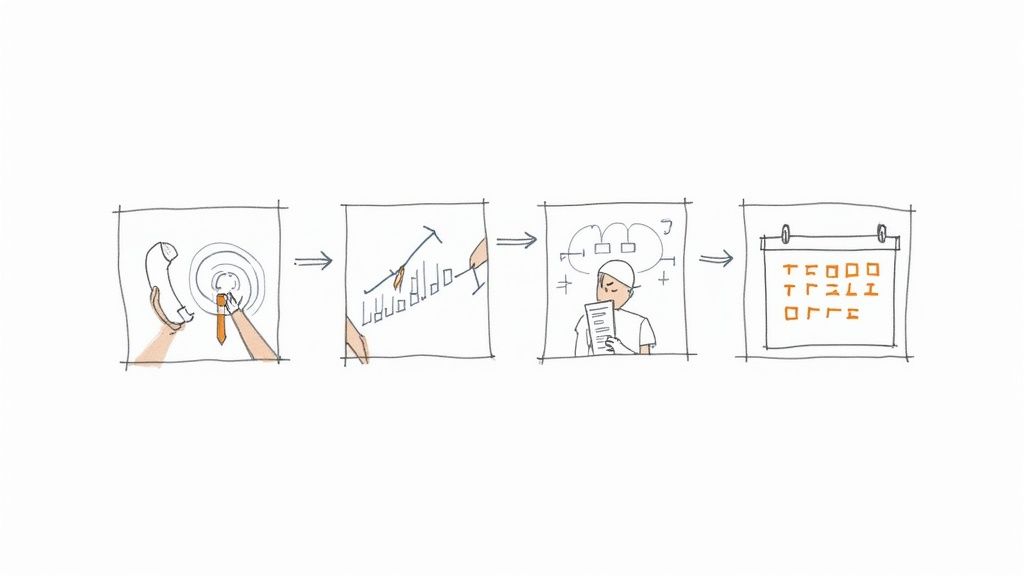
In the hyper-competitive home services market, relying on the same old growth strategies is a recipe for stagnation. From plumbing and HVAC to electrical and landscaping, homeowners are more discerning than ever, and a passive approach to finding new business simply won't cut it. Your competitors are actively pursuing leads, refining their sales funnels, and building local partnerships. To truly scale and secure a dominant market position, you need a proactive, strategic, and modern approach to growth.
This guide cuts through the noise to deliver proven business development best practices specifically adapted for the unique challenges of home service companies. We'll move beyond generic advice and dive into nine core strategies that will not only fill your pipeline but also build a sustainable engine for long-term expansion. Forget just waiting for the phone to ring; it's time to learn how to create predictable success.
You will learn how to implement actionable tactics for everything from strategic networking and data-driven decision-making to differentiating your value proposition and optimizing your sales processes. Each point is designed to give you a clear roadmap for generating more qualified leads, converting them at a higher rate, and building a business that thrives, not just survives.
1. Strategic Relationship Building and Networking
One of the most powerful and sustainable business development best practices is cultivating a robust professional network. For home service companies, this goes beyond collecting business cards; it's about building a symbiotic referral ecosystem with partners who regularly interact with your ideal customers. This strategic approach transforms lead generation from a constant hunt into a consistent, predictable flow of high-quality opportunities.

Instead of relying solely on direct-to-consumer advertising, you create a web of trusted allies who advocate for your business. This model was championed by authors like Dale Carnegie and Keith Ferrazzi and is validated by modern giants like HubSpot, whose partner program generates billions in mutual revenue.
How to Implement Strategic Networking
Focus on creating mutually beneficial relationships with key players in the home services space. The goal is to become the go-to provider they confidently recommend.
- Identify Key Partners: Connect with real estate agents, property managers, insurance adjusters, and complementary trades like roofers, plumbers, or remodelers.
- Provide Value First: Offer your expertise without expectation. Host a free "Lunch and Learn" for a local real estate office on identifying common HVAC issues during home inspections.
- Track Your Connections: Use a simple CRM to log interactions, note personal details, and set reminders for follow-ups. This ensures no relationship goes cold.
Key Insight: The most effective networking isn't about what you can get; it's about what you can give. By consistently providing value, you build trust and become an indispensable resource, which naturally leads to referrals. This "Go-Giver" approach, popularized by Bob Burg, establishes long-term loyalty and a powerful brand reputation.
2. Data-Driven Decision Making and Analytics
Effective business development relies on insight, not intuition. Data-driven decision-making is the practice of using quantitative metrics and analytics to inform your strategy, identify high-value opportunities, and optimize every stage of your sales pipeline. This approach replaces guesswork with evidence-based actions, ensuring your efforts are focused on what truly drives growth for your home service company.

Instead of reacting to market shifts, you can proactively identify trends and allocate resources effectively. This methodology was pioneered by experts like Thomas H. Davenport and is now fundamental to modern business, with companies like Amazon and Netflix using data to power everything from product recommendations to content creation.
How to Implement Data-Driven Analytics
Start by establishing a "single source of truth" for your data and focusing on a few key metrics that directly impact your bottom line. The goal is to create a clear picture of your pipeline's health.
- Implement a CRM: Use a reliable Customer Relationship Management (CRM) system to track every lead, interaction, and conversion. This centralizes your data.
- Identify Key Metrics: Focus on 3-5 critical numbers, such as lead source effectiveness, cost per acquisition (CPA), lead-to-booking conversion rate, and average job value.
- Conduct Regular Reviews: Hold weekly dashboard reviews with your team to analyze performance, identify bottlenecks, and adjust your strategy in real time. For more advanced applications, consider the ways AI-powered analytics can transform business decision-making for even deeper insights.
Key Insight: Data tells a story about your business. By tracking conversion rates at each stage of your sales funnel, you can pinpoint exactly where leads are dropping off. This insight allows you to make targeted improvements, such as refining your phone script or adjusting your follow-up cadence, which leads to immediate and measurable gains in revenue.
3. Value Proposition Development and Differentiation
A powerful value proposition is the cornerstone of effective business development best practices. It’s a clear, concise statement that explains how your home service solves a customer's problem, what specific benefits they can expect, and why you're a better choice than competitors. A strong value proposition moves your business from being just another option to being the only logical choice for your ideal client.

This concept, championed by experts like Geoffrey Moore and April Dunford, isn't about listing your services; it's about articulating the tangible outcomes you deliver. For example, instead of saying "We offer emergency plumbing," a differentiated proposition might be "We guarantee a 60-minute response time for plumbing emergencies, preventing costly water damage." This clarity equips your entire team, from sales reps to technicians, to communicate your unique value consistently.
How to Implement Value Proposition Development
To craft a compelling message, you must deeply understand your customer's pain points and how your solution uniquely addresses them.
- Conduct Customer Interviews: Speak with 20-30 of your best (and worst) customers. Ask what problem they had before hiring you and what specific outcome they achieved.
- Use a Framework: Utilize a tool like Strategyzer's Value Proposition Canvas to map customer pains, gains, and jobs-to-be-done against your services and how they deliver value.
- Quantify Your Benefits: Instead of vague promises, use concrete numbers. "Our high-efficiency HVAC systems reduce energy bills by up to 30%" is far more impactful than "We save you money."
- Test and Refine: Use A/B testing on your website, ads, and sales scripts to see which messaging resonates most with your target audience and drives conversions.
Key Insight: Your value proposition isn't what you think is important; it's what your customer perceives as valuable. The key is to shift your focus from your company's features (what you do) to the customer's benefits (what they get). By anchoring all your business development efforts in a customer-centric value proposition, you attract higher-quality leads who are already convinced you're the right solution.
4. Account-Based Business Development (ABBD)
Instead of casting a wide net, Account-Based Business Development (ABBD) is a highly focused strategy where you treat individual high-value accounts as markets of one. This approach concentrates your sales and marketing resources on a select group of target clients, such as large property management firms or commercial real estate developers, to deliver deeply personalized engagement. It’s a powerful shift from chasing many small leads to nurturing fewer, more significant opportunities.
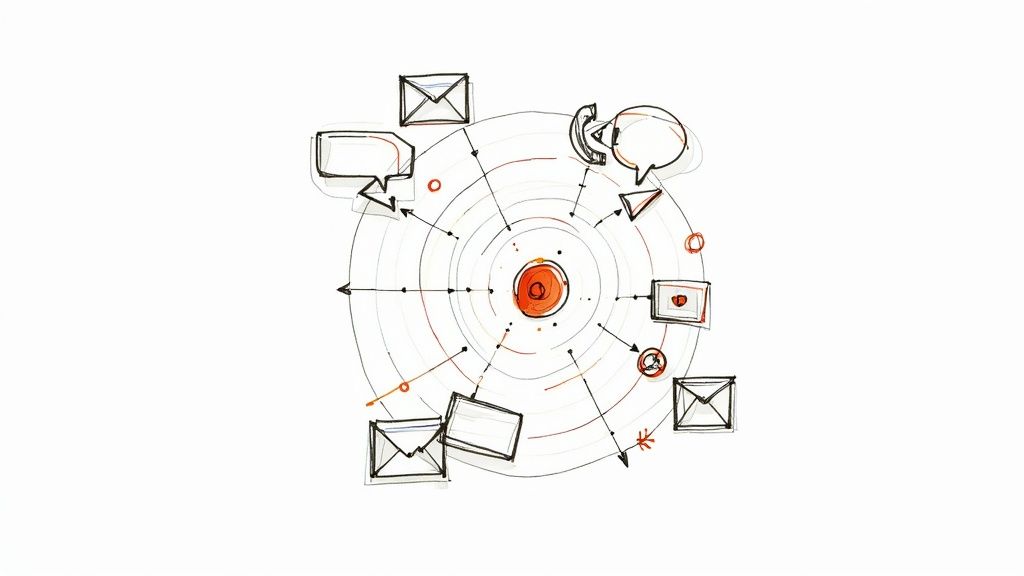
This methodology was pioneered by organizations like ITSMA and popularized by thought leaders such as Sangram Vajre. Tech giants like Snowflake successfully used it to target Fortune 500 companies, proving its effectiveness in landing large, complex deals by coordinating efforts across entire buying committees rather than just single contacts.
How to Implement Account-Based Business Development
The key is to start small and scale. Choose a handful of dream clients and dedicate your efforts to understanding their unique needs and challenges.
- Identify Target Accounts: Start with a list of 10-20 high-value targets, like multi-location commercial clients or luxury home builders in your service area.
- Create Detailed Account Plans: Map out the organizational structure, identify key decision-makers, and research their specific business goals and pain points.
- Develop Personalized Outreach: Craft account-specific offers. Instead of a generic "10% off," propose a custom preventative maintenance plan designed for a property management portfolio.
- Coordinate Internally: Ensure your sales, marketing, and service delivery teams are aligned on the strategy for each target account, creating a seamless customer experience.
Key Insight: ABBD flips the traditional sales funnel. Instead of generating a wide base of leads and narrowing them down, you start by identifying your ideal customers and then focus all your energy on engaging and delighting them. This makes it one of the most efficient business development best practices for securing high-value, long-term contracts.
5. Continuous Learning and Market Intelligence
The most forward-thinking business development best practices involve staying ahead of market shifts, not just reacting to them. Continuous learning is the systematic process of gathering and analyzing information about industry trends, competitor strategies, and evolving customer needs. For home service companies, this means proactively adapting your services and marketing instead of being caught off guard by a new technology or a competitor's aggressive new offer.
This proactive stance is a core principle championed by thinkers like Peter Drucker, who emphasized knowledge work, and Clayton Christensen, who explored disruptive innovation. It’s the reason companies like Amazon obsess over customer data and continually evolve their offerings; they treat market intelligence not as a one-time project, but as a constant, strategic function that fuels growth and defends market share.
How to Implement Continuous Learning
Integrate market intelligence into your weekly operations to make informed, agile decisions. The goal is to build a culture of curiosity and awareness that permeates every part of your business, from the field technicians to the sales team.
- Schedule Learning Time: Dedicate a few hours each week to research. Set up Google Alerts for your competitors and industry keywords like "smart home HVAC" or "eco-friendly plumbing."
- Leverage Industry Resources: Subscribe to top trade publications (e.g., ACHR News, Plumbing & Mechanical) and attend at least one major industry conference or trade show annually.
- Analyze Your Own Data: Conduct regular win/loss analysis. When you lose a bid, have your team (or a service like Phone Staffer) follow up to ask why. This feedback is pure gold.
Key Insight: Your market is constantly providing clues about its future direction. By establishing formal systems for listening-to customers, watching competitors, and tracking trends-you can anticipate demand rather than just reacting to it. This "radical open-mindedness," a principle from Ray Dalio, transforms your business from a passive service provider into an active, intelligent market leader.
6. Multi-Channel Outreach and Engagement Strategy
Relying on a single communication channel, like phone calls, is no longer sufficient in today's crowded market. A multi-channel outreach strategy engages prospects and partners across multiple touchpoints, including email, social media, phone, and even direct mail. This approach acknowledges that different decision-makers prefer different communication styles and that repeated, varied contact is necessary to cut through the noise.
This methodology, championed by sales leaders like Aaron Ross and Trish Bertuzzi, recognizes that a lead often requires 8-12 touches before converting. By using a coordinated sequence across different platforms, you increase visibility and build familiarity, making your cold call feel much warmer. Companies like HubSpot and Salesforce have built empires on this integrated approach.
How to Implement a Multi-Channel Strategy
The goal is to create a seamless and persistent presence without being intrusive. Start small and measure what works for your specific audience, whether it's commercial property managers or high-end residential clients.
- Select Core Channels: Begin with 3-4 key channels. For home services, this could be phone calls, personalized emails, and LinkedIn for commercial clients or Facebook for residential.
- Create Coordinated Sequences: Map out a touchpoint sequence. For example: Day 1: LinkedIn connection request. Day 3: Personalized email. Day 5: Follow-up phone call.
- Track Channel Effectiveness: Use lead source tracking in your CRM to identify which channels generate the most conversations and conversions, allowing you to optimize your efforts.
Key Insight: The power of a multi-channel strategy lies in orchestration, not just repetition. Each touchpoint should build upon the last, providing value and context. Instead of just "checking in," reference a previous email or social media interaction. This transforms your outreach from a series of isolated attempts into a cohesive, value-driven conversation.
7. Partnership and Ecosystem Development
One of the most scalable business development best practices involves moving beyond one-to-one relationships and building a true partnership ecosystem. This means creating strategic alliances with complementary businesses, technology providers, and industry players to expand your market reach and create compounding value. For a home service company, this transforms growth from a linear effort into an exponential one by leveraging the networks of others.
This strategy is championed by analysts like Jay McBain and researchers such as Geoffrey Moore. It’s powerfully demonstrated by platforms like Shopify, whose app ecosystem drives immense value, and Microsoft, which generates the majority of its revenue through its vast partner network. These models show that by enabling others to succeed alongside you, you build a powerful, self-sustaining growth engine.
How to Implement Partnership and Ecosystem Development
The goal is to create a formal, structured program that makes it easy and profitable for partners to work with you. This elevates simple networking into a predictable, revenue-generating channel.
- Define Partner Personas: Clearly identify the ideal characteristics of your partners, such as property management firms of a certain size, high-volume real estate agencies, or specific tech platforms your customers use.
- Create a Formal Program: Establish clear tiers, benefits, and requirements. Offer incentives like co-marketing funds, referral fees, and access to training resources to motivate partners.
- Invest in Enablement: Develop a partner portal with sales collateral, training materials, and a simple deal registration system. The easier you make it for them, the more they will sell for you.
- Track Performance: Use a Partner Relationship Management (PRM) tool or a CRM to monitor partner-sourced leads, track revenue, and measure partner satisfaction.
Key Insight: A successful ecosystem is built on mutual value, not one-sided demands. As strategist Ron Adner explains in 'The Wide Lens,' your success becomes dependent on your partners' success. By investing in their enablement and ensuring their profitability, you create powerful advocates who actively seek opportunities for you, building a competitive moat that is difficult for others to replicate.
8. Customer-Centric Approach and Voice of Customer Integration
Truly effective business development isn't about pushing your services; it's about pulling customers in by deeply understanding and addressing their needs. A customer-centric approach embeds the "voice of the customer" into every facet of your strategy, ensuring your growth efforts resonate with real-world problems and desires. This practice shifts the focus from "what we sell" to "what they need," creating a powerful foundation for sustainable growth.
This philosophy is famously championed by leaders like Jeff Bezos at Amazon, who built an empire on "customer obsession." For a home service company, it means every interaction, from the initial phone call to the final follow-up, is designed to solve a homeowner's problem efficiently and empathetically, turning satisfied clients into vocal advocates.
How to Implement a Customer-Centric Approach
Systematically gathering and acting on customer feedback is crucial. The goal is to make informed decisions based on data, not assumptions, which is a core tenet of modern business development best practices.
- Map the Customer Journey: Document every touchpoint a customer has with your business, from finding you online to leaving a review. Identify pain points and opportunities for improvement at each stage.
- Implement Feedback Loops: Use post-service surveys (like NPS) to gauge satisfaction. Critically, have a process to immediately follow up with anyone who had a negative experience to resolve their issue.
- Use Customer Language: Pay close attention to the exact words and phrases customers use to describe their problems in reviews, calls, and surveys. Incorporate this language into your marketing and sales scripts.
Key Insight: Your happiest customers are your most powerful and underutilized sales force. By actively listening to their feedback and showcasing their success stories (through testimonials and case studies), you create authentic social proof that is far more persuasive than any advertisement. This customer-driven marketing builds immense trust and shortens the sales cycle for new prospects.
9. Process Optimization and Sales Enablement
Effective business development isn't just about individual effort; it's about building a well-oiled machine. Process optimization involves creating repeatable, scalable systems, while sales enablement gives your team the tools, training, and content to execute flawlessly. This practice removes friction from your sales cycle, ensuring every lead is handled consistently and professionally, maximizing your chances of conversion.
This systematic approach was championed by thought leaders like Aaron Ross in his Predictable Revenue methodology and is the backbone of modern sales organizations like Salesforce, which uses its own CRM to enforce process discipline. By codifying what works, you empower your entire team to perform like your top players.
How to Implement Process Optimization
The goal is to standardize your most critical activities to ensure consistent execution and make it easier to onboard new team members. This creates a predictable engine for growth.
- Document Core Processes: Create simple playbooks for your top three activities: prospecting, discovery calls, and closing. Outline the key steps, questions to ask, and desired outcomes.
- Build a Content Library: Organize your sales collateral, case studies, and testimonials by buyer stage. This gives your team easy access to the right asset at the right time.
- Conduct Regular Coaching: Use call recordings and role-playing sessions to reinforce best practices and provide targeted feedback. This is one of the most effective business development best practices for elevating team performance.
Key Insight: Your processes should serve your team, not the other way around. The best systems are simple, intuitive, and designed to eliminate administrative burdens. By automating tasks like data entry and follow-up reminders, you free up your team to focus on high-value activities: building relationships and solving customer problems. To further optimize your processes, consider diving deeper into various sales enablement best practices.
9 Best Practices Comparison Guide
| Item | Implementation Complexity 🔄 | Resource Requirements ⚡ | Expected Outcomes 📊 | Ideal Use Cases 💡 | Key Advantages ⭐ |
|---|---|---|---|---|---|
| Strategic Relationship Building and Networking | High – requires consistent long-term effort | Significant time and interpersonal skills | Sustainable pipeline, high-quality referrals | Building trust, long-term partnerships | Builds credibility and exclusive competitive advantage |
| Data-Driven Decision Making and Analytics | Medium to High – needs data systems and skills | Investment in analytics tools and skilled analysts | Improved forecasting, prioritization, ROI clarity | Optimizing strategy, lead scoring, performance tracking | Evidence-based decisions reduce bias and optimize resources |
| Value Proposition Development and Differentiation | Medium – requires deep customer understanding | Customer research and market validation efforts | Shorter sales cycles, premium pricing, higher conversions | Differentiation in crowded markets, messaging clarity | Strengthens brand and reduces price competition |
| Account-Based Business Development (ABBD) | High – cross-functional coordination needed | Significant investment in technology and people | Higher ROI, larger deals, shorter cycles | Targeting high-value accounts with personalized outreach | Aligns sales & marketing, increases deal size |
| Continuous Learning and Market Intelligence | Medium – ongoing effort and discipline | Dedicated time and resources for research | Early opportunity identification, better decisions | Staying ahead of trends, competitive strategy | Improves strategic agility and reduces blind spots |
| Multi-Channel Outreach and Engagement Strategy | High – complex orchestration across channels | Broad skill sets and automation tools | Increased reach, improved response rates | Engaging diverse stakeholder preferences | Reduces channel dependence, maximizes visibility |
| Partnership and Ecosystem Development | High – complex management and coordination | Strong management and legal resources | Accelerated market penetration, additional revenue | Expanding reach via alliances and complementary partners | Shares costs and builds ecosystem moats |
| Customer-Centric Approach and Voice of Customer Integration | Medium to High – requires cross-functional collaboration | Time-intensive customer engagement and feedback loops | Higher conversion, retention, and relevant messaging | Aligning offerings with real customer needs | Gains social proof and competitive differentiation |
| Process Optimization and Sales Enablement | Medium – requires documentation and technology | Investment in CRM, training, content tools | Increased productivity, scalability, consistent execution | Scaling teams and standardizing sales processes | Reduces ramp time, improves efficiency |
Putting These Practices into Action and Scaling Your Growth
The journey to building a dominant home service business is paved with intentional, strategic action. We have explored a comprehensive framework of nine business development best practices, moving from foundational concepts like relationship building and value proposition refinement to advanced strategies such as account-based business development and data-driven analytics. Each practice represents a powerful lever you can pull to generate more qualified leads, close more profitable jobs, and create sustainable, long-term growth.
The sheer volume of these strategies can feel overwhelming, but the path forward isn't about implementing everything at once. True mastery lies in a phased, disciplined approach. Start by identifying the one or two areas that represent your biggest opportunities for improvement. Is your lead follow-up process letting potential customers slip through the cracks? Or is your team struggling to articulate what truly sets your services apart from the competition?
From Theory to Tangible Results
The core takeaway is this: consistent, focused execution is what separates thriving businesses from those that merely survive. The principles of a customer-centric approach, continuous learning, and process optimization are not one-time projects; they are ongoing commitments that become woven into the fabric of your company culture.
Think of these business development best practices as interconnected gears in a powerful engine.
- Strategic networking and partnerships fill your pipeline with high-quality opportunities.
- A differentiated value proposition and a multi-channel outreach strategy ensure your message resonates with the right audience.
- Data analytics and sales enablement provide the insights and tools your team needs to convert those opportunities efficiently.
When these gears turn in unison, they create unstoppable momentum. Your business evolves from being reactive, waiting for the phone to ring, to being proactive, systematically creating demand and steering its own growth. This proactive stance not only increases revenue but also builds a more resilient, predictable, and valuable enterprise. The ultimate benefit is freedom: the freedom from the constant stress of an empty sales pipeline and the freedom to focus on strategic leadership and delivering exceptional service to your customers.
Ready to transform these business development best practices from a checklist into a reality without overwhelming your team? Let Phone Staffer provide the specialized support you need, from expertly trained remote CSRs who capture every lead to a dedicated cold-calling team that books qualified appointments directly on your calendar. Visit Phone Staffer to learn how we can become the execution engine for your growth strategy.