

The Evolution of Call Center Quality Monitoring
Call center quality monitoring has undergone a significant transformation. It has progressed from basic checklists to dynamic call center quality monitoring forms and more complex evaluation systems. These forms are now essential to any successful call center, promoting consistent service and continuous improvement. They enable businesses to set clear performance standards, pinpoint specific training needs, and foster a culture of accountability.
From Checklists to Comprehensive Evaluations
Early quality monitoring often depended on simple checklists, mainly concentrating on adherence to scripts and set procedures. While useful for ensuring basic compliance, this method often missed the subtleties of customer interactions. Important soft skills, such as empathy and active listening, were frequently overlooked. Today's quality monitoring has embraced a more complete approach, encompassing both technical skills and essential soft skills. This is frequently implemented through detailed call center quality monitoring forms that capture a wider range of agent performance.
The Power of Data-Driven Insights
Modern call center quality monitoring forms are structured to provide actionable insights. For example, instead of simply checking a box for "greeting," evaluators use detailed criteria to assess the quality and effectiveness of the agent's greeting. This offers more specific feedback for the agent and provides a clearer understanding of customer interactions.
These forms also incorporate scoring systems that reflect customer priorities. This means aspects of the interaction that are most important to the customer, like problem resolution and empathy, carry more weight in the overall evaluation. This data-driven approach allows call centers to refine their training programs and operational strategies to optimize customer satisfaction.
As call centers continue to evolve, quality monitoring plays a vital role in boosting customer satisfaction. Historically, one of the key challenges was maintaining high customer satisfaction scores. By 2022, the average U.S. customer satisfaction score for call centers was around 73%. This underscores the importance of effective quality monitoring. Learn more about call center statistics here.
Balancing Efficiency and Quality
The most successful call centers recognize that efficiency and quality must go hand in hand. Quality monitoring forms help achieve this balance. They include metrics for both, assessing how quickly agents resolve issues (efficiency) and how effectively they do so (quality). This approach prevents an overemphasis on speed at the expense of customer experience.
For instance, a form might evaluate how efficiently an agent handles a call while also assessing their ability to build rapport and demonstrate genuine concern for the customer's needs. This balanced approach ensures a positive customer experience without compromising operational efficiency. Ultimately, the development of call center quality monitoring forms reflects the growing understanding of the importance of the customer experience.
Essential Elements of High-Impact Monitoring Forms
A call center quality monitoring form is more than a simple checklist. It serves as a strategic guide for delivering exceptional customer service. Its effectiveness relies on key elements that provide actionable insights and feedback. This section explores these essential components, transforming a monitoring form from average to high-impact.
Key Components of an Effective Form
A well-structured form balances objective metrics with qualitative assessments, ensuring evaluations are both thorough and impartial. This approach combines quantifiable data with valuable subjective observations.
-
Customer Verification: This crucial step protects sensitive information and maintains compliance. The form documents how agents verify customer identities, ensuring security and adherence to regulations.
-
Greeting and Opening: First impressions are vital. This element assesses the agent's professionalism, initial greeting, and ability to build rapport. A positive start sets the tone for the entire interaction.
-
Communication Clarity: Clear and concise communication is essential for effective customer service. The form evaluates an agent's language, pacing, and ability to avoid confusing jargon.
-
Product/Service Knowledge: Agents must possess a thorough understanding of products and services. This section evaluates their ability to accurately answer questions and provide helpful information.
-
Problem Resolution: Effective problem-solving lies at the heart of customer service. This element assesses how quickly and effectively agents identify customer needs and deliver solutions.
-
Empathy and Emotional Intelligence: Connecting with customers on an emotional level builds trust. This component evaluates an agent's ability to show empathy and handle sensitive situations with care.
-
Call Closing and Follow-Up: Ending a call professionally and ensuring proper follow-up are as important as the opening. This section assesses these final steps, ensuring a positive lasting impression.
To further illustrate the essential components and their impact, the following table provides a breakdown of recommended weights and evaluation methods:
To create a truly effective quality monitoring form, it’s crucial to understand the purpose and weight of each component. This table provides a comprehensive overview to guide you in building a form that aligns with your business goals and prioritizes customer satisfaction.
| Component | Purpose | Recommended Weight | Evaluation Method |
|---|---|---|---|
| Customer Verification | Protect sensitive information and ensure compliance. | 10% | Checklist, observation |
| Greeting and Opening | Establish rapport and set a positive tone. | 15% | Observation, scoring rubric |
| Communication Clarity | Ensure clear and concise communication. | 20% | Observation, scoring rubric |
| Product/Service Knowledge | Provide accurate and helpful information. | 20% | Observation, simulated scenarios |
| Problem Resolution | Effectively address customer issues and provide solutions. | 20% | Observation, case studies |
| Empathy and Emotional Intelligence | Build trust and handle sensitive situations with care. | 10% | Observation, role-playing |
| Call Closing and Follow-Up | End the call professionally and ensure customer satisfaction. | 5% | Observation, checklist |
This table provides a framework for designing your quality monitoring form, allowing you to tailor the weights and evaluation methods based on your specific needs and priorities. Remember, the goal is to create a tool that drives agent improvement and ultimately enhances the customer experience.
Scoring and Weighting for Impact
Assigning appropriate weights to each element enhances the form’s effectiveness. While compliance is necessary, problem resolution and empathy might carry more weight for customer satisfaction. This strategic weighting aligns evaluations with business goals.
The Importance of Contextual Feedback
Beyond numerical scores, detailed comments are vital for agent development. These comments provide specific examples of strengths and weaknesses, offering valuable context for improvement.
Utilizing Technology for Enhanced Monitoring
Technology can streamline the monitoring process. Integrating call center quality monitoring forms with platforms like CallMiner enables automated data collection and analysis. This automation saves time and reduces bias, leading to more objective evaluations.
Aligning Your Form With Business-Critical KPIs
A call center quality monitoring form isn't just a checklist; it's a powerful tool for driving business outcomes. This is achieved by strategically aligning it with Key Performance Indicators (KPIs). Successful call centers understand this connection, integrating metrics that directly contribute to their overall goals. This section explores how to choose and incorporate the right KPIs into your monitoring form to boost efficiency and customer satisfaction.
Identifying Your Core KPIs
Understanding broader Customer Service Quality Assurance practices is helpful in building a high-impact monitoring form. You can learn more about these practices here. Begin by identifying the KPIs most critical to your business objectives. Some examples include First Call Resolution (FCR), Customer Satisfaction (CSAT), and Average Handle Time (AHT).
Each KPI offers a unique insight into call center performance. For example, FCR shows how effectively agents resolve issues on the first contact, a crucial element of customer satisfaction.
Using KPIs in quality monitoring has become increasingly important. Essential KPIs include FCR, CSAT, and AHT. FCR tracks the percentage of issues resolved on the first call, with top call centers aiming for 80% or higher. CSAT measures customer satisfaction, with ideal scores at 85% or above. AHT measures the average time spent on each call.
The average AHT in 2024 was about 6.5 minutes, with top performers aiming for 5 minutes in 2025. These metrics provide a comprehensive view of performance. High FCR and strong CSAT scores indicate efficient and satisfactory service. For more detailed call center statistics, see this resource: Call Center Quality Monitoring Statistics.
Balancing Efficiency and Quality
While efficiency metrics like AHT are important, they shouldn’t overshadow quality. Focusing only on speed can harm the customer experience. Aim for a balance. Your quality monitoring form should reflect this by including both efficiency and quality-focused criteria. For instance, evaluate an agent’s speed while also assessing their ability to connect with customers and thoroughly address their concerns.
Visualizing KPI Impact
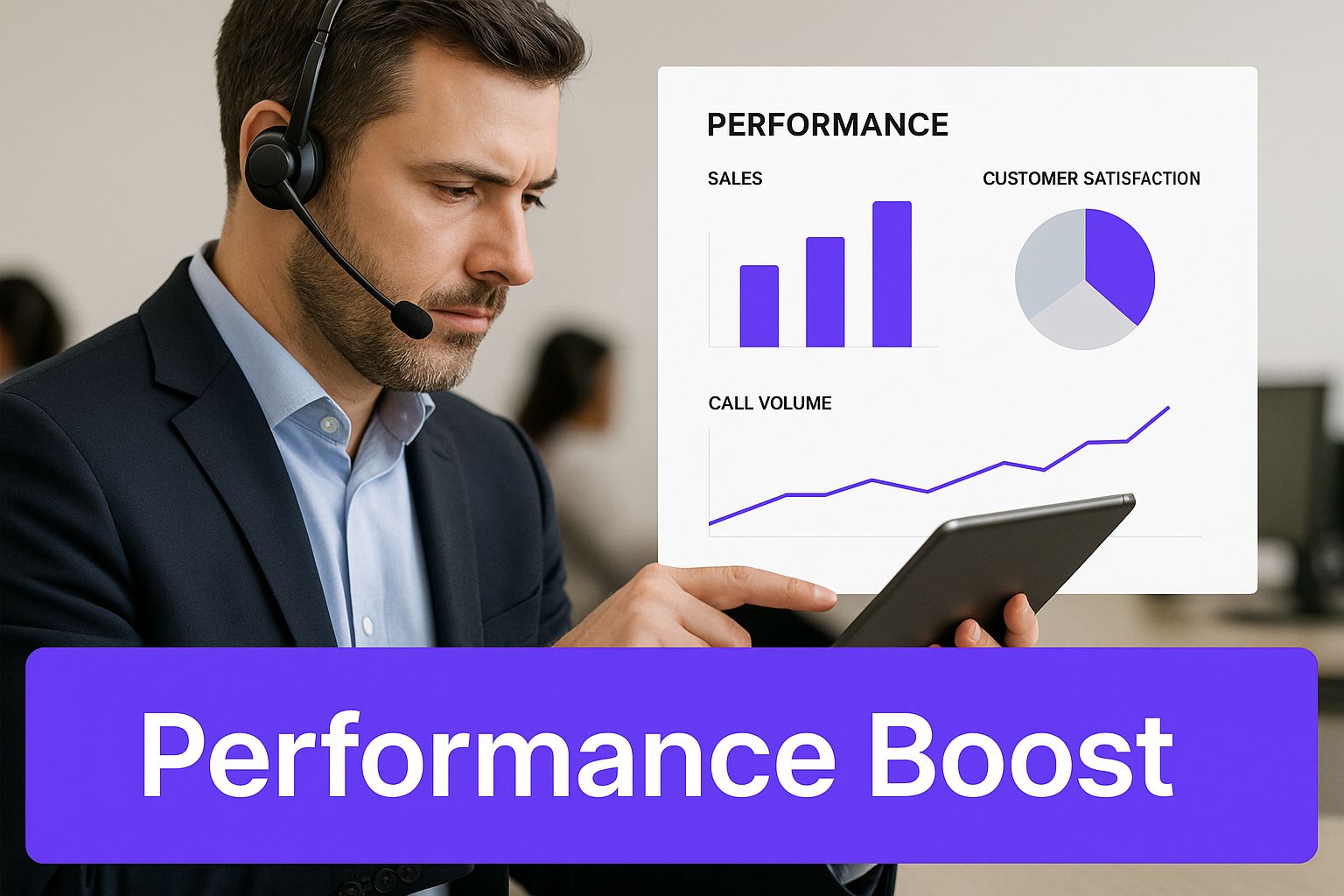
This infographic depicts a call center supervisor reviewing performance charts, highlighting the link between improved KPIs and a "Performance Boost." It emphasizes the importance of data-driven insights in positive change. Monitoring and analyzing these key metrics helps supervisors identify areas for improvement and implement strategies to enhance performance, ultimately boosting productivity and customer satisfaction.
To help illustrate how different KPIs relate to customer satisfaction and how they can be tracked within a quality monitoring framework, let's look at the following table:
Critical Call Center KPIs and Their Target Benchmarks: A comprehensive overview of the most important call center KPIs, with industry benchmarks and how they should be incorporated into quality monitoring forms.
| KPI | Industry Benchmark | Impact on Customer Satisfaction | How to Monitor |
|---|---|---|---|
| First Call Resolution (FCR) | 80% or higher | Directly impacts customer satisfaction; higher FCR means fewer follow-up calls and happier customers. | Track the number of calls resolved on the first attempt vs. total calls handled. |
| Customer Satisfaction (CSAT) | 85% or higher | Measures how satisfied customers are with the service. | Use surveys and feedback forms to directly ask customers about their experience. |
| Average Handle Time (AHT) | 5 minutes (Target for top performers in 2025) | Can positively or negatively impact satisfaction. Fast resolution is good, but rushing can decrease quality. | Measure the average duration of calls. |
This table highlights the importance of balancing efficiency (AHT) with effectiveness (FCR) and its direct link to customer satisfaction (CSAT). By monitoring these metrics, call centers can pinpoint areas needing improvement and enhance overall performance.
Benchmarking and Continuous Improvement
Establish clear benchmarks for each KPI based on industry standards and your own historical data. These benchmarks give agents targets to work towards. However, continuous improvement should be the ultimate aim. Regularly review and adjust your KPIs and benchmarks based on performance data and evolving customer needs. This ensures your quality monitoring form remains a relevant and effective tool for growth. It also allows you to customize evaluations for different interaction types and agent experience levels, promoting fair and targeted assessments.
Designing Forms That Evaluators Actually Want to Use
A well-designed call center quality monitoring form is essential for a successful quality assurance program. Even the most detailed form will be ineffective if it's too cumbersome for evaluators to use. This section explores the human element of form design and offers practical advice on creating user-friendly forms that promote consistent and accurate evaluations.
Intuitive Layouts and Clear Language
The design of your quality monitoring forms has a direct impact on evaluator engagement and the quality of the feedback you receive. A cluttered or confusing layout can quickly lead to evaluator fatigue and inaccurate assessments.
Prioritize intuitive layouts with clear headings, a logical flow, and easily accessible information. This will help evaluators navigate the form quickly and efficiently, enabling them to focus on the actual evaluation.
The language used in the form should also be clear and unambiguous. Avoid jargon or technical terms that may confuse evaluators. For example, instead of using "demonstrates adequate product proficiency," opt for a more straightforward phrase like "clearly explains product features and benefits." Clear language ensures consistent interpretation of the criteria by all evaluators.
Streamlining the Assessment Process with Technology
Technology can significantly enhance the usability of call center quality monitoring forms. Integrating these forms with call recording software, such as Twilio, allows evaluators to easily access call recordings and complete evaluations within a single platform.
This integrated approach eliminates the need to switch between multiple applications, saving valuable time and boosting overall efficiency. Features like automated scoring and reporting further streamline the process. These tools not only save time but also reduce the potential for human error and subjective bias, ultimately leading to more accurate and consistent evaluations.
Balancing Comprehensive Evaluations with Evaluator Efficiency
Finding the right balance between comprehensive evaluations and evaluator efficiency is a common challenge. Overly long or complex forms can overwhelm evaluators, leading to decreased engagement and potentially rushed assessments.
One effective solution is to implement weighted scoring. This approach assigns higher points to criteria that are most critical to customer satisfaction, such as effective problem resolution and demonstrating empathy.
To ensure your form aligns with business-critical KPIs, consider which metrics truly drive success in your customer support efforts. This article on customer support KPIs provides valuable insights into identifying and measuring key performance indicators. Weighted scoring allows for a more focused evaluation while still capturing essential information. Additionally, incorporating conditional logic within the form can dynamically hide irrelevant sections based on previous answers, further streamlining the evaluation process.
Reducing Subjective Bias in Evaluations
Subjectivity can compromise the integrity of any quality assurance program. To mitigate bias, use clearly defined evaluation criteria with specific examples of both good and bad performance. Conducting regular calibration sessions, where evaluators discuss and align their understanding of the criteria, can also help reduce inconsistencies.
These strategies ensure that evaluations are based on objective observations rather than personal opinions. Implementing blind evaluations, where evaluators are unaware of the agent being assessed, can further minimize bias. By addressing these crucial aspects of form design, you empower your evaluators to provide accurate, consistent, and valuable feedback, ultimately driving agent development and enhancing the overall customer experience.
Transforming Evaluations Into Growth Opportunities

The real power of a call center quality monitoring form isn't just about evaluating performance. It's about using it to help agents grow and improve. Top-performing call centers understand this, using these forms as tools for development and turning feedback into opportunities for positive change. This approach creates a culture where quality monitoring is welcomed, not dreaded.
Building Effective Feedback Loops
Turning evaluations into actionable improvements depends on strong feedback loops. This means going beyond simple scores and providing specific, constructive feedback directly linked to the call center quality monitoring form. For example, instead of saying "poor communication," offer concrete examples from the call, pointing out exactly where clarity could be improved.
This targeted approach helps agents clearly understand their weaknesses and take concrete steps to improve. Delivering feedback promptly, while the call is still fresh in the agent's memory, is also crucial. This maximizes the feedback's impact and reinforces the link between evaluation and growth.
Impact-Focused Coaching Sessions
Coaching sessions are key to translating feedback into tangible progress. These sessions should be structured around the call center quality monitoring form, using it as a guide for development. For instance, if the form reveals a weakness in product knowledge, the coaching session could focus on specific product training.
This targeted approach ensures coaching addresses the specific areas needing improvement, making it much more effective. It’s also important to frame coaching sessions as opportunities for growth, not as punishment. This positive framing encourages agents to embrace feedback and actively participate in their own development.
Recognizing and Rewarding Excellence
While addressing weaknesses is important, recognizing and rewarding great performance is just as vital. This creates a positive feedback cycle that reinforces the behaviors you want to see. When an agent excels in areas highlighted on the call center quality monitoring form, acknowledge their achievements. This recognition can range from verbal praise to more tangible rewards. This reinforces positive actions, motivates other agents to excel, and fosters a culture of appreciation and continuous improvement.
Empowering Team Leaders as Coaches
Team leaders are crucial in transforming evaluations into opportunities. They need to be able to use the call center quality monitoring form effectively as a coaching tool. This means understanding the form's nuances and being able to give specific, constructive feedback.
Team leaders should also be trained in effective coaching methods, such as active listening and motivational interviewing. This empowers them to guide agents toward improvement and build a positive learning environment. When team leaders effectively use the quality monitoring form as a developmental tool, it strengthens the entire team and ultimately improves customer experience.
Tracking Improvement and Demonstrating ROI
Tracking agent improvement is crucial for showing the return on investment (ROI) of quality monitoring. This means regularly reviewing quality scores, tracking key performance indicators (KPIs), and gathering customer feedback. By demonstrating the positive impact of quality monitoring on both agent performance and customer satisfaction, you prove its value to the organization. Tracking improvement also helps identify areas where further training or coaching might be needed, ensuring continuous improvement. This data-driven approach validates the importance of quality monitoring and justifies continued investment in its development and use. For home service businesses using Phone Staffer, this directly translates to better lead conversion rates and ultimately, increased revenue.
Customizing Your Form Across Diverse Interaction Types
The effectiveness of a call center quality monitoring form depends on its adaptability to different customer interactions. A generic approach often misses the nuances of various call types. This section explores customizing your forms for effective evaluation without creating extra administrative work.
Tailoring Criteria to Specific Interaction Types
Different interactions have unique objectives and metrics. A sales call prioritizes closing deals and upselling, while technical support focuses on resolution and customer education. Your quality monitoring form needs to reflect these differences.
-
Sales Calls: Focus on lead qualification, needs identification, product presentation, objection handling, and closing techniques. Evaluate how well the agent understands customer needs and tailors their pitch.
-
Technical Support: Prioritize accurate diagnosis, effective troubleshooting, clear explanations, and customer follow-up. Assess the agent’s ability to guide the customer and ensure understanding.
-
Complaint Handling: Emphasize empathy, active listening, problem ownership, and timely resolution. Measure the agent's ability to de-escalate and offer satisfactory solutions.
-
Account Management: Focus on relationship building, proactive service, and identifying growth opportunities. Evaluate how well the agent anticipates needs and personalizes support.
Adapting Weighting Based on Complexity and Objectives
The weight assigned to each criterion should reflect the interaction's complexity and business goals. In a complex technical support interaction, product knowledge and problem-solving might outweigh call opening and closing procedures.
For simpler calls like order confirmations, efficiency and accuracy might take priority. Strategic weighting ensures the evaluation accurately reflects the relative importance of different aspects.
Balancing Script Adherence and Situational Flexibility
While scripts ensure consistency and compliance, too much rigidity can hinder customer satisfaction. Your form should balance script adherence with the flexibility to handle unique situations.
Agents should follow the standard greeting but also adapt their language and approach to connect with each customer personally. This balance between structure and flexibility is crucial for excellent customer experiences.
Learning From Successful Implementations
Many organizations have successfully customized their quality monitoring. Studying their methods provides valuable insights. Some use a modular form design, combining sections for tailored evaluations.
Others use dynamic forms that adapt to the selected call type, streamlining evaluations and ensuring relevance. By learning from best practices, you can create a comprehensive and adaptable form, driving agent improvement and customer satisfaction. For home service businesses using Phone Staffer, this means better lead conversion and business growth. Ready to improve your call center? Learn more about Phone Staffer and its benefits for home service businesses.