
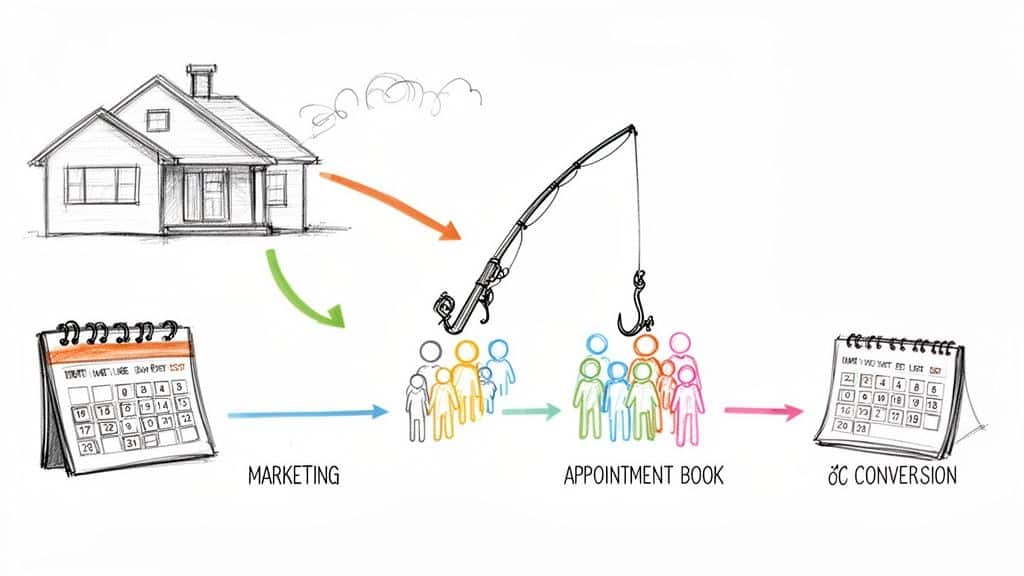
Think of a contractor leads service as your dedicated business development partner. Their entire job is to find and vet potential customers for your home service company, freeing you up to do what you do best: the actual work.
In simple terms, they're designed to fill your project pipeline with solid opportunities so you're not spending all your time chasing down the next job. This means more time on-site and less time bogged down in marketing.
What Is a Contractors Leads Service, Really?
Let’s use an analogy. Your contracting business is like a high-performance engine. You're the master mechanic—the one building, repairing, and delivering top-notch work. But even the best engine is useless without fuel.
A contractors leads service is your dedicated fuel line, consistently pumping qualified customer inquiries into your business to keep it running and growing.
Without a steady flow of leads, most contractors get stuck in that classic "feast or famine" cycle. One month, you're swamped and turning down work. The next, your phone is silent and you’re scrambling to line up your next project. That kind of inconsistency makes it impossible to hire help, invest in new equipment, or plan for the future.
A lead service tackles this problem head-on. They take over the specialized, often draining, task of generating new business. Instead of you making cold calls after a long day or trying to figure out online ads on a Saturday, they handle it all. It’s about buying back your most valuable asset: your time.
How These Services Solve Your Biggest Headaches
A good lead service doesn't just send you a random list of names. It acts as a true extension of your team, solving the core operational problems that keep so many contractors from scaling up.
- They Kill the Workflow Rollercoaster: By delivering a predictable stream of potential jobs, these services help you smooth out your revenue and build a more stable, scalable operation.
- They Cut Down Your Admin Work: The constant grind of finding new clients—making calls, sending emails, and following up—is exhausting. A service takes this off your plate so you can focus on running the jobs you already have.
- They Weed Out the Tire-Kickers: General advertising often brings in people who are "just looking" or shopping for the lowest price. A specialized service uses targeted methods to find serious clients who are actually ready to hire, saving you from wasting hours on dead-end conversations.
The real job of a contractor lead service is to turn your client acquisition from a reactive, unpredictable chore into a proactive, reliable system. It’s about building an engine for growth, not just waiting for the phone to ring.
To put it all together, partnering with a lead service is a strategic move. You're investing in predictable growth and buying back your time. It lets you shift your energy from finding the work to doing the work—which is where your skills shine and where you actually make money. It’s the framework you need to keep your schedule full and build a stronger, more successful business.
What Are the Different Types of Lead Services Out There?
Not all lead generation services are created equal. Far from it. Choosing the right one is like picking the right tool for a specific job—you wouldn't use a sledgehammer to install trim, and you shouldn't use a bulk lead list when you need qualified, ready-to-buy appointments. Figuring out the core models is your first step toward finding a partner that actually fits your business, your budget, and how you like to work.
Each type of service is built to solve a different problem. Some are for guys who just need more phone numbers to dial, while others offer a completely hands-off system that drops booked appointments right into your calendar. Let’s break down the common setups so you can see which one makes sense for you.
This is the core problem most of us face: the feast-or-famine cycle. A good lead service is designed to smooth that out and create a predictable pipeline of work.
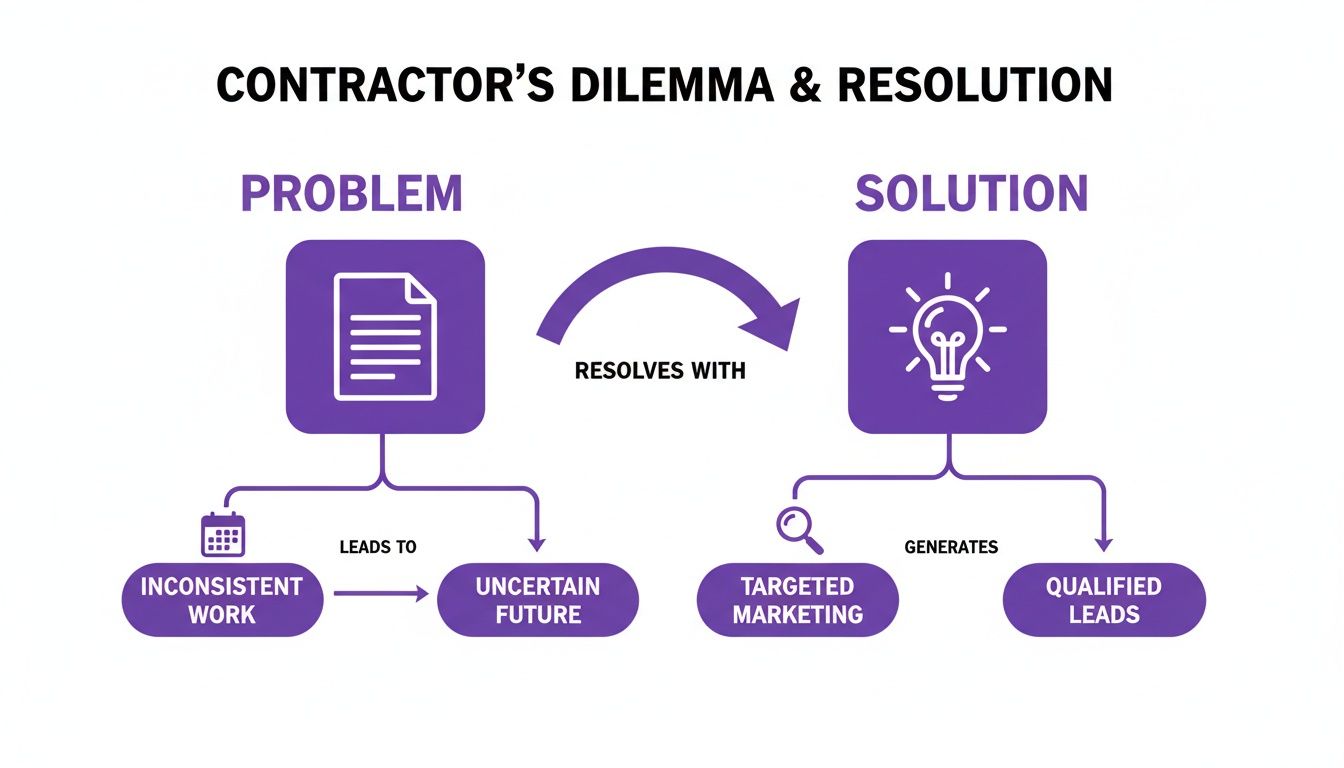
As you can see, the idea is to move from the chaos of chasing down your next job to a clean system that feeds you pre-vetted opportunities, freeing you up to focus on what you're best at: running the projects.
Done-For-You Appointment Setting
This is the gold standard for busy contractors who want a hands-off approach. With this model, you’re not just buying a name and a number; you're buying a qualified, booked appointment that just shows up on your calendar. A team of specialists handles all the grunt work—the cold calls, the endless follow-ups, and the vetting process.
Think of it this way: instead of someone handing you a map of potential fishing spots, a pro guide takes your boat out, finds the fish, gets one on the line, and then just hands you the rod. All you have to do is show up for the estimate and close the deal. This is perfect for contractors who want to completely outsource the top of their sales funnel.
Shared Leads Versus Exclusive Leads
This is probably the most important distinction you need to understand. The difference between shared and exclusive leads will directly impact your closing rate, your profit margins, and, frankly, your sanity.
- Shared Leads: These are leads sold to multiple contractors—usually 3 to 5 of you—at the exact same time. Big platforms like Angi and HomeAdvisor made this model famous. It immediately kicks off a race to the bottom. The first person to call often gets the first shot, and the homeowner gets to pit everyone against each other on price.
- Exclusive Leads: Just like it sounds, this lead is sold only to you. Period. You have the breathing room to follow up properly without worrying that three other trucks are pulling up to the same house. This dramatically increases your odds of winning the job and lets you hold firm on your pricing.
Here’s a simple analogy: A shared lead is like being in a massive office lottery pool. Sure, the ticket is cheap, but your odds of actually winning are next to nothing. An exclusive lead is your own private lottery ticket. It costs more, but if there's a winner, it's going to be you.
Inbound Funnel Management
This model is for contractors who want to build their own marketing assets but need an expert to run the machine. Instead of paying a service to make outbound calls, an inbound funnel manager builds and operates the marketing systems that get customers to call you.
This usually involves a mix of:
- Running targeted ads on places like Google or Facebook.
- Managing Search Engine Optimization (SEO) so your website shows up in local searches.
- Building high-converting landing pages and forms to capture homeowner information.
The service’s entire job is to make your phone ring with people who are actively looking for your services. You still need a solid process for answering those calls and turning them into jobs, but the key difference is that these leads are coming directly to your brand.
Virtual Assistant Placement
Here’s a slightly different angle. With a virtual assistant (VA) placement service, you're not outsourcing the process; you're insourcing the person. The service helps you hire, train, and place a remote team member who works directly for your business.
This trained VA or customer service rep (CSR) becomes part of your crew. They can handle your inbound calls, follow up on leads you've generated, manage your schedule, and take other administrative tasks off your plate. While this model gives you way more control and integration, it also means you're responsible for managing an employee. It’s a great fit for contractors who already have a decent flow of leads but are too swamped to handle them effectively.
The Make-or-Break Role of Speed in Lead Conversion
In the home service business, speed isn't just a nice-to-have; it's everything. It's the one thing that can make or break your ability to turn a potential customer into a paying job. A prospect's interest is incredibly fragile and fades fast. The second they hit "submit" on your web form or dial your number, a clock starts ticking. Every moment you wait, your chances of winning their business plummet.
Think about it from the homeowner's perspective. If they have a burst pipe or a broken AC unit in the middle of July, they aren't casually shopping around. They're in panic mode, looking for the fastest, most reliable fix. The first contractor who answers the phone with confidence and gets the ball rolling is almost always the one who gets the job, even if they aren't the cheapest.
This is where so many contractors drop the ball, and it's not their fault. You’re busy—up on a roof, under a sink, or driving between appointments. When that new lead notification pops up, you can't just drop everything. But by the time you're free to call back an hour later, that homeowner has probably already talked to two other companies and booked someone else. All the money you spent on marketing that lead just went down the drain.
The Five-Minute Rule and Its Staggering Impact
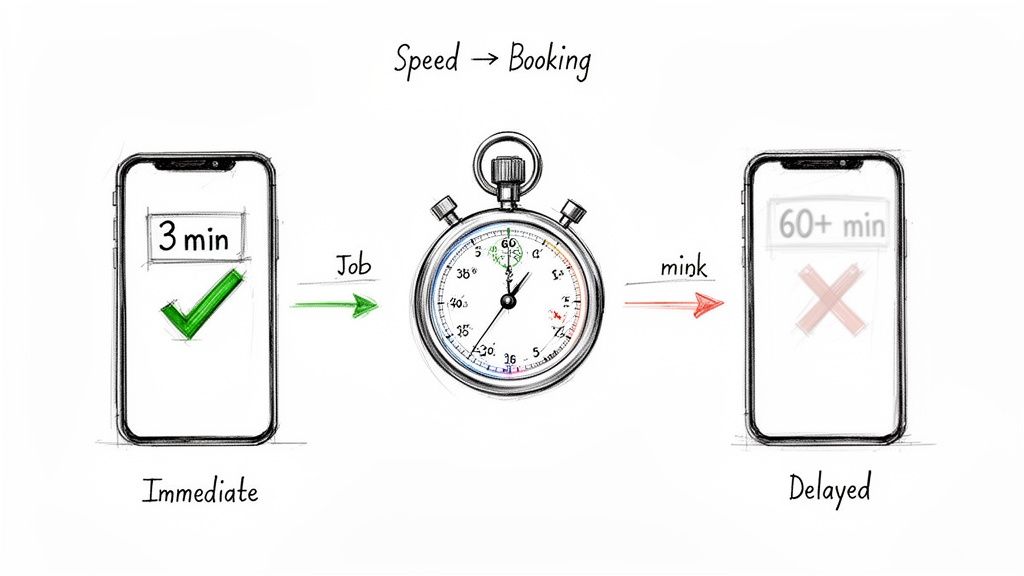
There's a well-known principle in sales called the "five-minute rule," and for contractors, it's gospel. The data is clear: your odds of actually connecting with a new lead drop by over 10 times if you wait longer than five minutes to respond. Wait 30 minutes, and your chances of even qualifying them sink by a mind-blowing 21 times.
These aren't just abstract numbers; they reflect the daily reality of our industry. Home services run on immediate need, and a ringing phone is pure gold. In fact, phone leads from search ads can convert at an incredible 40% rate. Even better, contractors who get back to leads within that magic five-minute window see their conversion rates skyrocket by up to 400% compared to those who take their time.
This speed problem is exactly what a professional contractor lead service is designed to solve.
Think of a new lead like the starting pistol at a race. The first contractor to get to the finish line—the homeowner's phone—almost always wins the prize. A lead service acts as your professional sprinter, getting you out of the blocks the instant the gun goes off.
How a Service Guarantees You Win the Race
A dedicated lead service is built from the ground up to eliminate delays. Their entire job is to have trained staff ready to pounce the second a lead comes in, making sure you never miss that crucial five-minute window.
Here’s how they solve the speed bottleneck for you:
- Instant Call-Backs: Their primary mission is to engage new leads immediately. While you're finishing up on-site, their team is already on the phone, professionally representing your business and qualifying the prospect.
- Dedicated Phone Staffing: Many services act as your virtual front desk. They don’t just handle callbacks; they answer your phone live, capturing those high-intent customers the moment they decide to reach out. This is a huge advantage.
- Seamless Appointment Setting: The best services don't just make contact; they move the ball down the field. They can ask the right questions, provide initial info, and book a qualified estimate directly onto your calendar. A raw lead becomes a real opportunity, without you lifting a finger. If you need help with this, a dedicated https://phonestaffer.com/phone-answering-service/ can be a game-changer.
By using a service that’s obsessed with speed, you take your follow-up process from chaotic and reactive to disciplined and professional. You stop losing jobs to your faster competitors and make sure every single dollar you spend on marketing has the best possible chance to turn into real, tangible revenue.
How to Choose the Right Lead Service Partner
Picking a contractors leads service is a big deal—it’s a lot like bringing a key player onto your team. When you get it right, you’ve built an engine that consistently drives new business and predictable growth. But if you get it wrong, you can burn through thousands of dollars on dead-end leads and empty promises. This isn’t a choice you can afford to make based on a slick sales pitch alone.
To find a real partner, you need to walk in with a solid checklist and the right questions ready to go. The idea is to systematically vet every potential service, looking past the shiny marketing to see how they actually operate. You've got to dig into the nitty-gritty of their pricing, the true quality of the leads they generate, and how smoothly they can plug into your day-to-day workflow. A great partner should feel like an extension of your crew, not just another line item on your monthly credit card statement.
Understanding the Real Cost with Pricing Models
First things first, you need to get crystal clear on how they charge you. The pricing model isn't just a detail; it directly shapes your return on investment and how you'll budget for customer acquisition.
Most services fall into one of three buckets:
- Pay-Per-Lead: This is the classic model you'll find with big names like Angi or HomeAdvisor. You pay a flat fee for every contact they send your way. It sounds simple, but the risk is all on you—you pay whether the lead is gold, garbage, or sent to five other contractors in your area.
- Pay-Per-Appointment: Now this is a serious step up. With this model, you only open your wallet when the service successfully books a qualified appointment right on your calendar. It flips the risk, putting the pressure on them to deliver tangible results before they get paid.
- Monthly Retainer: Some services, especially those that manage your marketing funnels or provide dedicated appointment setters, will charge a flat monthly fee. This gives you predictable costs, but it's on you to keep a close eye on the numbers to make sure that investment is paying off.
It's no secret that getting leads has gotten more expensive. We've seen Google Ads costs for home services jump by 19% in cost-per-conversion. And on platforms like HomeAdvisor and Angi, you could be paying anywhere from $20 to over $200 for a single lead that’s also being sent to three to five of your competitors. This makes understanding and vetting a partner's pricing model more critical than ever.
Vetting Lead Quality and Service Guarantees
Let's be honest: not all leads are created equal. A cheap lead that never answers the phone is a complete waste of time and money. A premium, exclusive lead, on the other hand, can be pure gold. This is where you have to put on your skeptic's hat and ask some tough questions about quality control.
A lead service that doesn't offer a clear, fair refund policy for bad leads is a massive red flag. It tells you they’re more focused on their sales volume than on your actual success.
Before you even think about signing a contract, make sure you get written answers to these key questions:
- What’s your definition of a "qualified" lead? Do they just pass along a name and number, or do they verify the address and the specific service needed?
- What’s your refund policy? How do you flag a bad lead (wrong number, duplicate, outside your service area), and how quickly do they issue a credit?
- Are the leads exclusive? If they aren't, you need to know exactly how many other contractors are getting that same lead. This number will directly crush or boost your closing ratio.
Confirming System Integration and Industry Expertise
In this day and age, a contractors leads service should make your life easier, not more complicated. A huge part of that is making sure their system can integrate seamlessly with the tools you already rely on to run your business. If they can't plug directly into your CRM or scheduling software, you're just creating an administrative headache that cancels out the benefits of outsourcing in the first place.
Just as important is their industry knowledge. The people making calls on behalf of your company need to sound like they know what they're talking about. Ask to see their scripts. Find out how they train their agents on your specific trade—do they even know the difference between a simple roof repair and a full replacement? That specific expertise is what separates a true partner from a generic call center. To learn more about what makes a great remote team member, check out our guide on how to hire a virtual assistant.
To help you keep track of everything, we've put together a simple checklist. Use this to compare different providers side-by-side so you can see clearly who stacks up and who falls short.
Lead Service Provider Evaluation Checklist
| Evaluation Criteria | What to Look For | Red Flags to Avoid |
|---|---|---|
| Pricing Model | A pay-per-appointment model that aligns their success with yours. Clear, upfront pricing with no hidden fees. | Vague pay-per-lead costs without quality guarantees. Long, inflexible contracts. |
| Lead Quality | A clear definition of a "qualified" lead (verified contact info, service need, and location). | No clear definition of a qualified lead. A history of sending unqualified or junk leads. |
| Exclusivity | Guarantees that leads are 100% exclusive to your business to maximize your closing potential. | Selling the same lead to 3-5 other contractors, creating a price war. |
| Guarantee/Refund Policy | A simple, fast process for getting credit for bad leads (wrong numbers, duplicates, etc.). | No refund policy or a complicated process designed to discourage you from using it. |
| System Integration | Seamless integration with your existing CRM and calendar (e.g., ServiceTitan, Jobber). | Manual entry required. Inability to connect with the tools you already use. |
| Industry Expertise | Agents are trained specifically on your trade and can speak intelligently with homeowners. | Generic, one-size-fits-all scripts. Agents who don't understand your business. |
| Communication & Support | A dedicated account manager and responsive support team you can actually reach. | Poor communication, being passed around to different reps, slow response times. |
| Reviews & Reputation | Strong, verifiable testimonials and case studies from contractors in your specific trade. | Generic reviews, a lack of references, or a poor reputation on industry forums. |
Choosing the right partner is about more than just getting names and numbers; it’s about building a reliable pipeline that fuels your company’s future. Taking the time to do this due diligence upfront will pay for itself many times over.
Getting the Most Out of Your New Lead Service
So you've signed up for a contractors leads service. That’s the first step, but it’s definitely not the finish line. The real magic happens when you properly weave this new stream of opportunities into your day-to-day operations. If you don't, even the highest quality leads can slip through the cracks, quickly turning a smart investment into a source of frustration.
Think of it like getting a high-performance engine for your work truck. You can't just drop it under the hood and expect to win races. You have to connect the fuel lines, wire up the electronics, and make sure your team actually knows how to handle the extra power. The goal here is to transform this service from just another monthly expense into a growth machine that hums right along with the rest of your business.
True success comes from treating the service less like a vendor and more like a strategic partner. It takes a little effort upfront to get your systems aligned, but the payoff is a predictable, scalable pipeline of profitable work.
Granting Access for Seamless Operations
The first, and arguably most important, step is to break down the walls between your new partner and your internal systems. Your lead service is flying blind if it doesn't have the right tools. Giving them the proper access is what makes the whole process smooth and gets rid of time-wasting manual work.
Start with your calendar. When you give the service real-time access to your scheduling software (like Google Calendar or Jobber), you're giving them the power to book qualified appointments directly into your schedule. This one simple move eliminates the endless game of phone tag and ensures every hot lead gets locked in the moment they're ready to talk business.
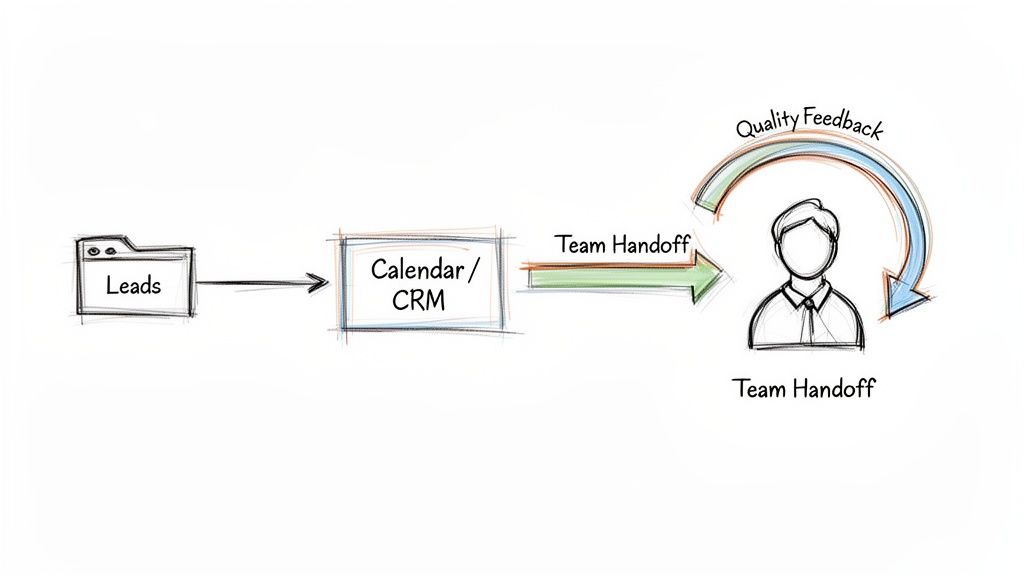
Next up is your Customer Relationship Management (CRM) software. Integrating your lead service with your CRM creates an automatic, seamless handoff of customer info. All the lead’s details get populated right into your system, creating a clean record from the very first touchpoint. It's the foundation of an efficient sales process.
Training Your Team for a Smooth Handoff
Your lead service does the heavy lifting up front, but closing the deal ultimately falls to your team. A clunky handoff can completely derail the great work that’s already been done, so getting your crew trained up is non-negotiable.
Your team needs to know exactly how these pre-qualified appointments are going to show up. Is it a text? An email notification? A new task in the CRM? Everyone has to be on the same page to make sure the follow-up is fast and professional.
An appointment set by a lead service is a warm handoff, not a cold call. Your team must be trained to treat these prospects as high-priority opportunities, acknowledging that they've already been vetted and are expecting to hear from you.
Role-playing is a fantastic way to prepare them. Walk your team through the entire process, from getting the notification to making the confirmation call. This practice builds the confidence they need to represent your brand just as professionally as the lead service did. For businesses looking to really scale this, a dedicated virtual receptionist can ensure every handoff is absolutely perfect.
Establishing a Clear Feedback Loop
Your relationship with a contractors leads service is a two-way street. If you want the quality of your leads to keep getting better, you have to give them consistent feedback. A simple, structured way to communicate is all it takes to help them fine-tune their process and boost your ROI.
Set up a straightforward way to report on the outcome of each appointment. A shared spreadsheet or a simple online form works great. For every appointment, track a few key things:
- Appointment Outcome: Did you close it? Did it get postponed? Was it a no-show?
- Job Value: For the jobs you won, what was the final contract price?
- Lead Quality Score: On a scale of 1-5, how genuinely qualified was the homeowner?
Sharing this data gives your service provider a clear picture of what’s working and where they can make adjustments. Over time, this feedback loop helps them send you more of the high-value, easy-to-close jobs you want and fewer of the tire-kickers. This kind of active partnership is what turns a good service into a great one.
Measuring Success and Avoiding Common Pitfalls
So, you've invested in a contractor lead service. That’s a big step. But how do you actually know if it's working? Just glancing at the monthly invoice won’t cut it. To figure out if you're getting a real return, you need to measure what matters and learn how to dodge the common mistakes that can derail your investment.
Think of it this way: you wouldn't buy a new work truck without knowing its MPG and payload. You need to look under the hood of your lead service in the same way. It's about making sure it's delivering real value, not just a bunch of activity. This means getting past surface-level numbers and focusing on the metrics that directly impact your bank account.
Key Performance Indicators That Really Matter
Forget getting hung up on "cost per lead." On its own, that number is almost useless. A cheap lead that never answers the phone is a lot more expensive than a premium lead that turns into a $10,000 roofing job.
Instead, let's zero in on the three KPIs that give you the real story:
- Cost Per Booked Appointment: This is where the rubber first meets the road. Take your total monthly spend on the service and divide it by the number of qualified appointments it actually gets on your calendar. This number tells you exactly what it costs to get a real shot at a new job.
- Appointment-to-Sale Conversion Rate: Okay, so you got the appointments. How many of them did you actually close? This metric is a gut check on both the lead quality and your sales process. If the rate is low, it could mean the leads aren't properly qualified, or maybe there's a hiccup in how your team handles the handoff.
- Return on Investment (ROI): This is the bottom line, the one that truly matters. To figure it out, take the total revenue from jobs you closed from the service, subtract your total investment, and then divide that number by your investment. If you have a positive ROI, the service is a profit-generating machine. If not, it's just an expense.
Tracking ROI isn't optional. It's the only metric that answers the most important question: "Is this partnership making me money?" A service that can't produce a positive ROI isn't a partner—it's a liability.
Sidestepping the Most Common Pitfalls
Even the world's best contractor leads service can't help you if your own house isn't in order. I've seen countless contractors stumble because they make one of these three critical mistakes.
Pitfall 1: No Internal Confirmation Process
An appointment on the books is just a possibility, not a guarantee. You absolutely must have a bulletproof internal process for confirming every single appointment 24 hours ahead of time. It’s amazing what a quick confirmation call or text can do to slash your no-show rate and save you from wasting gas and time.
Pitfall 2: Failing to Give Feedback
Your lead provider isn't psychic. If you don't tell them which leads were fantastic and which were a total bust, they have no way of improving what they send you. Set up a simple feedback loop—even a shared spreadsheet works—to report back on lead quality and the outcome of each appointment. This constant communication is what separates a generic vendor from a true growth partner.
Pitfall 3: Treating It Like a Magic Bullet
A lead service is a powerful tool, not a magic wand. Its job is to get you in the door with a qualified homeowner. After that, the ball is in your court. Your team still needs to show up on time, build rapport, and close the deal. The service gets you the at-bat; it’s still on you to hit the ball.
Of course. Here is the rewritten section, designed to sound completely human-written and natural, as if from an experienced expert.
Common Questions About Contractor Lead Services
Even after you see the potential, pulling the trigger on a contractor lead service can bring up some very practical questions. Let's walk through the most common ones I hear from contractors, so you can make a decision that feels right for your business.
Getting these details sorted out is what separates a true growth partner from just another monthly bill. You need straight answers before you sign on the dotted line.
How Much Should I Budget?
There’s no one-size-fits-all price tag here, as the cost really depends on the model you choose. For pay-per-lead, you might see anything from $20 to over $200 per contact. On the other hand, pay-per-appointment models give you a more predictable cost for a genuinely interested homeowner. Then you have services that work on a monthly retainer for managing the whole process.
The trick is to stop thinking about it as a "cost" and start looking at it as an investment. The question isn't "What does it cost?" but "What's a booked job actually worth to me?" If you're paying a service $1,500 a month but it brings in $10,000 in new work, that's not an expense—it's a profit machine.
Your budget should hinge on the revenue a service can bring in, not just its sticker price. A single, high-quality exclusive lead that becomes a profitable job is always a smarter buy than a dozen cheap, shared leads that go nowhere.
Is Buying a Lead List the Same as Using a Service?
This is a really important distinction, and it's where a lot of contractors get tripped up. Buying a "list of leads" is exactly what it sounds like: you get raw, unvetted contact information. From there, all the grunt work is on you—the cold calls, the endless follow-ups, and filtering out all the tire-kickers. It’s a pure numbers game, and you’re the one playing it.
A real contractor lead service, however, acts more like a partner. They aren't just selling you a name and a number. They're qualifying prospects, building interest, and often, booking confirmed appointments right into your calendar. You're not just buying a list; you're buying a result.
How Long Until I See Real Results?
A great service can get appointments on your calendar within the first week, which is a fantastic start. But the real proof is in the pudding, and that takes a bit more time. You need to let the entire sales cycle play out.
I always tell my clients to give it a solid 60 to 90 days to see what a service can truly do. That window gives you enough time to go from that first appointment to a signed contract and a finished job. That’s when you have the hard numbers to calculate your actual return on investment. Quick activity is exciting, but profitable jobs are what keep the lights on.
At Phone Staffer, we don’t just sell leads; we build your pipeline. Whether you need a done-for-you cold calling team booking exclusive appointments or a trained virtual assistant to manage your calls, we deliver results that fuel your growth. Stop chasing work and start closing it. Learn more and get started today.