
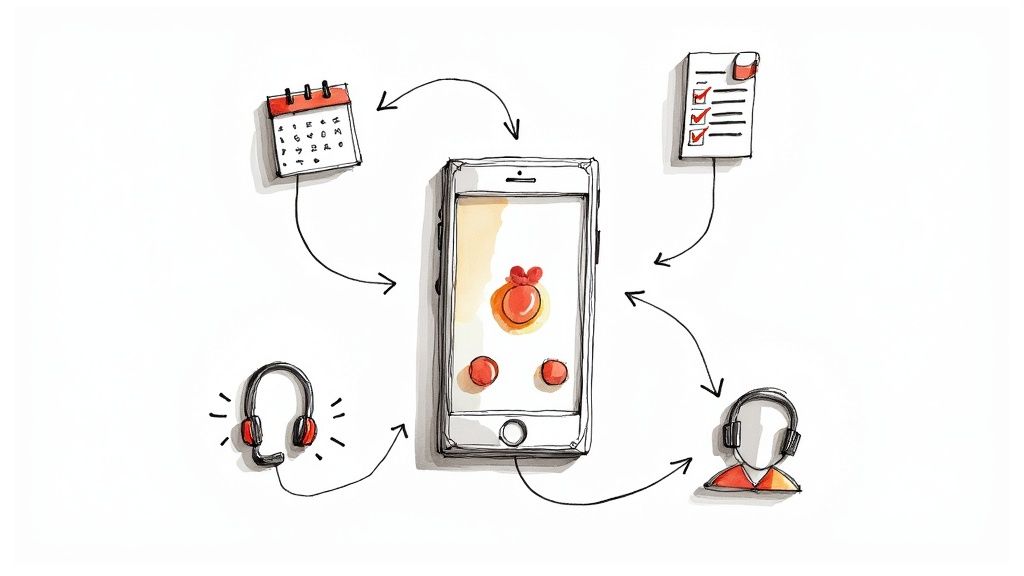
That ringing phone isn't just an interruption—it's your single best shot at landing a new customer. For any home service business, those first 10 seconds of a call are the entire ballgame. It's the moment you prove you're a trusted professional, not just some disorganized one-man show.
A polished, confident greeting does more than just sound good. It sets the stage for the whole interaction and can be the deciding factor that gets you the job.
Think about it from the customer's perspective. When someone calls you about a leaky pipe or a dead furnace, they're already stressed out. A fumbled or rushed "hello?" only makes things worse. Your calm, organized voice can be the very thing that convinces them to stop shopping around and book with you instead.
The High Stakes of Just Picking Up the Phone
Here’s a crazy thought: simply answering your phone gives you a massive advantage. It turns out that only about 38% of small businesses actually answer their incoming calls. That means nearly two-thirds of your competitors are letting potential customers go straight to voicemail. That’s a terrible experience for someone who needs help now.
Customer expectations are higher than ever, with 77% wanting an immediate response when they pick up the phone. You can dig into more of these business phone statistics to see just how much responsiveness matters, but the takeaway is simple.
Your ability to answer the phone isn't just good manners; it's a powerful competitive weapon. While everyone else is sending calls to a machine, your live answer is actively capturing the business they’re leaving on the table.
The Three Pillars of a Perfect Opening
A great opening isn't complicated. It’s built on three simple components that work together to build trust and take control of the conversation right from the start. Getting this structure down ensures every call, whether answered by you or a team member, sounds consistently professional.
-
A Warm Welcome: Kick things off with something positive and welcoming. A simple "Thank you for calling" or "It's a great day at…" immediately sets a friendly, customer-first tone.
-
Clear Identification: State your company name, then your first name. For example, "Thank you for calling Apex Plumbing, this is Sarah." This instantly lets the caller know they’ve reached the right place and eliminates any confusion.
-
A Direct Offer to Help: The final piece is transitioning the call directly to their needs. Finish your greeting with a straightforward question like, "How can I help you today?" This shows you’re ready to jump in and solve their problem.
Here’s a quick reference table with a few scripts your team can use to nail that first impression every single time.
Winning Phone Greeting Scripts for Home Service Pros
| Caller Situation | Greeting Script Example | Primary Goal |
|---|---|---|
| Standard Incoming Call | "Thank you for calling Pristine Plumbing, this is Mike. How can I help you?" | Professionalism & Efficiency |
| High-Urgency Service | "It's a great day at Rapid Response HVAC, you're speaking with Maria. How can I direct your call?" | Convey Confidence & Urgency |
| Follow-Up Call | "Welcome back to Guardian Electric, this is Tom. Do you have a job number or the name of the technician you're looking for?" | Acknowledge Relationship & Speed |
| After-Hours/Emergency | "You've reached our 24/7 line at First Choice Restoration, this is Jessica. How can I help you this evening?" | Reassurance & Availability |
Having these simple scripts handy ensures that even on a hectic day, your team projects the calm, professional image that wins jobs and builds trust from the very first word.
Guiding the Conversation from Hello to Booked
A confident, professional greeting earns you the right to start asking questions. From there, the real art of answering the phone is skillfully guiding the caller from their initial problem to a booked appointment on your calendar. It's all about taking control of the conversation—not in a pushy way, but by leading it with a clear purpose.
Your job is to become an expert information-gatherer. And your best tool for that? Active listening. Don't just wait for your turn to talk; really hear what the caller is saying. Do they sound stressed out? Unsure of what the real problem is? Picking up on these little cues helps you build rapport and tailor your response.
This simple flow is the backbone of a successful service call.
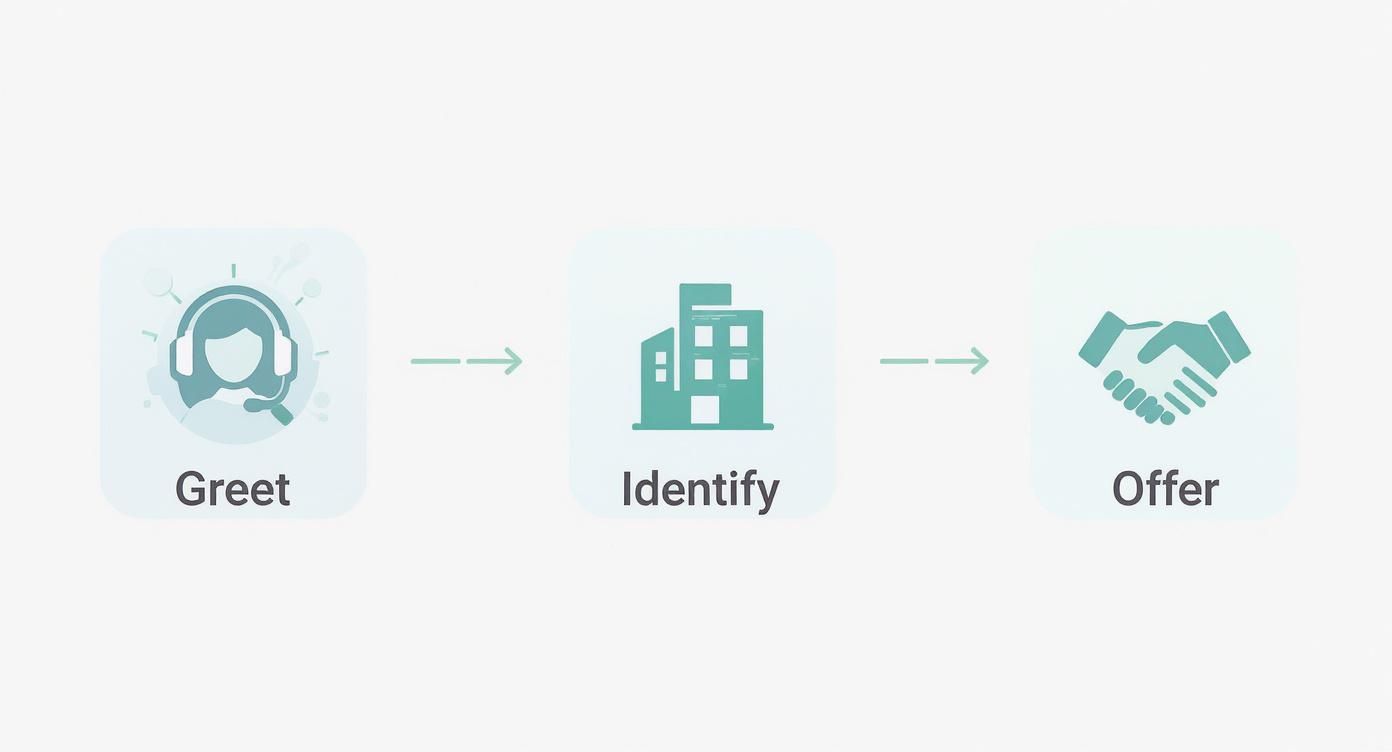
Each step naturally builds on the last, moving the caller smoothly from their first contact toward the solution you can provide.
Asking the Right Qualifying Questions
You can't solve a customer's problem until you fully understand it. Qualifying questions are your way of getting right to the heart of the matter, helping you figure out the urgency, scope, and specific nature of the job. You're not just taking an order; you're diagnosing a situation.
The best way to qualify is to move from broad questions to more specific ones.
- Start with open-ended questions: Get them talking with something like, "Can you tell me a little more about what's going on with your air conditioner?"
- Dig into specific details: Follow up to clarify the scope. "Is this affecting the entire house or just one room?" or "Is this the first time you've noticed this issue?"
- Gauge the urgency: You need to know their timeline. A simple "How long has this been happening?" helps you prioritize their call and manage their expectations.
This kind of structured questioning is what helps you tell the difference between a simple clogged drain and a potential sewer line break, ensuring you send the right tech with the right tools.
The quality of your questions directly impacts the quality of the appointment you book. Vague information leads to scheduling mistakes and unprepared technicians, while precise details ensure a smooth service call from start to finish.
Securing the Appointment with Confidence
Once you have the essential details, it's time to transition into booking the job. This is the moment you turn a phone call into actual business. You need to frame the appointment as the clear, logical next step to solving their problem.
First, confirm the key details back to the customer: their name, address, phone number, and a quick summary of the issue. Then, offer a specific time slot. Don't ask, "When are you free?" Instead, say, "I have an opening for a technician tomorrow between 10 AM and 12 PM. Does that work for you?" This assertive approach makes the decision simple for the customer. Honing your team's skills here is critical, and dedicated training on effective appointment setting techniques can make a world of difference.
Even with all the digital channels available, the power of a direct conversation hasn't faded. In fact, the global phone conferencing market is projected to hit $12.3 billion by 2025. This shows just how indispensable clear, direct talk is for business. By mastering this process, you make booking a service with your company feel easy, professional, and reassuring.
Navigating Objections and Difficult Callers
Let's be real—not every call is going to be a simple, straightforward booking. Your team will inevitably face objections and deal with frustrated, sometimes even angry, customers. How you handle these moments is what separates a good company from a great one.
The key is to train your team to see these challenges not as roadblocks, but as genuine opportunities to build trust and show what you're made of.
When a customer pushes back on price or scheduling, it's rarely a hard "no." It's usually a request for more information or reassurance. Equipping your CSRs to handle these conversations with empathy and confidence is non-negotiable.
Addressing Common Home Service Objections
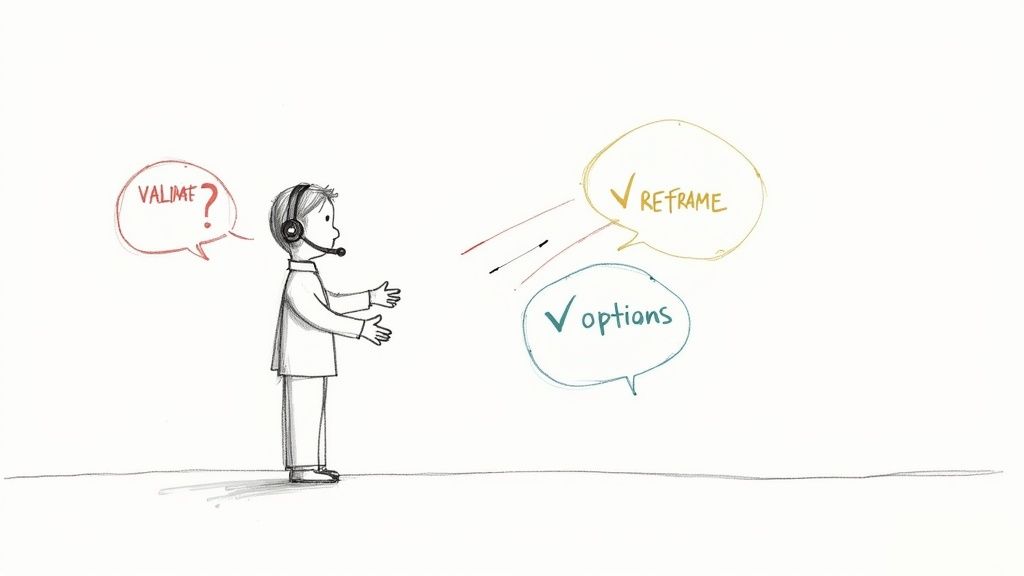
In the world of home services, objections almost always boil down to two things: price and scheduling. Having a solid, practiced response ready can turn a potential dead end into a booked job.
When they say: "Your price seems high."
- Avoid: Immediately jumping to defend the price or getting flustered. That just creates conflict.
- Instead, try: "I understand. To make sure we're comparing apples to apples, could I explain what's included in that quote? We use fully certified technicians and back all our work with a guarantee, which gives our clients a lot of peace of mind." This shifts the conversation from cost to value.
When they say: "I need someone here today, and you can't come until tomorrow."
- Avoid: A blunt, "Sorry, we're booked." This sounds like you don't care about their emergency.
- Instead, try: "I know how urgent this is for you, and I really wish we could get there sooner. Our first available spot is tomorrow morning. Should I lock that in for you before it's gone? I can also add you to our priority cancellation list in case anything opens up today." This validates their urgency while offering the very next best solution.
The goal isn’t to "win" an argument; it’s to make the customer feel heard and understood. Acknowledge their concern, validate their feelings, and then gently pivot back to the solutions and value your company provides.
De-Escalating Frustrated Callers
Sometimes, a caller is already upset the moment you say hello. Their AC is out on a 95-degree day, or a pipe just burst and is flooding their laundry room. In these high-stress situations, your team's first job is simply to de-escalate.
The most powerful tool for this is active listening. Just let the customer vent without interrupting. Research on customer interactions shows a staggering 91% of people get frustrated when they have to repeat their issue. By listening carefully the first time, you show respect for them and their problem.
When you're in the thick of it, you need proven strategies to handle difficult customers like a pro. Start with empathetic phrases like, “That sounds incredibly frustrating,” or “I can certainly see why you’re upset.”
Once they've had a chance to speak, summarize their problem back to them.
For example: “Okay, so just to confirm, your basement is flooding, and you need a plumber out immediately. Is that correct?”
This one small step proves you were actually listening. It instantly shifts the dynamic from confrontational to collaborative. Only then can you begin outlining the solution, turning a nightmare call into a showcase of your company's reliability under pressure.
Don't Let Calls Slip Through the Cracks: Your Voicemail and Routing Plan
Look, you're not going to catch every single call. It’s just not possible. But what you can control is the experience a customer has when you don't pick up. That's where a solid plan for voicemail and call routing becomes your safety net.
Think of it this way: a generic, full, or non-existent voicemail is a huge red flag. It tells a potential customer you're disorganized, and they'll probably just call the next company on the list.
Nail Your Voicemail Greeting
Your voicemail message needs to be short, professional, and clear. The goal is simple: reassure the caller they've found the right place and tell them what to do next. A great voicemail greeting really only needs three things.
First, state your business name right away. It confirms they dialed correctly. Next, give them the key info, like your hours or a quick reason you couldn't answer. Finally, and most importantly, set a clear expectation. Tell them what details to leave and when you'll call them back.
Here’s a script that works every time and is easy to adapt:
"You've reached Apex Plumbing. We are currently assisting other customers or it is outside of our normal business hours of 8 AM to 5 PM, Monday through Friday. Please leave your name, phone number, and a brief message, and we will return your call within one business hour. Thank you."
This is perfect. It’s professional, gets all the necessary info across in under 20 seconds, and builds trust by letting the caller know exactly when to expect a response. That’s how you get people to actually leave a message.
Set Up Smart Call Routing
Voicemail is only half the battle. A smart call routing strategy is what separates the pros from the amateurs. It’s all about getting the call to the right person on your team without playing phone tag. This is how you really start to answer business phone calls efficiently as you grow.
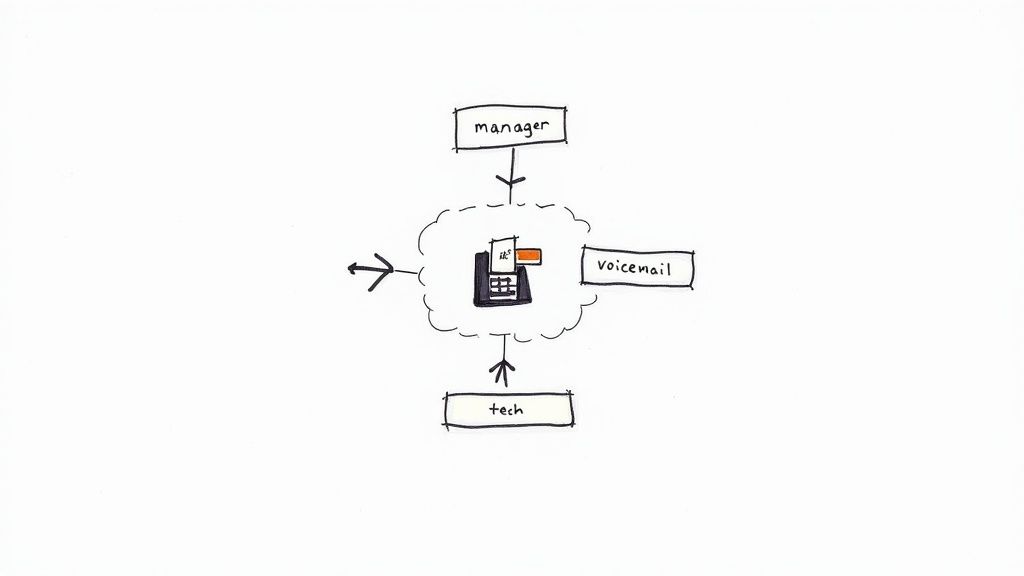
Not every call needs to land on your desk. A good system can automatically direct callers based on what they need.
- Billing Questions? Send those straight to your office manager.
- Technical Questions About a Job? That call should go to the lead tech or project manager.
- New Service Inquiries? These are gold. Route them directly to your best-trained CSR or salesperson who can close the deal.
Getting this right is becoming a huge focus for businesses. The global call center market ballooned to $352.4 billion in 2024 and is on track to hit $500.1 billion by 2030. That growth is all about tech that makes call handling smoother. Check out more of these contact center benchmarks and statistics to see where the industry is heading.
By setting up a clear routing plan, you create an effortless experience that makes your company look incredibly professional and simply run better.
You can't fix what you don't measure. Answering the phone effectively is a genuine skill, and just like any other part of your home service business, you need clear metrics to see what’s actually working and what's falling flat. This is all about shifting from guesswork to making smart, data-backed decisions that boost your booking rates.
The good news? You don't need a complex, expensive dashboard to get started. Just focusing on a handful of key performance indicators (KPIs) will tell you a ton about your customer experience and where your team shines.
https://www.youtube.com/embed/LRJXMKZ4wOw
Key Phone Metrics for Home Service Businesses
The right numbers tell a story. They might show you that your team needs more training on handling a specific objection, reveal your busiest call times, or even be the sign you need to finally hire another CSR.
To get a clear picture of what's happening on your phone lines, start with these essential metrics:
- First Call Resolution (FCR): What percentage of calls get fully resolved on the first try, with no need for a callback? A high FCR is a golden metric. It means your team is efficient, and your customers are walking away happy.
- Call Abandonment Rate: This is the percentage of people who hang up before ever speaking to a human. If this number is high, it’s a major red flag that your wait times are too long or your phone menu is frustrating customers.
- Average Handle Time (AHT): This tracks the total time a CSR spends on a call from start to finish, including any notes they take afterward. You want efficiency, of course, but an AHT that’s too low can mean your team is rushing and not qualifying leads properly.
Tracking these simple metrics is the first step toward building a predictable, scalable customer service machine. They give you the hard data needed to coach your team effectively and make smart hiring decisions.
For a powerful real-world example, just look at Vodafone's 80% First Call Resolution success. It’s a perfect case study on how zeroing in on a single metric can create massive improvements.
Hiring and Training Remote CSRs
As your business grows, bringing on remote customer service representatives (CSRs) or virtual assistants (VAs) to handle calls is a logical next step. But finding the right person is everything—they are the first impression, the voice of your company.
When you're hiring, look beyond just basic phone skills. You need someone with genuine empathy, who can think on their feet, and is obsessively detail-oriented. I always recommend using role-playing in interviews. Create a scenario with a difficult caller or a complex scheduling request and see how they react under pressure. Ask them to book a fake appointment to see if they can gather all the critical details accurately.
Once you find your person, the training needs to be rock-solid. Don't just hand them a script and throw them to the wolves.
Your process should look something like this:
- Software Immersion: They need to become an expert in your booking software before they ever speak to a real customer. Have them practice scheduling, rescheduling, and finding customer history until it's second nature.
- Script and Objection Practice: Role-play is your best friend here. Have them practice your scripts for greetings, qualifying questions, and common objections until they sound confident and natural, not like they're reading from a page.
- Shadowing and Reverse Shadowing: First, let them listen in on live calls with one of your seasoned pros. Once they’re comfortable, have them take the lead on calls while an experienced team member listens in, ready to provide constructive feedback right after.
A well-trained CSR, whether they're in your office or working remotely, is more than just an order-taker. They become a true asset who not only books more jobs but also builds your company's professional reputation, one call at a time.
Got Questions About Answering Your Business Calls?
Even with the best training, your team will inevitably run into tricky situations on the phone. It just comes with the territory. Having a solid game plan for these common questions ensures your team can handle anything a caller throws their way, looking like a total pro every time.
Here are some of the most frequent challenges we see and how to knock them out of the park.
How Should We Handle Angry or Frustrated Callers?
First thing's first: stay cool and let them vent. Never, ever interrupt. Your only goal at the start is to bring the temperature down, and that begins with listening and showing some genuine empathy. Simple phrases like, "I can definitely understand why you're upset about that," go a long way in validating their feelings.
Once they've had their say, repeat the core of the problem back to them. This one small step proves you were actually listening. Then, and only then, tell them exactly what you're going to do next to start making it right. Just be sure you don't make a promise you can't keep—that's a surefire way to make a bad situation worse.
What’s the Best Way to Deal with Spam Calls?
Telemarketers are a massive time-waster for any busy home service company. The most effective way to handle them is with a polite but firm script that gets you off the phone fast. You don't need to be rude, just direct.
Something as simple as, "Thanks for the call, but we're not interested. Please add us to your do-not-call list," is perfect. Don't get drawn into a conversation or answer their questions. If the same numbers keep popping up, it's probably time to invest in a good call-blocking service. Your team's time is far too valuable to waste on calls that don't lead to jobs.
A recent study found that a staggering 91% of customers get frustrated when they have to call a company more than once for the same issue. It’s a powerful reminder to get it right the first time, whether you're solving a real problem or just shutting down a spammer.
What Information Is Absolutely Critical to Get on Every Call?
For any service call, there are a few pieces of information you have to get right, no exceptions. Missing just one of these details can cause a world of headaches and delays later on.
Make sure your team has a mental (or physical) checklist that includes:
- The caller's full name
- The best number to call them back on
- The complete service address (don't forget the zip code!)
- A clear, detailed description of what's going on or what service they need
It’s also a great idea to ask, "How did you hear about us?" This is marketing gold. It tells you exactly which of your ads are actually working and where you should be spending your money.
How Quickly Should We Return a Missed Call?
In the home service world, speed is the name of the game. A customer with a leaky pipe or a broken AC isn't going to sit around waiting for a callback. The reality is, most businesses miss about 22% of their calls, which is a huge opening for the competitor who picks up the phone.
You should be aiming to return every missed call within one hour, max. But if you really want to stand out, get back to them in 15-30 minutes. Customers almost always call multiple companies, and more often than not, the first one to respond gets the job. A quick callback immediately shows you're reliable and on top of your game.
Answering your phones effectively is the lifeblood of your home service business, but let's be honest—it's also a full-time job. Phone Staffer can take that off your plate. We find, train, and place expert remote CSRs and VAs who live and breathe customer service, so you can be sure your leads get called, your phone gets answered, and your customers get the experience they deserve.
Ready to stop missing calls and start booking more jobs? Find out how we can help at https://phonestaffer.com.