
If you want to get more plumbing leads, the first and most crucial step is to build a rock-solid local digital presence. This isn't about fancy tech—it's about making it dead simple for local homeowners to find you online. That means having a mobile-friendly website that actually shows up in searches, a fully built-out Google Business Profile, and a steady stream of positive customer reviews that build trust before you even pick up the phone.
Build a Local Digital Footprint That Attracts Leads
Before a customer can hire you, they have to find you. And let's be honest, when someone has a burst pipe at 2 AM, they're not flipping through the Yellow Pages. They're grabbing their phone.
Your digital presence is your 24/7 salesperson, working tirelessly to bring in new business. Without a solid foundation online, even the best plumbers are invisible to the vast majority of potential customers. This isn't about complex coding; it's about being present and professional where it matters most.
We can boil it down to three core areas:
- Your Website: This is your digital storefront. It needs to be clean, easy to navigate on a phone, and speak the language your customers use when they need a plumber—fast.
- Your Google Business Profile (GBP): For local searches, this is everything. It's often the very first impression a customer has of your business, especially on Google Maps. A well-managed profile is a magnet for local calls.
- Your Reputation: Online reviews are the new word-of-mouth. They are absolutely critical for building the trust that turns a frantic searcher into a paying customer.
Optimize Your Website for Clicks and Calls
Think of your website as less of a brochure and more of a lead-generating machine. The entire goal is to make it incredibly easy for a stressed-out homeowner to find your number and call you, period.
This starts with a mobile-first design. With nearly 48% of consumers reaching out to service companies from a mobile device first, a website that’s clunky on a phone is a massive liability. You're just handing business to your competition.
Next, get specific with your content. Instead of a generic "plumbing services" page, create dedicated pages for "emergency water heater repair in [Your City]" or "clogged drain cleaning services." This is how you show up when customers have an urgent problem they need solved right now. To really dig into this, check out this ultimate guide to plumbing SEO.
A great plumbing website answers three questions in under five seconds: What do you do? Where do you do it? And how can I call you? If a visitor can't find that info instantly, they're gone.
Master Your Google Business Profile
Your Google Business Profile is, without a doubt, your most important local marketing asset. It's that info box that pops up in Google Search and on Google Maps, and it’s what customers see long before they ever click through to your website.
Here’s a look at the dashboard where you can manage your business's entire presence across Google.

This is your command center for everything from updating your hours to responding to customer reviews.
Optimizing your GBP isn't a "set it and forget it" task. You have to treat it like a living, breathing part of your business.
- Complete Every Single Section: Don't skip anything. Fill out your service areas, hours, phone number, and add a detailed list of every service you offer. The more info Google has, the better.
- Upload High-Quality Photos: This is huge for building trust. Regularly add pictures of your team in uniform, your branded trucks, and some clean before-and-after shots of your work.
- Encourage and Respond to Reviews: This is non-negotiable. Positive reviews directly impact your ranking on Google Maps. Just as importantly, responding to all feedback (good and bad) shows potential customers you actually care.
- Use Google Posts: Think of this as a mini-blog for your profile. Share weekly updates, special offers, or helpful tips using the "Posts" feature. An active profile signals to Google that you're an active, relevant business, which can give you a nice boost in local search results.
Digital Foundation Checklist for Plumbers
To get started, every plumbing business needs these core digital assets in place. This table breaks down the essentials for building an online presence that generates calls.
| Asset | Key Action | Why It Matters for Leads |
|---|---|---|
| Mobile-Friendly Website | Ensure the site is easy to read and navigate on a smartphone. Place your phone number prominently. | Nearly half of all initial customer contact comes from mobile devices. If they can't call you easily, they'll call someone else. |
| Google Business Profile | Claim, verify, and completely fill out every section of your profile, including services, hours, and service areas. | This is your most visible local asset. A complete profile ranks higher in Google Maps and local search, driving direct calls. |
| Local SEO Pages | Create specific pages for each core service (e.g., "Drain Cleaning," "Water Heater Repair") and location you serve. | This helps you rank for specific, high-intent searches when customers have an immediate need, increasing qualified leads. |
| Online Reviews Strategy | Actively ask happy customers for reviews on Google and respond to all new reviews within 24-48 hours. | Social proof builds trust. A high star rating and responsive management can be the deciding factor for a potential customer. |
Getting these four pieces right creates a powerful foundation. From here, all your other marketing efforts, from paid ads to referral programs, will be far more effective because customers will find a professional and trustworthy business when they look you up online.
Use Paid Ads to Fill Your Schedule Now
Let's be honest. When you have an empty slot on the calendar for tomorrow morning, you don't have time to wait for SEO to kick in. You need the phone to ring now. This is where paid advertising shines. It's the fastest, most direct way to get your business in front of homeowners at the exact moment a pipe bursts or a water heater gives out.
The real power of paid ads is their speed. You can launch a campaign this morning and be the first name a frantic homeowner sees when they Google "emergency plumber near me" this afternoon. This is how you intercept high-value, urgent jobs that would otherwise go straight to your competition.

This isn't about spraying ads all over the internet and hoping for the best. It's a targeted strike. We're going to focus on the two platforms that consistently deliver the best results for plumbers: Google Ads and simple social media retargeting.
Start with Google Local Services Ads
If you only have the budget for one paid strategy, make it this one. Google Local Services Ads (LSAs) are an absolute game-changer for local service businesses. These are the ads that show up right at the top of the search results—even above the traditional ads—and they come with a "Google Guaranteed" badge that builds instant trust.
Here's the best part: unlike standard ads where you pay every time someone clicks, LSAs are pay-per-lead. You only get charged when a potential customer actually calls or messages you through the ad. This model drastically cuts down on wasted ad spend from curious clickers who aren't ready to hire.
To get started, you'll go through a straightforward verification process where Google checks your licenses and insurance. It's a small upfront effort, but that "Google Guaranteed" checkmark is pure gold. When someone's basement is filling with water, it makes choosing your company a no-brainer.
Target Keywords That Signal Urgency
Once you dip your toes into traditional Google Ads (often called PPC, or pay-per-click), your success boils down to targeting the right keywords. Throwing your money at a broad term like "plumber" is like setting your cash on fire. You'll get all sorts of clicks from people looking for DIY videos or plumbing parts.
Instead, put your budget where the intent is. Think like a customer who's in a full-blown panic. What are they typing into their phone?
emergency plumber [your city]24 hour plumber near meburst pipe repair [your neighborhood]water heater leakingclogged sewer line help
These longer, more specific phrases are called "long-tail keywords." They get fewer searches, but the people who use them are ready to hire someone immediately. They have a problem, and they need a pro to solve it.
Your ad copy needs to match that same sense of urgency. Use headlines like "24/7 Emergency Plumber in [City]" or "Fast Response – Licensed & Insured." You want to speak directly to their problem and position yourself as the immediate solution.
Use Retargeting to Stay Top of Mind
Ever looked at a product online, only to see ads for it pop up everywhere you go for the next week? That's retargeting, and it’s an incredibly effective (and cheap) way to bring back potential customers who've already visited your site.
Here's how it plays out in the real world: a homeowner lands on your website, reads about your water heater installation services, but then gets distracted by their kids and leaves. Without retargeting, that lead is probably gone for good.
But with a simple retargeting campaign on a platform like Facebook, you can show that same person a friendly ad the next day. It could be something as simple as, "Still thinking about that water heater? We offer same-day installation and transparent pricing. Call us for a free estimate!"
This gentle nudge keeps your company at the front of their mind. It turns a cold trail into a warm lead, maximizing the value of every person who visits your website. Setting up a retargeting pixel is a simple process that can make a huge difference in your conversion rates over time.
Turn Happy Customers Into Your Best Sales Team
https://www.youtube.com/embed/X7IlAQ-aXOo
While paying for ads and chasing Google rankings will always have their place, let's talk about your most powerful—and most overlooked—source of high-quality leads: your existing customers.
Think about it. A happy homeowner isn't just another invoice. They're a walking, talking billboard who can send you warm referrals that are practically guaranteed to close. The trick is to stop passively hoping they'll remember you and start actively giving them a reason to.
Launch a Simple, Can't-Miss Referral Program
Hoping for word-of-mouth is a bad strategy. You need to give people a little nudge. A structured referral program makes it easy and worthwhile for your happy customers to spread the word. The best ones are dead simple and create a win-win for everyone involved.
For example, you could offer a $25 credit to your current customer when they send someone your way, and give that new customer $25 off their first job. It's a clean, simple incentive that makes everyone feel good.
- Make It Easy: Get some professional-looking referral cards printed. When you finish a job, hand one to the homeowner and say something like, "We really appreciate your business. If you know anyone who needs a hand, this card will get them $25 off their first call, and we'll put a $25 credit on your account as a thank you." It’s that simple.
- Keep It Clear: Don't bog it down with complicated rules. The easier you make it, the more referrals you'll get. Period.
If you want to get serious about this, check out some of the best referral marketing software platforms out there. They can automate the tracking and rewards, so the whole system runs itself.
Your Customer List is a Gold Mine—Treat It That Way
Every time you finish a job, that customer's contact info—name, address, email, phone number—should go straight into your database. This isn't just for billing. It's one of the most valuable assets your company owns.
Use this list to stay in touch in a helpful, low-pressure way.
- Seasonal Reminders: Send a quick email blast in the fall reminding folks to winterize their outdoor faucets.
- Helpful Tips: A spring newsletter with a checklist for getting sump pumps ready for the rainy season is genuinely useful.
- Check-Ins: A text message a week after a service call just to ask, "Hey, is everything still working well?" shows you stand by your work.
This kind of consistent, helpful contact keeps you top-of-mind. When a new plumbing problem pops up, you’ll be the first and only call they make.
Lock in Future Jobs with Service Agreements
Maintenance plans are the single best way to turn a one-time customer into a long-term client. They create predictable, recurring revenue for you and give the homeowner total peace of mind. It’s a perfect match.
Think of a service agreement as a VIP club. For a small monthly or annual fee, your members get priority scheduling, discounts on future repairs, and an annual inspection.
This isn't just about loyalty; it's a lead-generating machine. When a service member's water heater finally gives out, they aren't going to search for a random plumber on Google. They're calling their plumber—you. It completely cuts out the competition and feeds you a steady diet of high-value replacement and installation jobs.
Form Partnerships That Send You Quality Referrals
While digital ads and a slick website are essential, some of the best plumbing leads you'll ever get won't come from a Google search. They'll come from a simple, old-school source: other local professionals who homeowners already know and trust. Building a solid referral network is a low-cost, high-impact way to get pre-qualified customers calling you directly.
Think about it from the homeowner's point of view. Their contractor or real estate agent recommends you for a job. That recommendation carries weight. It’s not just another name pulled from an online directory; it's a trusted endorsement, which makes their decision to hire you almost a no-brainer.
Identify Your Ideal Referral Partners
The best partners are other local businesses that serve the same homeowners you do, but aren't your direct competitors. These pros run into plumbing problems all the time and need a reliable plumber they can confidently send to their clients. Your job is to become that go-to plumber.
Here are the people you absolutely need to connect with:
- Real Estate Agents: Agents are constantly getting homes ready to sell or dealing with new buyers who find plumbing surprises. Become their trusted plumber, and you'll get calls for everything from pre-sale inspections to emergency leak repairs the day after closing.
- Property Managers: These folks manage dozens, sometimes hundreds, of rental units. They need a dependable plumbing company for routine maintenance and late-night tenant emergencies. A good relationship here can mean a steady stream of predictable work.
- General Contractors & Remodelers: Kitchen and bath remodels almost always involve major plumbing work. Partnering with a good GC can lock in a pipeline of bigger, more profitable installation jobs.
- HVAC Technicians: HVAC guys are often working right next to water heaters or drain lines. When they spot a potential leak or a failing unit, you want it to be your business card they pull out.
Make the First Move and Build the Relationship
Reaching out to these pros isn't about a hard sales pitch. It’s about building genuine professional relationships. You’re not just asking for work; you're offering them a reliable solution that makes them look good. When you show up on time and fix a problem for their client, you reinforce their own reputation for quality.
Start small. Identify a few key businesses in your service area. A simple gesture like stopping by their office with coffee and donuts can go a long way. Introduce yourself, leave some professional-looking business cards, and just let them know you’re looking to connect with other solid local pros.
The fastest way to build trust is to give first. When you meet a contractor, ask what their ideal projects are. If a lead comes your way that isn't a fit for you but is perfect for them, pass it along. This "give to get" approach works better than any sales script.
After that first meeting, be sure to follow up. A quick email or a call a few weeks later helps keep your name top of mind. The goal isn't to know everyone; it's to build a tight-knit group of 5-10 solid referral partners who consistently send work your way. That focused effort is how you get more plumbing leads without spending a dime on advertising.
Scale Your Lead Flow With Smart Technology
As your plumbing business grows, you're going to hit a wall. It’s inevitable. You simply can't answer every call, track every quote, and remember every customer's service history on your own. Trying to juggle it all is a surefire way to miss opportunities and burn yourself out. This is exactly when smart technology and strategic outsourcing stop being a "nice-to-have" and become your best friends for growth.
Building a solid system to manage your leads isn't a luxury; it's a necessity. It’s what ensures every person who reaches out gets a professional, immediate response, preventing leads from ever falling through the cracks. More importantly, it frees you up to focus on what really moves the needle—managing your crew and tackling the big, profitable jobs—instead of being chained to your phone.
The infographic below offers a great starting point, showing you how to pinpoint key referral partners, which is a strategy that works hand-in-glove with a strong lead management system.
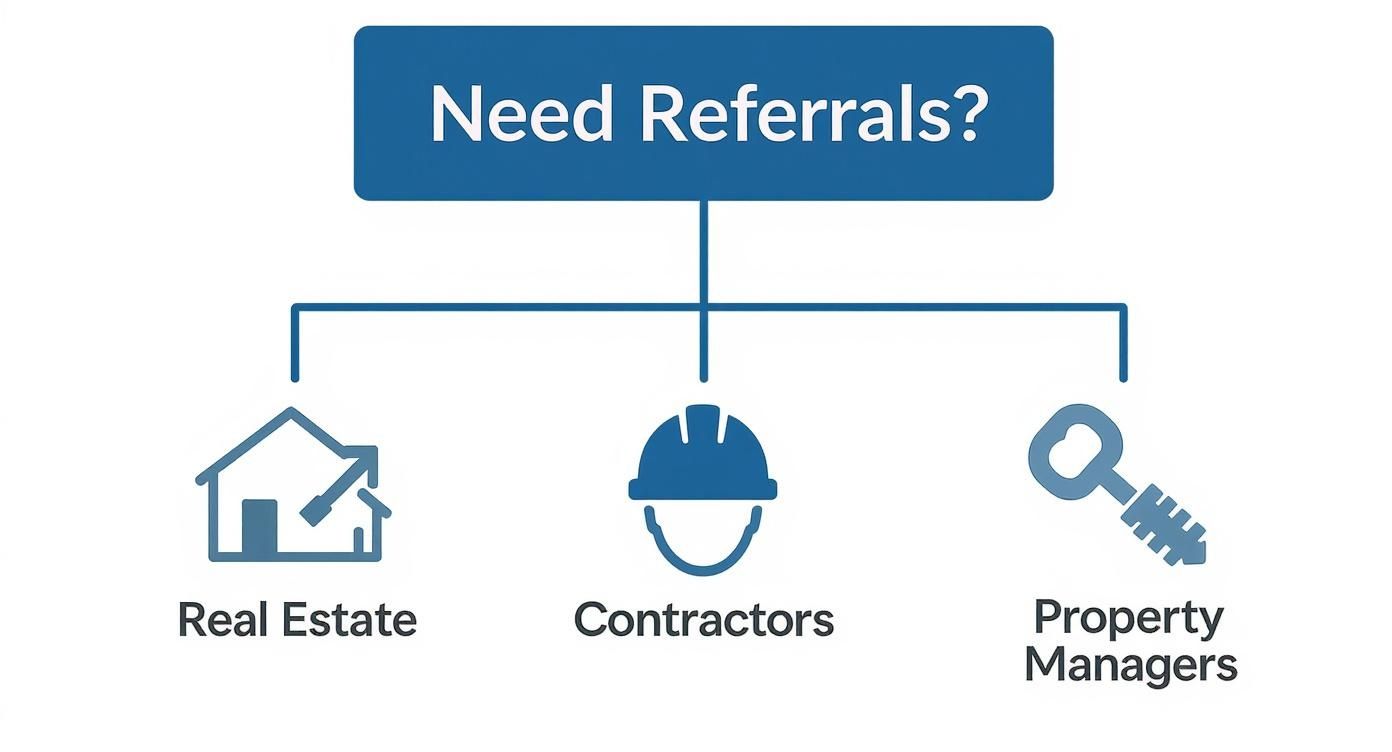
Think of this as a roadmap. It helps you quickly figure out which professional partnerships—like with local real estate agents or general contractors—are most likely to send you a steady stream of high-quality work.
Never Miss a Lead With Professional Answering Services
Picture this: it's 10 PM on a Friday, and a homeowner with a burst pipe calls you. They get your voicemail. What happens next? They immediately hang up and dial the next plumber on their Google search. You didn't just miss a call; you lost a high-margin emergency job and any chance of turning them into a lifelong customer.
This is where a professional answering service or trained Customer Service Representatives (CSRs) can be a total game-changer. They become a seamless extension of your business, making sure every single call gets answered by a real, trained person—24/7/365.
A professional CSR does more than just take a message. They're trained to turn callers into booked appointments. They can answer basic questions, show genuine empathy for a stressful situation, and schedule the job directly into your calendar.
And it’s not just for after-hours calls. Think about a busy Tuesday afternoon when you're under a sink. A dedicated CSR can field calls while you work, preventing constant interruptions and ensuring you capture every single lead. If you want to understand the level of detail that goes into this, you can look over a professional call center quality monitoring form to see what the pros track to ensure great service.
To help you weigh the options, here’s a look at how an in-house team stacks up against an outsourced service.
In-House vs Outsourced CSR Comparison
| Factor | In-House Team | Outsourced CSR Service |
|---|---|---|
| Cost | High fixed costs (salary, benefits, training, overhead) | Lower variable costs (pay per call or per minute) |
| Availability | Limited to business hours unless you hire multiple shifts | 24/7/365 coverage, including holidays and weekends |
| Scalability | Difficult and slow to scale; requires hiring and training | Instantly scalable to handle call volume spikes |
| Management | Requires direct supervision, scheduling, and quality control | Managed by the service provider; less work for you |
| Expertise | Training is on you; may lack specialized call-handling skills | Professionally trained in customer service and lead capture |
Ultimately, outsourcing gives you round-the-clock coverage and professional expertise without the headaches and high costs of hiring and managing another employee.
Organize and Automate With a Plumbing CRM
Once you have leads pouring in from different places—Google Ads, referral partners, your website—a spreadsheet or a notebook just won't cut it anymore. A Customer Relationship Management (CRM) platform becomes the central hub for your entire sales and customer service operation.
A good CRM built for the trades does way more than just store names and numbers. It gives you the power to:
- Track Leads From Source to Sale: You can see exactly which marketing efforts are paying off. Knowing your best leads come from a specific referral partner or Google Ads campaign tells you precisely where to double down on your budget.
- Automate Follow-Ups: Sent a quote but haven't heard back? The CRM can be set up to automatically send a polite follow-up text or email a few days later. This one simple automation can seriously boost your closing rate.
- Manage Customer History: Get a customer's complete service history in a couple of clicks. When you know you cleared their main drain six months ago, you can provide smarter, more proactive service on the next call.
The market for plumbing and HVAC services is enormous. The combined global market hit $270.6 billion in 2021 and is still growing fast. Technology like a CRM is what lets smart business owners claim their piece of the pie. By putting a reliable system in place, you’re not just getting more leads—you’re building a scalable business that's ready to grow without breaking.
Common Questions We Hear About Getting More Plumbing Leads
Jumping into lead generation can feel like opening a brand-new, complicated toolbox. You know you need the tools, but it's tough to know which one to grab first. Let's break down some of the most common questions we hear from plumbers who are serious about growing their business.
These are the real-world questions that pop up again and again, from figuring out a marketing budget to deciding which strategy will actually make the phone ring.
How Much Should I Actually Spend on Marketing?
This is the big one, and the honest-to-goodness answer is: it depends. A good rule of thumb for an established home service company is to set aside 5-10% of your total revenue for marketing. Now, if you're in a heavy growth phase and trying to steal market share, you might need to crank that up to 12-15%.
But here's a much better way to look at it: stop thinking of marketing as a cost. It's an investment. Instead of pulling a number out of thin air, work backward from your goal.
- Define Your Revenue Goal: How much more do you want the business to bring in this quarter?
- Know Your Average Ticket: What's a typical job worth to you?
- Find Your Target Job Count: Just divide the revenue goal by your average ticket price. Simple.
- Be Honest About Your Close Rate: What percentage of leads do you actually turn into paying customers?
- Calculate Your Lead Target: This will tell you exactly how many leads you need to hit your number.
Suddenly, your marketing budget has a purpose. You're not just "spending money on ads"; you're investing a specific amount to get the exact number of leads you need to hit your revenue goal. This approach turns marketing from a guessing game into a predictable growth machine.
I'm Just Starting. Which Lead Gen Strategy Should I Use First?
It’s easy to get overwhelmed by all the options. Facebook Ads? Chamber of Commerce meetings? Door hangers?
For any plumber, the absolute best place to start is by claiming and completely filling out your Google Business Profile (GBP). It's free, it's the single biggest factor in showing up in local searches, and it's the first place homeowners look when their pipe bursts.
Once your GBP is dialed in, your next move depends on what you need most.
- Need leads yesterday? Fire up Google Local Services Ads (LSAs). You only pay when someone calls you—a qualified lead, not just a click. That little "Google Guaranteed" badge also does wonders for building instant trust with a frantic homeowner.
- Want to build for the long haul? Put your energy into two things: creating a rock-solid system for getting 5-star reviews and launching a simple referral program for past customers. These efforts compound over time, building a powerful lead-generating engine that costs you next to nothing.
The key is not to do everything at once. Pick one or two of these, master them, and then add another layer once you've got the first ones running like clockwork.
Are Paid Lead Services Like Angi or Thumbtack Actually Worth It?
Lead generation platforms can be a huge help, but they have a serious catch. On one hand, they are a fantastic way to fill gaps in your schedule, especially when you're new or hitting a slow patch. They drop leads right into your lap.
The big downside? You’re almost always competing against a handful of other plumbers for that exact same lead. This often becomes a race to the bottom on price, which can absolutely crush your profit margins. If you're going to use these services, the secret is speed. The first plumber to call that lead is, more often than not, the one who gets the job.
- Pros: Fast access to leads, great for plugging holes in the calendar.
- Cons: Fierce competition, encourages price-shoppers, you don't own the lead source.
Think of these services as a faucet you can turn on when you need water and turn off when you don't. Use them as a supplement to your own marketing, but whatever you do, don't become dependent on them. The ultimate goal is always to build your own brand that generates its own exclusive leads.
At Phone Staffer, we build the systems that turn all those hard-won leads into booked jobs. Whether you need a team making proactive calls to potential commercial clients or a professionally trained CSR ready to capture every inbound call, we have the people and the process to make sure no opportunity ever falls through the cracks. Find out how we can help you convert more of your leads into profitable work.