
Mastering the Metrics That Actually Drive Results
Improving call center performance isn't about chasing superficial numbers. It's about focusing on the key performance indicators (KPIs) that truly predict business outcomes and contribute to a positive customer experience. This requires a balanced approach, combining efficiency metrics with those that measure customer satisfaction.
Balancing Efficiency and Customer Experience
Many call centers prioritize average handle time (AHT) as a primary efficiency metric. While keeping AHT low is important for managing costs, an excessive focus on speed can negatively impact customer satisfaction. Think of it this way: a quick call resolution is pointless if the customer's issue isn't actually resolved.
This is where customer satisfaction (CSAT) and Net Promoter Score (NPS) come into play. These metrics offer crucial insights into the customer's perception of your service. High CSAT and NPS scores indicate customers are happy with their interactions, increasing the likelihood of repeat business and positive word-of-mouth referrals. Top-performing call centers understand the importance of balancing AHT with these experience measures.
The infographic below visualizes the interplay between AHT, First Call Resolution (FCR) rate, and CSAT. It highlights the importance of finding the optimal balance between speed, effectiveness, and customer satisfaction.
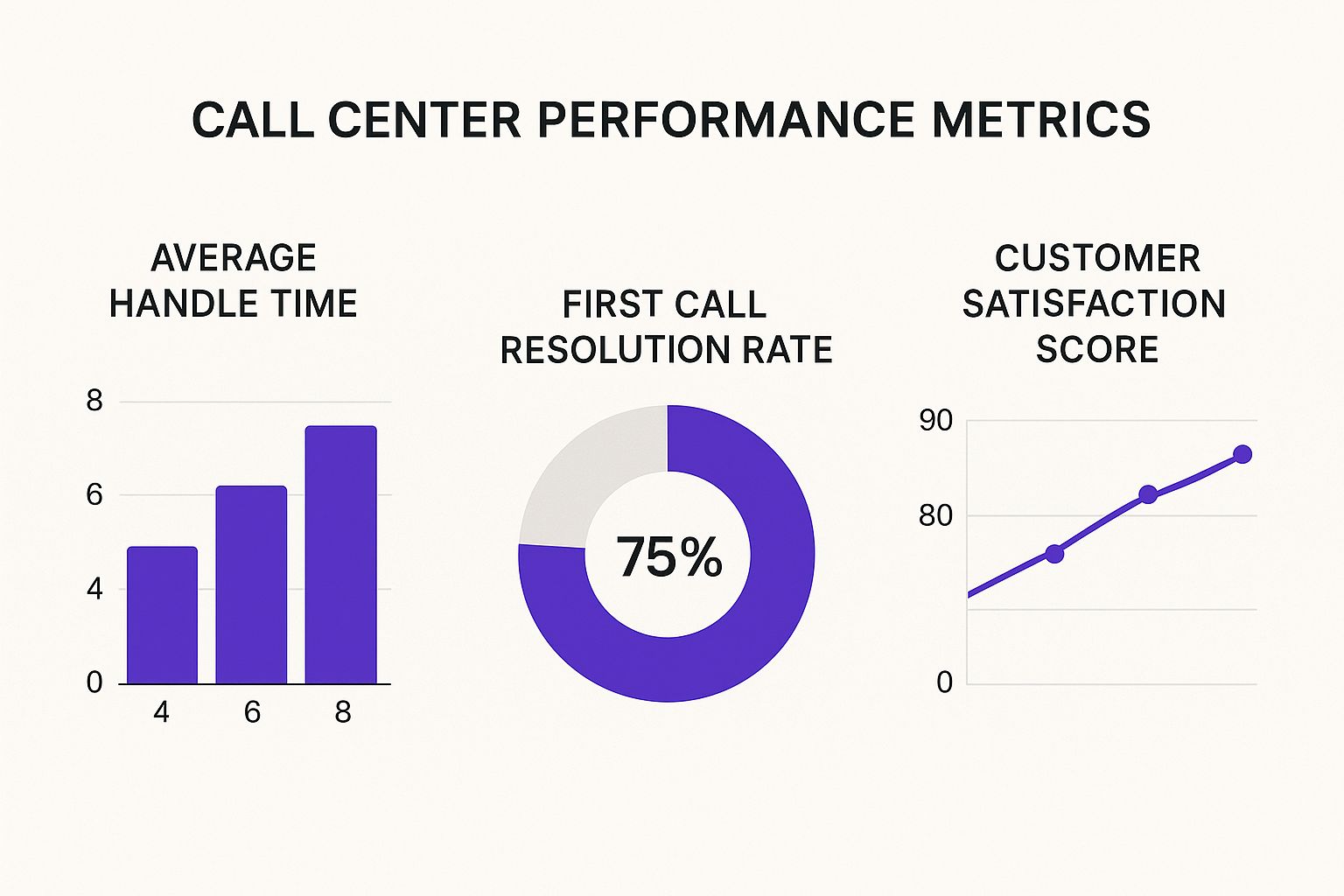
As the infographic demonstrates, while AHT is generally trending downwards, CSAT scores remain high. This suggests that the call center is effectively maintaining customer satisfaction while improving efficiency. This balanced approach is key to long-term success.
Setting Meaningful Benchmarks
Instead of relying on generic industry standards, leading organizations establish benchmarks based on their unique customer expectations. For example, a premium home services company, like those using Phone Staffer, might prioritize higher CSAT scores and a lower AHT than a budget-friendly provider. Understanding your target audience and their specific needs is crucial for setting realistic benchmarks.
To illustrate the various metrics and their target benchmarks, the following table provides a comparison of operational metrics versus customer experience metrics.
Essential Call Center Performance Metrics: A comparison of operational vs. customer experience metrics with target benchmarks
| Metric Category | Key Metrics | Industry Benchmarks | Business Impact |
|---|---|---|---|
| Operational Efficiency | Average Handle Time (AHT) | 4-6 minutes | Reduced operational costs, increased agent productivity |
| Operational Efficiency | First Call Resolution (FCR) | 70-80% | Improved efficiency, reduced call volume |
| Customer Experience | Customer Satisfaction (CSAT) | 85-90% | Increased customer loyalty, positive word-of-mouth |
| Customer Experience | Net Promoter Score (NPS) | +50 | Indicates customer loyalty and potential for growth |
This table highlights how focusing on both operational and customer experience metrics provides a well-rounded view of call center performance. Striking the right balance between these two categories is essential for achieving sustainable success.
Using Metric Correlations to Drive Improvement
Analyzing the relationships between different metrics can reveal hidden drivers of performance. For example, a high FCR rate often correlates with increased CSAT and lower AHT. This means resolving customer issues on the first call not only improves customer satisfaction but also increases operational efficiency.
By identifying these correlations, call centers can focus on the areas that will have the biggest impact. This data-driven approach allows for targeted improvements that benefit both the customer and the business. It enables you to move beyond simply tracking metrics to actually understanding what drives them.
Unlocking the Power of Sentiment Analysis
While most call centers focus on what customers say, the emotional context of these conversations often holds the key to improved performance. This is where sentiment analysis comes into play, offering real-time emotional intelligence that can transform agent-customer interactions. Imagine understanding not just a customer's words, but also how they're feeling. This is the power of sentiment analysis.
Understanding the Impact of Sentiment Analysis
Forward-thinking call centers are using sentiment analysis technology to personalize interactions and build stronger customer relationships. For example, if a customer expresses frustration, the system can alert the agent to adjust their approach, perhaps offering empathy or a more proactive solution. This responsiveness to emotional cues can de-escalate tense situations and turn negative experiences into positive ones.
This technology identifies real-time emotional cues, enabling agents to adapt their communication style and potentially transform a frustrating customer interaction into a positive one. This ultimately boosts key metrics such as First Call Resolution (FCR) and Net Promoter Scores (NPS). One of the most impactful ways to improve call center performance is through this integration of sentiment analysis technology.
According to a report, by 2025, about 95% of customer interactions will be processed using sentiment analysis tools. These tools analyze customer emotions in real-time during calls, allowing agents to tailor their responses based not only on the issue but also on the customer's emotional state. This reduces misunderstandings, improves communication, and increases customer satisfaction. Furthermore, companies using sentiment analysis report higher resolution rates and better customer retention.
This advancement aligns with a significant shift in the call center workforce: a projected 60% growth in remote call center agents between 2022 and 2024, driven by post-pandemic technological adoption. Remote work flexibility combined with AI technologies like sentiment analysis allows companies to maintain high-quality service while reducing operational costs and expanding their global workforce. Find more detailed statistics here.
Integrating Sentiment Analysis Tools
Integrating sentiment analysis tools with existing systems doesn't have to be complicated. Many platforms offer seamless integration with popular CRM and call center software. This allows for a streamlined workflow where sentiment data is readily available to agents within their familiar interface. You might be interested in: How to master…
Preparing Agents for Emotionally Intelligent Service
Preparing agents to respond effectively to emotional cues requires focused training. This training should cover:
-
Recognizing emotional cues: Agents need to identify different emotions expressed through voice tone, word choice, and pacing.
-
Adapting communication style: Agents should adjust their communication based on the customer's emotional state, using empathy, active listening, and personalized solutions.
-
Managing difficult conversations: Agents should learn techniques for de-escalating tense situations, addressing frustration, and turning negative interactions into positive ones.
Measuring the ROI of Emotionally Intelligent Service
The return on investment (ROI) of sentiment analysis can be measured through several key metrics:
-
Improved CSAT scores: Sentiment analysis can lead to higher customer satisfaction by ensuring agents address both the issue and the customer's emotional state.
-
Increased FCR rates: By understanding emotional needs, agents are better equipped to resolve issues on the first call.
-
Reduced AHT: Quickly identifying and addressing customer concerns can lead to shorter call times and reduced Average Handle Time (AHT).
-
Improved agent retention: Providing agents with the tools and training to handle challenging interactions effectively creates a more positive and less stressful work environment. This can improve agent retention, especially valuable in a competitive market.
By implementing sentiment analysis effectively and providing appropriate training, call centers can reach a new level of performance, enhancing customer experience, boosting key metrics, and building stronger relationships. This focus on emotional intelligence creates a more human-centered approach to customer service, leading to improved satisfaction and loyalty.

Transforming Conversations With Speech Analytics
Beyond basic call monitoring lies a wealth of untapped performance data. Leading call centers utilize speech analytics to uncover patterns and opportunities often missed by human observation. This technology transforms recorded conversations into actionable intelligence, driving measurable improvements in call center performance.
From Recordings to Actionable Insights
Speech analytics analyzes 100% of recorded calls, identifying keywords, phrases, and even the emotional tone of customer interactions. This provides a comprehensive understanding of customer needs, common pain points, and areas where agents excel or require additional support.
For example, if numerous calls contain complaints about a specific product feature, this data can inform product development and agent training initiatives. Explore how to use Voice Analytics for detailed insights into customer conversations.
Balancing Technology and Human Judgment
While technology plays a crucial role, human oversight remains essential. Speech analytics acts as a powerful tool for supervisors, providing them with data-driven insights to refine coaching strategies and personalize agent development plans.
This combination of technology and human expertise creates a balanced approach that maximizes the benefits of speech analytics.
Overcoming Implementation Challenges and Building Buy-In
Implementing speech analytics requires careful planning and clear communication with agents. Addressing concerns about privacy and ensuring that the technology is perceived as a supportive tool, rather than a monitoring mechanism, is key to fostering agent buy-in.
Highlighting the benefits of speech analytics for both agent development and improved customer experience can help build trust and encourage adoption.
Refining Scripts and Personalizing Coaching
Speech analytics provides valuable data for optimizing call scripts. By identifying common customer questions and concerns, call centers can refine scripts to address these issues proactively. This leads to improved first call resolution rates and enhanced customer satisfaction.
Furthermore, speech analytics enables personalized coaching by pinpointing areas where individual agents excel or require additional training. This targeted approach maximizes the effectiveness of coaching sessions and accelerates agent development.
Speech analytics is a proven method to enhance call center performance, delivering measurable improvements in both customer satisfaction and operational costs. Studies show that the application of speech analytics can increase customer satisfaction scores by up to 10% while simultaneously reducing operational costs by 20 to 30%.
This technology analyzes recorded calls for key phrases, sentiment, and compliance, allowing supervisors and AI-driven systems to identify training needs, optimize scripts, and improve agent coaching. With call centers facing heightened customer expectations and growing call volumes, speech analytics provides actionable insights that help agents address concerns more efficiently. It also supports compliance and quality assurance, which mitigates risk and fosters trust.
Organizations successfully implementing speech analytics report higher agent productivity and reduced average handle times, creating a virtuous cycle of cost savings and enhanced customer experience. Find more detailed statistics here.
Identifying Best Practices and Replicating Success
Speech analytics can identify exceptional performance examples within a call center. By analyzing calls where agents effectively resolved complex issues or achieved high customer satisfaction scores, supervisors can isolate specific behaviors and techniques.
This information can then be shared with other agents, replicating successful strategies and driving overall performance improvement across the team. This focus on identifying and replicating best practices creates a culture of continuous improvement and ensures that successful strategies are shared throughout the organization.

Building an Agent Retention Strategy That Works
Exceptional call center performance relies on a stable and engaged workforce. However, high agent turnover continues to be a significant hurdle. Simply offering superficial perks isn't enough. A truly robust retention strategy requires a deeper understanding of what motivates and retains agents. This means addressing the root causes of turnover, fostering a supportive environment, and providing opportunities for growth and recognition.
Understanding the Turnover Challenge
Agent turnover remains a major challenge affecting call center performance worldwide. Industry statistics show that annual turnover rates in some sectors can surpass 40%, creating a substantial financial burden for businesses. Replacing a single agent can cost upwards of $2,500 when considering rehiring, retraining, and lost productivity.
High attrition disrupts workforce stability and negatively impacts customer experience due to the constant influx of new, less experienced agents. Furthermore, 86% of customers are likely to abandon a brand after just two negative service interactions. This highlights the critical need for high agent retention and consistent service quality.
To combat this, call centers are implementing comprehensive workforce management strategies. These include targeted training, AI-driven coaching platforms, and employee engagement programs designed to improve job satisfaction and reduce burnout. These initiatives help stabilize the workforce, enhance key performance indicators like First Call Resolution and Customer Satisfaction Scores, and ultimately strengthen brand loyalty in competitive global markets. Find more detailed statistics here.
Creating a Supportive Team Environment
A positive and supportive team environment is essential for agent retention. This involves cultivating open communication, providing regular feedback, and creating opportunities for team building. Much like a sports team, success depends not only on individual skill but also on teamwork and camaraderie.
Call center agents thrive in environments where they feel valued, respected, and supported by both colleagues and supervisors. Providing effective agent training is paramount. For more insight into improving training strategies, consider this article on call center agent training.
Building Meaningful Career Paths
Many agents leave call centers because of limited career advancement opportunities. Offering clear career paths with opportunities for promotion, skill development, and increased responsibility can drastically improve retention. This might include specialized training programs, mentorship opportunities, or pathways to leadership roles.
By investing in their employees’ future, call centers demonstrate a commitment to their growth. This creates a more engaging and fulfilling work experience, much like providing a roadmap for success. Agents are more likely to remain engaged if they see a clear path for professional development within the organization.
Recognizing and Rewarding Performance
Effective recognition programs are key to motivating and retaining top talent. This goes beyond simple monetary bonuses. It includes acknowledging achievements, celebrating successes, and providing opportunities for professional growth.
For instance, recognizing an agent who consistently receives high customer satisfaction scores or efficiently resolves complex issues can significantly boost morale and reinforce positive behaviors. You might be interested in: How to master…
Addressing Burnout and Promoting Well-being
The demanding nature of call center work can contribute to agent burnout. Implementing strategies to manage stress, promote well-being, and foster a healthy work-life balance is crucial for retention. This might include offering flexible work arrangements, providing access to mental health resources, and encouraging breaks and time off.
By prioritizing agent well-being, call centers can cultivate a more sustainable and supportive work environment, leading to increased job satisfaction and reduced turnover.
Reimagining Training for Performance Breakthroughs
Traditional training methods often fall short of meeting the performance demands of today's call centers. Instead of generic, one-size-fits-all programs, successful organizations are adopting performance-focused learning experiences with impressive results. This involves using performance data to personalize development paths, addressing specific skill gaps and maximizing each agent's potential. It's the difference between a tailored suit and a mass-produced garment – the tailored option fits perfectly and performs better.

Personalized Development Paths for Targeted Improvements
Leading call centers use performance data to create individualized learning journeys. Instead of subjecting every agent to identical training, they pinpoint areas where each individual needs to improve. For instance, an agent struggling with First Call Resolution (FCR) might receive training focused on troubleshooting techniques, while another might focus on developing customer empathy skills.
This targeted approach ensures training relevance and impact, leading to faster and more substantial performance gains. You might find this helpful: How to master…
Implementing Effective Training Methods
Several practical training methods contribute to performance breakthroughs:
-
Microlearning: Delivering training in short, focused bursts makes it easier for agents to absorb and apply new information. This method is particularly effective for reinforcing existing skills or introducing new product features. Microlearning modules can be accessed on demand, integrating seamlessly into an agent's workflow.
-
Simulation-Based Practice: Simulating real-life call scenarios provides a safe environment for agents to practice handling difficult customer interactions. This hands-on experience builds confidence and equips them for a broader range of situations.
-
Real-Call Coaching: Providing feedback based on actual customer interactions is invaluable. Personalized coaching helps agents learn from their mistakes and improve their performance in real time.
Effective agent training is essential. For additional insights, explore this resource on call center agent training.
Measuring Training Effectiveness
Measuring training effectiveness goes beyond simple satisfaction surveys. Leading organizations link training outcomes to key performance indicators (KPIs). They track how specific programs impact metrics like FCR rates, Customer Satisfaction (CSAT) scores, or Average Handle Time (AHT). This data-driven approach demonstrates the value of training and highlights areas for continued improvement.
The connection between training and performance metrics provides a clear picture of Return on Investment (ROI) and enables continuous optimization. Let's examine the impact of different training approaches on key performance metrics. The following table provides a breakdown of the correlation between training methods and performance improvements.
Training Impact on Key Performance Metrics: Data showing the correlation between different training approaches and performance improvements
| Training Method | First Call Resolution Impact | Customer Satisfaction Impact | Average Handle Time Impact | Implementation Complexity |
|---|---|---|---|---|
| Microlearning | +5% | +3% | -2 minutes | Low |
| Simulation-Based Practice | +8% | +6% | -4 minutes | Medium |
| Real-Call Coaching | +12% | +9% | -6 minutes | High |
As the table illustrates, each training method offers varying levels of impact and complexity. While microlearning provides modest gains with low implementation complexity, real-call coaching yields the most significant improvements but requires more resources.
Building a Culture of Continuous Learning
Fostering a culture of continuous learning empowers agents to constantly develop their skills and adapt to evolving customer needs. This proactive approach ensures agents remain engaged, motivated, and prepared to deliver excellent customer experiences.
Investing in agent development benefits individual performance and contributes to the overall success of the call center. This, in turn, positively affects customer satisfaction, loyalty, and ultimately, the bottom line. Much like athletes who consistently train to improve their performance, call center agents require ongoing development to reach their full potential.
Eliminating Process Friction That Holds Agents Back
Even the most skilled call center agents can struggle when faced with inefficient processes. Imagine a Formula 1 driver stuck in traffic – their expertise is rendered useless without a clear path forward. Similarly, your agents can't deliver exceptional customer service if their workflow is riddled with bottlenecks and frustrating procedures. Top-performing call centers understand this and prioritize process optimization to empower their agents.
Identifying Workflow Bottlenecks
The first step in removing friction is identifying where it exists. This often involves mapping the customer journey and the agent journey. Think of these as two separate maps that should align seamlessly. Where are the disconnects? Are there redundant steps? Are agents spending too much time on administrative tasks instead of valuable customer interactions? Answering these questions reveals key areas for improvement.
For example, if agents consistently struggle to find information in the knowledge base, this highlights a need for knowledge base optimization. If a significant amount of time is spent transferring customers between departments, the call routing process may need streamlining. These bottlenecks, like clogs in a pipe, restrict the flow of information and service, leading to frustration for both agents and customers.
Applying Lean and Six Sigma Principles
Many successful call centers use principles from Lean and Six Sigma to streamline their processes. Lean focuses on eliminating waste, while Six Sigma aims to reduce variability. These methodologies offer a structured approach to process improvement, pinpointing and removing non-value-added steps.
A Lean approach might involve automating repetitive tasks like data entry, freeing up agents to focus on customer interactions. Six Sigma could be used to analyze call handling times and identify ways to reduce variability and improve consistency. Implementing these principles, much like fine-tuning a machine for optimal performance, results in greater efficiency and improved overall results.
Optimizing the Knowledge Base
A well-structured and easily searchable knowledge base is essential for agents. When agents can quickly access the information they need, they can resolve customer issues more efficiently. This, in turn, reduces handle times and improves First Call Resolution rates.
This optimization might involve restructuring the knowledge base, improving search functionality, or adding multimedia resources like videos and tutorials. A good knowledge base should be like a well-organized toolbox – the easier it is for agents to find the right tool, the faster they can complete the job.
Intelligent Workflow Design and Automation
Intelligent workflow design focuses on streamlining every step of the agent's process. This includes automating repetitive tasks, providing intuitive tools, and ensuring readily available information. For home service companies, platforms like Phone Staffer can automate tasks and manage customer interactions, effectively smoothing out workflows.
Targeted automation can significantly reduce the administrative burden on agents. Automating tasks such as call logging, data entry, or follow-up actions frees agents to concentrate on higher-value activities like problem-solving and building strong customer relationships. This automation, like a well-designed conveyor belt, keeps processes moving smoothly, reducing manual effort and boosting efficiency. This allows agents to dedicate more time and energy to addressing complex customer needs and delivering a truly personalized service experience. By eliminating routine tasks, agents can focus on what truly matters: connecting with customers and creating exceptional experiences.
Creating Seamless Experiences Across All Channels
Today's customers expect a consistent and positive experience, regardless of how they interact with your business. Whether it's a phone call, email, live chat message, or through social media, the experience should feel unified and personalized. This seamlessness, known as omnichannel integration, is crucial for call center performance. While delivering consistent service across all channels can be challenging, the right strategies can significantly improve both customer satisfaction and operational efficiency.
Breaking Down Channel Silos and Building Unified Customer Data
Many call centers operate with separate teams for each communication channel. This can lead to silos, where information isn't shared effectively, resulting in disjointed customer experiences. Imagine a customer calling about a problem they already discussed in an email, only to have to repeat everything. This is a common frustration point. Building a unified customer data view is the key to breaking down these silos. This means integrating all customer interaction data, from every channel, into a single, accessible platform.
This single platform provides agents with a complete history of customer interactions, allowing them to deliver personalized and efficient service. This comprehensive customer view is comparable to a doctor having a patient's full medical history; it allows for a more accurate assessment and treatment plan.
Empowering Agents with Complete Interaction Context
Agents need complete interaction context to deliver seamless omnichannel experiences. When they can access a customer's full interaction history, they can personalize the conversation and avoid redundant questions. This not only improves efficiency but also demonstrates respect for the customer's time. This empowerment directly improves First Call Resolution (FCR) rates and boosts customer satisfaction. For example, if an agent can see the customer has already attempted troubleshooting steps via live chat, they can bypass that part of the conversation and offer more advanced solutions.
Balancing Channel-Specific Needs with Consistent Experience Standards
While consistency is paramount, different channels have unique requirements. Live chat, for instance, requires faster responses than email. Finding the right balance between channel-specific needs and consistent experience standards is crucial. This involves developing tailored approaches for each channel while maintaining core service principles. Think of a restaurant with different dining areas: the atmosphere and service style might differ slightly between the bar, the main dining room, and the patio, but the overall quality and attention to detail should remain consistent. Check out our guide on How to master…
Workforce Planning for Seamless Coverage
Effective workforce planning is essential for seamless coverage across all communication channels. This includes forecasting demand, scheduling agents appropriately, and providing cross-training to handle multiple channels. Much like a conductor orchestrates different instruments to create a harmonious symphony, well-planned workforce management ensures smooth and efficient operation across all channels. This could mean having specialized teams for complex technical issues, while other agents handle routine inquiries across multiple channels. This flexibility and strategic resource deployment maximizes efficiency and minimizes customer wait times.
Measuring and Optimizing Cross-Channel Performance
Measuring cross-channel performance involves tracking key metrics across all channels and analyzing their interrelationships. This data can then be used to optimize the channel mix, personalize customer journeys, and identify areas for improvement. For example, if many customers switch from live chat to phone support for complex issues, it indicates a need to improve live chat support for those specific inquiries. This ongoing analysis and optimization, similar to adjusting a ship's sails to catch the best wind, ensures the call center operates at peak performance and delivers the best possible customer experience. By understanding customer preferences and issue complexity, you can tailor the channel mix to provide the most efficient and satisfying experience. This data-driven approach is key to long-term success in the dynamic world of omnichannel customer service.