

Knowing how to screen phone calls is about more than just answering the phone. It's about a quick, decisive process to identify a high-value lead and filter out the noise. For home service businesses, this means having a system to instantly pinpoint a caller's location, what service they need, and how urgently they need it. It’s all about making sure the profitable jobs get top priority.
Why Effective Call Screening Is Your Biggest Growth Lever
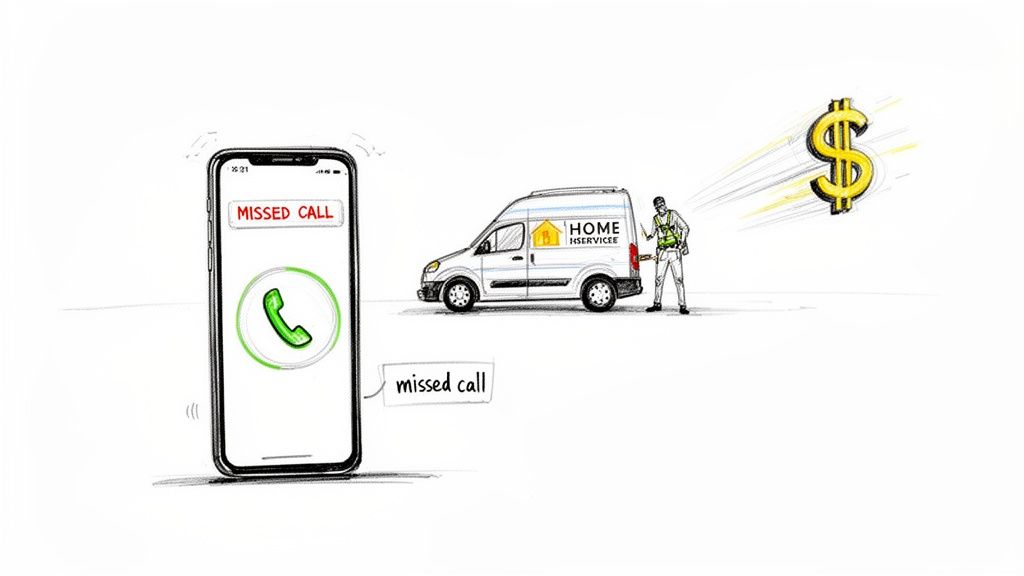
That ringing phone? For any home service business, it’s the sound of opportunity knocking. But let’s be real—what happens when you’re already on a job, wedged under a sink, or up on a ladder? Every single one of those missed calls is a potential job you just handed straight to a competitor. This isn't a small thing; it's a real drain on your revenue.
Think about it. A plumbing company misses a call on a Saturday afternoon. Turns out, it was a burst pipe. That one missed ring doesn't just represent thousands in lost emergency service fees; it’s the loss of a future loyal customer, too. This exact scenario plays out every day for contractors, electricians, and landscapers.
The True Cost of Unanswered Calls
The struggle to handle every incoming call is one of the biggest roadblocks for service businesses. In fact, research analyzing call data revealed that, on average, companies only answer 37.8% of all inbound calls. That means nearly two-thirds of potential customers are hearing nothing but a dial tone. That silence has a direct—and painful—impact on your bottom line.
A strategic approach to call screening isn't just an admin task—it’s a core growth strategy. It empowers you to capture the best leads, maximize profit on every job, and build a rock-solid reputation for reliability.
Moving From Reactive to Proactive
Without a screening process, your team is flying blind. They might waste 20 minutes on the phone with a price shopper who was never going to book, all while a five-star emergency call goes straight to voicemail. A solid call screening system completely flips this dynamic.
It creates a simple, repeatable filter that helps anyone answering your phone instantly separate serious buyers from casual tire-kickers. This is exactly why many businesses find so much value when they hire a virtual assistant who is trained specifically for this.
This proactive approach ensures that:
- High-priority leads get flagged and fast-tracked immediately.
- Your team’s valuable time is spent on revenue-generating conversations.
- Every potential customer feels heard and respected, which is huge for your brand image.
Building Your Lead Qualification Checklist
Before your team even picks up the phone, they need a playbook. A truly effective call screening process starts long before the phone rings—it begins with knowing exactly what a "perfect fit" lead looks like for your business. Flying blind is a recipe for wasted time and, worse, lost revenue.
Think of your lead qualification checklist as a simple, powerful filter. It gives anyone answering your calls, from an in-house CSR to a virtual assistant, the confidence to quickly spot the best opportunities. This isn't about turning people away; it's about channeling your time and energy into the jobs that will actually move the needle for your business.
Core Qualification Criteria
First things first, let's nail down the non-negotiables. These are the absolute must-haves you need to know to decide if a caller is a potential goldmine or a dead end.
Your checklist should be built around these four pillars:
- Service Area Confirmation: Is the property actually in your service zone? It’s a classic, avoidable mistake to spend 15 minutes on a quote only to find out they're 50 miles outside your territory.
- Job Type and Scope: Is this a service you actually offer, and is it the kind of job you want? A roofing company, for instance, needs to quickly tell the difference between a high-value full roof replacement and a low-margin shingle patch.
- Urgency: How quickly do they need this done? An HVAC company in the middle of a heatwave needs to put a "my AC is dead" call at the top of the list, way ahead of someone just "thinking about" a furnace tune-up for the fall.
- Budget Indicators: Asking "What's your budget?" straight up can be awkward. Instead, train your team to listen for clues. Do they ask about financing right away? Are they fixated on the "cheapest option"? These are telling signs.
With so many homeowners finding you on their phones, this initial screening has never been more critical. A staggering 70% of all home service inquiries now originate from mobile searches, and mobile devices account for a massive 72.7% of all Google traffic. This flood of calls makes a solid screening system non-negotiable. You can discover more about how homeowners use Google for home services.
A great lead qualification checklist isn't about asking more questions—it's about asking the right questions. The goal is to get the most critical information in the shortest amount of time to make a smart decision.
To get you started, here’s a quick-reference table outlining the key questions your team should have in their back pocket for every single call.
Essential Pre-Screening Questions for Home Services
| Qualification Criteria | Example Question | Why It Matters |
|---|---|---|
| Location | "To make sure we can get someone out to you, what's the service address?" | Immediately weeds out anyone outside your service area, saving everyone time. |
| Service Need | "Could you tell me a little more about what's going on with your [roof/plumbing/etc.]?" | Helps you identify if it's a profitable job you actually want (e.g., replacement vs. minor repair). |
| Timeline | "And how soon were you hoping to have this taken care of?" | This is key for prioritizing urgent, ready-to-buy customers over tire-kickers. |
| Decision-Maker | "Are you the homeowner, or will someone else need to approve the work?" | Ensures you're speaking with the person who can actually say "yes" to the job. |
Having these questions down pat transforms a chaotic first call into a smooth, efficient process that sets your team—and your business—up for success.
Mastering the First 30 Seconds with Winning Call Scripts
Those first 30 seconds on a call? They’re everything. It’s your one shot to make an impression, and for a home service business, it’s often the moment you either win a high-value job or lose that lead for good. The trick is to sound professional and empathetic while quickly gathering the information you need, all without making the customer feel like they're just another box on a checklist.
A great call script isn't a rigid, word-for-word document. Think of it more as a playbook. It gives your team a solid framework to guide the conversation with confidence, ensuring they get the essential details while making the caller feel genuinely heard and helped right from the start.
The Anatomy of a Perfect Opening
A killer opening is simple, direct, and puts the customer first. It needs to do three things almost instantly: confirm they've reached the right place, show you're ready to help, and kick off the qualification process without it feeling like an interrogation.
Here’s a classic, effective example that we've seen work time and time again:
"Thank you for calling [Your Company Name], this is [Your Name]. How can I help you today?"
It’s polite, professional, and gets straight to the point. From there, your script should act like a road map, branching out based on what the caller says. For instance, if they jump right in with a problem, a natural follow-up is, "I'm sorry to hear you're dealing with that. So I can get the right person to help, could I get your service address?" This simple transition shows empathy and moves the call forward.
Using a Decision-Tree Model
The best way to screen calls effectively is with a simple decision-tree model. This isn’t some complicated flowchart you need to print out and memorize. It’s more like a mental map that guides your CSR through a series of "if this, then that" questions. The goal is to quickly figure out if you should book the job, schedule a formal quote, or politely disqualify a tire-kicker.
This visual breaks down how a basic decision tree works, showing the essential checkpoints: location, service needed, and urgency.
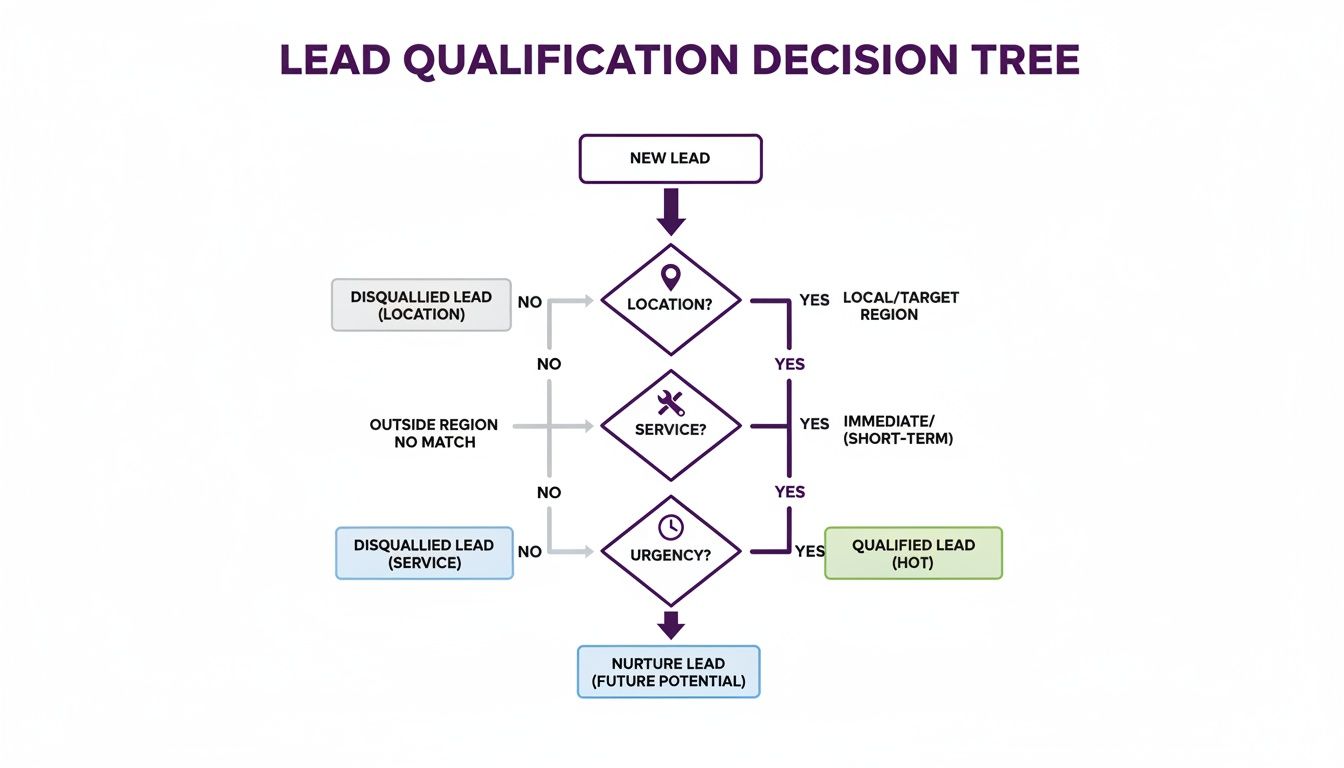
Following a model like this ensures every call follows a logical path, helping your team instantly prioritize the urgent, in-area jobs that fit your company’s sweet spot.
Real-World Script Examples
Let’s see how this plays out for a plumbing company facing two very different calls.
- Scenario #1: A panicked caller says, "My water heater is leaking all over my basement!"
- Empathy & Qualification: "Oh no, that sounds stressful. We can definitely help with that. To get a technician dispatched, can you confirm your full address for me?"
- Next Step: "Great, you're in our service area. The fee for an emergency dispatch is [$$$]. We can have someone there within the next two hours. Does that work for you?"
See how that moves from empathy to action? Now, let's contrast that with a less urgent, higher-consideration call.
- Scenario #2: "Hi, I'm thinking about remodeling my bathroom and wanted to get a price for a new shower installation."
- Qualification: "That's exciting! We'd be happy to provide an estimate. Are you the homeowner at that property?"
- Next Step: "Perfect. Our project manager handles all remodeling quotes. Can I schedule a brief call for them to discuss your project and set up a time for a free on-site estimate?"
This scripted-but-flexible approach gives your team the confidence and the tools they need to master call screening. They’ll stop wasting time and start turning more of the right conversations into profitable jobs.
Putting Technology to Work for Smarter Call Screening
Relying on your team's memory and gut feeling to screen calls works… until it doesn't. As your home service business grows, manual screening just can't keep up. It quickly becomes a bottleneck, and that's the cue to bring in technology. The right tools can automate the grunt work, freeing up your team to focus on the conversations that actually book jobs.
Modern phone systems are so much more than a dial tone. They're powerful platforms that can sort, filter, and route your inbound leads with surgical precision. Getting these systems in place is often far easier and more affordable than most business owners think, and the payoff is immediate.
Let’s not forget what’s at stake here. For home service companies, phone calls convert to revenue 10-15x more effectively than web leads. On top of that, callers are ready to pull the trigger and buy 30% faster. Every single call is gold, and technology is how you make sure you’re treating it that way. You can dig deeper into the value of calls for home services on invoca.com.
Set Up an IVR (Your Digital Receptionist)
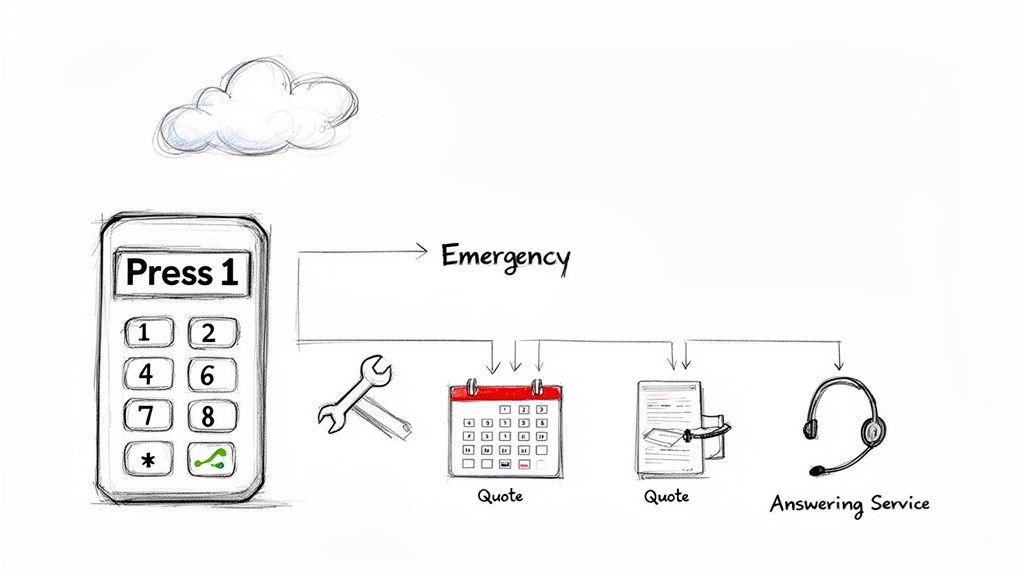
An Interactive Voice Response (IVR) system is your first line of defense. It’s that automated greeting that says, "Press 1 for new service inquiries, press 2 for billing…" This simple tool does a fantastic job of segmenting callers the second they dial your number.
For a home service business, a smart IVR can instantly:
- Fast-Track New Leads: Shoot all "new service" calls directly to your best sales-focused CSR.
- Streamline Support: Send existing customers with billing or scheduling questions to the right admin person, keeping your sales line open.
- Answer Common Questions: Offer up automated info like business hours or service areas, which cuts down on the simple calls your team has to field.
The goal isn't to build a frustrating phone maze. It's about getting the caller to the right expert on the first try, every time.
Use Call Routing for True Efficiency
Automated call routing is the next level. It takes the IVR's logic and applies even smarter rules to direct calls where they need to go, ensuring your most critical leads get priority. Think of it as an intelligent dispatch system for your phone.
Pro Tip: Configure your call routing to forward emergency or after-hours calls straight to the on-call tech's cell. This one move can be the difference between landing a high-profit emergency job and losing it to the competition who answered.
For instance, you could have a rule that routes a caller from a high-value zip code directly to your senior estimator. Or maybe any call that comes in after 6 PM automatically forwards to a professional answering service. Suddenly, your phone system isn't just a phone system—it's a proactive tool for managing leads.
Partner With a Professional Answering Service
For a lot of growing businesses, the easiest way to solve the call-screening puzzle is to simply hand it off. A professional answering service gives you highly trained agents who can screen calls 24/7/365, acting as a perfect extension of your in-house team.
This completely solves the problem of missed opportunities after hours, on weekends, or when your team is slammed. A dedicated missed call service ensures every single lead is captured and qualified based on your specific rules. That leaves you to focus on what you do best: running the business, not just answering the phone.
Training Your Team to Convert More Calls into Jobs
All the best scripts and tech in the world won’t matter if the person on the other end of the line isn’t prepared. Your goal should be to build a team that doesn't just answer phones, but actively drives revenue by turning more inquiries into booked jobs. That requires dedicated training that goes far beyond just reading lines off a page.
It really starts with the art of active listening. You need to train your team to hear what the customer isn't saying. A caller asking, "How much for a new water heater?" might really be trying to communicate, "My basement is flooding, and I need help now!" By uncovering the true pain point, your team can respond with genuine empathy and the right solution.
Turning Price Shoppers into Profitable Jobs
One of the toughest calls to handle in any home service business is the classic price shopper. They lead with, "I'm just getting a few quotes," and an untrained CSR will often just spit out a number and hang up. A seasoned pro knows this is a golden opportunity.
Instead of getting into a race to the bottom on price, you need to equip your team to pivot the conversation toward value.
- Acknowledge their process: Start with something like, "That's a smart approach. It’s important to find the right fit for your project." This validates their effort.
- Highlight your differentiators: Follow up with, "While you're comparing, be sure to ask about things like our 10-year parts and labor warranty and our same-day service guarantee. That's where we really stand out."
- Create a little urgency: End with, "Our current schedule is filling up fast this week. I can lock in a spot for a free, no-obligation estimate tomorrow morning if that works for you."
This simple technique reframes the entire conversation from price to value, giving you a real shot at winning over even the most budget-conscious customers. For many owners, learning how to hire a virtual assistant who already has these skills can be a total game-changer for their front-line communications.
Role-Playing Real-World Scenarios
Theory is one thing, but confidence is built through practice. Regular role-playing is probably the single most effective way to prepare your team for those tough calls. Don't use generic scripts; create realistic scenarios they'll actually face on a Tuesday afternoon.
Training Scenario Example:
A caller says, "Your competitor quoted me $300 less for the same job."
Bad Response: "Okay, thanks for calling."
Good Response: "I understand price is a big factor. Can I ask if that quote included a full system diagnostic and a 1-year service guarantee like ours does? Sometimes those lower prices have hidden costs."
This kind of practice builds muscle memory. It helps your team handle objections gracefully without getting flustered when a real customer is on the line.
Measuring What Matters: Key Call Handling KPIs
You can't improve what you don't measure. Tracking the right Key Performance Indicators (KPIs) is the only way to know if your call screening and training efforts are actually paying off. It's best to focus on a few core metrics that directly tie back to your business goals.
The table below breaks down the most critical metrics to monitor. These KPIs will give you a clear picture of your team's performance and show you exactly where to focus your coaching.
Key Performance Indicators for Call Screening Success
| Metric (KPI) | What It Measures | Industry Benchmark |
|---|---|---|
| Booking Rate | The percentage of qualified inbound calls that are converted into a booked appointment. | 70-85% |
| Average Call Duration | The average length of time your team spends on a single call. | 3-5 minutes |
| First Call Resolution | The percentage of customer issues resolved on the first call without needing a callback. | 70-75% |
Watching these numbers closely will help you spot trends, celebrate wins, and address weaknesses before they impact your bottom line. By focusing on these practical training techniques and tracking what truly matters, you can transform your call handling from a simple administrative task into a powerful engine for business growth.
Common Questions We Hear About Call Screening
Even with the best scripts and a solid plan, you're going to run into some unique situations. That's just the nature of the business. Here are some of the most common questions we get from home service pros who are just starting to get serious about screening their calls, along with some practical answers.
What’s the Best Way to Handle After-Hours and Weekend Calls?
Letting after-hours calls go to a generic voicemail is like leaving cash on the table, especially if you're in an emergency-heavy trade like plumbing or HVAC. The goal is simple: make sure a human being can handle every single call, no matter when it comes in.
You've got a couple of solid options here:
- On-Call Technician Routing: This is a fantastic move for capturing those high-profit emergency jobs. You can set up your phone system to automatically forward any calls that come in after hours directly to the cell phone of your on-call tech. No waiting, no missed opportunities.
- Professional Answering Service: If you don't have a dedicated on-call person or want to free up your techs, partnering with a 24/7 answering service is the way to go. They'll have trained agents ready to answer using your script, qualify the lead, and then either dispatch the call or get it booked for the next business day.
I’m a Solo Operator—How Can I Possibly Screen Calls?
When you're the one swinging the hammer and answering the phone, every interruption costs you time and money. You can't afford to stop what you're doing for every spam call or price shopper. The key is to let technology be your gatekeeper.
Use your voicemail as your first line of defense. Record a clear, professional greeting that instructs callers to leave their name, the service address, and a quick description of the problem. This one small step is a powerful filter.
Legitimate customers with real issues won't hesitate to leave that information. Tire-kickers and robocallers? They'll almost always hang up. You can then just check your messages between jobs and call back the people who sound like serious prospects.
Should I Hire In-House Staff or Use an Answering Service?
This is a fork in the road every growing business eventually faces. Bringing a customer service rep in-house means you get someone who lives and breathes your company culture and is there every day. But that also comes with the significant costs of salary, benefits, training, and finding the right person in the first place.
On the other hand, a professional answering service gives you instant 24/7 coverage without the overhead of another employee. These services are pros at screening calls and can handle fluctuating call volumes without a hiccup, meaning you never miss a lead because you're busy or it's after 5 PM. The right answer really boils down to your call volume, your budget, and how much hands-on control you want to maintain.
Is It Legal to Record Calls for Training Purposes?
Absolutely, and it's one of the best training tools you have—as long as you do it by the book. The laws on this can get tricky and vary quite a bit from state to state. Some states have a “one-party consent” rule, which means you're in the clear as long as one person on the call (your employee) knows it's being recorded.
But more and more states now require “all-party consent,” meaning you have to get a thumbs-up from everyone on the line. The safest, simplest, and most professional approach is to just assume you need everyone's consent. Start every call with a simple, automated disclosure like, "This call may be recorded for quality and training purposes." That's usually all you need to stay compliant and protect your business.
Stop letting high-value leads slip through the cracks. Phone Staffer can place a professionally trained, remote CSR into your business to answer every call, qualify every lead, and book more jobs on your calendar. Learn how our dedicated staffing solutions can help you grow.