

Starting a pest control business is a real-world puzzle, mixing hands-on fieldwork with sharp business strategy. You need to carve out your niche, navigate the maze of licensing and insurance, get your hands on the right equipment, and then craft a solid marketing plan to land those first clients. Nailing these steps from the get-go is what separates a struggling startup from a profitable, long-lasting company.
Charting Your Path in the Pest Control Industry
Jumping into the pest control world is a big move, but you're stepping into one of the most stable and recession-resistant home service industries out there. Forget the generic checklists you've seen. This is a practical, no-fluff roadmap that breaks down the entire process into clear, manageable stages.
We'll cover everything from getting the right licenses without pulling your hair out to buying the essential gear without breaking the bank. You’ll learn how to price your services to be competitive yet profitable and, most importantly, how to get your phone ringing with those crucial first customers. Think of this as your blueprint for building a business that's ready to grow from the moment you open your doors.
The image below gives you a bird's-eye view of the three core phases you'll move through as you go from idea to a thriving business.
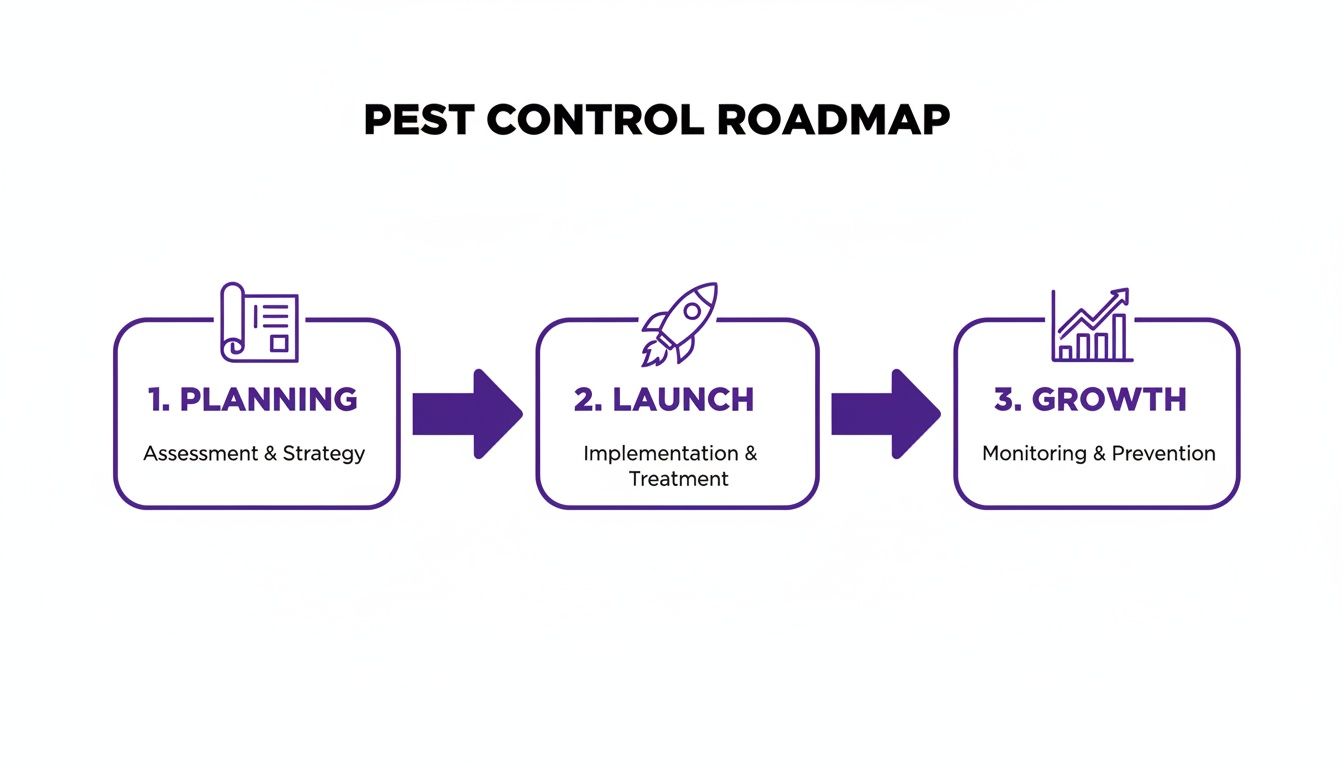
It’s a simple visual, but it drives home a key point: sustainable growth is always built on a foundation of careful planning and a strong, organized launch.
Understanding the Market Opportunity
The demand for professional pest management isn't just steady—it's growing. The U.S. industry revenue is projected to hit around $28.5 billion by 2025, climbing at a 5.0% compound annual rate. What’s driving this? Recurring service contracts and the simple fact that people will always need pests removed.
This consistent demand means your services will always be needed, protecting homes and businesses from damage and health risks. It doesn't matter if you're running a traditional operation with a fully-equipped truck or a leaner mobile setup; the core principles of excellent service and reliability are what count.
For those thinking about a mobile-first approach, this detailed guide on launching a mobile service business has some great takeaways on setup and operations that translate well to the pest control field.
At the end of the day, your success will be built on your reputation. It starts with your very first job and grows with every happy customer.
To give you a clearer picture of the journey ahead, here's a quick summary of the stages involved.
Pest Control Startup Roadmap at a Glance
This table breaks down the three main phases of launching your business, outlining the specific focus areas and what you aim to accomplish at each step.
| Stage | Key Focus Areas | Primary Goal |
|---|---|---|
| Phase 1: Planning | Market Research, Business Plan, Niche Selection, Financial Projections | Create a solid, actionable blueprint for a profitable business. |
| Phase 2: Launch | Legal & Licensing, Equipment & Supplies, Pricing & Packages | Get legally compliant, fully equipped, and ready to serve customers. |
| Phase 3: Growth | Marketing & Lead Gen, Sales Process, Hiring & Training | Acquire the first 10-20 paying clients and build operational momentum. |
Think of this table not as a rigid set of rules, but as a framework to keep you organized and focused as you move from one critical task to the next.
Getting Your Business Legal: Licenses, Insurance, and Structure
Alright, let's talk about the paperwork. I know it's not the exciting part of starting a business, but getting your legal ducks in a row is non-negotiable in the pest control world. This isn't just red tape; it's the foundation that protects you, your family, and your future company.
Think of it this way: handling your legal structure, licensing, and insurance upfront is what separates the professionals from the amateurs. It’s what lets you operate with confidence, knowing you’re covered.
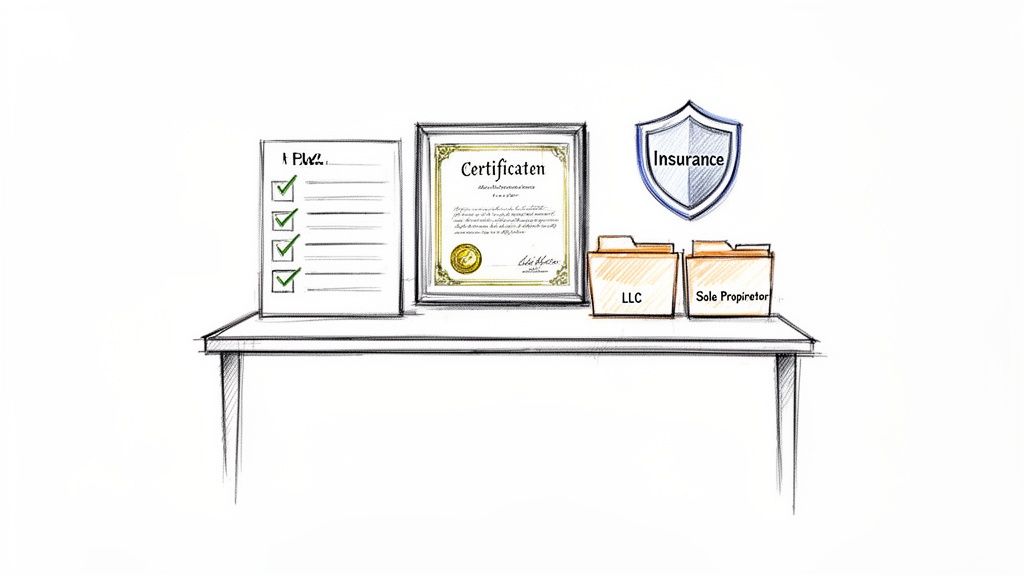
Getting this right protects your personal assets, keeps you on the right side of the law, and shows customers you're a legitimate business they can trust.
Choosing Your Business Legal Structure
Your first big decision is how to structure your company. For most new operators, it boils down to two options: a Sole Proprietorship or a Limited Liability Company (LLC). The choice you make has major implications for your personal liability and how you handle taxes.
A Sole Proprietorship is the path of least resistance. It's simple, cheap, and you and the business are considered one and the same in the eyes of the law. While that sounds easy, it means there’s no firewall between your business debts and your personal assets. If someone sues your business, they're essentially suing you.
An LLC, on the other hand, builds that legal wall. It separates you from the business, meaning if a job goes south and a lawsuit follows, your personal property—like your home or your savings—is generally safe. It takes a bit more paperwork and a small fee to set up, but that protection is priceless.
For a new pest control business, the liability protection an LLC provides isn't a luxury; it's a necessity. One mistake with a chemical application or an accidental property damage claim could otherwise put your entire financial life at risk.
Deciding on a structure is a big step. If you're weighing your options, digging into resources that break down the pros and cons can be incredibly helpful. For instance, this guide asks Should You Incorporate Your Business? and offers some valuable perspective.
Securing Your Pest Control Licenses
Pest control is a regulated industry, and for good reason. We handle powerful chemicals and play a direct role in public health and safety. You simply cannot operate legally without the right licenses. The exact requirements will vary from state to state, but the journey usually looks pretty similar.
First, you'll likely need to become a Certified Applicator (or your state's equivalent). This typically involves:
- Hitting the books and studying the official manuals from your state’s Department of Agriculture or environmental agency. You'll need to know your stuff on pest biology, chemical safety protocols, and local laws.
- Passing a state exam to prove you have the knowledge to do this job safely and effectively.
- Paying a licensing fee, which can run anywhere from a couple of hundred to several hundred dollars.
On top of your personal certification, your business itself will need a Pest Control Business License. This is a separate license that officially registers your company with the state. And don't forget, as you grow and hire technicians, you're responsible for ensuring they are also licensed or working under the proper supervision according to your state’s guidelines.
Getting the Right Business Insurance
Running a pest control business without insurance is like working with chemicals without gloves—it's a massive, unnecessary risk. One bad day—a chemical spill, an unexpected allergic reaction, even a simple fender bender in the work truck—could sink your entire business before it even gets started.
Here are the policies you absolutely need from day one:
- General Liability Insurance: This is your shield against property damage (think overspray hitting a client’s expensive koi pond) or bodily injury claims.
- Commercial Auto Insurance: Your personal car insurance won't cover you when you're driving for work. You need a dedicated commercial policy for your service vehicle. Period.
- Workers' Compensation: The minute you hire your first employee, this becomes a legal requirement in most states. It covers their medical bills and lost income if they get hurt on the job.
My advice? Don't just go for the cheapest quote. Find an insurance agent who actually understands the pest control industry. They can help you get the right coverage for specific risks like pollution liability (for chemical spills) and termite damage claims. Proper insurance isn't an expense; it's your ultimate safety net.
Budgeting for Your Essential Equipment and Supplies
Alright, you’ve navigated the legal maze and have your licenses in hand. Now comes the part that feels a lot more real: buying the gear. This is where your business plan stops being a document and starts turning into a truck, sprayers, and everything you need to actually solve a customer's pest problem. Let's break down what this will realistically cost.

Starting from scratch means a real investment in the tools of the trade. Knowing where to spend your money—and where you can be a bit more frugal—is key to keeping your finances healthy right out of the gate.
For a new, owner-operated business, you should plan on a total startup cost somewhere between $20,000 and $35,000. That's a big range, I know, but it covers everything. We’re talking about the truck, the licensing fees (which can hit you for $200 to $800), and the must-have liability insurance, which typically runs $1,200 to $3,000 for the first year. If you want a deeper look at how these numbers all fit together, you can learn more about what you need to build a profitable pest control business.
The Cornerstone of Your Business: Your Service Vehicle
Your truck or van is so much more than just a way to get from A to B. It’s your rolling billboard, your mobile storeroom, and your office on wheels. It’s also going to be your single biggest purchase, so don't rush this decision.
It’s tempting to want a brand-new truck with a slick, professional wrap right away. And while that looks sharp, it’s a fast track to high payments and instant depreciation. A reliable used truck is a much smarter play when you're just starting out.
Focus on finding a vehicle with the payload capacity to handle a big sprayer rig and all your gear. Mechanical reliability is everything—a truck that runs every single day is infinitely more valuable than a shiny one that's always in the shop.
Your Workhorse: Application Tools
After your vehicle, your main application tools are what directly make you money. This is not the place to cheap out. Quality, durable equipment doesn't just last longer; it works better and tells your clients you’re a serious professional.
At a minimum, your go-to toolkit should include:
- A Power Sprayer: A truck-mounted rig, usually 50-100 gallons, is your workhorse for efficient perimeter treatments.
- A Backpack Sprayer: You’ll need this for smaller, more precise jobs where the big sprayer is just overkill.
- Handheld Dusters: Absolutely essential for getting insecticide dust deep into wall voids and crevices where pests love to hide.
- Bait Guns: For applying precise beads of gel bait for roaches and ants. You can't do it right without one.
Trust me, investing in good brands here pays for itself. A cheap sprayer that keeps clogging or a bait gun that breaks mid-service will cost you far more in wasted time and sheer frustration than you saved upfront.
My advice is simple: put your money into a dependable vehicle and top-notch application tools. You can get by with budget-friendly options for other things, but your truck and sprayer are how you earn a living every single day.
Personal Protective Equipment (PPE) and Chemical Inventory
Your safety is non-negotiable. Period. You're handling professional-grade products, and that means following safety protocols to the letter. It all starts with having the right Personal Protective Equipment (PPE) before you even think about your first job.
Your basic PPE kit must include:
- Respirator with the right cartridges: To protect your lungs from chemical vapors.
- Chemical-resistant gloves and boots: To keep products off your skin.
- Safety glasses or goggles: To shield your eyes from splashes.
- Long-sleeved shirts and pants (or coveralls): A simple but necessary barrier.
When it comes to your first chemical order, be strategic. You don't need one of everything. Start with a solid, low-odor insecticide for general pest jobs, a good non-repellent for tricky ant and roach situations, and some quality rodent bait. You can always add more specialized products as you grow and face different challenges.
To help you put some real numbers to this, I've put together a table outlining the typical startup costs for a solo operator.
This table gives you a realistic breakdown of the key one-time expenses you'll run into. Just remember these are ranges—your final costs will depend on your choices between new and used gear and the specific brands you pick.
Estimated Startup Costs for a Pest Control Business
| Expense Category | Typical Cost Range | Notes & Considerations |
|---|---|---|
| Service Vehicle (Used) | $10,000 – $20,000 | Focus on reliability. A clean, well-maintained used truck or van is perfect. |
| Truck-Mounted Sprayer | $2,000 – $4,500 | Your primary money-maker. Invest in a quality brand like B&G or Birchmeier. |
| Application Tools | $500 – $1,500 | Includes backpack sprayer, duster, bait gun, and miscellaneous tools. |
| Initial Chemical Inventory | $800 – $2,000 | Start with versatile products for common pests in your area. |
| Safety Equipment (PPE) | $200 – $500 | Non-negotiable. Includes respirator, gloves, eyewear, and coveralls. |
| Ladders & Misc. Gear | $300 – $800 | Step ladders, extension ladders, flashlights, and inspection tools. |
By budgeting for these essentials thoughtfully, you can build a strong foundation for your business without getting buried in debt. It’s the smart way to position yourself for success right from day one.
Figuring Out What to Sell and How to Price It for Profit
Alright, you've got your licenses in hand and your gear is ready to go. Now we move from the paperwork and logistics into pure strategy. You need something to actually sell, and how you package your services will determine who you work with and, ultimately, how much money you make. This isn't just about killing bugs anymore; it's about building a business that lasts.
Your first major decision is where to focus your energy. Are you going to chase the high volume of residential accounts? Or will you aim for the bigger, more complex commercial contracts? Each path demands a completely different approach to sales, service, and pricing.
Choosing Your Playground: Residential vs. Commercial
This is a foundational choice you have to make right out of the gate. Residential work is all about building relationships with homeowners and selling them on recurring protection plans. It's a numbers game, really—your goal is to create a dense, profitable route where you can service multiple homes in the same neighborhood efficiently.
Commercial contracts, on the other hand, can be incredibly lucrative but come with their own set of challenges. We're talking restaurants, warehouses, office parks. The sales cycle is longer, and the documentation and compliance requirements are much more strict. Many new operators I know start with residential work to get cash flowing and build confidence, then slowly start bidding on commercial jobs as they grow.
There's a third option, too: become a specialist. Instead of being a jack-of-all-trades, you could build your entire brand around being the go-to expert for high-stakes problems like termites, bed bugs, or nuisance wildlife. These jobs almost always command premium prices because they require very specific knowledge, training, and equipment.
The Power of Recurring Revenue: Building Your Service Packages
The holy grail in any service business is predictable, recurring revenue. If you only rely on one-off emergency calls—the frantic homeowner with a wasp nest in their siding—you'll be stuck in a "feast or famine" cycle forever. The real money is in designing service packages that get customers to commit for the long haul.
This is how you turn a one-time transaction into a long-term relationship.
Here's a simple, proven structure to start with:
- One-Time Service: This is your foot in the door. It’s for a specific, immediate problem like a sudden ant invasion. Price it high enough to make it worth your while, but look at every one of these calls as a golden opportunity to sell them on a recurring plan.
- Quarterly Protection Plan: This will be the backbone of your residential business. It typically starts with a comprehensive interior and exterior "flush-out" service, followed by scheduled exterior-only treatments every three months to maintain that protective barrier.
- Bi-Monthly or Monthly Plans: These are perfect for customers with higher pest pressure or for most commercial accounts that need more frequent monitoring and service to stay compliant and pest-free.
The key is to stop selling "pest sprays" and start selling "peace of mind." You're offering a guaranteed, pest-free home all year round. That mental shift is what turns a simple service into a subscription people are happy to pay for.
How to Price Your Services with Confidence
Setting your prices feels daunting at first. It's tempting to look at what the competition is doing and just try to be a little cheaper. Don't do it. Competing on price is a race to the bottom that will leave you overworked, stressed, and broke. You need to price for profit.
A straightforward way to get your numbers right involves three key pieces:
- Calculate Your Hard Costs: First, figure out your direct costs for a single job. This means the actual price of the chemicals you'll use (you can calculate this down to the cost per finished gallon) and your fuel to get to and from the property.
- Factor In Your Time: What's your time worth? Seriously, put a number on it. If you want to make $75 per hour for your expertise and labor, and a job is going to take you two hours, that's $150 right there before anything else.
- Add a Healthy Profit Margin: Once you've covered your chemicals, gas, and your own time, you need to add profit. This is what actually grows the business. A margin of 30-50% (or even more) is a solid target. This ensures you're not just breaking even, but building a real company.
Let's walk through a quick example. Say a new quarterly plan's initial service will cost you $40 in chemicals and fuel. It takes you two hours, and you value your time at $150. Your total cost is $190. If you add a 40% profit margin, your price for that initial service lands around $266. Now you know that every job you do is actively contributing to your bottom line.
Winning Your First Customers and Filling Your Schedule
Alright, you've got your license, insurance is squared away, and your truck is stocked with professional-grade gear. Now comes the hard part. Without a steady flow of customers, you don't have a business—you have a very expensive hobby. This is the make-or-break moment where a new pest control business either takes off or stalls out on the runway. It all boils down to your ability to generate leads and, just as crucially, turn those leads into paying jobs.
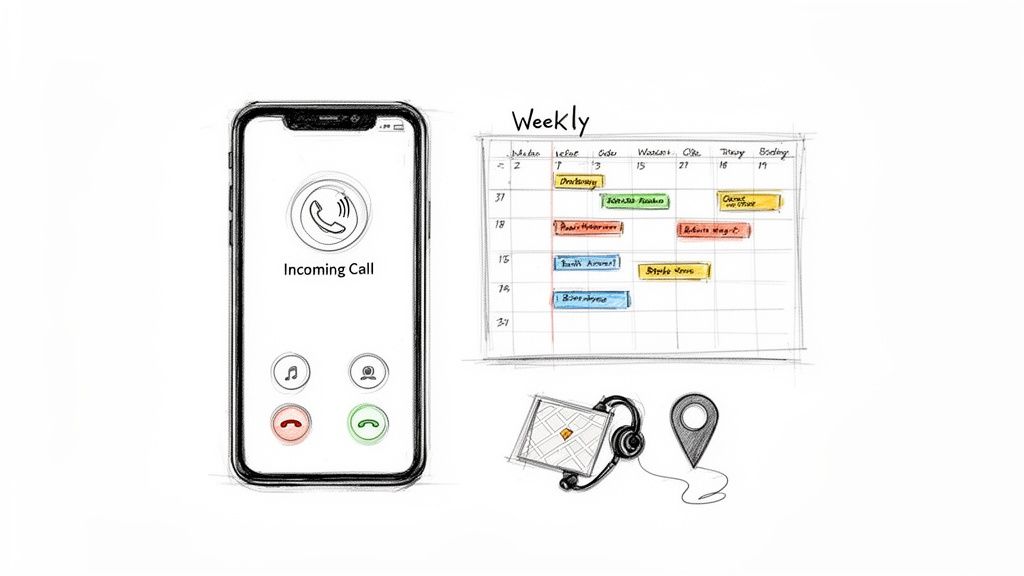
Let's get one thing straight: a missed call is a lost job. When someone finds ants marching across their kitchen counter, they aren't going to leave a voicemail and wait patiently. They're hanging up and dialing the next company on the list. Building a solid system to land those first customers is the single biggest challenge you'll face in your first year.
Laying Your Digital Foundation
Before you even think about spending a dime on ads, you need to set up your digital storefronts. These are the basics that make you look like a legitimate, trustworthy pro when people find you online.
Your two absolute must-haves are a simple, professional website and a fully built-out Google Business Profile (GBP).
- Your Website: It doesn't need to be fancy. A clean site that works well on a phone, with your business name, phone number, service area, and a list of pests you handle is perfect to start. Think of it as your digital business card, working for you 24/7.
- Google Business Profile: Honestly, this might be even more important in the beginning. Claiming and completing your free GBP is how you show up in local map searches when someone types "pest control near me." It’s a powerful and free way to get local leads.
Make sure that GBP is 100% complete. Add photos of your truck, your equipment, and yourself in uniform. List your hours and service area. Most importantly, start asking for reviews from your very first job—positive reviews are the biggest factor for climbing the local search rankings.
Answering the Call. Every. Single. Time.
Here’s a hard truth about starting out: you can't be two places at once. You can't be safely treating a home while also answering a new call, quoting a price, and getting them on the schedule. This is where most solo operators fumble and lose thousands in potential revenue.
How you handle lead generation, phone coverage, and appointment setting is the real engine for growth. The speed at which you convert an inbound call into a booked job has a massive impact on your bottom line. In fact, many successful pest control companies now use specialized software and dedicated phone staff just to capture every single lead. Some report this approach boosts booked appointments by double-digit percentages. To see how much technology is changing the game, you can explore detailed pest control statistics and trends.
This is why you have to figure out phone coverage from day one.
A professional answering service or a remote customer service rep (CSR) isn't an expense; it's an investment in capturing revenue. For what a few missed jobs would cost you each month, you can have a trained pro representing your brand, answering questions, and booking appointments right on your calendar.
This frees you up to do what you do best: provide great service. The new job just appears on your schedule, and you can focus on the work in front of you without a single distraction.
Actively Hunting for Your First Leads
Once your digital foundation is solid and you have a plan for incoming calls, it's time to go on the hunt. Sitting around and waiting for the phone to ring is a recipe for failure. You have to be proactive.
Here’s a practical, multi-pronged approach to get your schedule filled:
- Door-to-Door Flyers: It sounds old-school, but trust me, it works. When you finish a job, leave professional flyers on the doors of the 20 nearest neighbors. A simple message like, "We were just in your neighborhood helping the Smiths with an ant problem. Call us for a free inspection!" is incredibly effective.
- Network with Other Trades: Start building relationships with real estate agents, home inspectors, plumbers, and roofers. These folks are in homes all day and are often the first to spot a pest issue. A small referral fee can create a powerful stream of high-quality leads.
- Targeted Cold Calling: This isn't for everyone, but it’s a direct line to landing valuable commercial accounts. Make a list of local restaurants, property management companies, or small warehouses. A quick, professional call offering a free inspection can get your foot in the door for a lucrative monthly contract. Many business owners even use specialized cold calling services that book qualified appointments right on their calendars for them.
The Service Business Sales Process
Your sales process doesn't need to be complex. When a lead comes in—from a call, your website, or a referral—the goal is always the same: get on the property for an inspection.
The inspection is where the magic happens. It lets you accurately identify the problem, build a personal connection with the customer, and present your solution with confidence. It transforms you from just a voice on the phone into a trusted expert standing in their home. That personal interaction is what closes deals and builds the trust you need to sell a recurring service plan—the true lifeblood of your new business.
Answering the Big Questions About Starting a Pest Control Business
Jumping into the pest control world is exciting, but it's natural to have a few big questions swirling around. Let's tackle some of the most common ones I hear from new entrepreneurs to give you a clearer picture of the road ahead.
What Kind of Money Can I Realistically Make in My First Year?
This is the big one, right? Your first-year earnings can swing quite a bit based on your local market, how you price your services, and how hard you hustle for new business. For a solo owner-operator hitting the ground running, bringing in $50,000 to $80,000 in total revenue is a very achievable goal for the first twelve months.
The secret to a strong start isn't just landing jobs; it's landing recurring jobs. Getting customers on quarterly or bi-monthly plans is what builds that predictable, stable income. That regular cash flow is the lifeblood of your business, especially early on. If you're smart about keeping your startup costs down—think working from home and buying a reliable used truck—you'll see a nice chunk of that revenue turn into actual profit.
What's the Most Profitable Service to Offer?
While your general pest control plans pay the bills, the real money is often in the specialty services. These are the high-stakes problems that require specific skills and equipment, and homeowners will pay a premium to make them go away for good.
Here's where you'll find the highest profit potential:
- Termite Treatments: These are the big-ticket jobs. A single termite job can bring in thousands of dollars and can really move the needle on your revenue goals.
- Wildlife Removal: Not every company wants to deal with raccoons in the attic or squirrels in the walls. If you have the expertise, it's a fantastic, high-margin niche.
- Bed Bug Heat Treatments: This is an intense, detail-oriented service. It’s a lot of work, but the payoff from a single project can be massive.
A solid strategy is to build your foundation on the steady income from general pest control, but get certified and equipped to handle at least one of these high-ticket specialties. This gives you both day-to-day stability and the chance to land those huge, profitable jobs.
Do I Really Need to Rent an Office Space?
Absolutely not. In fact, I'd strongly advise against it when you're starting. A physical office is a cash-draining, unnecessary expense for a new pest control business. The most successful solo operators I know run everything from their homes to keep overhead rock-bottom.
What you do need is a dedicated, secure, and properly ventilated area to store your chemicals and equipment. This could be a specific section of your garage or a standalone shed. Your truck is your real office—it's where the work happens every day.
How Can I Get My First Customers to Trust Me?
In this line of work, trust is everything. It’s the single most important thing that turns a one-time call into a lifelong customer who tells their neighbors about you. Building that trust starts the moment you first connect with a potential client.
Professionalism is non-negotiable. Show up in a clean, branded truck wearing a sharp uniform. Take the time to walk the homeowner through what you're going to do before you start, and leave them with a clear, detailed service report when you’re done. Be on time, send a text when you're on your way, and never surprise them with hidden fees.
And the most powerful trust-builder of all? Guarantee your work. Offering to come back for free if the pests return between scheduled services shows you're confident in your results. That kind of accountability is what creates serious customer loyalty right from the start.
Trying to manage all of this—from answering calls to scheduling appointments—is a huge task for one person. This is where Phone Staffer can make a real difference. We can find, train, and place a skilled remote customer service rep right into your business to handle every call and book new jobs. We even offer a cold calling service to land those lucrative commercial accounts you've been after. Find out how we can help at https://phonestaffer.com.