
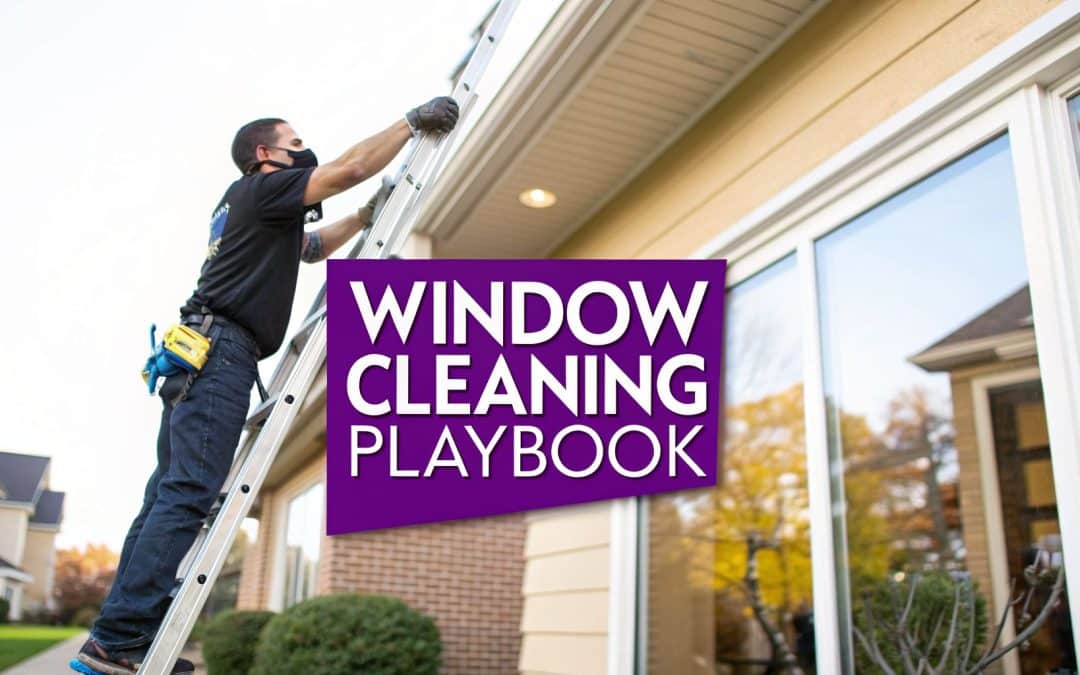
So, you want to start a window cleaning business? It all boils down to three simple things: scoping out your local market, getting your business legal, and grabbing the right gear. Believe it or not, you can get this whole thing off the ground with less than $500, especially if you start with residential homes to get cash flowing and build a name for yourself.
Your Guide to the Window Cleaning Business
Before you even touch a squeegee, let's talk about the real opportunity here. Starting a window cleaning business is more than just making glass sparkle—it’s a surprisingly straightforward way to build a profitable company with a very low barrier to entry. I've seen countless successful owners start with just the essentials and scale up from there.
This simple chart lays out the foundation. It’s all about getting your ducks in a row before you start chasing jobs.

As you can see, the real work begins long before you clean your first window. Nail the research and legal stuff first, and everything else falls into place much easier.
The Real Opportunity in Window Cleaning
The numbers don't lie. This is a solid business to get into. In the U.S. alone, the market pulled in $2.8 billion in revenue in 2023, with average profit margins hanging around a healthy 6.5%. When your startup toolkit can cost less than $500, you’re looking at a business you can launch without taking a huge financial gamble. You can find a deeper dive into these numbers over at Gitnux.org.
But the secret sauce? Recurring revenue. Window cleaning isn't a one-and-done service. Homes and businesses need it done again and again.
I know a roofer, Mark, who got tired of the feast-or-famine cycle. He jumped into window cleaning with just a $500 tool budget. He focused entirely on building a route of regular residential clients, and within his first year, he was clearing over $6,000 a month in profit. His story is proof: you don't need a fat wallet, just a smart plan.
You're not just buying yourself a job; you’re building a real asset. Your first goal should be to lock in a base of clients who give you predictable income. That's the cash that will fuel your growth.
Window Cleaning Business Quick-Start Checklist
To get you started, I've put together a quick-start checklist. This table summarizes the essential first moves you need to make to launch your window cleaning business the right way.
| Action Step | Key Consideration | Estimated Initial Cost |
|---|---|---|
| Market Research | Is your area more residential or commercial? What are competitors charging? | $0 |
| Legal & Financial Setup | Pick a name, register your business (LLC is smart), and open a separate business bank account. | $100 – $500 |
| Get Insured | General liability is non-negotiable. It protects you and makes you look professional. | $40 – $60 per month |
| Buy Starter Equipment | Get a good squeegee, scrubber, bucket, towels, and a solid ladder. Don't go crazy. | $250 – $500 |
| Set Your Prices | Will you charge per pane, per hour, or a flat job fee? Start simple with residential jobs. | $0 |
This isn't everything you'll ever need to do, but it’s the solid foundation you must lay down. Get these five things right, and you'll be on the fast track to a successful launch.
Building a Solid Business Foundation
Getting the foundation right from the very beginning is what separates a weekend side hustle from a legitimate, profitable business. This is where we handle the boring-but-crucial stuff—the legal and financial groundwork that protects you and sets you up to actually grow.

It’s time to move past the “idea” phase and get into the practical details. We’re talking about choosing a name, getting registered, securing the right insurance, and figuring out how to price your work so you can actually turn a profit.
H3: Deciding on Your Business Structure
One of the first big decisions you'll make is how to structure your company. For most new window cleaners, the choice boils down to two paths: Sole Proprietorship or a Limited Liability Company (LLC).
- Sole Proprietorship: This is the quick and easy route. You and the business are one and the same in the eyes of the law. The huge catch? If your business gets sued, your personal assets—your car, your house, your savings—are on the line.
- LLC: An LLC builds a legal wall between your business and your personal life. While it costs a bit more to set up and maintain, it means that if something goes wrong on a job, your personal assets are protected. For anyone serious about building a real company, an LLC is the way to go.
Think of the LLC as your first real piece of professional gear. It might have an upfront cost, but it provides essential protection that allows you to work with confidence.
The One Thing You Cannot Skip: Get Insured
Insurance always feels like a waste of money… until the day you desperately need it. In this business, General Liability insurance is non-negotiable. It’s what covers you if you accidentally break a window, scratch a floor, or damage a client’s property in any way.
I once knew a new business owner who tried to save $50 a month by putting off insurance. On his second job, his ladder slipped and shattered a massive custom window. The replacement cost was $5,000. That one incident nearly put him out of business before he even got started.
Don’t make that mistake. Get insured from day one. Many commercial clients and high-end homeowners won’t even consider hiring you without proof of insurance. It's not just a safety net; it’s a mark of professionalism that helps you land better jobs.
While you're getting set up, go to the IRS website and get your free Employer Identification Number (EIN). You'll also need to check with your city and state for a general business license. For home services, the process is usually pretty simple.
H3: Setting Up Your Business Finances
Keeping your business and personal finances separate is absolutely critical. It’s not just about making tax time easier; it’s about knowing whether your business is actually making money. The first step is to open a dedicated business bank account. You'll need your EIN and business registration documents to get this done.
This separation forces you to treat your business like a business. You’ll get a crystal-clear picture of your income and can easily track expenses like fuel, supplies, and marketing. Most importantly, it allows you to pay yourself a consistent salary.
A No-Nonsense Guide to Pricing Your Services
The single biggest mistake new window cleaners make is undercharging. You can't just throw a number out there and hope it works. You need a system.
Let’s walk through a common job: a 2,500 sq. ft., two-story home with 20 standard double-hung windows. That’s 40 panes of glass if you're cleaning them inside and out.
Here are the three most common ways to price this job:
- Price Per Pane: This is simple and easy to scale. If you charge $5 per pane, the job comes out to $200 (40 panes x $5). It's a fantastic method for beginners because it makes quoting on the spot a breeze.
- Price Per Hour: Figure out what you want to make per hour. Let's say your target is $50 an hour. If you estimate this house will take you four hours from start to finish, you'd quote $200. This method ensures you're paid fairly for your time, especially on more complex or dirty jobs.
- Flat-Rate Pricing: Once you have some experience, you can start giving a single flat price. For a house like this, you might quote a flat $225. This gives you a little buffer for stubborn screens or unexpected challenges, and customers love the simplicity of a single price.
My advice? Start with the per-pane or hourly model. As you get a better feel for how long jobs take, you can transition to flat-rate pricing. Remember, your prices directly determine your profit and your ability to grow. Don't be afraid to charge what you're worth.
Essential Equipment for Professional Results
Forget about those endless shopping lists packed with gadgets you’ll never actually use. When you're just starting out, all you really need is a handful of core tools to get a professional, streak-free finish every time. The key is thinking about return on investment—spending a little extra on quality gear right now will save you a ton of headaches and cash down the road.
I'll never forget what a 20-year veteran cleaner told me. He insisted the best money he ever spent was on a $40 high-quality squeegee blade. Cheap blades left frustrating streaks, forcing him to go back over his work and wasting precious time. That one premium blade, however, glided like a dream, cut his job time by 15%, and outlasted ten of the cheap ones. It paid for itself on the first couple of jobs.
That’s the mindset you need. Don't think of it as spending money; think of it as investing in your own efficiency. A sturdy ladder, a professional-grade scrubber, and a premium squeegee aren't expenses—they are your primary money-making assets.
Startup Kit vs Growth Kit Equipment Comparison
When you're starting, your focus is on getting the job done right without breaking the bank. But as you grow, your equipment needs to evolve to make you faster and more capable. Here’s a look at how your toolkit will change.
| Equipment Type | Startup Kit (Under $500) | Growth Kit (For Scaling) |
|---|---|---|
| Cleaning Tool | 14-inch or 18-inch Squeegee & T-Bar Scrubber | Water-Fed Pole System |
| Water Source | 5-Gallon Rectangular Bucket & Soap | Pure Water System (RO/DI) |
| Accessibility | 16-foot or 24-foot Extension Ladder | Additional Ladders, Standoffs, Step Ladder |
| Detailing | Microfiber Towels | More specialized towels, Scrapers |
| Safety | Non-Slip Shoes, Gloves | Ladder Stabilizer, Harness (for commercial) |
The startup kit is all about getting you in the game and generating cash. The growth kit is about reinvesting that cash to work smarter, not just harder.
Day-One Must-Haves
You don’t need a van overflowing with gear to get started. You can build an incredibly effective kit that will handle nearly any residential job you come across. This is the stuff you absolutely need before your first day.
Your initial toolkit should include:
- A High-Quality Squeegee: This is your most important tool, so don't be cheap. Get a 14-inch or 18-inch model with replaceable rubber.
- A T-Bar Scrubber: This is what you'll use to soap up the window and scrub away the grime. Match its size to your squeegee.
- A Professional Bucket: A rectangular 5-gallon bucket is perfect. It’s wide enough to dunk your whole scrubber and squeegee setup.
- Microfiber Towels: Get a big stack of these. They’re super absorbent, lint-free, and essential for detailing edges and wiping up drips.
- A Sturdy Ladder: A 16-foot or 24-foot extension ladder will give you safe access to most second-story windows.
- Basic Safety Gear: This is non-negotiable. Get a good pair of non-slip shoes, gloves to protect your hands, and a ladder stabilizer.
You can pull all of this together for a surprisingly low cost, often under $500. The goal is to get just what you need to provide amazing service and start bringing in money. In fact, if you're looking for those first few jobs, our advice on securing leads for a power washing business in Kansas City has tips that apply here, too.
Growth Gear for Scaling Your Business
Once you've got consistent work and a positive cash flow, it's time to reinvest in equipment that makes you faster and lets you take on bigger jobs. This is the gear that turns a one-person operation into a real business.
A friend of mine, Brian, ran his solo window cleaning biz for two years using just a ladder and a squeegee. He was making good money but was constantly exhausted from climbing up and down the ladder all day. He finally invested $2,500 in a water-fed pole (WFP) system. He told me it completely changed his business. Not only did it cut his time on an average two-story house by about 40%, but it also eliminated the safety risk of being on a ladder for hours. The investment paid for itself in less than two months just from the extra jobs he could now fit in. You can find more market outlook data for window cleaning services on marketresearch.com.
As you start to grow, consider adding these tools:
- Water-Fed Pole (WFP) System: This is how you’ll tackle multi-story homes and small commercial buildings without ever leaving the ground. It uses purified water that dries spot-free, so you don't even need a squeegee for high windows.
- Pure Water System: A WFP is only as good as the water running through it. You'll need a purification system (using reverse osmosis or deionization) to get that spot-free finish.
- Additional Ladders: A set of ladder standoffs (to protect gutters and siding) and a small step ladder for interior work will help you handle a wider variety of homes safely and professionally.
Sales and Marketing Strategies That Actually Work
Alright, you’ve got the gear, you’re officially a business, and you’re ready to go. Now for the most important part: getting paid. Without a steady stream of customers, your brand-new squeegees will just collect dust. Let’s talk about how to get your phone ringing and your calendar booked solid. This isn't about just printing some flyers and hoping for the best; it’s about building a real, repeatable system for finding clients.

A reliable marketing engine is what separates a side hustle from a scalable business. It’s what lets you focus on doing great work instead of constantly worrying about where the next job is coming from.
Master Your Digital First Impression: The Google Business Profile
Before you even think about paying for ads, your first marketing task is to claim and fully optimize your Google Business Profile (GBP). It's completely free, and it's the single most important thing you can do to get found online. When a homeowner types "window cleaner near me" into Google, a well-built GBP is what gets you on the map—literally.
Think of it as your online storefront. You need to fill out every single detail: list all your services, define your service areas, set your hours, and upload plenty of photos. As soon as you finish a job, snap some high-quality before-and-after shots and get them on your profile. Most importantly, make it a habit to ask every happy customer for a review. A profile with 10 five-star reviews will almost always get the call over a competitor with zero.
I talked to a new owner, Sarah, who landed her first $1,200 commercial gig—a small office park—solely because her GBP had more recent photos and positive reviews than the established competition. The client told her, "You looked more professional and active." That’s the power of a well-maintained profile.
The Fastest Way to Fill Your Schedule: Proactive Outreach
Waiting for the phone to ring is a painfully slow way to grow. If you want to build momentum quickly, you have to be proactive. For local service businesses, nothing beats the directness of old-school cold calling. The idea might make you cringe, but it’s brutally effective for landing both residential and commercial work.
Here’s the secret: you aren't selling window cleaning over the phone. You are simply selling the appointment. Your only goal is to book a time for a free, no-obligation estimate. That’s a much smaller, easier "yes" for someone to give.
A friendly, direct script is your best friend here. Ditch the long, slick sales pitch and get right to the point with a confident, neighborly tone.
A Cold Calling Script That Actually Books Appointments
I’ve seen this simple script work wonders for new business owners. Its power lies in its brevity and its clear, low-pressure call to action.
- You: "Hi, is this [Homeowner's Name]?"
- Them: "Yes, it is."
- You: "Hi there, my name is [Your Name] with [Your Company]. We're going to be in your neighborhood next week doing some work for a few of your neighbors, and I couldn't help but notice your windows from the street. I have an opening next Tuesday to swing by for a quick, free, no-obligation estimate. Would that work for you?"
This script is effective because it immediately builds social proof ("working for your neighbors"), makes a specific observation, and offers a step that requires very little commitment. It feels helpful, not pushy. Practice it out loud until it feels like a natural conversation. For more proven strategies, our guide on acquiring power washing leads in Scarsdale has some great tips that apply here, too.
Putting Your Growth on Autopilot
Let’s be realistic. You can't make thousands of calls yourself. That’s a full-time job, and as the owner, your time is far more valuable when you’re out giving estimates, managing your crew, and planning your next move. This is the point where you have to think about automation to truly scale.
This is exactly what services like Phone Staffer were built for. They take the entire appointment-setting grind off your shoulders. A dedicated service can:
- Build targeted calling lists for your specific zip codes.
- Make thousands of calls every day on your behalf.
- Use professionally trained callers who know how to book appointments for home services.
Imagine waking up to find three or four estimate appointments already plugged into your calendar for the day. A buddy of mine in the pressure washing business went from scrambling for his next job to having a two-week backlog after he outsourced his calling. It completely transformed his operation, allowing him to hire his first tech and finally stop living job-to-job. This is how you shift from being just a window cleaner to a true business owner.
Scaling from Solo Operator to Business Owner
Let's be honest, the point of all this hard work wasn't just to create a full-time job for yourself. You're building an asset. So, once the cash is flowing and your calendar is packed solid, it’s time to change gears. This is where you stop being a window cleaner who owns a business and start being a business owner who happens to be in the window cleaning industry.

This jump is the single biggest leap you'll make. It’s about making your first hire, creating dead-simple systems so things don't fall apart, and getting tasks off your plate so you can actually focus on growth.
Making Your First Hire
So, when do you pull the trigger on hiring? It’s simpler than you think. You hire when the pain of turning down good work hurts more than the fear of adding someone to payroll. If you’re constantly booked two weeks out and telling people "no," you’re literally throwing money away.
That's your cue to find your first technician. Here's a pro tip: focus on attitude and reliability, not just experience. You can teach anyone how to properly use a squeegee. You can't teach them to be a good person who shows up on time.
A franchise owner I know, Dave, learned this the hard way. He was desperate to expand and hired a guy with years of experience who looked perfect on paper. The problem? He had a terrible attitude. The new guy rushed jobs, was dismissive with customers, and in less than a month, Dave lost three recurring clients and watched his 5-star Google rating plummet to a 3.8.
That one bad hire cost him well over $10,000 in lost revenue and months of reputation management. The lesson is crystal clear: hire for character, train for skill. A great attitude is worth infinitely more than a decade of bad habits.
Building Your Operational Playbook
You can't clone yourself. If you want to scale, you need to bottle up your process into simple, repeatable systems. This ensures every single customer gets the same fantastic service, whether it's you on the job or your newest hire. This is your playbook.
Don't overthink it. This isn't a 100-page corporate manual. Start with the absolute basics:
- Pre-Job Checklist: A simple list your tech can run through before they even touch a window. Things like: greet the customer by name, confirm the work order, and walk the property to spot any pre-existing damage.
- On-Site Workflow: Your standard operating procedure for every job. For instance: always tackle screens first, then exterior glass, then move inside. Consistency is what makes you fast and prevents silly mistakes.
- Post-Job Sign-Off: The final steps. This should include doing a final walk-around with the client for approval, collecting payment, and—most importantly—asking them for a review.
These simple documents are the scaffolding for a business that can grow beyond you. They give your team clarity and your customers a predictable, high-quality experience.
Outsourcing to Focus on Growth
As the owner, your highest-value activity isn't washing windows; it's finding more windows to wash. To do that, you have to start delegating. Think about all the hours you sink into admin work that someone else could easily handle.
Take appointment setting, for example. It's essential, but it’s a grind. Are you, the CEO, really the best person to be making hundreds of calls to fill the schedule? Absolutely not. This is a perfect task to outsource to a dedicated appointment setting service, which often pays for itself in the new business it generates. The outreach strategies are surprisingly similar across industries; for instance, the principles in this article about generating leads for a roofing business in Broomfield apply just as well to window cleaning.
The same goes for things like bookkeeping or managing your social media. Every hour you buy back is an hour you can invest in true growth activities:
- Chasing down those big, lucrative commercial contracts.
- Adding new services like gutter cleaning or solar panel washing.
- Recruiting and training your next superstar technician.
This is the mental shift that turns a solo operator into a real CEO. You finally stop working in the business and start working on it.
Common Questions About Starting Your Business
When you’re first starting out, it can feel like you're drowning in questions. I get it. Every new owner feels that way. Let's cut through the noise and tackle the big questions I hear all the time, using real-world numbers and situations, not just theory.
How Much Can I Realistically Make in My First Year?
Forget the crazy industry numbers you see online for a minute. For a solo owner working full-time and really hustling, a first-year revenue between $50,000 and $75,000 is a solid, achievable target. That number all comes down to your local market, your pricing, and how hard you're willing to work to find jobs.
I know a guy, Chris, who pulled in $65,000 his first 12 months in a pretty standard suburban market. He wasn't a magician; he was just smart.
How did he do it?
- He built a base of about 40 recurring residential customers for quarterly cleanings. That gave him predictable income.
- He filled in the gaps with one-off jobs from local flyers and by hitting the phones.
- He kept his overhead incredibly low. No fancy van right away—just the essential gear and his reliable car.
That $65,000 became his reality because he watched his costs like a hawk and was efficient on every single job. That’s your roadmap.
What Is the Biggest Mistake New Window Cleaners Make?
The single most destructive mistake is underpricing your work just to land a job. It's a classic rookie move. You get nervous, forget to factor in your actual costs—like insurance, fuel, supplies, and your own time—and throw out a lowball number.
This "race to the bottom" is a trap. You end up attracting bargain hunters who have zero loyalty, and you'll never make enough profit to buy better equipment or hire your first employee.
The second-biggest mistake is a close tie: waiting for the phone to ring. Passive marketing is a slow death for a new service business. Every successful owner I’ve ever met was relentless in the beginning. They were out there knocking on doors, making calls, and asking for referrals to keep their schedule full.
You can be the best technician on the planet, but if you’re not selling, you're not working.
Should I Start with Residential or Commercial Clients?
Start with residential. Period. It's the fastest path to generating cash flow and building your confidence.
The sales process with a homeowner is incredibly quick. You can often provide a quote and book the work in the same conversation. Residential jobs are also perfect for dialing in your technique and, just as importantly, stacking up those five-star Google reviews.
Once you have a steady residential business paying the bills, then you can start strategically targeting commercial contracts.
Residential vs. Commercial at a Glance
| Aspect | Residential Clients | Commercial Clients |
|---|---|---|
| Sales Cycle | Fast (often same-day booking) | Slower (proposals, multiple decision-makers) |
| Job Size | Smaller, quicker jobs | Larger jobs, often recurring (storefronts) |
| Requirements | Basic insurance is usually fine | Often require higher liability coverage |
| Best For | Building initial cash flow & experience | Scaling revenue & predictable routes |
Think of it this way: use residential work to fund your start-up phase. Then, layer in commercial accounts to build a more scalable, valuable company.
How Do I Handle a Customer Complaint About Streaks?
First things first: don't get defensive. Your immediate goal is to solve the problem and show you're a true professional.
Address the complaint right away. Apologize for the issue and immediately offer a solution. Your response should sound something like this:
"I'm so sorry to hear that. We have a 100% satisfaction guarantee, and I want to make sure the job is perfect for you. I can have someone come back tomorrow morning to fix those spots at no charge. Would 9 AM work?"
This approach does two things perfectly. It makes the customer feel heard and presents a fast, painless solution. In my experience, this turns a potential negative review into a story about great customer service.
Nine times out of ten, streaks are from a simple mistake like a dirty squeegee blade or not detailing the edges properly. Use it as a free lesson to see what went wrong and make sure it doesn't happen again.
Building a profitable window cleaning business is more than possible, but you can’t scale if you're stuck doing everything yourself. To really grow, you need a system that fills your calendar with qualified leads. That’s where Phone Staffer comes in. We manage the entire outbound calling process for you, from building your target lists to booking solid appointments right on your calendar. Stop cold calling and start closing with Phone Staffer.