

Instead of blasting your message out to anyone and everyone, inbound marketing is about pulling the right people in. You create helpful content and experiences that attract potential customers naturally, building trust and establishing your company as the go-to expert. The result? A consistent flow of high-quality leads who are actually looking for the home services you provide.
Building Your Inbound Lead Generation Foundation
Every rock-solid marketing system starts with a strong foundation. Before you even think about writing a blog post or launching a local ad, you need crystal-clear answers to three questions: Who are you trying to attract? What will you offer them? And what are your competitors up to?
Getting these fundamentals right is the difference between a system that brings in profitable jobs and one that just burns through your marketing budget. It's about being strategic from day one.
Crafting Your Ideal Customer Profile
First things first, you need to know exactly who you're talking to. This goes way beyond basic demographics. I'm talking about creating a detailed Ideal Customer Profile (ICP) that gets into the mindset of a homeowner in a moment of need.
What’s keeping them up at night? For a plumbing company, the ICP isn't just "a local homeowner." It’s "Sarah, a 38-year-old working mom in the suburbs. She just found a puddle under her kitchen sink at 8 PM and is frantically Googling 'emergency plumber near me' because she's picturing ruined hardwood floors."
To build out your own profiles, dig into these areas:
- Urgent Problems: What specific issue triggers their search? A busted AC unit in the middle of July is a much more desperate problem than a slow-draining tub.
- Search Language: What exact words are they typing into Google? "Affordable roof repair" shows a different priority than "best local roofer for storm damage."
- Booking Triggers: What's the final piece of information that makes them pick up the phone? For some, it's seeing a wall of 5-star reviews. For others, it’s a "24/7 Emergency Service" badge or a clear promise of no hidden fees.
Designing Irresistible Offers
Once you know who you’re talking to, you have to give them a reason to contact you instead of the next company in the search results. A great offer isn't just a 10% discount. It's a low-risk, high-value entry point that solves a small piece of their problem right away. This is how you get your foot in the door and start building trust.
Here are a few real-world examples:
- An HVAC company could offer a "Free Smart Thermostat Calibration" for homeowners worried about skyrocketing energy bills.
- A landscaping business might provide a "Complimentary Lawn Health Analysis" to pinpoint problem spots before quoting a full treatment plan.
- A plumbing service could create a "Free Water Pressure & Leak Check" as a valuable preventative service.
The key is to make your offer so good that it feels foolish to pass up, turning a casual website browser into a genuine lead.
Analyzing the Competitive Landscape
Finally, you have to know who you’re up against. "Spying" on your local competition isn't about stealing their ideas—it's about finding gaps you can exploit. Take a look at the top 3-5 businesses that pop up when you search for your main services in your city.
The real goal of competitive analysis is to find the holes in their strategy. If everyone is fighting over who's cheapest, you can win by being the most reliable and professional. If their websites are slow and look like they were built in 2005, yours can be modern, fast, and easy to use.
Start by reading their online reviews. What are customers complaining about? Slow response times? Leaving a mess? Not showing up on time? That’s your roadmap. Use that intel to build your marketing around the things you do better. Many business owners find that getting help with this kind of research is a game-changer; our guide on how to hire a virtual assistant for internet marketing can show you how to delegate this effectively.
This simple diagram breaks down the flow: profile your customer, create a compelling offer, and see what the competition is doing.
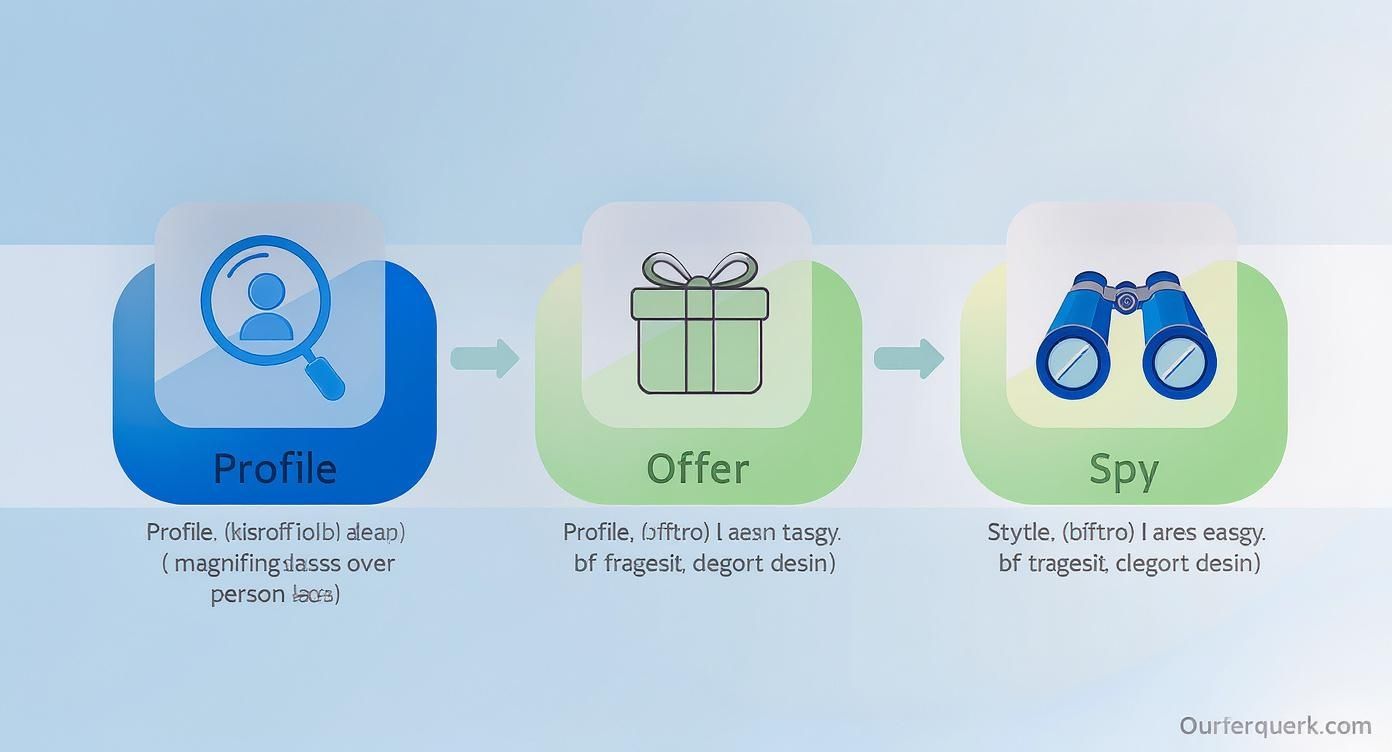
Nailing this three-part foundation ensures that every marketing move you make from here on out is strategic, targeted, and built to convert. If you want to dig deeper into the core concepts of attracting customers, this guide on What is Lead Generation Marketing? is an excellent resource.
Attracting Local Customers with Search and Content
Your website is your digital storefront. For a home service business, it needs to be the most visible, helpful, and trustworthy one on the block. We're not talking about casting a wide, generic net here. True inbound marketing is about becoming a magnet for local homeowners who have a problem right now that you can solve.
This means moving beyond bland blog posts and creating content that directly answers your community's questions, builds immediate trust, and makes you the obvious choice.
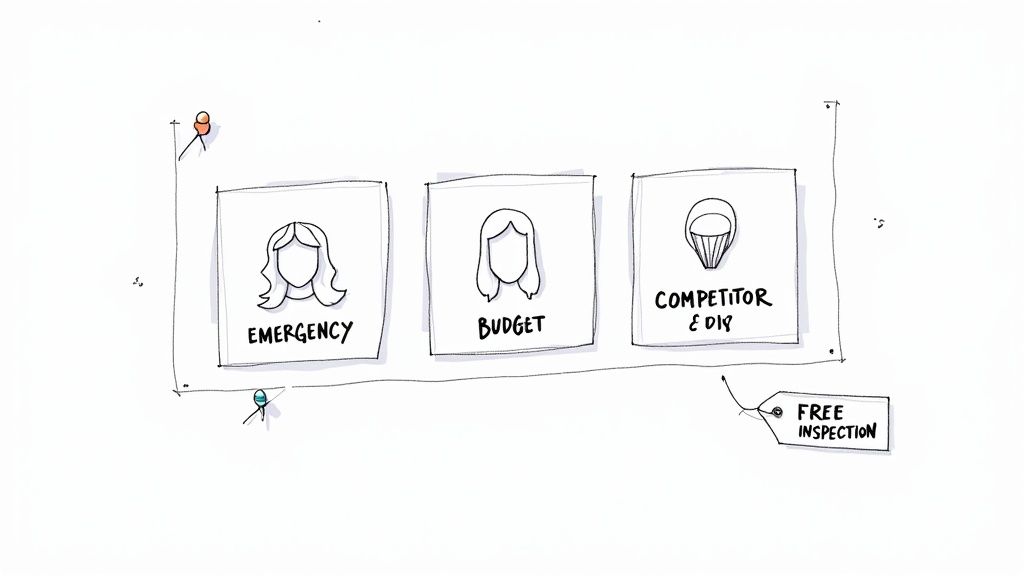
Let's keep the goal simple. When someone in your town has a leaky pipe or a dead AC unit, your business needs to pop up first in their search results. More importantly, your online presence needs to give them the confidence to pick up the phone and call you. You get there with a smart one-two punch of hyper-local content and targeted search engine optimization (SEO).
Dominate Search with Hyper-Local Service Pages
Think like your customers for a second. They aren't just Googling "plumber." They're searching for "emergency plumber in Springfield" or "HVAC repair near Oakhaven." To show up for these high-intent searches, you absolutely need dedicated pages on your website for every single service in every single town you cover.
And please, don't just copy and paste the content. Each page needs to be unique and speak directly to that community. Mention a local landmark, talk about the common types of homes in the area, or address problems specific to that town (like hard water issues in one suburb versus another). This is a huge signal to both Google and your prospects that you're a true local expert, not some faceless national franchise.
Getting this right means digging into the details. A solid strategy for localised keyword research is non-negotiable for uncovering the exact phrases people in your area are typing into the search bar.
Build Trust with Compelling Case Studies
Nothing sells your work better than showing your work. Project case studies are one of the most powerful tools in your content arsenal because they turn a finished job into a story of transformation. That's how you build real trust.
A killer case study is simple:
- The Problem: Briefly explain the mess the homeowner was dealing with.
- The Solution: Detail the exact steps your crew took to make it right.
- The Results: Show it off with stunning before-and-after photos. This visual proof is the most persuasive part, so don't skip it.
These stories act as powerful social proof, helping potential customers see the quality of your work and imagine it in their own homes. Post them everywhere: your website, your Google Business Profile, and your social media channels. Of course, managing all that can feel like a full-time job, which is why many owners look into hiring a virtual assistant for Instagram and other platforms to keep the content flowing.
Pro Tip: Make this a habit. When a job is done, don't just pack up the truck. Take five minutes to snap a few high-quality photos of the finished product. This simple act will feed your marketing machine for months.
Answer Questions with Practical How-To Guides
Your customers are constantly on Google asking questions. "How to fix a running toilet?" "Why is my air conditioner making that buzzing noise?" When you create simple, practical guides that answer these questions, you position yourself as the go-to authority.
Don't worry, you aren't giving away your secrets. A guide on a small DIY fix just proves your expertise. When that same homeowner eventually faces a major problem they can't fix, who do you think they'll call? The company that already helped them out for free. This kind of content is a long-term asset that drives traffic and builds a loyal following.
Relentlessly Optimize Your Google Business Profile
For any local business, your Google Business Profile (GBP) is arguably your most important marketing tool. It’s the new Yellow Pages, and it’s often the very first impression a customer gets of your brand. A neglected profile is like having a "Closed" sign on your door.
Here’s your optimization checklist:
- Fill Out Everything: Complete every single section—services, service areas, hours, and your business description—using your main keywords.
- Upload Photos Constantly: Get pictures of your team, your branded trucks, and, most importantly, your finished jobs on there. Aim to add a few new photos every single week.
- Get Reviews and Respond: Actively ask happy customers for a review, and make a point to respond to every single one, good or bad. Remember, nearly 90% of consumers check reviews before choosing a local business.
By weaving these content and local SEO strategies together, you build a powerful inbound marketing engine that makes your business impossible to ignore for the very customers you want to serve.
Turning Website Clicks into Actual Customers
Getting traffic to your website is a great start, but let's be honest—it doesn't pay the bills. The real work begins when you turn those anonymous clicks into actual leads: homeowners who are raising their hands and showing genuine interest in your services.
This whole process boils down to a simple, honest trade. You offer something genuinely helpful for free, and in return, they give you their contact information. It’s not a gimmick; it’s about building trust by proving you know your stuff before they ever see an invoice. For a local service business, this is your digital handshake.

Create "Lead Magnets" Homeowners Can't Resist
A lead magnet is just a fancy term for that irresistible piece of content you offer in exchange for an email. The secret is to make it so specific and valuable to your ideal customer that they feel like they have to download it. Generic offers get ignored every time, but targeted solutions get leads.
For a home service business, the best lead magnets tap into a homeowner's immediate worry or help them make a better decision.
Here are a few ideas that flat-out work:
- For an HVAC company: A simple "Buyer's Guide to a New Furnace" that breaks down SEER ratings and helps people spot common installation scams.
- For a plumbing business: A printable "Seasonal Home Maintenance Checklist" that walks them through simple steps to avoid a costly pipe burst in the winter.
- For a roofer: An exclusive "Storm Damage Inspection Guide" that shows homeowners exactly what to look for on their roof after a bad hailstorm.
These work because they provide immediate value and instantly position you as the helpful expert, not just another contractor trying to make a sale.
Build Simple Landing Pages That Convert
Your lead magnet needs its own home—a dedicated landing page. This isn't your homepage or a cluttered service page. A landing page has one job and one job only: to convince the visitor to download your offer. That's it. Any extra links, navigation menus, or sidebars are just distractions that will kill your conversion rate.
An effective landing page has just a few key ingredients:
- A Headline That Grabs Them: It needs to scream the main benefit. Don't say, "Our New eBook." Instead, try "Avoid Costly Repairs: Get Your Free Home Maintenance Checklist."
- Benefit-Driven Copy: Ditch the feature lists. Explain what’s in it for them. Short, scannable bullet points are perfect for highlighting the value.
- Signals of Trust: A couple of customer testimonials or logos of local associations you belong to can build instant credibility.
- A Clear Call-to-Action (CTA): The button should use action-packed text like "Download My Free Guide Now" or "Get the Checklist." Make it a bright, contrasting color so it’s impossible to miss.
The best landing pages feel like a natural conversation. They quickly identify the visitor's problem, present your offer as the clear solution, and make it incredibly easy to get it. When in doubt, keep it simple.
Don't Skip Conversion Tracking
This is the step most service businesses miss, and it’s a huge mistake. If you’re not tracking conversions, you’re flying blind. You have no real idea which of your marketing efforts are actually making the phone ring or filling out your contact form.
Conversion tracking is how you prove your marketing is working. Setting it up in a tool like Google Analytics lets you see exactly which pages and blog posts are driving real business. It helps you answer the important questions:
- Did that blog post on "how to fix a running toilet" lead to three plumbing calls last month?
- Is our "Springfield HVAC Repair" page converting better than our "Oakville" page?
- How many people who downloaded our furnace guide ended up scheduling a tune-up?
Once you have this data, the guesswork stops. You can double down on the strategies that are proven winners and cut back on what isn't. This data-driven approach is the engine of a successful inbound marketing lead generation system. Without it, you're just throwing content at the wall and hoping something sticks—and hope is not a business strategy.
Nurturing Prospects from Interest to Appointment
Okay, so a visitor downloaded your maintenance checklist. That's a great first step, but it’s a long way from a booked job and a signed check. The reality is, most leads who find your home service business aren't ready to pull the trigger the moment they land on your site.
This is where a smart nurturing process comes in. It’s what turns that initial spark of curiosity into a confirmed appointment on your calendar. Your goal is to build enough trust to become the only company they think of when their small problem inevitably becomes a big one. This automated follow-up is your secret weapon for turning lukewarm leads into real, paying customers—all without you having to manually chase them down.
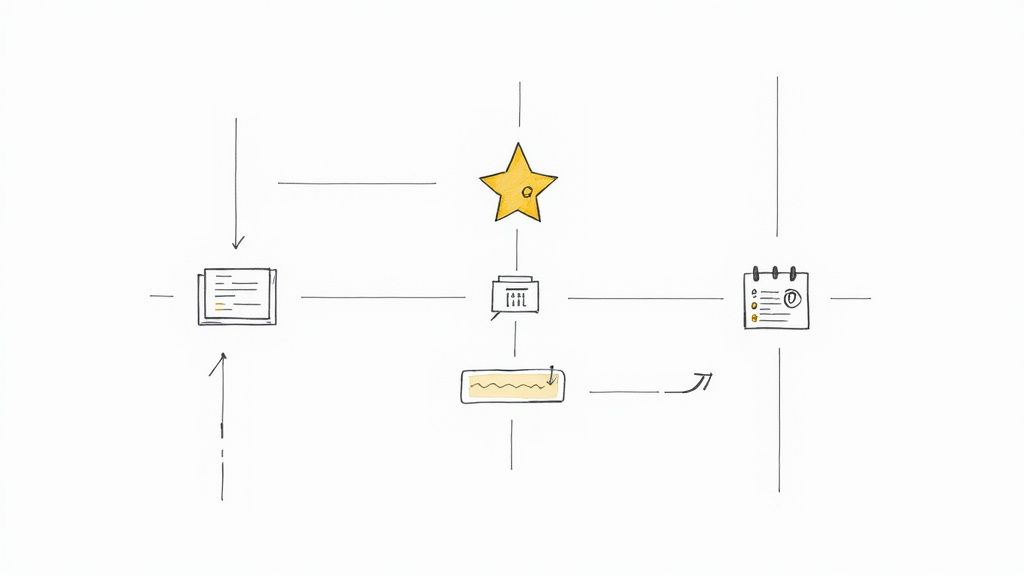
Building Your Automated Follow-Up System
The magic of effective lead nurturing lies in automation. By setting up simple, automated email sequences, you create a safety net. No lead falls through the cracks, even when you and your crew are out on jobs from sunup to sundown. This system quietly works for you 24/7, building relationships in the background.
Let's walk through a real-world example. Imagine a homeowner in your service area downloads your "Storm Damage Inspection Guide."
Your system can instantly fire off a thank-you email with the guide. A few days later, it might automatically send a short case study about a local roof repair you just finished. A week after that, maybe it sends a quick video explaining how to spot hidden water damage most people miss.
See what's happening here? You're not being pushy; you're being genuinely helpful. You're consistently providing value, which builds incredible trust and positions you as the go-to expert. When that homeowner finally decides it's time to get their roof looked at, who do you think they're going to call?
Segmenting Your Leads for Relevance
One of the biggest blunders I see in inbound marketing lead generation is blasting the same generic message to every single person on the list. A lead asking about a brand new AC installation has completely different problems and questions than someone who downloaded a guide on fixing a leaky faucet. This is where segmentation—grouping leads based on their interests—is a game-changer.
You can create simple segments right inside your email marketing software. Start with these:
- By Service: Group leads by plumbing, HVAC, electrical, roofing, etc.
- By Lead Magnet: Anyone who grabbed the "Furnace Buyer's Guide" goes into one bucket.
- By Location: Maybe you have a specific promotion for customers in a certain town or zip code.
When you segment your list, every email you send feels relevant and personal. You can send HVAC maintenance tips to your HVAC list and plumbing advice to your plumbing list. It stops feeling like marketing spam and starts feeling like valuable advice from a pro.
The numbers back this up. Companies that get lead nurturing right generate 50% more sales-ready leads at a 33% lower cost. This is solid proof that investing a little time in building these automated relationships seriously boosts your bottom line. You can dig into more lead generation statistics to see the full picture.
Crafting a Simple Nurturing Sequence
Look, you don't need some ridiculously complex, 20-email sequence to make this work. A simple three-to-five-part email series can do wonders. Here’s a blueprint you can steal for a lead who downloaded your "Seasonal Home Maintenance Checklist."
Email 1: Instant Delivery & Welcome (Day 0)
- Subject: Here’s Your Home Maintenance Checklist!
- Content: Get right to the point and deliver the checklist. Add a brief, friendly introduction to your company and let them know you’ll be sending a few more helpful tips their way soon.
Email 2: Provide More Value (Day 3)
- Subject: 3 Common Mistakes Homeowners Make in the Fall
- Content: Follow up with a quick, valuable tip that connects back to the checklist. This reinforces that you know your stuff and keeps the conversation going.
Email 3: Showcase Social Proof (Day 7)
- Subject: See How We Helped the Johnson Family
- Content: People trust other people. Share a short customer story or a glowing testimonial. This builds trust by showing you get real-world results for families just like theirs.
Email 4: Make a Soft Offer (Day 12)
- Subject: Ready for a Professional Tune-Up?
- Content: Now you can make a low-risk offer, like a discounted seasonal tune-up or a free inspection. Make it easy for them with a clear, can't-miss button to book an appointment.
This straightforward sequence gently guides a prospect from casual interest to being ready to hire you, all through helpful, automated communication.
Turning Phone Calls into Booked Appointments
All the hard work you’ve poured into your content, SEO, and lead nurturing brings a potential customer to one make-or-break moment: the phone call. This is where the rubber meets the road. It’s the human interaction that decides whether your marketing dollars turn into actual revenue.
When a call goes unanswered or is fumbled, a lead you spent time and money to attract just vanished. Worse, they’re probably calling your competitor right now.
For a busy home service business, this is a huge challenge. Your best people are out on jobs, not waiting by the phone. But when a homeowner calls with a burst pipe, they aren't going to leave a voicemail. They’re just going to hang up and dial the next number on Google.
The Real Cost of a Missed Call
Every time your phone rings and no one picks up, you're not just missing a call—you're losing money. It’s that simple.
Think about the mindset of your customer. The person with a flooded basement isn't just browsing; they're in full-on problem-solving mode. They are ready to hire the first competent, professional person who answers. That one call could easily be worth hundreds, if not thousands, of dollars.
This is the hidden bottleneck that sabotages so many marketing efforts. You can have the slickest website and rank #1 for every keyword in your city, but if the phone experience is a letdown, the whole system collapses. The answer isn't to work yourself into the ground; it's to build a smarter, more reliable system for this final, crucial step.
A professional and prompt response on the phone isn't just good service. It’s a direct reflection of your company's reliability. If you can't even answer the phone, a potential customer immediately wonders if you can be trusted to show up on time and do the job right.
From Answering Machine to Appointment Machine
This is exactly where a dedicated remote Customer Service Representative (CSR) or a professional answering service can change the game.
Instead of calls going to a noisy truck cab or a voicemail box that’s already full, they're handled by a trained professional. Their one and only job is to turn that caller into a booked appointment.
This system guarantees every single inbound lead gets a consistent, professional, and immediate response. A remote CSR does so much more than just take a message.
- Qualify the Lead Instantly: They follow a script to ask the right questions, making sure the caller is in your service area and has a problem you can actually solve.
- Collect Crucial Job Details: They get all the vital info—name, address, phone number, and a clear description of the issue.
- Schedule Directly into Your Calendar: With secure access to your scheduling software, they see your team's availability and can book the job right there on the call, sending an instant confirmation to the new customer.
This seamless process frees your technicians to focus on what they do best. It gets rid of the constant stress of juggling calls and ensures no lead ever falls through the cracks. It also creates a fantastic customer experience from the very first touchpoint. If you're ready to build a more efficient system, learning how to hire a virtual assistant to handle phone orders is the perfect place to start.
By integrating this human element, you ensure your inbound marketing lead generation efforts are never wasted. Every online form, every click-to-call button, and every local search discovery is met with a professional voice, ready to turn interest into a scheduled, profitable job. It’s the final piece of the puzzle that closes the loop and drives real growth.
Frequently Asked Questions
When you're diving into inbound marketing lead generation, a lot of questions pop up. Let's tackle some of the most common ones I hear from business owners, with straight answers to help you build a system that keeps the phone ringing.
How Long Does Inbound Marketing Take to Generate Leads?
This is the big one, isn't it? Everyone wants to know when they'll see a return. While a full-blown inbound strategy is a long game, you can definitely score some quick wins.
For example, a serious overhaul of your Google Business Profile can start bringing in calls within a few weeks. But for your content and SEO work to really hit its stride and deliver a predictable flow of leads, you should give it a solid 3-6 months.
The beauty of this approach is that it builds on itself. Unlike a paid ad that vanishes the second you stop paying, the content and local authority you build become permanent assets. They'll keep generating leads for you for years to come. The first few months are all about laying that foundation—the keyword research, the website fixes—that search engines need time to find and reward.
Think of it like planting a garden. You do the hard work of preparing the soil and planting seeds upfront. It takes some time to see the first sprouts, but with consistent care, it yields a harvest season after season.
What Is the Best First Step for a Small Home Service Business?
Easy. If you do nothing else, go all-in on your Google Business Profile (GBP). This is your modern-day storefront, billboard, and Yellow Pages ad combined into one incredibly powerful—and free—tool.
Your mission is to fill out every single section. And I mean every section.
- Services: Don't just list "Plumbing." List every single thing you do, from drain cleaning to water heater installation.
- Service Areas: Be specific. List every town, city, and even zip code you're willing to drive to.
- Photos: Go wild. Upload dozens of high-quality pictures of your team in action, your branded trucks, and your happy customers' finished projects.
- Reviews: This is non-negotiable. You need a simple, repeatable process for getting new customer reviews every single week.
A well-oiled GBP that's constantly getting fresh, positive reviews can start generating calls and website visits surprisingly fast. It’s the perfect foundation for all your other marketing efforts.
Can I Do Inbound Marketing with a Small Budget?
You absolutely can. In fact, inbound marketing is one of the most budget-friendly strategies out there because the main investment is your time and expertise, not a huge ad spend.
You don't need a massive budget to make a dent. You could start by writing just one genuinely helpful blog post a month that answers a common question you get from local customers. Spend some time beefing up your existing website service pages with local keywords and project details. And like we just discussed, obsessing over your GBP costs you nothing but effort.
Many of the best tools for things like keyword research (Ahrefs) or email marketing (Mailchimp) have free or very cheap starter plans. The whole point is to create digital assets that attract customers naturally, which is way more sustainable than constantly paying to rent their attention.
How Do I Measure Inbound Marketing Success?
Success here isn't a gut feeling; it's cold, hard data. You need to zero in on a few key performance indicators (KPIs) to see what's actually moving the needle.
Inside a tool like Google Analytics, you'll want to keep a close eye on your website's organic traffic (visitors who find you through a search engine) and where you rank for your most important local search terms.
But the real bottom line is lead volume. You have to track two things:
- Phone Calls: Use call tracking software. This is the only way to know for sure how many calls came directly from your website or GBP.
- Form Submissions: Make sure you have tracking set up on every "Request an Estimate" or contact form on your site.
When you track these specific conversion goals, you can see exactly which marketing channels and pages are producing real leads. This lets you stop guessing, make decisions based on real data, and truly measure your return on investment (ROI).
Ready to ensure every inbound lead gets a professional, immediate response? The experts at Phone Staffer can place a trained remote CSR in your business to answer calls, qualify leads, and book appointments right on your calendar, so you never miss a profitable opportunity again. Learn how we can help you convert more leads into booked jobs.