

Forget waiting by the phone for the next frantic call about a burst pipe. While emergency jobs certainly pay the bills, the most successful plumbing businesses I've seen don't live in that reactive, feast-or-famine cycle. They build a predictable flow of profitable, high-quality work.
This means making a critical shift in your thinking. You stop being just a service provider and start becoming a proactive marketer. It's not about just running a few ads; it's about laying a solid groundwork so the right customers come to you, often before they even have an emergency.
Define Your Ideal Customer and Services
Before you spend a single dollar on marketing, you have to know exactly who you're trying to reach. Are you the go-to plumber for homeowners in upscale neighborhoods who need whole-home repiping and high-end fixture installations? Or is your sweet spot securing long-term maintenance contracts with commercial property managers?
These are two completely different worlds. The homeowner might jump on Google and search for "best plumber for old house," while the property manager is more likely looking for a company with a proven system for preventative maintenance and a portfolio of commercial clients.
Get specific and create a detailed profile of your ideal client. Go beyond just "homeowners" and think about their real-life problems.
- For Residential Clients: Are they first-time homeowners completely lost about their plumbing? Or are they living in a 50-year-old house, constantly worried about what might fail next?
- For Commercial Clients: Is their biggest headache managing tenant complaints across multiple properties? Or is their main goal avoiding costly operational downtime and ensuring regulatory compliance?
Once you have that picture, you can sharpen your service offerings. Instead of being a jack-of-all-trades, you can become the undisputed expert in high-value services like trenchless sewer repair, tankless water heater installation, or hydro jetting. Specializing like this immediately builds your authority and makes you the obvious choice.
You can't be everything to everyone. When you focus on a specific type of customer and the profitable services they need most, your marketing suddenly becomes much easier and far more effective.
Establish Your Brand and Value Proposition
Plumbing is a tough, competitive business. There are roughly 132,000 plumbing companies in the U.S. fighting for a piece of a market valued at around $169.8 billion. In a field this crowded, your brand is what will make you stand out. If you want to dive deeper, you can read more about these plumbing industry statistics and see what you're up against.
And your brand is so much more than a cool logo and a clean truck wrap. It's the promise you make to every customer.
Is your promise lightning-fast, 24/7 emergency service? Or do you promise meticulous, white-glove craftsmanship on complex remodels?
That promise is your value proposition—a simple, powerful statement that tells a customer exactly why they should call you over anyone else. For instance, "Same-day water heater installations with guaranteed upfront pricing, so your family never has to take another cold shower." That hits home way harder than a generic "We fix water heaters."
This message needs to be everywhere—on your website, in your ads, on your social media. Every single time a potential customer interacts with your business, they should see and feel that same core promise.
Winning the Local Search Game When Urgency Hits
Let's be real. When a pipe bursts in the middle of the night, nobody is casually browsing for a plumber. They're frantically searching on their phone with one goal: find someone—anyone—who can fix it now. This is the moment of truth for your lead generation strategy. Winning at local search isn't just a nice-to-have; it's how you catch these high-intent customers right when they need you most.
Your command center for this is your Google Business Profile (GBP). It's not just a listing; it's your digital handshake. Think about this: a whopping 61% of consumers say they've hired a business simply because it popped up in their local search. Just having a profile isn't enough. You have to treat it like the powerful, lead-generating machine it is.
Fine-Tune Your Google Business Profile
Your GBP is your digital storefront. Every single field needs to be filled out with care and kept fresh. It sounds basic, but you’d be surprised how many plumbers get this wrong.
Start with your primary category: "Plumber." Easy enough. But don't stop there. Go deep with secondary categories. Do you install water heaters? Add "Water Heater Installation." Do you unclog drains? Add "Drain Cleaning Service." The more specific you are, the better Google gets at matching you to someone searching for that exact job.
Next, flesh out your services list with detailed descriptions. Don't just list "Slab Leak Repair"; create an entry for it and describe what's involved. Fill your profile with high-quality, real photos. I’m talking about pictures of your crew on the job, your branded vans, and maybe a before-and-after of a tricky installation. This stuff builds instant trust and makes you look far more credible than the competitor using generic stock photos.
A fully optimized Google Business Profile does the selling for you. It answers a customer's questions before they even think to ask, showing off your expertise and making it incredibly easy for them to call you during an emergency.
Build Trust with Reviews and a Smart Q&A
In a trade like plumbing, your reputation is everything. A constant flow of new, positive reviews is probably the single most important signal you can send to both Google and potential customers. You're the real deal. The best way to get them? Make it easy. As soon as you finish a job, send the customer a text or email with a direct link to leave a review.
And you absolutely have to respond to every single review, good or bad. A thoughtful response to a negative review can actually be more powerful than a dozen 5-star ratings. It shows you’re accountable and genuinely care about getting it right.
Here's a pro tip: don't ignore the Q&A section on your profile. You can actually populate it yourself. Think about the questions you get all the time and answer them right on your profile.
- Question: "Do you offer 24/7 emergency plumbing in Scottsdale?"
- Answer: "Yes, we do! Our plumbers are on standby 24/7 for emergency calls throughout Scottsdale and the surrounding area. If you have a burst pipe or a serious backup, call us anytime at [Your Phone Number]."
This is a brilliant way to provide helpful information while naturally working in the keywords people are actually searching for.
Dominate Your Service Area with Location-Specific Pages
To truly own your local market, you need to prove your relevance to Google on your own turf: your website. The single most effective way I've seen this done is by creating dedicated pages for each city or neighborhood you serve.
A generic "Sewer Repair" page is fine. But a page titled "Trenchless Sewer Repair in Plano, TX" is a game-changer.
These pages need to be more than just a copy-and-paste job with the city name swapped out. Talk about common plumbing problems in that specific area—maybe clay soil in one suburb causes foundation leaks, while older homes in another part of town have pipe issues. Feature testimonials from customers in that exact city. This level of detail screams "local authority" to Google, helping you climb the rankings in the all-important map pack. When a homeowner in Plano needs help, you'll be the first one they see.
Turning Your Plumbing Website Into a 24/7 Lead Generator
Think of your website as your best salesperson. It works around the clock, never gets sick, and can talk to countless customers at once. But for too many plumbing businesses, their site is just a digital business card. Let's fix that. It's time to turn your website into a powerful tool that brings in a steady stream of high-quality plumbing leads.
The mission is simple: make it ridiculously easy for a homeowner in a panic to get in touch with you. That means putting big, obvious click-to-call buttons at the very top of every single page. Someone with water pouring through their ceiling doesn't have the patience to hunt for your phone number.
The same goes for your contact forms. Keep them short and sweet. I'm talking three fields, tops: Name, Phone, and a small box for their issue. Every extra field you ask them to fill out increases the chance they'll just give up and go to your competitor.
Earning Trust Before You Earn the Job
People won't call you if they don't trust you. Your website is your first, best chance to build that confidence. Forget the cheesy stock photos of actors pretending to be plumbers. You need to show who you are.
Use real photos of your actual team on the job. Show your branded trucks out in the community. This authenticity is what connects with people.
Another massive trust builder is customer testimonials—real ones, with names and towns attached. Imagine a potential customer from your service area seeing a rave review from someone just a few streets over. That instantly makes you the go-to local expert in their mind.
This is all about getting ahead of the game. The plumbing world can be reactive, with more than 55% of customers only searching online when they have an emergency. That creates a stressful "feast or famine" cycle where you might end up paying $75 or more for a single lead from Google just to keep the phone ringing. Breaking free from that cycle requires a smarter, more consistent approach.
Key Takeaway: Your website has one main job: turning a visitor into a caller. Every button, picture, and sentence should guide them toward contacting you with as little friction as possible.
Go Beyond the Brochure: Become a Helpful Resource
A truly effective website doesn't just sell your services; it solves problems. By creating helpful content, like blog posts that answer the questions your customers are actually searching for, you establish your business as the local authority.
Think about the common headaches your customers face:
- "How to Keep Your Pipes from Freezing This Winter"
- "My Garbage Disposal Is Just Humming, What Do I Do?"
- "5 Telltale Signs You Need a New Water Heater"
Articles like these pull in visitors from search engines and showcase your expertise long before a pipe ever bursts. When that homeowner eventually does need a pro, whose name do you think they'll remember?
Finally, none of this will matter if your website is a nightmare to use on a smartphone. A huge number of emergency plumbing searches happen on a mobile device. If your site is slow, clunky, or hard to read on a small screen, you've already lost that lead. A smooth mobile experience ensures that every potential customer can reach you easily, which in turn helps your team improve call center performance by feeding them clear, ready-to-book leads.
Running Paid Ads Without Wasting Your Budget
I’ve seen plenty of plumbers get burned by paid ads, and it’s easy to see why. It can feel like you’re just throwing money at Google with nothing to show for it. But when you get it right, paid advertising is hands-down the fastest way to get your phone ringing with customers who have an urgent, profitable problem.
The secret isn't a massive budget; it's precision. It's about getting your ad in front of a homeowner with a burst pipe at the exact moment they’re desperately searching for help. When you do that, your ad spend turns directly into booked jobs.
H3: LSA vs. Search Ads: Where Should Your Money Go?
When it comes to paid ads for plumbers, the conversation really starts and ends with Google. But it's crucial to know you have two very different tools at your disposal: Local Services Ads and the more traditional Search Ads. They work in completely different ways.
-
Google Local Services Ads (LSA): You’ve seen these at the very top of Google—the ones with the little green “Google Guaranteed” checkmark. The beauty of LSAs is that you pay per lead, not per click. You only open your wallet when a real potential customer calls or messages you directly through the ad. For generating a steady stream of emergency calls, this is your most direct and cost-effective starting point.
-
Google Search Ads: These are the classic text-based ads you see just below the LSA block. Here, you pay every time someone clicks your ad, regardless of whether they end up calling. The trade-off for this pay-per-click model is a huge amount of control. You can write custom ad copy, target hyper-specific keywords (like "tankless water heater installation"), and direct people to a specific page on your website.
My Advice From the Trenches: Start with Google Local Services Ads. Get that foundation of high-intent, immediate calls coming in first. Once that’s running smoothly, layer in a targeted Google Search campaign to go after the more specific, high-ticket jobs. This two-pronged approach is incredibly effective.
Comparing Lead Generation Ad Platforms
Deciding where to put your ad dollars can be tough. This table breaks down the two main Google platforms to give you a clearer picture of where to start.
| Feature | Google Local Services Ads (LSA) | Google Search Ads |
|---|---|---|
| Payment Model | Pay-per-lead (you pay for a qualified phone call) | Pay-per-click (you pay whenever someone clicks your ad) |
| Best For | Immediate, high-intent emergency service calls | High-value, specific jobs & capturing broader search traffic |
| Ad Placement | Very top of the search results, above all other ads | Below LSAs, above organic search results |
| Control & Customization | Limited; Google creates the ad based on your profile | High; full control over keywords, ad copy, and landing pages |
| Main Advantage | Lower risk, as you only pay for actual leads | Maximum control over targeting and messaging |
Ultimately, LSAs offer a safer bet for getting started, while Search Ads provide the power to scale and target more lucrative work once you're ready.
H3: Writing Ad Copy That Actually Makes the Phone Ring
Your ad has about three seconds to grab a stressed-out customer's attention. This is your digital elevator pitch. Bland, generic copy like "Local Plumber – Call Us Today" is a complete waste of money because it gets scrolled right past.
You need to speak directly to their problem and show them you’re the solution.
Think about what a frantic homeowner needs to hear. For an emergency leak, an ad that says "Leaking Pipe? 24/7 Emergency Plumber in [Your City]. Upfront Pricing & Fast Response" is infinitely more powerful. In one short sentence, you’ve identified their pain, confirmed you can help right now, stated your location, and handled a major objection (surprise costs).
The infographic below highlights just how much more effective Google Ads can be for plumbers compared to other platforms.
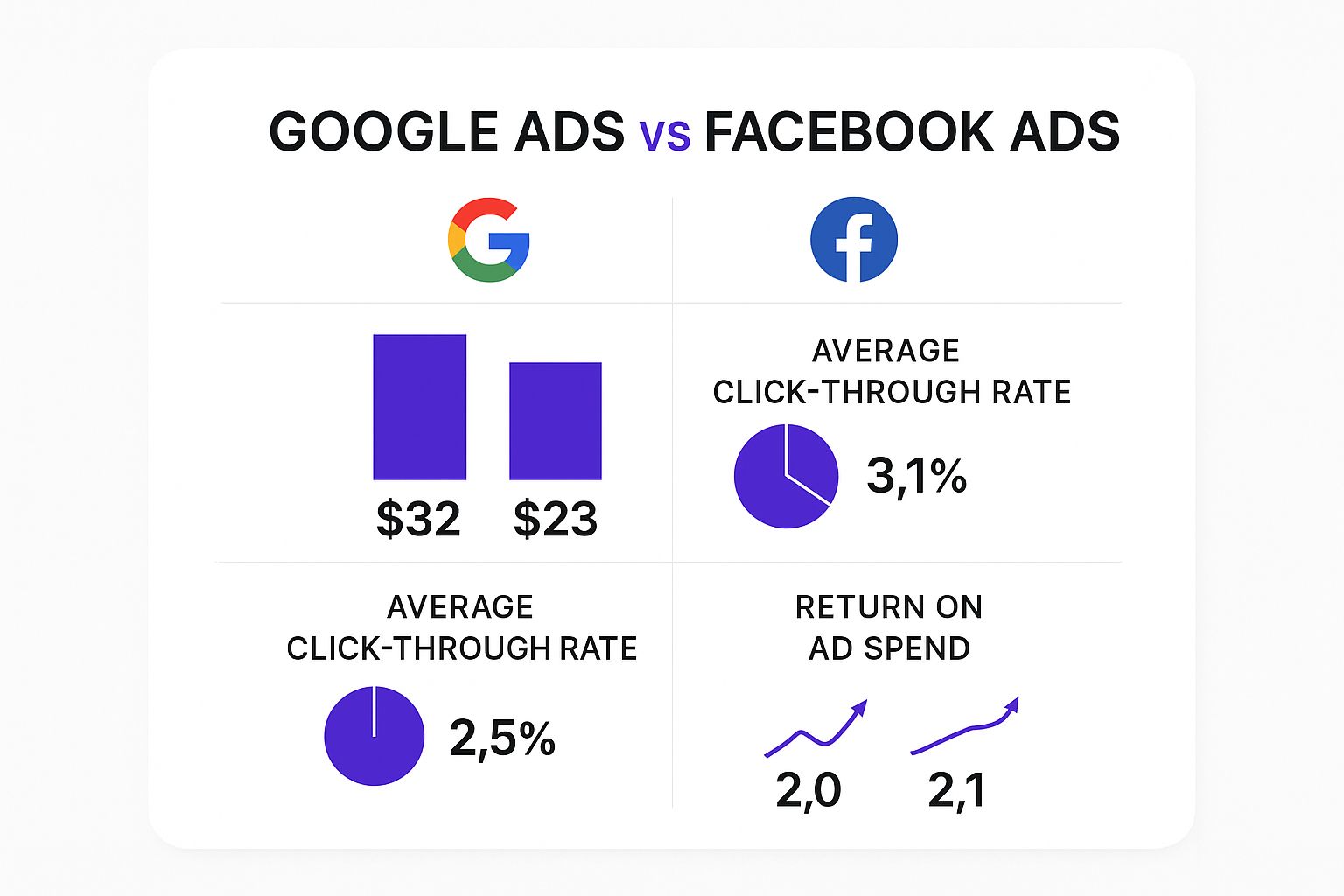
As you can see, the numbers don't lie. For direct-response lead generation in our industry, Google is the clear winner for return on investment.
H3: Stop Wasting Money with Smart Targeting
If I had to point to the #1 reason plumbers waste money on ads, it’s bad targeting. Showing your ad for "clogged drain repair" to someone who lives 50 miles outside your service area is just burning cash.
Get surgical with your settings.
- Geo-targeting: Set your campaigns to only show in the specific zip codes or towns you actually work in. Be ruthless about this.
- Ad Scheduling: If you don't run a 24/7 operation, why are your ads running at 2 a.m.? Schedule your ads to run only during business hours to ensure someone is there to answer the phone.
Finally, don't give up on people who almost hired you. Someone might click your ad, browse your site, and then get distracted by a phone call or a kid. That's where retargeting comes in. Using platforms like Facebook Ads, you can show a simple, low-cost reminder ad only to people who have recently visited your website.
It’s an incredibly smart way to stay top-of-mind and turn a missed connection into a second chance at a booked job.
Building Partnerships and Offline Connections

As much as we focus on Google and digital ads, some of the absolute best, most profitable plumbing leads still come from a good old-fashioned handshake. Don't ever underestimate the power of real-world relationships. These connections build a deep-seated trust that you just can't buy with an ad, creating a steady flow of work from people who are already pillars in your community.
Think of it this way: these partnerships aren't just about getting a random referral here and there. They're about creating a system. When you team up with the right local pros, you become their go-to plumber, and they essentially become a volunteer sales force for your business.
Cultivating High-Value Referral Partnerships
So, who should you be talking to? The trick is to find other professionals who run into plumbing problems before the customer thinks to Google a plumber. You want to be the first and only person they think to call.
- Real Estate Agents: These folks are always in a bind. They need reliable plumbers for pre-sale inspections, fixing issues found by a home inspector, and handling last-minute emergencies to keep a closing on track. Make them your priority, and you'll make them look like a hero to their clients.
- Property Managers: If you want a consistent source of work, this is it. A single property manager overseeing a portfolio of apartments or rentals is dealing with constant maintenance calls. A manager handling 200 units is a goldmine of hundreds of potential jobs a year, from leaky faucets to water heater replacements.
- General Contractors & Remodelers: Every single kitchen or bathroom remodel needs a plumber. If you can build a solid relationship with a few busy contractors, you can lock in your spot as their exclusive plumbing subcontractor.
A single, solid partnership with a busy property manager or a custom home builder can bring in more consistent, high-ticket work than a modest ad budget ever will—often with a $0 acquisition cost per lead.
To make these relationships truly last, you need to offer more than just a promise of good work. Formalize it. Create a simple referral program. This could be a small commission on completed jobs, or maybe you just make a point to send business their way when you can. The key is to always follow up, thank them for sending you the work, and treat their client like royalty.
Hyper-Local Offline Marketing That Works
Beyond those key partnerships, you can’t forget about marketing you can actually touch and feel. This is all about cementing your presence in the specific neighborhoods you serve. Honestly, one of your best tools is probably sitting in your driveway right now: your work truck. A clean, professional vehicle wrap isn't just branding; it's a mobile billboard. It gets seen by hundreds of potential customers every single day as you drive around town.
Another tactic that works like a charm is the classic door hanger. The next time you finish a job, don't just pack up and leave. Take a few minutes to leave a high-quality door hanger on the 50 closest homes. A simple message like, "Hi, we were just down the street helping your neighbor, the Smiths, install a new water heater! Here’s 10% off your next service call," is incredibly powerful. It provides immediate social proof and turns one job into several.
Partnering With a Plumbing Lead Generation Company
Let's be honest: running marketing campaigns, wrestling with SEO, and managing paid ads is a full-time job in itself. For a lot of plumbing business owners, the fastest path to serious growth isn't trying to do it all yourself. Sometimes, the smartest move is to bring in a specialist.
A dedicated plumbing lead generation company can be an absolute game-changer. Think of them as your outsourced marketing department, handling all the complex, time-consuming work of finding customers so you can focus on what you do best: running your crew and serving your clients.
These firms do more than just place a few ads. The good ones use sophisticated, multi-channel strategies to track down homeowners who are right now searching for a plumber. This is key. You aren't just getting a random name and number; you're getting a pre-qualified, high-intent lead from someone who is ready to book a job.
Finding the Right Partner for Your Business
Choosing the right company is everything. The market is flooded with lead gen services, and frankly, not all of them are worth your time or money. Before you even think about signing a contract, you need to do your homework and ask some tough questions to make sure they're the right fit.
Here’s what I always tell people to ask:
- Are the leads exclusive? You need to know if they're sending that same lead to you and three other plumbers in your area. Always, always push for 100% exclusive leads. Otherwise, you're just paying to get into a bidding war.
- What's your qualification process? Get specific. How do they verify that a lead is legitimate? Do they confirm the service needed and the location? You need to understand their process for filtering out tire-kickers and wrong numbers.
- How does your pricing work? Most companies use a pay-per-lead model or a flat monthly retainer. There are pros and cons to both, but a pay-per-lead structure often keeps the lead gen company more accountable for the quality they send you.
Firms at the forefront of this space, like Pearl Lemon Leads USA, are using advanced tech to run highly targeted campaigns. This approach not only boosts efficiency but also helps create a more predictable and sustainable flow of jobs for your business. If you're curious about who the major players are, it's worth taking a look at a breakdown of the top plumbing lead generation firms to see how they compare.
Answering Your Top Plumbing Lead Gen Questions
If you're trying to grow your plumbing business, you've probably got some marketing questions. It's a common conversation I have with owners. Let's break down a few of the most frequent ones I hear to give you some clarity on where to focus your efforts and budget.
How Much Should I Really Be Spending on Marketing?
This is the million-dollar question, isn't it? A good rule of thumb that I've seen work for countless businesses is to budget 5-10% of your total revenue for marketing.
Now, if you're hitting the gas and want to expand fast—maybe you just bought a new truck or hired another plumber—pushing that closer to 12% is a smart move to really build momentum.
But here’s the real secret: the percentage doesn't matter as much as your return. You have to track your return on ad spend (ROAS). If you see that your Google Local Services Ads are bringing in profitable jobs hand over fist, don't be afraid to pour more fuel on that fire. The data will always tell you where the money is.
I Need Leads Now. What's the Fastest Way?
For those "I need the phone to ring today" moments, nothing beats Google Local Services Ads (LSA). Seriously.
Once you get through Google's verification process and background checks, they slap that little "Google Guaranteed" badge on your profile and put you right at the top of the search results. We're talking above the regular ads, above the map pack, right at the top.
The best part? You only pay for actual leads—real phone calls from people in your service area looking for a plumber. It's the most direct path from a homeowner's emergency to your phone ringing.
What about social media? A lot of plumbers ask me if they should bother with Facebook. My answer is always yes, but you have to use it for the right reasons. Social media is for building your brand and earning trust, not for instant leads. Share photos of your crew, show off a beautifully finished job, or post a tip about preventing frozen pipes. You're building familiarity, so when one of your followers has a pipe burst, your name is the first one that pops into their head.
Tired of chasing leads and juggling calls? Phone Staffer can help. We provide trained, remote CSRs and VAs to answer your phones, qualify leads, and handle your admin tasks. We even offer a done-for-you cold calling service to book appointments directly on your calendar. Let us handle the phones so you can handle the plumbing.