
Getting a steady flow of leads for construction isn't about luck or waiting for the phone to ring. It's about building a reliable engine that mixes smart digital marketing with old-school outreach and networking to keep your project pipeline packed. This guide is your playbook for building that exact engine from the ground up.
Building Your Foundation for Consistent Construction Leads
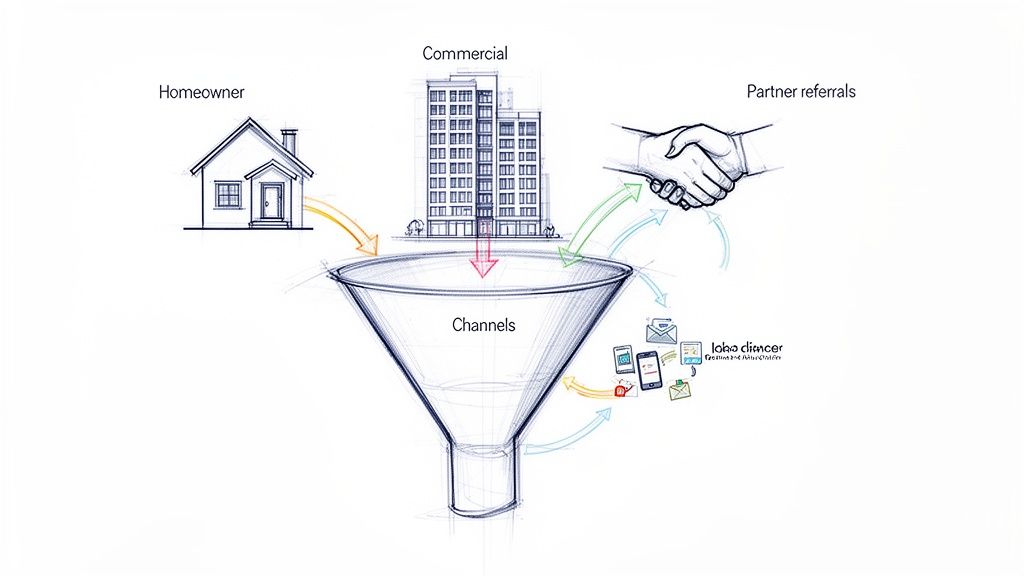
For any construction or home service company looking to grow, a predictable stream of good leads is everything. Just hoping for inquiries or relying on past clients to send people your way is a recipe for a feast-or-famine business cycle. The real goal is to build a solid system that brings in potential customers from all over, qualifies them, and turns them into paying clients.
This whole process doesn't start with a marketing campaign, though. It starts with a simple, yet powerful question: who are you really trying to reach? Nailing this down is the bedrock of every successful lead generation effort you'll ever make.
Define Your Ideal Client Profile
Before you put a single dollar into ads or spend an hour at a networking event, you need a razor-sharp picture of your perfect customer. Vague descriptions like "homeowners" or "local businesses" are far too broad and will waste your time and money.
You have to get granular.
- Residential Focus: Are you going after families in upscale neighborhoods who want to add a second story? Or is your sweet spot new homeowners in a specific development who are all looking for kitchen remodels?
- Commercial Niche: Do you excel at office build-outs for growing tech companies? Or maybe you're the go-to contractor for property managers who need to renovate apartment units between tenants?
- Budget and Scope: What’s the minimum project size that's actually profitable for you? Knowing this number helps you immediately filter out tire-kickers and focus on leads that are a great financial fit.
When you get this clear on your ideal client, you can pour your resources into the places where they’ll actually make a difference. You'll know exactly where to find them, what their biggest headaches are, and how to talk to them in a way that truly connects.
Embrace a Multi-Channel Approach
Putting all your eggs in one basket is a dangerous game. If that one lead source—whether it’s referrals from your best partner or a sudden change in Google’s algorithm—dries up, your entire pipeline can grind to a halt overnight. Spreading your efforts across multiple channels gives you stability.
The global construction market is massive, valued at an eye-watering $15.78 trillion, and getting your piece of it comes down to generating quality leads. In fact, contractors who actively chase leads through targeted outreach can see a 30% higher conversion rate, especially when they have a team dedicated to persistent follow-up. You can read more about the industry's growth projections over at BusinessWire.
This is about creating a system where different channels support each other. For example, great local SEO can bring in inbound phone calls, while your networking events generate high-ticket referrals. But no matter where a lead comes from, it needs to be handled quickly and professionally. That's why having a rock-solid system, like a 24/7 phone answering service for home services, is so crucial for turning those opportunities into jobs.
Here’s a quick breakdown of the core channels most construction and home service businesses should be focused on.
Core Lead Generation Channels for Construction Businesses
| Channel | Primary Use Case | Best For Targeting |
|---|---|---|
| Paid Ads (Google/Facebook) | Generating immediate, intent-based leads from people actively searching for your services. | Homeowners with specific needs (e.g., "kitchen remodel near me") or defined demographics (e.g., high-income zip codes). |
| SEO & Local SEO | Building long-term organic visibility to attract "free" leads from search engines and Google Maps. | Customers in a specific geographic service area searching for local contractors. |
| Networking & Referrals | Building relationships with partners (realtors, architects) and past clients to generate high-trust, high-quality leads. | High-value commercial projects and premium residential clients who rely on recommendations. |
| Outbound Prospecting | Proactively contacting potential clients (e.g., property managers, developers) to introduce your services. | B2B opportunities and landing large-scale commercial contracts. |
Ultimately, a mix of these channels creates a balanced and resilient system, ensuring your business isn't vulnerable to a single point of failure.
Getting Found Online: How to Attract Clients Ready to Hire
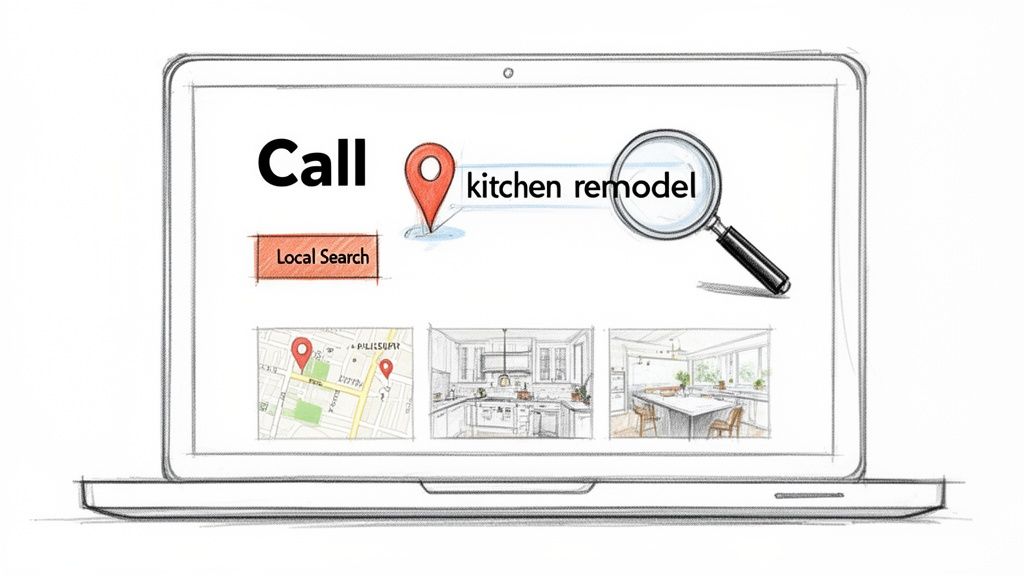
Let's be honest, your next big project isn't going to come from the phone book. It starts when a homeowner types "roofing contractor near me" or "best bathroom remodeler in Austin" into Google. They’re looking for someone now, and they expect to find credible options in seconds. This is the new reality: generating quality leads for construction is now a digital game.
Just having a website is table stakes. To actually win business, you need a smart online strategy that turns those searchers into paying clients. It’s all about making sure you’re the one they find and, more importantly, the one they call.
Your Website: The 24/7 Digital Showroom
Think of your website as your best salesperson. It works around the clock, never gets sick, and for many prospects, it’s the very first impression they’ll have of your company. It has to do more than just look pretty; it needs to be a well-oiled machine built to generate leads.
Here are the non-negotiables for a website that actually converts:
- A Killer Portfolio: Your work is your best marketing tool. Fill your site with high-quality photos and videos of finished projects. Break them down by category—Kitchens, Additions, Decks—so people can see exactly what you can do for them. Nothing sells a job faster than a stunning before-and-after gallery.
- Can’t-Miss Contact Info: Don’t make people dig for a way to reach you. Plaster your phone number at the top of every page. Add prominent "Get a Free Estimate" or "Schedule a Consultation" buttons throughout the site. Make it incredibly easy for them to take the next step.
- Instant Trust Builders: Showcase customer testimonials, industry certifications (like your NARI or NAHB badges), and five-star reviews. These signals tell a potential client you’re a legitimate, trustworthy professional before you've even spoken.
And whatever you do, make sure it works flawlessly on a phone. A huge chunk of your traffic will come from mobile devices. If your site is a clunky, slow-loading mess on a smartphone, you've already lost them to a competitor.
Own Your Backyard with Local SEO
Most contractors serve a specific geographic area, which makes Local Search Engine Optimization (SEO) your most powerful long-term play. When you get it right, you show up exactly when and where your customers are looking.
The heart and soul of local SEO is your Google Business Profile (GBP). This free listing is what powers your appearance in Google Maps and the coveted "local pack" at the top of search results.
An optimized Google Business Profile is arguably the single most powerful free marketing tool available to a local contractor. It drives direct calls, website visits, and even requests for driving directions right to your office.
To get the most out of it, you need to treat your GBP like a living profile. Constantly add photos of recent projects. Actively ask happy clients for reviews, and then—this is key—respond to every single one, good or bad. This engagement shows Google you're an active, reputable business, which helps you climb the local rankings.
Turn on the Faucet with Paid Ads
While SEO is a marathon, sometimes you need a sprint. When you need leads for construction flowing in today, paid advertising is your answer. Platforms like Google Ads let you jump to the front of the line, putting your business at the very top of the search results for the exact services you offer.
The beauty of paid ads is the precision. You can target people within a 15-mile radius who are actively searching for "emergency plumber" or "siding replacement estimate." This means your ad dollars are only spent on people who have a problem and are looking for a professional to solve it.
Success here comes down to the details:
- Target the right keywords: Go after phrases that show someone is ready to buy, not just browsing for ideas.
- Write ads that pop: Speak directly to the searcher's pain point and offer a clear benefit, like "Fast, Free Siding Estimates. Call Now!"
- Use dedicated landing pages: Don't just dump traffic on your homepage. Send them to a page built specifically for that ad, with one clear goal: getting them to contact you.
Managing ad campaigns can feel like a full-time job in itself. If you want the results without getting lost in the weeds, you might consider getting some help. Our guide on how to hire a virtual assistant for internet marketing breaks down how to bring in an expert. It’s a great way to let you focus on running the jobs while a pro handles the complexities of digital advertising.
Don't Forget Your Boots-on-the-Ground Game
In a world obsessed with clicks and keywords, it’s shockingly easy to forget where the best leads for construction truly come from. Hint: it’s usually from a handshake, not a Google search.
While you absolutely need a solid online presence, the foundation of a lasting construction business has always been built on reputation and real-world relationships. These old-school methods aren’t outdated; they’re the high-trust, high-conversion channels your competitors are probably ignoring.
The human element is your secret weapon. A killer local reputation doesn’t just materialize—it's forged through smart networking, genuine community involvement, and a referral system that turns happy clients into your best salespeople. This is how you play the long game, building a pipeline that’s not just profitable but practically bulletproof.
Turn Local Connections into a Referral Pipeline
Your next six-figure project is probably hiding in plain sight—in the contact list of another professional right in your town. The trick is to stop seeing other local businesses as totally separate and start seeing them as potential partners in a powerful referral network. Building these alliances takes a deliberate, consistent effort.
And think beyond other contractors. Your most valuable allies are often the people who talk to your ideal clients before they even know they need you.
- Real Estate Agents: These folks are on the front lines with new homeowners who almost always have a punch list of projects ready to go. A great agent is a goldmine for a remodeler.
- Architects & Designers: They’re in the picture from day one. Becoming their go-to contractor for bringing visions to life gets you in the door on high-value projects early.
- Material Suppliers: The guys at the local lumberyard or plumbing supply house hear everything. They know who’s busy and which ambitious DIYer is about to get in way over their head.
- Property Managers: For commercial contractors, property managers mean steady, repeat business. Think tenant improvements, ongoing maintenance, and emergency repairs.
Look, the point isn’t to just collect business cards. It’s to build real, reciprocal relationships where you become each other's trusted, go-to recommendation. This creates a steady flow of pre-qualified leads who already trust you because they trust the person who sent them.
Build a Referral Program That Actually Works
Word-of-mouth is great, but a structured referral program is like pouring gasoline on the fire. Happy clients and partners are usually willing to send people your way, but a real incentive gives them a reason to do it proactively. A good program doesn't have to be complicated, but it does have to be clear and consistent.
Start with your past clients—they’re your most believable champions. A simple email or postcard sent a few weeks after you’ve wrapped up a job can do wonders.
Example offer for past clients:
"We loved working on your home! If you know anyone planning a project, send them our way. To say thanks, we'll send you a $250 gift card to a great local restaurant once their project is underway."
For your professional partners, the deal might look a little different. It could be a tiered commission, a formal referral swap agreement, or even splitting the cost on some local advertising. Just make it a clear win-win for everyone.
Dig Your Roots Deeper with Community Engagement
Generating leads for construction isn’t always a direct sales pitch. Sometimes, it’s about becoming a name people in your town know and trust. When your company logo is tied to positive local events, you build a level of trust that no Facebook ad can ever buy.
This isn’t about huge, expensive gestures. It’s about consistent, visible support for the community you work in.
- Sponsor a kid's sports team: It’s a classic for a reason. Your name on the back of Little League jerseys puts your brand in front of hundreds of local families, week after week.
- Show up at home and garden shows: These events are full of people actively planning projects. It’s a perfect chance to show off your work, answer questions, and make a great first impression in person.
- Volunteer on a community build: Partnering with an organization like Habitat for Humanity doesn’t just do a lot of good; it publicly showcases your skills and your company’s character.
These activities create name recognition and goodwill. So the next time a homeowner needs a contractor, your name is at the top of their list—not just as a business, but as a trusted part of the community. That’s a competitive advantage your online-only rivals can’t touch.
Building Your Proactive Outbound Lead Machine
Waiting around for the phone to ring isn't a strategy for real growth. While SEO and paid ads are fantastic for catching people who are already looking for you, a proactive outbound system lets you create demand. This is about taking the reins of your project pipeline instead of just reacting to it. You stop being a passive order-taker and become an active hunter of high-value projects.
Now, I know a lot of contractors hear "cold calling" and immediately cringe. They picture some aggressive, annoying telemarketer interrupting dinner. But that's not what a modern, professional calling system is about. It's a targeted, value-first approach that connects you with your ideal clients—often before they've even started their public search for a contractor. This method is an absolute goldmine for generating commercial leads for construction, where decision-makers are used to professional outreach.
Crafting Your Ideal Client List
Look, effective outreach starts long before you ever pick up the phone. The quality of your calling list dictates the quality of your results. Period. Randomly dialing businesses from a directory is a surefire way to waste time and crush your team's morale.
Instead, you need to get laser-focused on identifying specific niches that are a perfect match for what you do best.
- For Commercial Roofers: Your list should be stacked with property management companies, commercial real estate brokers, and facility managers for big industrial parks or shopping centers.
- For Tenant Improvement Contractors: You should be targeting commercial leasing agents who constantly need reliable partners to get spaces ready for new tenants. Or, focus on industries known for frequent office updates, like tech companies or law firms.
- For Excavation Companies: Your ideal clients are residential developers, general contractors who always subcontract their earthwork, and even municipal planning departments.
Once you know exactly who you're after, use tools like LinkedIn Sales Navigator, local business registries, and industry association member lists to find the right contact info for key decision-makers. The more precise your list, the more powerful every single call becomes.
Structuring a Call That Actually Adds Value
A successful outbound call isn't a sales pitch. It's the start of a professional conversation. The goal isn't to sell a huge project on the first try—that almost never happens. The goal is simple: to qualify the prospect and book a discovery meeting.
Your script should be a flexible framework, not a rigid monologue you read word-for-word. It’s designed to uncover their pain points and offer a clear, easy next step.
Here's a powerful four-part framework that just works for construction services:
- The Permission-Based Opener: Always start with respect for their time. "Hi [Name], this is [Your Name] with [Your Company]. I know I'm calling you out of the blue, do you have 30 seconds for me to tell you why I'm calling?"
- A Relevant Value Proposition: Immediately connect what you do to their world. "We specialize in [Your Service] for businesses just like yours in the [City] area, helping property managers slash maintenance costs and keep tenants happy."
- An Insightful Discovery Question: Ask something that makes them think about a problem you can solve. "I was just wondering, how are you currently handling roofing maintenance across your portfolio of properties?"
- A Low-Friction Call to Action: Don't ask for the sale. Ask for the next logical step. "Based on that, it might make sense for us to schedule a quick 15-minute chat next week to see how we could streamline that for you. Would Tuesday or Thursday afternoon work?"
This approach completely changes the dynamic. You go from being an unwanted interruption to a relevant business inquiry. You're not just another contractor asking for work; you're a specialist offering a smart solution to a problem they almost certainly have.
The Power of Professional Referrals
While cold outreach is a direct way to fill the pipeline, it works even better when you pair it with a structured referral strategy. The diagram below lays out a simple but incredibly effective flow for turning your existing connections into a steady stream of leads.
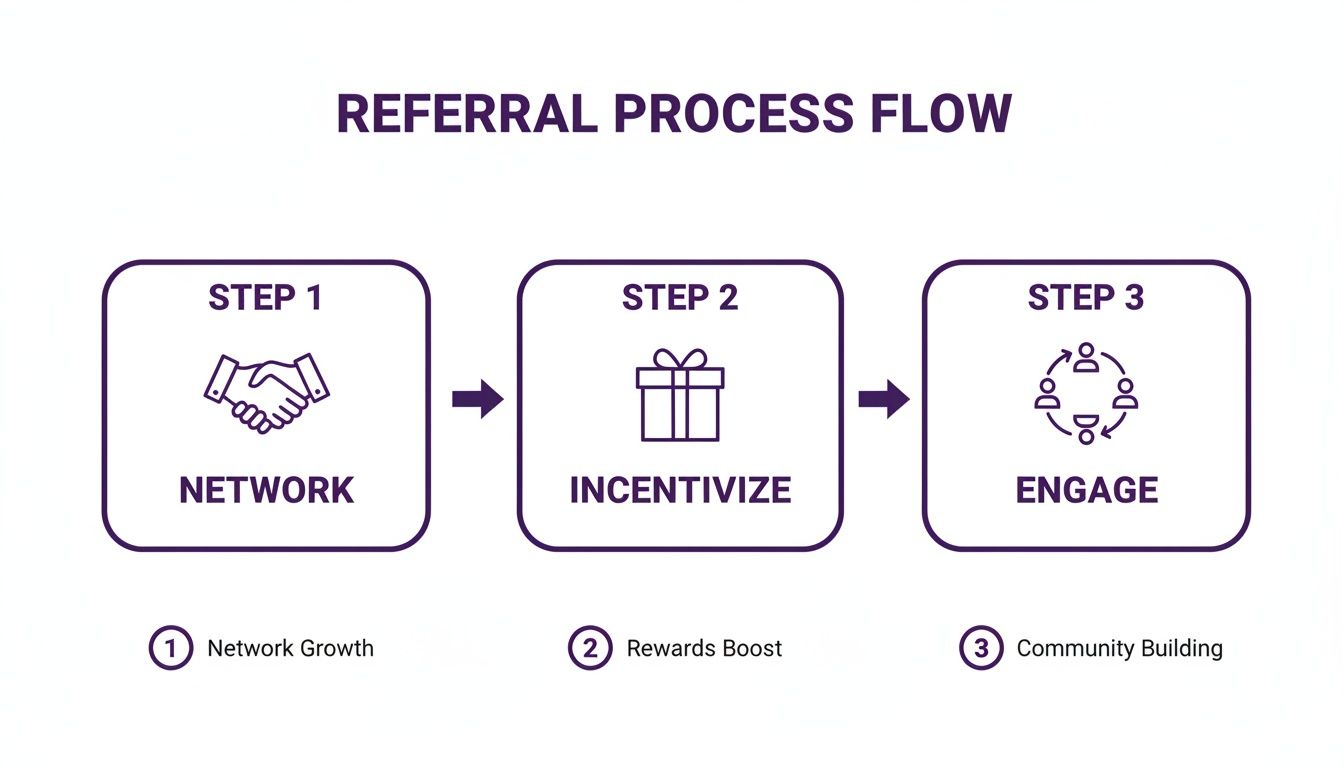
This process makes one thing clear: getting high-quality referrals isn't about just hoping for them. It demands a deliberate system where you actively build relationships and provide obvious value in return.
By building your outbound machine, you're creating a predictable and scalable source of leads for construction. It’s the single best way to smooth out that feast-or-famine cycle that plagues so many contractors, ensuring your calendar stays booked with the right kind of profitable jobs.
Scaling Your Lead Management with a Remote Team
Generating a steady stream of leads is a massive win, but it’s only half the battle. Each new inquiry—every single form submission and phone call—has an incredibly short shelf life. If you don't jump on it with speed and professionalism, that potential job vanishes into thin air, likely landing in the hands of the competitor who answered their phone first.
As your business grows, you'll inevitably hit a wall. You simply can't be on a roof, managing a job site, and simultaneously answering every incoming call to qualify a new lead. This is the exact spot where so many contractors get stuck. They become the bottleneck in their own sales process, and growth stalls.
But the solution isn't to rush out and hire an expensive, full-time receptionist. It's about strategically adding administrative muscle where you need it most: with a remote team.
The Power of Remote CSRs and Virtual Assistants
A remote Customer Service Representative (CSR) or Virtual Assistant (VA) is so much more than a simple answering service. They become a genuine extension of your team, a dedicated professional whose sole focus is ensuring no lead ever slips through the cracks. They are your first line of both defense and offense, professionally handling those crucial first steps that turn a casual inquiry into a booked appointment.
This model is particularly effective right now. The construction sector is facing a serious labor crunch, with a staggering 92% of U.S. contractors reporting difficulty finding skilled workers, according to a report from Trubuild.io. With crews stretched thin, having a hyper-efficient system for managing your sales pipeline is no longer a luxury—it's a necessity. In fact, businesses that deploy dedicated phone staff often see a 40-50% higher conversion rate from lead to job. That's a game-changing edge.
A well-trained remote team member can take over all the time-consuming tasks that are essential for growth but don't require your hands-on expertise as a contractor.
Here’s what they can immediately take off your plate:
- Immediate Lead Response: Calling new web leads within five minutes of submission, when the prospect’s interest is at its peak.
- Serious Lead Qualification: Using a proven script to ask key questions about the project, budget, and timeline to weed out the tire-kickers.
- Appointment Setting: Booking qualified, high-intent prospects directly onto your calendar for an estimate.
- Systematic Follow-Up: Nurturing leads that aren't quite ready to commit with scheduled follow-up calls and emails.
- Answering Every Call: Ensuring a live, professional voice represents your company every time the phone rings, capturing opportunities you'd otherwise miss.
Finding and Onboarding Your Remote Superstars
Hiring the right person is everything. You're not just looking for someone to read from a script; you need a team player who understands how critical a great first impression is. Look for people with stellar communication skills, a naturally friendly demeanor, and a background in customer service or sales support.
Once you find them, training is the bridge to success. A structured onboarding process is your best friend here, ensuring your new remote CSR is fully equipped to handle any situation with confidence.
Your training absolutely must cover:
- Your Company 101: They need to know what you do, who you serve, and what makes you better than the competition down the street.
- Scripts and Frameworks: Give them battle-tested scripts for qualifying leads, handling common objections, and setting appointments. Make it clear these are guides, not rigid monologues—a natural, conversational tone always wins.
- Your Tech Stack: Train them on the exact CRM and calendar tools you use. This is non-negotiable for them to seamlessly integrate into your daily workflow.
A well-trained remote CSR acts as a force multiplier for your business. For every hour they spend qualifying leads and setting appointments, you gain an hour back to focus on closing deals and running your projects.
Properly integrating a virtual assistant for a general contractor can completely change your operational capacity, allowing you to handle a much higher volume of leads with far greater efficiency.
Gauging Performance: In-House vs. Remote CSRs
So, how does this remote model stack up against a traditional in-house hire? When you look beyond just the hourly wage, the financial and operational benefits of a remote team become incredibly clear. Let's break down the key performance and cost factors.
In-House vs. Remote CSR Performance Metrics
| Metric/Cost Factor | In-House Employee | Remote CSR (e.g., via Phone Staffer) |
|---|---|---|
| Loaded Hourly Cost | $25 – $40+ (incl. taxes, benefits, overhead) | $10 – $15 (flat rate, no overhead) |
| Productive Hours/Day | 5-6 hours (after breaks, meetings, etc.) | 7-8 hours (focused solely on core tasks) |
| Lead Response Time | Variable; often delayed by other duties | < 5 minutes (primary, dedicated function) |
| Appointment Booking Rate | 15-20% on average | 25-35% with specialized training & focus |
| Training & Onboarding | Requires significant time from you/manager | Handled by the service provider |
| Flexibility & Scalability | Rigid; difficult to scale up/down quickly | High; easily add or reduce hours as needed |
As the numbers show, the remote model not only offers significant cost savings but also drives better performance on the metrics that directly impact your bottom line—like how quickly leads are contacted and how many actually turn into appointments.
Measuring What Matters: Your Key KPIs
To make sure your remote team is delivering a solid return, you have to track the right Key Performance Indicators (KPIs). These metrics provide a clear, data-driven picture of their impact.
Focus your attention on these core numbers:
- Lead Response Time: How fast are new leads being called? The goal is under five minutes, period.
- Contact Rate: What percentage of leads are they actually getting on the phone?
- Appointment Booking Rate: Of the leads they speak with, how many are converted into qualified appointments on your calendar?
- Cost Per Appointment: What’s your all-in cost (service fees, tools, etc.) to get one qualified estimate booked?
This strategic shift to remote support frees you up to do what you do best: build, renovate, and grow your business. You get all the benefits of a full-time administrative pro without the crippling overhead, creating a scalable system that turns a steady flow of leads into a predictable and profitable project pipeline.
Answering Your Burning Questions About Construction Leads
As you start getting serious about generating a steady stream of leads for your construction business, you're going to have questions. It's only natural. Marketing and sales can feel like a moving target, and you need to know where to put your time and money to get the best results.
Let's dive into the most common questions I hear from contractors and home service pros. This is your quick-reference guide to help you sidestep common pitfalls, make smarter decisions, and build a more predictable pipeline of profitable work.
How Much Should a Construction Company Spend on Marketing?
You’ll often hear the old rule of thumb: budget 5% to 10% of your annual revenue for marketing. Honestly, that’s an okay starting point, but it's a bit outdated. A much sharper way to think about it is through the lens of return on investment (ROI).
Instead of getting hung up on a fixed percentage, get obsessed with your cost-per-lead and cost-per-acquisition. Think about it this way: if you spend $1,000 on a Google Ads campaign that brings in 10 solid leads, and just one of those turns into a $20,000 kitchen remodel, that's a home run. Who cares if it was 2% or 12% of your revenue for that month?
My advice? Start with a modest, flexible budget. Test a few different channels, track your results like a hawk, and then pour gasoline on what’s actually working for your specific market and services.
What Is the Fastest Way to Get Construction Leads?
When you need the phone to ring yesterday, two things beat everything else for pure speed: paid advertising and a professional calling service. Both are designed to get you in front of prospects immediately.
With something like Google Ads, you can have your business show up at the very top of the search results within hours. This is perfect for grabbing those high-intent, "I need help now" leads—think "emergency plumber near me" or "storm damage roof repair." You're basically jumping to the front of the line for demand that already exists.
In the same vein, a done-for-you calling service can start prospecting your ideal clients and booking qualified appointments directly on your calendar, often within the first week. While things like SEO and networking are vital for your long-term health, they can't match the immediate punch of these proactive strategies.
Are Lead Generation Services Worth the Investment?
Look, platforms like Angi or HomeAdvisor can send you a high volume of inquiries, but they come with some serious baggage that every contractor needs to weigh. The biggest issue is the instant, cutthroat competition.
The second a lead comes in from one of these services, you're in a race to the bottom on price. That same lead just got sold to three, four, or even five of your competitors. It becomes a mad dash to be the first one to call and the cheapest one to quote, and that’s a tough game to win profitably.
Many contractors burn out chasing these low-quality, price-shopping leads. A much better long-term strategy is to build your own lead-generating assets—your website, your local SEO presence, your referral network. When you own the lead source, you control the quality and you're not in a bidding war before you've even said hello.
How Can I Improve My Lead Conversion Rate?
Getting more leads to turn into paying customers usually boils down to two things that sound simple but are incredibly powerful: speed and process. Nail these, and your conversion rate will climb.
Here’s the single most important thing you can do: respond to every single new inquiry within five minutes. Research has shown time and again that your odds of qualifying a lead fall off a cliff after that first five-minute window. Speed shows you’re a pro and that you value their business.
Second, you need a structured follow-up system. Very few leads are ready to sign on the first call. Use a simple CRM or even a spreadsheet to track every conversation and schedule your next follow-up. Finally, your first call should be all about qualifying them. This is where having a trained professional, like a remote CSR, handle that initial contact can be a game-changer. It ensures every lead is handled the right way, every time, which is one of the fastest ways to turn more of those inquiries into booked jobs.
At Phone Staffer, we build the systems that turn leads into revenue. Whether it’s our done-for-you calling service booking appointments directly on your calendar or our expertly trained remote CSRs ensuring every lead is handled with speed and professionalism, we help you grow without the overhead. Learn more at https://phonestaffer.com.