
Forget about just running a few ads and hoping for the best. To really grow your auto repair shop, you need a system—a predictable, repeatable machine that brings in the right kind of customers and keeps them coming back.
It all starts with a simple truth: modern car owners don't flip through the phone book anymore. They pull out their phones, search Google for "mechanic near me," and scan online reviews to find someone they can trust.
Our goal here is to build a marketing flywheel that constantly Attracts, Engages, Converts, and Retains those customers, turning them into lifelong clients.
Building Your Marketing Foundation for Growth
Building a solid marketing plan isn't about guesswork; it's about engineering a process for predictable growth. It’s more than just filling your service bays. It's about attracting high-value customers who appreciate your expertise, don't haggle over every dime, and stick with you for the long haul.
The opportunity is massive. The U.S. auto repair market is a giant, clocking in at nearly $90 billion in 2025 with around 303,000 shops competing for a piece of the pie. With so many options out there, having a smart, strategic approach is the only way to stand out.
Who Is Your Perfect Customer?
Before you spend a single dollar on marketing, you need to answer one crucial question: who are you really trying to reach?
Throwing a generic "we fix cars" message out there is like shouting into the wind—it gets lost in the noise. You have to get specific. Think about the work you do best and the customers you enjoy serving most.
- The European Car Specialist? If your shop is filled with BMWs, Audis, and Mercedes-Benz, your marketing needs to ooze that premium, specialized expertise.
- The Fleet Service Pro? Do you keep local plumbers, electricians, and delivery businesses on the road? Your message should be all about reliability, fast turnaround, and minimizing their costly downtime.
- The Family Car Guardian? Maybe your bread and butter is keeping older Hondas and Toyotas running safely for local families. Here, your marketing should hammer home trust, safety, and fair pricing.
Once you know exactly who you're talking to, every other decision—from the ads you run to the language on your website—becomes crystal clear.
The Four Pillars of Your Marketing Flywheel
I find it helpful to think of marketing not as a linear funnel, but as a powerful flywheel—a self-reinforcing cycle that gains momentum with every new customer. Each stage smoothly transitions into the next, building a sustainable growth engine for your shop.
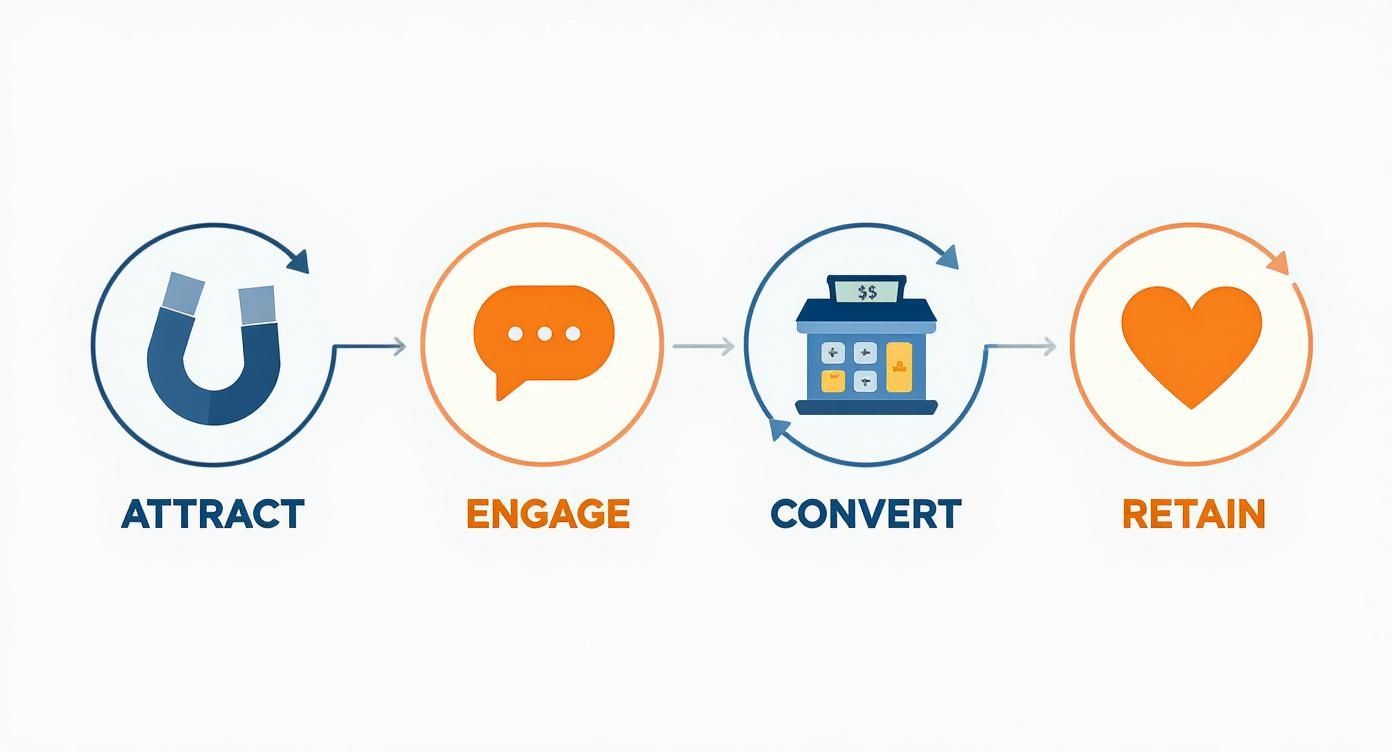
This model focuses on turning one-time customers into your most powerful marketing asset: loyal advocates who spread the word for you.
To get this flywheel spinning, we'll focus on four key stages.
| The Auto Shop Marketing Flywheel | ||
|---|---|---|
| Stage | Primary Goal | Key Tactics |
| Attract | Get discovered by local car owners actively seeking repairs. | Local SEO, Google Business Profile, Paid Ads, Content Marketing |
| Engage | Build trust through fast, professional, and helpful communication. | Answering every call, prompt text/email responses, clear estimates |
| Convert | Turn an interested prospect into a booked appointment. | Easy scheduling, seamless phone-to-shop experience, follow-ups |
| Retain | Turn a one-time repair into a lifelong customer relationship. | Exceptional service, review requests, service reminders, loyalty perks |
Nailing these four areas is the foundation for building a business that doesn't just survive, but thrives. You can learn more about creating these kinds of sustainable systems in our guide on business development best practices.
Mastering Local SEO to Win Your Service Area
Let’s be real. When a customer’s check engine light pops on, they’re not digging out a phone book. They’re grabbing their phone and searching "brake repair near me" or "oil change in Springfield." This is the moment of truth where your shop either gets the call or gets scrolled past. Showing up at the top of those local search results isn't about luck; it's about getting serious with Local SEO.
Local SEO is how you build trust with your community online. It’s how Google verifies you’re a legitimate, skilled, and relevant choice for someone with car trouble right now. And it all starts with the most powerful free marketing tool you have.
Your Google Business Profile Is Your Digital Front Door
Think of your Google Business Profile (GBP) as your shop's digital storefront. For most potential customers, it's the very first impression they'll have of you. Just claiming it is table stakes. You have to treat it like an active, living part of your business.
Here’s a look at the Google Business Profile interface. This is mission control for how customers see and interact with your shop online.
A profile that's half-filled out just looks sloppy. A fully optimized one, on the other hand, builds instant confidence. The secret is to get specific. Don't just list "auto repair" as a service. Get granular and add your high-margin services like "Transmission Repair," "EV Battery Service," or "European Vehicle Diagnostics."
Pro Tip: Get ahead of the game with the Q&A feature. What are the top five questions your front desk answers all day? "Do you work on diesels?" "Are you open Saturdays?" Post those questions yourself, then add your own clear, concise answers. It saves everyone time and shows you're dialed in.
You also need to be constantly uploading high-quality photos. People want to see clean service bays, modern equipment, your friendly team, and even pictures of completed jobs. Photos provide proof of your professionalism before a customer even steps through the door. For a deeper dive, check out this guide on optimizing your Google Business Profile.
On-Page SEO for Your Shop’s Website
Your GBP is critical, but it should always lead back to an equally professional website. Your site is your turf; it's where you control the entire story. On-page SEO is all about structuring your site's content so search engines understand exactly what you do and where you do it.
Stop lumping all your services onto one generic page. You need dedicated pages for your most profitable work. For instance, build out separate pages for:
- Brake Repair & Replacement
- Engine Diagnostics & Repair
- Tire Services & Alignment
- AC & Heating System Service
On each of these pages, weave in location-specific keywords naturally. Instead of just "brake repair," try phrases like "brake repair service in Springfield" or "trusted mechanic for AC service near downtown Springfield." This is how you signal to Google that you’re the local expert for that specific need.
The Power of Consistent Local Citations
The final piece of this puzzle is building credibility with search engines through sheer consistency. A local citation is any online mention of your shop's Name, Address, and Phone number (NAP). You'll find these on directories like Yelp, the Better Business Bureau, and other auto-specific sites.
Think of it like this: If ten different online directories give Google the same address and phone number for your shop, Google becomes extremely confident that the information is correct. But if those sources have little variations—"Main St." vs. "Main Street," or a slightly different phone number—it creates doubt and hurts your credibility.
That consistency is a massive trust signal. Inconsistent NAP information is a huge red flag for search engines and can absolutely tank your local rankings.
Your Action Plan for NAP Consistency:
- Establish the Standard: Decide on one official version of your shop's Name, Address, and Phone number. This is now your single source of truth.
- Audit Your Listings: Use a tool or just manually search for your shop online to find everywhere you're listed.
- Correct Every Inaccuracy: Go through and update every single incorrect or outdated listing you find. It’s tedious work, but it's non-negotiable for strong local SEO.
By locking down your Google Business Profile, building out specific service pages on your website, and ensuring your NAP is identical everywhere online, you create a powerful trifecta. This approach makes sure that when a local driver needs a pro, your shop is the first and most trusted name they see.
How to Build Trust with Online Reviews
Getting found online is a great start, but it's only half the battle. When a potential customer sees your shop next to three others in a Google search, what makes them choose you? More often than not, it's your online reviews.
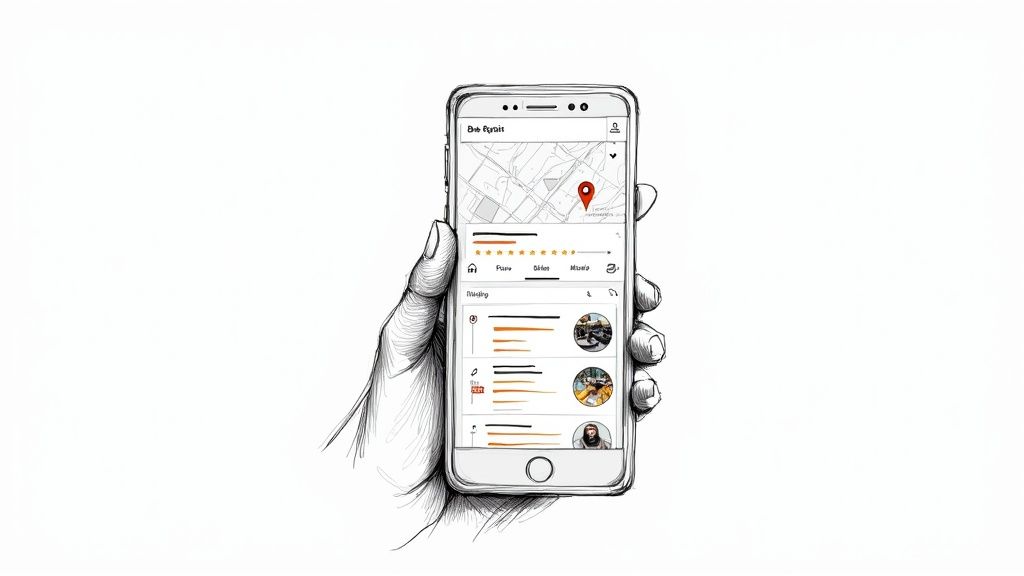
Your digital reputation is today's word-of-mouth advertising, and it carries incredible weight. A steady stream of positive reviews builds instant trust, showing new customers you’re a reliable and skilled choice before they even think about picking up the phone.
Proactively Generate Five-Star Feedback
Great reviews don't just fall from the sky. You need a simple, repeatable process to encourage happy customers to share their experience. Just waiting and hoping for feedback is a recipe for a stagnant, uninspiring review profile.
The trick is to make it incredibly easy for them. The absolute best time to ask is right after they've had a great experience and settled their bill. Don't just mention it in passing—put a system in place.
- The Post-Service Text: Send an automated text message about an hour after the customer drives away. Something simple like, "Thanks for choosing us today! If you were happy with your service, could you take 30 seconds to leave us a review?" Make sure to include a direct link to your Google review page.
- Coach Your Service Advisors: Train your front-desk team to spot delighted customers. When someone is praising the work, that's the perfect moment to say, "That's great to hear! It would mean a lot to our team if you could share that in a quick Google review."
- Use QR Codes: Place a small, well-designed sign at your checkout counter with a QR code that goes straight to your review page. This makes it a breeze for customers to act while they're still in the shop.
This is especially critical since so many customers are looking for a mechanic reactively. Recent data shows that over 40% of vehicle owners are dealing with urgent, unplanned maintenance rather than routine service. In these high-stress moments, a strong foundation of positive reviews gives them the confidence they need to make a quick decision.
Turn Negative Reviews into Marketing Wins
Sooner or later, every shop gets a bad review. It’s just part of doing business. What really matters isn't the negative comment itself, but how you respond to it. A professional, transparent, and empathetic response can actually win you more business than a five-star review ever could.
Why? Because potential customers are watching. They want to see how you handle things when they go wrong. A thoughtful reply shows you care, you’re accountable, and you’re committed to making things right. It builds more trust than a perfect record ever could.
Your response to a negative review is not for the person who wrote it; it's for the hundreds of future customers who will read it.
Here’s a simple framework for responding to criticism:
- Acknowledge and Apologize: Always start by thanking them for their feedback and apologizing that they had a bad experience.
- Show Empathy: Use phrases like, "I can certainly understand your frustration," or "That is not the standard of service we aim for."
- Take it Offline: Provide a direct line of contact. "My name is [Your Name], and I'm the owner. Please call me directly at [Phone Number] so I can personally resolve this for you."
- Keep it Professional: Never get into a public argument. Don't make excuses or, worst of all, blame the customer.
By handling criticism with grace, you transform a potential problem into a powerful demonstration of your shop’s integrity. For a much deeper dive into leveraging your online reputation, check out this guide on optimizing your Google reviews to help boost your visibility.
Running Paid Ads That Generate Appointments

While a solid SEO foundation is your long-term engine for growth, sometimes you just need to step on the gas. Paid advertising gives you that immediate boost, putting your shop directly in front of car owners who need your help right now. But this isn't about blindly throwing money at ads and hoping for the best. It's about running smart, targeted campaigns that deliver a real, measurable return.
The trick is to focus on platforms where someone's intent to buy is high, or where you can pinpoint your ideal customer with surgical precision. We're going to forget about expensive, broad-stroke advertising and concentrate on two channels that are perfect for marketing for auto repair shops: Google Local Services Ads and hyper-targeted social media campaigns.
Win High-Intent Customers with Google Local Service Ads
When a driver’s check engine light comes on, they aren't casually browsing—they're actively looking for a solution. This is exactly where Google Local Service Ads (LSAs) shine, placing your shop at the very top of the search results. I'm talking even above the traditional ads and organic listings.
What makes LSAs so ridiculously effective? They come with the coveted ‘Google Guaranteed’ badge, which acts as an instant signal of trust. That little green checkmark tells potential customers that Google has vetted your business, which goes a long way in calming their nerves and getting them to pick up the phone.
The best part, though, is the pay-per-lead model. You don't pay for clicks or impressions. You only pay when a qualified customer actually calls your shop directly through the ad. This slashes the financial risk and ensures your budget is spent on genuine opportunities, not just tire-kickers.
Insider Tip: To get the most from your LSAs, your team has to be ready to answer the phone professionally and turn those calls into appointments. An unanswered call from a guaranteed lead is literally throwing money away. A service like Phone Staffer ensures every LSA-generated call is captured and handled properly, maximizing the return on your ad spend.
Pinpoint Your Ideal Customers on Facebook and Instagram
While Google captures people who are actively searching, social media lets you proactively reach specific segments of your local market. Platforms like Facebook and Instagram have powerful targeting tools that let you get your message in front of the exact people you want to serve, even if they aren't looking for a mechanic at this very moment.
This is where that ideal customer profile we talked about becomes your secret weapon. You can build ad campaigns that target users based on some incredibly specific criteria.
Just imagine what you could do for your shop:
- Target New Movers: Create a "Welcome to the Neighborhood" offer and show it exclusively to people who have recently moved within a 5-mile radius of your shop. You can become their go-to mechanic from day one.
- Reach Specific Vehicle Owners: Specialize in European cars? You can run ads that only target users who have shown interest in brands like BMW, Audi, or Mercedes-Benz.
- Promote Seasonal Services: As summer heats up, run a campaign for an AC check-up targeted to local homeowners. In the fall, switch gears to ads promoting brake inspections and new tires.
Crafting Ads That Actually Convert
A great ad is a simple combination of a compelling offer and a clear call to action. You're not just selling an oil change; you're solving a problem and offering peace of mind. Your ad copy should speak directly to the driver's needs, and your visuals should reinforce your shop’s professionalism and trustworthiness.
Let's look at some real-world examples:
- Ad Copy Example (Facebook): "Is your car's AC blowing hot air? Don't sweat through another commute! Our certified techs will get your AC running ice-cold. Tap 'Book Now' to schedule your inspection in Springfield today!"
- Visual Idea: A quick, 15-second video of a technician using a thermometer to show the cold air blasting from a vent after a repair. It's simple, visual proof.
- Call to Action (CTA): Always use strong, direct CTAs. "Call Now for a Quote," "Book Your Appointment," or "Get Directions" leave no room for confusion and make it as easy as possible for them to take the next step.
By combining the high-intent power of Google LSAs with the precision targeting of social media, you create a paid ad strategy that doesn't just spend money—it generates profitable appointments and consistently grows your customer base.
Turning Phone Calls into Booked Jobs
Think about it: all your hard work—the slick website, the glowing five-star reviews, the perfectly targeted ads—it all funnels down to one single, critical moment. The phone call.
This is the make-or-break point where a curious driver becomes a paying customer, or they hang up and dial the shop down the street. Converting these calls into booked jobs is an art, absolutely, but it's also a science you can master with the right process.
Too many shops bleed thousands in revenue right here, and they don't even realize it. A phone that rings off the hook during a hectic lunch rush is a stack of lost jobs. A potential customer who gets a wishy-washy price quote loses confidence in seconds and moves on. The best marketing in the world can be completely torpedoed by a bad experience on the phone.
From First "Hello" to a Confident Booking
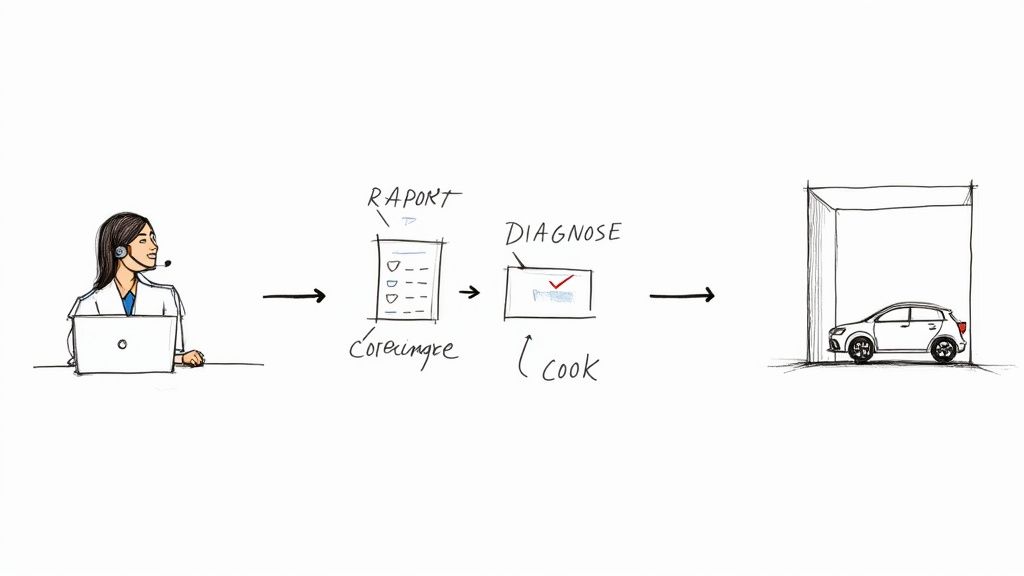
Every call from a new customer needs to follow a simple but powerful path. It’s not just about spitting out answers; it’s about guiding the caller from a state of uncertainty to a scheduled appointment in your bay. The real goal is to build instant rapport, show them you know your stuff, and make booking a visit feel like the easiest, most obvious next step.
When you nail this process, you transform a simple price check into the start of a long-term customer relationship. It immediately tells the caller they’ve found a professional, organized shop that actually values their business from the very first word.
A ringing phone isn’t an interruption to your work; it is the work. Each call is a customer who has already chosen to reach out to you over every other shop in town. Capturing that opportunity is everything.
The auto repair industry is incredibly resilient. With cars getting older and maintenance being non-negotiable, the demand is always there. In fact, the U.S. automotive aftermarket is projected to blow past $664 billion by 2028. You can get the full rundown in the 2026 Auto Care Factbook. This constant market growth means a steady stream of calls, making a superior phone process your ultimate competitive advantage.
The Real Cost of a Missed Call
The magic happens when you can guarantee that 100% of your calls are answered by a trained, professional voice. Think about the most chaotic times in your shop—the morning drop-off rush, the hectic lunch hour. That’s precisely when a new lead is most likely to call, and it’s also when your in-house team is least able to give them the focused attention they deserve.
This is where having a remote customer service representative (CSR) becomes a total game-changer. Imagine a seamless extension of your front desk—someone who is always there, never distracted by the chaos on the floor, and perfectly trained to follow your booking script every time.
How a Remote CSR Changes the Game:
- You Capture Every Single Lead: No call ever hits voicemail. Every potential job is handled professionally, even during your busiest hours or after you’ve locked up for the night.
- You Get Rock-Solid Consistency: They provide accurate info, ask the right diagnostic questions, and schedule appointments right into your shop management system, without fail.
- You Free Up Your Service Advisors: Your team on the ground can finally focus 100% on the customers standing right in front of them, which improves both service quality and shop efficiency.
By bringing in a service like Phone Staffer, you’re not just answering more calls. You’re plugging a massive leak in your revenue bucket. You’re finally ensuring that every dollar you invest in marketing pays off by turning that hard-won interest into real, profitable work on your schedule.
Measuring Your Marketing Success
You can't improve what you don't measure. Pouring money into ads or SEO without tracking the results is like driving with your eyes closed—you’re burning gas with no idea if you’re heading in the right direction.
To make smart decisions, you have to know exactly which marketing efforts are bringing cars into your bays and which are just draining your bank account.
This isn't about getting lost in complicated spreadsheets, either. It’s about focusing on a few key numbers that tell the real story of your shop's growth. Once you start tracking these, you can confidently double down on what works and cut what doesn't.
Key Metrics Every Shop Owner Should Track
To get a clear picture of your marketing performance, let's break down the essential numbers. These are the metrics that directly connect your marketing dollars to your bottom line.
-
Cost Per Lead (CPL): This is simply what you pay for each new opportunity. Think of it as the cost of getting the phone to ring or a web form filled out.
- Formula: Total Marketing Spend / Total New Leads = CPL
- Example: You spend $500 on Google Ads and get 25 calls from new customers. Your CPL is $20.
-
Customer Acquisition Cost (CAC): This goes a step further. It’s the total cost to actually get a new paying customer through the door and onto your schedule.
- Formula: Total Marketing Spend / New Customers Acquired = CAC
- Example: From those 25 calls, your team books 10 actual jobs. That same $500 campaign now has a CAC of $50.
These first two numbers show your immediate return on investment. But the most important metric of all is the one that looks at the bigger picture.
Understanding Long-Term Profitability
The true value of a new customer isn't just their first repair bill. It’s the total amount they’ll spend with you over years of loyal service.
Customer Lifetime Value (CLV): This is the holy grail metric. It forecasts the total revenue you can realistically expect from a single customer over the entire time they do business with you. A high CLV means you're not just fixing cars; you're building profitable, long-term relationships.
Knowing your CLV changes everything. A $50 CAC might seem a bit steep for a $100 oil change, but what if that same customer comes back twice a year for the next five years? Suddenly, that initial investment has paid for itself many times over.
We’ve actually put together a detailed guide to help you figure this out. You can learn how to use the customer lifetime value calculation formula specifically for your shop.
By keeping a close eye on CPL, CAC, and CLV, you stop guessing and start knowing. This data-driven approach is how you build a marketing machine that fuels sustainable, profitable growth for your shop.
Your Top Questions Answered
Even with the best playbook, you're going to have questions. You're not alone. I’ve heard these same questions from dozens of shop owners, so let’s get right to the practical answers.
What’s the Best Marketing Strategy for a Smaller Auto Shop?
If you're running a smaller, local shop, forget about casting a wide net. Your best bet is a laser-focused local SEO strategy. Your entire goal is to own the search results when someone within a five-mile radius pulls out their phone and types "mechanic near me."
Start with your Google Business Profile. Treat it like your most important digital asset. Fill out every single section—services, high-quality photos, weekly posts, the works. Then, make getting new customer reviews on Google a core part of your process. This one-two punch costs nothing but your time and delivers the highest ROI because you're catching customers exactly when they need you most.
How Much Should an Auto Repair Shop Really Spend on Marketing?
There’s no single magic number, but a solid rule of thumb is to budget between 3% and 5% of your total gross revenue. For a shop pulling in $800,000 a year, that translates to a marketing spend of $24,000 to $40,000.
But let’s be real—how you spend that money is far more important than the exact amount. A brand-new shop will probably lean heavily on Google Ads to get the phone ringing immediately. A more established shop, on the other hand, might put more of that budget into building long-term trust through content and managing their online reputation to protect their spot at the top.
Don't just ask, "How much should I spend?" A much smarter question is, "What am I willing to pay to get a new customer?" If you know a customer is worth $1,500 to your shop over their lifetime, spending $100 to get them in the door is a no-brainer.
How Do I Get More Customers for My Auto Repair Shop, Fast?
Want the fastest path to more customers? Eliminate friction. Make it ridiculously easy for people to find you, trust you, and book a service. It really boils down to three things:
- Be Discoverable: Get your Google profile dialed in so you show up first in local searches.
- Be Trustworthy: Keep a steady flow of great online reviews coming in. Social proof is everything.
- Be Responsive: Make sure a real, professional human answers every single phone call.
When you nail these three areas, you create a powerful engine for growth. Visibility gets them to call you, reviews convince them you’re the right choice, and a flawless phone experience ensures they actually book the appointment instead of calling the next shop on the list.
Ready to make sure every dollar you spend on marketing turns into a booked job? Phone Staffer gives you professionally trained, remote CSRs who answer every call, capture every lead, and schedule appointments right into your shop management system. See how we turn more of your phone calls into paying customers.