

A lot of roofers think marketing is just about running ads. That's a surefire way to burn through cash with little to show for it. Smart, effective marketing is really about the groundwork—the strategic thinking you do before you even think about spending a dollar on advertising. It's about knowing your local turf, figuring out what makes your company the obvious choice, and getting crystal clear on who your best customers are.
This initial planning is what separates the companies that land a few sporadic jobs from the ones with a steady, predictable flow of profitable work.
Building Your Foundational Marketing Strategy

Jumping straight into paid ads or social media without a plan is like slapping shingles on rotten decking. It might look okay for a minute, but it’s doomed from the start. A solid marketing strategy starts with a solid foundation. The whole point is to build a repeatable system that brings in the right kind of clients and cements your reputation as the go-to roofer in town.
This isn’t about flashy, one-off tactics. It's about smart preparation. When you've done this work, your message actually connects with people, your budget is spent wisely, and you'll know exactly how to tell if it's all working.
Analyze Your Local Market and Competitors
Before you can carve out your spot, you’ve got to know who you're up against. The first step is to size up the top 3-5 roofing contractors in your main service area. I'm not just talking about who has the most trucks on the road; I mean really digging into their marketing.
- Their Website: Is it professional and modern? More importantly, does it work well on a phone? Look for things like online booking forms, detailed pages for each service they offer, and a gallery of their actual work.
- Their Google Business Profile: Go to Google and search "roofer near me." Who shows up in that top map pack? Check out their review count, their average star rating, and how often they're posting updates or photos.
- Their Ad Spend: Are they running Google Ads for high-intent keywords like "roof leak repair"? That tells you exactly where they're putting their money to get emergency leads right now.
The point of this isn't to copy your competitors. It's to find the chinks in their armor. Maybe their websites are clunky and outdated, or they have a string of bad reviews complaining about poor communication. Those are your openings.
Define Your Unique Selling Proposition
I ask roofers this all the time: "Why should a homeowner choose you over every other roofer in the phone book?" If the answer is something generic like "we do quality work," you've got a problem. That's not a Unique Selling Proposition (USP); it's a basic expectation.
Your USP is the core of your brand's promise. It’s the one thing that makes you the obvious choice for a specific type of customer with a specific problem.
You need to get specific about what truly makes you different. Think about it:
- Specialization: Are you the guy everyone calls for standing-seam metal roofs? The expert in restoring slate roofs on historic homes? The crew that dominates the local commercial TPO market?
- Process: Maybe you use cutting-edge drone technology for every inspection, giving homeowners a level of detail no one else provides. Or perhaps you assign a dedicated project manager to every single job.
- Guarantee: Do you offer a 25-year workmanship warranty that blows the competition's 10-year warranty out of the water? Or maybe a "no-mess-left-behind" guarantee that homeowners love.
- Speed: Is your 24/7 storm damage response team known for being the fastest in the entire county?
This clear, powerful differentiator becomes the backbone of all your marketing, from the headline on your website to the copy in your ads. With the U.S. roofing market set to grow at a CAGR of 6.6% between 2024 and 2032, a strong USP is non-negotiable if you want to grab your piece of the pie. You can learn more about the roofing market growth trends to see just how big the opportunity is.
Dominating Local Search with Your Website and SEO
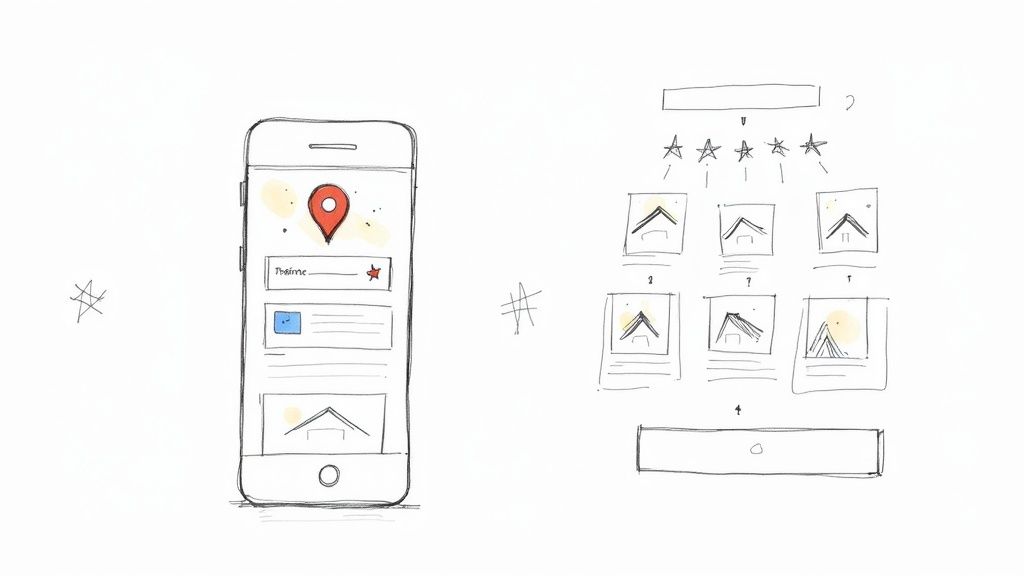
Think of your website as your hardest-working salesperson. It never sleeps, never takes a day off, and it's your #1 tool for generating leads. But even the best-looking website is completely useless if local homeowners can't find it. That's where Local SEO comes in—it’s the engine that drives qualified traffic right to your digital doorstep.
Local SEO is all about making sure your business pops up first when a homeowner in your service area frantically searches for something like "emergency roof repair near me." Showing up at the top of Google isn't about luck; it's a deliberate strategy that you can, and must, control.
The competition for those top spots is getting tougher every year. With a projected CAGR of 23.1% in North America between 2025 and 2032, the roofing market is booming, largely thanks to refurbishment projects and the push for energy-efficient materials. To grab your piece of that pie, you have to win the local search game.
Building a Website That Actually Converts
Before you even think about rankings, your website needs to be a lean, mean, lead-generating machine. A clunky, slow, or confusing site will send potential customers clicking away to your competition in seconds.
Here are the non-negotiables for a roofing website that turns visitors into booked jobs:
- Mobile-First Design: It’s a fact—over 60% of searches happen on a smartphone. If your site is a pain to navigate on a phone, you're throwing away business. End of story.
- Can't-Miss Calls-to-Action (CTAs): Your phone number needs to be big, bold, and at the top of every single page. Buttons like "Get a Free Estimate" should be bright and strategically placed so a visitor never has to hunt for them.
- Rock-Solid Trust Signals: You need to show off your licenses, insurance, certifications, and any warranties you offer. Plastering logos from organizations like the BBB or local trade associations builds instant credibility.
- Real, High-Quality Photos: Ditch the cheesy stock photos. Homeowners want to see your team, your trucks, and photos of beautiful roofs you've actually installed. It shows you're a real, established local business.
Mastering Your Google Business Profile
If your website is your sales hub, your Google Business Profile (GBP) is your digital storefront. For many potential customers, that little info box that pops up in Google Maps and the "Local Pack" is their very first interaction with your company. You can't afford to neglect it.
Your Google Business Profile is often the first impression a customer gets. A neglected profile is the digital equivalent of a boarded-up shop on Main Street. Keep it pristine, updated, and packed with helpful information.
Getting your GBP dialed in is one of the highest-impact things you can do for your marketing. Here's how to do it right:
- Complete Every Single Section: Don't skip anything. Fill out your business hours, define your exact service areas, and write a detailed business description that sells your expertise.
- Detail All Your Services: Don't just list "Roofing." Get specific. List out things like Asphalt Shingle Replacement, Metal Roof Installation, Storm Damage Tarping, and Gutter Repair. This helps you rank for more specific, high-intent searches.
- Upload Photos Constantly: Make it a habit. Post fresh photos every week of your crew on a job, finished projects (get the homeowner's permission!), and your branded vehicles.
- Answer Questions Proactively: Use the Q&A feature to answer the questions you always get on the phone. Think: "Do you offer financing?" or "What warranties do you provide?"
The Untapped Power of Hyper-Local Service Pages
Most roofers have a generic "Roof Repair" page. To truly dominate the search results, you need to go a level deeper and create service pages for the specific towns and neighborhoods you work in.
Instead of one broad page, build out multiple, targeted ones like these:
- "Asphalt Shingle Repair in Austin"
- "Tile Roof Leak Repair in Round Rock"
- "Commercial Flat Roof Maintenance in Cedar Park"
These hyper-local pages send a powerful signal to Google that you are the go-to expert for that service in that specific location. This is precisely how you start ranking for the valuable, "money" keywords that drive the best leads. Digging into the best keywords for roofers can give you a ton of ideas for these pages.
When you combine this hyper-local strategy with a perfectly tuned Google Business Profile and a consistent flow of new five-star reviews, you create an unstoppable local SEO machine that will feed your business a steady diet of qualified leads.
Turning On the Lead Faucet with Paid Advertising
While Local SEO is your long game for building a trusted brand, sometimes you just need the phone to start ringing right now. This is where paid advertising shines. Think of it as flipping a switch to put your company directly in front of homeowners at the exact moment they’re desperately searching for a roofer.
Pay-Per-Click (PPC) campaigns, especially on platforms like Google Ads, are hands-down the fastest way to get qualified leads in the door. You’re not waiting to earn your spot; you’re buying your way to the top of the search results for the most critical, high-intent keywords.
Google Ads: Your Secret Weapon for Urgent Roofing Needs
When a homeowner hears that dreaded drip, drip, drip in their living room, they aren't casually browsing. They're grabbing their phone and searching for an immediate solution. Your Google Ads need to be that solution. Getting this right is all about targeting the right keywords and writing ads that speak directly to their panic.
Forget broad keywords like "roofer." You need to get inside the head of a stressed-out homeowner.
- Emergency & Storm Keywords: Think like a customer in a crisis. They’re searching for
emergency roof tarping near me,storm damage roof repair, or24/7 roof leak help. These people need someone on-site, fast. - Quote-Based Keywords: You can also catch homeowners who are past the initial research phase and are ready to get bids. Target terms like
free roof replacement quote,cost to replace shingle roof, orlocal roofing estimates. - Problem-Specific Keywords: Get granular. Targeting searches like
fix leaking chimney flashingorhail damage roof inspectionlets you capture highly motivated leads who know exactly what they need.
How you structure your campaigns is just as important as the keywords you choose. Don't just throw everything into one big bucket. Create separate ad groups for each service—"Repairs," "Replacements," "Storm Damage," and so on. This lets you write super-relevant ad copy that matches what the person searched for, which Google rewards with better ad placement and, most importantly, lower costs.
Pro Tip: Your ad copy isn't about you; it's about solving their problem. A headline like "Leaky Roof? Fast, Guaranteed Repairs. Call Now!" will always beat a generic one like "Smith & Sons Roofing Services."
The Money Is in the Landing Page
Sending all that expensive ad traffic to your homepage is one of the most common—and costly—mistakes I see roofers make. Someone who clicked an ad for "emergency storm tarping" needs to land on a page that is 100% focused on emergency storm tarping. Don't make them hunt for information.
A high-converting landing page needs a few non-negotiable elements:
- A Matching Headline: If your ad says "Expert Hail Damage Repair," the headline on the page better say the same thing. It’s an instant confirmation for the visitor.
- A Big, Obvious Call-to-Action: Your phone number should be huge and unmissable. Add a simple contact form asking for only what you absolutely need to book an estimate.
- Benefit-Driven Bullet Points: Quickly list why they should call you. Think "24/7 Response," "Fully Insured," "5-Star Google Rating," and "We Work with All Insurance." These build instant trust.
- Real Social Proof: Add a few of your best customer reviews, especially any that mention the specific service the page is about (e.g., a review praising your quick storm response).
This focused approach strips away all distractions and funnels the visitor toward the only action that matters: contacting you.
Choosing Your Lead Generation Channels
Deciding where to spend your marketing dollars can be tough. SEO is a marathon, while PPC and Social Ads are sprints. This table breaks down the key differences to help you build a balanced strategy.
| Channel | Time to See Results | Typical Cost Per Lead | Best For |
|---|---|---|---|
| Local SEO | 6-12 Months | $ (Lowest over time) | Building a long-term, sustainable brand and generating "free" organic leads. |
| Google Ads (PPC) | 24-48 Hours | $$ (Medium-High) | Capturing high-intent leads who are actively searching for a roofer right now. |
| Social Media Ads | 1-2 Weeks | $-$$ (Low-Medium) | Proactively generating demand, especially for storm damage inspections in targeted areas. |
Ultimately, a winning strategy uses all three. SEO builds your foundation, PPC gets the phone ringing tomorrow, and Social Ads let you surgically target new opportunities.
Tapping into Social Media for Hyper-Targeted Leads
While Google captures people who are already looking, platforms like Facebook and Instagram let you get in front of people who should be looking. This is an absolute game-changer for storm response.
Picture this: a big hailstorm just hammered a specific part of town. With Facebook Ads, you can literally draw a circle on the map around those exact neighborhoods and push ads directly to the affected homeowners.
You can show them ads with images of hail-damaged shingles and offer a free, no-obligation inspection. This isn't just advertising; it's providing a timely solution. This kind of hyper-local targeting creates a predictable pipeline of high-quality leads, turning an unfortunate weather event into a massive opportunity to keep your crews busy when demand is sky-high.
Build Real Trust with Great Content and Raving Fans
Paid ads can get your foot in the door, but trust is what closes the deal. In the roofing business, a homeowner's confidence is everything. The best marketing isn't about the hard sell; it’s about becoming the most knowledgeable, reliable, and trustworthy roofer they can find.
You get there two ways: by creating genuinely helpful content and by letting your happy customers do the talking for you.
Think of this as an investment, not an expense. You aren't just buying one lead for one job. You're building a rock-solid reputation that will bring you business for years.
Become the Go-To Roofing Expert in Your Town
When a homeowner hears a drip in the attic or sees a shingle on the lawn, their first move is to Google it. Your mission is to be the one who provides the answer. When you create content that solves their real-world problems, you start building a relationship before they even pick up the phone.
This isn’t about pumping out generic blog posts. It’s about becoming a true local resource.
- Solve Local Problems: Instead of a boring "Our Services" page, write a blog post titled "5 Telltale Signs of Hail Damage Every [Your City] Homeowner Needs to Know." See how specific that is?
- Show Your Expertise: Film a quick video on your phone comparing two popular types of asphalt shingles. Show the difference in thickness, explain the warranties, and talk about which one stands up best to your local weather.
- Showcase Your Best Work: Your finished projects are your best sales tool. Turn them into simple case studies with stunning before-and-after photos. Briefly explain the homeowner's problem and how you solved it. That kind of visual proof is incredibly powerful.
This strategy does more than just build trust. Every article and video you create is another chance to rank on Google, which supercharges your local SEO efforts. And since residential jobs make up 55% of the entire roofing market, creating content that speaks directly to homeowners is a no-brainer. You can find more details on the roofing market's dominant segments to see just how big that opportunity is.
Turn Happy Customers into Your Best Sales Team
Let's be honest: a potential customer will always believe what a past customer says over what you say about yourself. Always.
That's why having a system for getting—and managing—customer reviews isn't just a nice-to-have; it's essential. A constant flow of positive reviews on Google is the most powerful social proof you can possibly get.
Your online reputation is just word-of-mouth in the digital age. A single bad review can scare away multiple prospects, while a wall of five-star reviews acts like a magnet for new business.
For a local service business like a roofing company, solid online reputation management for small businesses is absolutely critical. It’s not just about collecting stars; it's about actively guiding how the community perceives your company.
How to Get Reviews on Repeat
Don't just hope for good reviews. Build a simple, repeatable process that’s part of every single job you do.
- Plant the Seed Early: During your first meeting, mention that your entire team is focused on earning a five-star review. This sets the expectation from day one.
- Strike While the Iron is Hot: The "golden moment" is during the final walkthrough, right after the homeowner sees their beautiful new roof and is smiling from ear to ear. That's when you say, "We're so glad you love how it turned out. It would mean the world to us if you could share your experience on Google."
- Make It Insanely Easy: Don't make them hunt for your Google page. Right after that conversation, send them a text with a direct link. The fewer clicks it takes, the more likely they are to do it.
- Engage with Every Review: Thank every single person who leaves a positive review. If you get a rare negative one, respond calmly and professionally, offering to take the conversation offline to fix it. This shows everyone else that you stand by your work, no matter what.
This simple four-step process, when you do it consistently, will build a fortress of social proof that new prospects simply can't ignore.
Turning More Inquiries Into Booked Jobs
Getting a ton of leads feels great, but it doesn't mean much if they never turn into actual, paying work. The real magic—and the real money—happens in the follow-up. This is where you can double your appointment rate and leave your competition scratching their heads.
In roofing, speed-to-lead isn't just a buzzword; it's everything. Think about it: a hailstorm rolls through town, and a homeowner finds a leak. The first roofer who answers the phone professionally and can get an inspector on-site right away is almost guaranteed to win that job.
Every call that goes to voicemail is a potential $15,000 project you just handed to the next guy on the Google search results. You simply can't afford to be unavailable when a hot lead comes in, especially when you're busy on a roof or managing a crew.
The Power of an Immediate, Professional Response
Put yourself in the homeowner's shoes. They're stressed, maybe even a little panicked. When they call you or fill out your website form, an immediate, calm, and professional voice on the other end of the line is a massive relief. It builds instant trust and, more importantly, stops them from calling anyone else.
This is where having a dedicated remote Customer Service Representative (CSR) or Virtual Assistant (VA) can completely change your business. Instead of trying to juggle everything yourself, you have a trained professional ready to:
- Answer every single call live, so you never miss an opportunity.
- Qualify prospects with a few smart questions to see if they're a good fit.
- Book an estimate directly into your calendar.
- Gather all the critical info so your salesperson arrives at the inspection fully prepared.
A remote CSR isn't just another business expense. It's a direct investment in your closing ratio. It ensures every dollar you spend on marketing has the best possible chance of turning into a profitable job.
Having this system in place means you capture every single opportunity your marketing creates. It frees you up to focus on what you do best—selling jobs and running your crews—while a pro handles that crucial first impression.
This process of building trust starts with the first phone call and is reinforced by great content and happy customer reviews, which in turn generates powerful word-of-mouth referrals.
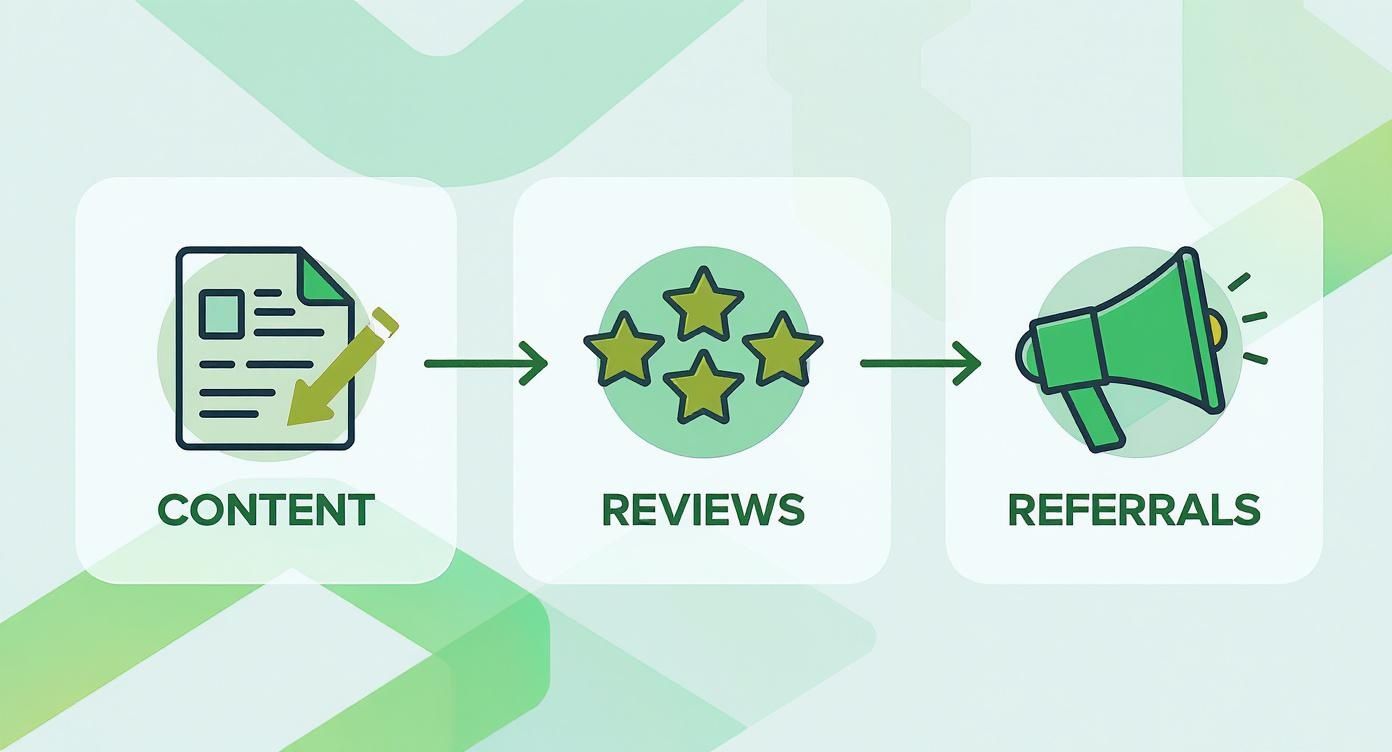
Trust isn't built in a single moment; it's the result of being consistent and professional at every single touchpoint.
A Follow-Up Sequence That Actually Works
Let's be realistic: not every lead is ready to book an appointment on the first call. Many homeowners are shopping around and getting multiple quotes. If your strategy is "one call and done," you're leaving a massive amount of money on the table.
You need a simple, structured follow-up plan that keeps you top-of-mind without being annoying.
The "3×3" Follow-Up Model
We've seen this simple sequence work wonders for contractors. It's a mix of communication channels spread over three days.
- Day 1: Call immediately when the lead comes in. No answer? Leave a quick, professional voicemail and immediately follow up with a text message. Something simple like, "Hi [Name], this is [Your Name] from [Your Company]. Just got your request for a roof estimate. I'll try you again shortly, or feel free to call/text me back here."
- Day 2: Send a follow-up email. Don't just ask for a call back. Provide value. Link to a blog post on your site about "Choosing the Right Shingle Color" or include a short video testimonial from a happy customer.
- Day 3: Place one final follow-up call.
This balanced approach shows you're persistent and professional, not pushy. By combining a lightning-fast initial response with a smart follow-up system, you’ll turn more of those hard-won leads into booked, profitable jobs.
Got Questions About Roofing Marketing? We've Got Answers.
When it comes to marketing a roofing business, the same few questions always seem to pop up. Let's cut through the noise and get straight to the practical answers that will help you spend your budget wisely and book more profitable jobs.
What’s a Realistic Marketing Budget for a Roofer?
A solid rule of thumb is to dedicate 5-10% of your total revenue to marketing. For most roofing companies, this is the sweet spot—enough to keep the lead pipeline full without tying up too much cash.
Of course, this isn't set in stone. If you're fighting for every lead in a packed market or you've set some ambitious growth targets for the year, bumping that up to 12% can be a really smart move. The trick is to start with the low-hanging fruit—things like a killer Google Business Profile and targeted Google Ads for storm repair—and then scale your spending as you see what's bringing in the best return.
The right way to think about marketing isn't as an expense. It's an investment in a predictable system for generating leads. You're not just spending money; you're building a machine that turns dollars into booked jobs.
This mindset shift ensures every marketing dollar is working directly toward growing your bottom line.
If I Only Do One Thing for Marketing, What Should It Be?
For any local roofer, your single most powerful marketing tool is, without a doubt, your Google Business Profile (GBP). It is the absolute engine for local search, and it's where the majority of your customers will find you.
Think of it as your digital front door. A well-managed profile—packed with crisp, recent photos, detailed service descriptions, and a constant flow of new five-star reviews—is what gets you into Google's "Local Pack." That's the map section at the top of the search results, and it's prime real estate for anyone with a leaking roof who needs help right now.
How Do I Keep Leads Coming in During the Slow Season?
When the storms die down, your marketing has to shift gears from reactive to proactive. Instead of waiting for emergency calls, you need to give homeowners a reason to think about their roof today.
Here are a few tactics that flat-out work:
- Run highly targeted ads on Google or Facebook for things like "preventative roof inspections" or "annual roof maintenance packages."
- Lean on your email list. Reach out to past customers with special offers for gutter cleaning, attic ventilation checks, or pre-winter tune-ups.
- Create useful content. A simple blog post or a quick video on "5 Ways to Winterize Your Roof" positions you as the expert and keeps your name top-of-mind.
This proactive approach smooths out your revenue, keeps your best crews busy when your competitors are quiet, and cements your reputation as the go-to expert all year long.
Tired of juggling calls while you're on a roof or meeting with a homeowner? Phone Staffer can take that entire headache away. Our trained, remote CSRs and VAs answer every call, qualify every lead, and book solid appointments right on your calendar. You'll never miss a valuable opportunity again. Learn how our dedicated staff can help you convert more leads into profitable jobs.