
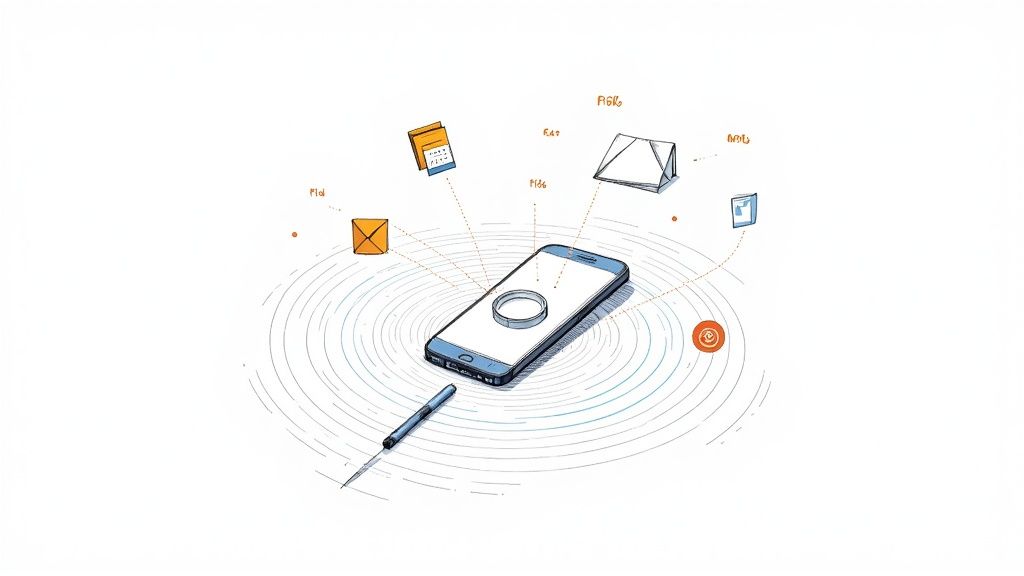
At its core, phone call tracking software is a tool that finally connects the dots between your marketing and the phone calls you receive. It assigns unique, trackable phone numbers to each of your marketing channels—think one number for your Google Ads, another for your Facebook page, and even one for the vinyl wrap on your truck.
This simple switch allows you to see exactly which ads and campaigns are making your phone ring. It’s the difference between guessing what works and knowing for sure.
Understanding Phone Call Tracking and Why It Matters
Let's use an analogy. Imagine your marketing is a fleet of small fishing boats. One boat represents your Google Ads, another is for your social media, and a third is your direct mail flyers. You know you're catching fish (leads), but you have no idea which boat is bringing in the biggest haul. You might be spending a ton on fuel for a boat that's coming back empty, while your most successful boat is getting ignored.
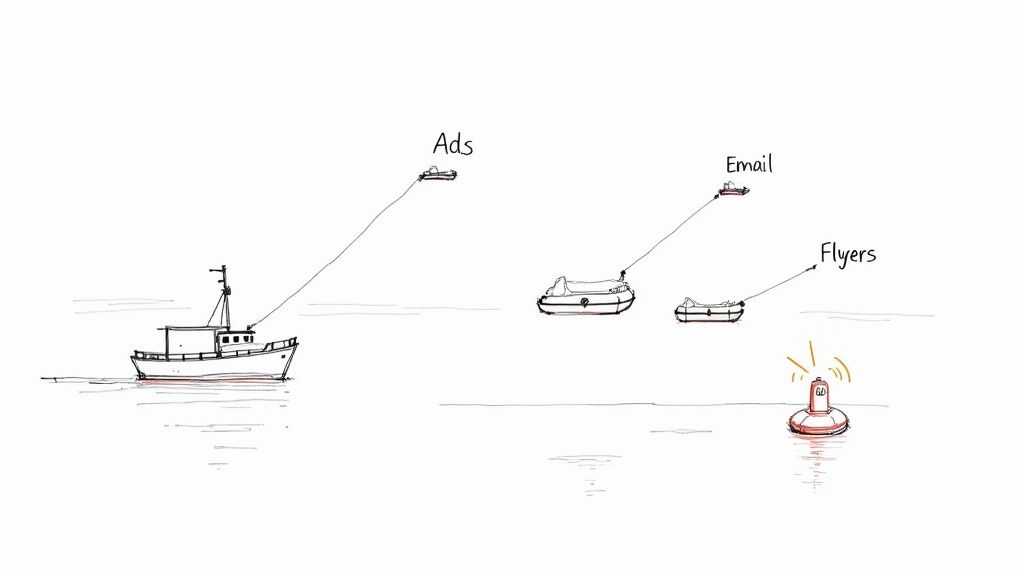
Phone call tracking software is the radar for that entire fleet. It closes the loop, showing you which marketing efforts are delivering real, paying customers over the phone.
By linking specific calls back to the exact campaign that drove them, you get a crystal-clear picture of your return on investment (ROI). You stop wasting money and start doubling down on what actually works.
For home service businesses, this isn't just a nice-to-have. When a single phone call can turn into a job worth thousands of dollars, knowing what made that customer pick up the phone is absolutely crucial.
The following table breaks down the shift in thinking that happens when a home service business adopts call tracking. It’s a move from hoping for the best to making decisions based on cold, hard data.
Before and After Implementing Call Tracking
| Business Challenge | Before Call Tracking (The Guesswork) | After Call Tracking (The Data-Driven Approach) |
|---|---|---|
| Marketing Budget Allocation | "I think our Google Ads are working, so let's keep spending there. Maybe boost the Facebook budget too?" | "Our Google Ads for 'roof repair' drove 42 qualified leads last month, converting at $50 per lead. Our Facebook ads only brought in 5 leads at $200 each. Let’s reallocate the Facebook budget to the roof repair campaign." |
| Evaluating New Channels | "We just spent $1,500 on new truck wraps. The phone seems to be ringing a bit more, so I guess they're working?" | "The unique number on our new truck wraps generated 15 calls in the first month. Three of those calls turned into jobs totaling $12,000 in revenue. The wraps paid for themselves 8 times over." |
| Understanding Customer Needs | "We get a lot of calls for emergency services, but I'm not sure which ones are most profitable." | "Keyword tracking shows that '24/7 HVAC repair' calls have the highest booking rate and average job value. Let’s create a dedicated landing page and ad campaign for that specific service." |
| Staff Performance and Training | "Our booking rate feels low. I wonder if the team is saying the right things on the phone." | "Call recordings show that when our CSRs mention the '10% new customer discount,' the booking rate jumps by 25%. Let’s make that a standard part of our script." |
Ultimately, call tracking replaces assumptions with answers, empowering you to make smarter, more profitable decisions across your entire business.
How Dynamic Number Insertion Works
The magic behind modern call tracking is a clever piece of tech called Dynamic Number Insertion (DNI). Instead of showing the same phone number to every single person who visits your website, DNI swaps it out based on how they got there.
Here’s how it works in a real-world scenario:
- A homeowner clicks your ad: A potential customer searches "emergency plumbing repair" and clicks on your Google Ad.
- The code kicks in: A small bit of code on your website instantly recognizes the source—Google Ads, the specific campaign, even the keyword—and swaps your main business number for a unique tracking number just for that visitor.
- The call gets tracked: When the customer dials that number, the software logs all the source data while forwarding the call seamlessly to your main business line. The customer has no idea anything different is happening.
This gives you incredibly detailed, session-level data. You won't just know that Google Ads brought you a call; you'll know it came from the "Emergency Repair" campaign and was triggered by the keyword "leaky pipe fix."
The Growing Importance of Call Attribution
It’s no surprise that the demand for this kind of clarity is exploding. The global call tracking software market was valued at around USD 10.05 billion in 2024 and is expected to hit USD 19.30 billion by 2031, all because businesses are tired of pouring money into marketing black holes. You can see a full breakdown of the market trends in this full research on call tracking software growth.
Many of the top platforms are even taking it a step further by turning the audio from your calls into searchable text. A key element in these advanced systems is powerful audio transcription and speech-to-text technology. This feature unlocks a new level of insight, allowing you to spot customer trends, refine sales scripts, and improve staff training without having to listen to hours of recordings.
What to Look for in a Great Call Tracking Platform
Not all call tracking software is built the same. Some basic tools might just tell you that a call came from your Google Ads campaign, but the really good stuff digs much, much deeper. Top-tier platforms give you a suite of powerful features that turn raw call data into smart business decisions.
Think of it like this: a basic compass points north, but a modern GPS shows you the fastest route, warns you about traffic ahead, and even suggests a better way to go. The best call tracking platforms are your business's GPS, guiding every marketing dollar with precision.
Let's break down the features that separate the good from the great.
Dynamic Number Insertion for Pinpoint Accuracy
The magic behind modern call tracking is a feature called Dynamic Number Insertion (DNI). In simple terms, this technology shows a unique phone number on your website to each visitor depending on where they came from. The person who clicked a Google Ad sees a different number than the person who found you on Facebook.
This is a game-changer. Instead of just knowing a call came from "the internet," DNI tells you the exact ad, keyword, or social media post that made the phone ring. This level of detail is how you stop guessing and start confidently moving your marketing budget to the campaigns that actually book jobs.
This feature is absolutely essential. Without DNI, you're only seeing a small piece of the puzzle, making it impossible to truly know which ads are working and which are wasting your money.
Call Recording and Transcription for Training and Quality
For any home service business, call recording and transcription is one of the most valuable tools you can have. It does exactly what it sounds like: records every incoming call and turns the audio into text you can search and review later.
This creates an incredible training library. You can listen back to calls to make sure your customer service reps are hitting all the right points, communicating your company’s value, and giving every caller a fantastic first impression. It allows you to use real-world examples to coach your team on everything from handling tough questions to booking more appointments on the first call. Plus, these recordings provide a clear record to help settle any customer disputes, which can be a real lifesaver.
AI-Powered Call Intelligence to Uncover Hidden Insights
This is where the leading call tracking platforms really start to pull away from the pack. Instead of you having to manually listen to hours of recordings, modern systems use Artificial Intelligence (AI) to analyze conversations for you.
AI-powered tools can automatically:
- Score Your Leads: The system listens for keywords that signal a hot lead (like "emergency repair" or "how soon can you get here?") and flags them for immediate follow-up.
- Analyze Customer Sentiment: AI can pick up on the tone of a conversation and alert you if a customer sounds frustrated or unhappy. This gives you the chance to step in and fix a problem before it becomes a one-star review.
- Spot Common Trends: By analyzing hundreds or thousands of calls, the software can identify recurring questions or common objections. You can use this insight to improve your website's FAQ page or refine your team's phone scripts.
Beyond these core features, some platforms are more like a comprehensive call center software, blending everything into one unified system. These advanced tools turn every single phone call into a goldmine of data.
When you pair this kind of smart technology with a team ready to act on those insights—like a professional phone answering service—you create a powerful system that ensures no high-value lead ever gets missed. It’s this combination of smart tech and skilled people that truly drives growth.
How to Implement Call Tracking in Your Business
Bringing phone call tracking software into your business is more straightforward than you might think. With a clear roadmap, you can quickly move from marketing guesswork to data-driven certainty. The whole process boils down to a few manageable steps, designed to get you up and running without any major technical headaches.
It all starts with picking a provider that actually fits your business. Think about what you really need—are you just looking to see which Google Ads are working, or do you want the whole suite of features like AI-powered call analysis? Once you've landed on a platform, the real setup begins.
Setting Up Your Tracking Numbers
First things first, you need to assign unique phone numbers to each of your marketing channels. This is the bedrock of accurate attribution. You'll create different numbers for every single campaign you want to measure, which gives you a crystal-clear view of what’s making the phone ring.
You can set up numbers for pretty much anything:
- Digital Ads: A specific number for each Google Ads campaign or even down to the ad group level.
- Social Media: A dedicated number for your Facebook profile or that new ad you're testing.
- Offline Marketing: Unique numbers for your business cards, yard signs, truck wraps, and flyers.
- Website Sources: Different numbers to track visitors who found you through organic search versus those who typed your URL directly.
This simple step ensures that when a call comes in, you know exactly what prompted that person to pick up the phone. No more guessing.
Installing the Tracking Script
To track your online efforts, you’ll need to add a small piece of code to your website. It’s usually a single line of JavaScript, much like the Google Analytics code you probably already have. Most providers offer dead-simple instructions or even have plugins for platforms like WordPress, making installation a breeze.
This little script is the magic behind Dynamic Number Insertion (DNI). It’s smart enough to see where a visitor came from—say, a specific Facebook ad—and show them the correct tracking number. This is how you connect their online journey to their eventual phone call.
The diagram below breaks down how these core features work together, from assigning numbers to analyzing the call itself.
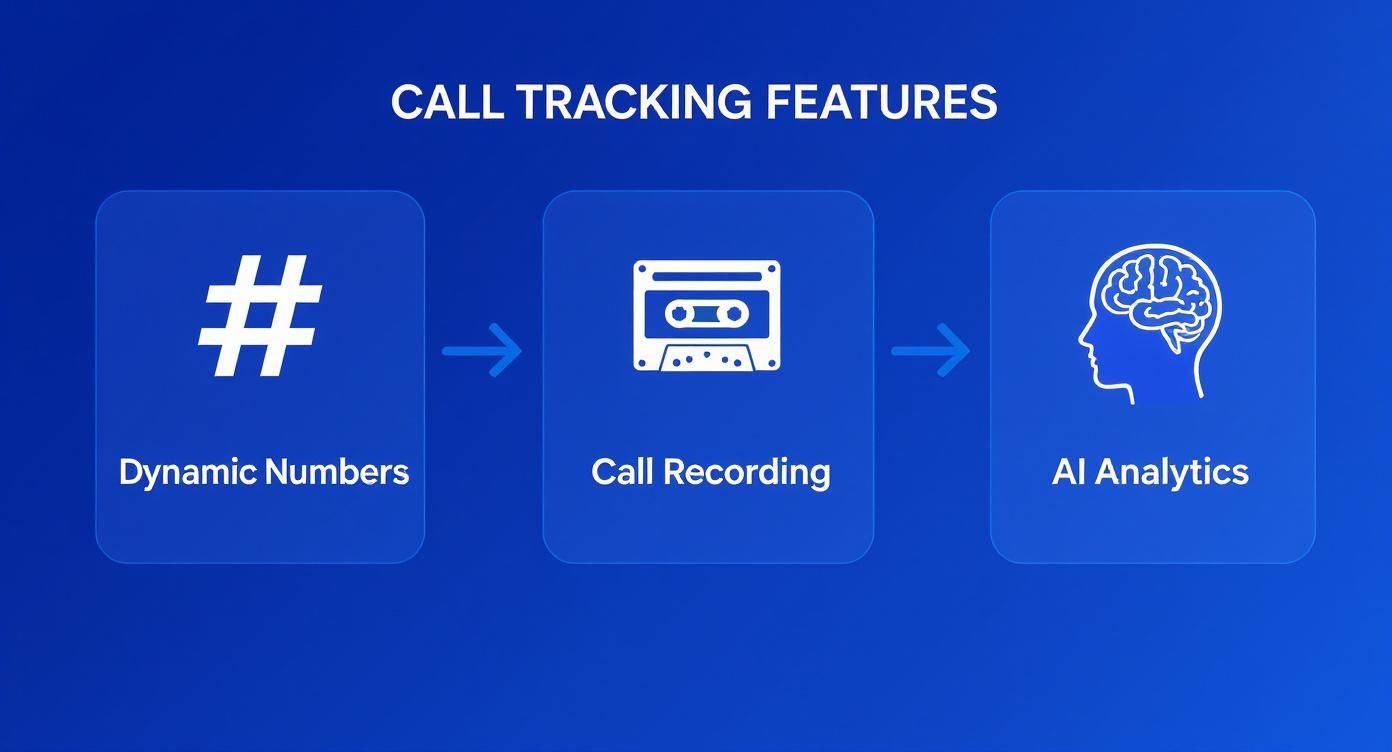
This process shows how a simple website visit gets turned into a rich data point, ready for recording and deep analysis.
Integrating with Your Existing Tools
To really get the most out of your data, you need to connect your call tracking platform with the other software you rely on every day. Hooking it up to your CRM and Google Analytics is a must if you want a complete picture of your customer's journey from start to finish.
Connecting to your CRM, for example, lets customer data flow seamlessly, beefing up your customer records and making follow-ups way more effective. This is huge for businesses with outbound teams, where performance tracking is everything. The market for outbound call tracking software, already valued at USD 1.18 billion in 2024, is booming for this very reason—integrated data is essential for monitoring your team and fine-tuning sales scripts. You can find more details about outbound call tracking software on 360iresearch.com.
Here’s a final pro-tip for a smooth launch: get your campaign naming conventions right from day one. Using clear, descriptive labels like "Google Ads – HVAC Repair – Spring" instead of something vague will keep your reports clean and easy to read. This helps you make smarter decisions, faster.
And of course, once the calls start flooding in, you'll need a solid system to handle them. Check out our guide on how to hire a virtual assistant to handle phone orders to make sure no lead ever slips through the cracks.
Measuring the Call Tracking Metrics That Matter
https://www.youtube.com/embed/HmiT6IWBS8c
So, you’ve got call tracking software up and running. Great. Now comes the real work: turning all that raw data into smart decisions that actually boost your bottom line. Staring at a dashboard full of numbers is one thing, but knowing which ones are waving a red flag—or a green one—is what separates the pros from the amateurs.
This is where you graduate from simply counting calls to understanding the story your data is telling. When you zero in on the right key performance indicators (KPIs), you can fine-tune your marketing, sharpen your team's performance, and make sure every dollar you spend is pulling its weight.
Core Metrics for Marketing Performance
The first, most immediate win from call tracking is pinpointing exactly which marketing efforts are making your phone ring. This is your ground zero for analysis. It answers the most fundamental question of all: "Where are my best leads actually coming from?"
Start by getting a handle on these essential metrics:
- Total Calls by Source: This is your bird's-eye view. It shows you which channels—Google Ads, Facebook, your truck wraps, that flyer you sent out—are generating the most inbound calls.
- First-Time vs. Repeat Callers: Are your ads bringing in fresh faces or just reminding existing customers to call? Distinguishing between the two helps you measure both customer acquisition and loyalty.
- Cost Per Lead (CPL): This one is non-negotiable. Divide your ad spend for a specific campaign by the number of calls it generated, and you get your CPL. It's the ultimate metric for judging how efficiently you're spending your budget.
According to Forrester, an incredible 84% of marketers say phone calls convert at a higher rate and bring in more revenue than any other type of lead. If you're not tracking where these high-value leads come from, you're flying blind on your ROI.
These initial numbers are your guide. They tell you which campaigns to double down on and which ones are just wasting your money.
Metrics That Reveal Sales and Operational Efficiency
Call tracking isn't just a marketing tool. The data gives you a powerful, unfiltered look into how your team handles leads once they come in. This is where you can uncover hidden operational bottlenecks and identify training opportunities that directly impact your booking rate.
To see what's happening after the phone rings, keep an eye on these metrics:
- Call Duration: Are calls from a specific Google Ad campaign consistently under a minute? That might be a sign your ad copy is misleading and attracting the wrong people. On the flip side, longer calls can mean your team is successfully engaging qualified prospects.
- Peak Call Times: Knowing your busiest hours and days is a game-changer for staffing. If you see a spike in missed calls every Friday afternoon, you know you're leaving money on the table and need more hands on deck.
- Answered vs. Missed Calls: Think of this as a health check for your front-line operations. A high missed-call rate is the business equivalent of locking your doors during business hours.
Essential Call Tracking Metrics and Their Meaning
To really connect the dots, it helps to see how raw data translates into business intelligence. This table breaks down what these metrics measure and, more importantly, the strategic questions they help you answer.
| Metric | What It Measures | Strategic Question It Answers |
|---|---|---|
| Call Volume by Source | The total number of calls from each marketing channel (e.g., Google Ads, Facebook, Flyers). | Which of my marketing channels are most effective at generating phone calls? |
| Conversion Rate by Channel | The percentage of calls from a channel that turned into a booked job or sale. | Which channels are not just driving calls, but driving high-quality, ready-to-buy leads? |
| Peak Call Times | The hours and days of the week when you receive the most calls. | Am I staffed appropriately during my busiest times to avoid missing valuable leads? |
| Average Call Duration | The average length of a phone conversation, often segmented by marketing source. | Is my ad copy attracting qualified customers, or are calls short because of a mismatch in expectations? |
When you consistently track and analyze these numbers, your call tracking software stops being a simple attribution tool. It becomes the command center for your entire business, giving you the hard data you need to guide your marketing, sales, and operational strategies with confidence.
Taking Call Tracking to the Next Level
So, you know the basics: call tracking tells you which ads are making your phone ring. But that’s just scratching the surface. The real magic happens when you move beyond simple attribution and turn your call tracking software into the command center for your entire business.
Think of it less as a report card and more as an intelligent system that understands your customers, empowers your team, and actually helps you grow automatically.
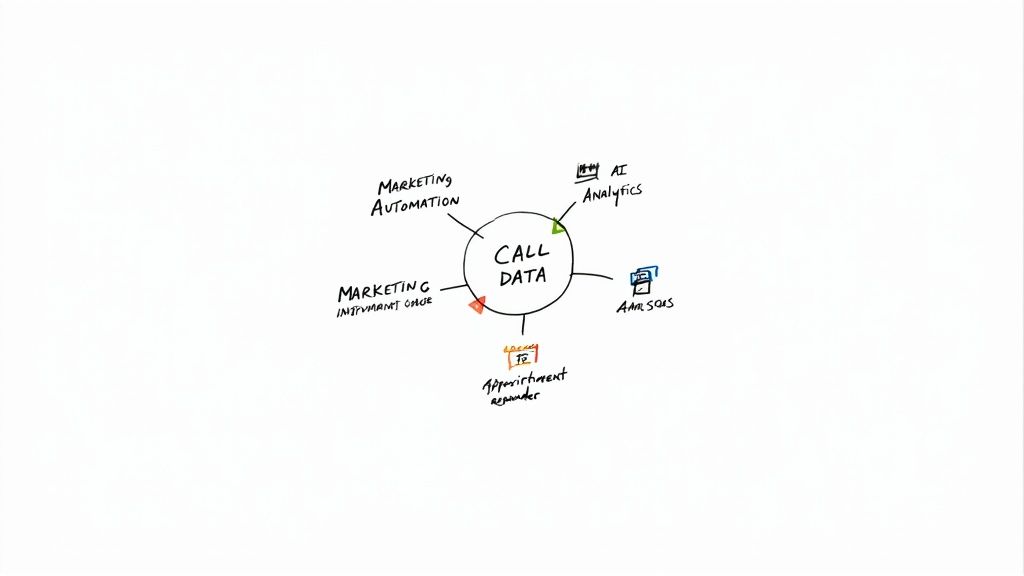
The secret? It's all about integration. When you connect your call data to the other tools you use every day, you create a seamless flow of information. Suddenly, you’re not just seeing a phone call; you’re seeing the customer’s entire story, from the moment they first clicked your ad to the day you sent the final invoice.
Finally, a Single View of Your Customer
Picture this: a homeowner clicks on your Google Ad, spends a few minutes on your website looking at different services, and then calls to ask a question. Without an integrated system, you’d see those as three totally separate events.
But when you connect your phone call tracking software with your Customer Relationship Management (CRM) platform, those disconnected dots suddenly form a clear picture.
This setup automatically creates or updates a customer’s profile in your CRM every time they call. That record can instantly show your team:
- Where they came from: The exact ad, keyword, or social media post that made them pick up the phone.
- What they looked at: The specific pages on your site they visited right before calling.
- What they said: A full recording and transcript of the conversation for easy reference.
This unified view gives your team immediate context. When that same customer calls back a month later, your staff sees their entire history at a glance. They know what the initial problem was and can provide a genuinely personal experience without making the customer repeat themselves.
This doesn't just make for happier customers; it makes your whole sales process incredibly efficient. Your team knows exactly who they're talking to and what's important to them from the second they say hello.
Using AI to Work Smarter, Not Harder
This is where things get really interesting. Modern call tracking platforms are packed with Artificial Intelligence (AI) that can sift through your call recordings to find patterns and opportunities a person could never spot on their own.
In fact, the use of AI analytics is a huge reason the call tracking market is projected to grow to USD 28 billion by 2034. Tools like automated lead scoring and sentiment analysis are becoming non-negotiable for serious sales and support teams. You can read more about these call tracking market trends on marketresearch.com.
Here’s how AI can give you an edge:
- Automated Lead Scoring: The software listens for "money" words in conversations—things like "emergency," "get a quote," or "schedule now." It then automatically scores and bumps these leads to the top of the list, so your team always focuses on the most urgent opportunities first.
- Sentiment Analysis: AI can actually detect the emotional tone of a call. If a customer sounds frustrated, the system can flag the call for a manager to review. This lets you jump on problems and resolve them before they turn into a nasty online review.
- Keyword Spotting: The platform can pick up on frequently asked questions. If you notice dozens of callers are asking about your financing options, that's a huge sign you need to add a dedicated financing page to your website, front and center.
Real-World Plays for Home Service Businesses
Let's ground these advanced strategies in some day-to-day examples for a home service business.
Scenario 1: The Automated Appointment Reminder
A customer calls to book an HVAC tune-up. Your integrated system logs the appointment in your CRM. This action can automatically trigger a workflow that sends a confirmation email right away and then a text message reminder 24 hours before the visit, drastically cutting down on no-shows.
Scenario 2: The Proactive Upsell
While on a call for a simple plumbing leak, a customer casually mentions their water heater is getting old. AI keyword spotting flags the phrase "old water heater." This can create a task for your sales team to follow up in a week with a special offer on new water heater installations, turning a small repair job into a major sale.
Scenario 3: The Marketing Agency ROI Report
If you’ve hired a marketing agency, proving their worth is everything. By integrating call tracking data, they can go way beyond showing you clicks and impressions. They can deliver a report that shows exactly how many qualified phone leads, booked appointments, and even how much revenue their campaigns generated—undeniable proof of their ROI.
When you start using these advanced strategies, your software stops being a simple reporting tool and becomes your playbook for predictable, sustainable growth.
Maximizing Your Call Tracking ROI
Getting your hands on powerful data from phone call tracking software is a great start, but it's only half the battle. The real magic happens when you turn those insights into booked jobs and actual revenue. It’s all about closing the loop between tracking a lead and converting it, making sure every dollar you spend on marketing pulls its weight.
Your data tells you the "what" and the "why"—what channels are bringing in calls and why people are picking up the phone. But it's your team that provides the "how"—how to skillfully turn that ringing phone into a happy, paying customer. Think of it as a partnership: smart tech points you in the right direction, and skilled people seal the deal.
From Data Points to Action Plans
The reports your call tracking software spits out aren't just for spreadsheets. They're a roadmap for making your front-line operations better, starting today.
Let's say your reports show a big spike in missed calls every weekday between 4 PM and 6 PM. That's not just a curious statistic; it's a flashing red light telling you you're understaffed when demand is highest. By simply adjusting schedules or bringing in some extra help during that window, you can stop leaving easy money on the table.
By analyzing peak call times, you can ensure adequate staffing to prevent missed opportunities. This simple adjustment, guided by data, can directly increase your booking rate and capture revenue that was previously slipping away.
This is how your call tracking platform becomes more than just a reporting tool—it becomes an operational playbook for growing your business.
Turning Call Recordings into a Training Goldmine
One of the most valuable features for getting a real return on your investment is call recording. These recordings build an incredible library of real customer interactions that are pure gold for training your team. Forget generic scripts; you can use actual conversations to see what’s working and what’s falling flat.
Listen to the calls handled by your best-performing CSRs. What specific phrases do they use to build instant trust? How do they navigate tricky questions about pricing? You can pull these real-world examples and use them to create best practices for the entire team.
On the flip side, you can spot weak points. If you notice that you're losing multiple callers after they ask a certain question, that’s a clear signal that your team needs better training on how to answer it. You can then role-play those exact scenarios until everyone feels confident and effective. Every call becomes a chance to get better, which steadily improves your team's ability to convert leads into jobs. This is especially crucial when onboarding new people; for more on that, check out this great guide on how to hire a virtual assistant.
At the end of the day, getting the most out of your software means using it to not only find your best leads but also to give your team the skills to close them every single time. That synergy between technology and training is what turns your marketing budget into predictable, sustainable growth.
Got Questions? We've Got Answers
Jumping into any new tech for your business can feel like a big step. It’s smart to have questions. Here are some of the most common ones we hear from business owners about call tracking, with straight-to-the-point answers.
Will Tracking Numbers Mess Up My Local SEO?
That's probably the number one concern, and it's a good one. The short answer is no, as long as you do it right.
Modern call tracking platforms use something called Dynamic Number Insertion (DNI). Think of it like a little piece of code on your website that shows a special tracking number to visitors from a specific ad campaign, but—and this is the important part—it keeps your real business number visible to Google’s web crawlers.
This way, your official Name, Address, and Phone Number (NAP) details stay consistent everywhere online, which keeps your local SEO strong. You get all the tracking data without confusing the search engines.
What’s This Going to Cost Me?
The price tag can vary, but it's usually tied to how much you use it. Most services have monthly plans that look at two key things:
- How many different tracking numbers you need (one for Google Ads, one for Facebook, etc.).
- The total number of minutes you rack up from all the calls each month.
For most small to medium-sized home service businesses, you can expect to find plans starting in the $30 to $50 per month range. The price goes up from there if you have a ton of calls or want fancy features like AI call analysis.
Is This Stuff a Pain to Set Up?
Honestly, no. The companies that make this software know you're busy running a business, not coding websites.
The setup is usually just a matter of pasting one line of JavaScript code into your website's header. If you've ever installed Google Analytics, it's the exact same idea. Many even have simple plugins for platforms like WordPress that make it a one-click install. You definitely don’t need to be a tech wizard.
Ready to stop guessing which ads are actually working and start seeing real data on what makes your phone ring? Phone Staffer doesn't just help you track those leads; we help you answer them with a live, professional voice ready to book the job.
See how we can help you turn more calls into customers by checking out our lead answering and conversion services.