
Think of effective phone customer service training as more than just a manual and a headset. It's the deliberate process of molding your agents into genuine problem-solvers and brand ambassadors. The goal isn't just to teach them what to say, but how to think, listen, and act in a way that directly boosts key metrics like customer satisfaction and first-call resolution.
Building Your Training Program Foundation
A top-tier training program doesn’t just happen by accident. It's not a collection of random modules you throw at new hires. Instead, it’s a carefully constructed blueprint where every single lesson connects directly to a measurable business outcome. Before anyone ever picks up a phone, this foundation ensures your training is consistent, scalable, and actually works.
Forget thinking of this as a simple checklist of topics. See it as a journey that transforms a nervous new employee into a confident, competent expert. That journey begins by pinpointing your core business objectives. Is your main goal to get your First Call Resolution (FCR) rate up? Or maybe you're laser-focused on improving your Customer Satisfaction (CSAT) scores? Your training program has to be built to serve these specific goals.
Defining Your Core Curriculum
A truly great curriculum is a balanced mix of two things: the technical know-how (hard skills) and the human touch (soft skills). You can't have one without the other; they have to be woven together from day one.
- Hard Skills (The 'What'): This is all the technical stuff. Think deep product knowledge, mastering your CRM software, knowing the internal process for escalations, and understanding compliance rules. An agent simply can't solve a problem if they don't have the facts.
- Soft Skills (The 'How'): Here’s where the human element comes in. This covers everything from active listening and showing genuine empathy to de-escalating a tense situation and keeping a positive tone. These are the skills that define the quality of the entire customer interaction.
You can have an agent who knows your product inside and out, but if they lack soft skills, they can still leave a customer feeling frustrated and unheard. The real magic happens when you develop both skill sets in parallel.
Integrating Key Performance Metrics
The best training programs are built on data, not guesswork. Heading into 2025, the line connecting training to call center performance is sharper than ever. Take First Call Resolution—a massive driver of customer loyalty. It’s staggering to think that around 60% of failed FCR attempts happen because agents simply can't get their hands on the right information during the call.
This is a huge gap, and it's precisely the kind of problem a strong training program is designed to fix. For a deeper dive, you can review more call center statistics to see just how critical this is.
This means you need to let your performance data shape your curriculum. If you notice agents are consistently fumbling on billing questions, that training module needs to be beefed up with more hands-on practice and role-playing. When you directly link your training content to these real-world performance gaps, you're not just educating people—you're solving tangible business problems and driving real results.
Mastering Communication and Active Listening

Exceptional service isn’t found in a script; it’s built moment by moment within the conversation. While product knowledge is a must-have, it’s the quality of the interaction that turns a routine call into a genuinely positive experience. This is where your phone customer service training needs to pivot from just teaching what to say to mastering how to listen and connect.
Let's be real—customers, especially frustrated ones, rarely spell out their problems perfectly. Your agent's first job is to play detective, and their best tool is active listening. This isn't just about passively hearing words. It’s about total focus, grasping the real message behind the complaint, and showing you understand. It’s the difference between a customer sighing, "I already told your colleague this…" and feeling heard the first time.
The Power of Tone and Phrasing
On a phone call, your tone of voice does all the heavy lifting. With no body language or facial cues to rely on, how you sound is your personality. A warm, confident tone can put a customer at ease instantly, while a flat, robotic delivery can build a wall between you.
The same goes for the words you choose. Small shifts in phrasing can completely change the dynamic of a call. Think about how you deliver bad news.
- Negative Phrasing: "I can't get you that part until next month; it's back-ordered."
- Positive Phrasing: "That part will be available next month, and I can place the order for you right now to ensure it ships out the moment it arrives."
Both sentences convey the same core information. But the second one is proactive and focuses on the solution, not the problem. This is a critical skill to drill into your agents. It reframes the interaction from a frustrating dead end into a clear path forward, empowering the agent and reassuring the customer.
One of the biggest mistakes I see agents make is taking a customer's frustration personally. Emotional intelligence is key. Your training must teach reps to acknowledge and validate the customer's feelings—"I can definitely understand why that would be frustrating"—without getting defensive. This simple act of empathy builds rapport and can shift the entire tone of the call from adversarial to collaborative.
Asking Smarter Questions
The fastest way to fix a problem is to understand it completely. Agents trained in effective questioning techniques can cut through the noise and get to the root cause much quicker. Move them beyond generic questions and teach them how to use clarifying and probing questions instead.
Imagine a customer says, "Your online portal isn't working."
An untrained agent might ask a vague question like, "What isn't working about it?"
A well-trained agent, on the other hand, asks specific, guiding questions to get the full picture:
- "Could you tell me what page you were on right before the error happened?"
- "What was the exact error message that popped up on your screen?"
- "What were you trying to do right when you ran into this issue?"
These questions do more than just gather facts; they guide the customer toward providing the exact details needed for a quick fix. This structured approach makes the customer feel like they're in capable hands, turning a potentially long and frustrating call into a smooth and efficient one. It's a fundamental part of truly advanced communication.
Handling Tough Calls with Proven De-escalation Tactics
Sooner or later, every single one of your agents will get that call—the one with an irate customer on the other end. These moments are make-or-break. They’re where customer loyalty is either cemented for life or completely destroyed. That’s why teaching effective de-escalation isn't just a nice-to-have; it's a core requirement for any serious phone customer service training program.
When faced with anger, the natural human reaction is to get defensive or immediately try to fix the problem. But jumping to a solution too quickly can backfire because the customer just wants to feel heard first. Your initial goal isn't to solve anything; it's to bring the emotional temperature down a few degrees.
The Acknowledge and Pivot Method
I've found one of the most effective techniques is a simple two-step process: first, acknowledge the customer's frustration, and then, pivot the conversation toward a solution. This approach validates how they feel without necessarily agreeing with every claim or, just as importantly, accepting abuse.
A key lesson for agents is realizing that acknowledging anger isn't the same as admitting fault. A simple phrase like, "I can absolutely understand why you're so frustrated with this," is pure empathy. It's not an admission of guilt. It builds a bridge from conflict to collaboration.
Once the customer feels understood, the agent can then pivot. This transition is everything. We train our reps to use specific bridging phrases to shift the focus from emotion to action. After validating their feelings, they might say, "So I can get this fixed for you, could we walk through exactly what happened?"
De-escalation in the Real World
Role-playing is the only way to get this right. Theory is one thing, but practicing in a safe environment is what builds muscle memory. Here are a couple of common scenarios we use, especially relevant for home service businesses.
Scenario 1: The Billing Dispute
- The Situation: A customer is on the line, yelling about an unexpected charge on their latest invoice. They feel cheated and are accusing the company of being dishonest.
- De-escalation in Action: The agent calmly responds, "I can see this charge was a complete surprise, and I definitely understand why that’s so upsetting. Let's pull up your invoice together so I can see exactly what you're seeing."
- Why It Works: This response validates their feeling of shock ("a complete surprise"), shows empathy ("understand why that's so upsetting"), and pivots directly to a collaborative action ("Let's pull up… together").
Scenario 2: The Service Failure
- The Situation: A critical piece of equipment you installed has stopped working, leaving the homeowner with a massive headache. They're angry and want someone there now.
- De-escalation in Action: The agent says, "It sounds incredibly frustrating to have your system fail like that, and I'm going to do everything I can to get this sorted out for you. To get started, can you tell me what's happening on your end?"
- Why It Works: It acknowledges the real-world impact ("incredibly frustrating"), states a clear, positive intention ("get this sorted out"), and immediately moves into productive fact-finding.
Giving your team a structured playbook like this empowers them. It helps them stay calm under pressure and guide the call productively, turning a potentially disastrous interaction into a resolved issue and a saved customer.
Weaving Technology and Tools Into Your Training
In today's world, a great customer service agent is only half the equation. The other half is the technology they use. Your phone customer service training needs to marry these two elements seamlessly, making your tech stack feel less like a hurdle and more like a trusted partner for your team.
The goal isn't just to teach people what buttons to press. It's about building a natural workflow where the technology becomes an extension of their skills. When an agent can instinctively navigate your CRM or knowledge base, they aren't fumbling for information; they're actively listening and solving problems.
Think about it this way: teaching an agent to jot down notes in the CRM while the customer is talking is a game-changer. It's a small shift, but it massively boosts data accuracy and cuts down on that dreaded after-call work.
Turning Your Tech Stack Into a Problem-Solving Engine
Your technology stack is essentially your agent’s toolkit. The better they know how to use it, the faster and more effectively they can handle calls.
- Becoming a CRM Pro: Your agents need to be able to pull up a complete customer history in a heartbeat. Run timed drills where they have to find a specific order number or a past support ticket. This builds muscle memory.
- Wielding the Knowledge Base: Don't just show them where the knowledge base is; teach them how to search it. Focus on using precise keywords and filters to slash search time from minutes to seconds. It should be their first reflex, not a last resort.
- Automating the Everyday: Identify repetitive tasks, like sending a password reset email or explaining a common policy. Show your agents how to use pre-built templates or macros to handle these instantly, freeing up their brainpower for the truly tricky issues.
The right training makes a tangible difference in the metrics that matter most.
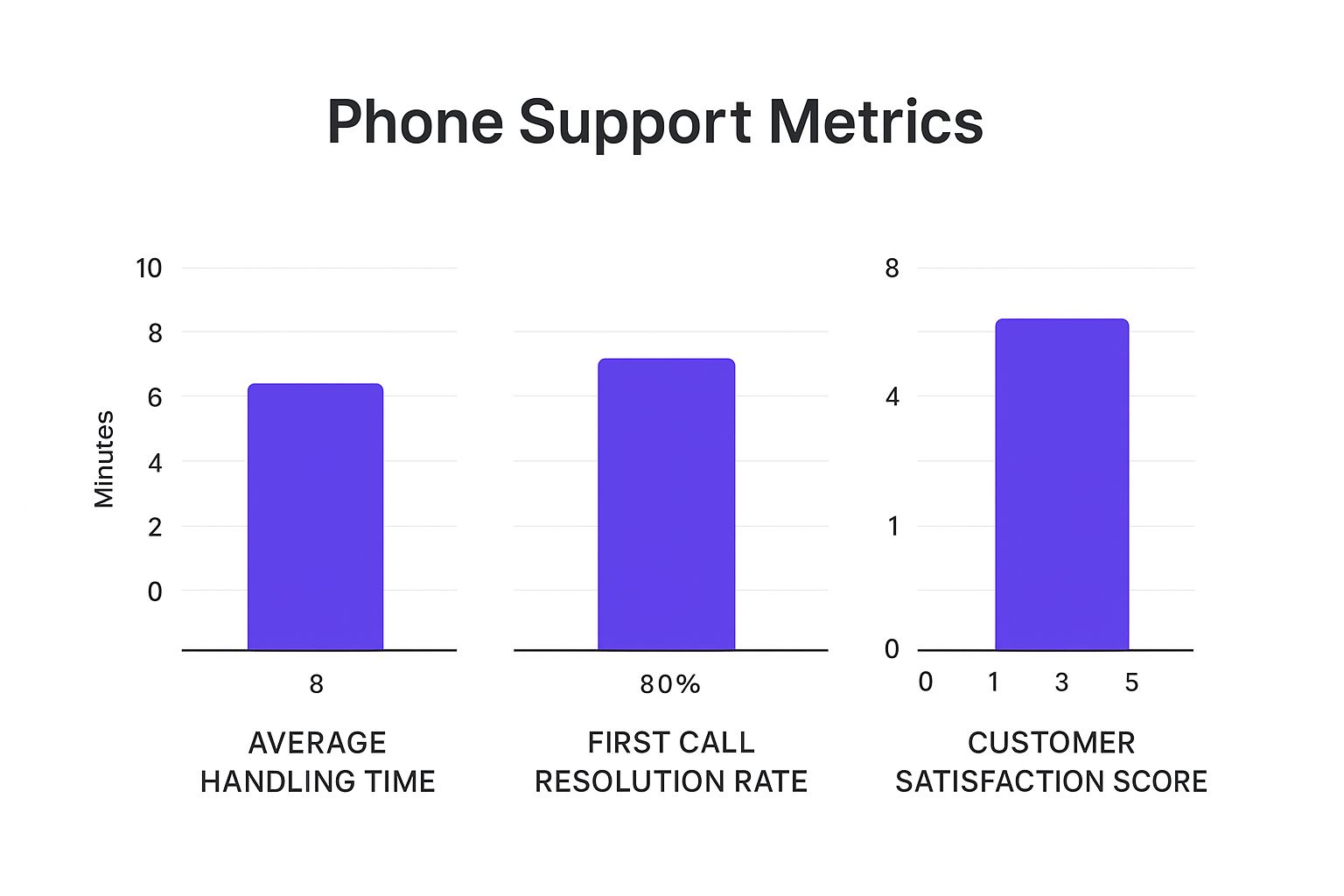
As you can see, when agents get better with their tools, handle times drop and first-call resolution rates climb. And what follows right behind? A welcome boost in customer satisfaction. It’s a clear return on your training investment.
To make sure your agents are true masters of their digital toolkit, it's crucial to structure training around the specific platforms they'll be using every day.
Essential Tools in Modern Phone Support Training
| Technology/Tool | Primary Function | Key Training Focus Area |
|---|---|---|
| CRM (Salesforce, HubSpot) | Customer Relationship Management | Navigating customer history, real-time logging of interactions, and managing support tickets efficiently. |
| Knowledge Base (Zendesk Guide) | Centralized Information Hub | Mastering keyword searches, using filters effectively, and quickly finding accurate answers to common questions. |
| Communication Platform (Aircall, Nextiva) | Phone & Omni-Channel Comms | Call routing, transfers, conferencing, and integrating with other tools like the CRM for a unified view. |
| Automation & Macros | Repetitive Task Handling | Creating and using canned responses, email templates, and automated workflows for common inquiries. |
| AI-Powered Assistants | Real-Time Agent Support | Using AI suggestions for responses, sentiment analysis to gauge customer mood, and call summary generation. |
By focusing your training on these key areas, you're not just teaching software; you're building confidence and competence that translates directly into better performance on the floor.
The entire support industry is moving in this direction. Over 90% of companies are investing in AI tools to sharpen response accuracy and speed. It's no longer a "nice-to-have"—it's a core part of delivering efficient service.
This technical fluency is especially vital in specialized industries. Take home services, for example. A customer calling about a plumbing emergency needs fast, accurate information. An agent who has to put them on hold to look up a contractor's schedule isn't just inefficient; they're adding stress to an already tense situation. You can see more on the specific challenges of this field in our guide to finding a quality answering service for contractors.
When you empower your agents by turning them into tech power users, they can deliver the kind of fast, knowledgeable, and smooth service that customers don't just appreciate—they expect.
Making Skills Stick with Role-Play and Coaching
Classroom learning gives your team the playbook, but practice is what wins the game. This is where a solid program of role-playing and consistent coaching comes in. It’s the critical step that turns theoretical knowledge into a genuine skill they can use under pressure.
Frankly, without this bridge, most of what you taught them will evaporate within a few weeks.
The point of role-playing isn't for someone to "win" the conversation. It's about building muscle memory in a safe space. This is where agents can experiment with de-escalation tactics, try out positive phrasing, and stumble through complex problems without a real customer on the line. Practice builds the confidence they need to handle whatever gets thrown at them.
Designing Role-Play Scenarios That Actually Work
Generic scenarios just don't cut it—they build generic, unhelpful skills. For role-playing to be effective, it has to feel real. Dig into your own call logs and support tickets. What are the most common, thorny, or just plain weird situations your agents run into? Use those.
You need to create detailed prompts for both the "agent" and the "customer." A good prompt is much more than just "billing dispute."
Here’s a better example:
- Customer Role: You're a homeowner who just got an invoice for a plumbing repair that’s $150 higher than your quote. You're convinced you've been misled and are demanding the extra charge be removed. You’re angry and feel like you’re being ripped off.
- Agent Goal: Acknowledge the customer's frustration and validate their feelings. Then, explain why the price is different (maybe unexpected parts were needed) and work toward a solution that satisfies both parties, without just writing off the full amount.
This level of detail forces your agents to think on their feet and use specific skills—empathy, active listening, problem-solving—in a context that feels just like a real call.
How to Structure a Coaching Session That Helps, Not Hinders
Feedback is the fuel for improvement, but it has to be delivered the right way. A coaching session shouldn't be a laundry list of everything an agent did wrong. It’s a two-way conversation focused on specific, coachable behaviors. I’ve found the best model is to have a manager or a trusted senior agent listen in on a role-play (or a real call recording) and then break it down together afterward.
Always focus your feedback on observable actions and their impact on the customer.
- Don't say: "You sounded a bit rude."
- Instead, try: "When you said, 'You have to do this first,' it could sound a bit demanding. What if we tried phrasing it as, 'A great first step would be to…'? It feels more collaborative."
This gives the agent a clear, concrete takeaway they can use on their very next call. It’s about refining the behavior, not criticizing the person.
The financial impact of excellent phone support is impossible to ignore. The global contact center industry is on track to hit a staggering $496 billion by 2027, showing just how much businesses are investing in skilled agents. When you consider that a single support call can cost anywhere from $2.70 to $5.60, the quality of every single interaction hits your bottom line. You can dig into more call center operational costs to see the direct ROI of great training.
When you build a culture where peer reviews and manager-led call breakdowns are just part of the routine, training stops being a one-time event. It becomes a continuous process of refinement. This is how you develop a team that doesn't just meet customer expectations, but consistently blows them away.
Measuring the ROI of Your Training Program

A great phone customer service training program feels good—agents are more confident, and the mood on the floor is better. But feelings don't get you budget approval for next year. To prove your program is more than just a feel-good expense, you need to show its value with cold, hard data.
Measuring the return on investment (ROI) isn't just a box-ticking exercise. It's how you discover what's truly working, what isn't, and how to fine-tune your approach for even better results. The secret is to draw a straight line from what you teach to the business metrics that leadership actually cares about.
Did you just spend a week on de-escalation techniques? You should see a direct drop in escalated calls. If you drilled your team on product knowledge, that First Call Resolution (FCR) rate better be climbing. That's how you build an unshakeable case for your training.
Establishing Your Performance Baseline
Before you can celebrate improvements, you have to know where you started. You need a crystal-clear snapshot of your team's performance before the new training kicks off. This baseline is your yardstick for success.
I always recommend tracking your core Key Performance Indicators (KPIs) for at least a month beforehand. This smooths out any weird spikes or dips from a single good or bad week, giving you a much more reliable average. The most crucial metrics to watch are:
- First Call Resolution (FCR): What percentage of issues get solved on the very first call?
- Average Handle Time (AHT): From "hello" to "goodbye," how long does an average call take?
- Customer Satisfaction (CSAT) Scores: What are customers saying in post-call surveys?
- Call Escalation Rate: How often are your agents calling for a lifeline from a supervisor?
This pre-training data is your "before" picture. Once training is done, you keep tracking these exact same KPIs to create the "after" picture, and the difference between the two is where you find your story.
Your goal is to move beyond just numbers and tell a compelling story. Instead of saying "things got better," you can say, "After our two-day product knowledge workshop, our team's FCR shot up by 15%, and we shaved 45 seconds off our AHT." Now that's a narrative that proves ROI.
Connecting Metrics to Training Modules
This is where the real insight comes from. Tying specific KPIs back to the exact skills you taught isolates the impact of each part of your curriculum. It shows you precisely where your training dollars are making the biggest splash.
Think of it like this—different training initiatives are designed to move different needles. Here’s a simple way I like to map it out:
| Training Module | Primary Metric It Should Move | Secondary Metric It Should Move |
|---|---|---|
| Product Knowledge & CRM Fluency | First Call Resolution (FCR) | Average Handle Time (AHT) |
| Active Listening & De-escalation | Customer Satisfaction (CSAT) | Call Escalation Rate |
| Time Management & Call Control | Average Handle Time (AHT) | Calls Handled Per Hour |
| Positive Phrasing & Rapport | Customer Satisfaction (CSAT) | Customer Retention |
When you adopt this data-first approach, you stop hoping your training is effective and start knowing it is. You transform your program from a line-item expense into a proven engine for business growth and customer loyalty. That kind of evidence is exactly what you need to get buy-in for your next big idea and build a true culture of continuous improvement.
Common Questions About Phone Service Training
Even with the best-laid training plan, you're going to have questions pop up. It just comes with the territory. Getting ahead of these common hurdles with solid answers will keep your program on track and make sure everyone—from brand-new reps to your seasoned veterans—gets real value from your phone customer service training.
Here are some of the questions I hear most often from managers who are building or tweaking their training.
How Do You Adapt Training For Remote Teams?
When your team is remote or hybrid, you can't just rely on the spontaneous learning that happens in an office. You have to be much more intentional about creating engagement, but the core principles of good training don't change.
Instead of huddling in a conference room for role-play, use breakout rooms on your video conferencing platform. This creates the same small-group dynamic where reps can practice and coaches can pop in to listen. For group work, things like shared documents or collaborative whiteboards are perfect for brainstorming solutions to tough customer problems together.
For the self-guided parts of your training, a solid learning management system (LMS) or even just a meticulously organized shared drive is your best friend. This way, every agent has access to the exact same scripts, videos, and guides, no matter where they're logging in from. Don't forget to schedule regular video check-ins, too—they're crucial for answering questions and keeping everyone feeling like part of a team.
How Do You Keep Veteran Agents Engaged?
Your experienced agents have heard it all before. They don't need another session on basic greetings. To keep them sharp and engaged, you need to challenge them with next-level skills that prepare them for leadership roles.
Think about creating advanced training modules just for them. These aren't mandatory refreshers; they're opportunities.
- Mentorship Programs: Train them on how to coach new hires or lead peer feedback sessions.
- Product Specializations: Turn them into your ultimate subject matter experts for the most complex services you offer.
- De-escalation Masters: Give them the toughest customer scenarios to dissect, making them your go-to resource for calls that have gone sideways.
Another great move is to involve them directly in building your training materials. Ask a top performer to record a best-practice call or lead a role-playing exercise on a tricky topic. This not only validates their expertise but makes your training more authentic and powerful for everyone else.
How Often Should You Run Refresher Training?
How often you need refreshers really depends on your business. Are you constantly launching new products or changing policies? If so, you'll need them more frequently. As a general starting point, aim for focused training sessions at least quarterly. The key is to not try and boil the ocean in every session.
A huge mistake I see is managers waiting until a problem surfaces to schedule a refresher. Training should be proactive and part of your operational rhythm, not a reaction to bad metrics.
One quarter, you might focus entirely on a new software feature. The next, you could do a deep dive into handling a specific type of customer complaint you've seen trending up. By keeping these sessions short and targeted, you keep the information fresh and avoid the burnout that comes from those dreaded all-day training marathons. It builds a culture where getting better is just part of the job.
Are you ready to stop worrying about hiring, training, and managing your customer service team? Phone Staffer can help. We provide trained, remote CSRs and VAs specifically for home service businesses, ensuring your phones are always answered and your leads are handled professionally. Learn how we can build your dream team for you.