
In a world of automated chats and email threads, the human connection of a phone call is more powerful than ever. For customer service teams, especially in home services where trust is paramount, every call is a critical touchpoint. Mastering phone etiquette for customer service isn't just about being polite; it's a strategic tool that directly impacts customer satisfaction, retention, and your company's bottom line. Poor phone handling can instantly turn a potential lead into a lost opportunity, while exceptional service can create a loyal advocate for your business.
This guide moves beyond generic advice to provide a clear, actionable framework for excellence. You will learn the specific, practical rules that transform good customer service representatives into great ones, ensuring every interaction builds your reputation and drives business growth. We'll explore eight essential practices, from the initial greeting to the final confirmation, offering fresh perspectives and implementation details. These strategies are designed to help your team master the art of the phone call, creating consistently positive experiences that set your home service business apart from the competition. Get ready to refine your team's approach and turn every call into a win.
1. Answer Within 3 Rings
The first rule of exceptional phone etiquette for customer service is also one of the most fundamental: answer every call within three rings. This isn't just a courtesy; it's a strategic first impression. Three rings typically equate to 15-20 seconds, and adhering to this standard signals to the customer that your business is responsive, efficient, and values their time. Failing to meet this expectation can start the interaction on a negative note, suggesting disorganization or understaffing before a single word is spoken.
Companies renowned for their customer service, like Zappos and American Express, build this principle into their operational DNA. They understand that a swift response sets a professional and positive tone for the entire call.
The Impact of a Prompt Answer
The three-ring rule directly impacts customer perception and key business metrics. A rapid response minimizes the chance of a caller hanging up and seeking a competitor. It immediately reduces customer frustration and builds a foundation of trust, showing you are ready and available to solve their problem. This simple action can transform a potentially negative experience into a positive one.
This infographic highlights the powerful outcomes of implementing the three-ring rule.
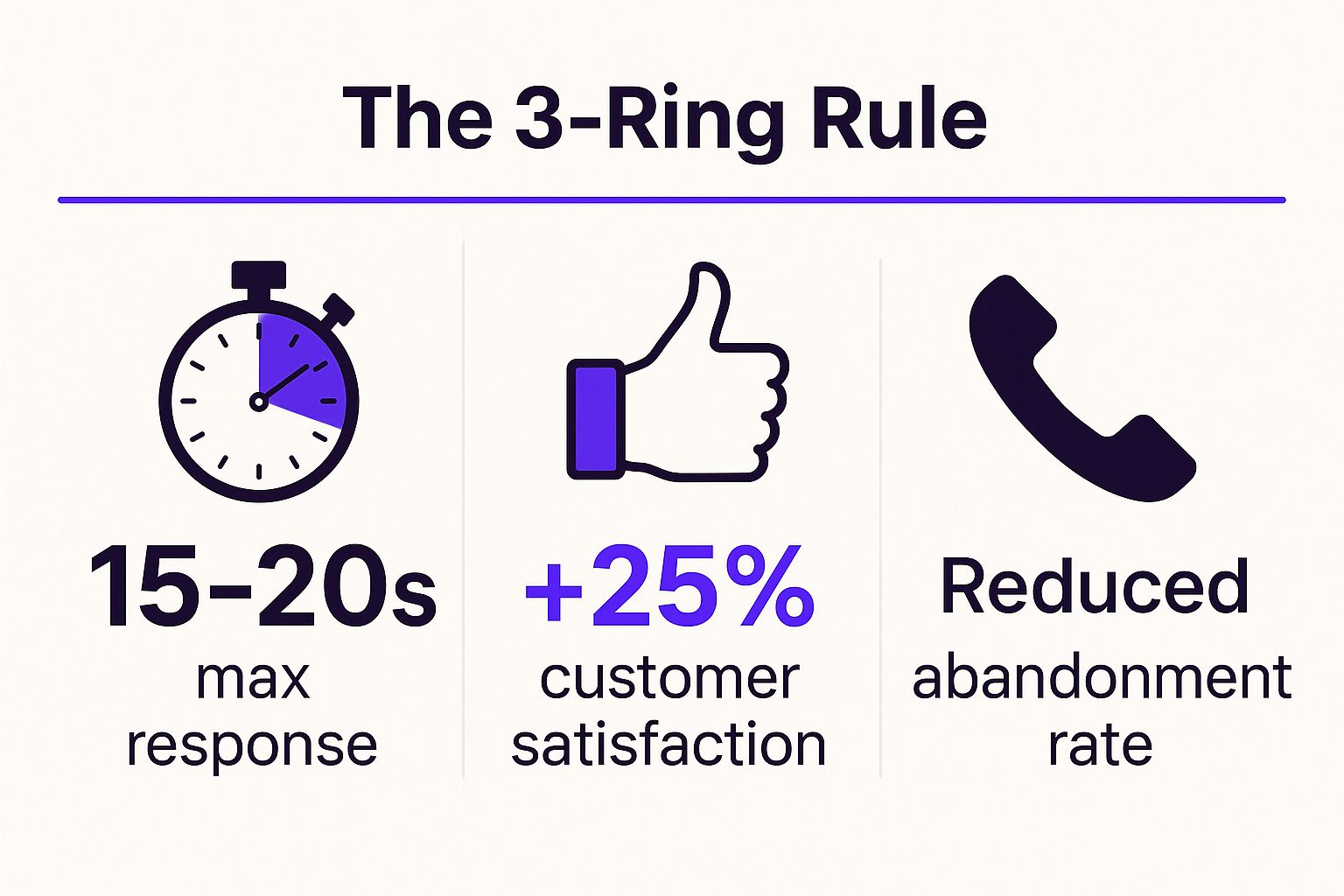
The data clearly shows that a faster response time directly correlates with higher customer satisfaction and a lower call abandonment rate, proving its value beyond simple courtesy.
How to Implement the 3-Ring Rule
- Utilize Technology: Modern call queue management systems are essential. Use them to track average ring times, monitor live call volumes, and identify peak hours. This data allows you to staff accordingly and prevent overload.
- Prepare Your Team: Train representatives to have their opening greetings polished and ready. This removes hesitation and ensures they can answer confidently and professionally the moment they connect.
- Optimize Call Routing: Implement intelligent call routing to distribute incoming calls evenly among available agents. This prevents a single representative from becoming overwhelmed while others are free, ensuring a balanced workload and faster pickup times for everyone.
- Monitor and Report: Make ring time a key performance indicator (KPI). Regularly review metrics with your team to highlight successes and identify areas for improvement, reinforcing the importance of this standard.
2. Professional Greeting with Company Name and Personal Identification
Once the call is answered promptly, the next critical step in exceptional phone etiquette for customer service is delivering a polished, professional greeting. This isn't just about saying hello; it's about immediately orienting the customer, establishing credibility, and personalizing the interaction. A structured greeting that includes the company name, the representative's name, and a clear offer of help confirms to the caller they have reached the right place and are speaking with a real person ready to assist them.
This practice is a cornerstone of the world-class training programs at companies like Disney and Nordstrom. They teach that a consistent, warm greeting reassures the customer, reduces their anxiety, and sets a collaborative tone from the very first sentence.
The Impact of a Structured Greeting
A standardized yet personal greeting immediately builds a bridge of trust. When a representative identifies themselves and their company, it removes the customer's initial uncertainty. This simple act of transparency makes the interaction feel safer and more professional, signaling that your business is organized and accountable. It also gives the customer a name to associate with their service experience, which humanizes the company and fosters a stronger connection.
This approach transforms a faceless corporate call into a one-on-one conversation. Instead of talking to "the company," the customer is now talking to "Sarah at Apple Support" or "Michael at Amazon," which fundamentally changes the dynamic to be more personal and effective.
How to Implement a Professional Greeting
- Create a Standard Script: Develop a simple, clear greeting format for your team to follow. For example: "Thank you for calling [Company Name], you're speaking with [Your Name]. How can I help you today?" This ensures every customer receives the same professional introduction.
- Practice for Natural Delivery: Encourage representatives to practice their greeting until it sounds natural and welcoming, not robotic. Remind them to speak clearly, at a moderate pace, and to smile while they talk. A smile can genuinely be heard in the tone of voice, conveying warmth and enthusiasm.
- Customize When Appropriate: While consistency is key, allow for slight customization based on the context. For a specific department, the greeting could be, "You've reached the billing department at [Company Name], this is Jennifer. How may I assist you?" This provides even more clarity for the caller.
- Reinforce Through Training: Make the professional greeting a non-negotiable part of your onboarding and ongoing customer service training. Use role-playing exercises to help agents master the delivery and understand its importance in shaping the customer's perception.
3. Active Listening and Verbal Confirmation
Beyond a prompt answer and a polite greeting, the most critical element of phone etiquette for customer service is active listening. This technique involves more than just hearing words; it means fully concentrating on the customer's message, understanding their emotional state, and confirming that understanding. By doing so, you ensure the problem is accurately identified from the start, which prevents misunderstandings and makes the customer feel genuinely heard and respected.

This practice, championed by communication experts like Dale Carnegie and Stephen Covey, is a cornerstone of effective dialogue. Companies known for stellar service, like Nordstrom and USAA, train their teams to use verbal confirmation meticulously. They repeat back order details or summarize account issues to ensure absolute clarity before taking action, turning a simple phone call into a collaborative problem-solving session.
The Impact of Active Listening
Active listening and confirmation directly build trust and rapport. When customers know you are paying close attention, their frustration decreases, and their confidence in your ability to help increases. This method drastically reduces errors and the need for follow-up calls, saving time for both the customer and the business. It transforms the interaction from a transactional exchange into a relationship-building opportunity, which is key to long-term loyalty.
How to Implement Active Listening and Verbal Confirmation
- Paraphrase and Summarize: Regularly use phrases like, "So, if I'm understanding you correctly…" or "Let me just summarize to make sure I have this right…" This confirms details and gives the customer a chance to correct any misunderstandings.
- Take Detailed Notes: Jot down key points, dates, and names during the conversation. This not only helps you recall information but also forces you to focus intently on what the customer is saying.
- Ask Clarifying Questions: Don't be afraid to ask for more detail. Use open-ended questions like, "Could you tell me more about what happened next?" or "What else should I know about this situation?" to gather all necessary information.
- Pause Before Responding: Take a brief, intentional pause after the customer finishes speaking. This shows you are thoughtfully considering their words instead of just waiting for your turn to talk. It also gives you a moment to formulate a more effective and empathetic response.
4. Control Your Tone and Speak Clearly
Beyond what you say, how you say it is a cornerstone of effective phone etiquette for customer service. Your tone of voice, pitch, and clarity are powerful tools that convey empathy, confidence, and professionalism. When customers call, they can't see your body language, so your voice becomes the primary vehicle for expressing your willingness to help. A calm, warm, and clear vocal delivery can de-escalate a tense situation and reassure an anxious customer, while a monotone, rushed, or unclear voice can create friction and frustration.

This principle is mastered by brands like The Ritz-Carlton and Chick-fil-A, where team members are trained to maintain a consistently pleasant and accommodating tone. This standard ensures that every customer interaction feels positive and reflects the brand’s commitment to superior service, building loyalty through vocal connection.
The Impact of Vocal Delivery
The right tone directly influences the customer's emotional state and their perception of your company. A friendly and professional voice builds immediate rapport and trust, making the customer feel heard and valued. It demonstrates that the representative is engaged and genuinely interested in resolving their issue. This approach transforms a transactional call into a relational experience, significantly boosting customer satisfaction and reinforcing a positive brand image.
This video provides excellent techniques for mastering vocal tone and clarity in a professional setting.
How to Master Your Tone and Clarity
- Smile While You Speak: It may sound simple, but physically smiling as you talk naturally lifts the tone of your voice, making you sound friendlier and more approachable. This is a technique famously used in Disney's guest service training.
- Practice Mindful Pacing: Speak at a moderate, deliberate pace. Talking too fast can make you seem rushed and difficult to understand, while talking too slowly can sound condescending. Adjust your pace to match the customer's, but always maintain clarity.
- Record and Review Your Calls: Use call recordings (with permission) for self-coaching. Listen to your own interactions to identify areas for improvement, such as filler words ("um," "uh"), monotone delivery, or abruptness.
- Use Positive Language: Frame your sentences positively. Instead of saying "I can't do that," try "Here’s what I can do for you." This shifts the focus from limitations to solutions and maintains a helpful, constructive tone throughout the conversation.
5. Never Put Customers On Hold Without Permission
Placing a customer on hold is sometimes a necessary part of resolving an issue, but doing so without their consent is a major breach of phone etiquette for customer service. Simply asking for permission transforms the act from a dismissive interruption into a collaborative pause. It shows respect for the customer's time and agency, giving them a sense of control over the interaction and maintaining a transparent, professional dialogue. This simple courtesy prevents the customer from feeling abandoned or ignored.
Top-tier service organizations, such as Southwest Airlines and American Express, make this a non-negotiable step. Their representatives are trained to explain why a hold is necessary and to provide a time estimate, framing it as a necessary step toward a solution. A great example is: "To find the best flight option for you, I'll need to check our system. May I place you on a brief hold for about 45 seconds?"
The Impact of Asking First
Asking for permission before placing someone on hold fundamentally changes the customer's experience. It replaces the abrupt silence of an unexpected hold with a moment of mutual understanding. This small act of respect significantly reduces customer anxiety and impatience, reinforcing their perception that you are working diligently on their behalf. It maintains the positive momentum of the call, even when there's a necessary delay.
Thanking the customer upon returning from the hold further solidifies this positive connection. Saying "Thank you so much for holding" acknowledges their patience and gracefully re-engages them in the conversation, making the entire process feel seamless and considerate.
How to Implement a "Permission-First" Hold Policy
- Script the Request: Equip your team with clear, polite phrases. Train them to always state the reason for the hold and provide an estimated duration. For example, "May I place you on a brief hold while I review your account? It should only take about 30 seconds."
- Adhere to Time Estimates: If you say it will be 30 seconds, make every effort to return within that window. This builds trust and shows that you respect the customer's time as promised.
- Offer Alternatives for Longer Holds: If you anticipate a delay of more than two minutes, offer a callback. This provides the customer with a choice and shows immense respect for their schedule, preventing them from being tethered to the phone.
- Check In and Apologize: If a hold is taking longer than expected, briefly return to the line to provide an update and apologize for the delay. For instance: "I apologize, this is taking a bit longer than I thought. I just need one more minute. Is it okay to continue holding?"
6. Use Positive Language and Avoid Negative Phrases
The language you use on a call can instantly shape the customer's mood and perception of your company. A core principle of exceptional phone etiquette for customer service is the strategic use of positive, solution-oriented language. This means consciously avoiding negative words like "can't," "won't," or "problem," and instead focusing on what you can do for the customer. This approach de-escalates tension and frames the interaction constructively.
World-class service organizations like the Disney Institute and The Ritz-Carlton build their entire customer experience framework around this concept. They train their teams to replace negative phrasing with positive alternatives, ensuring every conversation remains helpful and empowering, even when delivering difficult news.
The Impact of Positive Phrasing
Choosing positive language directly influences the outcome of a service call. Negative words often trigger defensive reactions and signal a dead end, making customers feel unheard and powerless. Conversely, positive phrasing communicates a commitment to finding a solution, which builds rapport and maintains customer trust. This simple linguistic shift can turn a potential conflict into a collaborative problem-solving session.
This approach reassures the customer that you are their advocate. It transforms the dynamic from "us vs. you" to "us working together," which is crucial for customer retention and loyalty.
How to Implement Positive Language
- Reframe "No" with Alternatives: Instead of saying, "I can't schedule you for Tuesday," try, "While Tuesday is fully booked, I do have an opening on Wednesday morning. Would that work for you?" This focuses on the available solution, not the limitation.
- Create a Phrase Guide: Develop a "Say This, Not That" chart for your team. For example, replace "That's not my department" with "I'll connect you with the right specialist who can best assist with that."
- Replace "But" with "And": The word "but" often negates whatever came before it. Instead of "I understand, but we don't have that part," try, "I understand you need that part, and I am checking with our supplier to see when we can get it for you."
- Practice Active Listening: Train representatives to listen for the customer's core need, not just their request. This allows them to offer creative, positive solutions that address the underlying issue, showcasing true expertise and care.
7. Take Detailed Notes and Summarize Next Steps
Effective phone etiquette for customer service extends beyond the immediate conversation; it involves creating clarity and accountability for what comes next. The practice of taking detailed notes and summarizing agreed-upon actions before ending the call is crucial. This ensures nothing is lost in translation, confirms mutual understanding, and provides a clear record for any future interactions. A forgotten detail or misunderstood resolution can unravel all the rapport you've built.
This systematic approach is a cornerstone of support methodologies used by major tech companies like Microsoft and IBM. They understand that a clear summary and documented notes transform a conversation into a concrete action plan, which is essential for complex problem-solving.
The Impact of Note-Taking and Summarization
This practice directly impacts resolution accuracy and customer confidence. When a representative meticulously documents key information and then verbally confirms the next steps, it demonstrates professionalism and a commitment to getting it right. This drastically reduces the likelihood of repeat calls for the same issue, as both the customer and the company have a shared understanding of the resolution path, timelines, and responsibilities.
For example, when an Amazon representative confirms an order cancellation and tells you exactly when to expect the refund email and the credit to your account, it eliminates ambiguity and prevents future anxiety. Similarly, Apple Support often concludes calls by summarizing troubleshooting steps and providing a case number, creating a seamless experience if the customer needs to call back.
How to Implement Note-Taking and Summarization
- Use Standardized Templates: Create pre-built note templates within your CRM or helpdesk software for common issue types (e.g., appointment scheduling, billing disputes, technical support). This ensures reps capture the most critical information consistently.
- Actively Confirm Key Details: During the call, repeat back important information for confirmation. This includes the spelling of names, specific dates, address details, or model numbers. A simple, "So I have that correctly, the appointment is for Tuesday at 3 PM?" can prevent major errors.
- Provide a Reference Point: Always give the customer a case, ticket, or reference number. This simple piece of information empowers the customer and makes any follow-up call significantly more efficient for both parties.
- Structure Your Summary: End every call with a clear, concise summary. State the problem as you understood it, the solution or action you are taking, what the customer needs to do (if anything), and the expected timeline for completion. Ask, "Does that sound right to you?" to secure their agreement.
8. End Calls Professionally with Confirmation
The final moments of a customer service call are just as crucial as the first. Ending the call professionally with a clear confirmation and a warm closing solidifies the positive experience, ensures clarity, and prevents follow-up calls born from confusion. This practice demonstrates thoroughness and respect, leaving the customer feeling confident that their issue has been fully resolved and their business is valued. A rushed or abrupt ending can undo all the rapport you've built.
Companies known for customer service excellence, such as L.L.Bean and John Deere, integrate this closing procedure into their support standards. They understand that a strong finish reinforces the entire interaction, turning a good call into a great one and cementing customer loyalty. A proper closing is a key component of professional phone etiquette for customer service.
The Impact of a Professional Closing
A structured, professional closing does more than just signal the end of the conversation; it provides closure and reassurance. By summarizing actions taken and confirming resolution, you eliminate ambiguity and reduce the likelihood of repeat calls for the same issue. Asking "Have I resolved everything for you today?" empowers the customer, giving them a final opportunity to voice any lingering concerns. This final check is a powerful tool for boosting first-call resolution rates and overall customer satisfaction.
This practice also leaves a lasting positive impression. A simple, "Thank you for choosing us," reinforces the customer's decision to do business with you and makes them feel appreciated, not just processed.
How to End Calls Professionally
- Summarize and Confirm: Briefly recap the key actions taken and the agreed-upon resolution. For example, "So, I've processed your refund, and you should see it in your account within 3-5 business days."
- Ask for Final Questions: Always create an opening for any last-minute thoughts. Use clear, open-ended questions like, "Is there anything else at all I can assist you with today?"
- Offer a Reference: Provide your name and a call reference number. This gives the customer a direct point of contact and a record of the interaction, which builds trust and accountability.
- Thank the Customer: Express genuine gratitude for their call and their business. Phrases like, "Thank you for being a valued customer," or "Thank you for calling," add a personal, appreciative touch.
- Let the Customer Hang Up First: This is a small but significant gesture of respect. It ensures the customer has finished speaking and doesn't feel cut off, giving them the final say in ending the conversation.
Customer Service Phone Etiquette Comparison
| Item | Implementation Complexity 🔄 | Resource Requirements ⚡ | Expected Outcomes 📊 | Ideal Use Cases 💡 | Key Advantages ⭐ |
|---|---|---|---|---|---|
| Answer Within 3 Rings | Moderate – requires staffing and call management systems | Medium – staffing and technology for call routing | Increased customer satisfaction by 25%, reduced abandonment rate | High-volume call centers aiming to enhance responsiveness | Builds positive first impression, reduces caller frustration |
| Professional Greeting with Company Name and Personal Identification | Low to Moderate – training required for consistent delivery | Low – requires training and scripting | Builds trust and brand reinforcement | Customer interactions where personal connection and clarity are vital | Establishes professionalism, personalizes customer experience |
| Active Listening and Verbal Confirmation | High – requires extensive training and practice | Medium – training investment | Reduced miscommunication, stronger relationships | Complex customer issues requiring accurate understanding | Enhances problem resolution, makes customers feel valued |
| Control Your Tone and Speak Clearly | Moderate – ongoing training and self-awareness needed | Low to Medium – coaching and feedback tools | Builds trust and reduces frustration | All customer service calls, especially sensitive situations | Improves communication effectiveness, enhances reputation |
| Never Put Customers On Hold Without Permission | Moderate – involves time management and customer courtesy | Low – training and process adherence | 40% higher customer satisfaction when followed | Situations requiring callbacks or wait times | Demonstrates respect, reduces customer anxiety |
| Use Positive Language and Avoid Negative Phrases | High – requires extensive training and cultural adaptation | Low to Medium – language coaching | More positive customer experience, stronger relationships | Conversations prone to conflict or negative sentiment | Reduces defensiveness, fosters constructive dialogue |
| Take Detailed Notes and Summarize Next Steps | Moderate – multitasking skills and documentation tools needed | Medium – documentation systems | Clarity and accountability, improved follow-up service | Issues requiring tracking and follow-up | Prevents misunderstandings, ensures clear expectations |
| End Calls Professionally with Confirmation | Low to Moderate – discipline and scripting necessary | Low – training and scripting | Ensures satisfaction and positive final impression | All customer service calls to confirm resolution | Creates lasting positive impression, prevents unresolved issues |
Transforming Calls into Conversions: Your Next Step
Navigating the landscape of customer interactions requires more than just a script; it demands a genuine commitment to excellence. The eight principles we've explored, from answering promptly to ending calls with professional clarity, are not merely isolated rules. They are interconnected components of a comprehensive strategy designed to build trust, foster loyalty, and ultimately drive business growth for your home service company. Mastering these tenets of phone etiquette for customer service transforms your phone lines from a simple communication tool into a powerful engine for customer acquisition and retention.
From Good Habits to Great Business
Implementing these practices consistently is where the real value lies. It's the difference between a customer feeling heard and feeling processed. When your team actively listens, uses positive language, and takes detailed notes, you signal that you value their time and their business. This isn't just about avoiding negative reviews; it's about proactively creating positive ones. For home service businesses, where trust is the currency of every transaction, the initial phone call sets the entire tone. A professional, empathetic, and efficient interaction can be the single factor that converts a hesitant inquirer into a loyal, lifelong customer who recommends your services to their network.
Key Takeaways for Immediate Implementation
To start making an impact today, focus on these critical actions:
- Audit Your Greeting: Is every call answered with a consistent, professional greeting that includes your company and the representative's name? This small step immediately establishes credibility.
- Empower with Positive Language: Train your team to replace phrases like "I don't know" with proactive alternatives like "Let me find that out for you." This shift from a negative roadblock to a positive action plan completely changes the customer's experience.
- Master the Art of the Summary: Before hanging up, ensure every representative confirms the details of the conversation and clarifies the next steps. This simple act eliminates confusion, prevents costly errors, and demonstrates a high level of professionalism and care.
Elevating your phone etiquette for customer service is a continuous journey, not a final destination. It requires ongoing training, consistent reinforcement, and a cultural commitment to putting the customer first. By weaving these principles into the fabric of your daily operations, you do more than just improve service; you build a reputation for reliability and excellence that becomes your most valuable competitive advantage. Each call is an opportunity to reinforce that reputation and turn a simple service request into a lasting business relationship.
If your team is stretched thin or you lack the resources to implement this level of professional phone support, you're not alone. Phone Staffer provides expertly trained, US-based remote CSRs who specialize in exceptional phone etiquette for home service businesses. Visit Phone Staffer to learn how we can ensure every call is answered professionally, turning your phone lines into a reliable lead conversion machine.