

A plumber business plan is your strategic playbook for winning in a competitive market. It's far more than just a document you cobble together for a bank loan; think of it as a living, breathing tool that guides your daily decisions, helps you dodge those all-too-common cash flow traps, and sets you on a path for real, sustainable growth.
Your Business Plan Is More Than Just a Document
Too many plumbers see a business plan as a one-and-done chore. They write it, get the loan, and then it gets shoved into a filing cabinet to collect dust. That’s a huge missed opportunity.
Your plan is actually the single most important tool for building a business that's not just profitable but also built to last. It’s your blueprint for making smart, proactive decisions instead of constantly putting out fires.
Think of it as the foundation of your company. A solid foundation supports everything you build on top of it, from your marketing campaigns to hiring your first apprentice. Without that solid base, you’re just guessing your way through some of the most critical decisions you'll ever make.
A Practical Tool for Daily Decisions
Look, a business plan isn't about predicting the future with 100% accuracy—no one has a crystal ball. It’s about being prepared for it. The process forces you to answer the tough questions that will ultimately shape your company’s identity and direction.
- Define Your Value: What actually makes you different from the other dozen plumbers in your area? Your plan will force you to nail down your unique selling proposition.
- Identify Your Ideal Customer: Are you going after high-end residential remodels or focusing on 24/7 emergency commercial calls? Knowing this will guide every single marketing dollar you spend.
- Anticipate Cash Flow Gaps: By mapping out your expected income and expenses, you can see the slow seasons coming. This lets you plan ahead and avoid the cash crunch that sinks so many new businesses.
A well-crafted plumber business plan transforms your vision from a vague idea into a series of clear, actionable steps. It's your guide for navigating challenges and capitalizing on opportunities.
A business plan gives you a roadmap, so let's quickly look at the key stops along the way. Having these sections clearly defined is what makes the plan a truly useful tool for lenders and, more importantly, for you.
Core Components of a Winning Plumbing Business Plan
| Component | What It Achieves |
|---|---|
| Executive Summary | A powerful, one-page overview that hooks the reader (like a potential investor). |
| Company Description | Defines your mission, legal structure, and what makes your business tick. |
| Market Analysis | Shows you understand your customers, competitors, and the local market landscape. |
| Organization & Management | Outlines your team structure and the experience backing your operation. |
| Services Offered | Details the specific plumbing services you provide and your pricing strategy. |
| Marketing & Sales Strategy | Explains exactly how you'll find, attract, and win new customers. |
| Financial Projections | The numbers-driven section with your forecasts for revenue, costs, and profit. |
Having these components locked down gives you a clear picture of where you are and a detailed map of where you're going.
Navigating a Booming and Fragmented Market
The opportunity in the plumbing world right now is massive. The U.S. plumbing market is valued at an impressive $169.8 billion and is made up of roughly 132,000 different businesses. This highly fragmented landscape is actually good news—it means a well-organized company with a clear plan can quickly grab a decent slice of the market.
Having a strategic plan gives you an immediate leg up. While your competitors are running their businesses based on gut feelings, your decisions will be backed by solid research and clear financial projections. This structured approach is what separates a long-term, sustainable business from a side hustle that just pays the bills for a while.
As you grow, your plan will help you manage that increasing complexity, from scheduling jobs more efficiently to knowing when it's finally time to get some administrative help. Thinking through things like how to hire a virtual assistant becomes a strategic next step, not a frantic reaction because you're totally overwhelmed.
What's Your Plumbing Business All About? Mission, Vision, and Structure
This is where your plumber business plan gets its soul. We're moving beyond the nuts and bolts of fixing pipes and starting to tell a story. Think of this section as the heart of your company—it's your chance to define what you stand for and paint a picture of where you're headed. Whether you're trying to win over an investor, a lender, or a rockstar technician, this is your first real shot to get them excited.
What's Your Mission? (The "Why")
Your mission statement is your "why." In a sentence or two, it should nail down your purpose, who you're helping, and what makes you the obvious choice. This isn't just some fluffy marketing slogan you stick on a van; it's the compass for your entire operation. It'll guide every decision you make, from the jobs you take to the people you bring onto your team.
So, what really makes your company tick? Is it your lightning-fast 24/7 emergency response? Maybe you're the go-to expert for high-efficiency, eco-friendly plumbing. Whatever it is, that's what your mission needs to capture.
- Avoid this: "To be the best plumber." It's vague and, frankly, boring.
- Try this instead: "To provide the Springfield community with reliable, transparent, and timely plumbing solutions, ensuring every customer feels secure and respected in their home."
See the difference? The second one is specific, it's focused on the customer, and it instantly communicates your core values. Anyone reading that knows exactly what you're about.
How Will You Structure the Business? (The Legal Stuff)
This might not be the most exciting part, but choosing the right legal structure is a huge deal. It directly impacts your taxes, your personal liability, and how you operate. Getting this wrong can cause major headaches down the road.
Here are the usual suspects for a plumbing business:
- Sole Proprietorship: The simplest to get going, but there’s a catch—there's no legal separation between you and the business. If someone sues the company, your personal assets (house, car, savings) are on the line.
- Limited Liability Company (LLC): This is the go-to for most plumbers, and for good reason. It shields your personal assets from business debts and lawsuits while still being relatively easy to manage from a tax perspective.
- S Corporation (S Corp): If you’re a bit more established and pulling in steady profits, an S Corp can offer some nice tax benefits. The trade-off is more paperwork and stricter rules you have to follow.
I can't stress this enough: talk to a CPA or an attorney. They can look at your specific situation and help you pick the structure that makes the most sense for your goals.
What's Your Vision? (The "Where")
If the mission is your "why," the vision is your "where." This is your moonshot—the big, ambitious goal you're aiming for. It should get you and your team fired up to come to work every day. It answers the question, "If we knock it out of the park, what will this company look like in 5 or 10 years?"
A powerful vision statement isn't just a dream; it’s a destination. It could be becoming the #1 rated commercial plumber in your state, or maybe even franchising the unique way you do business. It gives everyone a mountain to climb.
A vision could be something like: "To become the most trusted and technologically advanced plumbing service in the tri-state area, celebrated for our unparalleled craftsmanship and commitment to green solutions."
This sets a high standard and gives you a clear roadmap for growth and innovation. When you put it all together—your mission, vision, and legal structure— you create a rock-solid foundation. It gives your plumber business plan the depth and credibility it needs to truly stand out.
Pinpointing Your Services and Dominating a Niche
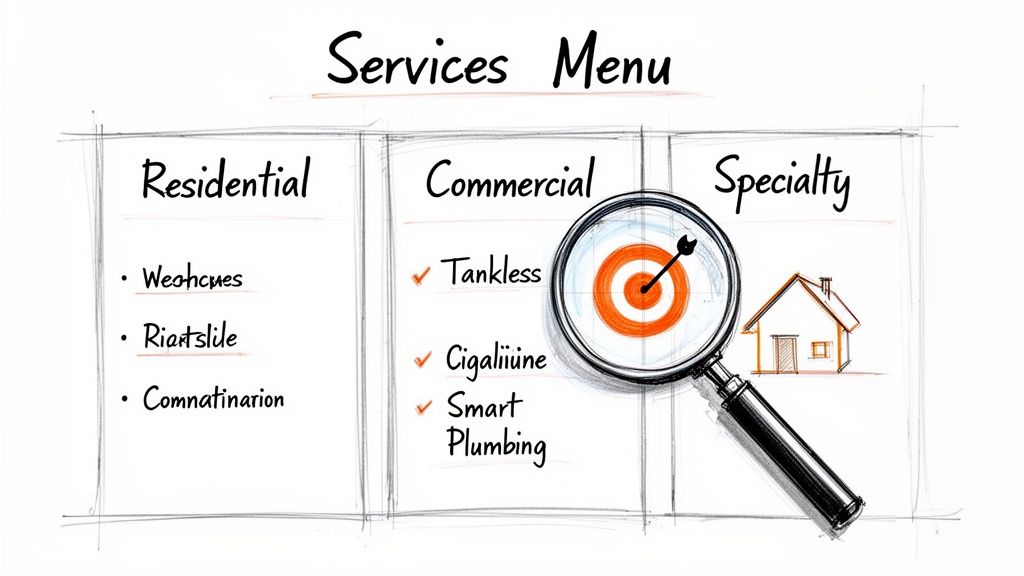
Here's a hard truth: you can't be everything to everyone. Trying to offer every plumbing service under the sun is a recipe for disaster. You'll stretch your team too thin, your marketing will be all over the place, and your profits will suffer.
The most successful plumbing companies I've seen aren't just general pipe-fixers. They solve specific problems for a specific type of customer, and they do it better than anyone else in town.
This part of your plumber business plan is where you draw a line in the sand. It’s about getting crystal clear on what you do, who you do it for, and why they should call you instead of the other guy. This focus is what separates the perpetually struggling plumber from the one with a booked-solid schedule and a healthy bank account.
Choosing Your Battlefield: Residential vs. Commercial
First things first, you need to decide where you'll spend most of your time. While you might occasionally cross over, the worlds of residential and commercial plumbing are miles apart in terms of needs, sales cycles, and day-to-day operations.
- Residential Plumbing: This is all about working directly in people's homes. Jobs are usually smaller, but the potential volume is huge. The name of the game here is building trust, delivering incredible customer service, and becoming a well-known name in your local community. It’s a relationship-driven business.
- Commercial Plumbing: Here, you're dealing with businesses, property managers, and big construction projects. The jobs are larger and often based on contracts, which can mean more predictable revenue. To succeed, you need to be a great networker, have a deep understanding of complex building codes, and possess the crew and gear to handle major work.
Picking one as your primary focus is a strategic move. It lets you fine-tune your equipment purchases, your team's training, and your marketing budget for maximum impact. You can still take on the occasional job from the other side, but your business plan needs to be clear about where you're aiming your main efforts.
Finding Your Profitable Niche
Once you’ve picked your main market, it’s time to get even more specific. A niche is your specialty—the one thing people know you for. Specializing lets you charge more for your expertise, makes your operations more efficient, and turns you into the go-to expert.
Think about where the industry is headed. For instance, the market for plumbing fixtures and fittings is booming. Projections show it’s set to grow from $114.31 billion in 2025 to $123.37 billion in 2026. A lot of that growth is coming from homeowners wanting smart, water-saving solutions. Carving out a niche here could be a brilliant move.
Here are a few examples of niches that work:
- The Emergency Expert: You're the 24/7, lightning-fast response team for burst pipes and sewer backups. All your marketing screams speed and reliability.
- The High-Efficiency Specialist: Your bread and butter is installing tankless water heaters, low-flow toilets, and other green plumbing technology.
- The Remodel Pro: You team up with local contractors and designers for high-end kitchen and bath remodels, focusing on complex luxury fixture installations.
- The Drain Cleaning Guru: You invest in top-of-the-line hydro-jetting and camera inspection gear to tackle the nastiest drain and sewer problems no one else can fix.
Your niche isn't about limiting your business; it's about focusing your efforts to attract the most profitable work. It's the difference between being a plumber and being the plumber for a specific need.
Sizing Up the Competition
You can't expect to dominate a niche if you don't know who's already playing in that space. A competitive analysis doesn’t need to be some complicated report. Just open up a simple spreadsheet and start digging into the top 5-10 plumbing companies in your service area.
For each competitor, find out:
- Their Niche: What do they seem to focus on? A quick look at their website's homepage and service list will usually tell you.
- Their Pricing: Are they the cheap option or the premium service? You might have to make a "mystery shopper" call to get a feel for their rates.
- Their Reputation: What are actual customers saying on Google, Yelp, and Angi? Jot down their average star rating and total number of reviews.
- Their Weaknesses: Do you see a pattern in the bad reviews? Maybe they're always late, leave a mess, or never answer their phone. Those are your opportunities.
This simple exercise will shine a spotlight on gaps in the market. If every competitor is a jack-of-all-trades, there’s a massive opening for a specialist. If no one has a great reputation for communication, you can make that a cornerstone of your brand. In fact, as you grow, simply having a bulletproof system to answer every single call—like using a dedicated home service receptionist—can become your single biggest edge. This analysis feeds directly into your marketing strategy and helps you find a unique spot where you can win.
Building a Marketing Engine That Generates Leads
Let's be blunt: having the best plumbing skills in town doesn't mean a thing if your phone isn't ringing. This part of your business plan is where we stop hoping for work and start building a system—an engine—that brings in a steady, predictable flow of high-quality leads.
We're moving beyond just relying on sporadic word-of-mouth. This is about creating a modern strategy that actively finds new customers and keeps your schedule full. It's the difference between being a plumber and running a real plumbing business.
Your Website is Your Digital Storefront
Think of your website as the first impression. For many potential customers, it's the very first time they'll interact with your brand, and you only get one shot. It needs to look professional, be dead simple to use, and, most importantly, make it incredibly easy for them to hire you.
A homeowner in a panic doesn't have time to mess around. They need to find three things instantly: your phone number, the services you offer, and proof that you're a trustworthy pro. Your website has literally seconds to deliver this information before they click away.
And it absolutely must work perfectly on a smartphone. A huge number of people will be searching for a plumber on their phone, often standing in a puddle of water. If they have to pinch and zoom just to find your number, they'll hit the back button and call your competitor without a second thought.
Master Local SEO to Own Your Neighborhood
For a local business, Search Engine Optimization (SEO) is your secret weapon. It's how you get found by customers who are actively looking for your services right now. When someone in your town searches "emergency plumber near me," you have to be at the top of that list.
The absolute core of local SEO is your Google Business Profile. Claiming and meticulously optimizing this free listing isn't optional; it's essential.
- Fill Out Everything: Don't skip any fields. Add your exact service areas, hours, photos of your team and vans, and a detailed description of every service you offer.
- Get Those Reviews: Make it a habit to ask every single happy customer to leave you a review on Google. Those stars are gold—they build trust and are a massive factor in how high you rank.
- Post Updates Regularly: Use the "Posts" feature to share special offers, service highlights, or quick plumbing tips. This signals to Google that you're an active, relevant business.
A fully optimized Google Business Profile is like having a free, high-visibility billboard that only shows up when your ideal customer is driving by. It's the bedrock of any serious marketing plan for a home service business.
When you dominate the local search results, your business is the first one people see and the easiest one to call when a pipe bursts.
Run Targeted Ads That Actually Work
SEO is a marathon, not a sprint. But sometimes you need to turn on the faucet and get leads today. That's where paid advertising, like Google Ads, comes into play, placing you right at the top of the search results instantly.
The key here is to be surgical with your targeting. Don't waste money bidding on a generic term like "plumber." Instead, focus on high-intent keywords that signal urgency, like "water heater repair springfield" or "24-hour plumber cost." This ensures your ad budget is spent on people who are ready to book a job, not just browsing for DIY tips.
And please, don't send ad traffic to your homepage! Create a dedicated landing page that makes it incredibly easy for the visitor to call you or fill out a form without having to hunt for your contact info.
Fill Your Calendar With Proactive Outreach
The strategies above are fantastic for capturing people who already know they need a plumber. But what about creating new demand? This is where proactive outreach can be a total game-changer, especially for smoothing out the slow seasons.
Instead of just waiting for residential emergencies, you can actively build relationships with clients who provide consistent, high-volume work. I'm talking about property management companies, real estate agents, and local contractors who need a reliable plumbing partner.
This is where a service like done-for-you cold calling can be incredibly effective. A dedicated team can reach out to these ideal commercial clients for you, introducing your services and booking introductory meetings that go straight into your calendar. It's a powerful way to fill the gaps in your schedule with profitable, recurring work.
Never Miss a Lead With Professional Call Answering
Finally, let's talk about the single biggest leak in most marketing funnels: missed phone calls. You can spend thousands on ads and SEO, but if a potential customer calls and gets your voicemail, you've almost certainly lost them forever. They'll just hang up and call the next plumber on the list.
Answering every single call with a live, professional person can dramatically increase the return on your marketing investment. It immediately tells customers you're reliable and ready to solve their problem.
This is especially true after hours and on weekends, which is when a lot of high-value emergencies happen. A professional answering service or a specialized plumbing virtual receptionist can be the difference between landing a major emergency job and losing it to a competitor who picked up the phone. These services don't just take messages; they can book appointments, qualify leads, and dispatch technicians based on your exact procedures. Learn more about how a plumbing virtual receptionist can help you convert more of the leads you're already paying for.
Mapping Out Your Financial Projections
Let's talk numbers. This is where the rubber meets the road for your plumbing business plan. Your financial projections are more than just a required section for a bank loan; they're your personal reality check. This is how you prove to yourself, long before you talk to any lender, that your business idea is not just a good one, but a profitable one.
I get it, most plumbers would rather be fixing a leak than staring at a spreadsheet. But spending the time here will save you massive headaches down the line. It forces you to think through every single cost and every potential source of income, which is the best way to avoid the cash flow traps that sink so many new businesses.
Breaking Down Your Startup Costs
Before you can make a dime, you have to spend a few. The first step is getting an honest, detailed look at what it will cost to get your truck on the road. These expenses fall into two buckets: one-time investments and the initial recurring bills you'll have from day one.
Depending on whether you're buying a brand-new, fully-stocked van or piecing things together with used equipment, getting started can cost anywhere from $7,500 to over $22,000. The key is to be brutally honest and thorough in your estimates.
To help you get started, here's a sample breakdown of what you'll need to budget for.
Sample Startup Costs for a One-Van Plumbing Business
| Expense Category | Estimated Cost Range | Notes |
|---|---|---|
| Work Van/Truck | $5,000 – $15,000+ | Used vs. new is a big factor. Don't forget van wraps/lettering. |
| Tools & Equipment | $2,000 – $5,000 | Includes hand tools, power tools, drain snakes, camera, etc. |
| Licenses & Permits | $250 – $1,000 | Varies greatly by state and city. |
| Insurance (Initial) | $500 – $1,500 | This is often a down payment on general liability & workers' comp. |
| Initial Marketing | $500 – $2,000 | Website setup, business cards, Google Business Profile optimization. |
| Software | $100 – $500 | First month/year for scheduling software like Jobber or Housecall Pro. |
| Contingency Fund | $800 – $2,500 | 10-15% of total costs. For the things you inevitably forget. |
Don't skip that contingency fund. Trust me, unexpected costs will pop up. Having that buffer is the difference between a minor hiccup and a major financial problem.
Projecting Your Revenue and Profit
Once you know the cost to open your doors, you need a realistic forecast of the money coming in. This is your Profit and Loss (P&L) statement. The trick is to avoid just picking a number that sounds good. Instead, build your projection from the ground up.
Start with your capacity. How many jobs can one plumber realistically handle in a week? Let's say it's 10 jobs. Now, what's your average ticket price? If you figure an average of $400 per job, your maximum weekly revenue for that truck is $4,000.
From there, you can build out your monthly and annual projections. Just remember to be realistic about seasonality—you’ll likely be swamped with frozen pipe calls in the winter and might see a slowdown in the spring. This kind of data-driven forecasting is way more convincing than just saying, "I hope to make X amount."
Your P&L statement follows a simple formula:
Revenue – Cost of Goods Sold (COGS) = Gross Profit
Gross Profit – Operating Expenses = Net Profit
COGS is the direct cost of doing a job, like the pipes and fittings you install. Operating expenses are everything else—gas, insurance, marketing, salaries, and those software subscriptions.
Forecasting Your Cash Flow
Profit is one thing, but cash is king. Your P&L shows if you're profitable over a period, but the cash flow statement tracks the actual money moving in and out of your bank account each month. You can be profitable on paper but go out of business because you don't have enough cash on hand to pay your bills.
This statement is non-negotiable. It helps you see lean months coming, giving you time to arrange a line of credit or build up a cash reserve. It simply tracks your starting cash, adds all incoming cash (from jobs, loans), and subtracts all outgoing cash (expenses, loan payments) to give you an ending balance for the month.
Marketing is a perfect example of a key cash outflow that's necessary to generate that incoming cash from jobs.
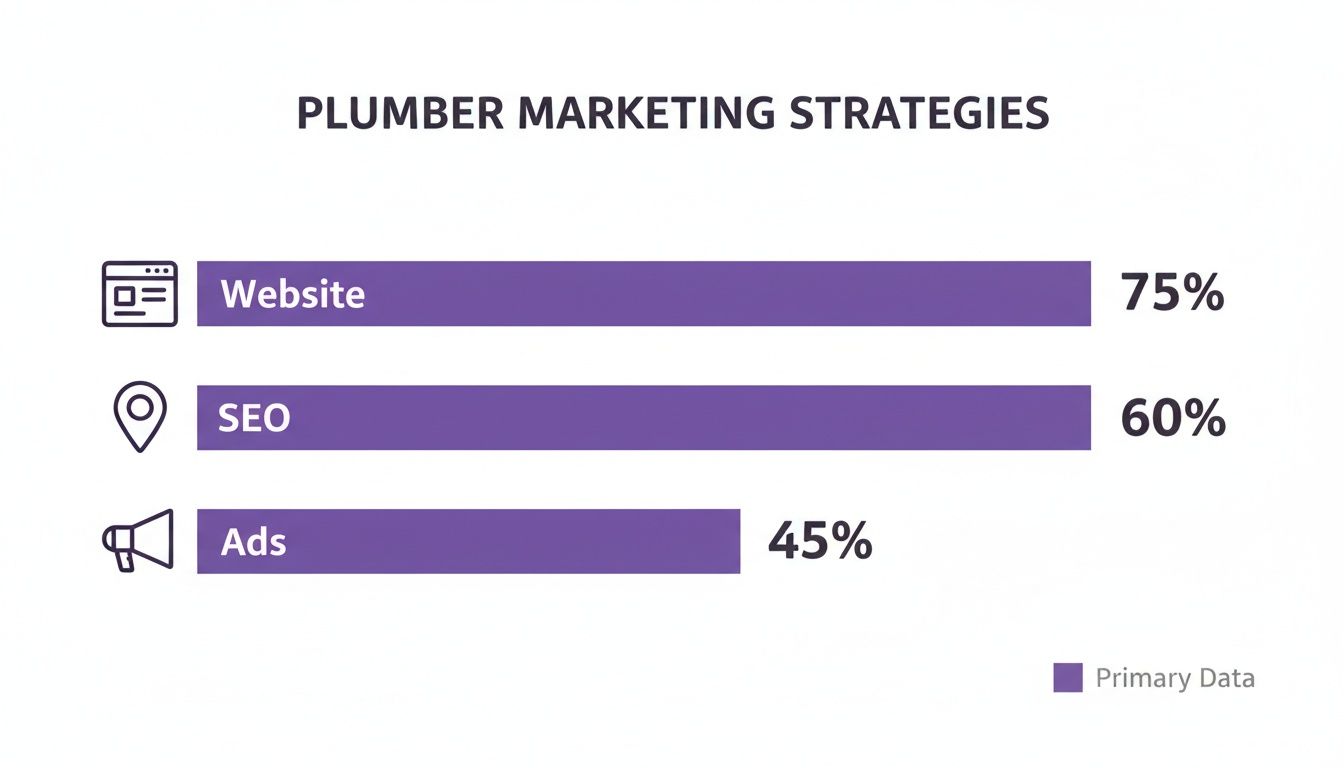
As you can see, the industry leans heavily on having a professional website and solid local SEO. These aren't just expenses; they're investments in driving the phone calls that keep your cash flow positive.
Putting together these financial documents can feel like a chore, but they are the heart of your plumber business plan. They turn your goals and strategies into a clear, numbers-based roadmap for success.
Answering Your Top Questions About a Plumbing Business Plan
Even with a step-by-step guide in front of you, putting together a solid business plan for your plumbing company can bring up some tricky questions. Let's tackle some of the most common ones that pop up when you're in the middle of the planning process. Getting these details right will make all the difference.
How Long Does My Business Plan Need to Be?
There’s no magic page count, but for a small plumbing business looking for a bank loan, you're typically looking at a document that's 20-30 pages long, including all the financial documents.
The real goal here is to be thorough without being long-winded. Your executive summary, for example, needs to be a hard-hitting single page that makes someone want to keep reading. On the other hand, sections like your Market Analysis and Financial Projections are going to need more space to really dig into the data and prove your case.
Focus on clear, well-researched info that supports why your business will succeed. Avoid fluff. A lean, powerful plan will always beat a long, rambling one that hides the important details.
The goal isn't to write a novel; it's to create a clear, compelling argument for your business's success. Every page should serve a distinct purpose in proving your concept is viable and profitable.
Do I Really Need a Plan If I'm Not Getting a Loan?
Yes, absolutely. A business plan is critical for getting a loan, but its true power is as your internal roadmap. Honestly, the process of creating the plan is often more valuable than the final document.
Why? Because it forces you to stop and think critically about every single piece of your business:
- Who is my ideal customer? What specific problem am I solving for them?
- How does my pricing strategy stack up against the competition?
- What are the most effective marketing tactics for actually getting the phone to ring?
- Where do I want this company to be in one, three, and five years?
Without this blueprint, you're just guessing. That can lead to some seriously expensive mistakes with your cash flow, marketing budget, and hiring decisions. Think of your plan as the GPS that keeps you heading in the right direction.
What's the Biggest Mistake Plumbers Make in Their Business Plan?
One of the most common—and most damaging—mistakes is creating wildly unrealistic financial projections. It’s so easy to get starry-eyed about how much revenue you'll bring in and completely underestimate your expenses. Bankers and investors see this all the time, and it’s an instant red flag that kills your credibility.
To avoid this trap, you have to ground your numbers in reality.
Base your revenue forecasts on solid market research, your actual capacity (how many jobs can you or your crew really handle in a week?), and a conservative lead conversion rate. Don't just invent numbers you think they want to see.
For expenses, get granular. Go way beyond the obvious costs like your truck and tools. You need to account for everything: fuel, insurance, software subscriptions, marketing, and even a contingency fund for those unexpected repairs or slow weeks that always pop up. When your numbers are rooted in reality, it shows you've done your homework and you truly understand the business you’re in.
How Often Should I Update My Business Plan?
Your plumber business plan shouldn't be a one-and-done project that gets filed away. It’s a living document. You should be formally sitting down to review it at least once a year to see how you're tracking against the goals you set.
It's also a smart move to pull it out and update it whenever a big change is on the horizon. This could be triggered by things like:
- Expanding into a new service area or a specialized niche like drain cleaning.
- Getting ready to hire your first technician or add more staff.
- Considering a major equipment purchase, like a new jetter or camera system.
- Seeing a big shift in the local market, like a new competitor opening up shop.
Revisiting your plan regularly keeps it relevant and useful. It helps you stay in the driver's seat and guide your growth, rather than just reacting to whatever comes your way.
Are you spending more time on the phone than with your tools? Phone Staffer can change that. We provide trained, remote CSRs and VAs who handle your calls, book your jobs, and manage your schedule so you can focus on billable work. Learn more about how we can help your business grow.