
When a homeowner's pipe bursts, they aren't casually browsing the internet. They're grabbing their phone and searching for an "emergency plumber near me," and they need one now. This is the moment where Pay-Per-Click (PPC) advertising becomes your most powerful tool for booking jobs.
PPC services put your business right at the top of the search results, instantly. Forget waiting months for SEO to kick in. A well-run PPC campaign can have your phone ringing with new leads the very same day it goes live. It’s the fastest, most direct line to customers who are actively looking to hire a professional.
Why PPC Is Your Fastest Path to Booked Jobs
In the home services game, speed is everything. Your customers are usually dealing with a problem that needs a fast solution, whether it's a broken AC in July or a leaky roof during a storm. They have what we call "urgent intent," and PPC is designed to capture it.
While Search Engine Optimization (SEO) is absolutely essential for long-term growth and building your brand's authority, it's a marathon, not a sprint. PPC lets you skip the line, placing you right in front of motivated customers at the exact moment they need your help.
Immediate Visibility and High-Intent Leads
Think of PPC like paying for the best billboard on the busiest highway. You get prime real estate on Google's first page, instantly. This is a massive advantage, especially when you're a local business competing against bigger companies with established online footprints.
For home service pros, this means your ad pops up when a potential customer types in searches like:
- “emergency plumber near me”
- “roof leak repair cost”
- “local electrician for new wiring”
These aren't just casual questions; they're direct signals from someone ready to hire. By targeting these very specific, high-intent keywords, you make sure every dollar of your marketing budget is working to attract customers who are ready to make a decision.
PPC puts your ads right in front of people actively searching for your exact services, often when they're ready to book now. This direct pipeline to motivated customers is why it delivers such a strong return on investment.
A Quick Look at PPC vs. SEO
Deciding where to put your marketing dollars can be tough. This table breaks down how PPC and SEO deliver leads, helping you see where to focus for both immediate jobs and sustainable, long-term growth.
PPC vs SEO Speed and Impact for Home Services
| Attribute | PPC (Pay-Per-Click) | SEO (Search Engine Optimization) |
|---|---|---|
| Speed to Results | Immediate (hours to days) | Slow (months to a year+) |
| Cost | Pay per click; direct ad spend | "Free" clicks, but requires investment in content, tech, and time |
| Lead Flow Control | High control; can turn on/off instantly | Less direct control; results build over time |
| Targeting | Hyper-specific (keywords, location, time of day) | Broader targeting based on content relevance |
| Sustainability | Stops when you stop paying | Builds lasting online authority and traffic |
| Best For | Immediate lead generation, promotions, testing new markets | Long-term brand building and consistent organic leads |
While SEO is the foundation for a healthy business, PPC is the accelerator. You need both, but if you need calls this week, PPC is where you start.
Measurable Results and a Competitive Edge
One of the best things about PPC is that everything is trackable. You can see exactly how many people clicked your ad, called your business, or filled out a form on your website. This data-driven approach takes the guesswork out of your marketing and shows you your exact return on ad spend (ROAS).
And this isn't just a theory—the numbers prove it. A staggering 84% of small businesses report seeing good results from their PPC advertising campaigns, solidifying its role as a lead-generating powerhouse. You can explore more small business marketing stats to get the full picture.
Ultimately, PPC levels the playing field. It gives a local plumber or electrician the power to compete head-to-head with the big national brands for the same customer. It turns your marketing from a hopeful expense into a predictable, revenue-generating machine.
Setting Your Foundation for PPC Success
Jumping into pay-per-click advertising without a solid plan is a lot like starting a major home renovation without blueprints. You might end up with something, but I guarantee it won't be what you wanted, and it'll cost you way more than it should have. Before you spend a single dime on ads, you have to lay the groundwork.
This means getting crystal clear on your goals, figuring out a realistic budget, and deciding who's actually going to do the work. This prep work is what turns ad spend from a hopeful guess into a predictable, strategic investment that actually grows your business.
Defining Your Campaign Goals
Your first job is to get way more specific than just "I want more leads." That's not a goal; it's a wish. To know if your ads are actually working, you need concrete, measurable targets.
Think about what a truly successful week or month looks like for your business. Instead of a vague desire for more calls, what tangible outcomes will move the needle? Ask yourself questions like:
- How many qualified phone calls do we need this week to hit our revenue goal?
- What’s our target for online form submissions for new roof quotes?
- Are we trying to book 15 new HVAC installations this month, or is the goal 50 smaller plumbing repair jobs?
When you set a specific target—like "Generate 20 qualified inbound calls for emergency plumbing repairs per week"—you create a north star for your entire strategy. Every keyword you bid on and every ad you write is now laser-focused on hitting that number.
Establishing a Realistic Budget
"So, how much should I spend?" It's the question I hear most often. While there's no single magic number, a serious effort in most competitive local markets is going to require a starting budget between $1,000 and $3,000 per month. This gives you enough runway to gather real data, test what works, and start optimizing for better results.
One of the most common mistakes I see home service businesses make is starting with a budget that's just too small to work. A $300 monthly spend might only get you a few clicks a day. That’s not nearly enough data to learn anything or make smart decisions.
Your budget really just dictates the scale of your campaign. A smaller budget might mean focusing on one core service in a very tight geographic area. A larger budget can support multiple services across several towns. The key is to stop seeing it as a "cost" and start treating it as an investment designed to bring in profitable work.
Deciding Between DIY and Agency Management
The last piece of your foundation is deciding who’s going to steer the ship. This choice really comes down to a trade-off between your time, your expertise, and how fast you want to grow.
Here’s a quick breakdown to help you think it through:
| Consideration | DIY (In-House) | Hiring a PPC Agency |
|---|---|---|
| Cost | No management fees, but your time is valuable. Don't forget that. | A monthly management fee, usually a flat rate or a percentage of your ad spend. |
| Expertise | A very steep learning curve. 47% of small business owners manage marketing themselves, but these platforms get more complex by the day. | You get instant access to specialists who live and breathe this stuff. They bring years of industry experience to the table. |
| Time | Demands a serious, ongoing time commitment for managing, optimizing, and reporting. It's not a "set it and forget it" thing. | Frees you up to focus on what you do best: running your business and taking care of customers. |
| Tools | You'll have basic access to the ad platforms. | Agencies pay for advanced tools for keyword research, bid management, and analytics that are too expensive for a single business. |
If you're just starting out with a tiny budget and you have a ton of time to learn, going the DIY route might seem tempting. But for most home service businesses that are serious about growth, partnering with a good agency—especially one that knows your industry—is the fastest path to getting a real return on your investment. They've already made the costly mistakes, so you don't have to.
To really get this right, you have to start with a solid base of knowledge. I'd recommend reviewing the basics of PPC for beginners. This will help you make much smarter decisions, whether you decide to run the campaigns yourself or hire a pro.
Building PPC Campaigns That Get Homeowners to Call
Alright, with the groundwork laid, it's time to get into the nuts and bolts of building a PPC machine that actually makes your phone ring. A winning campaign isn't a shot in the dark. It’s a deliberate process of finding the right homeowners, hitting them with the perfect message, and making it ridiculously easy for them to book a job. This is where your strategy turns into real-world appointments.
This whole thing starts by putting yourself in your customer's shoes. Imagine their AC dies in the middle of a July heatwave or a pipe bursts at 2 AM. What do they frantically type into Google? Your job is to get inside their head and match their urgent problem with your immediate solution.
Mastering Keyword Research for Home Services
Keyword research is the absolute heart of any successful PPC campaign. The goal is simple: bid on the exact phrases a desperate homeowner uses when they need help right now. Forget casting a wide net with broad terms like "plumbing." You need to get laser-focused and local to attract people who are ready to buy.
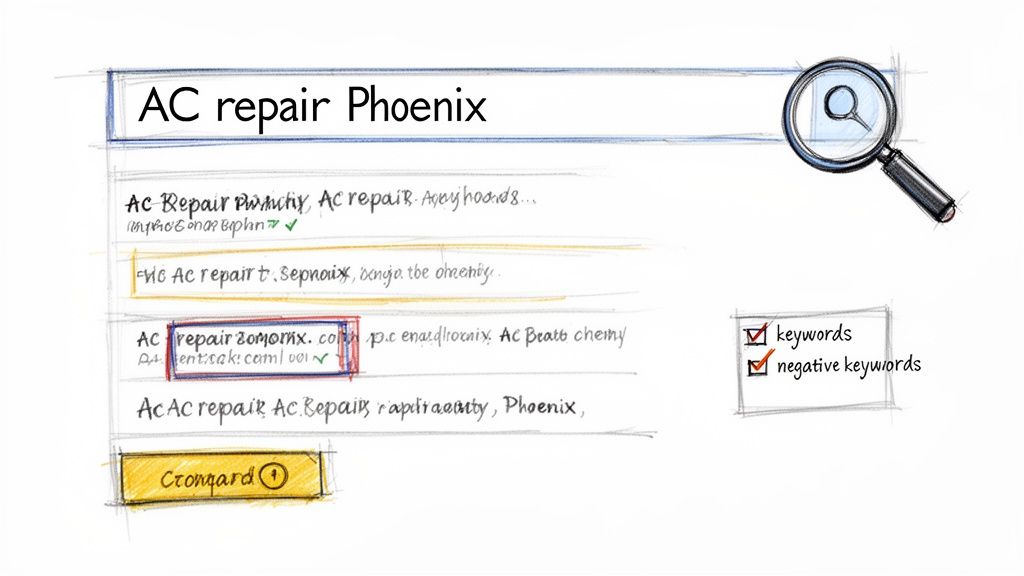
Think like a customer. They don't search for "HVAC"; they search for "AC repair Phoenix" or "furnace not working near me." These are the money phrases that lead to jobs.
Your keyword list should be a healthy mix of:
- Service-Specific Keywords: Think "water heater installation," "drain cleaning service," or "emergency roof leak repair."
- Location-Based Keywords: Tack on your city, county, or even specific neighborhoods to those service terms.
- Urgency-Based Keywords: Include phrases like "24-hour electrician," "same-day AC service," or "emergency plumber."
Now, here’s a pro tip that separates the amateurs from the experts: negative keywords. These are the terms you explicitly tell Google not to show your ads for. This is non-negotiable for protecting your budget from wasted clicks.
For example, if you're an HVAC contractor, you’d add negative keywords like "free," "training," "jobs," and "DIY." This stops your ads from showing up for people looking for a new career or a YouTube tutorial. It's a simple step that ensures every dollar you spend is aimed directly at a potential customer.
Writing Ad Copy That Speaks to the Problem
Once you've got your keywords dialed in, your ad is your first handshake with a potential customer. You only have a few lines to grab their attention, so every word counts. Your ad copy needs to do three things, fast: acknowledge their problem, present your solution, and give them a compelling reason to click your ad.
Great ad copy for home services isn't clever or witty—it's clear, direct, and reassuring. It needs to scream trustworthiness and urgency.
A homeowner in a panic doesn't care about a cute slogan. They care about finding a fast, reliable professional to fix their problem. Your ad should immediately tell them, "We can solve your problem right now."
Look at this example for an electrician:
- Headline: 24/7 Electrician in [City Name]
- Description: Licensed & Insured. Upfront Pricing. Fast, Reliable Service for Outlets, Wiring & Panels. Call Now!
This copy works because it's direct. It builds instant trust ("Licensed & Insured"), eases financial anxiety ("Upfront Pricing"), and ends with a strong, clear call to action.
Choosing the Right Campaign Types
Not all Google Ads campaigns are built the same, and using the right tool for the job makes all the difference. For a home service business, you'll want a strategic mix to cover all your bases.
- Search Ads: This is your bread and butter. These are the classic text ads at the top of Google's search results, perfect for capturing someone actively searching for "emergency plumber." They are designed to drive immediate calls and website leads.
- Local Service Ads (LSAs): If you're eligible, these are a game-changer. LSAs appear above the traditional search ads and come with a "Google Guaranteed" badge that builds incredible trust right away. Customers can call you directly from the ad, and you often only pay per lead. It's a must-have.
- Remarketing Campaigns: What about the people who visited your site but didn't call? Don't let them get away. Remarketing lets you show display ads to these warm leads as they browse other websites, keeping your business top-of-mind until they're ready to pull the trigger.
This multi-pronged approach ensures you’re visible at every stage of a homeowner’s decision-making process. The numbers back it up: industries like automotive services can see average costs-per-click of $2.41 and conversion rates as high as 7.76%, which translates directly to booked appointments. A typical small business budget of $1,000–$3,000 per month is often enough to target specific keyword groups, test offers, and run remarketing to bring interested homeowners back. To see more data, you can explore some great small business marketing stats.
Turning Clicks into Customers with Optimized Landing Pages
Getting someone to click your ad is a great first step, but let's be honest, it's only half the battle. The real work—and where your money is truly made or lost—happens after the click. It happens on your landing page. This is where your investment in PPC services for small business starts to pay off, turning a curious searcher into a scheduled job.
Think of it this way: your ad makes a promise. If it says "24/7 Emergency AC Repair," the page they land on better scream that exact message. Dropping them on your generic homepage to hunt for that info is a surefire way to lose them to a competitor in seconds. You need a seamless path from ad to action.
What a High-Converting Landing Page Looks Like
For a home service business, a landing page has one job and one job only: get the visitor to call you or fill out a form. That's it. Anything that distracts from that single goal is actively costing you money.
It’s a specialist tool for a specialist job. You wouldn't use a Swiss Army knife to frame a house; you use a framing hammer. Your homepage is the Swiss Army knife, built for general exploration. Your landing page is the framing hammer, designed for one specific, powerful action.
Here are the non-negotiable parts of a landing page that actually works for home services:
- A Headline That Echoes the Ad: If the ad promised "Leaky Roof Repair," the headline better say something almost identical. This immediately tells the visitor, "Yes, you're in the right place."
- A Big, Obvious Click-to-Call Button: Your phone number should be impossible to miss, especially on a mobile device where most urgent searches happen.
- A Dead-Simple Contact Form: Keep it short. Name, phone number, and a quick note about their problem is usually all you need. Every extra field you add is another reason for them to give up.
- Trust Signals: This is huge. Plaster your licenses, certifications, "Best Of" awards, and a few stellar customer reviews right where they can see them. These visuals build instant credibility with a homeowner who’s never heard of you.
Your landing page isn't a digital brochure; it's a direct-response machine. Its only purpose is to convert a visitor with an immediate problem into a qualified lead who's ready to book a job.
Pairing your ad campaigns with these kinds of personalized landing pages can boost their effectiveness by as much as 5%. That's a serious lift. For a plumber, it's the difference between a generic page and one that immediately addresses an 'emergency plumbing' click with focused, reassuring content.
Test, Tweak, and Win: The Power of A/B Testing
Even a landing page you think is perfect can almost always be better. That’s where A/B testing (or split testing) comes in. It’s a beautifully simple concept: show two slightly different versions of your page to visitors and see which one gets more of them to contact you.
You don't need to reinvent the wheel here. Tiny changes can produce surprisingly big results. For instance, you could test:
- Your Call to Action (CTA): Does "Get a Free Estimate" pull better than "Schedule Service Now"?
- Button Color: Sometimes, just changing a button from blue to a high-contrast orange can make a world of difference.
- Form Length: What happens to your conversion rate if you ditch the "email address" field? Does it go up?
- Headline Wording: Try rephrasing the main benefit. Small shifts in language can have a big psychological impact.
By methodically testing just one thing at a time, you can steadily dial in your page's performance. Over a few months, a page that started by converting 5% of visitors into leads might get tweaked up to 10% or more. You've just doubled the return on your ad spend without spending a single dollar more.
If you really want to maximize the impact of your PPC campaigns, optimizing your landing pages isn't optional. For a deeper dive, check out these 10 essential landing page optimization best practices. Creating this dedicated, optimized experience is exactly how you make sure your hard-earned ad dollars turn directly into a packed appointment calendar.
7. Connecting PPC Leads with Your Frontline Operations
Getting a steady flow of clicks and form submissions from your PPC ads feels like a win, but let's be honest—it doesn't pay the bills. The real make-or-break moment happens when that digital lead meets your real-world team. This is where so many home service businesses drop the ball, letting hot leads go cold because they simply don't have a solid system in place to handle them.
Managing these new opportunities is what separates a business that's just spending money on ads from one that's investing in growth. In this game, speed and efficiency are everything. You have to build a seamless bridge between your marketing and your frontline crew.
The journey from an ad click to a customer call seems simple, but it's a critical path for converting your ad spend into actual revenue.
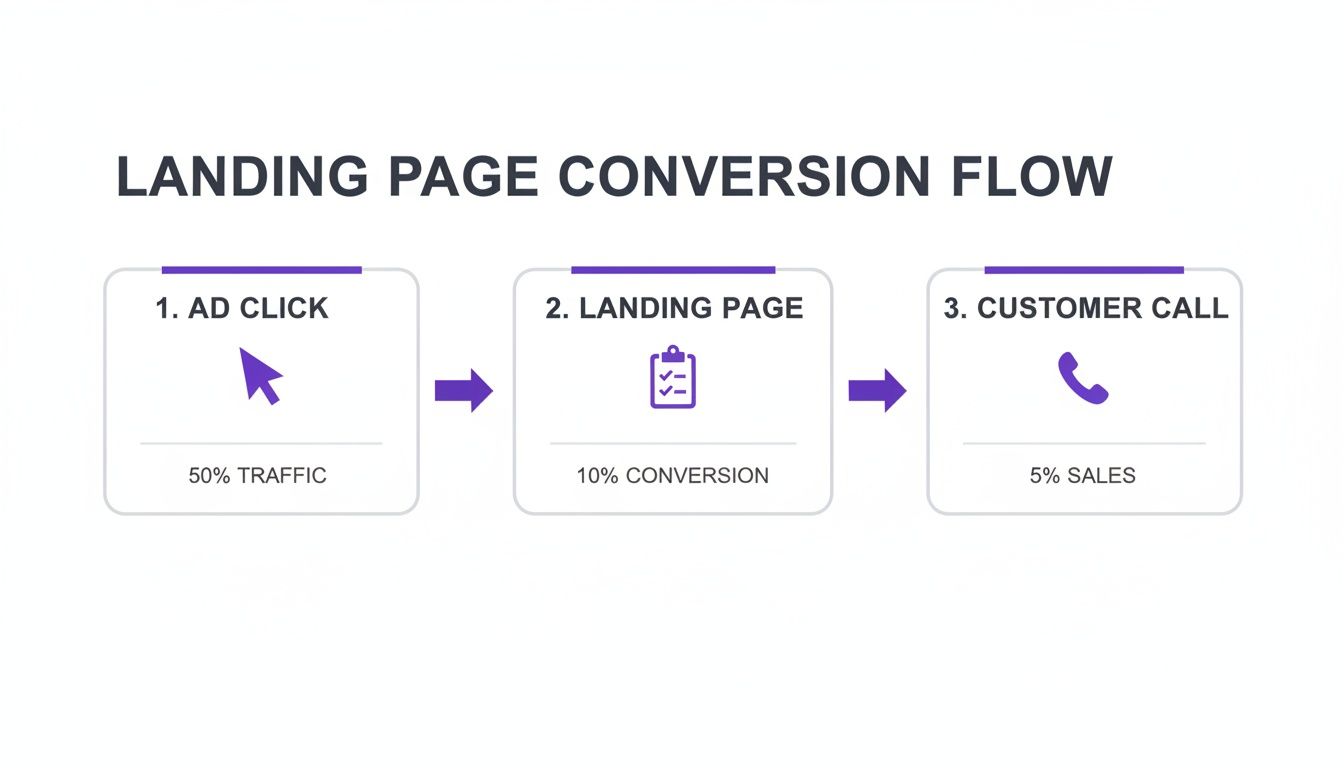
Think of it this way: every step in that diagram is a potential leak in your bucket. A smooth, well-tracked process is the only way to plug those leaks and make sure your investment pays off.
Robust Tracking from Click to Call
You can't fix what you can't see. Before you do anything else, you need airtight tracking to know exactly which ads, keywords, and campaigns are actually making your phone ring. This goes way beyond just glancing at the click count in your Google Ads dashboard.
Real operational insight comes from tools that specialize in call tracking. A technology called Dynamic Number Insertion (DNI) is a perfect example. It shows a unique phone number to each website visitor based on how they found you. So, when a homeowner who clicked your "emergency HVAC repair" ad calls, you know with 100% certainty that the lead came from that specific campaign.
This data is pure gold. It lets you:
- Attribute Revenue: Directly connect a booked job and its dollar value back to the exact ad that brought them in.
- Optimize Ad Spend: Confidently double down on the campaigns that generate high-value calls and pull the plug on the ones that don’t.
- Understand Customer Intent: Listen to call recordings to hear the exact words and phrases customers use, which is invaluable for sharpening your ad copy and landing pages.
Integrating Leads into Your Workflow
Okay, a lead comes in—either a call or a form submission. What happens next? If the answer is, "It lands in an email inbox that someone checks when they get a chance," you are actively losing money. Speed is your single biggest competitive advantage here.
A streamlined workflow ensures no lead ever falls through the cracks. It's all about integrating your lead sources directly with your main business software.
Your goal should be a closed-loop system where a new lead automatically kicks off the next step in your sales process without anyone having to lift a finger. This cuts down on human error and dramatically shrinks your response time.
For instance, when a potential customer fills out a form on your landing page, it should instantly create a new contact and a follow-up task in your CRM or scheduling software. That kind of automation provides immediate visibility and holds your team accountable for acting fast.
Amplifying Your Investment with a Responsive Team
Having the right tech is a huge piece of the puzzle, but it’s only half the equation. You also need the right people ready to jump on those leads the second they arrive. This is where many owners, already stretched thin, hit a wall. It’s nearly impossible to answer every call instantly when you're out on a job site or managing your crew.
This is precisely why services like Phone Staffer are a game-changer for businesses running PPC services for small business. A dedicated team of trained, remote Customer Service Representatives (CSRs) can completely fill that operational gap.
Picture this scenario:
- A homeowner clicks your ad and submits a request for a quote at 10:00 AM.
- Instead of that lead sitting in an inbox, a trained CSR from Phone Staffer calls them back by 10:05 AM.
- The CSR qualifies the lead, answers their initial questions, and books a confirmed appointment right on your calendar.
That level of immediate response turns your ad spend into tangible appointments before your competitors even know the lead exists. It completely transforms your customer experience management from reactive to proactive.
Considering 65% of small to mid-sized businesses are already running PPC campaigns, and that these ads can deliver twice the traffic of SEO, you can't afford to let that traffic go to waste. A lightning-fast follow-up process ensures you squeeze every last drop of value out of every single click you pay for.
Answering Your Top PPC Questions
Even with a solid game plan, jumping into pay-per-click advertising can feel like a big leap. It's totally normal to have questions, especially when you're putting your own money on the line. I get these questions all the time from contractors, so let's clear the air and get you moving forward with confidence.
These are the real-world concerns that pop up when the rubber meets the road. Getting straight answers is the first step to feeling good about your marketing spend.
How Much Should I Actually Spend on PPC Each Month?
This is always the first question, and the honest-to-God answer is: it depends on your market and what you're trying to achieve. But that's not very helpful, is it? So let's get practical.
For most competitive local markets, a monthly ad spend between $1,000 and $3,000 is a realistic starting point. This gives you enough budget to gather meaningful data and actually get some traction.
If you spend much less than that, you're just not going to get enough clicks to learn what's working and what isn't. Think of it as a science experiment—you need a big enough sample size to get reliable results. A tiny budget just gives you a trickle of data, making it almost impossible to make smart decisions.
The biggest mindset shift you can make is to stop seeing your ad spend as a "cost" and start seeing it as an investment. The real focus isn't the upfront spend, but the Return On Ad Spend (ROAS). If you're consistently turning $1,000 into $4,000 of booked jobs, that initial investment suddenly looks pretty smart.
The average cost-per-click (CPC) for a small business often lands somewhere between $4.66 to $5.26 on Google Ads. But here's the kicker: on average, businesses earn $2 for every $1 spent on PPC. When it’s managed right, it’s an incredibly profitable machine. You can dig into more of these advertising trends to see the potential for yourself. This is exactly why a decent budget matters—it’s the fuel that makes the whole thing run.
How Long Until I Start Seeing Results?
Here’s the great news. Unlike SEO, which is definitely a long game, PPC can start delivering results almost immediately. Once your campaigns are built correctly and you flip the switch, you can see clicks, website traffic, and even phone calls within the first few days.
But let's be clear: there's a big difference between "seeing activity" and "getting predictable, profitable results." That initial phase is all about gathering data. It usually takes a solid one to three months of active management to really get your campaigns humming.
During that time, your agency (or you, if you're hands-on) will be busy:
- Trimming the fat from your keyword list.
- Testing different ad headlines to see what connects with homeowners.
- Adjusting your bids based on what's driving calls.
- Finding and blocking irrelevant search terms (these are called negative keywords).
So, expect to see the phone start ringing quickly, but give it a full 90 days to really dial in the strategy for maximum profit.
Should I Run Ads Myself or Hire an Agency?
You can absolutely manage your own PPC campaigns. The tools are out there for anyone to use, especially if you have a ton of time to dedicate to learning the ins and outs of the platforms. The real question you have to ask yourself is: is this the best use of my time as a business owner?
Running a great PPC campaign isn't a "set it and forget it" kind of deal. It demands constant attention. The ad platforms are complex, and they're always changing the rules of the game.
Hiring a specialized agency that lives and breathes home services marketing will almost always get you better results, faster. They bring years of experience, expensive tools you wouldn't buy on your own, and a deep understanding of what makes a homeowner in your area actually pick up the phone. They’ve already made all the costly mistakes, so you don't have to.
What’s More Important: PPC or SEO?
That's like asking a roofer if a hammer is more important than a nail gun. They’re different tools for different jobs, and you need both in your truck to get the work done right. They're most powerful when they work together.
- PPC is your sprinter. It's built for speed. It's the best tool on the planet for generating high-intent leads right now. When you need the phone to ring this week, you turn on PPC.
- SEO is your marathon runner. It’s the long-term play for building a sustainable business, generating organic traffic, and becoming the go-to authority in your town. It creates a powerful asset that brings in "free" leads for years to come.
The most successful home service companies I know don't choose one over the other. They use PPC to drive immediate cash flow while they invest in SEO to build a rock-solid foundation for the future.
Ready to stop wondering and start booking more jobs? The team at Phone Staffer can provide the trained, remote CSRs you need to answer every call and turn your PPC leads into confirmed appointments. Visit https://phonestraffer.com to see how we can help you capture every opportunity.