
A good receptionist job description template is a great starting point, but it's just that—a start. If you want to attract someone truly exceptional, you need to paint a picture that captures the reality of this dynamic, modern role.
Beyond the Front Desk: The Modern Receptionist Role
Let's be real: the old-school image of a receptionist just answering phones and taking messages is decades out of date. Today, this person is the operational heart of the office, the central hub that keeps everything running smoothly.
The modern receptionist is more of a strategic administrative partner. Understanding this fundamental shift is the key to writing a job description that brings in candidates with the skills you actually need.
Instead of just routing calls, they’re now navigating complex digital communications. This means being comfortable, if not fluent, in tools like your company's CRM, communication platforms like Slack, and a whole suite of virtual meeting software. These aren't just "nice-to-haves" anymore; they're core competencies.
The New Skill Set in Action
Think about your day-to-day office life. The modern receptionist is often the first line of defense for minor IT hiccups—rebooting a stubborn printer or walking a coworker through a screen-sharing issue. They're also juggling sophisticated scheduling software, managing digital mailrooms, and coordinating logistics for a team that might be working from anywhere.
This expanded role isn't just about more tasks; it's about greater responsibility and value. As of 2025, the average hourly wage for receptionists hit about $17.90, a 3.5% increase from 2024. This isn't just a random bump; it reflects a competitive market and the growing recognition that this role requires a diverse and valuable skill set. Diving into more receptionist career statistics can give you a clearer picture of these trends.
A great receptionist is the central nervous system of your office. They don't just manage the flow of information; they anticipate needs, solve problems before they escalate, and set a positive, professional tone for the entire organization.
To really see how much has changed, it helps to put the old and new expectations side-by-side.
Then vs Now: Receptionist Skill Requirements
This table really highlights the jump from basic administrative tasks to a more integrated, tech-focused support role.
| Traditional Skill | Modern Skill Equivalent |
|---|---|
| Answering a multi-line phone system | Managing multi-channel communications (VoIP, chat, email, video calls) |
| Greeting visitors and managing a sign-in sheet | Visitor management software & security badge systems |
| Basic typing and data entry | CRM data management & generating basic reports |
| Managing a physical mailroom | Digital document management & virtual mailroom coordination |
| Manual scheduling in a physical day planner | Advanced calendar management across multiple platforms |
| Making copies and sending faxes | Basic IT troubleshooting and A/V setup for meetings |
This evolution is precisely why a generic job description template often fails. You end up attracting candidates for a job that no longer exists.
By highlighting these modern duties, you’re not just listing tasks. You’re painting a picture of an essential team player who contributes directly to your company's efficiency and culture, setting clear expectations for a successful long-term hire.
Building Your Job Description, From Title to Benefits
This is where the magic happens. We're going to move beyond generic templates and build a job description that truly sells the role, shows off your company’s personality, and pulls in exactly the right kind of candidates. A great hire starts with a great job description.
It all begins with the very first thing an applicant sees: the job title.
Nail the Job Title to Get Noticed
Using a vague title like "Office Assistant" is a surefire way to get a flood of mismatched applications. You need to be specific and use language that candidates are actually searching for.
Think about what a potential hire would type into a job board. To get better results and clearer matches, try titles like these:
- Front Desk Coordinator works perfectly for roles heavy on scheduling and office logistics.
- Client Experience Specialist is a great fit if the job is all about high-touch customer service.
- Medical Office Receptionist immediately signals the need for specific industry experience.
This one small change does a ton of heavy lifting, filtering your applicant pool right from the start so you connect with people who get it.
Write a Job Summary That Makes a Great First Impression
Right after the title, the job summary is your hook. This is not the place for a dry, bulleted list of tasks. Instead, this is your chance to give candidates a feel for your company culture and the real impact of the role. Are you a high-energy, fast-paced office or a calm, client-focused practice? Let them know.
A compelling job summary answers the candidate's unspoken question: "What's it actually like to work there?" It should feel less like a corporate memo and more like a genuine invitation to join a team with a clear purpose.
For instance, instead of saying, "We are a leading firm seeking a receptionist," try something with a little more personality. "As the first point of contact for our creative agency, you'll be the welcoming face and organizational backbone that keeps our team thriving." See the difference? That simple shift makes the position feel important and much more appealing.
To make sure your job description fits into your overall hiring strategy, it’s worth thinking about the bigger picture of building a better recruitment process template.
This visual breaks down the core responsibilities that should be at the heart of any solid receptionist job description.
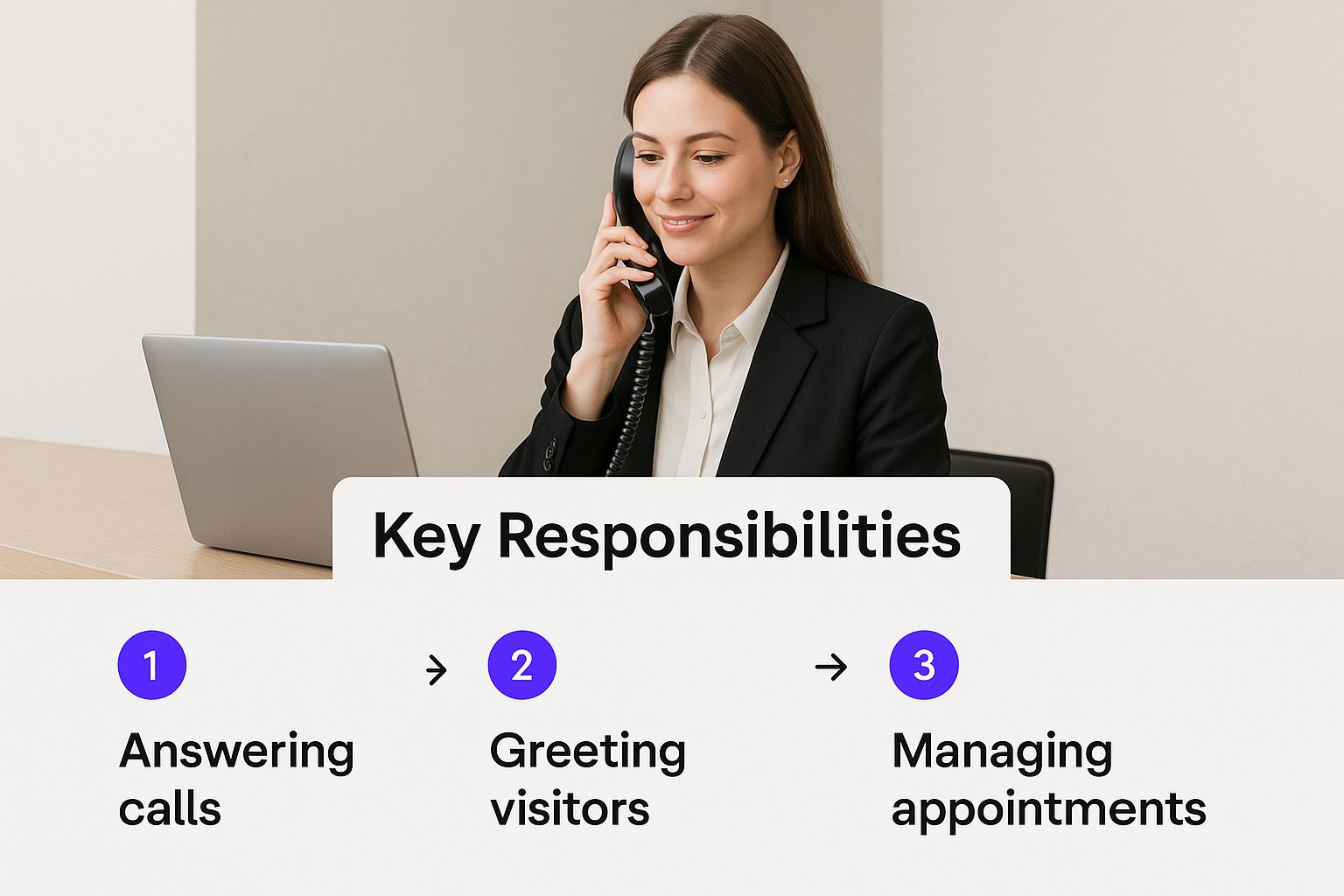
As the image shows, a receptionist's role is a mix of crucial client-facing duties and essential back-office support, and your description needs to clearly define both.
Separate Your Must-Haves From Your Nice-to-Haves
One of the biggest mistakes I see hiring managers make is creating an intimidating laundry list of qualifications. This can scare away fantastic candidates who have 90% of what you need but feel unqualified because they can't check every single box.
It’s much more effective to create two distinct lists.
- Required Qualifications: These are the absolute deal-breakers. Think proficiency in Microsoft 365, a high school diploma, or previous experience with a multi-line phone system. Non-negotiables only.
- Preferred Qualifications: These are the "nice-to-haves" that would make a candidate really shine. This could be experience with your specific CRM, bilingual abilities, or past work in your industry.
Splitting it up like this opens up your applicant pool without lowering your standards.
Be Upfront About Compensation and Benefits
In today's job market, transparency is everything. I can tell you from experience that job postings with clear salary ranges get more—and better—applicants. Ditch the vague phrases like "competitive salary." Nobody's buying it.
Be direct. Provide a specific hourly rate or salary range. Then, take it a step further with benefits. Don't just list them; frame them in a way that shows you actually care about your team's well-being.
-
Instead of: Health, dental, and vision insurance.
-
Try: We offer a comprehensive benefits package, including health, dental, and vision insurance, to ensure our team stays happy and healthy.
-
Instead of: 401(k) plan.
-
Try: Plan for your future with our 401(k) retirement savings plan, which includes a generous company match.
That thoughtful touch shows you value your employees as people, not just as numbers, and makes your offer far more compelling.
Defining Clear Responsibilities and Daily Wins
If your list of responsibilities is vague, you'll get vague, uninspired candidates. It's that simple. To find a receptionist who will truly take ownership of the front desk, you need to paint a vivid picture of what a successful day, week, and month actually looks like in your office. This means ditching the generic bullet points and getting real about the specific tasks that make or break this role at your company.
The best way I've found to do this is by grouping duties into core functions. This helps applicants mentally walk through a typical day and understand the different hats they'll be expected to wear.

Client Experience and Communication
This is ground zero for first impressions. These responsibilities are all about managing every external interaction with poise and efficiency. Think of this person as the director of first impressions for your entire business.
- Be the Welcoming Face: Greet every single person—from a high-profile client to the delivery driver—with a professional and genuinely friendly demeanor. This includes managing a seamless check-in process.
- Master of Communications: You need someone who can command a multi-line phone system, expertly screening and routing calls without ever sounding flustered.
- Digital Front Door: This person will also be monitoring and responding to general company emails and maybe even website chat inquiries, providing quick and accurate answers.
This part of the job isn't just about answering phones; it's about orchestrating a positive, consistent experience for anyone who comes into contact with your brand.
Operational and Administrative Support
Behind every flawless first impression is an office that runs like a well-oiled machine. This is where you detail the internal tasks that keep the business humming. It's a non-negotiable part of any modern receptionist job description template.
For instance, their day could involve:
- Calendar Coordination: Juggling appointments and managing conference room bookings, with the foresight to resolve scheduling conflicts before they happen.
- Supply Chain Command: Keeping a sharp eye on office and kitchen supplies, then ordering what's needed so the team never runs out of essentials.
- Vendor Liaison: Acting as the go-to contact for office vendors, like the cleaning crew or the IT technician, and coordinating their visits.
A Quick Tip: A well-defined list of responsibilities does more than just outline tasks. It empowers candidates to see themselves succeeding in the role and helps you attract people who are genuinely excited about the work itself.
Tailoring Duties to Your Industry
Of course, the specifics here will shift dramatically depending on your industry. A generic, copy-pasted list just won't work.
A receptionist at a medical practice will be handling sensitive patient check-ins and verifying insurance details. In a busy law firm, they might be managing confidential client intake forms and scheduling depositions. Be specific to your world.
The receptionist role remains a significant part of the U.S. workforce, though its nature is evolving. As of May 2024, there were about 1,054,500 receptionists in the United States, earning a median hourly wage of $17.90. While the field is projected to see a slight decline of 1% over the next decade, this points more to a stabilization of the role—and a greater need for specialized skills—rather than its disappearance. You can dig into more of this data by checking out the U.S. Bureau of Labor Statistics on receptionist employment trends.
By being specific and grouping tasks logically, you give candidates the clarity they need to see if they're not just qualified, but a truly great fit for your team.
Pinpointing the Skills That Truly Matter
So, how do you actually define what separates a good receptionist from a truly great one? Let’s be honest, slapping clichés like “strong communicator” or “team player” onto your receptionist job description template is a surefire way to attract generic candidates. It’s time to get specific about the skills that will make a real impact on your business.

The key is to think in two distinct categories: hard skills and soft skills. Both are absolutely critical, but they fulfill very different needs at the front desk.
Hard Skills for the Modern Front Desk
Hard skills are the concrete, teachable abilities a candidate needs to hit the ground running. Think of these as the technical tools in their toolkit—the specific things they know how to do.
In today’s world, a receptionist needs much more than just a fast typing speed. You need to be explicit about your technical stack.
- Software Proficiency: Do they need to be a wizard with Microsoft 365 or live and breathe Google Workspace? Maybe experience with a CRM like Salesforce or a specific scheduling platform is a dealbreaker. Name them.
- Communication Systems: Handling a multi-line VoIP phone system is often standard. But what about internal communication? Proficiency with tools like Slack or Microsoft Teams is just as important for keeping the internal gears turning smoothly.
- Office Equipment Mastery: This isn’t just about the printer. Does the role involve managing high-volume scanners, postage machines, or setting up A/V equipment for important meetings? Say so.
Being upfront about these requirements acts as a filter. It helps candidates self-select, ensuring that only those with the right foundational knowledge apply, saving everyone a lot of time.
Soft Skills That Make the Difference
If hard skills are about what a person can do, soft skills are all about how they do it. These are the interpersonal traits and a person's innate character that dictate how they’ll manage stress, engage with clients, and ultimately, shape the first impression of your company.
Don't just list them. Describe them in the context of your daily operations.
Vague skills attract vague candidates. When you frame soft skills within real-world scenarios, you find someone who not only has the right personality but also understands how to apply it to solve your specific business challenges.
I've seen this make all the difference. Instead of falling back on the same old tired phrases, try reframing them to reflect what you actually need.
- Instead of "Organized," try: "Proven ability to manage and prioritize conflicting appointments across multiple executive calendars without breaking a sweat."
- Instead of "Good Communicator," try: "Ability to explain complex information clearly and patiently to clients and colleagues, regardless of their technical know-how."
- Instead of "Problem-Solver," try: "A proactive approach to identifying and resolving office issues—like a broken coffee machine or a double-booked conference room—before they become bigger problems."
- Instead of "Personable," try: "Demonstrated emotional intelligence to handle sensitive or stressful client situations with genuine discretion and empathy."
This level of detail does more than just list qualifications; it tells a story about the role. It empowers the right people—the ones who read your description and think, "Hey, I've done that before, and I'm great at it"—to apply with real confidence.
Essential Receptionist Skills Breakdown
To really nail this down, it helps to see a full breakdown of the skills that matter most for a modern receptionist. Here’s a look at the essential hard and soft skills, along with why each one is so crucial for success in the role.
| Skill Category | Specific Skill Example | Why It's Important |
|---|---|---|
| Technical Proficiency | Experience with multi-line VoIP phone systems | Ensures seamless call routing and a professional first point of contact for all incoming calls. |
| Software Fluency | Mastery of Microsoft 365 (Word, Excel, Outlook) | Essential for drafting documents, managing schedules, and handling email correspondence efficiently. |
| Administrative Acumen | Digital file management and organization | Keeps company records accessible, secure, and compliant, preventing information bottlenecks. |
| Communication | Active listening and verbal clarity | Reduces misunderstandings and ensures visitors, clients, and staff feel heard and understood. |
| Emotional Intelligence | Empathy and composure under pressure | Allows them to de-escalate tense situations and manage difficult personalities with grace. |
| Problem-Solving | Resourcefulness in finding solutions | Enables them to handle unexpected issues (e.g., a delivery mix-up) independently and effectively. |
| Time Management | Prioritizing tasks amid constant interruptions | Crucial for balancing front-desk duties with administrative tasks without letting quality slip. |
Thinking through these categories helps you build a job description that isn't just a list of duties but a true reflection of the capable, professional individual you need to represent your brand.
Adapting the Role for Remote and Hybrid Work
The front desk isn't always a physical desk anymore. With so many companies shifting to flexible work, the receptionist role has evolved, too. We're now looking at job descriptions for a virtual or hybrid reality, which is a whole different ballgame.
This isn't just a simple copy-and-paste job from your old template. A remote receptionist acts as the central communication hub for a team that could be spread across the country—or the world. Your receptionist job description template needs a serious update to reflect this new way of working.
Key Responsibilities for a Virtual Receptionist
Instead of greeting people walking through the door, a virtual receptionist manages the digital front door. This requires a unique skill set built on tech-savviness and a ton of self-discipline.
Think about what their day-to-day really looks like:
- Digital Communications Management: They'll be the master of your virtual phone system (VoIP), the gatekeeper of company-wide chat channels, and the person who ensures every email landing in a central inbox gets to the right place.
- Remote Team Support: This person is often the glue holding a scattered team together. They’ll be coordinating virtual meetings across tricky time zones, managing digital document workflows, and providing administrative help to colleagues they may never meet in person.
- Virtual Mailroom Operations: The traditional mail cart is gone. In its place, they’ll be handling digital mail scanning, sorting, and distribution.
A great virtual receptionist brings the same sense of order and warmth as an in-person one, but they do it all through a screen. Their real superpower is projecting professionalism and a welcoming vibe through purely digital channels.
This isn't just a niche role anymore; it's a booming industry. The global market for virtual receptionist services is on track to hit nearly $25 billion by 2025. Why? Because outsourcing these duties can slash overhead costs by 40% to 60% compared to hiring in-house.
When you're writing the job description, setting clear expectations is everything. It helps to have solid remote work protocols in place, and a resource like this work-from-home policy template and guide can give you a great starting point.
Ultimately, you’re looking for someone who is not just friendly and organized, but also incredibly self-sufficient and completely at ease in a digital-first environment.
Answering Your Top Questions About Writing the Job Description
Even with a great template in hand, you’re bound to hit a few roadblocks. It happens to everyone. Getting straight answers to these common questions can be the difference between a job post that sits unnoticed and one that pulls in fantastic candidates from day one.
Let's dive into some of the most frequent things I hear from hiring managers when they're putting together a receptionist job description.
What’s the Most Important Section to Get Right?
Without a doubt, it's the “Responsibilities” section. This is where a candidate truly gets a feel for the day-to-day reality of the job. It's your best shot to go beyond a dry, uninspired list and show them what the work actually involves.
Instead of just saying "Manage a multi-line phone system," try painting a more vivid picture. Something like, "Serve as the first point of contact, expertly managing a multi-line VoIP system to ensure every call is handled with professionalism and warmth." This small shift helps candidates self-select, saving you the headache of reviewing applications from people who aren't a good fit.
Do I Really Have to Include the Salary?
Yes. One hundred percent, yes. In today's hiring world, salary transparency isn't just a nice-to-have; it's a fundamental expectation. In many places, it's also the law, so this is a habit you need to get into now.
Putting the salary range right in the post shows you respect the candidate's time. It also means you’re only attracting people whose expectations align with your budget. I’ve seen it time and time again: job descriptions with clear salary info get more—and better—applicants. It’s a simple tweak with a huge payoff.
Hiding the salary is the fastest way to lose a great candidate's trust before you've even spoken to them. Be upfront and direct; it demonstrates confidence in the value of the role and your company.
How Can I Make My Receptionist Job Posting Stand Out?
The key is to let your company's culture shine through. Don't just list what they'll do, talk about why it matters. What kind of impact will this person have on your team? What makes your office a place someone would actually want to be every day?
Drop the stiff, corporate language and write with a warmer, more human tone that reflects your team's vibe. Highlighting unique perks can make a world of difference. Whether it’s opportunities for professional development, a tight-knit team, or even just a top-of-the-line coffee machine, these details make your post far more magnetic than a competitor's sterile listing.
What’s a Common Mistake I Should Avoid?
The most common mistake I see is creating a massive "wish list" of skills. This often backfires by scaring off great candidates who have 90% of what you're looking for but feel unqualified because they can't check every single box.
Be realistic. You need to clearly separate your non-negotiable "must-haves" from your "nice-to-haves." Another classic blunder is using internal acronyms or company-specific jargon that an outsider won't understand. Keep your language crystal clear to attract the broadest pool of qualified people.
Finding the right person to be the face of your business is crucial. Phone Staffer specializes in hiring, training, and placing top-tier remote CSRs and VAs for home service companies, ensuring your phone is always answered and your leads are always followed up on. Let us find the perfect fit for your front desk, so you can focus on running your business. Learn more about our virtual receptionist services.