

So, what exactly is a remote customer service agent? Forget the traditional picture of a call center packed with cubicles. A remote customer service representative, or CSR, is a professional who handles all your customer-facing tasks—like calls, emails, and chats—from their own dedicated workspace, typically at home.
They rely on modern communication tools to connect with your customers and your team, giving your business a flexible and incredibly effective way to manage customer relationships.
Why Businesses Are Shifting to Remote Customer Service
That old-school image of a busy call center is fading fast, and for good reason. More and more companies, particularly in the home service industry, are making a smart move away from the front desk and toward a network of skilled professionals working remotely.
This isn't just a passing trend; it's a major shift in how businesses connect with their customers.
Think of remote customer service agents as the digital front door to your business. They're often the first voice a potential customer hears, ready to book jobs, handle urgent questions, and represent your brand professionally. The best part? They can do it all without ever setting foot in a physical office. This change is fueled by huge leaps in communication tech and the simple fact that customers now expect fast, helpful support whenever they need it.
The Data Behind the Shift
The move to remote teams isn't just a gut feeling—it's backed by solid performance data. Time and again, the numbers show that well-managed remote teams can not only meet but often exceed the performance of their in-house counterparts.
This infographic breaks down some of the key differences in performance metrics between in-house and remote customer service teams.
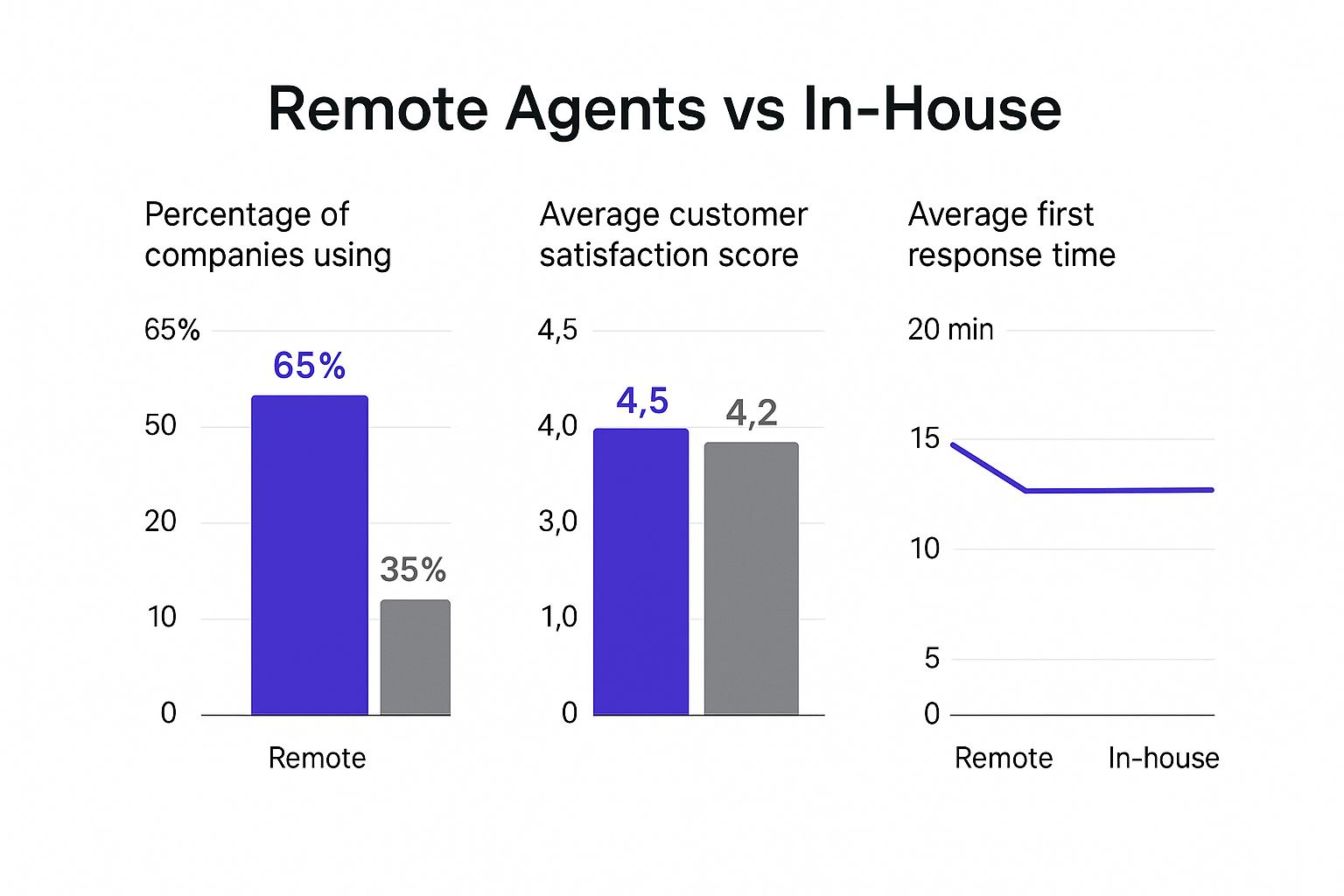
As you can see, companies leveraging remote agents often report higher customer satisfaction scores and quicker first-response times. In a competitive field like home services, those advantages are huge and are a big reason why this model is catching on so quickly.
To put it in perspective, let's look at a side-by-side comparison.
In-House vs. Remote Agent Key Differences
This table offers a quick comparison of the operational and strategic differences between traditional in-house customer service staff and remote agents.
| Attribute | In-House Agents | Remote Customer Service Agents |
|---|---|---|
| Hiring Pool | Limited to local geographic area | National or global talent pool |
| Overhead Costs | High (office space, utilities, hardware) | Low (agents use their own equipment) |
| Flexibility | Rigid 9-to-5 schedules | 24/7 coverage across time zones |
| Scalability | Slow and expensive to scale | Fast and cost-effective scaling |
| Employee Retention | Often lower due to commute, office stress | Generally higher due to work-life balance |
This comparison highlights that remote agents offer a fundamentally more agile and cost-efficient structure, allowing home service businesses to adapt quickly to changing customer demands without the heavy investment required for a physical office.
A New Standard for the Workforce
This operational adjustment is just one piece of a much larger global workforce transformation. The flexibility to work from anywhere is no longer a niche perk; it’s becoming the new standard, a change kicked into high gear by recent global events and the rise of powerful digital tools.
The rise of remote work has been profound. It is projected that approximately 36.2 million Americans, or 22% of the workforce, will be working remotely, which marks an 87% increase from pre-pandemic levels.
This opens up a massive talent pool, giving businesses unprecedented access to skilled professionals, no matter where they live. For a home service company, this is a game-changer. You're no longer limited to hiring the best person in your town; you can hire the best person, period. You can explore more about the growth of remote work statistics and what this trend means for your business.
This model delivers a powerful combination of benefits:
- Expanded Talent Access: Recruit top-tier agents from across the country or even the globe.
- Increased Flexibility: Easily offer around-the-clock coverage by hiring agents in different time zones.
- Improved Scalability: Quickly scale your customer service team up or down to match seasonal demand without the usual hiring headaches.
By truly understanding this shift, you can position your business to build, manage, and grow a customer service team that actively fuels your success.
The Strategic Advantages for Home Service Companies

Sure, most people know the general perks of remote work by now. But for home service companies—think HVAC, plumbing, or electrical—the specific benefits are nothing short of game-changing. This isn't just about convenience; it's a powerful strategy for boosting growth, efficiency, and customer care.
Let's paint a picture. It's 10 PM, and a customer's water heater has just burst. In a typical office setup, that frantic call probably hits an expensive, impersonal answering service or, worse, goes straight to voicemail. A missed call is a missed job, especially when it's an emergency.
Now, imagine that same call gets picked up by one of your own remote customer service agents, who happens to be starting their day in a different time zone. They're fresh, focused, and have your scheduling software right in front of them. They can calm the panicked customer, book an emergency visit, and get a technician dispatched while your local team rests. This isn't a pipe dream—it's what smart businesses are doing right now with a distributed team.
Unlock 24/7 Coverage Without Overtime Costs
In the home service world, customer needs don't clock out at 5 PM. Emergencies are a round-the-clock reality, and being there to answer the call is how you capture those high-value jobs. Hiring remote agents in different time zones is the most straightforward way to make that happen.
This approach gives you seamless 24/7 availability, but without the crippling cost of overtime or night-shift pay for your local staff. Your business is always "on," building a reputation for reliability that your 9-to-5 competitors simply can't touch.
Dramatically Reduce Overhead Expenses
One of the first and most powerful benefits you'll notice is a major drop in overhead costs. A brick-and-mortar office brings a long list of expenses that really add up.
- Office Rent: Ditching the need for a large front office space saves a huge chunk of change every single month.
- Utilities: Say goodbye to separate bills for electricity, heating, cooling, and internet for the office.
- Office Equipment: The upfront cost of desks, chairs, phone systems, and computers for every CSR vanishes.
These aren't just small budget trims. This is serious capital you can pour back into things that actually grow your business, like buying better tools, running stronger marketing campaigns, or expanding your service fleet.
By shifting to a remote model, businesses can see overhead reductions of thousands of dollars per employee annually. The money saved on rent and utilities alone can be redirected to core operational needs, directly fueling growth and improving service quality.
Expand Your Talent Pool Beyond Local Limits
When you're hiring for an in-office role, your options are limited to people who live within a reasonable commute. That geographic fence can force you to hire someone who’s simply available, not necessarily the absolute best person for the job.
Hiring remote CSRs smashes those barriers. Suddenly, you can recruit top-tier talent from anywhere in the country—or even the world. This nationwide talent pool means you can find people who already have experience in the home service industry. They know the lingo, understand dispatching, and get why customer urgency is so important.
Access to this wider range of skills ensures you build a team of true professionals who deliver amazing service, leading directly to more booked jobs and happier, more loyal customers. It's a total shift from hiring who's nearby to hiring who's truly the best.
How to Find and Hire Exceptional Remote Talent
When you expand your search for talent beyond your local area, you tap into a massive pool of qualified candidates. But finding the right person requires a specific strategy. You’re not just looking for a customer service pro; you need a self-starter who will absolutely excel in a remote setting. Your entire process, from the job post to the final interview, has to be geared toward finding these unique individuals.
Think of it like casting for a movie. You need an actor who not only knows their lines (the customer service part) but also embodies the character of a remote worker—disciplined, proactive, and comfortable with technology. A fantastic local actor might struggle without a director on set, just as a great in-office CSR might feel lost without direct supervision. Your hiring process is the audition that finds your star performer.
The good news is that the demand for remote work is still strong, so a well-crafted job post will get plenty of eyes on it. Remote job postings have seen consistent growth, especially in customer service. In fact, remote listings saw an 8% increase in just one recent quarter, which tells you there's a healthy, expanding market for these roles. You can see more data on this trend by exploring the FlexJobs remote work economy index.
Writing a Job Description That Attracts Self-Starters
A generic job description is a magnet for generic candidates. If you want to find exceptional remote customer service agents, your post needs to speak directly to the kind of person who thrives on their own. You have to go beyond a boring list of duties and paint a clear picture of the role and the autonomy it demands.
So, instead of just saying "answers phones," describe the real impact they’ll have: "You will be the first point of contact for homeowners in distress, calmly guiding them and scheduling critical service appointments." Make sure to highlight the specific qualities you’re truly looking for.
Be sure to include these key elements:
- Emphasis on Autonomy: Use phrases that signal independence, like "self-managed," "proactive problem-solver," and "takes initiative."
- Technical Requirements: Be upfront about the non-negotiables. State clearly that they need a quiet, dedicated workspace, a reliable high-speed internet connection, and familiarity with tools like CRMs or VoIP systems.
- Focus on Communication: You have to stress the importance of excellent written and verbal communication. When you're not in the same room, it’s the bedrock of good teamwork.
Mastering the Virtual Interview Process
The virtual interview is your single best tool for seeing what’s behind the resume. It's your chance to assess not just what a candidate knows, but how they think, communicate, and handle the unique pressures of working solo. The key is to structure your interview to probe for the essential traits of a successful remote employee.
I always recommend starting with a brief video call to establish a personal connection and get a feel for their communication style. From there, you can move into questions that reveal their aptitude for working from home. Ditch the generic questions like "What are your weaknesses?" and instead, use situational questions that mimic real-world challenges.
A well-structured virtual interview process is less about grilling a candidate and more about discovering if they possess the internal drive to succeed without constant oversight. It's about finding evidence of self-discipline, resourcefulness, and a proactive mindset.
To really get to the heart of it, ask specific, behavior-focused questions that show you how they operate:
- "Describe your ideal remote work environment. How do you set up your day to stay focused and avoid distractions?" This question tells you a ton about their self-discipline and organizational skills.
- "Tell me about a time you faced a technical issue while working alone. What steps did you take to troubleshoot it before asking for help?" This tests their resourcefulness. Can they solve their own problems?
- "How do you prefer to communicate with a team you don't see in person? Give an example of how you've kept colleagues in the loop on a project." This assesses their proactivity and shows whether they can be a good teammate from afar.
The Candidate Evaluation Checklist
After the interviews are done, a structured evaluation process is critical for making an objective, data-driven decision. I suggest creating a simple checklist or scorecard to rate each candidate across the most important areas for a remote role. This helps you compare apples to apples and stops you from being swayed by one great answer while overlooking potential red flags.
Your checklist should give weight to both traditional customer service skills and the specific competencies needed for remote work.
| Skill Category | Key Competencies to Evaluate |
|---|---|
| Customer Service Acumen | Empathy, active listening, and problem-solving skills. |
| Technical Aptitude | Comfort with software, ability to learn new tools quickly. |
| Remote Work Readiness | Self-discipline, time management, and proactive communication. |
| Home Service Knowledge | Familiarity with industry terms and customer urgency (a big plus). |
Using this structured approach—from the job post all the way to the final evaluation—ensures you don't just fill a seat. You hire a dedicated, professional remote agent who is perfectly equipped to help your home service business thrive.
Building Your Remote Team's Technology Stack

Handing a talented remote CSR a clunky, disconnected set of tools is like asking a master plumber to fix a major leak with nothing but a roll of duct tape. They might get a temporary patch in place, but you're not empowering them to deliver the professional, lasting results you hired them for. To truly unlock the potential of your remote team, you have to equip them with the right technology.
Think of this "tech stack" as your team's virtual headquarters. Each piece of software plays a crucial role, and they all need to work together to create a smooth, professional operation. From answering calls to booking jobs and keeping everyone on the same page, these tools form the digital backbone of a high-performing remote customer service team. Getting this foundation right from the start will save you countless headaches later.
This isn't about chasing every new, flashy piece of software. It's about deliberately building a reliable system that empowers your agents to be efficient and effective from their very first day.
The Three Pillars of Remote Operations
For a home service business, a solid tech stack really comes down to three essential pillars. If any one of them is weak or missing, your whole customer service operation will feel it. You absolutely need a system to manage calls, a central place to track customer information, and a hub for your team to communicate with each other.
Let’s break down the core components that make up this foundation.
- Cloud-Based Phone System (VoIP): Think of this as your company’s phone network, but supercharged. It lets your agents make and receive calls from anywhere with an internet connection, all while looking like they're sitting in your main office.
- Customer Relationship Management (CRM): This is your business’s digital brain. It holds every piece of customer history, job detail, and past conversation, giving your CSRs the full story before they even say hello.
- Team Collaboration Hub: This is your virtual breakroom and meeting space, all in one. It’s where your team can ask quick questions, share important updates, and build a real sense of camaraderie, even when they’re miles apart.
When these tools don't work in harmony, you get chaos. Information gets lost in translation, customers are forced to repeat themselves, and your team ends up working in isolated silos instead of as a cohesive unit.
Choosing the Right Tools for Your Team
With thousands of software options out there, just picking one can feel overwhelming. The secret is to ignore the noise and focus on your specific needs as a home service company. A generic sales CRM, for example, just won't have the critical dispatching and job scheduling features your business relies on.
Start by looking at your current budget and team size. Many of the best software providers offer tiered plans, which are perfect for growing businesses. You can start with the essentials and add more advanced features as your team expands, ensuring you're not paying for a bunch of tools you don't need yet.
Your tech stack is a direct investment in your company's efficiency and professionalism. The right tools empower your remote team to handle complex scheduling, securely manage customer data, and deliver a consistently excellent brand experience on every single call.
A well-equipped remote CSR team needs a specific set of tools to function at a high level. Below is a breakdown of the essential software categories, their primary purpose, and the specific features you should look for when building out your stack.
Core Technology Stack for Remote CSRs
| Tool Category | Core Function | Must-Have Features | Example Platforms |
|---|---|---|---|
| VoIP System | Manages all inbound and outbound calls professionally. | Call recording, smart routing, voicemail-to-email, call analytics. | RingCentral, Nextiva, Dialpad |
| Home Service CRM | Acts as the central hub for all customer and job data. | Scheduling/dispatching board, invoicing, detailed customer history. | ServiceTitan, Jobber, Housecall Pro |
| Collaboration Hub | Facilitates instant internal team communication. | Direct and group messaging, file sharing, video huddles. | Slack, Microsoft Teams, Google Chat |
When you're making your final selections, look for platforms that can integrate with each other. For example, connecting your VoIP system to your CRM is a game-changer. When a customer calls in, their entire service history can pop up on the CSR's screen automatically. This small integration provides instant context, helping your team deliver faster, smarter, and more personal service. It’s this kind of seamless workflow that separates an okay remote setup from a great one.
Onboarding and Training for Peak Performance
You can't just hand a new hire a login and a phone number and hope for the best. For remote customer service agents, a structured onboarding and training process isn't just a nice-to-have; it's the absolute backbone of their success. It’s what transforms a promising candidate into a high-performing team member who genuinely gets your business and your customers.
Think of it like building a house. You wouldn’t start putting up walls without first pouring a solid foundation. Onboarding is that foundation. A shaky start almost guarantees inconsistent service, agent burnout, and a revolving door of new hires. But a strong, detailed plan? That creates confident, capable agents who are set up to thrive from day one.
This process is even more critical when your team is spread out. You lose the casual, in-office learning, so you have to be deliberate about teaching everything from company culture and brand voice to the nitty-gritty of your daily operations.
The First 30 Days: Your Integration Blueprint
That first month is everything. It's the make-or-break period for bringing a new remote agent into the fold. A well-designed 30-day plan helps them absorb crucial information without feeling like they're drinking from a firehose, allowing them to start contributing confidently. The key is to blend learning, observation, and hands-on practice.
A successful first month unfolds in clear, progressive stages:
- Week 1: Culture and Systems Immersion. The first week is all about the fundamentals. This means deep dives into your company’s mission, values, and brand voice. They should also get comfortable with your core tech stack—your VoIP phone system, CRM, and communication tools like Slack or Teams. The trick is to do this in a training environment where they can click around and explore without any risk of breaking something important.
- Week 2: Shadowing and Scenario Practice. Now, the learning gets active. The new agent should spend significant time listening in on live calls handled by your seasoned pros. This is followed by virtual role-playing sessions. You can walk them through common home service scenarios, like a frantic homeowner with a burst pipe or a customer trying to understand your pricing for a new HVAC system.
- Week 3: Supervised Call Handling. It's time to get on the phone. In the third week, the agent begins taking real calls, but with a manager or mentor listening in to provide live support and feedback through a private chat. This "safety net" is a huge confidence builder and allows for immediate course correction on real-world issues.
- Week 4: Independent Operation with Review. By the final week, your agent should be handling calls on their own. The focus now shifts to reviewing and refining their performance. Daily check-ins and listening to call recordings together become the most powerful coaching tools you have.
The goal of a structured 30-day plan isn't to rush an agent into service, but to build their competence and confidence layer by layer. This methodical approach reduces anxiety and dramatically improves knowledge retention.
Fostering Connection and Continuous Growth
For remote workers, isolation is a real risk. That's why building a sense of team and providing ongoing support is non-negotiable if you want to keep your agents engaged and at the top of their game. Two of the best ways to do this are through a virtual mentorship program and a commitment to continuous skills development.
A virtual buddy system is a simple but incredibly effective way to combat loneliness. Pair a new hire with a veteran agent—not their manager—to give them a go-to person for all the small, informal questions they might be hesitant to ask a supervisor. It's a fantastic way to forge a personal connection and weave them into the team culture.
Ongoing training also ensures your team’s skills never go stale.
- Coaching with Call Recordings: Make a habit of reviewing call recordings together. Be sure to point out what went well, not just what needs work. This transforms feedback from a critique into a constructive coaching session.
- Virtual Role-Playing: Keep your team sharp by running regular role-playing exercises that cover new or challenging scenarios. It’s a low-stakes way to practice handling difficult customers or learn how to talk about a new service you're launching.
When you combine a robust onboarding plan with a genuine commitment to connection and skill development, you build more than just a remote team. You build a group of dedicated professionals who feel truly valued and connected to your company's success.
Managing Performance and Fostering a Strong Remote Culture
How do you lead a team of remote customer service agents you can't see every day? It’s a common question, but the answer is simpler than you might think. You have to shift your focus from watching activity to measuring impact. True leadership for a distributed team is built on a foundation of trust, using clear data to guide performance while actively building a culture that keeps everyone feeling connected and motivated.
Forget about micromanaging keystrokes or obsessing over time on the clock. That approach breeds resentment, not results. Instead, concentrate on the key performance indicators (KPIs) that actually tell you about the quality of service your customers are receiving. When you track the right metrics, you get an objective, bird's-eye view of how your team is performing without ever needing to look over their shoulder.
Measuring What Truly Matters
For a home service business, a handful of specific KPIs can reveal almost everything you need to know about your customer service health. These aren't just vanity metrics; they get to the very heart of agent effectiveness and customer happiness.
- First-Call Resolution (FCR): This one is huge. What percentage of your customer's problems are solved completely on the first try? A high FCR is a sign of knowledgeable, empowered agents, and it saves everyone—your customers and your company—a ton of time and frustration.
- Customer Satisfaction (CSAT) Scores: It’s the most direct question: are your customers happy after talking to your team? Simple post-call surveys give you honest feedback and a clear score you can track over time.
- Average Handle Time (AHT): You never want agents to feel rushed, but tracking AHT is fantastic for spotting opportunities. It can show you who might need a little extra training on your software or, conversely, who has mastered efficiency and could share their tips.
Focusing on these outcomes gives your remote team the autonomy they crave to do their best work. To go deeper, check out our detailed guide on the most important call center KPI examples and learn how to set the right benchmarks for your team.
Building a Connected Remote Culture
Performance data is only one piece of the puzzle. A strong, inclusive culture is the glue that holds a remote team together, fighting off the isolation that can tank morale and, ultimately, performance. You have to be deliberate about creating connection when you can't just bump into each other at the water cooler.
This has never been more critical. The entire customer service industry is leaning heavily into remote work. The global call center market, valued at around $340 billion recently, is expected to surge to nearly $500 billion by 2027, a trend powered by the success of remote agents. As more companies go remote, a standout culture becomes a powerful competitive advantage. You can review the call center industry statistics to see the full scope of this expansion.
A thriving remote culture doesn't happen by accident. It's built through consistent, deliberate actions that make every team member feel seen, heard, and valued, no matter where they are.
Here are a few practical ways to make that happen:
- Daily Virtual Huddles: Kick off each day with a quick 10-15 minute video call. This isn’t for dry status updates—it’s a chance to connect face-to-face, share a quick win, and get everyone energized.
- A "Water Cooler" Channel: Create a dedicated space in Slack or Teams just for fun. Think casual chat, pet photos, or celebrating personal milestones. This digital breakroom is vital for building real friendships.
- Virtual Team-Building: Get creative and schedule regular online activities. It could be anything from a virtual escape room to an online game tournament. These events break up the routine and remind everyone they’re part of a team of real, interesting people.
Answering Your Top Questions About Remote Agents
Even with all the clear upsides, making the switch to a remote team naturally brings up a few "what if" questions. It’s smart to think through the practical side of things. Let's walk through the most common concerns we hear from home service business owners who are thinking about hiring remote customer service agents.
Getting these questions answered upfront helps you move forward with confidence, knowing you’ve covered all your bases. Think of it like a final pre-flight check—you've planned the destination, but you need to double-check the details to ensure a smooth ride.
How Much Does It Cost to Hire a Remote Agent?
This is usually the first question on everyone's mind, and the honest answer is: it depends. The two biggest factors are the agent's experience and their location. The great news is that the cost is almost always significantly lower than hiring an in-house employee since you’re not paying for things like office space, desks, or extra utilities.
- US-Based Agents: You can typically expect to pay between $15 to $25+ per hour. The final rate really depends on their background and specific skills.
- Global Talent: Looking for talent outside the US can open up a wider, more cost-effective pool of candidates, often at a lower hourly rate.
Don't forget to factor in the software they'll need to do their job well. This usually includes access to your CRM, a VoIP phone system, and any equipment you decide to provide.
The real savings aren't just in the hourly rate; they come from slashing all the overhead tied to a physical office. That's money you can put right back into marketing, new trucks, or other areas that directly grow your business.
How Do I Ensure Data Security with a Remote Team?
This is a big one, and it's a completely valid concern. Keeping your customer data safe is non-negotiable, and having team members outside the office just means you need to be intentional about your security plan. A layered approach works best here.
Start by using a secure, well-regarded CRM. From there, make sure your remote agents access all company systems through a Virtual Private Network (VPN). You’ll also want to enforce strong password requirements and conduct regular training on data privacy and how to spot phishing scams. Finally, have every agent sign a solid confidentiality agreement and restrict their access to only the information they absolutely need.
Can Remote Agents Handle Complex Scheduling?
Absolutely. A well-trained remote agent with the right software can manage even the most complicated dispatching schedules. Modern field service management tools give them the exact same real-time view of your technicians' availability as someone sitting right there in your office.
The key to making this work flawlessly is having crystal-clear, documented procedures for every situation. You need a playbook for everything, from booking a simple tune-up to handling a middle-of-the-night emergency call. When your training is thorough and your processes are solid, a remote agent becomes an indistinguishable part of your local team.
Ready to build a high-performing remote team without the hiring headaches? Phone Staffer can hire, train, and place expert remote CSRs directly into your home service business. We handle the entire process, so you get a fully-equipped professional ready to answer your phones, book jobs, and delight your customers from day one. Learn more about how Phone Staffer can help you.