
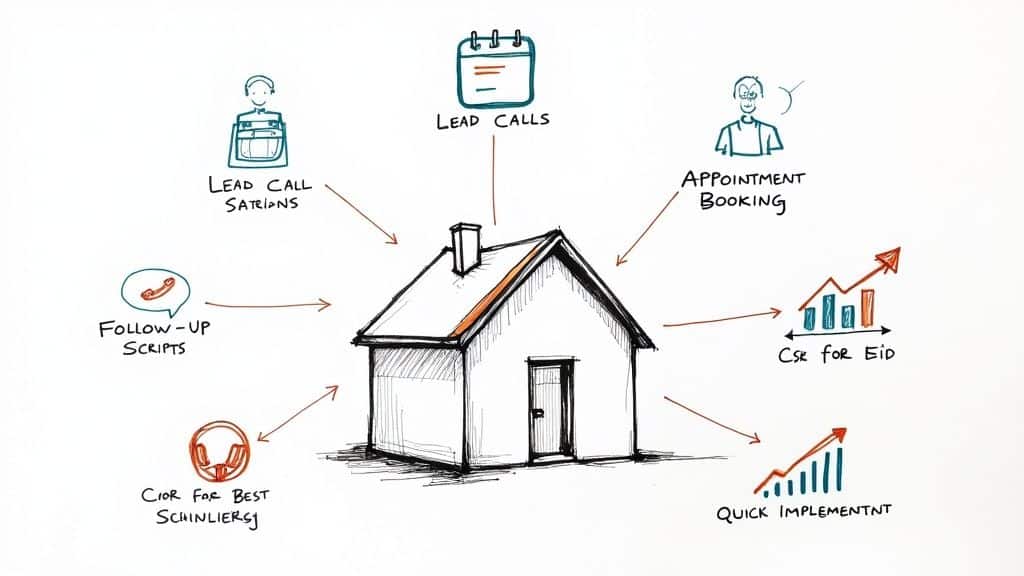
For home service businesses-plumbers, HVAC techs, electricians, and roofers-every unanswered call is a lost job. Every fumbled inquiry is a direct win for your competitor. The difference between a thriving business and one that constantly struggles often comes down to mastering the art of the sale, from the first ring to the final follow-up. While you're an expert at your trade, turning raw leads into loyal, paying customers requires an entirely different set of tools and a refined process.
This guide moves beyond generic advice to deliver actionable sales best practices tailored specifically for the unique demands of the home service industry. We will break down 10 essential strategies that address the entire customer journey, from initial contact to long-term relationship management. You'll learn how to implement proven methodologies like Consultative Selling to understand customer needs deeply and Value-Based Selling to justify your premium service.
A robust sales process requires understanding how to build a sales pipeline that consistently drives revenue, preventing potential customers from falling through the cracks. This article provides the framework to do just that. We'll explore everything from effective objection handling and negotiation tactics to modern social selling techniques that build trust before you even speak to a homeowner. Forget abstract theories; these are practical, on-the-ground systems for booking more appointments, impressing customers, and creating a repeatable engine for sustainable business growth. Let's get started.
1. Mastering the First Impression: Phone-First Lead Conversion
For most home service businesses, the sales process doesn't begin on a website form or an email; it starts with a ringing phone. Over 80% of new business originates from a phone call, making this first interaction the single most critical touchpoint in your customer journey. This isn't just about answering a question; it's your first and best opportunity to build trust, demonstrate professionalism, and convert an anonymous caller into a booked appointment.
Mastering this phone-first approach is one of the most fundamental sales best practices because it directly addresses the customer's immediate need and emotional state. A homeowner with a leaking pipe or a broken air conditioner is often stressed and looking for a quick, reliable solution. Your response on the phone sets the entire tone for their experience with your brand.
How to Implement a Phone-First Strategy
A successful phone-first conversion strategy relies on a structured yet empathetic approach. It’s not about a hard sell, but about confidently guiding the caller to the next logical step: scheduling a service call.
- Active Listening: Train your team to listen for keywords that indicate urgency ("water everywhere," "it won't turn on," "my family is cold"). Acknowledge their frustration immediately to build rapport. For example, instead of just saying "Okay," try "That sounds incredibly stressful; let's see how we can get a technician out to you right away."
- Empathy and Confidence: The caller needs to feel heard and believe you are the right person to solve their problem. A calm, confident tone reassures them they’ve made the right call.
- Control the Conversation: Your goal is to gather the necessary information (name, address, problem description) and book the appointment efficiently. A well-designed script helps guide the conversation without making it feel robotic.
Key Insight: A disorganized or rushed phone call is the fastest way to lose a lead. The customer will simply hang up and call the next company on the list. A professional, efficient, and empathetic voice on the other end of the line instantly differentiates you from the competition.
2. Targeting High-Value Accounts: A Focus on Commercial Clients
While residential jobs are the bread and butter for many home service companies, securing high-value commercial contracts can be transformative. This requires a shift from a wide-net approach to a highly focused strategy known as Account-Based Marketing and Selling (ABM/ABS). Instead of marketing to individual leads, you treat an entire high-value business or property management group as a single "market."
Adopting this account-based model is one of the most powerful sales best practices for scaling a service business because it concentrates your sales and marketing resources on prospects with the highest revenue potential. This strategic alignment ensures every piece of communication is personalized and relevant, significantly increasing the likelihood of landing large, recurring contracts with clients like apartment complexes, office buildings, or retail centers.
How to Implement an Account-Based Strategy
An effective ABM/ABS approach is about precision and personalization. It involves identifying your ideal commercial clients and creating a coordinated plan to engage all the key decision-makers within that organization.
- Define Your Ideal Commercial Profile: Start by identifying the characteristics of your best potential commercial clients. Consider factors like property size, number of locations, industry (e.g., hospitality, real estate management), and service needs. This focus prevents you from wasting resources on accounts that aren't a good fit.
- Identify the Buying Committee: In a commercial sale, you're rarely selling to just one person. Identify the key players, such as the facilities manager, the property owner, and the procurement officer. Your goal is to build relationships and communicate value to each of them.
- Create Personalized Outreach: Generic marketing won't work. Develop messaging that speaks directly to the specific challenges of that business. For example, create a custom proposal for a property management company highlighting how your preventative maintenance plan reduces unexpected repair costs across their portfolio.
Key Insight: Securing a commercial account is not a single transaction; it's about winning over a committee. Your strategy must address the unique concerns of each stakeholder, from the budget-focused executive to the on-the-ground maintenance supervisor, to demonstrate that your company is the best long-term partner.
3. SPIN Selling: Structuring the Conversation for Success
While a confident phone presence is crucial, what you ask is just as important as how you sound. SPIN Selling is a proven methodology that moves beyond simple question-and-answer and transforms your sales calls into structured, consultative conversations. Developed by Neil Rackham, this technique uses a specific sequence of questions to uncover a customer's core needs and guide them toward your solution.
This approach is one of the most effective sales best practices because it puts the customer's problem at the center of the conversation. Instead of pushing a service, you are pulling the customer toward a solution they help define. For a homeowner, this feels less like a sales pitch and more like a collaborative problem-solving session, which builds immense trust and increases the likelihood of booking a high-value job.

How to Implement SPIN Selling
The SPIN framework consists of four question types designed to be asked in order. This progression helps you understand the full scope of the customer's issue and its impact on them.
- Situation Questions: These gather basic facts about the customer's current setup. For example, "Can you tell me a little about your current AC unit?" or "How old is your water heater?"
- Problem Questions: Here, you uncover specific difficulties or dissatisfactions. Ask questions like, "Are you concerned about how high your energy bills have been?" or "What issues have you had with the unit keeping the house cool?"
- Implication Questions: These questions explore the consequences of the problems, highlighting their significance. For example, "What happens to your family's comfort when the AC can't keep up on a hot day?" or "Have you had to deal with any water damage from the leak under the sink?"
- Need-Payoff Questions: Finally, you encourage the customer to articulate the value of a solution. Ask, "How would a more efficient, reliable AC unit benefit your family this summer?" or "What would it mean to have peace of mind knowing that plumbing issue is solved for good?"
Key Insight: The power of SPIN Selling is in the Implication questions. Getting a customer to state the negative consequences of their problem in their own words creates a powerful, intrinsic motivation to accept your proposed solution. It shifts the dynamic from you selling to them buying.
4. Building Community Trust with Social Selling
In the home services industry, trust isn't just a bonus; it's the foundation of every sale. Social selling is the modern-day equivalent of being the trusted local expert everyone recommends. It’s the process of using platforms like Facebook, Instagram, and Nextdoor to build relationships, establish your credibility, and engage with your community long before a homeowner needs your services. Instead of waiting for a lead to call you, you become a familiar, helpful presence they already know and trust.
This approach is one of the most effective sales best practices for home service businesses because it shifts the dynamic from a cold transaction to a warm relationship. When a homeowner's AC breaks, they're more likely to call the company they’ve seen sharing helpful maintenance tips and engaging positively in their local Facebook group, rather than a random name from a search engine. You’re not just another service provider; you're a part of their community.
How to Implement a Social Selling Strategy
A successful social selling strategy focuses on providing value and building genuine connections, not just posting ads. It’s about being a helpful neighbor online, positioning your business as the go-to expert.
- Share Valuable, Non-Salesy Content: Post practical tips relevant to your trade, such as "5 DIY Ways to Improve Your Home's Air Quality" or "How to Prepare Your Plumbing for Winter." This positions you as an expert who wants to help, not just sell.
- Engage in Local Community Groups: Actively participate in local Facebook or Nextdoor groups. Answer questions related to your expertise when they arise, and offer helpful advice without an immediate sales pitch. For example, if someone asks for a plumber recommendation, you can respond with, "Happy to help if you need it. A common cause for that issue is X, you might want to check that first."
- Showcase Your Team and Work: Humanize your business by posting behind-the-scenes photos of your team, celebrating a job well done (with customer permission), or highlighting a technician of the month. This builds familiarity and trust.
Key Insight: Social selling is a long-term play that builds brand equity. While it may not lead to an immediate booking every time, it fills your future sales funnel with warm, high-trust leads who are far more likely to choose you over competitors when the need arises.
5. Value-Based Selling: Communicating ROI, Not Just Price
While a customer with a broken furnace needs an immediate fix, their decision often comes down to long-term value, not just the upfront cost. Value-based selling shifts the conversation from "How much does it cost?" to "What is the return on this investment?" This approach focuses on demonstrating quantifiable business or personal value to the customer, justifying the purchase by highlighting its long-term financial and operational benefits.

Adopting this strategy is one of the most powerful sales best practices for differentiating your service from lower-priced competitors. Instead of competing on price alone, you compete on the superior outcome and financial wisdom of choosing a better, more efficient solution. It repositions your technicians from simple repair people to trusted advisors who help customers make smart financial decisions for their homes.
How to Implement Value-Based Selling
Success with this strategy requires reframing your offerings in terms of tangible returns. You must connect the dots between your service and the customer's wallet, showing them how spending more now saves them money later.
- Build Simple ROI Models: Don't just tell a customer a high-efficiency HVAC unit is better; show them. Create a simple one-page sheet that calculates their estimated annual energy savings, the break-even point for the investment, and the total cost of ownership (TCO) compared to a cheaper, less-efficient model.
- Focus on Business Impact: For commercial clients, frame the value in terms of their business operations. A new, reliable water heater for a restaurant isn't just a piece of equipment; it's a tool that prevents costly downtime, ensures compliance with health codes, and avoids negative customer reviews.
- Use Case Studies and Data: Support your claims with real-world proof. Use data from past jobs to show average energy savings in your local climate or provide testimonials from customers who have seen significant returns after upgrading their systems.
Key Insight: Price is only an issue in the absence of value. When a customer understands the clear, long-term financial benefits and peace of mind your solution provides, the initial cost becomes a secondary consideration to the overall investment.
6. Embracing Inbound Selling: Attracting Customers Naturally
Modern homeowners rarely respond to cold calls or aggressive sales tactics. Instead, they research solutions online long before picking up the phone. Inbound selling is a customer-centric approach that attracts prospects by providing valuable content and helpful resources, positioning your business as a trusted authority. It’s about earning trust before a sales conversation even begins, making it one of the most effective sales best practices for long-term growth.
This strategy aligns perfectly with the home service buyer's journey. A customer with a failing water heater will search for "signs of water heater failure" or "cost to replace a water heater." By creating content that answers these questions, you attract qualified leads who are actively looking for your expertise, rather than chasing homeowners who may not need your services.
How to Implement an Inbound Selling Strategy
Implementing inbound selling means shifting from a "push" to a "pull" mentality. The goal is to become a resource that customers find organically when they have a problem.
- Create Problem-Solving Content: Develop blog posts, videos, or downloadable guides that address common homeowner issues. Topics like "5 Signs Your AC Needs a Tune-Up" or "DIY vs. Professional Drain Cleaning" attract your ideal customer at the exact moment they need help.
- Optimize for Local Search: Ensure your content is optimized for local search terms ("plumber in [Your City]," "emergency HVAC repair near me"). This helps you appear at the top of search results when local customers are looking for a solution.
- Guide with Clear Calls-to-Action (CTAs): Every piece of content should guide the user toward the next step. A blog post about leaky faucets should end with a clear CTA like "Experiencing a leak? Schedule your service call online now!"
Key Insight: Inbound selling transforms your sales process from an interruption into a welcome solution. When a customer finds you through your helpful content, the initial sales call is warmer, trust is already established, and the path to a booked job is significantly smoother.
7. Pipeline Management and Forecasting
Guesswork is the enemy of growth. For a home service business to scale beyond day-to-day operations, you need a clear, systematic way to track potential jobs from initial contact to a completed sale. This is where pipeline management comes in. It's the process of visually tracking and managing sales opportunities as they move through defined stages, giving you a real-time snapshot of your business's health and future revenue potential.
Implementing a structured sales pipeline is one of the most impactful sales best practices because it transforms sales from a reactive activity into a predictable, manageable process. Instead of just hoping the phone rings, you can accurately forecast future revenue, identify bottlenecks in your sales process, and coach your team based on data, not just intuition. This disciplined approach is how small shops evolve into regional powerhouses.
How to Implement Pipeline Management and Forecasting
Building a reliable pipeline isn't about complex software; it’s about defining your sales process and sticking to it. A CRM like Salesforce is a powerful tool, but the principles can start with a simple spreadsheet.
- Define Your Stages: Map out the customer journey from lead to closed deal. A typical home service pipeline might look like this: New Lead > Contact Made > Estimate Scheduled > Proposal Sent > Job Won/Lost. Each stage must have clear entry and exit criteria.
- Establish Qualification Standards: Determine the minimum information needed to advance a lead. For example, a lead can't move to "Estimate Scheduled" without a confirmed address, a clear description of the problem, and a specific appointment time.
- Conduct Regular Reviews: Hold weekly meetings to review the pipeline with your sales team or CSRs. Discuss key opportunities, identify deals that are stuck, and strategize on how to move them forward. This keeps momentum high and ensures no lead falls through the cracks.
Key Insight: Your sales pipeline is a diagnostic tool for your business. If estimates are being sent but few are converting, it signals a potential issue with your pricing, proposal clarity, or follow-up process. A well-managed pipeline illuminates the exact friction points that are costing you money.
8. Embracing the Solution Selling Mindset
Instead of selling individual services like a new water heater or an HVAC tune-up, the solution selling approach positions you as a trusted advisor who diagnoses underlying problems and recommends a comprehensive fix. This methodology shifts the focus from a single transaction to solving the customer's broader challenges, such as high energy bills, poor air quality, or recurring plumbing issues.
Adopting solution selling is one of the most impactful sales best practices for home service businesses because it builds immense long-term value. A homeowner might call about a single leaky faucet, but your technician can diagnose that as a symptom of high water pressure that is also damaging their appliances. By proposing a complete solution-a pressure-reducing valve alongside the faucet repair-you solve the immediate issue and prevent future costly breakdowns, establishing deep trust and loyalty.
How to Implement Solution Selling
Implementing solution selling requires training your team to think like consultants, not just order-takers. It's about uncovering the "why" behind the customer's call and presenting a holistic solution that provides lasting peace of mind.
- Diagnose Before Prescribing: Train technicians and CSRs to ask probing questions. Instead of just asking "What's the problem?", ask "What have you noticed lately with your system?" or "How have your utility bills been?" This uncovers deeper issues the homeowner may not even be aware of.
- Bundle Services into Solutions: Package complementary services together. For instance, an "Energy Efficiency Upgrade" could bundle attic insulation, duct sealing, and a smart thermostat. This makes the value proposition clearer than selling three separate items.
- Educate the Customer: Explain the root cause of the problem and how your comprehensive solution addresses it. Use simple analogies, like how high water pressure is like high blood pressure for a home's plumbing system. This empowers the customer and justifies the investment.
Key Insight: Solution selling fundamentally changes the customer relationship from transactional to consultative. When you solve a bigger problem than the one they called about, you transition from being a one-time service provider to their go-to home expert, dramatically increasing customer lifetime value.
9. Objection Handling and Sales Negotiation
Objections are not rejections; they are requests for more information. When a potential customer says, "Your price is too high," or "I need to think about it," they are signaling an unresolved concern. Effective objection handling is the art of uncovering that concern and addressing it with confidence, turning a potential roadblock into an opportunity to build trust and demonstrate value.
Mastering this skill is one of the most crucial sales best practices for home service professionals because it directly tackles the final hurdles before a sale. Instead of seeing objections as a sign of a lost deal, top performers view them as buying signals. A structured approach allows you to maintain control of the conversation, reinforce the value of your solution, and guide the customer toward a confident "yes."
How to Implement a Structured Objection Handling Process
A successful negotiation strategy is built on preparation and empathy. It’s about understanding the customer's true hesitation and framing your service not as a cost, but as a valuable investment in their home's safety and comfort.
- Listen, Validate, and Isolate: Never interrupt an objection. Listen carefully to the entire concern, then validate it to show you understand (e.g., "I can certainly appreciate that you want to be mindful of your budget."). Ask clarifying questions to isolate the real issue. Is it truly about the price, or is it about the perceived value?
- Reframe the Value Proposition: Connect your price back to the specific benefits and outcomes that matter to the customer. For example, "While our premium system is a significant investment, it comes with a 10-year parts and labor warranty and is 30% more energy-efficient, which will save you an average of $450 per year on utility bills."
- Prepare Your Responses: Anticipate the most common objections (price, timing, needing a second opinion) and have well-reasoned, evidence-based responses ready. Use testimonials, case studies, or data to back up your claims and build credibility. Reviewing past interactions is key; understanding how your team handles these conversations through call monitoring can provide invaluable insights for training.
Key Insight: The goal is not to "win" an argument but to collaboratively find a solution. When you treat an objection as a valid point of discussion rather than a confrontation, you transform the dynamic from a negotiation into a partnership, making the customer feel understood and respected.
10. Relationship Building and Account Management
For home service businesses aiming for sustainable growth, the goal isn't just to complete a single job; it's to become the go-to provider for that household for life. This is where strategic account management comes in. It’s the process of transforming a one-time customer into a long-term, high-value client by nurturing the relationship, anticipating their needs, and consistently delivering exceptional value.
Adopting this approach is one of the most powerful sales best practices because it shifts your focus from transactional wins to building a recurring revenue stream. A customer who trusts you for their plumbing repairs is more likely to call you for a water heater installation or a kitchen remodel. This strategy reduces customer acquisition costs and creates a loyal base of brand advocates who refer you to their friends and neighbors.
How to Implement Relationship-Focused Account Management
Building lasting customer relationships requires a proactive, systematic approach. It's about staying relevant and helpful even when the customer doesn't have an immediate, urgent need.
- Segment Your Customer Base: Identify your most valuable customers, those with multiple properties, or those who have invested in significant projects. These accounts deserve a higher level of personalized attention.
- Create a Proactive Communication Cadence: Don't just wait for them to call you with a problem. Implement a schedule for check-in calls, seasonal maintenance reminders (e.g., HVAC tune-ups before summer), and newsletters with helpful home-care tips.
- Leverage Your CRM: Use your Customer Relationship Management software to document every interaction, note personal details (like anniversaries or upcoming projects), and track service history. This allows any team member to provide a personalized, informed experience. Regular reviews of these interactions, which can be improved through call monitoring, help ensure consistent quality. Learn more about how call monitoring strengthens customer service on phonestaffer.com.
Key Insight: The best sales opportunities often come from existing customers. By actively managing these relationships, you uncover needs for system upgrades, preventative maintenance plans, and other high-ticket services before they even think to look at a competitor.
Top 10 Sales Best Practices Comparison
| Method | Implementation Complexity 🔄 | Resource Requirements ⚡ | Expected Outcomes 📊⭐ | Ideal Use Cases 💡 | Key Advantages ⭐ |
|---|---|---|---|---|---|
| Consultative Selling | High — multi-touch discovery, expert sellers required | High — senior reps, extensive research & follow-up | Strong long-term revenue, larger deal sizes, lower churn | Complex B2B/enterprise sales and strategic engagements | Builds trust, differentiates by expertise, reduces buyer remorse |
| Account‑Based Marketing & Selling (ABM/ABS) | High — cross-team planning and account orchestration | High — dedicated teams, CRM, intent/data platforms | Higher conversion & deal size for targeted accounts; better ROI | Named accounts, enterprise targets, strategic renewals | Highly personalized engagement; aligns sales & marketing |
| SPIN Selling | Medium — structured question sequence; training needed | Medium — sales training, coaching, practice time | Improved qualification and buyer commitment; predictable outcomes | Complex consultative deals needing deep discovery | Proven, research-backed questioning; lowers buyer resistance |
| Social Selling | Medium — consistent content cadence and engagement | Low–Medium — time commitment, social tools, modest budget | Greater visibility, trust, and indirect pipeline growth | Relationship-driven markets; SME and mid-market outreach | Cost-effective lead gen; expands networks; builds thought leadership |
| Value‑Based Selling | High — requires ROI/TCO modeling & business analysis | High — subject-matter expertise, data, case studies | Higher price realization, reduced price objections, stronger retention | Offers where ROI is measurable (software, services, consultancy) | Justifies premium pricing; defends against commoditization |
| Inbound Selling | Medium — content strategy, lead nurture and alignment | Medium — content production, SEO, marketing automation | More qualified leads, lower CAC over time; steady pipeline growth | Products with educational purchase journeys; SaaS & services | Attracts pre‑educated prospects; builds brand authority |
| Pipeline Management & Forecasting | Medium — defined stages, regular reviews & discipline | Medium — CRM rigor, analytics, manager coaching time | Improved revenue predictability; early risk identification | Organizations needing visibility and predictable revenue | Better forecasting; identifies at‑risk deals; optimizes resources |
| Solution Selling | High — diagnostic process and cross‑functional delivery | High — product breadth, implementation teams, senior sellers | Higher deal values, stronger outcomes, increased retention | Integrated offerings, systems integrators, complex projects | Bundled solutions defend price; enables expansion and stickiness |
| Objection Handling & Sales Negotiation | Medium — frameworks, roleplays, situational judgment | Low–Medium — training, playbooks, evidence resources | Fewer stalled deals; improved win rates and negotiated terms | Late‑stage deals, price/timing objections, competitive bids | Preserves momentum; converts concerns into added value |
| Relationship Building & Account Management | High — ongoing multi‑level engagement and executive touch | High — dedicated AMs, customer success alignment, time | High retention and expansion revenue; strong advocacy | Strategic/key accounts and long‑term partnerships | Maximizes lifetime value; reduces churn; drives referrals |
Putting Your Plan into Action
Navigating the landscape of modern sales can feel overwhelming, but mastering these proven sales best practices is the single most effective way to build a resilient and profitable home service business. We've explored a comprehensive toolkit, from the deep-dive discovery of SPIN Selling to the targeted precision of Account-Based Marketing and the customer-centric approach of Inbound Selling. Each of these methodologies offers a unique lens through which to view your customer interactions, transforming them from simple transactions into meaningful, value-driven partnerships.
The common thread woven through all these strategies is a fundamental shift in perspective. It’s about moving away from simply selling a service to actively solving a customer's problem. Whether you're handling objections with empathy, building long-term relationships for repeat business, or using social selling to establish authority, the goal remains the same: to become a trusted advisor, not just another contractor. This is what separates market leaders from the competition.
From Knowledge to Action: Your 30-Day Implementation Plan
Information is only powerful when applied. The true challenge isn't knowing these sales best practices; it's embedding them into your daily operations until they become second nature. Trying to overhaul your entire sales process overnight is a recipe for failure. Instead, focus on incremental, sustainable change.
Start by choosing just one or two key areas from this guide to master over the next month. Your choice should align with your biggest current challenge.
- Is your team struggling with inbound calls? Focus on Solution Selling. Develop and role-play new scripts that prioritize diagnosing the customer's root problem before ever mentioning a price.
- Are you losing leads during the follow-up process? Implement a structured Pipeline Management system. Define your sales stages and create a simple, automated follow-up cadence for every new lead.
- Need to land larger commercial accounts? Dedicate your efforts to Value-Based Selling and Relationship Building. Identify your top five ideal commercial clients and craft a personalized outreach plan focused on the long-term ROI you can provide them.
Once you’ve chosen your focus, commit to it. Hold a team training session, set clear goals, and most importantly, track your Key Performance Indicators (KPIs). Monitor your call booking rate, lead conversion percentage, and average job ticket size. Seeing these numbers improve provides the tangible proof and motivation needed to continue building on your success.
The Lasting Impact of Sales Excellence
Ultimately, adopting these sales best practices does more than just increase your revenue. It fundamentally changes the customer experience, building a reputation that generates referrals and commands loyalty. When customers feel heard, understood, and valued, they don't just become one-time clients; they become advocates for your brand. This creates a powerful growth engine that is far more sustainable than any marketing campaign.
The journey to sales mastery is a marathon, not a sprint. It requires patience, consistency, and a commitment to continuous improvement. By breaking it down into manageable steps and celebrating small wins along the way, you can transform your sales process from a source of stress into your company’s greatest competitive advantage. Remember, your technical skill gets you in the door, but your sales skill is what builds the entire house.
Ready to implement elite sales best practices without the heavy lifting of hiring and training? The experts at Phone Staffer provide professionally trained virtual assistants who specialize in the home service industry, turning more of your inbound calls into booked, high-value jobs from day one. Learn how Phone Staffer can upgrade your sales process today.