

SEO for HVAC is all about making sure your business shows up when local customers search for things like "ac repair near me" or "furnace installation cost." It's the strategy that turns your website from a simple online brochure into your best lead-generation machine, making you the first company a homeowner calls when their system gives out.
Why SEO for HVAC Is No Longer Optional
Think about it. When an air conditioner dies on the hottest day of the year, nobody is pulling out the Yellow Pages. They're grabbing their smartphone and frantically searching for help. That split-second search is where you either win or lose a new customer.
If your HVAC company isn't on the first page of Google for those critical searches, you're essentially invisible to most people in your service area. It's not just about getting found, though. It’s about getting chosen. A solid SEO strategy builds trust before you even pick up the phone. Seeing your name pop up in the local map pack tells a potential customer that you’re a legitimate, relevant, and trusted local pro.
The Competition Is Already Online
Let's be blunt: your competitors are already doing this. Right now, they are actively working to capture those high-intent searches for emergency repairs, new system installations, and routine maintenance calls. Every day you put SEO on the back burner, you're handing over jobs and market share to other contractors who get it.
The HVAC market is only getting bigger and more crowded, making a strong online presence more critical than ever.
The global HVAC market hit $157.71 billion in 2023 and is expected to grow by 5.5% each year through 2030. That growth means more competition, and you need every advantage you can get. Digging into these HVAC industry trends makes it clear where things are headed.
A smart SEO plan delivers a consistent flow of inbound leads, which means you can spend less on old-school advertising that’s often expensive and hard to track. You're investing in a long-term asset—your digital storefront—that keeps bringing in business month after month.
How SEO Directly Impacts Your Bottom Line
When you get down to it, good SEO for an HVAC business drives real, measurable growth. It’s not just about rankings; it’s about revenue.
Here’s what a successful strategy actually does for you:
- You get better leads. You’re not chasing cold prospects. You're attracting homeowners who have an urgent problem and are ready to hire someone to fix it. That means higher closing rates.
- You become the local authority. Showing up at the top of search results consistently builds incredible brand recognition and trust in your community, making you the default choice.
- You can actually measure your results. Unlike a billboard, you can track every click, call, and contact form that comes from your SEO work. This gives you a crystal-clear picture of your return on investment.
Skipping SEO is like having a secret phone number. You could be the best tech in the entire state, but if customers can't find you when they need you, it doesn't matter.
Mastering Your Local SEO Foundation
Before you can even think about dominating local search, you've got to get the foundation right. It's just like building a house—you wouldn't put up walls on shaky ground, and the same goes for your digital presence. Nailing these fundamentals is non-negotiable if you want SEO results that actually last.
This foundation really comes down to three things: your Google Business Profile, your website's on-page SEO, and making sure your business info is consistent everywhere online. Get these right, and you're setting yourself up to be found by customers when they need you the most.
Your Google Business Profile Is Your Digital Storefront
Let's be clear: your Google Business Profile (GBP) is probably the single most powerful tool you have for local SEO. It's often the very first thing a potential customer sees, especially when they're searching "AC repair near me" and that Google Map Pack pops up. An incomplete or outdated profile is the digital equivalent of a storefront with a broken sign and boarded-up windows. It just screams "don't trust us."
To really make it work for you, you have to go way beyond just listing your name and address. Every single section of your GBP is a chance to send strong ranking signals to Google and build confidence with searchers.
- Services: Don't just put "HVAC." Get specific. List out everything you do, from "ductless mini-split installation" and "emergency furnace repair" to "smart thermostat setup." Think like a customer.
- Products: If you install specific systems, like a Trane XR14 or a Carrier Infinity Series, add them as products. Use good photos and write clear descriptions.
- Photos: Keep a steady stream of real photos coming. Pictures of your team on the job, your branded vans parked in local neighborhoods, and finished installations prove you're a real, active business.
- Updates: Try to post a weekly update. It can be a special offer, a seasonal maintenance tip, or a quick "before and after" from a recent job. This keeps your profile fresh and tells Google you're open and active.
- Q&A Section: Don't wait for customers to ask questions—ask and answer them yourself! Add common queries like, "What are your service hours?" or "Do you offer financing?" This lets you control the information and helps customers get answers fast.
When someone's AC dies in the middle of July, their journey from panic to picking up the phone is incredibly fast. They have a problem, they search, and they contact someone. It’s that simple.
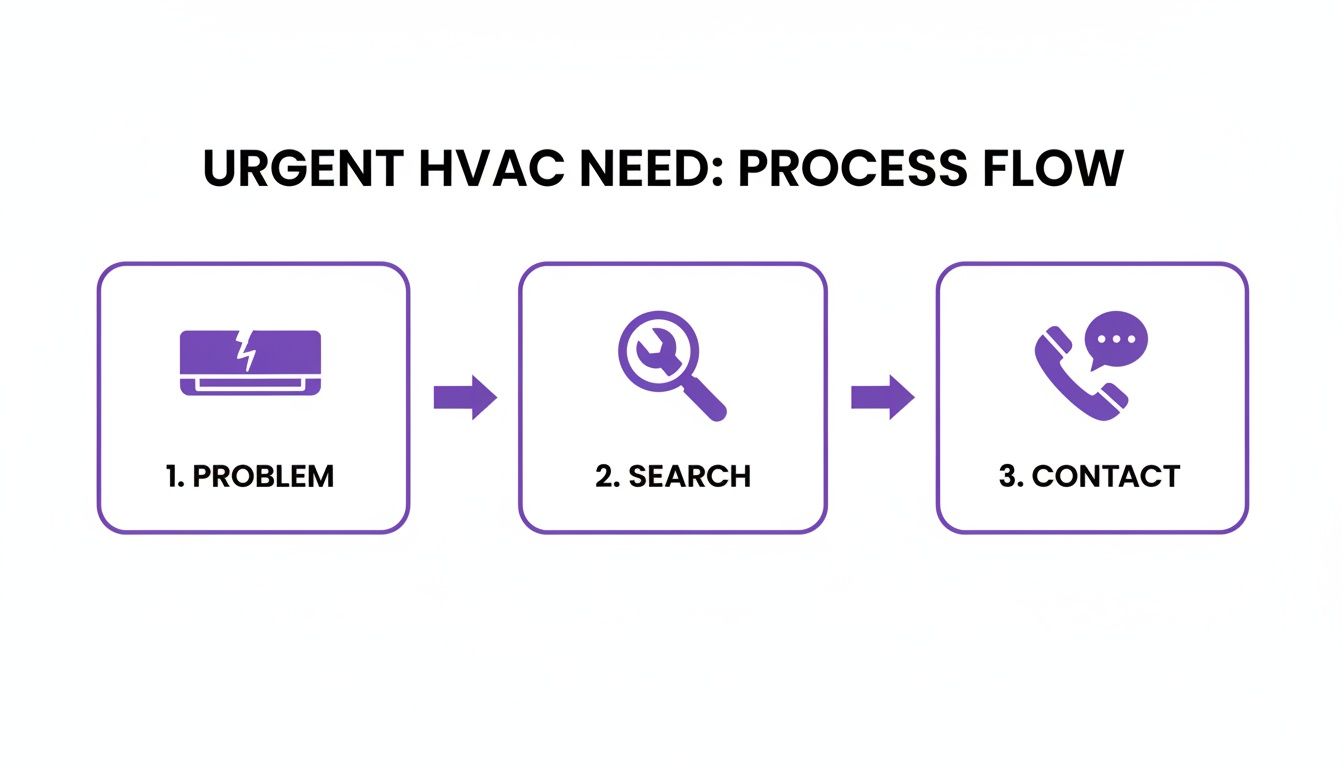
This is precisely why a fully optimized Google Business Profile is so critical. It’s your best shot at getting in front of customers at the exact moment they’re looking for a solution.
Fine-Tuning Your Website's On-Page SEO
While your GBP is the handshake, your website is where you actually close the deal. Good on-page SEO makes it crystal clear to both Google and your visitors what you do and where you do it. The best way to start is by creating dedicated pages for each service and for each town you serve.
A single, generic "Services" page just won't cut it anymore. If you offer five key services in three different towns, you should have specific pages for the most important combinations.
For instance, you'd want pages like:
yourwebsite.com/ac-repair-springfieldyourwebsite.com/furnace-installation-springfieldyourwebsite.com/duct-cleaning-shelbyville
Each of these pages needs unique content that's actually relevant to that service in that location. Talk about local landmarks, mention common problems in the area (like dealing with high humidity in the summer), and feature testimonials from local clients. This hyper-local strategy shows Google that you're the go-to expert for that service in that specific town.
For a deeper dive, this SEO basics for small businesses with a local ranking guide is a fantastic resource to build on these foundational concepts.
The Power of Consistent NAP Information
Finally, we need to talk about NAP: your Name, Address, and Phone Number. This information has to be 100% identical everywhere it shows up online. Any little inconsistency can confuse search engines and make customers question if you're a legitimate business.
Think about it from Google's perspective. If it sees "123 Main St." on your website, "123 Main Street" on Yelp, and "123 Main St., Ste 4" on another directory, it starts to wonder which one is correct. That doubt is enough to hurt your local rankings.
Your job is to do an audit and make sure your NAP is consistent down to the very last comma. Check it across:
- Your Website (Header, Footer, Contact Page)
- Google Business Profile
- Facebook Business Page
- Yelp, Angi, HomeAdvisor
- Local Chamber of Commerce and any other online directories
When all these sources match perfectly, they all reinforce to Google who you are and where you're located. It's a simple but incredibly powerful signal that so many businesses get wrong.
Creating Content That Books Appointments
Getting the technical side of SEO right is what puts you on Google’s radar. But it's your content that gets a homeowner to actually pick up the phone and call you. A winning content strategy for an HVAC business has nothing to do with pumping out generic blog posts. It’s all about creating genuinely useful resources that answer the exact questions your potential customers are asking.
Think of your website's content as your best, most knowledgeable technician—one who’s on call 24/7. When a homeowner’s furnace starts making a strange banging noise at 2 a.m., your blog post should be the first thing they find on Google. It should give them clear, simple answers and an easy way to book a service call. This is how you turn a basic website into a lead-generating machine.

This approach to SEO for HVAC builds an incredible amount of trust. When you provide real value before asking for anything in return, you position your company as the go-to local expert.
Build Hyper-Local Service Pages
Think of your service pages as your digital sales reps. A single, generic "AC Repair" page just won't cut it in today's competitive market. You need to build out hyper-local pages that speak directly to customers in the specific towns, cities, and even major neighborhoods you work in.
These pages need to feel like they were written just for someone living in that community.
- Drop in local landmarks. For instance, "We offer emergency AC repair for homes just around the corner from Springfield Town Square."
- Talk about local climate challenges. "Tired of fighting Austin's brutal summer humidity? We specialize in installing high-efficiency dehumidifier systems to keep you comfortable."
- Showcase reviews from neighbors. Nothing builds confidence faster than a glowing testimonial from someone who lives down the street.
So, instead of one page for "Furnace Installation," you should have pages for "Furnace Installation in Oakwood" and "Heat Pump Installation in Brookside." Each page needs unique content that’s relevant to that service in that specific place. This makes it far more likely to show up when a homeowner nearby searches for help.
Craft a Blog That Actually Solves Problems
Your blog is where you get to prove you know your stuff. It’s your best opportunity to answer the hundreds of questions that homeowners are typing into Google every single day. The trick is to stop thinking like a contractor and start thinking like a customer. What are their real-world headaches and worries?
Just think about the questions you get asked on the job all the time. That’s your goldmine for blog topics.
- Why is my furnace making a weird clanking noise?
- Seriously, how often should I change my air filter?
- Is a smart thermostat really worth the money in a Texas summer?
- What are the warning signs my air conditioner is about to die?
- What's the real difference between a heat pump and a traditional furnace?
Every one of those questions is a perfect blog post. When you give someone a clear, helpful answer, you’re doing more than just optimizing for a keyword—you’re starting a relationship.
Pro Tip: Always wrap up a problem-solving post with a clear call to action. After you explain the likely causes of a noisy furnace, guide them to the next step: "If these quick checks don't fix the noise, it's time to bring in a pro. Schedule your diagnostic with us today to keep your family warm and safe."
Turning Information into Appointments
Let's be clear: the end goal of all this content is to get a reader to become a paying customer. Every single article and page you create needs to have a clear, easy path for them to take the next step. This isn't about being pushy; it's about making it dead simple for them to book a call when they're ready.
Different types of content will attract customers at different stages of their journey.
| Content Type | Customer Question | Main Goal |
|---|---|---|
| Problem-Solving Blog Post | "Why does my AC smell musty?" | Build trust and show your expertise. |
| Local Service Page | "AC repair in Glendale" | Capture someone ready to book now. |
| System Comparison Guide | "Best HVAC systems for older homes" | Guide a customer thinking about a big purchase. |
This strategy ensures you have something for everyone. The person just starting their research might find your blog, while the one with a broken AC will land right on your service page. By creating targeted, helpful content for each scenario, you guide people smoothly from their initial Google search all the way to a booked job on your calendar. This holistic view is what separates okay SEO from truly great SEO for HVAC companies.
Building Trust with Reviews and Local Links
In the home services world, trust is everything. It’s the foundation your business is built on. When you're working on your HVAC SEO, you're not just trying to make a search engine happy—you’re trying to earn a homeowner's confidence before they even pick up the phone. Google gets this. That’s why it rewards two of the most powerful trust signals out there: customer reviews and local backlinks.
Think of it this way: positive reviews are your digital word-of-mouth. Local links are your community endorsements. When you nail both, you show Google that you’re not just some company with a website, but a respected, active part of the local scene. This is what separates the businesses on page one from everyone else.

Generate a Steady Stream of Positive Reviews
Your Google Business Profile's star rating is often the first thing a potential customer sees. A high rating with lots of reviews can single-handedly get you the call over a competitor. The secret is making it dead simple for happy customers to leave you feedback.
Don't just cross your fingers and hope they’ll do it. You need a system.
- Strike while the iron is hot: Send a review request within 24 hours of finishing the job. The positive experience is still fresh in their mind.
- Keep it simple: Send a direct link to your Google review page via text or email. The fewer clicks it takes, the more reviews you’ll get. It's that simple.
- Personalize the ask: A quick message from the tech can work wonders. "Hi [Customer Name], this is [Technician Name] from [Your Company]. Glad we could get your AC running today! If you have a minute, we'd appreciate you sharing your experience on Google."
A constant flow of new reviews tells Google your business is active, relevant, and keeping customers happy. If you're looking for ideas, check out these HVAC testimonials to see how others are showcasing their great work.
How to Handle the Inevitable Bad Review
Look, negative reviews happen. Even to the best of us. What really matters is how you respond. A professional, calm reply can actually build more trust than a flawless 5.0-star rating ever could.
Never, ever ignore negative feedback. Always respond publicly and quickly.
- Acknowledge their frustration and apologize. Start with something like, "Thank you for the feedback, and we're truly sorry your experience didn't meet expectations."
- Take the conversation offline. The goal is to solve the problem, not have a public debate. Offer a direct line: "We want to make this right. Please call our manager, [Name], directly at [Phone Number] so we can sort this out."
- Stay professional. Don't get defensive. Your public response is for every future customer who reads it. Show them you take service seriously.
Demystifying Local Link Building
Think of backlinks as votes of confidence from other websites. When a well-regarded local website links to yours, it's telling Google that you're a trusted local authority. This isn't about shady SEO tricks; it’s about real community involvement that just happens to have amazing SEO benefits.
A link from the local Chamber of Commerce, a neighborhood blog, or the youth sports team you sponsor is worth far more for local SEO than a random link from an irrelevant site. Google understands context and rewards local relevance.
Here are a few practical ways to earn these powerful local links:
- Sponsor a local event or team: Little league teams, 5K charity runs, and community festivals almost always list their sponsors online with a link back to their website.
- Partner with other local pros: Get to know local real estate agents, plumbers, and electricians. You could offer to write a guest post for their blog (e.g., "Top 5 HVAC Checks Before You Buy a Home") in exchange for a link.
- Join your local Chamber of Commerce: Most chambers have an online directory where they list and link to all their members. This is often one of the easiest and most authoritative local links you can get.
These activities do more than just boost your website's authority. They weave your business into the fabric of the community, building real-world brand recognition and trust that pays off both online and off.
Turning SEO Traffic Into Profitable Jobs
You’ve done everything right. You’ve nailed your keyword research, optimized your website, and climbed the local search rankings. Now, the moment of truth arrives: a homeowner with a busted AC on a 95-degree day finds you on Google and calls. This is where your SEO investment pays off, right?
Well, not so fast.
The hard reality is that getting your phone to ring is only half the battle. If that call goes to voicemail or gets a rushed, unprofessional answer, you’ve just thrown away every single dollar you spent to get that lead. That desperate customer isn't going to leave a message—they're just going to hang up and call the next HVAC company on Google’s list.
This is, without a doubt, the biggest leak in the sales funnel for most home service businesses. All your brilliant online work can be completely torpedoed by what happens in the first 30 seconds of that phone call.
The True Cost of a Missed Call
A missed call isn't just a missed opportunity; it's money straight out of your pocket. You paid for that lead with your time and marketing budget, and now it's gone, likely to the competitor right below you in the search results. When someone's heat is out in the middle of winter, they have zero patience for a phone that just rings and rings.
And don't forget the lifetime value of that customer. A simple repair call can easily turn into a lucrative maintenance contract and, down the road, a full system replacement worth thousands. When you lose that first call, you lose all of that potential future revenue, too.
Every unanswered ring tells a customer you're either too busy for them or not professional enough to handle their emergency. In their mind, the search for a reliable HVAC contractor isn't over—it's just starting again.
The problem is, as an HVAC owner, you're constantly pulled in a million directions. You can't be on a roof fixing a unit and personally ensure every incoming call gets the immediate, expert attention it needs.
Why Professional Call Handling Is a Game-Changer
Even if you do manage to answer the phone, the quality of that first impression is everything. A distracted, uninformed, or rushed response can be just as bad as not answering at all. The person answering your phone is the face of your company—your director of first impressions.
A truly professional customer service representative (CSR) does so much more than just take a message. A great CSR is trained to:
- Show genuine empathy for the customer's frustrating situation.
- Quickly and efficiently gather the essential details needed to get a tech dispatched.
- Confidently answer common questions about service fees, scheduling, and what to expect.
- Secure the appointment on the spot, turning a frantic caller into a booked job.
This caliber of service builds instant trust and reassures the customer they called the right company. It transforms a simple phone inquiry into a seamless, professional experience that sets the tone for the entire relationship.
Plugging the Leaks with a Dedicated Solution
This is exactly where specialized services come in, designed to fill that critical gap. Instead of watching valuable leads slip through your fingers, you can have every call handled by a trained professional who lives and breathes the home services industry.
This screenshot from the Phone Staffer website nails it—they provide trained, remote team members who become an extension of your business, managing these crucial customer interactions for you.
What you're seeing is a clear solution to the lead conversion problem. It’s about integrating skilled CSRs directly into your workflow to handle calls and book appointments so that no opportunity is ever missed. This approach effectively patches the leaks in your sales funnel, ensuring you get the maximum return on your SEO investment.
By entrusting your call handling and appointment setting to experts, you guarantee that every single lead your SEO generates is treated with the urgency and professionalism it deserves. You’re no longer just answering the phone; you're actively converting that hard-earned traffic into profitable, booked jobs. This is the final, crucial step that turns a good SEO strategy into a great one that drives real, measurable growth for your HVAC business.
Common SEO Questions from HVAC Owners
Diving into SEO for your HVAC business always brings up a few key questions. Once you get past the theory and start thinking about the day-to-day, you need real answers. Let's tackle some of the most common things we hear from HVAC owners who are right where you are now.
How Long Does HVAC SEO Really Take to Work?
This is always the first question, and for good reason. You're investing time and money and you want to know when you'll see a return.
While you can see some quick wins in as little as 1-3 months—especially from whipping your Google Business Profile into shape—real, lasting results take a bit longer. Think of SEO as building a reputation, not just flipping a switch.
To see significant movement for those high-value keywords like "AC repair in [Your City]," you should plan for 6-12 months of consistent work. That's the time it takes for Google to really notice your new content, index your pages, and start trusting the authority you're building with reviews and local links. It's a long-term play, but one that pays off month after month.
Can I Do All This SEO Stuff Myself?
Yes, you absolutely can. Many HVAC owners should handle the foundational pieces of their own SEO, at least to start. Nobody knows your business better than you do.
You can get a huge head start by focusing on a few key areas:
- Perfecting your Google Business Profile. Fill out every single section. Don't skip anything.
- Building out local service pages. Write detailed pages for the exact jobs you do in the specific towns you serve.
- Asking every happy customer for a review. Make it a simple, repeatable part of your process after every job.
But let's be realistic—as you grow, SEO can become a massive time sink. More advanced stuff like technical site audits, deep competitor research, and consistent local link building really do require specialized knowledge. Many owners get the basics dialed in and then partner with an agency to take it to the next level, freeing them up to actually run the business.
A hybrid approach often works best. You handle the things you know inside and out—like posting photos of recent installs or answering customer questions on GBP—and you let a specialist handle the more technical, time-consuming tasks.
Local Search vs. Organic Search: What's More Important?
For 99% of HVAC contractors, local search is king. It’s not even a debate. Your entire business model is built on serving customers within a specific service area. That means your number one goal is showing up in the Google Map Pack and for any search that includes a city or town name.
Just think about your best customer. They aren't searching for a generic "furnace repair" guide. They're on their phone typing "furnace repair in Dallas" or "AC company near me." These are local searches, and they're packed with intent to buy.
The great thing is, a strong local SEO game naturally boosts your organic search performance over time. As you build authority in your service area, Google starts seeing you as a relevant result for broader HVAC topics, too. But you always, always start by winning in your own backyard. It's the most direct path to more calls and more profitable jobs on the schedule.
A great SEO strategy makes the phone ring, but if there's no one there to answer it professionally, that investment goes down the drain. Phone Staffer ensures every lead gets captured. We provide trained, remote CSRs who answer your calls and book appointments, turning your hard-won SEO traffic into actual jobs. Learn how we help HVAC contractors convert more leads.