
Let's be honest, the term "cold call" can make you cringe. It probably brings to mind a pushy telemarketer reading from a stale script, trying to sell you something you don't want.
But we need to get that image out of our heads.
A modern cold call, especially for a home service business, is nothing like that. Think of it as the digital version of knocking on doors in a neighborhood you're already working in. Instead of walking the block, you're just picking up the phone to start a helpful conversation. The main goal? To see if they have a need you can solve and book an appointment.
Defining the Modern Cold Call for Home Services
For an HVAC, plumbing, or roofing contractor, a cold call is a surgical tool. It's a focused way to connect with specific homeowners in your service area who are very likely to need what you offer, whether they know it yet or not.
Instead of passively waiting for leads to trickle in from Google ads or direct mail, you’re taking the initiative. This proactive approach puts you firmly in the driver's seat, letting you fill gaps in your schedule during slow months or strategically break into a new neighborhood. The entire game changes when you stop thinking of it as a hard sell and start treating it as a friendly, value-first conversation.
The Purpose Beyond the Dial
Here’s where a lot of people get it wrong. The point of a cold call is not to sell a brand-new AC unit or a full roof replacement over the phone. That's just not going to happen, and trying to force it is a surefire way to fail.
The real purpose is much simpler and far more realistic: secure a qualified appointment.
That’s it. Your entire conversation should be built around achieving a few small wins that lead to that bigger goal:
- Introduce Your Business: Quickly and clearly say who you are and what you do.
- Identify a Potential Need: Ask smart questions to uncover if the homeowner has a problem you can fix.
- Offer Value Upfront: Give them something first, like a free inspection, a special on a seasonal tune-up, or even just a useful tip.
- Book a Follow-Up: Get a firm time on the calendar for a tech to visit, give an estimate, or perform a small service.
To help break it down, here’s a quick look at the core components.
A Modern Cold Call at a Glance
| Component | Description for Home Services |
|---|---|
| Opener | A brief, friendly introduction of you and your company. The goal is to build rapport in seconds. |
| Pitch | A concise statement about why you're calling and the value you can offer (e.g., a furnace tune-up special). |
| Qualifying | Asking targeted questions to confirm they're a good fit (e.g., "How old is your current water heater?"). |
| Handling Objections | Addressing common concerns like "I'm not interested" with prepared, empathetic responses. |
| The Close | The final step: confidently asking to schedule a specific date and time for an appointment. |
Each part flows into the next, guiding the homeowner from curiosity to commitment.
Why It Still Works Today
With all the focus on digital marketing, it’s easy to think the phone call is dead. It's not. That direct, human connection you get from a two-way conversation is something an email or a social media ad just can't match.
The data backs this up. A recent survey heading into 2025 revealed that 68% of sales professionals work for companies that still rely on cold calling. More importantly, 65% of reps personally use it to hit their targets. This isn't some outdated tactic; it's a proven strategy that continues to deliver when it's done right. You can read the full research about cold calling trends to see just how relevant it remains.
A successful cold call for a home service business isn't about closing a deal; it's about opening a door. Your goal is simply to earn the homeowner's trust for the next step—an in-person appointment.
Why Cold Calling Still Drives Growth in Home Services
In a world overflowing with digital ads and social media noise, it’s fair to wonder if cold calling still has a place. For a home service business, the answer is a resounding yes. It remains one of the most direct and powerful ways to drum up new business.
Think about it: online marketing is great, but it’s often a waiting game. You put an ad out there and hope someone clicks. Cold calling is different. It’s proactive. You’re not waiting for leads to come to you; you’re going out and creating them.
This direct approach lets you connect with homeowners instantly, build a little rapport, and answer their questions right then and there. An email can be deleted without a thought, and a social media ad is easily scrolled past, but a real conversation? That creates a human connection. And that’s a huge advantage when you're asking someone to trust you enough to come into their home to fix their furnace or landscape their yard.
Take Control of Your Schedule and Territory
One of the best things about cold calling is the immediate impact it can have. Is your schedule looking a little light next week? A few hours of focused calls can fill those empty slots fast. It gives you direct control over your workflow.
Maybe you're looking to expand into a new neighborhood. Instead of waiting months for your local SEO to kick in, you can start making calls and introduce your services directly to the people who live there. It's about surgically targeting opportunities instead of casting a wide net and just hoping for the best.
This is how you turn a simple phone number into a real opportunity. We dive deeper into this process in our guide on what is a sales lead, which explains how these first conversations fit into your overall growth plan.
The Undeniable Math of Making Connections
Despite what you may have heard, the numbers don't lie—cold calling still works. Success isn’t about closing a deal on every single call. It's a numbers game, and the wins add up over time. You just have to understand the benchmarks and constantly work to improve them.
Cold calling isn't just about making sales; it's about starting conversations. In home services, where trust is everything, a well-placed, friendly call can open the door to a long-term customer relationship.
Modern data shows this is still a reliable and measurable way to find new customers. A 2025 analysis from Cognism found that the global success rate for cold calling is around 6.7% (based on meetings booked). That's a solid improvement from the 4.82% baseline in 2024. These figures prove that with a good script and a skilled caller, you can consistently book appointments. You can dig into more stats in the 2025 cold calling report.
A proactive calling strategy is the perfect partner to your other marketing efforts. For more ideas on how to round out your approach, check out these effective small business lead generation strategies. When you combine direct outreach with your digital marketing, you build a powerful system that keeps your pipeline full and your business growing, no matter what season it is.
The Anatomy of a Successful Cold Call
A great cold call isn't magic. It's a skill, and like any skill, it's built on a solid framework. Think of it less like a rigid script and more like a roadmap—a series of steps that guide the conversation from a cold "hello" to a warm opportunity. When you follow this blueprint, you create a natural, logical flow that turns skepticism into genuine interest.
Each stage builds on the one before it, making the process feel helpful and professional, not pushy. The ultimate goal? To get that appointment booked.
This simple process of connecting with the right people and asking the right questions is what fuels real, measurable growth.
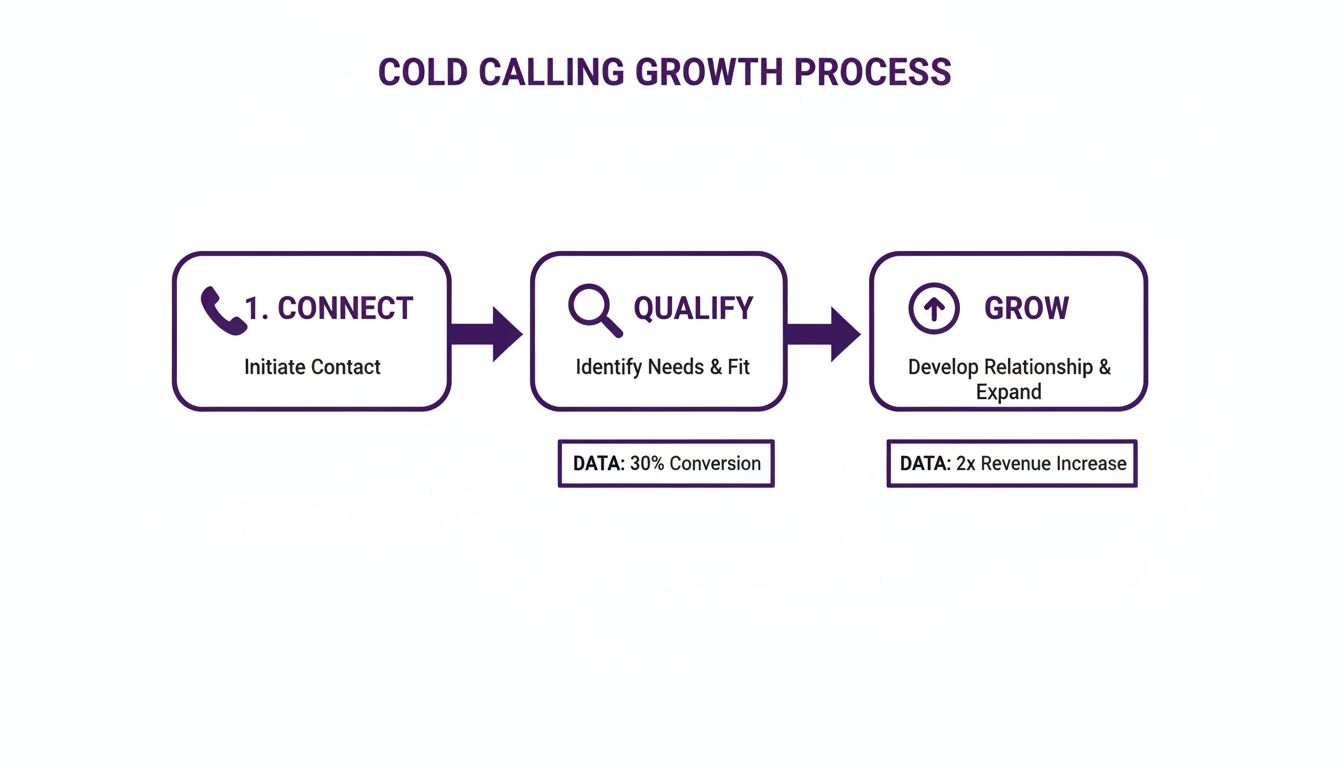
Let's break down the five crucial stages that move the conversation forward.
Stage 1: The Opening
You have about seven seconds. That's it. This is your first and most important test. If you start with a tired line like, "Am I speaking with the homeowner?" you’ve already lost. They know it's a sales call, and the walls go up.
Instead, your opener needs to sound confident, friendly, and local. Try something that establishes a connection right away: "Hi, my name is John from ABC Plumbing. We’re actually working with a few of your neighbors on Main Street this week, and I just had a quick question for you."
It’s disarming, it's relevant, and it makes them curious. That's all you need to get to the next stage.
Stage 2: The Value Proposition
Okay, you have their attention. Now you have to immediately answer the question everyone is thinking: "What's in this for me?" This isn't the moment for a long-winded story about your company's history. You need a single, powerful sentence that offers them something of value.
For example: "We're offering a complimentary furnace safety check to local homeowners to help prevent any surprise breakdowns this winter."
See what that does? It offers clear, immediate value without asking for anything in return… yet.
Stage 3: The Qualifying Questions
Now it's time to shift gears. This is where you find out if the person on the other end is actually a good fit for your services. You stop talking at them and start talking with them. The goal is to ask simple, open-ended questions to gather key information.
- "When was the last time you had your air ducts cleaned?"
- "Just out of curiosity, how old is your current water heater?"
- "Have you had a chance to check for any missing shingles after that last big storm?"
A huge part of effective cold calling is knowing who to call in the first place. For businesses using a CRM, mastering HubSpot contact scoring is a game-changer, helping your team focus their energy on the leads most likely to say yes.
Stage 4: Handling Objections
Let’s be real: you're going to get objections. But here's the secret—objections aren't rejections. They're usually just requests for more information. When someone says, "I'm not interested," or "I'm too busy," don't panic. The trick is to respond with empathy and then smoothly pivot back to your value proposition.
If a homeowner says, "We already have an HVAC guy," a great response is, "That's great to hear! We're not looking to replace them, just offering a second opinion with a free inspection while we're in the area."
This simple reply acknowledges what they said, shows respect, and keeps the door open. You sound confident, not desperate.
Stage 5: The Close
This is the final step, and it's where a lot of people get nervous. You have to confidently ask for the appointment. Don't be vague with something like, "When might be a good time?" That puts the work back on them. Instead, take control by offering specific, easy choices.
Try a strong closing line like this: "We have a technician available tomorrow morning around 9 AM or in the afternoon at 2 PM. Which of those works better for you?"
This makes it incredibly easy for the homeowner to say yes and gets a firm commitment locked into your calendar.
Practical Cold Calling Scripts You Can Use Today
Understanding the anatomy of a great cold call is the first step. But having a solid, field-tested script in your back pocket is what gives you the confidence to actually pick up the phone.
Think of a script less like a screenplay you have to recite word-for-word and more like a roadmap. It’s there to keep you on the right path, making sure you hit all your key talking points without getting lost. The best ones are built with natural breathing room, creating space for the homeowner to talk. That's how a one-sided pitch becomes a real conversation.
Let's dive into some templates designed for real-world home service situations. Use these as a foundation, and feel free to tweak the language to match your company's personality and specific offers.
Script For Seasonal HVAC Maintenance
This script is your best friend when you need to fill up the schedule before the summer scorchers or winter freezes arrive. It’s a proactive approach that taps into a need every homeowner has but almost always procrastinates on.
Caller: "Hi, my name is [Your Name] from [Your Company Name]. We’re calling a few homeowners in the [Neighborhood Name] area today. With the weather starting to warm up, we’re offering a $59 A/C tune-up special this week to make sure everything is running efficiently before the first heatwave hits. We have a technician available in your area on Wednesday morning or Thursday afternoon. Which of those works better for a quick check-up?"
Why this script works:
- It’s Local: Right away, mentioning the neighborhood by name tells them this isn't a random call from a massive call center.
- It’s Timely: Connecting the offer to the changing seasons makes it feel urgent and relevant.
- It’s Specific: You’re not being vague. You give them a clear price ($59) and two simple scheduling options, making it incredibly easy to say "yes."
This approach gets straight to the point, respects their time, and frames the offer as a helpful reminder, not an aggressive sales pitch.
Comparing Effective vs. Ineffective Cold Call Openers
You’ve got about seven seconds to either get hung up on or earn the right to keep talking. That’s it. A weak, clunky opening gets you a dial tone almost instantly. A strong, confident opener that leads with value, on the other hand, piques their curiosity.
Let's look at the difference a few words can make.
| Ineffective Opener | Effective Opener | Why It Works Better |
|---|---|---|
| "Hi, am I speaking with the homeowner?" | "Hi, this is [Name] from [Company]. We're working with a few of your neighbors in the area and I just had a quick question for you." | The effective opener is disarming and immediately establishes a local presence. It makes the homeowner curious instead of defensive. |
| "Would you be interested in a free roofing estimate?" | "We noticed that big hailstorm passed through your neighborhood last week. We’re offering free, no-obligation roof inspections to check for any hidden damage." | It connects directly to a real, recent event. This frames the offer as a helpful service, not just another sales attempt out of the blue. |
See the pattern? The effective openers provide immediate context and value. They instantly answer the homeowner's unspoken question: "Why are you calling me right now?"
The most successful cold calls feel less like a sales pitch and more like a helpful neighbor giving a friendly heads-up. The goal is to offer a solution before they even realize they have a problem.
By shifting your approach to use these kinds of targeted, value-driven scripts, you can completely change your cold calling game. This isn't about arm-twisting or high-pressure tactics; it’s about starting helpful conversations that naturally turn into booked jobs and a much healthier bottom line.
Choosing Your Calling Strategy: In-House vs. Outsourced
Alright, so you’re on board with giving cold calling a real shot. Now comes the big question: do you build a team yourself, or do you bring in the pros? This is more than just a preference—it’s a major fork in the road for your business that will shape your budget, your time, and ultimately, your growth. Let’s break down what each path really looks like for a home service company.
Bringing everything in-house gives you total, hands-on control. You're the one hiring, training, and shaping the scripts. This means every single call can be a perfect reflection of your brand's voice and values. That kind of control is a powerful advantage, but it doesn't come cheap, and the biggest cost might just be your own time.
You'll be on the hook for everything: salaries, software, and keeping your team motivated. Managing the day-to-day grind and morale of a calling team can quickly turn into a full-time job you didn't sign up for.
The Case for an In-House Team
The main draw for keeping your cold calling in-house is that deep connection to your business. Your callers are your people, breathing your company culture every day. That immersion can translate into truly authentic, convincing conversations with homeowners.
But don't underestimate the legwork. The operational side is a heavy lift.
- Hiring: Finding people with the right blend of charm and thick skin to handle cold calling is tougher than it sounds.
- Training: You have to build their knowledge from the ground up—your specific services, the scripts, and how to handle a "no" gracefully.
- Technology: Get ready to invest in dialers, a CRM to track everything, and decent headsets.
- Data Management: This one’s a silent killer. You’re responsible for finding and cleaning up your contact lists.
That last point is a huge deal. One recent analysis showed that B2B contact data goes bad at a rate of 2.1% every month. That means after a year, nearly a quarter of your expensive list could be totally useless. The same study found that reps waste about 27.3% of their time just wrestling with bad data. You can learn more about these cold calling statistics and see just how much time goes down the drain.
Partnering with an Outsourced Expert
Outsourcing is the "get it done now" approach. When you partner with a specialized service, you're essentially plugging into a ready-made machine. You get a team of trained, professional callers who know how to start booking appointments from day one, minus the massive overhead of building your own operation.
This path lets you skip the entire hiring and training headache, which can save you weeks, if not months. A good partner already has the systems, the tech, and the management to get you consistent results. The trick is to find a service that actually gets the home service industry and isn't just reading a generic script.
Choosing to outsource is like hiring a master plumber instead of trying to fix a burst pipe yourself. You're paying for expertise and immediate, professional results without the steep learning curve.
There’s also a smart middle ground. A modern hybrid model, like the trained remote CSRs or Virtual Assistants from Phone Staffer, can bridge that gap. You get a dedicated professional who can handle your outreach calls without the cost or commitment of a full-time employee. It’s a flexible way to get serious expertise in your corner.
Your Cold Calling Questions Answered
Even with a solid plan in hand, a few practical questions about cold calling are bound to pop up. That’s perfectly normal. Nailing the details is what turns a frustrating exercise into a profitable part of your business.
Let’s tackle some of the most common concerns we hear from home service business owners. The goal here is to give you the straightforward answers you need to start dialing with confidence, making sure your strategy is effective and compliant from day one.
Is Cold Calling Legal for Home Service Businesses?
The short answer is yes, cold calling is completely legal. But it’s not the Wild West. You have to follow the rules, and the biggest one is the National Do Not Call (DNC) Registry. Before your team calls a single number, that list must be scrubbed against the official DNC database to remove anyone who has registered.
Ignoring this can lead to some seriously steep fines. You also have to immediately honor any request from a homeowner to be placed on your internal do-not-call list. If you're doing this in-house, this step isn't optional—it's essential. Most reputable calling services, on the other hand, handle all this compliance for you automatically.
Think of DNC compliance as basic professional courtesy. Respecting people's privacy not only keeps you on the right side of the law but also protects your brand's reputation right there in your community.
How Many Calls Does It Take to Get a Lead?
This is the million-dollar question, and the honest answer is: it depends. Your success rate hangs on a few critical factors, like the quality of your contact list, the skill of the person making the calls, and how compelling your offer is.
That said, we can look at industry averages to get a realistic starting point. A common conversion rate for booking a qualified appointment hovers between 2% and 5%.
What does that mean in the real world? It means you should plan on making anywhere from 20 to 50 calls just to book one solid appointment. Remember, this isn't just a numbers game. It's about the quality of the conversations. A well-trained caller armed with a great script can push those numbers up, turning more dials into actual, paying jobs. The best thing you can do is track your own metrics to figure out what the benchmark is for your specific business.
What Is the Best Time of Day to Cold Call Homeowners?
Timing is everything. It can make a massive difference in your connection rate—that is, the percentage of calls that people actually answer. Call someone while they’re swamped at work or trying to eat dinner with their family, and you’re practically asking for a dial tone.
So, when’s the sweet spot? While it can vary by neighborhood, a few time slots have consistently proven to be winners for reaching homeowners.
- Late Afternoons (4:00 PM – 7:00 PM): This window is perfect. You’re catching people after they’ve gotten home and decompressed from work, but before they’re deep into their evening routine.
- Saturday Mornings (10:00 AM – 12:00 PM): Don’t sleep on the weekends. Homeowners are often around the house, thinking about their to-do lists and home projects, making them more receptive to your call.
Ultimately, the only way to know for sure is to test and measure. Try calling at different times and on different days. Keep a simple spreadsheet to track when people are picking up. Your own data will always beat a gut feeling.
Ready to fill your calendar without the headache of managing a calling team yourself? Phone Staffer provides trained, professional callers who specialize in the home service industry. We handle the calls so you can focus on running your business. Book more appointments with Phone Staffer today.