

Let’s be honest, you can’t answer the phone when you’re on a ladder or under a sink. For home service pros, every missed call is a missed opportunity. This is where a virtual receptionist comes in—it’s the practical fix for capturing every single lead while you're out in the field.
What a Virtual Receptionist Really Is
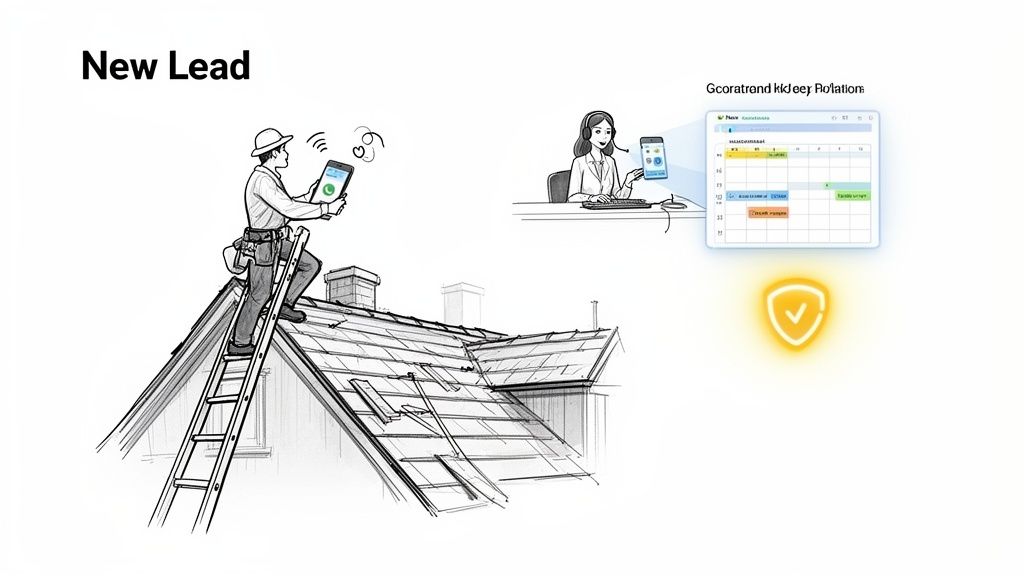
Picture this: you're halfway through a tricky roof repair, and your phone starts ringing. It’s a new customer, ready to book a big job. But you can't stop what you're doing to answer. By the time you get a free moment to call back, they’ve already found someone else. This exact scenario costs small businesses a fortune.
A virtual receptionist is your dedicated front desk, just without the physical desk. They solve this problem without the salary, benefits, and overhead of a full-time, in-house employee.
Think of it less as an answering service and more as a highly skilled, remote front-office team. They don't just take messages; they become a seamless extension of your business, trained to handle customer calls just like you would if you weren't busy doing the actual work.
What They Actually Do For You
So, what’s on their daily to-do list? A virtual receptionist does much more than just say, "Hello." They actively manage your customer interactions to drive real business results, impacting everything from your schedule to your bank account.
Let's break down the essential tasks a virtual receptionist handles and how each one directly benefits your business.
Core Functions of a Virtual Receptionist
| Function | Impact on Your Business |
|---|---|
| Professional Call Answering | Establishes immediate credibility and a professional image, no matter your company's size. |
| Appointment Booking | Fills your calendar with qualified jobs by scheduling directly into your system, like Jobber or ServiceTitan. |
| Lead Qualification | Screens callers to separate serious buyers from "tire-kickers," ensuring you only spend time on valuable leads. |
| Basic Customer Support | Handles common questions about services, pricing, and availability, freeing up your time. |
By covering these bases, a virtual receptionist makes sure no lead falls through the cracks and every customer feels taken care of from the very first call.
Here's a number that should stick with you: a study found that 67% of customers hang up out of frustration if they can't speak to a real person. They almost never call back.
Ultimately, a virtual receptionist turns your ringing phone from a constant interruption into an automated tool for generating revenue. They handle the front-end communication so you can focus on the work that pays the bills, all while keeping your sales pipeline full. It's the smart way to grow without the high cost of a traditional hire.
How a Virtual Receptionist Integrates with Your Business
It might be hard to picture how a remote service can feel like a genuine part of your crew, but it’s actually a pretty simple setup. A virtual receptionist doesn't just answer your phone; they become a true extension of your business, plugging right into your day-to-day operations.
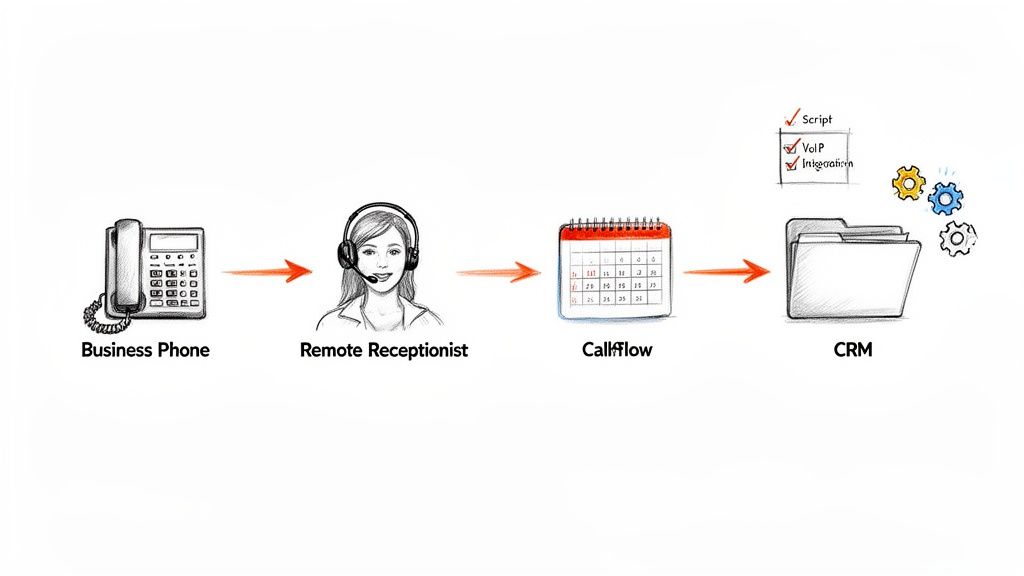
It all starts with something you're probably already familiar with: call forwarding. When a customer dials your main business line, the call is instantly routed to your virtual receptionist. There's no clunky transfer or confusing phone menu. Your customer just gets a friendly, professional human on the line, ready to solve their problem.
Setting Up Your Remote Front Desk
The onboarding process is where the real connection happens. This isn't some generic, one-size-fits-all script. You’re giving your receptionist the exact playbook they need to represent your brand just like you would.
Here’s what that typically looks like:
- Providing Custom Scripts: You decide exactly how the phone is answered. You tell them what info to gather and how to talk about your services, ensuring every call has your company’s unique voice.
- Granting Software Access: By giving them access to your scheduling software (like Jobber or ServiceTitan), they can book qualified appointments directly into your calendar. No more back-and-forth.
- Sharing Business FAQs: You’ll arm them with the answers to all those common questions—pricing, service areas, and what you do. This lets them handle most calls on their own, saving you from repeating yourself all day.
This initial groundwork transforms them from an outsider into a knowledgeable teammate who understands your workflow.
The Technology Behind the Scenes
You don’t need to be a tech wizard to get this running. The whole system is built on reliable, everyday technology that just works. The core piece is VoIP (Voice over Internet Protocol), which is just a fancy way of saying your calls run over the internet instead of an old-school phone line.
This seamless connection means that whether your virtual receptionist is across town or across the country, the call quality is crystal clear, and the connection is instantaneous. For your customer, it feels exactly like they’re calling an office down the street.
The other key component is powerful CRM (Customer Relationship Management) integration. When your receptionist books a job, all the customer's details automatically pop into your CRM. That means clean records and zero manual data entry for you. For businesses trying to see how this fits into their existing tools, understanding seamless integration capabilities is what makes the operational flow so smooth.
Ultimately, the goal is for this integration to be completely invisible to your customers and hands-off for you. They get fast, professional service, and you get a packed calendar and perfect customer records without the constant phone interruptions. It’s not just an answering service; it’s your front office, fully connected and ready to grow with you.
Making the Numbers Work: The Financial Case for a Virtual Receptionist
When you run a home service business, every decision has to make sense on the balance sheet. While a virtual receptionist certainly smooths out your daily operations, it's the financial impact that really tells the story. This isn't just about answering phones; it’s a strategic move that delivers a serious return on your investment.
Let's get straight to the dollars and cents. The main argument boils down to a simple cost-benefit comparison. When you bring an in-house receptionist on board, their salary is only the beginning. You’re also on the hook for payroll taxes, benefits, vacation days, and the cost of the desk, computer, and office space they occupy. These "hidden" costs can easily inflate their base pay by 30% or more.
A virtual receptionist service flips that model on its head. All those variable, complex expenses are replaced by a single, predictable monthly fee. What was once a major fixed overhead cost becomes a flexible tool that you can scale up or down as your business needs change.
The True Cost of an In-House Employee
Hiring a full-time employee is a major financial undertaking. A receptionist's salary can easily top $3,500 a month, and that's just the starting line.
Once you add everything up, the real picture comes into focus:
- Salary: The base wage you pay your employee.
- Benefits: Health insurance, 401(k) matching, and other perks needed to attract talent.
- Taxes & Insurance: Your share of payroll taxes, plus workers' comp and unemployment insurance.
- Overhead: The cost of a desk, computer, phone, and the square footage they take up in your office.
This is exactly why so many businesses are making the switch. The global virtual receptionist market is exploding—valued at around $3.85 billion in 2024 and expected to reach $9 billion by 2033—as companies look for smarter alternatives to pricey in-house staff. In fact, AI-driven virtual receptionists can be 85-95% cheaper than live answering services, which could save a single business up to $250,000 over five years compared to a traditional hire.
Think about it this way: you're not just saving money, you're unlocking it. The cash that would have been tied up in one person's salary and benefits can now be poured back into marketing, new tools, or other areas that fuel real growth.
If you want to run the numbers for your own business, a virtual assistant cost comparison calculator can give you a much clearer picture of the potential savings.
From Overhead Expense to Revenue Machine
Here's the most exciting part of the equation: it’s not just about cutting costs. It’s about driving new revenue. A virtual receptionist isn't an expense line item; it's a revenue-generating engine that never clocks out.
Think about what one missed call is really worth. For an HVAC contractor, that could be a $5,000 system install. For a plumber, a $500 emergency call-out. How many of those potential jobs are slipping through the cracks after hours, during lunch breaks, or when you’re stuck on another job site?
Let's do some quick math. If your average ticket is $400 and a virtual receptionist service costs $300 a month, you only need to capture one job you would have otherwise missed to pay for the entire service.
Every single call they secure after that is pure profit. Capturing just two or three extra jobs a month can mean thousands of dollars in new revenue, delivering an ROI that blows most other business investments out of the water. This is how a small, local operation can present a professional, big-company image and compete with anyone—without the big-company overhead.
Comparing Your Call Handling Options
Making the right call for your business's front line is a huge decision. You need a solution that not only snags every lead but also represents your brand like a pro—all without breaking the bank.
Let’s lay out the main options on the table: a virtual receptionist, a traditional in-house hire, a basic answering service, and the old standby, voicemail. We'll see how they really stack up for a busy home service business.
Each one comes with a different price tag, a different level of effectiveness, and creates a totally different experience for your customers. For a contractor or home service owner, getting this right is the key to investing in growth, not just another expense.
Virtual Receptionist vs. In-House Staff
Hiring a full-time receptionist to sit in your office might feel like the gold standard. You get a dedicated person who really learns the ropes of your business. The problem? It comes with the highest price tag. We’re talking salary, benefits, payroll taxes, insurance, and office overhead. It's a massive commitment.
Plus, that person is only human. They work 9-to-5, take lunch breaks, and go on vacation.
A virtual receptionist, on the other hand, gives you that same professional, human touch at a fraction of the cost. They work remotely, so all that overhead disappears. Better yet, many services offer extended hours or even 24/7 coverage, meaning you’ll never miss a lucrative emergency call at 10 PM on a Friday again.
This flowchart puts it into perspective. When you're trying to run a lean operation, a virtual receptionist is almost always the smarter financial move.
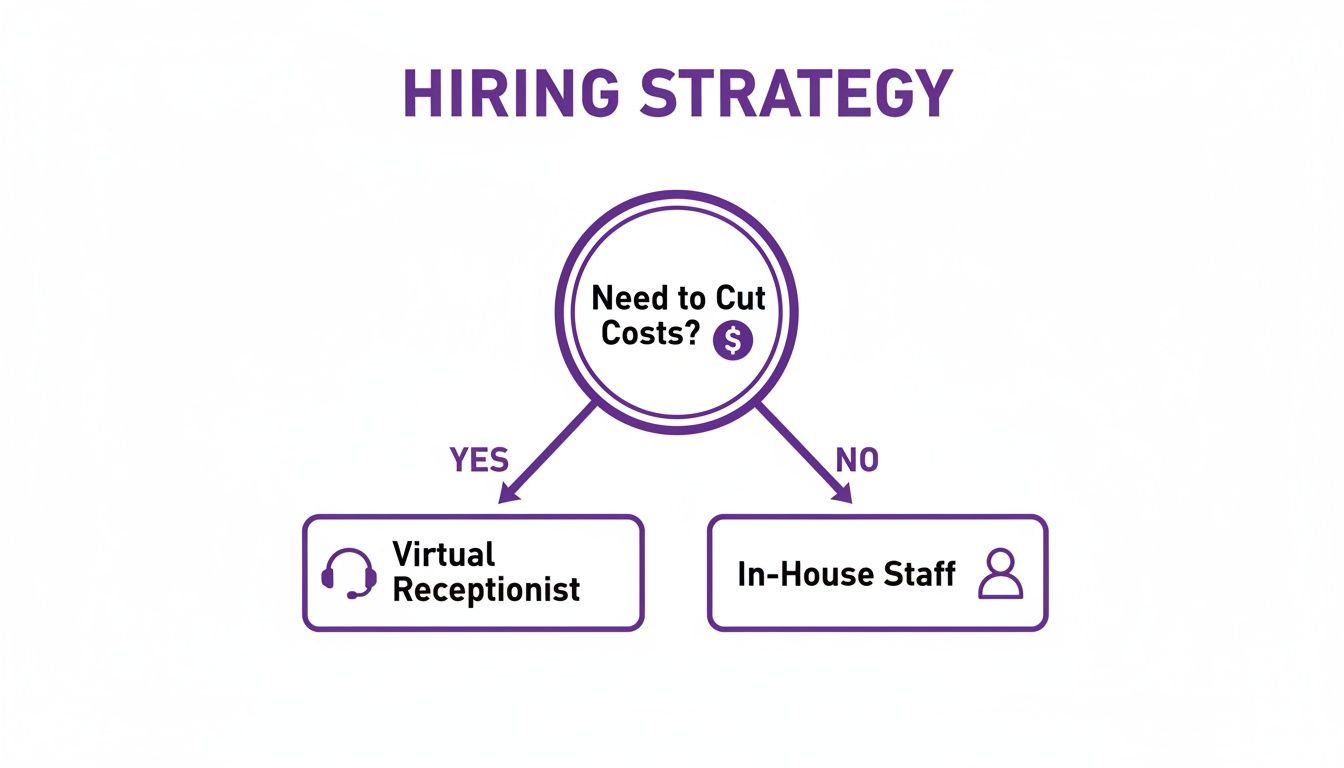
The real takeaway here is that you don't have to choose between quality and cost. You can get professional, reliable service without the financial weight of another full-time employee.
Answering Service vs. Virtual Receptionist
At first glance, an "answering service" and a "virtual receptionist" might sound like the same thing. They’re not. They are worlds apart in what they actually do for your business.
A traditional answering service is just a message-taking factory. They pick up the phone, say a generic greeting, scribble down a name and number, and send you a message. The rest of the work—calling back, qualifying the lead, booking the job—is still on you.
A true virtual receptionist is an extension of your team. They are proactive, not passive. They can:
- Book Jobs Directly: They get access to your calendar (whether you use Jobber or ServiceTitan) and can book qualified appointments right on the spot.
- Qualify Your Leads: Using your script, they ask the right questions to separate the serious customers from the tire-kickers.
- Provide Real Support: They can answer common questions about your services, pricing, and service area, often solving a customer's problem on the very first call.
This turns them from a simple message pad into an active part of your sales and operations engine.
The Problem with "Voicemail Only"
Finally, we have the "let it go to voicemail" strategy. To be blunt, this is the fastest way to lose business. In today's world, customers want answers now. They won't wait.
Think about it: when was the last time you left a voicemail for a service and patiently waited for a callback? Probably never. One study found that 67% of customers just hang up if they can't reach a real person. And you know who they're calling next? Your competition.
Relying on voicemail is like putting up a sign that says, "Your business isn't important enough for me to answer."
It’s a terrible first impression that costs you real money. The virtual receptionist market is projected to hit $3,500 million by 2025 for a reason—business owners are waking up to this reality. You can discover more insights about these market trends and see that smart companies are ditching outdated methods.
For home service pros, investing in immediate, professional call handling isn't a luxury; it’s essential for growth.
Comparison of Call Handling Solutions
To make the choice even clearer, let's break down how these four options compare side-by-side. This table will help you match your business needs and budget to the right solution.
| Feature | Virtual Receptionist | In-House Staff | Answering Service | Voicemail Only |
|---|---|---|---|---|
| Cost | Low to moderate (monthly fee) | Very High (salary, benefits, overhead) | Low (per-call or per-minute) | Free |
| Availability | Typically 24/7 or extended hours | Standard business hours (8-5, M-F) | 24/7 | 24/7 (but ineffective) |
| Appointment Booking | Yes, integrates with your software | Yes, but limited to their work hours | No, just takes messages | No |
| Lead Qualification | Yes, follows custom scripts | Yes, with training | No | No |
| Customer Experience | High (professional, immediate help) | High (dedicated, in-person presence) | Low (impersonal, delayed response) | Very Low (frustrating, often ignored) |
| Integration | Deep integration with CRMs, calendars, etc. | Manual integration with office systems | None | None |
| Scalability | Easy to scale up or down | Difficult and costly to scale | Easy to scale | Not applicable |
Looking at the comparison, it’s clear why so many home service companies find that a virtual receptionist hits the sweet spot. It offers the high-touch, professional service of an in-house employee without the crippling cost, and provides the functionality that basic answering services and voicemail completely lack.
Finding the Right Virtual Team for Your Business
Knowing you need help is the easy part. Finding the right partner to provide that help? That’s a whole different ballgame. It's crucial to understand that not all virtual receptionist services are built the same. Some are little more than basic message-takers, while others, like Phone Staffer, provide highly trained, specialized remote CSRs who truly become part of your team.
The real difference is graduating from a simple answering service to a strategic partner in your growth. A genuine partner doesn't just catch calls you might miss—they actively generate leads, build customer relationships, and handle the back-office grind that frees you up to run your business. It's about finding a team that gets the unique pressures and opportunities of the home service industry.
More Than Just Answering Calls
A top-tier service flips the script by focusing on outcomes, not just tasks. Instead of just reacting to inbound calls, the right team can proactively hunt for new business. This is where specialized skills really move the needle.
Think about the power of proactive outbound calling. A dedicated remote team can circle back on old quotes that went cold, call past customers to schedule routine maintenance, or even cold-call potential commercial clients to fill gaps in your schedule. Suddenly, your front office transforms from a reactive cost center into a proactive revenue engine.
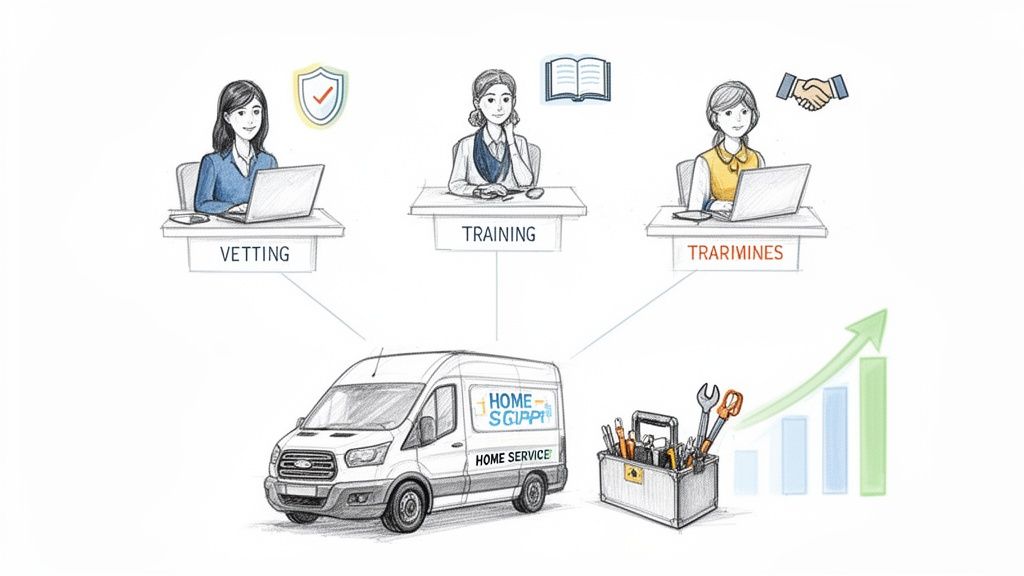
The key is to find a provider that invests in people. A rigorous vetting, training, and placement process ensures the person representing your brand is professional, knowledgeable, and aligned with your company’s values from day one.
This is especially critical for home service franchises trying to scale across multiple cities. Patchy phone coverage can absolutely kill your conversion rates and tarnish a brand's reputation. A flexible, remote solution designed for lead-heavy businesses makes sure every call gets handled professionally, every job is booked efficiently, and every administrative task gets done right.
The Phone Staffer Difference
At Phone Staffer, we’re all about delivering tangible results for home service companies. We do this through two primary services, each designed to tackle your biggest growth challenges head-on.
Our Core Services Include:
- Done-For-You Cold Calling: We don't just hand you a list of leads; we book qualified appointments directly onto your calendar. Our trained callers act as your dedicated sales development team, turning cold outreach into warm opportunities.
- Remote CSR and VA Placement: We find, train, and place skilled remote customer service representatives and virtual assistants directly into your business. They’re ready to handle everything from inbound calls and schedule management to all those essential administrative tasks.
This two-pronged approach ensures both lead generation and lead conversion are covered. We build your sales pipeline and then provide the skilled professionals you need to manage it, making sure no opportunity ever slips through the cracks.
Real-World Results in Home Services
The impact of a specialized virtual team really comes to life with real-world examples. Imagine a multi-location plumbing franchise that was constantly missing after-hours calls. By bringing on a team of remote CSRs, they not only got 24/7 coverage but also saw a 40% increase in booked emergency jobs within just three months.
Or, think about a roofing company whose sales reps were too swamped to follow up on every single online lead. They integrated a Phone Staffer VA to handle the initial outreach and qualification. This streamlined their follow-up process and led to a 25% boost in their quote-to-job conversion rates.
These aren't just one-off success stories. The global demand for these services points to a major shift in how businesses operate. The virtual receptionist market is projected to be worth a staggering $15,928.08 million in 2025, which just goes to show its massive appeal. For home service businesses, the value is even clearer, with countless firms confirming significant cost reductions after making the switch. You can read the full research about these market dynamics to understand the scale of this opportunity. It's about turning your phones into a reliable source of revenue without the headaches of traditional hiring.
Common Questions About Virtual Receptionists
It’s one thing to read about the benefits, but it's another to figure out how it all works in the real world. Every home service owner I talk to has a few practical questions before they're ready to pull the trigger. Let's get right into the most common ones so you can see if this is the right fit for you.
How Much Does This Actually Cost?
This is usually the first question, and for good reason. The good news is a virtual receptionist costs a fraction of a full-time, in-house employee. When you factor in salary, benefits, and taxes, an on-site hire can easily top $3,500 a month. A virtual service is much more budget-friendly.
Most services use one of a few common pricing models:
- Monthly Plans: You pay a flat fee for a certain number of calls or minutes. This makes your monthly costs predictable.
- Per-Minute Billing: Pay only for the time an agent is actively on the phone. This is perfect if your call volume goes up and down.
- Hybrid Models: A mix of both—a small base fee plus charges for any time you go over. It’s a nice balance between predictable costs and flexibility.
No matter which model you choose, the ROI is what really matters. If the service helps you capture just one extra job a month that you would have otherwise missed, it often pays for itself. At that point, it’s not an expense; it’s a revenue-driver.
Can a Virtual Receptionist Use My Software?
Absolutely. In fact, they have to. A top-tier virtual receptionist service isn't just answering calls; they're plugging directly into the tools you already use to run your business.
That means they can book appointments straight into your calendar, whether you're using Jobber, ServiceTitan, or something else. They can also log customer notes and update contact info in your CRM. This deep integration is what makes a virtual receptionist feel less like a service and more like a true extension of your team.
What Is the Difference Between a Virtual Receptionist and a VA?
Great question. The terms often get mixed up, but their roles are actually quite different. The easiest way to think about it is a specialist versus a generalist.
A virtual receptionist is your front-line specialist. Their world revolves around customer-facing communication—answering calls, qualifying new leads, and getting appointments on the books. A virtual assistant (VA) is more of a generalist who tackles a wider range of back-office tasks like managing your email, doing data entry, or handling research projects.
Many business owners start with a virtual receptionist to handle their phones and then bring on a VA later to help with the administrative load. Services like ours can help you find the right fit for both roles.
How Do They Learn to Represent My Brand?
This is where a professional service really shines. They won't just throw a random person on your phones. Instead, they’ll have a structured onboarding process designed to make your virtual receptionist sound like they’ve been part of your team for years.
It starts with creating custom call scripts tailored to your company's voice and goals. You’ll provide them with a detailed FAQ document that covers everything from your services and pricing to your exact service areas. This training gives them the confidence to answer customer questions accurately and professionally, ensuring your brand is represented perfectly on every single call.
Ready to stop missing calls and start booking more jobs? Phone Staffer provides highly-trained remote CSRs and done-for-you cold calling services to help your home service business thrive. Learn how we can fill your calendar today.