

So, what exactly is appointment setting?
Think of it as the crucial first step that turns a curious homeowner into a confirmed sales opportunity on your calendar. It's the process of reaching out to potential customers, figuring out if they're a good fit, and then scheduling a real conversation with someone on your sales team.
The True Role of Appointment Setting
Let's ditch the textbook definition. At its core, appointment setting is like a handshake that starts a real conversation. It’s not about randomly filling up time slots; it’s a deliberate method for engaging with leads, getting a handle on what they need, and booking a meeting that puts fuel in your sales pipeline.
This is especially true for home service businesses. If you're in HVAC, plumbing, or roofing, you know a deal almost always closes after an on-site visit or a detailed consultation. Great appointment setting makes sure your expert technicians are spending their time on promising jobs, not chasing down dead ends.
Building Trust from the First Call
That very first interaction with a potential customer sets the stage for everything that follows. When the scheduling process is smooth and professional, you immediately build trust and show them you’re an organized, reliable company.
This is your first, best chance to prove you respect their time and are ready to solve their problem.
Appointment setting isn't just an administrative task—it's the engine of your sales funnel. It qualifies leads, manages your team's most valuable asset (time), and lays the groundwork for a successful sale.
More Than Just Scheduling
Ultimately, appointment setting is the bridge connecting your marketing efforts to your sales team. It ensures all those leads you worked so hard to get are handled properly and moved systematically toward becoming paying customers.
This process has become so vital that the global market for appointment scheduling software was valued at USD 403.90 million and is expected to hit over USD 1 billion by 2033. That growth highlights just how critical this function is for any modern business. If you're interested, you can dive into the full market analysis of appointment scheduling software to see the trends.
Why Smart Appointment Setting Is Your Secret Growth Weapon

It’s easy to think of appointment setting as just another administrative chore—filling in time slots on a calendar. But in reality, a well-oiled appointment setting process is one of the most powerful growth engines you can have for your home service business.
Think of it this way: effective scheduling isn't about filling your calendar; it's about strategically filling it with the right opportunities. It’s the gatekeeper for your sales pipeline.
A smart system weeds out the tire-kickers and ensures your technicians spend their valuable time visiting serious, qualified homeowners who are actually ready to make a decision. This single change can dramatically boost your closing rate and stop wasting time on dead-end leads.
Maximize Your Revenue and Efficiency
Every single appointment on your schedule represents a real cost—your team's time, the fuel in your trucks, and other operational resources. A strategic approach to setting those appointments is all about making sure that investment pays off.
For instance, a sharp appointment setter at a roofing company knows to prioritize the call about an urgent, active leak over a routine request for a quote on a project six months down the road. This isn't just great customer service; it's smart business. You capture high-intent customers at their moment of greatest need, which maximizes both your immediate revenue and your team's efficiency.
A seamless booking experience does more than just schedule a visit—it builds instant credibility. It communicates that your company is professional, organized, and respects the customer's time, setting a positive tone for the entire relationship.
That first impression is absolutely critical. Research has found that a staggering 82% of B2B decision-makers feel sales reps are unprepared, a feeling that easily carries over to the home services world. A polished, professional scheduling process shows you're on the ball from the very first interaction, which directly impacts whether or not you'll get the job.
If you want to dig deeper into this, our guide on how to increase conversion rates for home services has a ton of practical strategies you can use.
Manual vs Automated Appointment Setting
So, how should you actually manage your appointments? The choice between doing it the old-fashioned way and using modern tools can have a huge impact on your efficiency and how customers see you.
Here’s a look at how manual and automated approaches stack up against each other.
| Feature | Manual Setting (Phone/Email) | Automated Setting (Software) |
|---|---|---|
| Efficiency | Labor-intensive and prone to human error like double-booking. | Highly efficient, with 24/7 availability and instant calendar updates. |
| Lead Quality | Relies on the setter's skill to qualify leads during the call. | Can use pre-qualification forms to filter leads automatically. |
| Customer Experience | Can be personal but is limited by business hours and availability. | Offers immediate, convenient booking options anytime, anywhere. |
| Cost | Involves direct labor costs for staff dedicated to scheduling. | Reduces labor costs and minimizes lost revenue from missed calls. |
Ultimately, a strong appointment setting system transforms your calendar from a simple schedule into a strategic asset. It makes sure your skilled technicians are focused on high-value jobs, streamlines your entire operation, and builds the kind of professional reputation that wins over today's homeowners.
Building Your Appointment Setting Workflow
A solid appointment setting process isn't something you just wing; it’s a well-oiled machine designed to turn a curious lead into a confirmed job on the calendar. For any home service business, having a clear, repeatable system is the bedrock of growth. It's what keeps leads from falling through the cracks and ensures every potential customer gets the right attention.
Think of this workflow as a roadmap. Each stop along the way moves a potential customer closer to becoming a valuable, scheduled appointment for your team. When you break down the journey, you can tune up each individual step for the best possible results.
This flow chart gives you a bird's-eye view of the key stages, from the initial research all the way to the final confirmation.
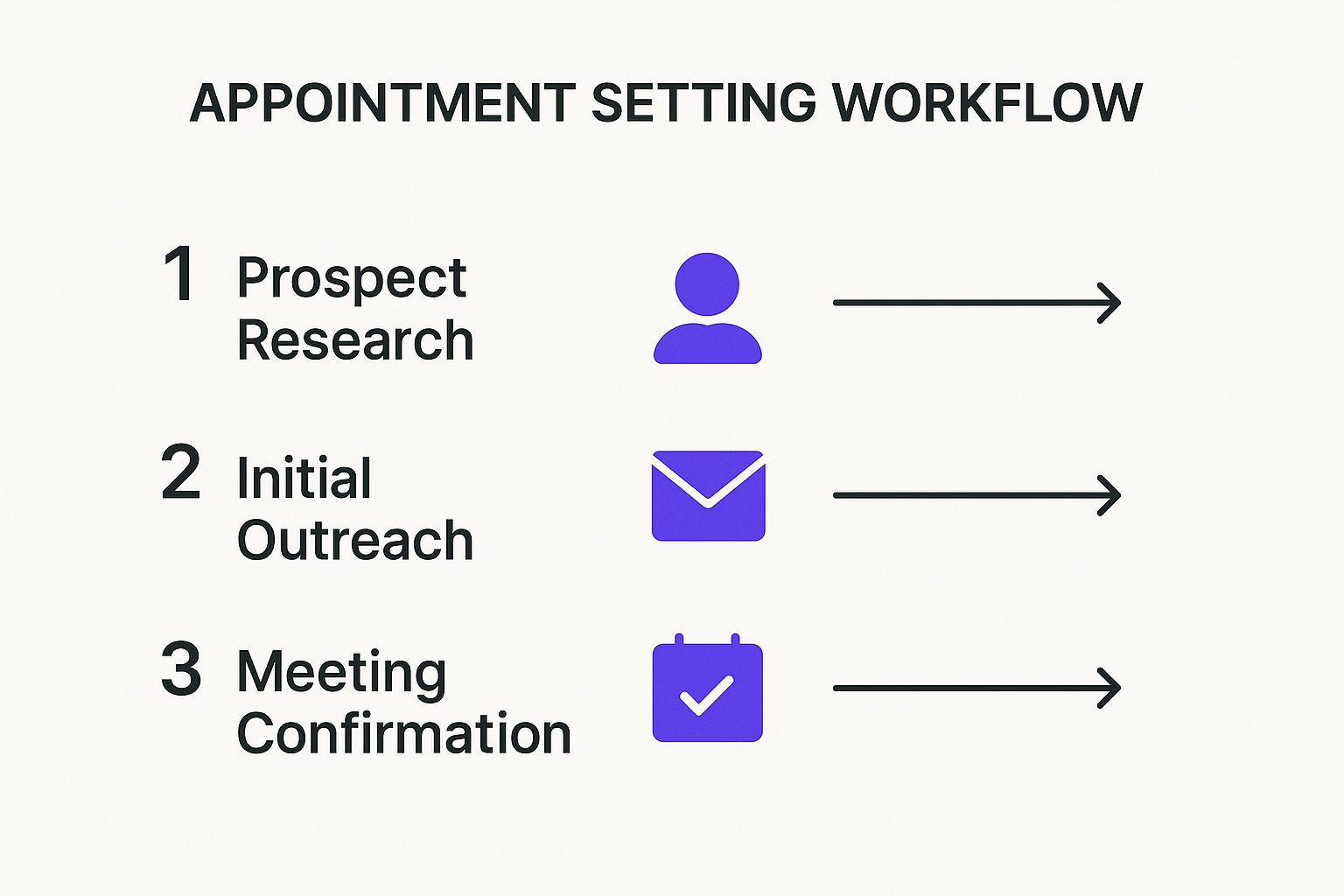
As you can see, it’s a structured path. A good system smoothly guides a prospect from one stage to the next, building the momentum you need to get that appointment booked.
Stage 1: Initial Lead Capture and Research
It all starts with a lead. This could be anyone—someone who filled out a form on your website, called your office number, or clicked on one of your ads. The second their information hits your system, the clock is officially ticking.
Before you even think about picking up the phone, do a little homework. Seriously, it pays off. A quick peek at their property on Google Maps or a glance at their service history (if they're a returning customer) provides incredible context. This prep work allows your team to personalize the conversation right from the get-go.
Stage 2: Strategic Outreach
Once you’ve done your research, it's time to make contact. Here's a reality check: it takes an average of eight attempts just to get a prospect on the phone. Persistence is everything. This isn’t a one-and-done deal.
A smart outreach strategy uses a mix of channels to get the job done:
- Phone Calls: Still the most direct and effective way to have a real conversation and qualify someone on the spot.
- Emails: Great for following up, sending over requested information, and confirming appointment details in writing.
- SMS/Text Messages: The secret weapon for quick reminders and confirmations. Using text messages can slash your no-show rate.
Stage 3: Effective Lead Qualification
The moment you connect with a lead, your mission is to qualify them. You need to figure out if they're a good fit for what you offer and if they have a real, pressing need. It's all about asking smart questions to understand their situation and how serious they are.
For a home service pro, good qualification questions are your best friend:
- "Could you tell me how old your current water heater is?" (This helps gauge the potential for a replacement job.)
- "Have you noticed your AC unit making any strange noises or not cooling like it used to?" (This uncovers immediate problems.)
- "Are you just starting to gather quotes for this project, or are you hoping to get it fixed as soon as possible?" (This tells you exactly where they are in the buying process.)
Qualification isn’t about putting up walls; it's about becoming a problem-solver. When you truly understand what a lead needs, you make sure your technicians are only spending time on appointments that are likely to turn into paid work.
Stage 4: Pitching and Scheduling
Once you've confirmed they're a good fit, the goal is to lock in that appointment. But this isn't a hard sell on the service itself. Instead, you're pitching the value of the appointment. You need to clearly explain what the homeowner gets out of your visit—a professional diagnosis, an accurate quote, or expert advice from a pro.
When it comes to scheduling, be direct and make it easy for them. Don't ask, "When works for you?" That puts the work on them. Instead, offer concrete options: "I have an opening tomorrow at 10 AM or Thursday at 2 PM. Does either of those work for you?" This simple shift makes it much easier for them to say yes.
And as soon as they agree, send an immediate confirmation by email or text to seal the deal.
Essential Tools for Modern Appointment Setters

Let’s be honest, appointment setting used to be a mess of sticky notes and overflowing spreadsheets. Not anymore. Today, technology has completely changed the game, turning a manual headache into a smooth, efficient system.
Think of these tools as power-ups for your team. They’re not here to replace people; they’re here to handle the repetitive, administrative work. This frees up your staff to do what they do best: build real relationships with homeowners and truly understand their needs. The goal is a perfect partnership where technology and people work together without a hitch.
The Core Tech Stack
For any home service business, there are three absolute must-have tools that form the backbone of a solid appointment-setting process. Each one has a specific job in getting a lead from an initial "hello" to a booked job on the calendar.
- Customer Relationship Management (CRM) Systems: This is your command center. A good CRM is like a digital memory bank, tracking every call, email, and note for every lead. Having that complete history is pure gold when it's time to make a follow-up call.
- Scheduling Software: This is what finally kills the endless "what time works for you?" email chain. It syncs with your technicians' calendars, lets customers book their own appointments online, and automatically sends confirmations and reminders.
- Communication Platforms: These tools bring all your conversations into one place. Instead of jumping between phone logs, texts, and emails, everything is in a single, unified inbox. Nothing falls through the cracks.
If you want to manage inquiries and schedule meetings like a pro, you need the right gear. It's worth exploring some of the top call management software solutions to get a feel for what’s possible.
Automation That Drives Revenue
One of the biggest money-losers for any home service business? No-shows. It's a frustrating waste of time and fuel. This is exactly where a little bit of automation makes a huge difference.
Simple, automated SMS and email reminders are incredibly effective at keeping the appointment on a homeowner's radar, which can slash your no-show rate. It’s no wonder the scheduling software market is booming—it’s expected to grow from USD 0.40 billion in 2023 to USD 1.88 billion by 2033. For your business, this translates directly to fewer wasted trips and more paying jobs.
The right technology doesn’t replace the human touch; it enhances it. By automating administrative tasks, your team has more time and energy to dedicate to creating outstanding customer experiences.
Ultimately, getting these tools to work together creates a system that not only saves time but also captures more business. For companies looking to grow without ballooning their overhead, a smart tech stack is non-negotiable. This is also a place where getting expert help can pay off; trained professionals, like those offering virtual assistant services, are skilled at managing these exact tools and workflows.
Mastering the Appointment Setting Conversation
A great appointment isn't just booked; it's earned during the conversation. Skilled communication is what turns a curious phone call into a solid, confirmed job on your technician's schedule. This isn't about high-pressure sales tactics. It's about building real trust and showing your value from the first hello.
Think of your appointment setter as a friendly guide. Their real job is to help a homeowner understand the problem they're facing and see your company as the obvious solution. This starts with building a connection, genuinely listening to their concerns, and confidently guiding them toward scheduling a visit.
Building Instant Rapport and Trust
Let's be honest, homeowners are usually stressed when they call a service company. A warm, confident voice can make all the difference, instantly putting them at ease. The mission is to go from stranger to trusted advisor in less than a minute.
A great first step? Ask if they have a moment to talk. It’s a simple sign of respect that shows you value their time and immediately sets a professional tone.
From there, it's all about active listening. Don't just wait for your turn to speak. Hear them out completely, then repeat their concerns back to them ("Okay, so it sounds like the water heater is making that loud banging noise again…"). Showing that you're actually listening builds the foundation of trust you need to move the conversation forward.
When a potential customer feels heard and understood, they stop seeing you as a salesperson and start seeing you as a problem-solver. That mental shift is the secret to getting the appointment.
Handling Common Homeowner Objections
Every appointment setter hits roadblocks. The trick isn't to avoid them but to be ready with confident, helpful responses that focus the conversation on value, not just cost.
Let’s break down two of the most common hurdles you'll encounter.
1. "I'm just getting a few prices."
You'll hear this one a lot. Instead of getting defensive, the best move is to agree with them and then pivot to what makes your visit different.
- How to Respond: "That's a really smart way to do it. A lot of our happiest customers got a few quotes first. What they found is that our on-site diagnosis is incredibly thorough. We'll find the exact issue so you get a firm price, not just a guess over the phone. I have a spot for one of our specialists tomorrow at 10 AM—would that work for you?"
2. "I need to check with my partner."
This is a perfectly reasonable request. Your goal is to keep things moving forward while making it easy for them to get the information they need.
- How to Respond: "That makes perfect sense. To make it easier for both of you, how about we pencil in a tentative time? That will hold a spot on our calendar for you. We can send a confirmation email with all the details that you can easily share. Would Thursday afternoon be a good placeholder?"
When you nail these conversational skills, your team can handle just about any situation with confidence. Appointment setting becomes less about filling a schedule and more about securing high-quality jobs that are ready for your team to win.
How to Measure Your Appointment Setting ROI
You can't fix what you don't measure. For any home service business, tracking the right numbers is what turns appointment setting from just another task on the to-do list into a powerful growth engine. By focusing on a few key performance indicators (KPIs), you can see exactly what’s working, what isn’t, and where to put your energy.
This data-first mindset takes all the guesswork out of the equation. Instead of scratching your head wondering why revenue dipped last month, you can pinpoint the real culprit—maybe it’s a high no-show rate or a low close rate—and fix the problem at its source. This is how you systematically fine-tune your sales process for better results.
Measuring your appointment setting ROI isn't just about counting booked calls. It's about understanding the entire journey from initial lead to a closed sale, allowing you to make smarter, more profitable business decisions.
Key Metrics You Must Track
To get a truly clear picture of your performance, you need to zero in on the metrics that matter most. These will give you a complete view of how efficient and effective your entire process really is.
-
Cost Per Appointment (CPA): This is your bottom line. It tells you precisely how much you’re spending to get one qualified lead on the calendar. To figure it out, just divide your total marketing and sales costs for a specific period by the number of appointments you set.
-
Appointment-to-Sale Conversion Rate: This is the ultimate test of your efforts. It reveals the percentage of your completed appointments that turn into actual paying jobs. A high number here means your leads are solid and your sales team is closing deals.
-
No-Show Rate: A high no-show rate is a silent killer of profits. Tracking this number helps you spot issues with your confirmation and reminder system before they start seriously hurting your bottom line.
This obsession with efficiency isn't just a local thing; it's a global shift. In the Asia-Pacific region, for example, rising internet penetration—which is expected to hit over 70% by 2025—is driving a massive wave of businesses to adopt scheduling software. In fact, 62% of urban small and medium enterprises in Southeast Asia are already using digital tools to manage their appointments. You can discover more about these global scheduling trends to see how technology is fundamentally changing service delivery worldwide.
Common Questions About Appointment Setting
Even with a solid plan, you're bound to have questions as you put an appointment setting process into action. It's totally normal. Getting clear answers is the key to making confident moves for your home service business, whether you're starting from square one or tweaking what you already have. Let's tackle a few of the most common questions we hear from business owners just like you.
Should I Hire In-House or Outsource?
This is the classic "build vs. buy" debate, and honestly, the right answer depends entirely on your lead volume and what resources you have on hand.
Bringing your appointment setting in-house gives you ultimate control. Your team lives and breathes your brand, which is a huge plus for established companies with a consistent flow of leads to manage. You train them your way, and they're fully integrated into your company culture.
On the other hand, outsourcing to a specialized agency can be a game-changer, especially for smaller businesses or those whose work is highly seasonal. It’s often more cost-effective because you get instant access to a team of trained pros without the headache and expense of hiring, training, and managing them yourself.
What’s the Difference Between an Appointment Setter and a Salesperson?
Think of it like a one-two punch in sports. They're on the same team, but they have very different jobs.
The appointment setter is the one who makes the assist. Their entire focus is on qualifying the lead, getting them interested, and locking in that meeting. The salesperson—your comfort advisor or senior technician—is the one who shows up to that meeting and scores the goal by closing the deal.
Their roles don't overlap, but they are completely dependent on each other. The setter lines up the shot, and the salesperson sinks it. Simple as that.
How Quickly Can I Expect to See Results?
You'll see some positive signs pretty fast. Within a few weeks of launching a new script or using a new piece of software, you should notice an uptick in booked appointments. That’s a great leading indicator.
But when it comes to seeing a real impact on your revenue? That takes a little more time, usually somewhere in the ballpark of 1-3 months. This gives you enough runway to gather real data, fine-tune your approach, and see how many of those appointments actually turn into paying customers.
Ready to stop wasting leads and start filling your calendar with qualified, sales-ready appointments? Phone Staffer can hire, train, and manage a remote team of callers and CSRs for your business, or our experts can do the cold calling for you. Learn how we can help you grow.