
Let’s start with a simple idea: Customer Experience Management, or CEM, is about looking at your business through your customer's eyes. It's the art and science of managing every single interaction a customer has with your company to make sure it's not just good, but exceptional.
This isn't just about fixing a leaky pipe or a broken AC unit. It's a proactive strategy designed to build real loyalty by consistently meeting—and even exceeding—what your customers expect from you.
Defining Customer Experience Management
Think of it this way: You're not just a service provider; you're the host of an experience. A great host doesn't just put food on the table. They think about everything—the invitations, the ambiance, the conversation, and making sure every guest leaves with a smile, feeling like they were truly taken care of. That’s what CEM is all about.
For a home service business, this means carefully orchestrating a smooth, positive journey for every homeowner. That journey starts the moment they search for you online, continues through the booking call and the technician's visit, and doesn't end until the final invoice is paid and you've followed up to ensure they're happy.
From Service Call To Lasting Relationship
Ultimately, CEM is the sum of every feeling, perception, and thought a customer has about your company. It’s shaped by every phone call, every text message, and every interaction with your team. This is why actively collecting customer reviews is so important—it gives you a direct line into what customers are actually thinking and feeling.
When you get this right, you transform a one-time service call into a trust-building event that customers remember. It’s how you go from being just another contractor to their contractor—the one they call back and recommend to friends.
The business world is catching on, and the numbers prove it.
The global customer experience management market was valued at USD 12.04 billion in 2023. It’s expected to shoot up to around USD 32.87 billion by 2030, growing at a rate of nearly 15.8% each year. This boom shows just how seriously companies are taking the customer journey.
To see what this looks like in practice for a home service business, let's compare the old way of thinking with a CEM-focused approach.
CEM Focus for Home Service Businesses
| Customer Touchpoint | Traditional Approach (Just Service) | CEM Approach (Total Experience) |
|---|---|---|
| First Call | Answer the phone and book a job. | Ensure a warm, professional greeting. Answer questions clearly and instill confidence from the first second. |
| Scheduling | Give the customer a wide service window. | Offer precise, convenient appointment times. Send automated reminders via text and email to keep them informed. |
| Technician Arrival | Technician shows up and gets to work. | Technician arrives on time, in uniform, introduces themselves, and communicates the plan before starting work. |
| During Service | Focus solely on the technical repair. | Keep the workspace clean, explain the work being done, and treat the customer's home with respect. |
| Billing | Hand over a paper invoice. | Provide a clear, digital invoice with easy online payment options. Explain all charges transparently. |
| Follow-Up | The job is done. Move to the next one. | Send a thank you note, request a review, and check in a few days later to ensure everything is still working perfectly. |
As you can see, the difference is huge. A CEM approach intentionally manages each step to create a powerful competitive advantage. It’s not just about the quality of the work, but the quality of the entire experience you deliver.
The Pillars of an Effective CX Strategy
A powerful customer experience strategy doesn't just happen by chance. It’s built on three core pillars that work in harmony to create a consistently positive, memorable experience for every homeowner you serve. If one pillar is weak, the whole structure can feel wobbly. But when you get all three right, you create a powerful engine for customer loyalty and business growth.
The first pillar is deep customer understanding. This is about more than just knowing a customer's name and address. It means getting inside their head and mapping out their entire journey with your business—from the moment they first hear about you to the final follow-up call after the job is done.
To do this well, you have to become a great listener. Gather feedback with post-job surveys, keep a close eye on your online reviews, and most importantly, train your team to listen for those little off-the-cuff comments customers make. The goal is to build a complete, honest picture of what it’s really like to be your customer, identifying both the frustrating pain points and the moments of unexpected delight.
Turning Insight Into Action
The second pillar is all about proactive engagement. Once you truly understand the customer’s journey, you can start making it better. This is where you take all that valuable insight and use it to personalize communication and empower your team to solve problems before they even become problems.
For example, if you learn that customers get anxious waiting for a technician, you can set up automated "on my way" texts with a photo and a short bio of the tech. If you discover your invoices are confusing, you can redesign them to be crystal clear. This pillar is about turning passive knowledge into active, experience-boosting improvements.
This is all about creating a feedback loop where every customer interaction becomes a source of valuable data.
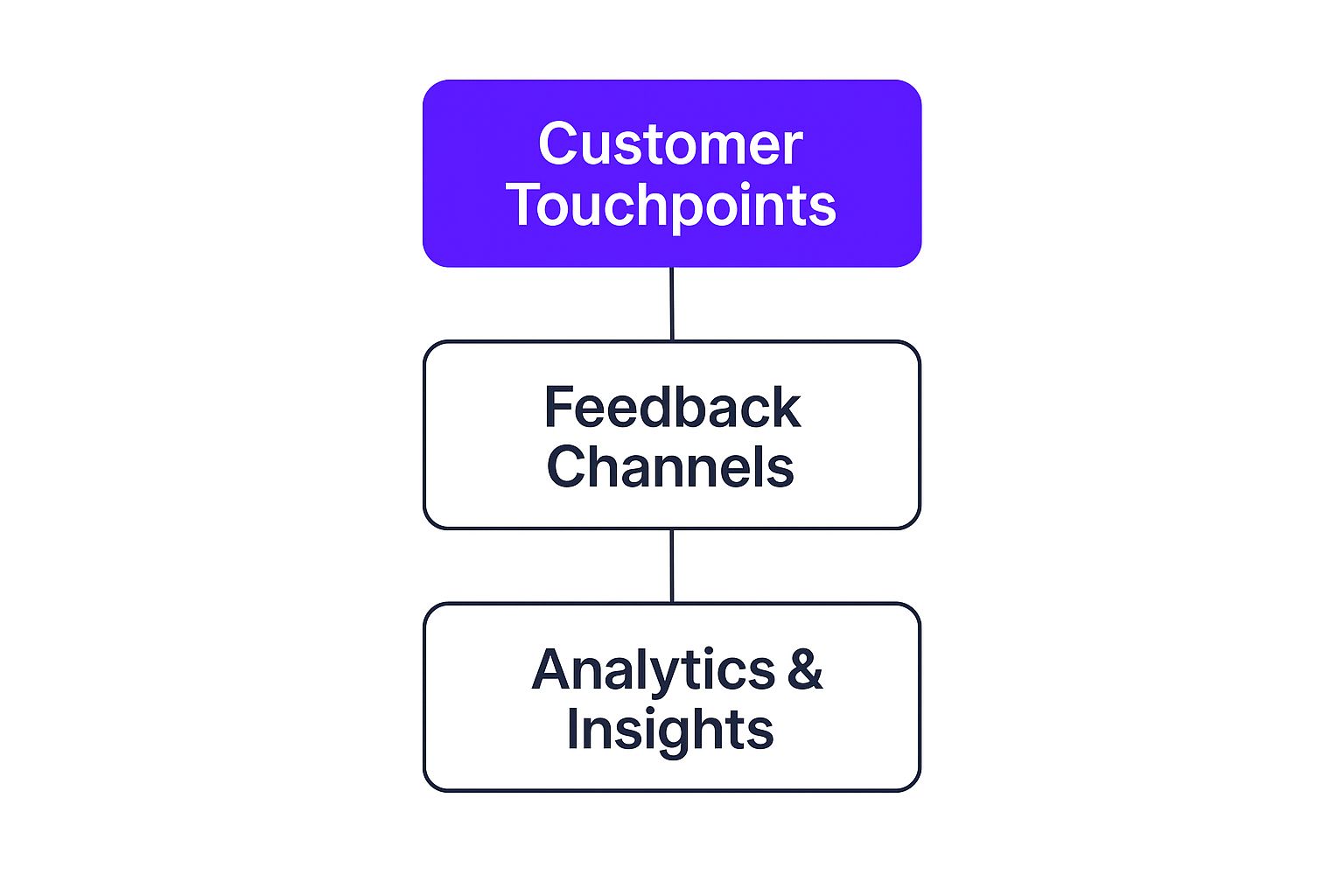
As you can see, every touchpoint is a chance to gather feedback. That feedback, when analyzed, gives you the actionable insights you need to keep making things better for the next customer.
Measuring What Matters Most
The third and final pillar is consistent measurement. After all, you can't improve what you don't measure. This means picking a few key metrics to track your progress and shine a light on areas that need more attention. It's how you know if your efforts are actually paying off.
A great customer experience management strategy is a continuous loop. You listen to customers, use that feedback to engage them more effectively, and measure the results to find new ways to listen even better.
For a home service business, some of the most useful metrics are:
- Net Promoter Score (NPS): This classic metric measures loyalty by asking one simple question: "How likely are you to recommend us to a friend or colleague?"
- Customer Satisfaction (CSAT): Perfect for getting feedback on specific interactions, like how the initial booking call went or what they thought of the technician's professionalism.
- Customer Effort Score (CES): This one asks how easy it was for the customer to get their problem solved. A low-effort experience is a huge driver of loyalty.
By keeping an eye on these numbers over time, you can see the direct impact of the changes you're making. Let's say you start sending surveys (Pillar 1) and use the feedback to train your team (Pillar 2). Watching your NPS score (Pillar 3) climb is the ultimate proof that your strategy is working.
Why Customer Experience Is Your Competitive Advantage
In the home services world, doing good work is just table stakes. It’s the bare minimum. Your competitors probably unclog drains, fix furnaces, and patch drywall just as well as you do. So, what really sets you apart? It's the experience you provide from start to finish.
That experience is what earns loyalty, defends your pricing against low-ball offers, and builds a business that lasts. Thinking about the customer's journey isn't just about being nice; it's a rock-solid business strategy with real, measurable returns. It turns a one-time service call into a long-term relationship, which dramatically cuts down on how much you have to spend finding new customers. After all, it's way easier (and cheaper) to get another job from a homeowner who already knows and trusts you.
Turning Happiness Into Your Best Marketing
When you get the customer experience right, you do more than just create repeat business. You build a volunteer marketing team. Happy homeowners don't just pay the bill and forget about you; they become your most passionate and believable advocates.
This plays out in two huge ways:
- Real Word-of-Mouth: When a neighbor mentions they have a leaky pipe, whose name do you think comes up first? The company that made the process easy and stress-free. A personal referral like that is pure gold—it carries a level of trust you can't buy with an ad.
- Five-Star Online Reviews: Let's be honest, almost everyone checks reviews before calling a contractor. A great experience is what motivates someone to go online and leave that glowing, detailed review that convinces the next person to pick up the phone and call you.
Justifying a Premium Price Point
Beyond bringing in new business, a fantastic experience gives you the power to charge what you're worth. When you deliver a smooth, professional process—from the initial phone call to the final follow-up—you're selling more than just a repair. You're selling peace of mind.
Homeowners will gladly pay a premium for reliability, clear communication, and the confidence that the job will be done right without any hassle. A well-managed experience removes friction and anxiety, making your service inherently more valuable than a cheaper, less predictable alternative.
This is exactly why the global customer experience management market is booming. It was valued at USD 18.42 billion in 2024 and is on track to hit USD 51.11 billion by 2030. Businesses everywhere are waking up to its power. You can learn more about the rapid expansion of the CEM market on Mordor Intelligence.
At the end of the day, investing in how you treat your customers is what gives you a lasting edge. It’s a strategic asset that insulates you from price wars, drives organic growth, and builds a brand that homeowners genuinely trust for years. In a crowded market, it's the key to not just surviving, but truly thriving.
Mapping Your Critical Customer Touchpoints
For any home service business, the customer's journey is a series of make-or-break moments. We call these touchpoints. They're every single interaction a customer has with your company, from the first time they hear your name to the final follow-up call.
Each touchpoint is a chance to win or lose. A good one builds trust and moves the relationship forward. A bad one can sour the entire experience before your technician's truck even leaves the shop. Understanding and mapping these moments is the foundation of managing the entire customer experience.
The First Impression: Discovery and Booking
It all starts the moment a homeowner realizes they have a problem. They might find you through a Google search, a friend's recommendation, or a local ad. That first point of contact—whether it's a phone call or a form fill on your website—sets the tone for everything that follows.
This is your single most important touchpoint. Think about it: research shows that in the customer experience market, call centers brought in the largest share of revenue at 31% in 2023. That tells you just how critical that direct, human contact is. A friendly, efficient, and understanding voice on the other end of the line immediately tells a customer they made the right choice. You can learn more about the importance of customer interaction channels on Grandview Research.
Building Trust Before the Visit
Okay, so the appointment is on the books. Great! But the experience doesn't just pause until your tech shows up. The time between booking and the actual service is a golden opportunity to build trust.
- Appointment Confirmations: Send an email or text right away confirming all the details. It shows you're organized and on top of things.
- Reminder Alerts: A quick reminder the day before the visit is a simple courtesy that reduces no-shows and keeps you top-of-mind.
- Technician-on-the-Way Notifications: This one is a game-changer. A text with your technician’s name, photo, and an ETA gives the customer incredible peace of mind.
This kind of proactive communication turns what could be anxious waiting time into a positive, reassuring part of the process. And if you're looking for ways to get more of those initial leads, you might find our guide on successful advertising for roofing businesses helpful.
A great customer experience isn't about a single grand gesture. It's about flawlessly executing the small, predictable steps that make a customer feel respected, informed, and in control throughout their entire journey with your business.
From the service call itself to clear invoicing and post-job follow-ups, every single step matters. When you take the time to map and improve each touchpoint, you create a consistently excellent experience that doesn't just satisfy customers—it turns them into your biggest fans.
Using Technology to Power Your CX
Trying to deliver a consistently great customer experience for every single customer is a massive challenge. Doing it at scale? It's pretty much impossible without the right technology.
The best tools don’t replace the human touch; they make it better. They handle the repetitive, behind-the-scenes work so your team can focus on what really matters: providing exceptional, personal service to homeowners.
Think of your Customer Relationship Management (CRM) software as the central nervous system of your entire CX strategy. It’s a single database that stores every shred of information about a customer—their service history, past conversations, even personal notes like the name of their dog. This means that whether a customer calls the office or meets a technician on-site, your team has the full story and can provide a seamless, informed experience.
Streamlining Your Operations for a Better Experience
Beyond just holding data, technology actively improves the service you're delivering in the moment. Modern scheduling and dispatching software, for example, is a total game-changer for any home service business. It can optimize a technician's route, slash travel time, and let you give customers much tighter, more accurate service windows. Say goodbye to those frustrating four-hour waits.
These systems also enable features that customers absolutely love, like automated appointment reminders and "your tech is on the way" alerts. These small, tech-driven touchpoints build a huge amount of trust and keep customers in the loop. They turn moments of potential anxiety into opportunities to prove you're a professional and reliable company. This is a crucial part of what modern customer experience management is all about.
The goal of technology in CX isn't to create distance. It's to close gaps, automate logistics, and free up your team's time to build stronger, more personal relationships with the people you serve.
The Rise of Intelligent Automation
The most forward-thinking companies are now weaving in even more advanced tools. The rapid growth of the CEM market is directly tied to the adoption of technologies like AI and automation. Businesses that were early to embrace tools like virtual assistants and chatbots grabbed a serious competitive edge, proving just how essential technology has become. You can discover more insights about technology's role in the CEM market on Fortune Business Insights.
For a home service business, this could look like:
- Automated Feedback Tools: Automatically sending a simple text or email survey the moment a job is finished to gather feedback while the experience is still fresh in the customer's mind.
- Communication Platforms: Using a system that brings all communication together, so customers get timely updates through their preferred channel, whether that’s a text, an email, or a phone call.
At the end of the day, technology is the engine that makes a scalable CX strategy run. It gives you the structure, efficiency, and data you need to deliver a consistently top-notch experience to every customer, every single time.
How a Virtual Receptionist Elevates Your Customer Experience
For a home service business, the first phone call isn't just a phone call. It’s your one and only shot at a great first impression, and it’s where your entire customer experience begins. A dedicated virtual receptionist is one of the smartest investments you can make in your customer experience strategy, making sure that critical first moment is always a win.
Think about it from your customer's perspective. They could hit voicemail, or worse, get ahold of a frazzled owner trying to talk over the sound of a power tool. Or, they could be greeted by a friendly, professional expert ready to help. That single difference immediately builds a sense of trust and competence. At Phone Staffer, our trained professionals make sure every call is a positive, seamless interaction, not a moment of frustration.
Turning Calls Into Confidence
A virtual receptionist does so much more than just take messages. They become a core part of your team and your customer experience process, trained and ready to:
- Answer questions on the spot: Give callers the information they need, right when they need it.
- Book jobs directly: Turn interested callers into scheduled appointments without any friction.
- Gather critical details: Make sure your techs show up to the job fully prepared and looking like pros.
This flawless first contact sets the stage for everything that follows. It sends a clear message: you respect your customer's time and you’re serious about providing fantastic service from the very first hello.
A seamless, professional first interaction is not just about good manners; it's a strategic investment in customer loyalty and brand perception that pays dividends throughout the relationship.
This approach also lets you and your technicians get back to doing what you do best—delivering top-notch work in the field. And don't forget the data. Analyzing what customers say is huge; in fact, text analytics captured around 39% of revenue in the CEM market in 2023. You can see more about the impact of analytics on the CEM market at Grandview Research. While some businesses turn to automated tools like the best customer service chatbots, when a homeowner has a problem, nothing beats the confidence that comes from hearing a live, professional voice on the other end of the line.
Questions We Hear All the Time About CEM
If you're a home service business owner, you've probably heard the term "customer experience management," but you might be wondering what it actually looks like on the ground. Let's clear up some of the most common questions we get.
Isn't CEM Just a Fancier Name for Customer Service?
Not quite, though they're definitely related. Think of it this way: customer service is what happens when things go wrong—it's reactive. A customer calls with a leaky pipe, a broken AC unit, or a billing question, and your team responds. It’s a crucial moment, but it's just one moment.
Customer experience management (CEM) is proactive. It’s about thoughtfully designing the entire journey a customer takes with your business. It starts the second they see your truck or Google your name and continues long after you’ve sent the final invoice. Great customer service is a huge piece of the puzzle, but it’s not the whole picture.
How Can a Small Business Possibly Implement This?
You don't need a corporate-sized budget or a dedicated department to get started. The secret is to stop trying to do everything at once and focus on the moments that matter most.
Here are a few simple, high-impact things you can do right now:
- Map It Out: Grab a pen and paper and sketch out every single step a customer takes, from their first call to their final review. Where are the rough spots?
- Just Ask: Make it a non-negotiable habit to ask for feedback after every single job. You'll be amazed at what you learn.
- Nail the First Impression: The initial phone call sets the tone for everything that follows. Make sure it's answered quickly and professionally, every single time.
The best CEM strategies don't start with a massive overhaul. They start small. By mastering one or two key moments, like that first phone call, you build a rock-solid foundation for everything else.
What's the Actual ROI on This Stuff?
It might feel like a "soft" investment, but putting money and effort into customer experience delivers a very real, very measurable return. The business impact is undeniable.
A solid CEM strategy drives tangible results:
- Customers Stick Around: When people have a great experience, they call you back next time. That means you spend less money trying to find new customers.
- You Get More Referrals: Happy customers don't just come back; they tell their friends, family, and neighbors. That's the best kind of marketing there is, and it's free.
- You Can Charge What You're Worth: When you provide a reliable, seamless, and stress-free experience, people are willing to pay for it. In fact, a recent study showed that 77% of customers will happily pay more for a positive, personalized experience.
At the end of the day, CEM isn't an expense. It's a direct investment in building a more profitable, sustainable, and respected home service business.
Ready to perfect your most important customer touchpoint? Phone Staffer ensures every call is answered professionally, converting more leads and starting every customer journey on the right foot. Learn how we can help your business grow.