

Let's cut to the chase. Inside sales is simply the process of selling to customers remotely. Instead of driving out to a potential customer's home for an initial chat, your team connects with them using phones, email, video calls—you name it.
For a home service company, this means having a dedicated specialist who works from an office (or even from home) to qualify leads, understand customer needs, and book solid appointments. Think of them as the air traffic controller for your sales pipeline, expertly guiding qualified jobs to your field technicians.
Redefining the First Customer Touchpoint
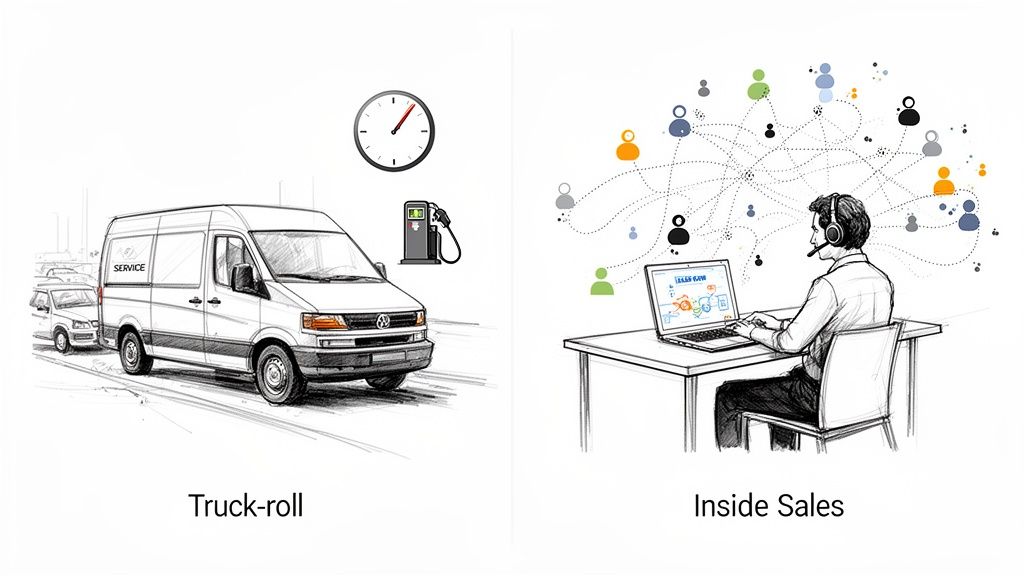
In the old-school home service model, what happens when a potential customer calls? You dispatch a technician. That "truck roll" immediately starts costing you money in fuel, wages, and vehicle wear-and-tear, all before you even know if the job is a sure thing.
This approach forces your highly skilled technician—an expert in HVAC, plumbing, or electrical work—to also be a salesperson. They're often thrown into a sales role without the right training or mindset. It's a slow, expensive system that severely limits how many prospects your team can actually talk to in a day. It’s a model built on hope.
Inside sales flips this script completely. Instead of sending out your most expensive assets (your tech and their fully-stocked van) to a maybe-customer, a trained professional engages them first. This remote specialist’s entire job is to create a fantastic first impression, diagnose the customer's problem over the phone, and schedule a firm appointment for a genuinely interested lead.
From In-Person Visits to Strategic Conversations
The real magic here is in how you use your resources. Traditional outside sales bets everything on that physical, in-person meeting. Inside sales, on the other hand, uses communication and technology to connect with far more people, far more efficiently.
To see how these two models stack up for a home service business, let's break them down side-by-side.
Inside Sales vs Outside Sales at a Glance
| Characteristic | Inside Sales (Remote Specialist) | Outside Sales (Field Technician) |
|---|---|---|
| Primary Goal | Qualify leads & set firm appointments. | Diagnose technical issues & close the sale on-site. |
| Main Tools | Phone, CRM, email, scheduling software. | Van, diagnostic tools, parts, tablet for estimates. |
| Cost Per Interaction | Low. Minimal overhead per call or email. | High. Includes fuel, vehicle wear, and travel time. |
| Lead Volume | High. Can contact 30-50 leads per day. | Low. Limited to 3-5 site visits per day. |
| Key Skillset | Communication, empathy, and organization. | Technical expertise, problem-solving, and hands-on skill. |
| Sales Cycle Speed | Fast. Initial contact to appointment can be minutes. | Slow. Depends heavily on travel time and scheduling. |
As you can see, the roles are fundamentally different, designed for maximum efficiency in their respective areas.
By splitting the initial customer conversation from the hands-on technical work, you create two powerful, specialized roles. Your inside sales team masters lead qualification and appointment setting, freeing up your field technicians to do what they do best: solve problems and close deals on-site.
This specialization is the heart of what inside sales is all about. It’s not just about making calls; it's a strategic move to build a more scalable, profitable, and efficient sales engine for your business. You save your most valuable field resources for customers who are ready to buy.
The Operational Divide Between Inside and Outside Sales
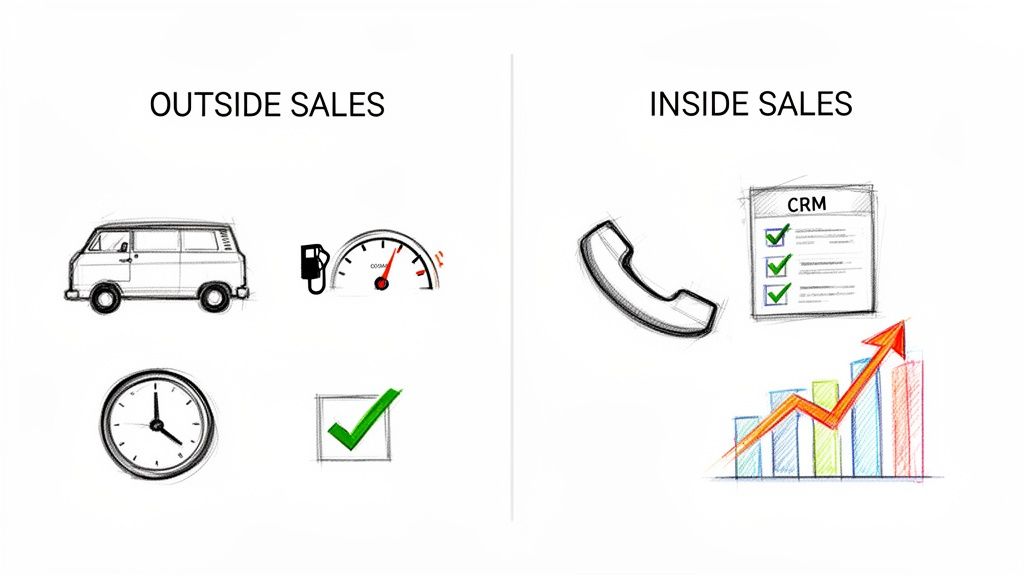
The difference between inside and outside sales isn't just about where the work gets done. It's a fundamental split in how you operate, how efficient you can be, and what it costs to land a new job. While both teams are chasing the same goal—more revenue—the way they get there is night and day.
Think of the old-school outside sales model like sending a delivery driver out on a route with a bunch of question marks. Your highly-paid, skilled technicians hop in their vans every morning, but a huge chunk of their day is spent just driving. They're at the mercy of traffic jams, long travel times, and the nagging uncertainty of whether a prospect will even be home.
This model is packed with hidden costs that quietly eat away at your profits.
The Hidden Costs of Traditional Outside Sales
The most obvious expense is the "truck roll"—the cost of sending a van and a technician to a customer’s door. But the financial drain goes much deeper. You're losing money in ways you might not even be tracking.
- Wasted Windshield Time: Every hour a technician spends staring at traffic is an hour they aren't diagnosing a problem or closing a sale. That's lost revenue, plain and simple.
- Rising Fuel and Maintenance: With fuel prices always in flux, every mile on the road adds up. More driving also means more wear and tear, leading to bigger and more frequent repair bills for your fleet.
- Physical Limits: A technician can only be in one place at a time. The simple physics of travel puts a hard cap on how many homes they can visit in a day, which seriously limits your growth potential.
When you rely only on your field team for those first conversations, you're essentially paying a premium for every single prospect interaction, whether it leads to a job or not. It’s an expensive bet to place on every lead that comes in.
The High-Volume Efficiency of Inside Sales
Now, let's flip the script and look at an inside sales operation. It's less like a delivery route and more like an air traffic control tower. From one central spot, an inside sales specialist can handle dozens of leads at once. There’s no traffic, no fuel costs, and no physical distance limiting their reach.
This changes your entire sales process from being reactive to proactive. Instead of waiting for a technician to free up, an inside sales rep can call a new web lead within minutes—striking while the iron is hot and the customer is most interested. That kind of speed is impossible for a field-based team to match.
The financial upside is massive. There's a reason inside sales has become the go-to model for so many industries. An inside sales call costs around $50, while an in-person field visit can run anywhere from $215 to $400. Check out this in-depth industry report for more stats. For a home service company, that means you could make four to eight inside sales calls for the price of just one truck roll.
The real power of an inside sales model is strategic lead qualification. Your team can sift through inquiries, filter out the tire-kickers, and gather key details upfront. This ensures your expert field techs are only sent out to the most serious, ready-to-buy customers.
This is about more than just saving money on gas. It's about protecting your most valuable asset: the time and expertise of your technicians. By letting an inside sales team handle the initial contact, qualification, and appointment setting, you free up your field crew to do what they do best—solve problems and close high-value jobs.
Why Inside Sales Is a Game Changer for Home Services
If you're in the home services business, you know the drill. A lead comes in, you send a tech out, and you cross your fingers, hoping it turns into a paying job. But what if there was a better way? Adopting an inside sales model isn't just about changing how you make phone calls—it’s about fundamentally changing how you grow your business.
This isn't some minor tweak. It's a strategic shift that transforms your lead management from a costly guessing game into a streamlined revenue engine. It tackles the exact problems that keep most home service companies from breaking through to the next level.
Drastically Reduce Customer Acquisition Costs
Let's talk about the biggest, most immediate win: a massive drop in your Customer Acquisition Cost (CAC). Every single time you roll a truck, the cash register starts ringing—and not in a good way. You're burning money on fuel, wear and tear on the vehicle, and most importantly, your technician's highly valuable time. All of this happens before you even know if the lead is serious.
We call this "windshield time," and it's a silent profit killer.
An inside sales specialist stops this bleeding. Instead of sending your most expensive people to every single inquiry, you use a far more efficient person to vet them first. Think about it: one inside sales rep can qualify dozens of leads in a single day for a fraction of what it costs to send just one tech out on one unproductive visit.
By handling the initial conversation, qualification, and scheduling from an office, you save your field team for what they do best: closing high-probability, ready-to-buy jobs. This one change alone can completely rework your cost to land a new customer.
This isn't just about saving a few bucks on gas. It's about reallocating your entire operational budget. You stop wasting payroll on non-revenue-generating travel and can finally put that money toward things that actually grow the company.
Significantly Increase Your Booked Job Rate
In home services, speed is the name of the game. Study after study shows the same thing: the first company to respond to a lead is the one that almost always gets the job. When a homeowner's AC gives out in July or a pipe bursts under their sink, they aren't waiting around for a callback. They're calling your competitors, and the first person to answer with confidence wins.
This is where an inside sales model gives you a huge leg up.
- Immediate Follow-Up: A dedicated inside sales rep isn't crawling through an attic or stuck in traffic; their one and only job is to respond to leads. They can jump on new inquiries within minutes, not hours, catching that homeowner right when they're most motivated.
- Persistent Outreach: How many leads have you lost simply because you were too busy to call back a second or third time? An inside sales process builds in a structured follow-up plan, making sure no potential job ever slips through the cracks.
This proactive approach fills your schedule, period. Instead of watching good leads go cold, you engage them quickly and professionally, turning more of your marketing dollars into actual appointments and paid invoices.
Deliver a Superior and Consistent Customer Experience
First impressions matter more than we'd like to admit, and an inside sales rep ensures every single one is a great one. Your technicians are masters of their craft, no doubt. But they aren't always trained sales professionals or customer service experts, which can lead to a mixed bag of experiences for your clients.
A trained inside sales professional, on the other hand, is a specialist in communication. They deliver a polished, consistent, and high-quality interaction every time. They know the right questions to ask, how to set clear expectations, and how to build trust from the very first "hello." This level of professionalism immediately elevates your brand and makes customers feel like they're in good hands.
Unlock Effortless and Cost-Effective Scalability
This might be the most powerful benefit of all. Think about what it takes to grow when you're relying on the traditional model. Need to handle more jobs? You have to hire another tech, buy another van, drop thousands on tools and inventory, and get it all insured. It’s a massive, slow, and expensive undertaking.
Now, what does it take to scale your inside sales team? You add another person with a headset and a computer.
The difference in cost and complexity is staggering. Whether you hire someone in-house or partner with a service like Phone Staffer for a remote CSR, you can expand your sales capacity almost overnight to match your lead flow. This gives you the agility to grow smarter, not just bigger.
Measuring Success with the Right Inside Sales KPIs
So, you've decided to bring sales inside. That’s a huge step, but how can you tell if it's actually paying off? The goal isn't just to have someone glued to the phone; it's to book more high-value jobs and keep your technicians busy. That’s where Key Performance Indicators, or KPIs, come in.
Think of them as the dashboard on your truck. You wouldn't drive cross-country without a speedometer or a fuel gauge, right? KPIs give you that same kind of critical feedback for your sales process. They show you what's working, where the leaks are, and help you make smart adjustments before you end up stranded.
For a home service business, you don't need a hundred different metrics. A handful of carefully chosen KPIs will tell you the real story, from the moment a lead comes in to the second your dispatcher adds a new job to the board.
Lead Response Time
Let's start with the one that can make or break a deal before you even say hello: Lead Response Time. This is simply how long it takes for your rep to reach out after a lead hits your inbox from your website, a form, or a service like Angi.
In our world, speed is everything. A burst pipe or a dead AC unit isn't a "get to it later" problem for a homeowner. A study from LeadResponseManagement.org revealed something incredible: contacting a lead within 5 minutes instead of 30 minutes makes you 21 times more likely to qualify them. If you wait an hour, your odds drop off a cliff. A quick response tells a frantic customer you're professional, you're on the ball, and you're ready to solve their problem now.
Contact Rate and Appointment Set Rate
Once you're responding quickly, you need to see how many people you're actually getting on the phone. That's your Contact Rate—the percentage of leads your team has a real conversation with. If this number is low, it could mean your leads aren't great, or maybe your team isn't following up enough times.
From there, we look at the Appointment Set Rate. Of all the people you talk to, what percentage actually book a job? This is where the rubber meets the road. It's a direct reflection of how well your inside sales rep can build trust, explain your value, and convince that homeowner to let your tech through their door.
A high Appointment Set Rate is solid proof that your phone scripts, training, and overall process are hitting the mark. If it's lagging, it’s a signal to pull up some call recordings and figure out where things are going sideways.
These two numbers are a powerful duo. They show you exactly how many leads you need to feed the machine to hit your booking goals for the week or month.
Cost Per Booked Appointment
Finally, we get to the number your accountant will love: Cost Per Booked Appointment. This is the ultimate gut check. You take all your inside sales costs—salaries, software subscriptions, or the fee for a service like Phone Staffer—and divide it by the total number of jobs you booked.
The result tells you exactly what you're paying to get a technician on-site with a customer ready to buy. It’s the clearest way to judge if your investment is worthwhile and to compare the real value of different marketing efforts. A low Cost Per Booked Appointment means you've built a lean, mean, revenue-generating machine.
To make this crystal clear, here are the most important metrics to watch, along with some typical benchmarks you can aim for in the home service industry.
Essential Inside Sales KPIs for Home Service Companies
| KPI (Key Performance Indicator) | What It Measures | Why It Matters | Good Industry Benchmark |
|---|---|---|---|
| Lead Response Time | Average time to first contact a new lead. | Speed is critical. A fast response catches homeowners when their need is highest and dramatically increases conversion rates. | Under 5 minutes |
| Contact Rate | Percentage of total leads you successfully speak with. | Shows the quality of your leads and the effectiveness of your follow-up cadence. A low rate means wasted marketing spend. | 30-40% (Varies by lead source) |
| Appointment Set Rate | Percentage of contacted leads converted to a booked appointment. | Directly measures your rep's sales skills and the effectiveness of your script and process. | 40-60% (For qualified, contacted leads) |
| Cost Per Booked Appointment | Total inside sales cost divided by the number of booked appointments. | This is your ROI metric. It tells you exactly how much it costs to generate a real sales opportunity. | $50 – $200 (Highly variable by trade and market) |
Keeping a close eye on these numbers isn't about micromanaging; it's about having the clarity to lead your team effectively. It turns your inside sales operation from a simple expense into a predictable engine for growth.
Building Your Home Service Inside Sales Playbook
Knowing your KPIs is one thing. Actually putting them to work is a whole different ballgame. To get from theory to a humming, appointment-booking machine, you need a playbook—a straightforward, repeatable set of steps your team can follow to turn leads into booked jobs, every single time. This isn't about writing a massive, complicated manual. It's about nailing down the core actions that actually get results.
The real goal here is to create a process so clear that anyone on your team, from a brand-new hire to a seasoned veteran, can jump in and execute it perfectly. A solid playbook takes the guesswork out of the equation and makes sure every potential customer gets the same fantastic experience. It’s the concrete foundation you build a scalable sales operation on.
Define Your Primary Goal
Before you even think about writing a script, you have to decide what the playbook's main mission is. Are you trying to book as many estimates as possible, no matter what? Or is the plan to qualify leads more carefully and only schedule appointments for bigger, higher-value jobs? Your answer to that question will shape everything that follows.
For most home service businesses, the objective is crystal clear: book qualified appointments for your technicians. This focus ensures your inside sales efforts are directly feeding your field team, filling their calendars with genuine opportunities, not just kicking tires.
Create a Simple and Effective Call Script
A script isn't meant to turn your team into robots reading from a page. Think of it more like a pilot's checklist—it’s there to make sure you hit all the critical points during a fast-paced conversation. It gives your reps structure and, just as importantly, confidence.
A great script just needs a few key ingredients:
- A confident opening: Quickly state who you are and what company you're with to build immediate trust.
- Key qualifying questions: A few smart questions about the customer's problem, how urgent it is, and where they're located will tell you if they're a good fit.
- A clear value proposition: In one or two sentences, explain what makes your company the best choice for the job.
- A direct call to action: Don't just ask them to call back. Offer specific time slots for an appointment to make scheduling dead simple.
This basic framework keeps the conversation on track and moving toward the only goal that matters: getting that appointment on the books.
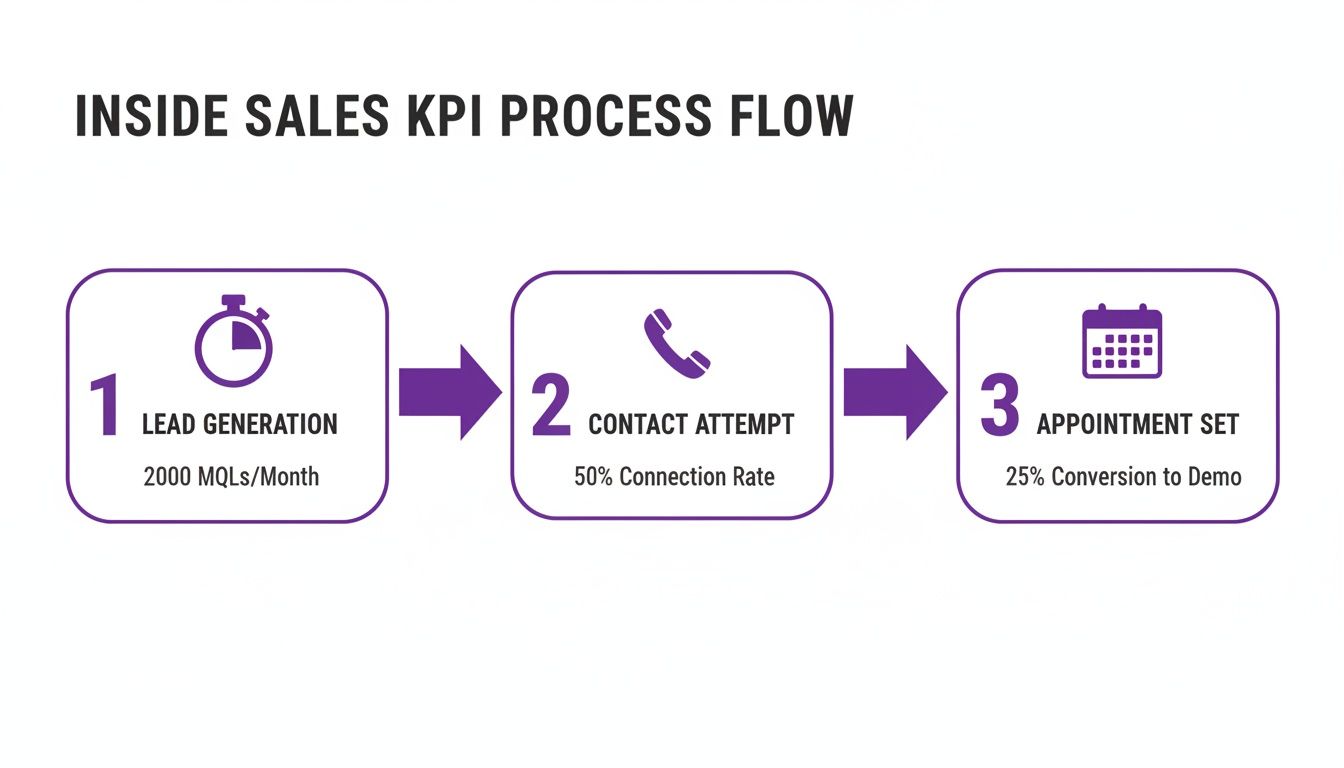
As you can see, a structured playbook is all about moving a potential customer smoothly from one stage to the next, making sure you're maximizing every single opportunity.
Establish a Smart Follow-Up Cadence
Let's be real: most jobs aren't booked on the first call. What separates the top performers from everyone else is a persistent, professional follow-up plan. This "cadence" is simply a pre-planned sequence of calls, emails, and maybe texts, all designed to keep your company top-of-mind without being a pest.
A simple, effective cadence might look something like this:
- Day 1: Call within 5 minutes of the lead coming in. No answer? Leave a voicemail and immediately send a text.
- Day 2: Call again, maybe in the afternoon to catch them at a different time.
- Day 4: Send a follow-up email that offers some helpful info, not just a "checking in" message.
- Day 7: Make one last call before you mark the lead as unresponsive and move on.
This systematic approach is what truly drives results. Inside sales works so well because it forces consistency in lead coverage and follow-up—two areas where busy contractors often drop the ball. In fact, most sales reps spend only 30% of their time on actual selling. The rest gets eaten up by other tasks. A structured cadence, powered by the right tech, ensures your reps are connecting with more leads at exactly the right moments.
Building this entire system from the ground up can feel overwhelming for many home service owners. That’s where an outsourced solution like Phone Staffer can be a powerful shortcut, letting you plug a professionally managed, playbook-driven team right into your business.
This strategy gives you all the benefits of a high-functioning inside sales team without the headache and overhead of building it all yourself. To keep refining your sales process, it's also worth exploring proven live chat sales techniques to boost conversions and close more deals for your home service business.
The Essential Tech Stack for Inside Sales Success
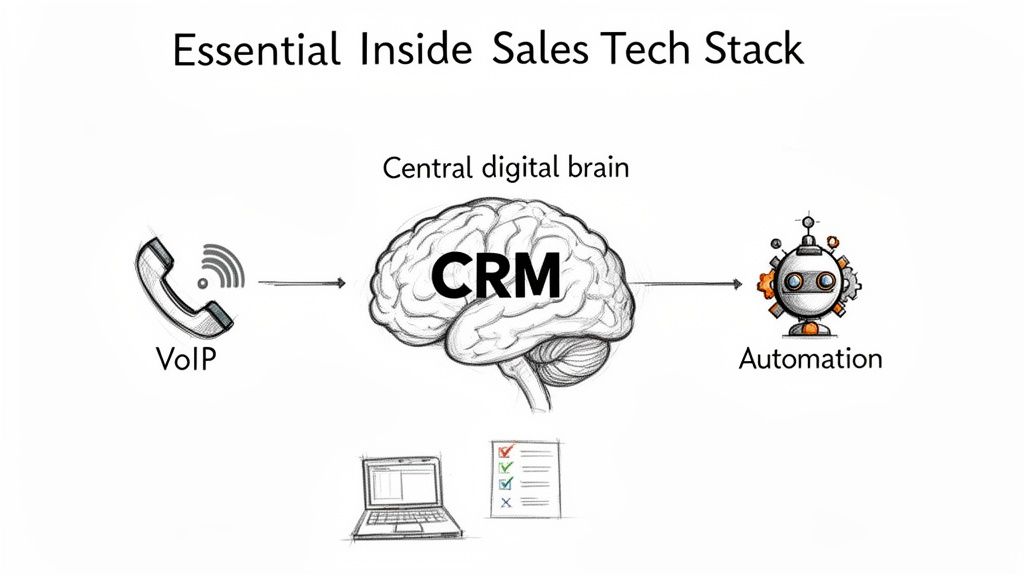
An effective inside sales team doesn’t just run on good scripts and hustle; it’s powered by the right technology. The term "tech stack" might sound intimidating, but for a home service business, you don't need a dozen complicated platforms. You just need a few core tools that work together to make your sales process smooth, measurable, and ready to grow.
Think of this technology as the central nervous system for your entire sales operation. It connects every conversation, organizes every customer detail, and automates the grunt work that bogs your team down. With a solid setup, your reps can stop juggling tasks and focus on what they do best: connecting with customers and booking jobs.
Let's break down the three essential components that form the foundation of any high-performing inside sales system.
Your CRM: The Digital Brain
Your Customer Relationship Management (CRM) software is, without a doubt, the most important piece of the puzzle. It’s the digital brain of your company—a central hub that remembers every interaction you've ever had with every lead and customer.
A good CRM stores contact info, logs every call and email, shows you where each lead is in your sales process, and nudges your team when it's time to follow up. It’s the official end of messy spreadsheets, sticky notes, and trying to recall what you discussed with a homeowner two weeks ago. For a home service company, this means anyone on your team can instantly see a customer's entire history, from their first call about a clogged drain to their last AC maintenance.
A VoIP Phone System: The Flexible Lifeline
Next up is your phone system. A Voice over Internet Protocol (VoIP) system is a modern, internet-based phone service that blows traditional landlines out of the water with its flexibility. It's the lifeline that connects your inside sales team directly to your customers.
Because VoIP runs over the internet, your team can make and take calls from anywhere—the main office, their home, or even a smartphone app while on the move. This is a game-changer if you use remote CSRs or virtual assistants. Most VoIP services also plug right into your CRM, automatically logging calls and even providing recordings you can use for training. This creates a seamless flow of information where no detail ever gets lost.
The combination of a CRM and VoIP system creates a powerful feedback loop. Every call provides data that makes your CRM smarter, and your CRM provides the context your reps need to make every call more effective.
Automation: The Virtual Assistant
The final piece of the tech puzzle is automation. Think of simple automation tools as a tireless virtual assistant that handles all the repetitive, low-value tasks your team hates doing. This is where you get a massive efficiency boost.
So, what kinds of tasks can you hand off to a machine?
- Data Entry: Automatically logging call notes and updating customer records in the CRM.
- Lead Nurturing: Sending pre-written follow-up emails or texts after a conversation.
- Internal Notifications: Alerting a manager the second a high-value lead comes in.
This kind of tech-first approach is fundamentally changing how home service companies operate. Beyond just having a good playbook, using the right technology is critical for growth—you can see how Scheduledrop helps home service businesses scale faster by applying these principles. In fact, AI-powered tools can boost win rates by over 30% just by automating research and prioritizing the best leads. This tech can free up around 20% of a sales team’s time, letting them focus on actual selling instead of administrative work.
Common Questions About Inside Sales for Home Services
Even with all the benefits laid out, I get it. Shifting to an inside sales model can feel like a huge leap for a hands-on home service business. It’s completely natural to have questions about how a remote sales process can possibly work for a company that built its reputation on in-person expertise.
Let's walk through some of the most common hesitations I hear from owners and get you some clear, practical answers.
"But My Business Is Too Hands-On for Inside Sales!"
This is probably the number one concern, and it’s a valid one. Many owners believe a technician has to be on-site to build that initial trust and close the deal. This comes from a good place, but it slightly misunderstands what an inside sales specialist actually does.
Their job isn't to diagnose a complex HVAC issue or a tricky plumbing leak over the phone. Not at all.
Their true role is to master the critical first steps of the customer journey—the stuff that happens long before a wrench ever comes out of the toolbox. Think of them as your first impression experts. They handle:
- Responding to new leads instantly, before your competitors even see the notification.
- Asking smart qualifying questions to figure out how urgent the customer's problem is.
- Clearly explaining your company's value and what the homeowner can expect from your process.
- Booking a solid, confirmed appointment for your expert field technician.
This setup frees up your most skilled (and expensive) technicians to do what they do best: solve problems and deliver amazing service in the field. When they walk up to the door, they're meeting a customer who is already prepped, qualified, and ready for a solution, which makes closing the actual job infinitely easier.
"Do I Really Have to Hire Another Full-Time Employee?"
Nope, and this is where the model gets really powerful for growing your business. For most home service companies, the thought of adding another full-time salary, benefits, training, and equipment to the payroll is a major roadblock.
Partnering with a specialized service gives you all the power of a professional inside sales team without the overhead and commitment of a direct hire. It's a flexible solution that grows with your business, not ahead of it.
This approach means you can scale your sales capacity up or down based on the season. You get expert help right when you need it—whether that's during the summer AC rush or a winter freeze that has phones ringing off the hook for plumbers.
"Okay, What's the Very First Step to Get Started?"
The simplest way to start is with a quick, honest look at your current lead management. It's easy. The next time a new lead pops in from your website or a contact form, start a timer.
Just see how long it actually takes for someone on your team to make that first call.
If that time is more than five minutes, you've just found a massive, immediate opportunity for improvement. From there, you could create a basic call script for an existing office employee to follow. But if you want a more direct path, you can explore an outsourced solution that plugs right into your current system and starts turning those leads into booked jobs from day one.
An expert inside sales team can turn your unpredictable lead flow into a steady, reliable stream of revenue. Phone Staffer provides highly-trained, remote CSRs and appointment setters who act as a seamless extension of your home service business, ensuring every single lead is handled with speed and professionalism. Learn more about how we can fill your calendar.