

At its core, lead qualification is the art of figuring out which potential customers are most likely to become actual paying customers. It's about sifting through all your phone calls, emails, and form submissions to separate the serious homeowners from the window shoppers. This way, your team can pour all its energy into the opportunities that have a real chance of closing.
Why Lead Qualification Is Your Business Filter

Picture this: you run an HVAC company, and the phone is ringing off the hook during a heatwave. If you don't have a good filter, you could spend half your day driving all over town to give quotes to people who can't afford your services, live outside your service area, or are just "kicking the tires" for a future project.
This is exactly where a solid qualification process comes in. Think of it as a gatekeeper for your business, protecting your most valuable and non-renewable resource: time.
By asking the right questions from the very first conversation, you can spot the high-value jobs and politely pass on the ones that are destined to go nowhere. It’s a game-changing shift from being reactive to every single inquiry to being strategic about where you invest your expertise. For a deeper dive into the basics, check out our guide on what is a sales lead.
From Inquiry to Opportunity
The real goal isn't just getting more leads; it's about getting better leads. A truly qualified lead is so much more than a name and phone number. It’s a homeowner who has a genuine problem you can fix, the authority to approve the work, and a realistic budget to get it done.
The entire process is about gathering just enough intel to paint a clear picture of the opportunity before you commit to a site visit or a detailed proposal.
A robust lead qualification process stops your team from chasing dead ends. It ensures that every estimate you provide is for a homeowner who is genuinely prepared to move forward, dramatically increasing your closing ratio and profitability.
Now, while most businesses think they have a good handle on this, perception doesn't always match reality. A HubSpot study found that while around 70% of marketers believe their leads are high-quality, that confidence often isn't supported by a structured, repeatable system. You can find more insightful lead generation stats over at UpLead.
This gap is precisely why a formal system is so crucial. It takes the guesswork out of the equation and lets you assess each potential job on its real merits. The table below really highlights the difference between a golden opportunity and a complete waste of time.
Qualified Lead vs Unqualified Lead for a Home Service Business
The difference between a lead that turns into a profitable job and one that just drains your resources is often clear from the first conversation. Here's a quick comparison.
| Characteristic | Qualified Lead Example | Unqualified Lead Example |
|---|---|---|
| Problem Clarity | "My AC unit is making a loud rattling noise and isn't cooling the house. I need someone to look at it this week." | "I was just wondering what a new AC system costs. Not looking to buy right now, just curious." |
| Budget Awareness | "I know a quality repair might cost a few hundred dollars, and I'm prepared for that." | "What's the absolute cheapest you can do it for? I found someone on Craigslist who said they’d do it for $50." |
| Decision-Making | "I'm the homeowner, and I can approve the work as soon as I get the quote." | "I need to talk to my spouse, and then maybe my landlord. I’ll get back to you… eventually." |
| Urgency | "We have family coming this weekend, so getting this fixed is a top priority." | "Sometime in the next six months would be fine. No rush at all." |
As you can see, the qualified lead gives you clear signals that they are serious, prepared, and ready to act. Learning to spot these signals is the first step toward building a more efficient and profitable home service business.
The Four Pillars of a Qualified Home Service Lead
Let's be honest, not every ringing phone is a guaranteed job. To figure out which calls are worth dropping everything for, you need a solid system. Many of the most successful contractors I know use a framework based on four key questions. It's a lot like the classic BANT model from the sales world, but we'll tweak it for home services.
Think of these as the four legs of a sturdy work table—if even one is wobbly or missing, the whole opportunity can come crashing down. Nailing these four areas in your initial conversation will tell you almost instantly if you're talking to a real, ready-to-buy customer or just a tire-kicker.
Pillar 1: Budget
First up, the money talk. I know, it can feel awkward, but it's absolutely essential. This isn't about being pushy; it's about making sure you're both operating in the same financial reality. A genuinely qualified lead has a ballpark idea of what things cost and can actually afford to get the work done.
You don't need them to give you their bank statement, but you have to feel out their expectations. If someone has a $100 budget for a job you know is going to be closer to $1,500, you’ve found a major disconnect. Catching that mismatch on the phone saves you both the time and gas of a wasted site visit and a quote that's dead on arrival.
Pillar 2: Authority
The second pillar is simple: are you talking to the person who can actually say "yes"? In our world, that usually means the homeowner or someone with the power to approve the project and sign the check.
- Plumbing Example: You could ask something like, "Just to be sure, are you the homeowner, or do you need to run this by a landlord or property manager before we can move forward?"
- HVAC Example: For a big job like a new system, try, "Will anyone else need to be part of the final decision on this?"
Spending an hour troubleshooting a furnace with a tenant who has zero authority to approve a $500 repair is a frustrating waste of your time. Make sure you're connected to the decision-maker right from the get-go.
A conversation with someone who can't make a decision is just practice. A conversation with the actual decision-maker is a real sales opportunity.
Pillar 3: Need
Next, you need to dig into the customer's real problem. What's their pain point? Are they dealing with a full-blown emergency, or is this more of a "someday" project? A powerful, immediate need is one of the strongest buying signals you'll ever get. A homeowner with a backed-up sewer line has a much more urgent need than someone daydreaming about a kitchen renovation for "sometime next year."
Getting a clear picture of their situation helps you prioritize your entire day. That call about the overflowing toilet? It goes straight to the top of the list. The person who's "just collecting ideas" can be scheduled for a follow-up when things are less hectic.
Pillar 4: Timeline
Finally, a qualified lead has a timeline that actually works with your schedule. If a potential customer needs a new water heater installed tomorrow but you're booked solid for the next two weeks, they aren't a qualified lead for you, at least not right now.
This is all about managing expectations on both sides. A simple question like, “When were you hoping to have this all taken care of?” can tell you everything you need to know. It clarifies whether their timing and your availability line up. This final check ensures you're only pouring your energy into jobs you can realistically win and complete.
Your Step-By-Step Lead Qualification Process
If you want to turn a random stream of calls into a reliable pipeline of great jobs, you need a process. A repeatable, defined process for qualifying leads is like having a playbook for every single inquiry. It ensures your team knows exactly what information to get, how to spot the best opportunities, and makes sure valuable leads never slip through the cracks.
Let’s walk through the steps to build a system that takes the guesswork out of lead management, giving you a clear path from that first phone call to a scheduled, profitable job.
Step 1: Gather the Initial Information
Every conversation starts with discovery. When a potential customer reaches out, the first thing to do is gather the essential details. Think of it as your intelligence-gathering phase—you’re getting the lay of the land.
Here’s the key information you need right away:
- Contact Details: Get their full name, phone number, email, and the exact service address.
- The Problem: What specific issue are they calling about? Is it an emergency, like a burst pipe, or are they looking to upgrade their electrical panel?
- Lead Source: Always ask how they found you. Was it a Google search, a friend’s recommendation, or did they see one of your trucks? This information is pure gold for your marketing strategy.
Step 2: Ask the Right Qualifying Questions
Once you have the basics down, it's time to dig a little deeper. This is where you use the four pillars we talked about—Budget, Authority, Need, and Timeline—to separate the truly interested customers from the tire-kickers. The goal is to frame your questions to get clear, direct answers that reveal the lead’s real potential.
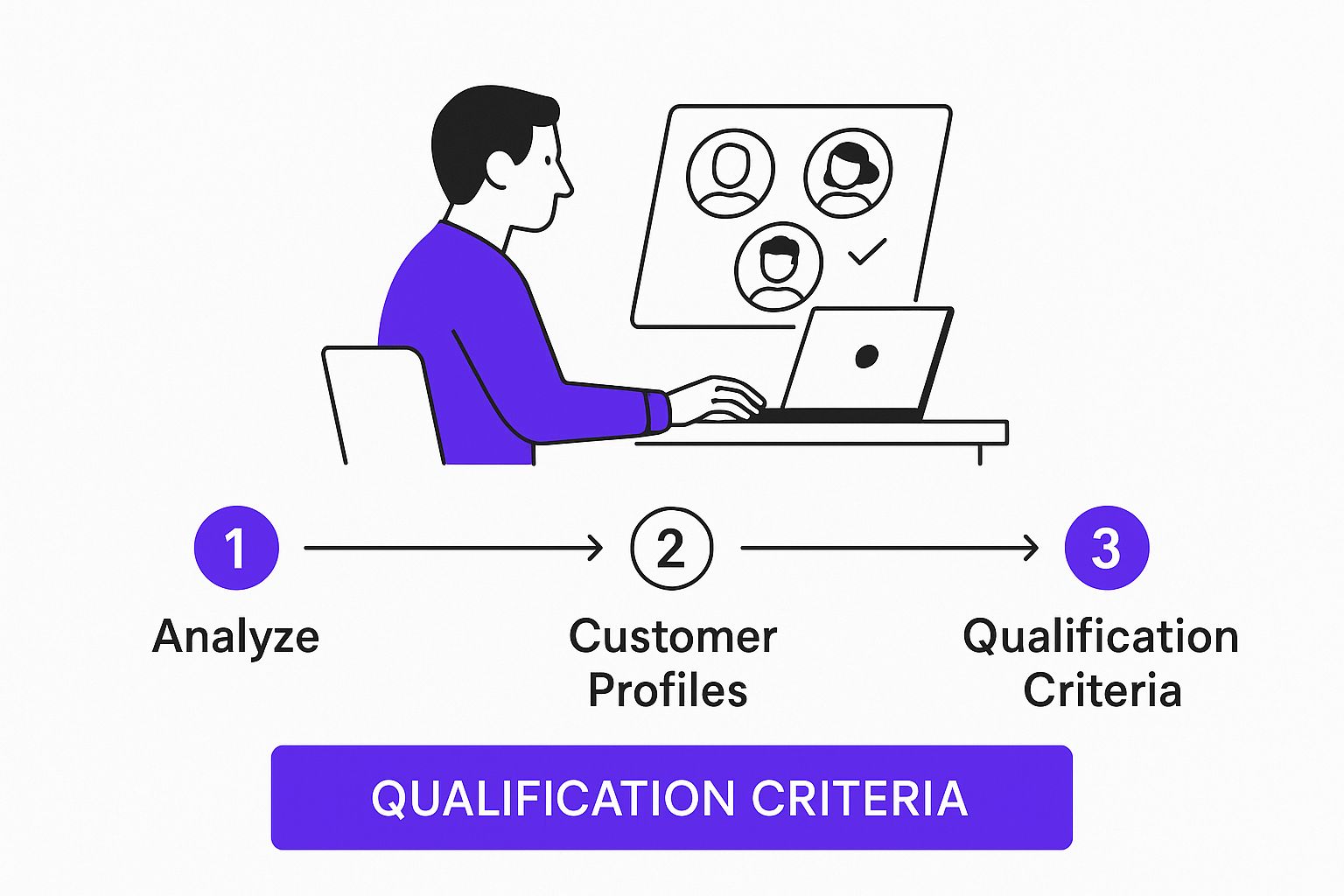
This is where you move beyond just taking a message and start actively shaping your sales pipeline. You're not just booking appointments; you're booking the right appointments.
Step 3: Score and Prioritize Your Leads
Let's be honest, not all leads are created equal. Lead scoring is how you rank them objectively. By assigning points based on the answers you get, you can quickly see who needs your attention now. For instance, a homeowner with an urgent, confirmed need and a ready budget scores way higher than someone just casually price-shopping for a project six months down the road.
Lead scoring is a simple but incredibly effective way to focus your team's energy. It puts the best opportunities at the top of the list, ensuring your most valuable leads get the fast response they need to convert.
This system creates a clear pecking order. Your team knows exactly who to follow up with first, second, and third. High-scoring leads get immediate action, while lower-scoring ones can be handled differently.
Step 4: Nurture or Hand Off the Lead
Based on its score, every lead should head down one of two clear paths.
- Hand Off to Sales: If the lead scores high and is ready to go, it's time to pass them to your estimators or book an on-site visit. This handoff needs to be smooth, with all the information you've gathered passed along so the customer doesn't have to repeat themselves.
- Nurture for Later: If a lead seems promising but just isn't ready to pull the trigger (a medium score), they go into a nurturing campaign. This could be a simple series of follow-up calls or emails with helpful tips, keeping your company top-of-mind until they are ready.
Having a structured approach like this is more important than ever. The lead generation market is set to explode from $3.1 billion to over $15 billion by 2031. At the same time, challenges persist—a staggering 44% of sales reps report being too busy to follow up properly. You can dig into more lead generation trends at Exploding Topics to see why a solid process is no longer optional.
Sorting Your Leads From Curious to Committed
Figuring out who's just window-shopping versus who's ready to pull out their wallet is a huge deal for any home service business. It’s the difference between spinning your wheels and closing a sale. In the industry, we call these leads Marketing-Qualified Leads (MQLs) and Sales-Qualified Leads (SQLs). Getting this right saves a ton of time and seriously bumps up your success rate.
https://www.youtube.com/embed/zv5rUEpSc3g
Think of it this way: an MQL is like a homeowner who just downloaded your free checklist on "Prepping Your AC for Summer." They're interested, sure, but they’re not calling you to schedule a tune-up just yet. They're in the early stages, gathering info and getting a feel for things.
An SQL, however, is the person who fills out the "Get a Free Estimate" form on your website. Their action screams intent. This is a hot lead, someone who needs a prompt, personal follow-up from your sales team.
From Education to Estimation
The real art is in guiding a lead from that initial curiosity to a firm commitment. You can't hit someone who's just starting their research with a hard-sell pitch; you'll scare them away. The key is to build trust by offering helpful, no-strings-attached advice until they're ready to make a move.
To get this process down to a science, many businesses use systems to rank their leads. Following lead scoring best practices helps you assign points to different actions—like a website visit or a form submission—so you know exactly which leads deserve your immediate attention.
An MQL needs to be educated and nurtured. An SQL needs to be contacted and scheduled for a quote. Confusing the two is one of the fastest ways to lose a potential customer.
For example, a homeowner who signs up for your monthly newsletter is an MQL. You can keep them engaged by sending them tips on DIY plumbing fixes or how to save on their energy bills. But when that same person clicks a link in your email to check out your financing options and then submits a contact form? They’ve just become a red-hot SQL.
MQL vs SQL What Home Service Businesses Need to Know
To make this crystal clear, let's break down the key differences. This table shows you exactly what sets an MQL apart from an SQL, so you know how to respond to each one.
| Attribute | Marketing-Qualified Lead (MQL) | Sales-Qualified Lead (SQL) |
|---|---|---|
| Common Action | Downloads a DIY guide, subscribes to a blog, or follows you on social media. | Fills out a "Request a Quote" form, calls to ask about installation timelines, or asks about specific model pricing. |
| Their Mindset | "I'm learning about my options and trying to understand my problem." | "I have a problem I need solved soon, and I'm ready to talk to a professional about a solution." |
| Your Best Response | Nurture with helpful content like emails, blog posts, and tips. | Contact them directly within minutes to discuss their needs and schedule an on-site estimate. |
Getting a handle on MQLs and SQLs is fundamental for any home service company looking to grow. It ensures your marketing team is warming up the right people and your sales team is spending their time on leads that are actually ready to convert.
It's also worth noting that the game is always changing. We're now seeing another category gain traction: Product-Qualified Leads (PQLs). In fact, they’re now the most valued lead type for 46.4% of businesses. These are people who've used a product or a digital tool, like a free project cost calculator on your website. As our industry adopts more digital tools, this is a trend to watch.
How to Streamline Your Lead Qualification Process
Knowing the theory behind lead qualification is one thing. Actually building a system that works consistently is a whole different ball game, especially when you’re a busy home service professional. Juggling active jobs, managing your crew, and keeping current customers happy doesn't leave much time to carefully screen every person who calls.
This is where things often fall apart. But it doesn't have to. The secret isn't working harder; it's connecting your strategy to a practical solution that does the heavy lifting for you.
Imagine having a dedicated expert on your front line, someone whose only job is to handle this crucial first step. That’s exactly what a service like Phone Staffer brings to the table. Our trained virtual receptionists act as your professional filter, using a script built around your specific criteria to qualify leads from the very first hello.
Turning Calls Into Qualified Appointments
The process itself is simple but incredibly effective. When a potential customer calls, your virtual receptionist does more than just jot down a name and number. They start the qualification process right then and there.
They ask the right questions to gather the essential details, separating the serious homeowners from the tire-kickers before they ever take up a slot on your calendar.
This means every single lead that gets passed on to you is:
- Verified: The caller actually needs a service you provide, in an area you serve.
- Ready: They have a real problem and a timeline that makes sense for both of you.
- Prepared: They’ve been pre-screened for critical factors like budget and decision-making authority, so you're not walking into a conversation that’s going nowhere.
To make this process even faster and more efficient, you can also look into specialized lead qualification tools that work alongside your other systems. These can help automate some of the initial data gathering, freeing up that human touch for the most promising leads.
Reclaim Your Time and Focus on Growth
For a busy contractor, the impact is immediate. You get back countless hours you would have otherwise wasted on dead-end phone calls and fruitless site visits. Think about it: research shows that sales reps often spend less than 36% of their time on activities that actually generate revenue. The rest gets eaten up by administrative work.
Outsourcing that initial screening flips the script entirely.
By delegating the initial lead qualification, you ensure every call is answered professionally and that you receive a steady stream of pre-qualified, estimate-ready leads. This is how you implement a robust system without having to do all the work yourself.
Ultimately, this lets you stop being the company receptionist and get back to what you do best—delivering high-quality work and growing your business. Your lead flow transforms from a chaotic flood of random inquiries into an organized, predictable pipeline of profitable jobs.
Common Questions About Lead Qualification
Even with the best system on paper, real-world questions always pop up. Getting your head around what lead qualification is is the first hurdle, but actually mastering it means knowing how to handle the tricky situations that can trip you up.
Let's tackle some of the most common questions we hear from contractors when they first start getting serious about filtering their leads. Think of this as the last little bit of coaching before you dive in.
How Long Does Lead Qualification Take?
This is a classic "it depends" situation, but I can give you some solid guideposts. For a simple, straightforward job—say, a leaky faucet or a clogged drain—you can often qualify the lead in a single phone call that takes just a few minutes. You’re just checking off the boxes: service, location, urgency. Done.
But for a major project like a full kitchen remodel or a new HVAC installation, the conversation will naturally be longer. It might stretch across a few phone calls or emails over several days, maybe even a week. You'll need to dig deeper into their budget, their specific vision for the project, and their timeline. The goal isn't to hit a specific time limit; it's to follow a consistent process, no matter how long it takes.
The point of qualifying a lead isn't just to be fast; it's to get to a clear "yes" or "no." A five-minute call that tells you a lead is a bad fit is way more valuable than a week of back-and-forth that goes nowhere.
What Are the Biggest Mistakes to Avoid?
By far, the biggest and most expensive mistake is not having a formal process at all. When you just "wing it" on every call, you're guaranteed to waste time and money chasing people who were never going to hire you.
A few other critical errors we see all the time include:
- Treating Every Lead the Same: You can't talk to someone just kicking the tires for information (an MQL) the same way you talk to a homeowner who’s ready to sign a contract (an SQL). It's a massive misstep.
- Avoiding the Budget Question: I get it, talking about money can feel awkward. But many contractors put it off, worried they'll sound too aggressive. The result? You spend hours putting together a detailed quote only to have the homeowner get sticker shock and disappear.
Can I Automate Parts of the Process?
You absolutely can, and you should. Automation is your friend here. Simple things, like making "Service Needed" or "Project Timeline" required fields on your website's contact form, can do some of the initial filtering for you. You can also set up email autoresponders to follow up with people who download a guide from your site but aren't quite ready for a phone call.
That said, for a home service business, nothing beats a real conversation. The human touch is where the magic happens. A real person can quickly gauge a homeowner’s personality, understand the nuances of their problem, and sense their actual urgency in a way no form ever could. This is exactly why services that provide trained receptionists work so well—they combine a repeatable, efficient system with the irreplaceable value of human judgment.
Stop wasting your days on dead-end leads and start booking more profitable jobs. Phone Staffer gives you professionally trained, remote CSRs who qualify every single call. You can finally stop chasing and start focusing only on homeowners who are ready for an estimate. Discover how our virtual receptionists can transform your lead flow.