
A contractor I know bid a 200 amp service upgrade as a “standard swap.” The inspector failed it because the run conditions and installation details didn't match the assumption behind the wire choice, and the rework wiped out the profit.
That's how 200 amp wire jobs go wrong. Not because the crew can't pull cable, but because someone treated a service upgrade like a commodity instead of a design decision.
Why a Simple Wire Choice Can Make or Break Your Job
On paper, a 200 amp service upgrade looks routine. Homeowner wants more capacity, the utility has its requirements, the panel changes, the meter setup gets coordinated, and the crew installs conductors that match the service. That's the clean version.
Field reality is messier. The meter may be farther than expected. The route may force tighter bends. The customer may want the upgrade now, but also mention a future shop, hot tub, or EV charger halfway through the estimate. If your quote assumes one conductor size and one cable type without checking those variables, you're gambling with labor, inspection risk, and callbacks.
Where contractors lose money
Most bad 200 amp wire decisions start with one of these mistakes:
- Treating “standard” as universal: A size that works for one dwelling service doesn't automatically work for a feeder, subpanel, or unusual run.
- Ignoring installation details: Conduit path, termination rating, lug compatibility, and cable assembly choice all affect whether the job goes smoothly.
- Underestimating customer communication: Homeowners hear “bigger wire” and think upsell unless you explain the reason in plain language.
- Forgetting liability: A loose aluminum termination or the wrong cable assembly can turn a profitable install into a warranty problem.
Practical rule: The wire decision isn't only electrical. It's a quoting decision, a scheduling decision, and a liability decision.
A new project manager usually wants a simple answer. “What wire do we use for a 200 amp service?” The honest answer is that there's a common starting point, but the profitable answer depends on application, material, route, and how the conductor will terminate.
What separates smooth jobs from painful ones
The companies that handle these upgrades well usually do three things before they send the final quote:
- They identify whether they're dealing with a true dwelling service or something downstream.
- They decide copper or aluminum on purpose, not by habit.
- They document the reason for any upsizing so the customer, installer, and inspector are all looking at the same logic.
That's what protects margin. It also protects your reputation, because nobody remembers that your wire choice saved a few dollars if the inspection fails or the panel runs hot later.
Decoding the NEC for 200 Amp Service
A lot of confusion around 200 amp wire comes from one bad habit. People look for a conductor “rated for 200 amps” and stop thinking there. Residential service sizing is not that straightforward.
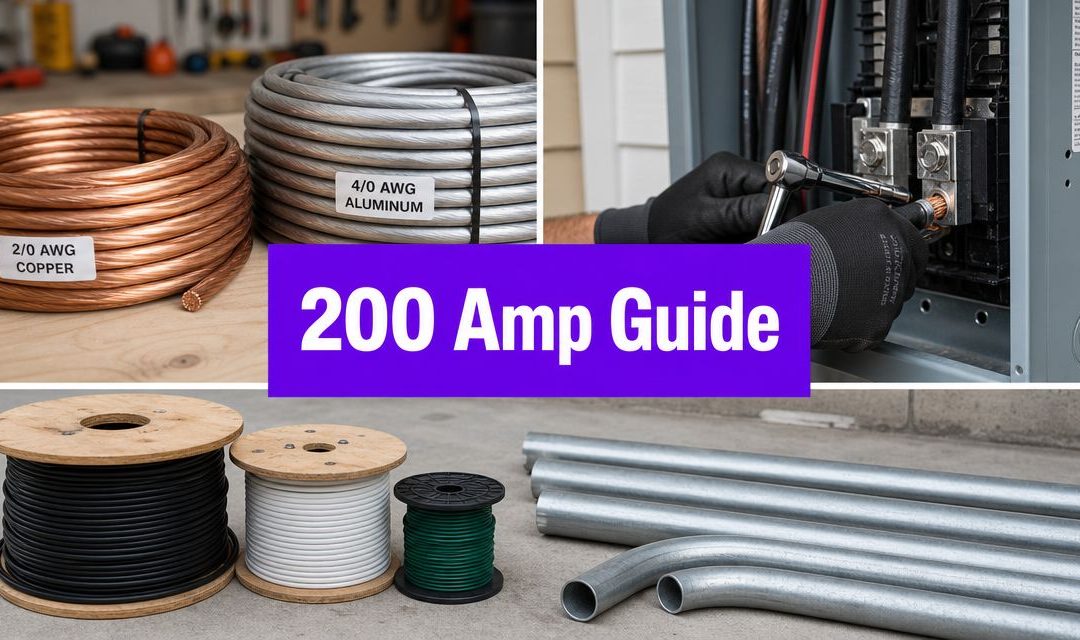
For a standard 200 amp residential service entrance, the NEC-based rule commonly used in major markets allows conductors to be sized at 83% of the service rating, so the wire must carry at least 166 amps. That's why 2/0 AWG copper and 4/0 AWG aluminum are widely cited for a dwelling's main service conductors. They exceed that minimum, with published ampacity figures of about 175 amps for 2/0 copper and 180 amps for 4/0 aluminum at 75°C, as explained in this residential 200 amp wire sizing reference.

Why that rule trips people up
Consider a bridge. The bridge isn't designed around one perfect moment where every lane is maxed out continuously. Residential services account for diverse dwelling loads. Everything in the house usually isn't drawing at full nameplate all the time.
That's why a dwelling service has a code path that feels different from general ampacity chart reading. It's not a loophole. It's a specific allowance for this application.
But there's a catch, and it matters for your business. That rule is specific to dwelling service conductors. If you carry that same assumption into every 200 amp application, you can mis-size a feeder or subpanel job and own the consequences.
What to teach a new estimator
When I train someone on these projects, I tell them to separate the job into two questions:
| Question | Why it matters |
|---|---|
| Is this the main residential service conductor? | That determines whether the dwelling-service rule applies. |
| What are the actual installation conditions? | That affects material choice, cable type, and whether the common answer still makes sense. |
If the estimator can't answer the first question clearly, the quote isn't ready.
The right answer for a house main service can become the wrong answer the moment the conductor feeds a subpanel instead of the service equipment.
The practical starting point
For most standard dwelling service entrance work, 2/0 copper or 4/0 aluminum is the starting conversation. Not the automatic final answer. The starting point.
That distinction keeps crews out of trouble. It also keeps your office from promising one material and one size before anyone has verified route, equipment, and scope. In the field, the fastest way to lose confidence is to tell a customer one thing at the kitchen table and then change the whole plan after rough inspection.
Copper vs Aluminum A Critical Business Decision
Material choice isn't just a technical preference. It changes your quote, your install pace, and how the customer feels about the job before you've even unloaded the truck.

What copper does well
Copper buys you familiarity. Many electricians like the way it handles, terminates, and bends compared with larger aluminum conductors. Customers also tend to hear “copper” and assume premium quality, which makes some sales conversations easier.
That said, copper can push a quote high enough to lose the job if the customer is price sensitive. If your company serves a competitive residential market, that matters. You can be technically right and still lose the work.
Where aluminum wins
Aluminum often helps contractors put together a sharper quote while still delivering a compliant installation. It's also lighter to handle on site, which crews appreciate when they're pulling larger conductors through awkward routes.
The trade-off is that aluminum requires discipline. The lugs and connectors have to be listed for aluminum. The terminations need to be prepared correctly. The crew needs to use antioxidant compound where required by the equipment instructions and follow torque requirements instead of “good and tight.”
Here's the side-by-side business view:
- Copper fits premium positioning: Easier to sell to homeowners who equate higher material cost with better long-term value.
- Aluminum supports competitive bids: Often the better choice when you need to control upfront project cost without cutting corners.
- Copper can simplify perception: Fewer customer objections, especially if they've heard old stories about aluminum problems.
- Aluminum rewards process control: Great option when your installers are consistent about terminations, connectors, and inspection prep.
How to sell aluminum without sounding defensive
One contractor I've worked with standardized around aluminum for many residential service upgrades. He stopped arguing material and started explaining application.
His script was simple. “We use aluminum where it's appropriate, listed, and installed for that exact purpose. The safety comes from correct sizing, listed terminations, and proper installation, not from repeating internet myths.”
That works because it moves the conversation away from fear and toward workmanship.
Field note: Customers rarely object to aluminum once you explain where it's used, how it's terminated, and why your company installs it that way.
If your crews aren't consistent, aluminum will expose it. If your crews are sharp, aluminum can be a strong value option that helps you win jobs and protect margin.
When Run Length Changes Everything Voltage Drop
A detached workshop is where “standard 200 amp wire” assumptions start falling apart. The homeowner says they want a serious space for tools, climate control, and future flexibility. The panel size sounds straightforward, but the route from the service equipment to the building is long enough that the conductor choice needs a harder look.

Voltage drop is easiest to explain with a hose. The longer the hose, the harder it is to maintain pressure at the far end under load. Electricity isn't water, but the customer usually understands that analogy immediately.
Why the estimate changes
Project managers sometimes encounter issues. They hear “200 amp” and plug in the same material they use for a short, ordinary run. But a long feeder run to a detached structure can require upsizing for performance and code compliance, especially when the customer expects heavy equipment to start cleanly and run reliably.
This is also where many callbacks begin. The installation passes, but the customer complains that equipment doesn't behave the way they expected. You don't want your first conversation about voltage drop to happen after the drywall is done and the invoice is paid.
A better approach during the site visit is to ask a few direct questions:
- What will the outbuilding power? Don't let “just a workshop” stand as the whole answer.
- How far is the route? Measure the path you'll install, not the distance as the crow flies.
- Is this a service or a feeder? That changes the sizing path.
- Does the customer plan to expand later? Future loads often show up after the trench is closed.
The upsizing conversation
One major industry guide states that for a 200 amp residential service, 3/0 AWG copper or 4/0 AWG aluminum is the minimum practical conductor size, while 2/0 AWG copper is closer to the limit because its allowable ampacity is listed around 195–200 A. The practical takeaway is that upsizing from 2/0 to 3/0 copper reduces conductor heating and leaves more margin for temperature correction and continuous-load considerations, as noted in this 200 amp service wire size guide.
When I'm explaining this to a homeowner, I don't lead with code language. I tell them the longer run puts more stress on the design, and larger wire gives the system more breathing room.
Here's a solid explainer to support that conversation:
If you spot the long-run issue early, you can quote the correct material the first time. If you miss it, you'll either eat the change order, fight with the customer, or explain to the inspector why your “standard package” didn't fit the actual job.
Choosing the Right Service Cable Assembly
Conductor size gets most of the attention, but cable assembly mistakes are what send crews back to the supply house and jobs back to rework. A lot of expensive confusion comes from grabbing the right size in the wrong assembly.

SEU and SER are not interchangeable
On residential work, the names sound close enough that newer team members sometimes treat them like substitutes. They're not.
SEU is commonly used where the assembly fits the service entrance application and configuration. SER is the assembly crews usually reach for when they need the conductor set that suits interior feeder work to subpanels. If your warehouse labels are sloppy or your truck stock is mixed, this mistake becomes more likely.
I've seen an apprentice run the wrong assembly to a subpanel because the size looked right and the outer jacket looked familiar. The inspector caught it immediately. Nobody argued about amperage. The issue was application.
What to check before the pull
Use a simple pre-install check on every 200 amp wire job that involves service cable:
- Confirm what the cable is feeding.
- Confirm the conductor count needed at the destination equipment.
- Confirm the grounding and neutral arrangement for that installation.
- Confirm the cable type matches the route and use.
That checklist sounds basic, but basic errors are the ones that kill margin.
The wrong cable assembly can look correct from ten feet away. Inspection happens at arm's length.
Why this matters for training and purchasing
This is one place where operations and field training overlap. If your office quotes “200 amp cable” without naming the assembly, someone in the field will fill in the blank. That's how avoidable mistakes happen.
A better purchasing and quoting habit is to specify the assembly, not just the wire size. That helps apprentices, helpers, warehouse staff, and project managers all work from the same assumption.
For teams that also touch industrial or mixed-use work, conductor and cable selection gets even more nuanced. This expert guide for industrial automation is useful because it reinforces a mindset many residential shops need more of. Match the conductor and cable choice to the exact application, not the nickname people use on the jobsite.
If your team learns that lesson early, they'll make fewer mistakes when work moves beyond simple service swaps.
Quoting and Installing with Confidence
A profitable 200 amp wire job is built before the crew starts pulling conductors. It starts when the quote accounts for the details that slow installers down and create risk if they're missed.
Heavy conductors don't behave like branch-circuit wire. They need room in the raceway, room to bend, and room inside the equipment to land cleanly. If the estimate ignores that, the crew ends up improvising, and improvisation around service conductors is where bad terminations begin.
Installation details that deserve line items
Some costs belong in every serious quote, even if the customer never notices them directly:
- Torque-controlled terminations: A torque wrench isn't optional when you're landing service conductors.
- Proper aluminum termination practice: If aluminum is part of the design, the crew needs the correct listed connectors and the installation method the equipment calls for.
- Labor for conductor handling: Bigger wire means slower pulls, more setup, and more care inside the can.
- Allowance for layout problems: Tight wall space, awkward meter locations, and difficult routing always cost labor.
I've seen the aftermath of a loose aluminum connection on a residential job. The problem wasn't that aluminum was used. The problem was that the termination wasn't made with enough care. Heat damage at a lug is a brutal reminder that installation quality is part of risk management, not just craftsmanship.
How to justify a higher quote
Customers don't need a lecture on ampacity tables. They need a short, credible explanation for why your quote is higher than the competitor's.
Try language like this:
| Customer concern | Better response |
|---|---|
| “Why is your wire bigger?” | “Your run and equipment setup call for more margin, so we're quoting it to perform correctly and pass inspection cleanly.” |
| “Why not use the cheaper option?” | “We can use different materials where appropriate, but the installation method and terminations have to match the application.” |
| “Another contractor said standard wire is fine.” | “Standard only works when the conditions are standard. Your layout adds factors that need to be accounted for.” |
When your office team needs help tightening that explanation, these customer communication strategies are useful because they focus on making technical decisions understandable to homeowners without sounding evasive.
For owners who operate across regions or want to tighten compliance habits, this overview of UK essential schemes for contractors is also a good reminder that licensing, qualifications, and documentation shape customer trust as much as technical skill does.
One line worth remembering: If you can't explain the wire choice simply, the customer will assume it's padding.
A strong quote protects your gross margin. A strong install protects your business after the truck leaves.
Frequently Asked Questions on 200 Amp Wire
Can I oversize 200 amp wire
Yes, oversizing is often a practical choice when run conditions, future planning, or installation margin justify it. The important part is making sure the larger conductor still fits the equipment, routing method, and termination requirements. Bigger wire can solve one problem and create another if the lugs, bend space, or conduit plan weren't considered.
Is the common residential answer always right for a subpanel
No. That's one of the most common field misunderstandings. The answer that fits a dwelling service conductor doesn't automatically carry over to every feeder or subpanel application. When the job changes, the code path can change with it.
Should I choose individual conductors or a cable assembly
It depends on the route and the equipment you're feeding. Individual conductors in raceway can give you more flexibility on some jobs. A service cable assembly can speed installation when it matches the application. The wrong choice usually shows up as either installation difficulty or inspection trouble.
What should my estimator document on site
At minimum, document the application type, route, conductor material, termination compatibility, cable assembly choice, and anything unusual about access or distance. Photos help. A rough sketch helps. A vague note like “200A upgrade, standard wire” does not help anyone.
How much should I rely on the inspector's opinion before quoting
You should respect the local inspector, but don't build a business process around hoping the AHJ fills in design gaps for you. Quote the work based on sound field judgment, then verify any gray areas early. If your market has local expectations beyond the book answer, your office should know them before the permit is pulled.
What's the safest default mindset for 200 amp wire jobs
Treat every job as application-specific. Don't let familiarity replace verification. The jobs that go smoothly are usually the ones where somebody asked one extra question before ordering material.
What should I tell a homeowner in one sentence
Tell them this: the wire size and type have to match the exact installation, not just the number on the panel.
Phone Staffer helps home service companies turn more leads into booked jobs through outbound calling. If your electricians are too busy to chase every opportunity, Phone Staffer can handle the calling, follow-up, list building, and appointment setting so your team stays focused on running work.