

When you're trying to figure out if your team is productive, you have to look at more than just the raw numbers. You need to mix that quantitative data—the hard numbers—with qualitative feedback on how well the work was actually done. It's about seeing the full picture, not just counting tasks.
Moving Beyond Busywork to Measure Real Impact
Let's be honest for a second: the old way of tracking productivity is broken. Counting hours or tallying up checked-off tasks only tells you who’s busy, not who’s effective.
Think about it in home service terms. A tech who knocks out eight jobs in a day sounds like a rockstar, right? But what if four of those jobs lead to angry callbacks? That "productivity" just created more work and unhappy customers. This is exactly where outdated metrics fall flat.
The real challenge today is shifting our focus from activity to impact. A flurry of activity that doesn't push your main business goals forward is just well-organized busywork. It looks like progress, but it’s often just draining your resources and your team’s morale.
The Problem with Surface-Level Metrics
When you focus only on volume, you can accidentally encourage the wrong behaviors. For example, if your CSRs are pressured to hit a high number of calls per hour, they might start rushing people off the phone. Sure, their call count goes up, but customer satisfaction plummets and you lose out on sales. It's a perfect case of a metric causing more harm than good.
The goal isn't just to do more; it's to do more of the right things. Real productivity connects every single task to a bigger business outcome, whether that's keeping more customers, earning more from each job, or fixing a problem on the very first call.
This distinction is huge because wasted effort is a massive hidden cost. In fact, research suggests the average office worker is only truly productive for about 2 hours and 53 minutes out of an eight-hour day. That gap is a clear signal that we need better ways to encourage focused, high-value work.
To give you a clearer idea, let's compare the old way of thinking with a more modern, impact-focused approach.
Shifting from Outdated to Modern Productivity Metrics
This table contrasts traditional metrics that track busyness with modern ones that measure what truly matters.
| Outdated Metric (Measures Busyness) | Modern Metric (Measures Impact) |
|---|---|
| Number of Calls Handled (CSRs) | First-Call Resolution Rate & Customer Satisfaction (CSAT) Scores |
| Hours Logged in the Field (Techs) | Job Completion Rate vs. Callback/Warranty Rate |
| Number of Tasks Completed (Admin) | Invoice Accuracy & Time-to-Invoice |
| Number of Estimates Sent (Sales) | Closing Rate & Average Job Value |
Moving to these modern metrics helps ensure that everyone's effort is directly contributing to the health and growth of the business, not just filling up the workday.
Making the Shift to Meaningful Measurement
So, how do you start measuring what actually matters? You need to look at both the "what" and the "how."
The "what" is your quantitative output—jobs done, calls answered, leads generated. The "how" is the qualitative side—customer happiness, work quality, and whether company standards were met. Looking at both gives you a complete, honest view of an employee's contribution.
Getting this right often means having better systems in place. Some companies turn to strategies like business process outsourcing to manage specific tasks with crystal-clear, outcome-based goals. By redefining productivity around genuine impact, you build a culture where everyone on the team knows exactly how their work helps the company win.
Defining What Productivity Really Means for Your Business

Before you can track anything, you need to answer a simple question: what does a "productive" day actually look like in your company? If you don't have a clear, agreed-upon definition, you’re just chasing numbers without any real meaning. A one-size-fits-all approach is a recipe for confused employees and unfair evaluations.
Think about it. What makes a field technician productive is completely different from what makes a marketing coordinator productive. For the tech, it’s not just about how many jobs they can cram into a day. A truly valuable tech has a high first-time fix rate, gets great customer reviews, and maybe even upsells a service plan when it makes sense for the homeowner.
On the other hand, a marketing coordinator who pumps out ten social media posts is just making noise if those posts don't bring in calls. Their productivity is tied to lead quality, campaign conversion rates, and the overall cost to acquire a new customer. Each role pushes the business forward in its own way, and your metrics have to reflect that.
From Vague KPIs to Role-Specific Results
The best way to figure this out is to talk to your team. They’re the ones in the trenches, and they know what actually moves the needle. Sit down with each department—or each person, if you're a smaller operation—and hash out what success actually looks like for their specific role.
When you do this, measurement stops being a top-down mandate and becomes a shared goal. Everyone understands what they're aiming for and, just as importantly, why.
Key Takeaway: Your goal is to define productivity by the results people get, not just the tasks they do. For every role, ask: "What outcome shows this person is winning and helping the company grow?"
On a global scale, economists look at this through a lens called labour productivity—essentially, the gross domestic product (GDP) produced per hour worked. The OECD found that the average in its member countries was just over USD 67 per hour in 2022. While you’re not tracking GDP, the core principle is the same: output versus input. You need to apply this concept to every single role in your business.
A Practical Framework to Define Productivity
To get a grip on productivity, it helps to understand how to measure operational efficiency and connect individual contributions to the bigger picture.
Here’s a simple framework to guide those conversations with your team:
- Pinpoint Core Responsibilities: What are the top 3-5 things this person is truly responsible for? Forget the long list of daily tasks and focus on the functions that create real value.
- Define What Success Looks Like: For each of those responsibilities, what’s the ideal outcome? Get specific. "Handle customer calls" is vague. "Resolve customer issues on the first call" is a clear, valuable outcome.
- Pick a Metric to Measure It: How do you put a number on that outcome? For our example, the metric is the First-Call Resolution (FCR) Rate.
Let’s see this in action for a Customer Service Representative (CSR) at a home service company:
- Core Responsibility: Answering inbound calls and booking appointments.
- Success Outcome: Turning a high percentage of qualified leads into scheduled jobs.
- Measurable Metric: Booking Rate (the percentage of qualified calls that become booked jobs).
When you follow this simple process for every role, you build a measurement system that's custom-fit, fair, and actually useful. It gets you out of the trap of tracking "busy work" and focuses the entire team on activities that drive real growth. This isn't a step you can skip if you're serious about improving your team's performance.
Choosing the Right Metrics and Tools
Once you’ve clearly defined what productivity looks like for each role, it's time to pick the right metrics and the tools to track them. The goal here isn't just to count things. It's to build a complete, balanced picture of performance that goes beyond one or two simple numbers.
For example, a technician's value isn't just about how many jobs they complete in a day. It’s also about the quality of that work—did it stick, or did they have to go back? And how did their work contribute to bigger company goals, like growing customer lifetime value?
Creating a Balanced Scorecard
To get a true sense of performance, you need to avoid the trap of focusing on a single, often misleading, metric. A far better approach is what's known as a balanced scorecard, which blends different types of data for a more holistic and fair assessment.
Your scorecard should include these three types of metrics:
- Quantitative Metrics (Output): These are the classic, numbers-driven metrics that measure volume and efficiency. Think jobs completed per day, estimates sent per week, or calls handled per hour. They’re easy to track, but they don't tell the whole story.
- Qualitative Metrics (Quality): This is all about the how. How well was the work done? You can measure this through things like customer satisfaction (CSAT) scores, first-time fix rates, and the number of positive online reviews mentioning a specific tech.
- Strategic Metrics (Alignment): These are the metrics that tie an employee's day-to-day work directly to the company's bottom line. For a tech, this could be upsell revenue generated from service agreements. For a CSR, it might be the customer retention rate they influence.
When you bring these three together, the picture becomes much clearer. A technician who knocks out six jobs a day (quantitative) with a 98% CSAT score (qualitative) and sells two new service plans (strategic) is undeniably a rockstar. This balanced view is the secret to getting it right.
Selecting the Right Technology for the Job
Trying to track all of this by hand on a spreadsheet is a recipe for disaster. The right software automates all the data collection, which frees you up to actually coach your team instead of getting buried in data entry. The trick is to find tools that seamlessly fit into your current workflow, not ones that add another headache.
As you consider your options, it's worth exploring different perspectives on how to measure employee productivity effectively and ethically. Building a system based on trust and improvement will always be more effective than one that makes your team feel like they're under a microscope.
Here are a few common types of tools that can help:
- Field Service Management (FSM) and CRM Software: For any home service company, this is your command center. It's a goldmine of data, tracking everything from booking rates and average ticket value to job completion times and customer history.
- Project Management Software: Tools like Asana or Trello are fantastic for your office staff, marketing team, or anyone working on project-based tasks. They make it easy to see task completion, timelines, and progress on key initiatives.
- Communication Platforms: If you have CSRs, call tracking software is non-negotiable. These systems can track call volume, first-call resolution rates, and even record calls for quality assurance and coaching.
This infographic shows just how powerful visualization can be. A simple dashboard can give you an at-a-glance view of how an employee is spending their time.
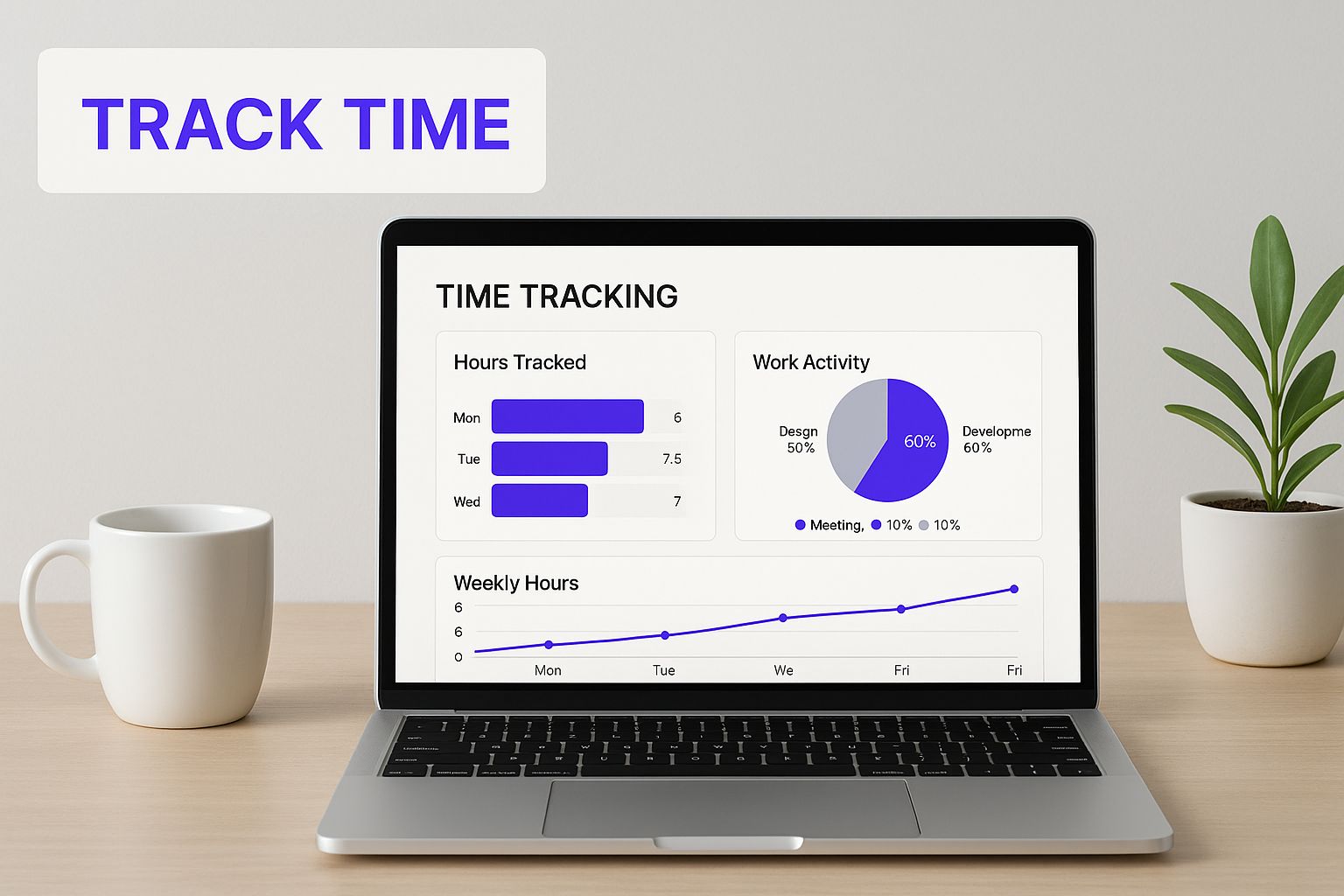
When you can see the data laid out like this, you can spot patterns and identify where someone’s focus is without having to look over their shoulder.
Comparing Your Tool Options
There's no single "best" tool out there—the right one for you depends entirely on the roles you're measuring and the metrics you decided are most important. It's all about finding the right fit for the job.
Pro Tip: Before you go shopping for new software, take a deep dive into the tools you already pay for. Your FSM or CRM probably has powerful reporting features you aren’t even using. Master those first.
The software landscape can feel overwhelming, but a clear strategy makes it much easier to navigate. The table below breaks down some of the main categories to help you see how they stack up.
Productivity Measurement Tools Comparison
| Tool Category | Best For | Key Metrics Tracked | Potential Pitfall |
|---|---|---|---|
| Field Service Management (FSM) | Technicians, dispatchers, and entire service operations. | Job completion times, first-time fix rates, travel time, revenue per technician. | Can be complex to set up; reporting might require customization. |
| Project Management Software | Office staff, marketing teams, administrative roles. | Task completion rates, project deadlines, team workload balancing. | Not suitable for tracking real-time, in-field service metrics. |
| CRM Software | Sales teams and customer service representatives (CSRs). | Lead conversion rates, customer lifetime value, follow-up activities, CSAT. | May lack detailed operational metrics specific to field service work. |
| Call Tracking & Analytics | Customer service representatives (CSRs) and sales teams. | Call volume, missed calls, first-call resolution, call duration. | Only provides insight into phone-based interactions; needs to be paired with other tools. |
Ultimately, choosing your tools comes after you've defined what you want to measure. That clarity will guide you to the software that actually tracks what you care about, giving you clear, automated insights that help your whole team perform at their best.
How to Roll Out Your System Without Freaking People Out

Introducing any new way of measuring productivity can feel like walking on eggshells. If you handle it poorly, your team will immediately think "big brother" is watching, and morale will tank. But when you get it right, it becomes an incredible tool for growth, recognition, and genuinely fair evaluations.
The whole thing boils down to two key ingredients: fairness and transparency. Your crew needs to understand the why behind the new system. They need to trust that it’s a tool to help them, not a hammer to bring down on them. This isn't just about launching some new software; it's about shifting the culture and building trust from day one.
Frame It Around Growth, Not Gotcha
This is the most critical part, and you have to get it right from the start. This initiative is not about catching people slacking off. It's about spotting opportunities for everyone to win. When you announce this, lead with what’s in it for them, not just what's in it for the company.
Explain how having clear metrics will help you:
- Reward your top performers fairly, using real data instead of just gut feelings.
- Pinpoint where someone might need more training or support to really hit their stride.
- Make sure workloads are balanced so nobody is getting consistently buried.
- Create clear, achievable paths for promotions and career growth.
When you kick off the conversation this way, you immediately bring the defensive walls down. People are far more likely to get on board when they see how this directly helps them and their career. It builds a culture of improvement, not one of constant scrutiny.
Have a Clear Communication Plan
Don’t just fire off a company-wide email and hope for the best. You need a real plan for rolling this out. The goal here is to over-communicate so there’s absolutely no room for rumors or misunderstandings to fill the void.
Think about it this way: a solid communication strategy is directly tied to how engaged your team is. In fact, productivity can jump by 20% to 25% in companies where employees feel connected and in the loop. That connection is built on clear, honest talk. You can find more of these employee productivity insights to see how engagement really does drive results.
Your plan needs to spell out exactly what you'll say, who you'll say it to, and when.
A Quick Tip for Managers: When you talk to your team, try saying something like this: "We're bringing in this new system to get a much clearer picture of our team's wins and challenges. This data is going to help me be a better coach, make sure you have what you need to succeed, and celebrate your hard work in a way that’s totally fair and transparent for everyone."
Tackle Privacy Concerns Head-On
Let's be honest: one of the first things your team will wonder is how their data is being used. Get out ahead of it. Address privacy concerns directly before anyone even has a chance to ask. Transparency here isn't just a good idea; it's non-negotiable.
Be crystal clear about what you're tracking and—just as important—what you are not tracking. Reassure them that the focus is on work output and efficiency, not on monitoring their personal activity.
Make sure your team knows:
- Exactly which metrics you’ll track for their specific role.
- How that data will actually be used (for coaching, planning, and performance reviews).
- Who gets to see the data (like the employee, their direct manager, and HR).
- And reiterate, again, that the goal is improvement, not punishment.
When your team sees you’ve thought through these things and have fair, clear policies, it builds a massive amount of trust. That foundation is absolutely essential if you want this effort to be seen as a positive step forward for everyone.
Turning Data into Actionable Feedback
Collecting technician performance data or CSR booking rates is a great start, but it's just that—a start. The real magic happens when you take those raw numbers and turn them into meaningful, constructive conversations that actually help people improve.
Data sitting on a dashboard is useless. Its power is only unlocked when it becomes the foundation for coaching, development, and, just as importantly, recognition.
This is where you make the leap from just measuring productivity to actively improving it. The goal isn’t to use metrics as a weapon. It’s about creating a roadmap to help every single person on your team reach their potential.
From Numbers to Narratives
Your first job is to find the story behind the numbers. A low first-time fix rate for a tech isn't just a bad statistic; it's a narrative waiting to be understood.
Does it mean they need more hands-on training for a specific type of HVAC unit? Are they rushing because their schedule is packed too tight? Or are they missing a specific tool that would make all the difference? Digging into the data helps you move past assumptions and find the real root of the problem.
To start spotting these stories, you can:
- Benchmark against the team: How does one employee's metrics stack up against the team average? This quickly highlights your high performers (who could be great mentors) and those who might need a little extra support.
- Look for trends over time: Was a dip in performance a one-off bad week, or is it part of a pattern? A single off-week could be anything, but a steady decline over a month points to a bigger issue that needs your attention.
- Connect the dots between metrics: Never look at a single data point in isolation. For example, a CSR with a slightly lower booking rate might have the highest customer satisfaction scores because they take the time to build real rapport. That’s a valuable trade-off you’d completely miss if you only focused on one number.
How to Have Constructive Feedback Sessions
Once you've spotted a trend, it's time to talk. A data-informed feedback session should feel supportive and collaborative, not like an interrogation. The key is to present the data as a starting point for a discussion, not a final verdict.
Never, ever start a conversation with, "Your numbers are down." Instead, put on your coaching hat.
A much better approach is something like this: "Hey, I was looking at our team's numbers for last month, and I noticed your callback rate was a bit higher than usual. What’s your take on that? Are you running into any specific challenges on those jobs?"
See the difference? This approach invites them into the problem-solving process. It shows you’re there to help, not to blame, turning a potentially tense moment into a genuine coaching opportunity.
Use Coaching Questions to Find Real Insights
Your role here is to be a coach, and great coaches ask great questions. Instead of just telling your team members what to do, guide them to find their own solutions. This builds ownership and encourages them to think critically about their own performance.
Here are a few powerful coaching questions to keep in your back pocket:
- "When you look at this data, what stands out to you?"
- "Walk me through a recent job that you felt went really well. What was the key to that success?"
- "On the flip side, was there a recent job that felt like a real struggle? What were the roadblocks?"
- "What's one thing that could make your day more productive or less stressful?"
- "What kind of support or training from me would be most helpful for you right now?"
These kinds of questions transform a one-sided review into a two-way dialogue. You'll get valuable insights you would never find on a spreadsheet.
Create Personalized Development Plans
The whole point of these conversations is to create a concrete, personalized development plan. This isn't a scary, formal "Performance Improvement Plan" (PIP). Think of it as a collaborative roadmap for growth, built specifically for that individual.
Based on your chat, the plan might include things like:
- Targeted Training: If a tech is struggling with a certain type of repair, maybe they need to attend a half-day training session or shadow a senior tech for a few jobs.
- Better Resources: Perhaps a CSR needs a better headset or a second monitor to work more efficiently. Simple fixes can have a huge impact.
- Process Tweaks: You might discover a flaw in your dispatching process that's setting a tech up for failure before they even leave the shop.
- Shared Goals: Work together to set one or two clear, achievable goals for the next 30 days, based directly on the data you discussed.
By turning your productivity data into a continuous cycle of analysis, coaching, and development, you create a powerful engine for growth. It shows your team that you're measuring performance not for control, but out of a shared commitment to getting better every single day. This is how you build a high-performing team that feels supported, engaged, and ready to win.
Have Questions About Measuring Productivity? We Have Answers.
Putting a productivity measurement system in place is a big step, and it's completely normal for questions to pop up. When you start shifting from just tracking "busyness" to measuring real, tangible impact, you're bound to hit a few tricky spots.
Let's walk through some of the most common questions we hear from home service company owners. Getting these right is the key to creating a system that feels fair and actually motivates your team, instead of making them feel like they're under a microscope.
How Do I Measure Productivity for My Office Staff?
This is the big one, right? It’s simple to count how many jobs a technician completes in a day, but what about your marketing specialist or office manager? Their work isn't so easily tallied. For these roles, you have to think differently—moving away from volume and toward outcomes.
Forget counting tasks. Instead, measure their progress against clearly defined goals.
- Project-Based Milestones: For a big marketing campaign, you’d track its journey from the first concept meeting to launch day. Did the important milestones get hit on schedule and on budget?
- Feedback from the Team: How did the sales guys feel about the leads your marketing coordinator brought in? Did that new brochure design get approved right away, or did it need a dozen revisions?
- Business Impact: Did that new online booking system the office manager championed actually cut down inbound calls by 15%? Did that spring marketing push lead to a real jump in qualified leads?
The trick is to define what a "win" looks like for every major project before it even starts. This shifts the focus from counting how many things someone did to looking at the quality and impact of what they delivered.
What are the Biggest Mistakes to Avoid?
It's surprisingly easy to get this wrong, and a few common blunders can undermine your entire effort. Usually, the biggest mistakes start with good intentions but are executed with the wrong approach.
Here are the most damaging errors I see time and time again:
- The One-Size-Fits-All Trap: You can't apply a technician's metrics to a CSR and expect it to work. It’s a recipe for frustration. Every single role needs its own set of relevant measurements.
- Focusing Only on the Numbers: If you’re obsessed with jobs-per-day but ignore first-time fix rates or what customers are saying in their reviews, you’re getting a warped view of performance.
- A Lack of Transparency: Just dropping tracking software on your team without explaining why you're doing it is the fastest way to kill morale. Be completely open about what you’re measuring and how that information will be used to help everyone.
- Using Data to Punish: The moment metrics become a stick to beat people with instead of a tool for coaching, you create a culture of fear. That's the opposite of what you want.
- Setting and Forgetting: Your business goals aren't static, so why should your metrics be? You need to regularly review what you’re measuring to make sure it still aligns with what’s most important to the company right now.
How Often Should I Talk About Productivity with My Team?
Finding the right rhythm for feedback is critical. If you save it all for a once-a-year review, you miss countless chances to make small adjustments that can have a huge impact. But, on the flip side, daily check-ins can feel like you're breathing down their necks.
A balanced approach works best.
- Quick Weekly Check-Ins: These are informal, five-minute chats. A simple, "How's the week going? Running into any roadblocks I can help with?" keeps communication flowing.
- Deeper Monthly or Quarterly Reviews: This is your time to zoom out and look at the trends in the data. Here, you can have bigger, more strategic conversations about goals, challenges, and where they want to grow.
This two-part rhythm makes talking about performance a normal, low-stress part of the routine. It stops being a scary annual event and becomes an ongoing, supportive conversation.
Can Measuring Productivity Actually Hurt Team Morale?
Yes, it absolutely can—if you do it badly. Morale takes a nosedive when people feel like Big Brother is watching, when they're judged by metrics that don't tell the whole story of their work, or when they're pushed into an unhealthy competition with their coworkers.
To avoid this, you have to build your system on a foundation of trust. The best way to do that? Involve your team in creating the metrics from the very beginning. When they help build the yardstick, they're far more likely to see it as a fair tool.
Always, always frame it as a way to find opportunities for support, better training, and celebrating wins. When your team sees you’re using data to help them get better and to shine a spotlight on their great work, a good measurement system can actually boost morale. It provides clarity and proves that you notice and value their hard work.
Ready to ensure your phones are always answered and every lead is handled professionally? The team at Phone Staffer can place a highly-trained, remote CSR directly into your business, helping you convert more leads and deliver exceptional customer service. Learn how we can help you grow.