

Before you even think about posting a job opening, you need to get brutally honest about what this role really is. Hiring a new customer service representative is a major step, and getting it wrong is expensive. The secret to success starts long before you look at the first resume—it begins with a crystal-clear definition of the person you need.
Define Your Ideal Hire Before You Start Looking

Let's get one thing straight: a generic CSR job description is a recipe for disaster in a home service business. Your representative isn't just a friendly voice answering calls. They are the central hub of your entire operation, the person who keeps the wheels turning.
Think about it. They’re the ones calmly talking a frantic homeowner off the ledge about a burst pipe while simultaneously juggling schedules to dispatch the right technician. This isn't your average call center gig. It requires a specific mix of empathy, sharp logistical thinking, and genuine grace under pressure.
Skipping this foundational step is like trying to build a house without a blueprint. You might get something standing, but it’s going to be wobbly and will eventually fall apart.
Map the Daily Realities of the Role
Forget the job title for a minute. What will this person actually do all day? This is where you need to get granular.
The best way to do this is to talk to the people on the ground. Grab your lead technician, your office manager, and anyone else who interacts with your current CSRs. Ask them what makes their lives easier and what drives them crazy. You're building a profile based on reality, not just what you think the job is.
Drill down into these specifics:
- Scheduling and Dispatch: How tricky is your scheduling? Does the CSR need to know which plumber is certified for tankless heaters or which HVAC tech is fastest at navigating downtown traffic?
- Problem-Solving: What are your top three customer emergencies? A dead furnace in January? A busted AC unit during a heatwave? Your new hire will be the first line of defense.
- Tech Savvy: Be specific. Do they need to master Housecall Pro, Jobber, or your custom-built CRM? List the exact software they’ll live in every day.
- Money Matters: Will they be taking credit card payments over the phone, explaining line items on a confusing invoice, or handling billing disputes? This requires a ton of patience and precision.
When you define the role this clearly, your job description acts as a filter. It automatically weeds out people who just want to answer phones and attracts the operations-minded professionals you actually need. You’re hiring a coordinator, not just a receptionist.
Look Beyond the Obvious Skills
Of course, you need someone with great communication skills. That's a given. But the truly exceptional CSRs in this industry have a different set of superpowers.
Multitasking isn't just about answering an email while on a call. It's about instantly knowing that the call from the flooded basement takes priority over the email asking for a routine quote—and handling both without dropping the ball.
This becomes even more critical for remote positions. Learning how to hire remote employees effectively is key, as you need to find someone with the rock-solid self-discipline to manage this chaos from a home office.
The job market for CSRs is always competitive, and getting a new hire up to speed is a huge investment—it can take months before they’re truly effective. That’s why you have to get it right the first time. The more precise you are upfront, the better your chances of finding a perfect, long-term fit.
Write Job Descriptions That Attract True Professionals
Think of your job description as your number one sales pitch. It’s the very first impression a potential hire gets of your company, giving them a real glimpse into your culture, the daily grind, and what it actually takes to win on your team. Let's be honest, a generic, copy-pasted description is just going to pull in generic, uninspired applicants.
If you want to find a real pro, you need to write a description that speaks their language. It has to go way beyond a boring list of tasks and instead, paint a clear picture of the impact they'll have on your business. This is your first and best chance to filter out the people just blasting out resumes and attract the ones who are truly driven by a job well done.
Frame Responsibilities Around Impact
The single biggest difference between a "meh" job description and a great one is how you talk about responsibilities. Stop listing what the person will do and start describing the outcome of their work. It's a subtle shift, but it makes all the difference because it attracts people who think in terms of results, not just ticking off a to-do list.
For example, look at the difference here:
Generic Task: "Answer incoming phone calls."
Impact-Oriented Responsibility: "Serve as the first, crucial point of contact for homeowners, providing quick solutions and scheduling assistance to resolve their urgent needs."
Generic Task: "Schedule appointments for technicians."
Impact-Oriented Responsibility: "Strategically manage technician schedules and dispatching to maximize daily routes, boost efficiency, and ensure a seamless customer experience from the first call to the finished job."
See the difference? The second version tells a candidate that their role is absolutely essential to the business's success. It shows them they won’t just be a cog in the machine—they’ll be a key part of what makes it all run smoothly.
Detail the Unique Challenges and Rewards
You have to be straight with people about what a CSR job in the home service industry is really like. This isn’t your typical, sleepy call center gig, and the right person will actually be excited by that. Don’t shy away from talking about the high-stakes nature of the work.
Talk about the real scenarios they’ll face every day:
- Calmly talking a panicked homeowner through a plumbing emergency over the phone.
- Playing schedule Tetris to get a technician to a "no-heat" call on the coldest day of the year.
- Explaining a parts delay to a frustrated customer with empathy and confidence.
Being upfront about these challenges does two critical things: it weeds out the candidates who can't handle the pressure, and it attracts natural-born problem-solvers who thrive in this kind of fast-paced environment. Just make sure you follow it up by talking about the rewards, too—like the satisfaction of turning a customer's bad day around or being the hero who gets a family's AC fixed during a brutal heatwave.
The point isn't to scare people off; it's to attract the right people. Being honest about the job's demands is the best way to find someone who is truly ready and motivated for the specific challenges your business throws at them.
Use Language That Reflects Your Culture
The tone you use in your job description should sound like your company. If you're a tight-knit, family-run shop, let that warmth and personality show. If you're a fast-growing, tech-savvy operation, use language that conveys that energy and drive.
Ditch the corporate jargon and stiff, formal phrases. Just write like you’re talking to a person. It's a small thing, but it helps candidates start to picture themselves working with you and your team.
For some more great ideas on this, check out these 8 Tips For Writing an Effective Job Description. When you craft a story that’s compelling and authentic, you turn a simple job post into a magnet for the best talent out there.
Find and Screen Candidates More Efficiently

So you've crafted the perfect job description. Now comes the hard part: getting it in front of the right people. If your strategy is to just post it on a few job boards and wait for the magic to happen, you're going to get buried in applications, and frankly, most won't be a good fit.
The best people for your business—the ones who already know the lingo and the rhythm of home services—are probably already employed. They aren't scrolling through job sites. You have to go find them. This means you need to switch from a passive "post and pray" approach to an active sourcing strategy.
Proactive Sourcing Beyond Job Boards
Here's a little secret: the best CSR for your company might not even have "customer service" in their current job title. Think about the real skills you need. You're looking for someone who can handle dispatching, coordinate logistics, and manage a technician's chaotic schedule.
This is where platforms like LinkedIn become your secret weapon. Instead of searching for "CSR," start searching for titles like "Dispatcher," "Logistics Coordinator," or "Service Coordinator." Get even more specific and look for people with those titles who are working for other local trade companies. They already get it.
When you find someone who looks promising, don't just send a generic connection request that screams "recruiter." A little personalization goes a long, long way.
- Be specific: "Hi Sarah, I saw your profile and was really impressed with your background in dispatching for HVAC companies. That's exactly the kind of experience we're looking for to help manage our plumbing team."
- Show them what's in it for them: Mention your company culture, a specific growth opportunity, or a unique benefit that might make them pause and consider what you're offering.
- Keep it casual: Frame your message as an exploratory chat, not a formal job offer. You're just opening a door.
This approach completely flips the script. You're not waiting for them to find you; you're tapping top-tier talent on the shoulder and showing them a better opportunity they didn't even know existed.
How to Scan Resumes in Under a Minute
Once the applications do start to trickle in, you need a system to weed out the "no's" from the "maybe's" in seconds. Your time is your most valuable asset, so don't waste it. The trick is to scan for industry-specific green flags and red flags.
Green Flags to Look For:
- Specific Software: Have they used industry CRMs like Jobber, Housecall Pro, or ServiceTitan? That’s a huge head start.
- Action Verbs: Look for words that show they did things, not just answered phones. "Coordinated," "dispatched," "scheduled," and "resolved" are pure gold.
- Longevity: Candidates who have stuck around at previous jobs for two or more years are often more reliable.
A resume that mentions "managing a fleet of 15 technicians" is infinitely more valuable than one talking about "handling high call volumes" at a big-box store. You're looking for operational thinking, not just a friendly voice.
The Initial Phone Screen Framework
Before you block out an hour on your calendar, a quick 15-minute phone screen can save you from a world of headaches. The goal here isn't to have them recite their resume back to you. It's to get a gut check on their communication skills, their problem-solving instincts, and whether their personality will vibe with your team.
I always like to start with a simple, open-ended question: "Tell me what you know about our company and what caught your eye about this role." Their answer tells you everything. Did they do a sliver of research, or are they just blasting their resume into the void?
Then, hit them with a quick situational question to see how they think on their feet. Something like, "Imagine a frantic customer calls because their basement is flooding, but every single one of our plumbers is tied up on other jobs. What's the very first thing you do?"
There’s no single correct answer. You're listening for their process. Do they lead with empathy? Do they try to gather more information? Or do they panic? This one little question reveals more about their natural instincts than their entire work history ever could.
Conduct Interviews That Predict On-The-Job Success

A resume tells you where a candidate has been. A great interview, on the other hand, shows you where they can go. Too many home service owners fall into the trap of asking tired, generic questions that just get them rehearsed, predictable answers.
The real mission here is to get past that polished interview persona. You need to see how a person actually thinks, behaves, and problem-solves under pressure.
This is where you make a crucial shift: stop asking what they would do and start asking what they have done. Digging into their past experiences is the single best way to predict their future performance. After all, past behavior is one of the most reliable indicators of future actions, especially in a high-stakes customer service role.
Instead of asking, "How do you handle angry customers?"—which just invites a textbook response—you need to go deeper. Simply rephrasing it as a behavioral question that forces them to recall a specific moment can completely change the dynamic of the interview.
Behavioral Questions That Uncover Real Skills
Behavioral questions are powerful because they get candidates to tell a story. They’re built around a framework you might have heard of called the STAR method (Situation, Task, Action, Result). You don’t need to explain it to them; just ask questions that naturally lead to that kind of detailed response.
For a home service CSR, you need to know a lot more than just their phone etiquette. You’ve got to get a feel for their problem-solving instincts, their empathy, and how they juggle multiple things at once.
Here are a few powerful behavioral questions I’ve seen work wonders for this role:
- "Tell me about a time you had to deliver bad news to a customer about a delayed service call. What was the situation, and what specific steps did you take?"
- "Describe a complex scheduling conflict you had to resolve—maybe a technician was running late for an emergency, and you had to shuffle their whole afternoon."
- "Walk me through an instance where you made a mistake that affected a customer. How did you take ownership of it, and what was the outcome?"
Listen closely to their answers. Are they specific? Do they take responsibility, or do they subtly shift blame? The details in these stories will tell you more about their character and competence than any generic answer ever could.
Situational Role-Playing for a Real-Time Assessment
While behavioral questions look to the past, situational role-playing puts a candidate’s skills on display right now. This is your chance to see them in action, and for a home service business, it’s an invaluable tool for hiring customer service representatives who can actually handle the job's unique pressures.
Set up a scenario they are almost guaranteed to face in their first week. You don't need a long, drawn-out script. Just a five-minute exercise is plenty, but make it realistic. You're looking for their raw instincts, not a polished performance.
Home Service Role-Play Scenario
You: "Okay, let's try a quick role-play. I'm a customer calling in a panic. Ring, ring…"
Candidate: "Hello, [Your Company Name], this is [Candidate's Name]. How can I help you?"
You (in a frantic voice): "Water is pouring through my ceiling! It's coming from the upstairs bathroom, and I don't know what to do! My water heater is in the attic—I think it just exploded!"
Now, just stop and observe. Let them take the lead.
What you're watching for is a very specific sequence of actions:
- Empathy and Reassurance: Do they immediately try to calm you down? Something like, "Okay, take a deep breath. We're going to get this figured out for you."
- Information Gathering: Are they asking critical questions? "Can you see a shut-off valve anywhere?" or "Is the water hot or cold?"
- Problem-Solving: Do they offer immediate, actionable advice? "If it's safe to do so, see if you can turn off the main water supply to your house."
- Action and Commitment: Do they take control of the dispatch? "I'm looking at our technicians' locations right now and will have someone heading your way immediately."
This simple test reveals their ability to stay calm, think logically, and take decisive action—all mission-critical skills that a standard interview question would completely miss. It separates the people who can talk about good customer service from those who can actually deliver it when things get chaotic.
Onboard Your New CSR for Long-Term Success
You did it. You navigated the resumes, conducted the interviews, and finally found a promising new customer service representative. But don't pop the champagne just yet—the real work is just beginning.
Hiring is only half the battle. A star candidate can turn into a disengaged, short-term employee if their first few weeks are a chaotic mess of logins, unsupported calls, and vague expectations. A well-thought-out onboarding plan is your best defense against early turnover and the key to building a team that sticks around.
High turnover is a silent killer for home service businesses. Some industries see annual turnover rates skyrocket past 40%, and the cost to replace a single agent can easily exceed $2,500 when you factor in recruiting, training, and lost productivity. As highlighted in a detailed look at customer service statistics, this isn't just an HR problem; it's a significant financial drain. Investing in a great onboarding experience isn't an expense—it's a smart business decision.
The First 30 Days: Building a Solid Foundation
The first month is all about immersion. The goal isn't to create a superstar by day 30, but to build a confident employee who understands the fundamentals of your business and knows their way around your systems. Rushing this part is a classic mistake that creates bigger headaches later.
Your focus should be on guided, hands-on learning. Think of it like teaching someone to swim by starting them in the shallow end, not by tossing them into the deep.
Here’s what to focus on in those critical first 30 days:
- Mastering Your Tech Stack: Get them deep into your CRM and scheduling software, whether it's Jobber, Housecall Pro, or another platform. Set up a sandbox environment where they can practice creating mock jobs, dispatching phantom technicians, and running dummy invoices without any real-world consequences.
- Learning the Lay of the Land: Your new CSR needs to think like a dispatcher. They should know your service boundaries cold, understand typical travel times between neighborhoods, and learn the unique skills of each technician. Who’s your go-to for a tricky boiler repair? Who’s certified for that niche commercial job? This knowledge is gold.
- Shadowing and Reverse Shadowing: Start them off by listening in on calls with a seasoned team member. Once they have a feel for it, flip the script. Have the new hire take the lead on calls while the veteran CSR listens in, ready to jump in or provide immediate feedback. It’s a game-changer for building confidence.
By the end of the first month, your new CSR should be able to handle a basic service call from start to finish with minimal help. They should know where to find answers, who to ask for support, and feel like they’re truly part of the team.
To help structure this crucial period, here is a week-by-week checklist that breaks down the first month into manageable steps.
Onboarding Checklist for New Customer Service Representatives
| Timeframe | Task Category | Specific Action Items |
|---|---|---|
| Week 1 | Immersion & Basics | • Company culture & team introductions. • Systems setup (logins, email, phone). • Initial software training (CRM, scheduling). • Shadowing senior CSRs on live calls. |
| Week 2 | Operational Knowledge | • Deep dive into service offerings & pricing. • Review technician profiles & skills. • Study service area map & travel zones. • Begin "reverse shadowing" on simple inbound calls. |
| Week 3 | Hands-On Application | • Handle routine scheduling calls independently. • Practice in a sandbox CRM environment. • Role-play common customer questions & scenarios. • Weekly check-in and feedback session. |
| Week 4 | Building Confidence | • Take a wider variety of calls with minimal supervision. • Learn basic troubleshooting & escalation procedures. • Introduction to performance metrics. • Review of the first 30 days. |
This checklist provides a clear roadmap, ensuring no critical steps are missed and setting your new hire up for a successful transition into their role.
The Next 30 to 60 Days: Fostering Independence
With the core fundamentals locked in, the second month is all about letting the training wheels come off. Your new CSR will start handling a higher volume and wider variety of customer interactions on their own.
Now is the time to introduce more complex situations. Move beyond simple scheduling and start role-playing the tough stuff: customer complaints, billing disputes, and unexpected parts delays. How you handle these moments is what separates good service from great service.
This is also the perfect time to arm them with sales skills. As they start fielding calls from new leads, they'll inevitably face questions about price or availability. Get them up to speed by having them review a practical guide on how to handle sales objections and then practice those techniques in mock calls.
The Final 30 to 90 Days: Driving Performance
In the last leg of onboarding, the focus shifts from learning to performing. Your CSR should be operating with a high degree of autonomy, so it’s time to introduce the key performance indicators (KPIs) that define success in the role.
Start tracking and discussing metrics like:
- Average Call Handle Time: Are they resolving issues efficiently without rushing the customer?
- First-Call Resolution Rate: Can they solve the customer's problem on the first try? This is a huge driver of customer satisfaction.
- Booking Conversion Rate: How good are they at turning an inquiry into a scheduled, revenue-generating job?
Consistent communication is still crucial here. Keep up with weekly one-on-one meetings to go over their metrics, celebrate their wins, and pinpoint areas where a little more coaching could help. By day 90, you shouldn’t just have a new employee; you should have a fully integrated, confident, and productive member of your team who is ready for the long haul.
In-House Hire Versus An Outsourced Service
https://www.youtube.com/embed/PxU_u7DTu3o
As your home service business grows, you'll eventually hit a fork in the road. Do you tackle the whole process of hiring a customer service rep yourself, or do you bring in an outsourced service? This isn't just about getting the phones answered—it's a major strategic decision that affects your budget, your day-to-day operations, and how fast you can scale.
The True Cost of an In-House Hire
Hiring a CSR directly is a much bigger financial commitment than just their hourly wage or salary. Once you start looking past the paycheck, the hidden costs pile up fast. It's not uncommon for the real cost to be nearly double their base pay.
Think about it. You're not just paying a wage. You're also on the hook for:
- Benefits and Taxes: This is the big one—payroll taxes, health insurance, 401(k) contributions, and paid time off.
- Recruitment and Onboarding: The money and, just as importantly, the time you spend on job ads, interviews, background checks, and training is a huge investment.
- Equipment and Overhead: They need a computer, a headset, software licenses (which can get pricey), and a place to work.
- Your Management Time: A new employee doesn't run on autopilot. They need direct supervision, coaching, and performance reviews, pulling you or another manager away from revenue-generating work.
A 2024 report on hiring trends found the median salary for a customer service representative was around $51,719. That’s a hefty starting point before you even factor in all the extras, which can easily tack on another 25-40% to the total cost. You can get a deeper look into how remote work is shaking up pay scales in the 2025 global hiring trends and impact report from Oyster.
The Outsourced Service Alternative
Going with a specialized service like Phone Staffer is a completely different approach. Instead of building your own customer service arm from the ground up, you get instant access to a team of trained professionals who already know the home service industry inside and out.
This model has some serious perks, especially if you're focused on growth and keeping things lean. You get to skip the entire time-consuming and expensive hiring circus.
The real beauty of an outsourced service is the scalability and predictability. You get exactly the coverage you need—whether it's 8 hours a day or 24/7—without the headache of managing another employee on your payroll.
This onboarding flowchart gives you a good visual of the time sink involved in just getting a new in-house hire ready to go.
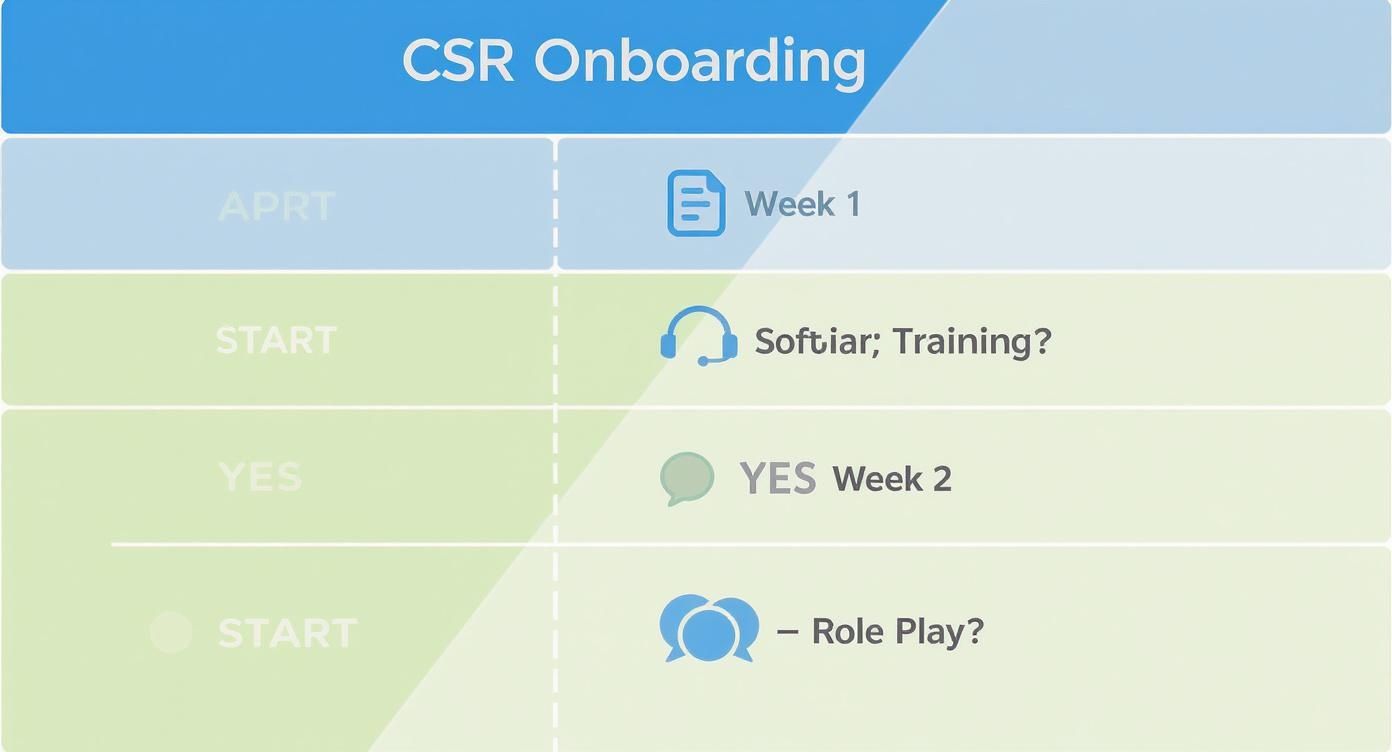
As you can see, even the basics like software training and role-playing can eat up the first few weeks. That’s a lot of time and money spent before your new hire is even close to being fully productive.
In-House CSR vs. Outsourced Service Comparison
So, how do the two options really stack up side-by-side? Breaking it down can help clarify which path makes the most sense for your business right now.
| Factor | In-House Employee | Outsourced Service (e.g., Phone Staffer) |
|---|---|---|
| Total Cost | High: Base salary + 25-40% in taxes, benefits, overhead. | Predictable: Fixed monthly fee. No hidden costs. |
| Recruitment | Time-consuming & expensive: Job posts, interviews, background checks. | Instant: Access to a pre-vetted, trained team. |
| Training Time | Weeks or months until fully proficient. Significant management oversight. | Minimal: Agents are already experts in home service software and workflows. |
| Scalability | Difficult: Hiring and firing is a slow, legally complex process. | Flexible: Easily scale coverage up or down based on seasonal demand. |
| Management | Direct responsibility for performance, scheduling, and HR issues. | Hands-off: The service handles all management, payroll, and HR. |
| Coverage | Limited to standard business hours unless you hire multiple people. | 24/7/365 coverage is often available to capture every lead. |
| Control | Full control over training, culture, and daily tasks. | Less direct control over individual agents, but high-quality service is guaranteed. |
Choosing between an in-house hire and an outsourced partner really comes down to what you want to focus on. If you're trying to grow your business, offloading the administrative and financial weight of a customer service department can free you up to do just that.
Common Questions About Hiring CSRs
When you're thinking about bringing on a new customer service rep, a few questions always seem to pop up. For home service business owners, the answers aren't always straightforward.
What's a Realistic Salary for a CSR?
You might see national averages floating around $51,000, but that number can be all over the map depending on your location, the candidate's experience, and whether you're hiring for an in-office or remote position.
For a truly skilled home service CSR—someone who can not only answer the phone but also handle dispatching and master your schedule—you should expect to pay on the higher end of your local market rate. It's the only way to attract top talent. And don't forget the "hidden" costs. Things like benefits and payroll taxes can easily tack on an extra 25-40% to that base salary.
How Long Should the Hiring Process Take?
From the moment you post the job ad to your new hire’s first day, a solid, well-thought-out process usually takes about four to six weeks. I know it's tempting to rush, especially when you're swamped, but that's a recipe for a bad hire.
Here’s a rough idea of how that time breaks down:
- Week 1: Getting the job ad out there and letting applications roll in.
- Week 2: Sifting through resumes and holding quick initial phone screenings.
- Week 3: Conducting the real, in-depth interviews and maybe some role-playing exercises.
- Week 4: Doing your due diligence with reference checks before making an offer.
If you factor in a standard two-week notice period for your chosen candidate, you land right in that six-week timeframe.
The biggest mistake you can make is hiring out of desperation. A bad hire costs far more in lost revenue and team morale than taking an extra week or two to find the right person for the job.
Stop wasting time on the hiring rollercoaster and get back to growing your business. Phone Staffer provides expertly trained, US-based remote CSRs who are ready to handle your calls, book jobs, and delight your customers from day one. Discover how our done-for-you service can transform your front office.