

In the competitive home service industry, a friendly voice and a quick fix are just the beginning. Exceptional customer experiences, the kind that generate glowing reviews and repeat business, are built on a foundation of strategic training. Simply hiring for a "good attitude" isn't enough. Your team, from dispatchers to technicians, needs a robust toolkit of skills to handle everything from complex scheduling inquiries to de-escalating homeowner frustrations on-site.
This guide dives into the 10 essential customer service training topics that will transform your support staff from reactive problem-solvers into proactive relationship-builders. We’re not just listing concepts; we are providing a complete blueprint for each topic, tailored specifically for the unique challenges of home service businesses. For each of the ten core areas, you'll find:
- Why It Matters: A direct explanation of how this skill impacts your bottom line and customer satisfaction.
- Learning Objectives: Clear, measurable goals for your team to achieve.
- Training Activities: Practical, hands-on exercises like role-playing and script analysis.
- Key Metrics: How to track progress and measure the real-world impact of your training.
Implementing these essential topics requires engaging formats. Many businesses find that creating effective customer service training videos helps standardize instruction and ensures every team member receives the same high-quality information, whether they're in the office or in the field. This comprehensive approach ensures that the skills learned are not just understood but consistently applied, turning every customer interaction into an opportunity to build loyalty and strengthen your brand's reputation.
1. Communication Skills & Active Listening
Effective communication is the cornerstone of exceptional customer service, but it goes beyond simply talking. This foundational training topic focuses on both verbal and non-verbal cues, empathetic listening, and the art of clear information exchange. It teaches service professionals to hear not just what customers say, but also what they don’t say, allowing them to uncover the root of an issue and build genuine rapport.

For home service businesses, where a technician is a guest in a customer's personal space, this skill is paramount. It transforms a transactional service call into a reassuring, trust-building experience.
Why It Matters
Strong communication and active listening skills directly impact first-call resolution rates, customer satisfaction (CSAT), and long-term loyalty. When a homeowner feels truly heard and understood, especially during a stressful situation like a burst pipe or broken furnace, they are more likely to become a repeat customer and a vocal advocate for your brand.
Suggested Lesson Objectives
- Identify and practice the three levels of listening: internal, focused, and global.
- Demonstrate empathetic communication using verbal and non-verbal techniques.
- Apply questioning strategies (open-ended vs. closed-ended) to diagnose customer issues accurately.
Training Activities
- Role-Play Scenarios: Simulate difficult customer calls, such as a complaint about a previous job or an inquiry about complex pricing.
- Call Recording Analysis: Review recorded calls as a group to identify moments where active listening succeeded or could have been improved.
- "What They Mean" Game: Present a vague customer statement (e.g., "The AC is just not working right") and have trainees brainstorm clarifying questions to uncover the real problem.
Sample Metrics to Track
- Customer Satisfaction (CSAT): Measure post-interaction survey scores related to feeling "heard and understood."
- First-Call Resolution (FCR): Track the percentage of issues resolved without needing a follow-up call or visit. For a deeper dive, learn more about how to improve call center performance.
- Recommended Module Length: 2-3 hours for initial training, with 30-minute monthly refreshers.
2. Emotional Intelligence (EI) & Empathy
Beyond just hearing a customer's problem, emotional intelligence (EI) allows a service professional to understand and manage their own emotions while simultaneously recognizing and influencing the emotions of others. This customer service training topic focuses on developing self-awareness and empathy, enabling team members to de-escalate tense situations and build connections on a human level.

For a homeowner dealing with the anxiety of a major plumbing leak or a sudden electrical failure, a technician who responds with genuine empathy rather than just technical proficiency can completely change the customer experience. This skill transforms a potentially negative memory into a positive one.
Why It Matters
High emotional intelligence directly correlates with improved conflict resolution, higher Net Promoter Scores (NPS), and increased employee resilience. When a team member can remain calm and empathetic in the face of a customer's frustration, they prevent escalation and reinforce the customer's decision to trust your company. This is a key differentiator in a competitive market.
Suggested Lesson Objectives
- Define the four core components of emotional intelligence: self-awareness, self-management, social awareness, and relationship management.
- Recognize emotional triggers in oneself and customers during simulated interactions.
- Apply empathetic statements and validation techniques to de-escalate customer frustration.
Training Activities
- "Emotion Labeling" Exercise: Play recorded customer calls (with sensitive info removed) and have the team identify and label the emotions the customer is likely feeling at different points.
- Mindfulness Moments: Start meetings or training sessions with brief, guided breathing exercises to teach team members how to regulate their own emotional responses under pressure.
- Customer Journey Mapping: Have trainees map out the emotional highs and lows a customer might experience during a typical service call, from initial panic to final relief.
Sample Metrics to Track
- Net Promoter Score (NPS): Analyze qualitative feedback from Detractors and Passives to identify trends related to emotional connection and empathy.
- Employee Burnout/Turnover Rate: Track retention, as teams with higher EI are often more resilient and experience less stress-related turnover.
- Recommended Module Length: 3 hours for an initial workshop, with 45-minute quarterly sessions focused on specific EI skills.
3. Product & Service Knowledge
Nothing erodes customer confidence faster than an agent who doesn't know their own offerings. This essential training topic moves beyond basic features and focuses on creating true product experts who can speak with authority on every service, piece of equipment, and membership plan your company offers. It's about empowering your team to be consultants, not just script-readers.
For a home service business, this means a CSR can confidently explain the difference between a tankless and a traditional water heater, or a technician can articulate the long-term value of a specific HVAC filter. This expertise turns a simple inquiry into an opportunity to provide genuine value and build trust.
Why It Matters
Deep product and service knowledge is directly linked to higher first-call resolution rates, increased sales conversion, and greater customer trust. When a team member can answer complex questions accurately and recommend the right solutions without hesitation, they position your company as a knowledgeable and reliable authority, reducing customer anxiety and encouraging upselling opportunities.
Suggested Lesson Objectives
- Explain the features, benefits, and common troubleshooting steps for core company services.
- Compare and contrast different equipment models or service tiers to guide customer decisions.
- Identify opportunities for cross-selling or upselling relevant services and products during customer interactions.
Training Activities
- Product/Service Demonstrations: Have technicians or product experts provide hands-on demonstrations of key equipment or service processes for the customer-facing team.
- Knowledge Base Scavenger Hunt: Create a quiz where trainees must use the company’s internal knowledge base or reference guides to find answers to specific, technical customer questions.
- "Teach Me" Role-Play: Pair up trainees and have one person act as a brand-new customer while the other explains a complex service (like a sewer line inspection) in simple, easy-to-understand terms.
Sample Metrics to Track
- First-Call Resolution (FCR): A high FCR often indicates that agents have the knowledge needed to solve problems without escalation.
- Average Handle Time (AHT): While not the only goal, a decrease in AHT can show that agents are finding information more efficiently.
- Upsell/Cross-sell Rate: Track the percentage of interactions that result in the successful sale of an additional product or service tier.
- Recommended Module Length: 4-6 hours for initial onboarding, with 1-hour quarterly updates for new products or service changes.
4. Problem-Solving & Troubleshooting
Beyond simply answering questions, elite customer service professionals are expert problem-solvers. This training topic equips your team with systematic approaches to diagnose the root cause of an issue, evaluate potential solutions, and implement the most effective fix. It moves agents from a reactive stance to a proactive one, teaching structured methodologies like the "5 Whys" or decision-tree analysis to deconstruct complex customer problems.
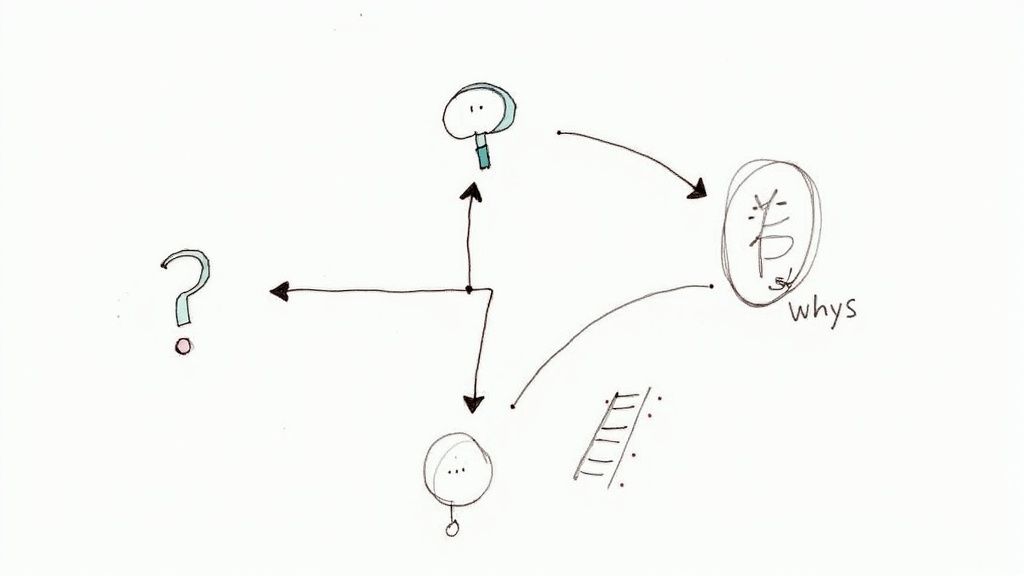
For a home service business, this means a technician doesn't just fix a leaky faucet; they investigate why it was leaking to prevent a recurrence, saving the customer future headaches and expense. This deeper level of service builds immense trust and positions your company as a true expert.
Why It Matters
A structured approach to troubleshooting directly reduces callbacks and repeat visits, which are costly for both the business and the customer. When your team can accurately diagnose and solve problems on the first try, it boosts operational efficiency and significantly enhances customer confidence. This skill turns a one-time fix into a long-term customer relationship.
Suggested Lesson Objectives
- Apply the "5 Whys" technique to uncover the root cause of a customer's issue.
- Develop a simple troubleshooting flowchart for a common service request (e.g., a pilot light not staying lit).
- Evaluate multiple solutions to a complex problem and recommend the best course of action based on customer needs and long-term value.
Training Activities
- Case Study Analysis: Present detailed scenarios of past complex jobs. Have the team work together to map out how they would have diagnosed and resolved the issue.
- "Build a Decision Tree" Workshop: Choose a common technical problem and have the group collaboratively create a visual decision-tree guide for solving it.
- Role-Play Escalations: Simulate a scenario where a first-level fix failed, and the technician must troubleshoot a deeper, more complex issue with the customer.
Sample Metrics to Track
- First-Contact Resolution (FCR): Monitor the percentage of issues fully resolved during the initial call or visit.
- Repeat Visit Rate: Track how often a technician must return to a customer's home for the same issue within a 30 or 60-day period.
- Recommended Module Length: 4 hours for a deep-dive workshop, followed by 1-hour quarterly sessions focusing on new or complex issues.
5. Conflict Resolution & De-escalation
Even the best businesses face upset customers. This specialized training topic equips your team to manage tense or hostile interactions by understanding escalation triggers, using calming techniques, and finding constructive solutions. It's about transforming a negative, high-stress situation into an opportunity to demonstrate empathy and problem-solving prowess.
For a home service technician dealing with a frustrated homeowner whose HVAC system failed on a 100-degree day, these skills are not just helpful; they are essential for maintaining professionalism and ensuring safety.
Why It Matters
Effective conflict resolution prevents negative online reviews, reduces customer churn, and minimizes the stress on your employees. When a team member can confidently de-escalate a heated conversation, they not only save that customer relationship but also protect the company's reputation. Companies like Comcast have demonstrated significant reductions in escalated complaints after implementing robust de-escalation training.
Suggested Lesson Objectives
- Identify the common triggers that lead to customer anger and escalation.
- Demonstrate calming techniques, such as a lowered vocal tone and validating language (e.g., "I can see why this is so frustrating").
- Apply a structured framework to guide a difficult conversation toward a mutually agreeable resolution.
Training Activities
- High-Stakes Role-Play: Simulate scenarios like a job that went over budget, an accidental property damage claim, or a technician arriving late.
- De-escalation Scripting: Have teams collaboratively write and practice scripts for common high-tension situations, focusing on offering choices to give the customer a sense of control.
- Emotional Trigger Analysis: Review case studies of customer complaints and have trainees identify the key emotional drivers and pivotal moments where de-escalation could have been applied.
Sample Metrics to Track
- Number of Escalated Calls: Monitor the percentage of calls that need to be transferred to a manager.
- Negative Review Rate: Track the frequency of negative reviews mentioning poor handling of a complaint.
- Recommended Module Length: 3-4 hours for an in-depth workshop, with quarterly 1-hour role-playing sessions.
6. Multi-channel Communication & Omnichannel Support
Customers today expect to interact with your business on their preferred platform, whether it's a phone call, an email, a website chat, or even a social media message. This training topic equips your team to provide a seamless and consistent high-quality experience across all these channels. The goal is to create a unified customer journey, where a conversation can start in one channel and continue in another without losing context or quality.
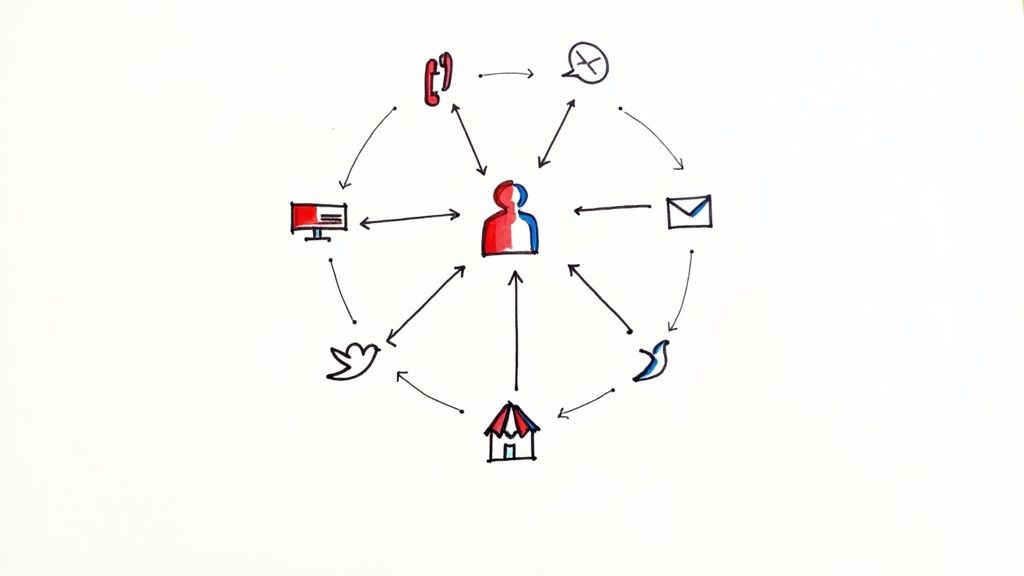
For a home service company, this means a customer can book an appointment via a website chatbot, receive an email confirmation, get a text from the technician, and later provide feedback on Facebook, all while feeling they are engaging with one cohesive company.
Why It Matters
A strong omnichannel support strategy eliminates friction and frustration for the customer. It prevents them from having to repeat their issue every time they switch channels, which significantly boosts customer satisfaction and operational efficiency. Companies that master this create a modern, convenient experience that sets them apart from competitors who still operate in silos.
Suggested Lesson Objectives
- Define the difference between multi-channel and omnichannel support.
- Demonstrate proper communication etiquette and tone for at least three different channels (e.g., phone, email, live chat).
- Utilize a CRM or unified communications platform to track a customer interaction across multiple touchpoints.
Training Activities
- Channel-Switching Role-Play: Start a customer issue via email, then have the "customer" call in to continue the conversation. The trainee must pick up the interaction seamlessly using a unified customer record.
- Etiquette Quiz: Create a short quiz with scenarios asking for the appropriate response on different channels (e.g., use of emojis in chat vs. formal language in email).
- Template Creation Workshop: Have teams collaborate to build standardized response templates for common inquiries on different platforms, ensuring consistent branding and information.
Sample Metrics to Track
- Customer Effort Score (CES): Survey customers on how easy it was to get their issue resolved. A low score indicates a smooth omnichannel experience.
- Channel-Specific CSAT: Measure customer satisfaction on each support channel to identify areas for improvement. Dive deeper by learning how to improve overall call center performance.
- Recommended Module Length: 3-4 hours for a comprehensive overview, with 45-minute sessions dedicated to mastering each new channel added.
7. Customer Relationship Management (CRM) & Systems
The most empathetic agent can’t help a customer without the right information. This training topic focuses on the technical proficiency needed to navigate your Customer Relationship Management (CRM) software and other internal systems effectively. It ensures your team can quickly access customer history, track interactions, update job notes, and manage follow-ups without fumbling through screens or asking for repeat information.
Proficiency with tools like Salesforce, HubSpot, or industry-specific CRMs is the engine that powers a seamless customer journey. For a home service company, this means a dispatcher can see a customer’s entire service history, including past issues and equipment details, enabling a more personalized and efficient interaction from the very first moment of contact.
Why It Matters
Efficient use of your CRM directly impacts operational speed, accuracy, and the customer’s perception of your professionalism. When an agent can pull up a complete history instantly, it prevents the customer from having to repeat their story, a common frustration point. This technical skill reduces call times, minimizes errors in scheduling or billing, and ensures a smooth handoff between the office and field technicians.
Suggested Lesson Objectives
- Navigate the CRM to locate a customer’s full service history, contact information, and past communication logs.
- Demonstrate how to accurately create new job tickets, update customer records, and schedule follow-up tasks.
- Explain the importance of data integrity and consistent note-taking for team-wide visibility.
Training Activities
- Sandbox Scavenger Hunt: Create a series of tasks in a training version of your CRM. Have trainees find specific customer information, update a job status, and schedule a mock appointment.
- Quick Reference Guide Creation: Task trainees with developing their own one-page "cheat sheet" for the most common CRM functions.
- Role-Based Scenarios: Simulate a call where a customer has a complex history (e.g., multiple properties, a recent complaint). The trainee must use the CRM to get up to speed and resolve the new issue.
Sample Metrics to Track
- Average Handle Time (AHT): Monitor for a decrease as agents become more proficient at navigating systems.
- Data Entry Accuracy: Regularly audit new customer records or job tickets for completeness and correctness.
- Recommended Module Length: 4-6 hours for initial onboarding, with 1-hour quarterly updates on new features or process changes.
8. Sales Skills & Upselling/Cross-selling
This training topic repositions customer service from a cost center to a revenue driver by teaching agents how to ethically identify and act on sales opportunities. It's not about aggressive pitching, but about consultative selling: listening for customer needs and offering valuable solutions that also increase their lifetime value. The goal is to solve the customer's immediate problem while anticipating future needs they may not have considered.
For home service businesses, this could be a technician recommending a water softener after noticing hard water buildup during a faucet repair, or a CSR suggesting a maintenance plan after a customer calls about a costly emergency furnace breakdown. This approach transforms a reactive support interaction into a proactive, value-adding consultation.
Why It Matters
Ethical upselling and cross-selling directly boost revenue and enhance the customer experience. When done correctly, it shows you understand a customer's unique situation and can offer comprehensive solutions, not just quick fixes. This builds trust and positions your company as an expert advisor, increasing both the average transaction value and customer loyalty.
Suggested Lesson Objectives
- Distinguish between consultative upselling and aggressive, hard-selling tactics.
- Identify verbal cues and pain points that signal a potential need for an additional product or service.
- Articulate the value proposition of upgraded services or maintenance plans in a customer-centric way.
Training Activities
- "Listen For the Clue" Drills: Play recorded service calls and have trainees identify specific customer phrases (e.g., "This old thing is always breaking," "My energy bills are so high") that open the door for a relevant offer.
- Product Ecosystem Mapping: Have teams create visual maps showing how different services and products (e.g., HVAC repair, duct cleaning, smart thermostats) connect to solve broader customer problems.
- Objection Handling Role-Play: Simulate scenarios where a customer is hesitant about an upsell and practice responding with empathy and value-focused explanations, not pressure.
Sample Metrics to Track
- Average Revenue Per Customer (ARPC): Monitor the average amount a customer spends over a specific period.
- Service Agreement Conversion Rate: Track the percentage of service calls that result in the customer signing up for a maintenance plan.
- Recommended Module Length: 3 hours for initial training, with 45-minute quarterly skill-building workshops.
9. Compliance, Privacy, & Regulatory Requirements
This essential training topic ensures your team understands and adheres to legal and regulatory standards specific to data handling and customer privacy. It moves beyond simple etiquette to cover the strict rules of the road, such as PCI compliance for payment information, local regulations for recording calls, and data privacy laws like CCPA. This training protects both the customer and your business from significant legal and financial risk.
For a home service company, this could involve regulations around storing customer payment details, handling personal information collected for service agreements, or even state-specific rules for telemarketing. Failure to comply isn't just bad service; it can lead to hefty fines and a complete loss of customer trust.
Why It Matters
Adherence to compliance standards is non-negotiable. A single breach can result in severe penalties, lawsuits, and irreversible damage to your brand's reputation. Proper training builds a culture of security and responsibility, showing customers that you take the protection of their sensitive information seriously and safeguarding your business from liability.
Suggested Lesson Objectives
- Identify key regulatory requirements applicable to the business (e.g., PCI DSS, state-specific privacy laws).
- Explain the company’s data handling and privacy policies in simple terms.
- Demonstrate the correct procedure for securely collecting, storing, and disposing of customer information.
Training Activities
- "Red Flag" Scenarios: Present scripts where a customer asks an agent to do something non-compliant (e.g., "Just text me my credit card number on file"). Have the team identify the red flag and role-play the correct, secure response.
- Compliance Decision Trees: Create simple flowcharts for common situations, like handling a payment or updating personal information, to guide agents through the compliant process.
- Regular Quizzes: Implement brief, mandatory quarterly quizzes on key compliance points to ensure knowledge retention and document ongoing training efforts.
Sample Metrics to Track
- Compliance Audit Pass Rates: Track internal or external audit scores related to customer data handling.
- Number of Reported Data Incidents: Aim for zero incidents related to improper handling of customer information by service staff.
- Recommended Module Length: 2-hour initial deep dive, with mandatory 1-hour annual refreshers.
10. Feedback, Continuous Improvement, & Performance Metrics
Exceptional customer service isn't a static goal; it's a moving target achieved through constant evolution. This training topic instills a culture of growth by teaching representatives how to embrace feedback, understand performance metrics, and actively contribute to continuous improvement. It connects their daily actions to larger business outcomes, fostering a sense of ownership and accountability.
For home service businesses, this means every interaction, from scheduling a plumbing visit to following up on an HVAC installation, becomes an opportunity to learn and refine processes. This approach, similar to Amazon's "Day 1" mentality, prevents complacency and drives ongoing excellence.
Why It Matters
A team that understands and acts on feedback and metrics is an empowered one. This focus directly improves operational efficiency, employee engagement, and customer loyalty. When technicians and CSRs see how their performance impacts key indicators like Net Promoter Score (NPS) or job completion times, they become proactive problem-solvers rather than just order-takers.
Suggested Lesson Objectives
- Define key performance indicators (KPIs) like CSAT, FCR, and Average Handle Time (AHT).
- Demonstrate how to receive and provide constructive feedback in a professional manner.
- Develop a personal action plan for improvement based on performance data and coaching.
Training Activities
- Metric Deep Dive: Dedicate a session to explaining each key metric, what it measures, why it matters, and how individual actions influence it.
- Peer Feedback Sessions: Structure a safe environment for team members to provide 360-degree feedback on role-played scenarios, focusing on specific, observable behaviors.
- Real-Time Dashboard Review: Use a live or sample performance dashboard to show agents how data is tracked and visualized, connecting their work to the numbers.
Sample Metrics to Track
- Net Promoter Score (NPS): Gauge overall customer loyalty by asking how likely customers are to recommend your service.
- Employee Satisfaction (eNPS): Measure how likely your own team is to recommend your company as a place to work, which is often a leading indicator of customer experience. For more on this, explore how to improve overall call center performance.
- Quality Assurance (QA) Scores: Use a standardized scorecard to evaluate interactions against company standards for communication and process adherence.
- Recommended Module Length: 2 hours for initial training, with 45-minute quarterly reviews and goal-setting sessions.
10-Point Customer Service Training Comparison
| Training | Implementation 🔄 (complexity) | Resources & Tech ⚡ (requirements) | Expected Outcomes ⭐📊 | Ideal Use Cases 💡 | Key Advantages ⭐ |
|---|---|---|---|---|---|
| Communication Skills & Active Listening | 🔄 Low–Medium — role‑play + ongoing reinforcement | ⚡ Minimal — trainers, call recordings, quiet spaces | ⭐ Better CSAT & FCR; 📊 fewer repeat contacts | 💡 Frontline inbound support, general service channels | ⭐ Stronger rapport; broadly applicable |
| Emotional Intelligence (EI) & Empathy | 🔄 Medium — requires reflection & facilitated practice | ⚡ Low–Medium — assessments, coaching, mindfulness tools | ⭐ Lower burnout; improved de‑escalation; 📊 higher engagement | 💡 High‑stress teams, retention & culture initiatives | ⭐ More authentic interactions; improved morale |
| Product & Service Knowledge | 🔄 Medium–High — intensive onboarding + updates | ⚡ High — knowledge base, simulators, SMEs, continual updates | ⭐ Higher FCR & accurate info; 📊 better upsell rates | 💡 Complex products, technical support, sales‑support | ⭐ Confidence, fewer escalations |
| Problem‑Solving & Troubleshooting | 🔄 Medium — teach methodologies + practice scenarios | ⚡ Medium — decision trees, case libraries, diagnostics | ⭐ Improved FCR; 📊 fewer recurring issues | 💡 Tiered technical support, root‑cause reduction efforts | ⭐ Ownership; systemic problem identification |
| Conflict Resolution & De‑escalation | 🔄 Medium — scenario practice, safety protocols | ⚡ Low–Medium — scripts, role‑play, de‑escalation aids | ⭐ Fewer escalations/churn; 📊 reduced complaints | 💡 Retail, airlines, healthcare, high‑volume contact centers | ⭐ Safer interactions; ability to salvage loyalty |
| Multi‑channel Communication & Omnichannel Support | 🔄 High — process alignment across channels | ⚡ High — omnichannel platform, integrations, CRM sync | ⭐ Consistent CX; 📊 higher satisfaction & revenue | 💡 E‑commerce, businesses with many touchpoints | ⭐ Seamless experience; data continuity |
| Customer Relationship Management (CRM) & Systems | 🔄 Medium–High — system training + governance | ⚡ High — CRM licenses, sandboxes, integrations, super‑users | ⭐ Improved efficiency & handoffs; 📊 richer analytics | 💡 Complex customer journeys, coordinated teams | ⭐ Reduced repetition; data‑driven decisions |
| Sales Skills & Upselling/Cross‑selling | 🔄 Medium — consultative selling + coaching | ⚡ Medium — product data, scripts, incentive structures | ⭐ Increased revenue; 📊 higher ARPU/LTV | 💡 Support calls with upsell potential, customer success teams | ⭐ Additional revenue from existing customers |
| Compliance, Privacy, & Regulatory Requirements | 🔄 Medium — mandatory, recurrent updates | ⚡ Medium — LMS, legal support, compliance checklists | ⭐ Risk reduction; 📊 fewer legal/financial penalties | 💡 Healthcare, finance, EU/CCPA‑affected operations | ⭐ Legal protection; builds customer trust |
| Feedback, Continuous Improvement & Metrics | 🔄 Medium — managerial coaching + culture change | ⚡ Medium — dashboards, QA tools, coaching time | ⭐ Better performance & accountability; 📊 measurable gains | 💡 Scaling ops, quality improvement initiatives | ⭐ Transparent goals; sustained improvement |
Transform Your Team from a Cost Center to a Growth Engine
Navigating the landscape of customer service can feel complex, but the path to excellence is paved with intentional, consistent training. Throughout this guide, we've broken down ten essential customer service training topics that serve as the foundational pillars for building an exceptional support experience in any home service business. From mastering the nuances of active listening and emotional intelligence to leveraging CRM systems and de-escalating tense situations, each topic represents a critical piece of the customer satisfaction puzzle.
The journey doesn't end with a single training session. The most successful home service companies understand that customer service is not a static department but a dynamic, evolving discipline. They treat it as an ongoing conversation, constantly seeking feedback, measuring performance, and refining their approach. This commitment transforms customer service from a reactive cost center into a proactive, strategic growth engine for your entire operation.
Key Takeaways for Immediate Impact
To truly embed these principles, focus on turning knowledge into action. Here are the most critical takeaways to implement now:
- Integrate, Don't Isolate: Training should not be a one-off event. Weave these topics into your daily operations. Use real customer calls for role-playing, discuss conflict resolution tactics in team huddles, and review CRM best practices during one-on-one meetings.
- Empowerment is Paramount: A well-trained team is an empowered one. Give your CSRs the knowledge (product expertise, de-escalation scripts) and the authority (problem-solving frameworks, resolution options) to make decisions that satisfy the customer on the first call.
- Metrics Tell the Story: You cannot improve what you do not measure. Consistently track key metrics like First Call Resolution (FCR), Customer Satisfaction (CSAT), and Net Promoter Score (NPS). Use this data not to punish, but to identify coaching opportunities and celebrate wins.
- Technology is Your Ally: Modern tools are essential. Your CRM is not just a digital rolodex; it's a treasure trove of customer history and context. Ensure your team is proficient in using it to personalize every interaction and provide seamless, omnichannel support.
From Training to Transformation
Ultimately, investing in these customer service training topics is about more than just reducing complaints or improving response times. It’s about building a reputation for reliability, trust, and care that sets you apart in a crowded market. When a customer calls with a burst pipe or a broken air conditioner, they are seeking more than a technical fix; they are looking for reassurance and a competent, empathetic guide.
A well-trained team delivers that experience consistently. They not only solve the immediate problem but also build lasting relationships, identify upselling opportunities that add genuine value, and gather the frontline feedback needed to innovate and improve your services. This holistic approach is what turns a one-time customer into a lifelong advocate for your brand. By prioritizing continuous learning and professional development, you are investing directly in your company's most valuable asset: its relationship with its customers.
Ready to implement world-class customer service without the immense overhead of building your own training program from scratch? Phone Staffer provides professionally trained, remote CSRs and VAs specifically for home service businesses. We handle the hiring, training, and management, ensuring your phones are always answered by an expert ready to convert leads and delight customers from day one. Learn more about how Phone Staffer can elevate your customer experience.