
Understanding Where You Really Stand Right Now
Let's be honest, most call center managers I've met focus on the wrong metrics. After years of working with home service businesses, I've seen this firsthand. Chasing vanity metrics like the number of calls answered can mislead you. It's about the quality of those interactions and what they actually achieve. Are you efficiently solving customer problems or just moving them around?
So, how do you know you’re on the right track? First Call Resolution (FCR) is a key indicator. This tells you how often your team fully resolves an issue on the first contact. Average Handle Time (AHT) is another critical metric. Shorter AHT is usually better, but don't sacrifice quality for speed. I've seen call centers obsessed with lowering AHT, only to have customer satisfaction tank because agents were rushing and not really solving anything.
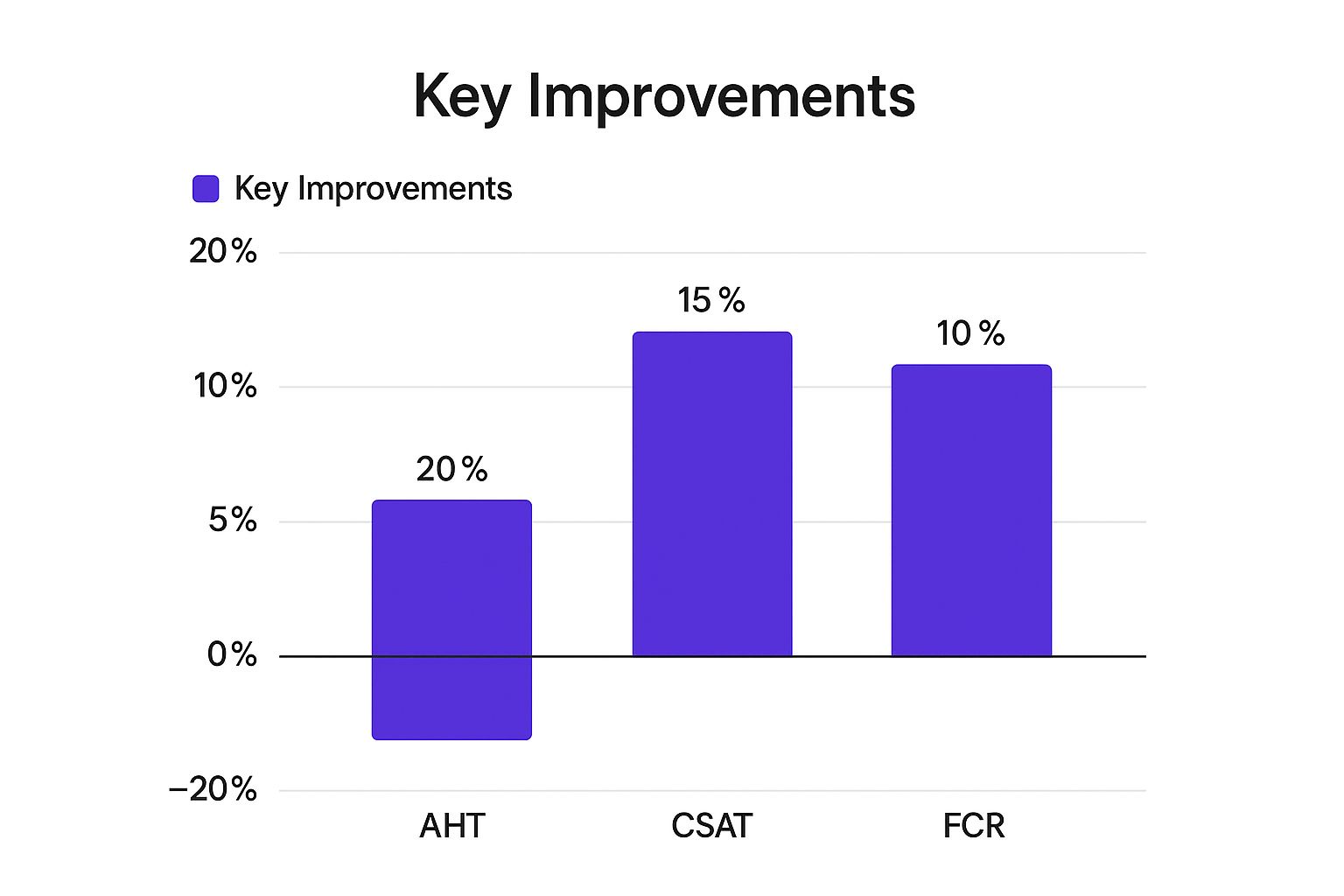
The infographic above visualizes the impact of focusing on key improvements. Imagine a 20% reduction in AHT, combined with a 15% jump in Customer Satisfaction (CSAT) and a 10% boost in FCR. That’s the power of prioritizing the right metrics. These improvements are connected – efficiency and customer happiness can absolutely go hand-in-hand.
Knowing industry benchmarks is also vital for setting realistic targets. To give you some context, the average customer satisfaction score in the U.S. was around 73% in 2022. Most call centers aim for an 80% answer rate within 20 seconds, but the real goal is to push that to 90% within 15 seconds. Learn more about call center statistics. This data helps you see where you stand and start setting ambitious, yet achievable goals. Honestly, assessing your current situation is the first step to building a truly effective, customer-centric call center.
Key Performance Benchmarks by Industry
Understanding how your call center stacks up against others in your industry is essential. The following table provides a comparison of essential call center metrics, giving you a framework for setting realistic improvement targets.
| Metric | Industry Average | Top Performers | Improvement Target |
|---|---|---|---|
| First Call Resolution (FCR) | 70% | 85% | +15% |
| Average Handle Time (AHT) | 6 minutes | 4.5 minutes | -1.5 minutes |
| Customer Satisfaction (CSAT) | 75% | 90% | +15% |
| Service Level (Percentage of calls answered within a target time) | 80% within 20 seconds | 90% within 15 seconds | +10% within a shorter timeframe |
As you can see, there's often a significant gap between average and top-performing call centers. Use this table as a starting point to identify areas where your team can excel and aim for those higher benchmarks. Remember, even small improvements in these key areas can make a huge difference in overall performance and customer perception.
Creating Training That Agents Actually Remember
Let's be honest, PowerPoint presentations can be soul-crushingly boring. And if you want a truly effective call center, you need training that actually resonates with your agents. Think about your own experiences – what training has stuck with you? I'm guessing it was the stuff that was engaging, interactive, and felt relevant to your day-to-day work. Your call center agents are no different. They're dealing with complex customer situations all day long, so they need training that prepares them for real-world challenges, not just reciting scripts from a manual.
One of the best training approaches I've seen is scenario-based learning. Instead of just lecturing on company policies, put your agents in simulated customer interactions. This gives them a chance to actually apply what they’re learning and builds their confidence in handling tricky situations. For example, have them role-play dealing with an irate customer who's been stuck on hold for far too long. This kind of hands-on practice makes the learning experience more memorable and so much more impactful.
Beyond Technical Skills: The Power of Emotional Intelligence
Technical know-how is important, absolutely. But it’s only part of the equation. Truly great call center agents also have high emotional intelligence. This means they can understand and manage their own emotions, and they can pick up on and respond effectively to the emotions of others. Think about it: an agent might be technically proficient, but if they lack empathy, the customer can still end up feeling frustrated. That's why training should also focus on developing empathy, active listening, and positive communication skills.
Peer-to-peer learning is another incredibly valuable tool. Agents often learn best from each other, sharing tips, tricks, and real-world experiences. Create opportunities for them to collaborate and learn from both successes and challenges. This not only builds a more supportive team environment but also creates a shared sense of responsibility for improving the call center's performance. Plus, it fosters empathy, which translates to better customer interactions. Did you know that when employees feel empathized with, 76% report higher engagement? This can significantly improve customer service outcomes. Considering that replacing an agent can cost around $10,000, according to these customer service statistics, investing in your team’s emotional intelligence is a direct investment in your customers and your bottom line.
Ongoing Coaching for Continuous Improvement
Training shouldn't be a one-and-done event. Implement ongoing coaching that focuses on support and development, not punishment. Regular feedback and guidance help agents refine their skills and stay motivated. This is especially critical in the fast-paced world of home services, where customer needs and industry best practices are always changing. By providing continuous support, you're empowering your agents to grow professionally and deliver truly exceptional service, ultimately leading to a more successful call center.
Smart Technology That Enhances Human Connection
Let's be honest, implementing new tech in your call center can feel like walking a tightrope. Do it wrong, and it can be a real mess. So often, I see companies get caught up in the hype of replacing humans altogether, instead of, you know, actually helping them. They spend a fortune on these shiny new systems, then watch their customer satisfaction scores tank. The reason? They lost sight of the human element. The real magic is in finding technology that boosts human connection, not replaces it.
One example that comes to mind is using AI-powered chatbots. These are fantastic for handling those simple, repetitive questions. Think password resets, order tracking – things like that. What this does is free up your human agents to deal with the trickier stuff, the issues that really need a human touch – empathy, creative problem-solving, that kind of thing. If your agents are constantly swamped with basic requests, they're going to be burned out and less effective when a customer calls with a real problem. Automating the routine stuff gives your team the breathing room they need to truly excel.
Amplifying Agent Effectiveness With the Right Tools
Another smart way to use technology is to give agents immediate access to customer information. Picture this: a customer calls in, and your agent can instantly see their entire history with your company. Past purchases, service requests, even their preferred way of getting in touch. This makes the interaction so much more personal and efficient. The customer feels understood, and the agent can quickly get to the heart of the matter. This is where a well-integrated CRM system, like Salesforce, can be a real game-changer. The screenshot below gives you a glimpse of a Salesforce Service Cloud interface.
Salesforce gives you a complete picture of every customer interaction, empowering your agents to deliver truly personalized support. Having all that information at their fingertips saves time, improves First Call Resolution (FCR), and makes customers happier. The right tools help your team work smarter, not harder.
Avoiding the Pitfalls of Over-Automation
But here's the thing: technology should support the customer experience, not dictate it. Going overboard with automation can be just as bad as having none at all. Nobody wants to wade through a complicated phone menu only to be met with a robotic voice that can't understand their problem. The goal isn’t to get rid of human interaction; it's to make that interaction more valuable. It's interesting to note that only 25% of call centers have effectively integrated AI, which means there's a huge opportunity for improvement. Meanwhile, U.S. companies are losing around $75 billion every year because of poor customer service. Discover more insights. This really underscores the need for a strategic approach to adopting new technology. You might also find this interesting: Virtual Assistant for Small Businesses – General Contractor. Don’t just throw money at every new gizmo that comes along. Focus on tools that solve specific problems and genuinely improve things for both your customers and your agents. That's how you get the most out of your tech investments and really boost your call center's performance.
Building Flexible Teams That Handle Anything
The home service world is a rollercoaster. Quiet one moment, flooded with calls the next. Maybe a storm hits, maybe it's a holiday weekend…who knows! The point is, rigid staffing just won't cut it. You need a team that can bend and stretch with these unpredictable spikes. Think of it like shock absorbers for your call center, smoothing out the bumps in the road.
The magic word here is flexibility. That means having a mix of full-time employees, part-timers, and even on-demand agents ready to jump in when things get crazy. This approach not only handles those sudden call surges but also helps control costs during slower periods. You're not paying for folks you don't need, which keeps your bottom line healthy. It's all about finding that sweet spot – enough people for the rush, but no overstaffing during the lulls.
Cross-Training: Creating Versatile Agents (Without Burning Them Out)
One of the smartest moves I've seen is cross-training. Basically, you train your agents to handle different types of calls and tasks. A scheduling agent, for example, could also be trained to answer basic billing questions. This creates a versatile team that can shift effortlessly to where they're needed most, like a Swiss Army knife for your call center.
But, and this is a big but, you absolutely have to avoid agent burnout. Don't dump a ton of information on them all at once. Focus on core skills first, then gradually expand their expertise. Check in with your team regularly to make sure they're not feeling overwhelmed. Remember, happy agents equal productive agents.
Integrating Remote and Part-Time Workers
Adding remote and part-time workers to your team is another great way to boost call center performance and build that flexible model. They're a fantastic resource for handling fluctuating call volumes. The key to success is clear communication and a smooth onboarding process. Think of them as an extension of your in-house team, just working different hours or from a different location. Tools like Slack, Zoom, and shared CRM systems make this integration seamless.
This blended workforce model gives you the agility to respond to changing demands, which is critical. I mean, think about it: 61% of managers reported increased call volumes between 2020 and 2021, and 40% of consumers will ditch a business after just one bad experience. Discover more insights. A flexible team helps you avoid long hold times and minimizes those negative experiences. For more on this, check out our guide on: Phone Answerer vs. Call Centers. This extra flexibility becomes a major factor in boosting your overall call center performance.
Performance Management for Distributed Teams
Managing a team spread across different locations requires a different approach. You can't just swing by someone's desk for a quick chat. You need clearly defined performance expectations, regular virtual check-ins, and tools to track performance remotely. These tools can range from basic time-tracking software to more advanced platforms that analyze call recordings and customer feedback.
Focus on results, not just hours clocked. Celebrate successes and address any issues head-on. Even when your team isn't physically together, building a strong team culture is essential for improving call center performance. That sense of community and shared purpose keeps everyone motivated and focused on delivering excellent service.
To help you visualize the different staffing approaches, take a look at this comparison:
Staffing Model Comparison: Analysis of different staffing approaches showing flexibility, cost, and performance trade-offs
| Staffing Model | Flexibility | Cost Efficiency | Quality Control | Best Use Case |
|---|---|---|---|---|
| Full-Time In-House | Low | Low | High | Consistent, predictable call volume |
| Part-Time In-House | Medium | Medium | Medium | Moderate fluctuations in call volume |
| Remote/On-Demand | High | High | Medium | Unpredictable spikes in demand, seasonal businesses |
| Blended (Mix of all) | High | High | High | Businesses needing both stability and surge capacity |
This table highlights how a blended model offers the best balance of flexibility, cost-effectiveness, and quality control, making it ideal for handling the unpredictable nature of the home services industry. By strategically combining different staffing models, you can create a robust and adaptable call center that meets the demands of your business while maximizing efficiency.
Turning Data Into Decisions That Stick
Data without action is just noise. I've seen it firsthand—call centers overflowing with reports that never see the light of day, much less lead to any real improvements. The real magic isn't about collecting more data, it's about knowing how to transform that data into actionable insights. It's about pinpointing the metrics that truly matter and building systems that keep everyone laser-focused on what actually makes a difference.
Beyond Basic Reporting: Unearthing Actionable Insights
Think of your data like a gold mine. Basic reports are like picking up nuggets at the surface—you find some value, sure, but the real motherlode is buried deeper. Advanced analytics are like bringing in the heavy-duty excavators—you dig deeper, uncover hidden veins of gold, and truly maximize your yield. This means going beyond simple call volume and average handle time (AHT). We need to delve into customer behavior patterns, agent performance trends, and operational efficiency opportunities.
For example, do call volumes surge at certain times of day or on particular days of the week? Do certain customer segments need more hand-holding than others? Is there a link between an agent's time with the company and their first-call resolution (FCR) rates? Answering these questions requires looking at the data from different angles and exploring the connections between various metrics.
Creating Feedback Loops That Drive Continuous Improvement
Data-driven decisions shouldn't be a one-and-done affair; they should be integrated into a continuous feedback loop. Think of a thermostat—it constantly measures the temperature and adjusts the heating or cooling to maintain the desired setting. Your call center should operate similarly, constantly monitoring performance data, identifying areas for improvement, implementing changes, and then measuring the impact of those changes.
This feedback loop requires setting clear performance targets, reviewing progress regularly, and tweaking things as needed. It's not a set-it-and-forget-it situation. It's about actively managing the process and making sure everyone is on the same page.
Accountability Systems That Motivate, Not Intimidate
Accountability is crucial, but it shouldn't feel oppressive. The goal is to motivate, not to create a climate of fear. When agents understand how their individual performance contributes to the overall success of the call center, they're much more likely to be engaged and invested in improving.
This involves providing regular feedback—both positive reinforcement and constructive criticism—and creating opportunities for agents to share their own ideas for improvement. When agents feel valued and empowered, they’re more likely to take ownership of their performance and aim for excellence. For some additional resources on optimizing your call center, check out: Best Phone Answering Services.
Building the Case for Change With Data
Data is your secret weapon when it comes to persuasion. When you need to request resources, propose process changes, or justify new technology investments, having the data to back up your arguments can be the deciding factor.
Let's say you want to convince your boss to invest in a new CRM system. Instead of just saying "it would be nice to have," you can present hard data showing how the current system is impacting AHT, FCR, and ultimately, customer satisfaction. Quantifying the potential benefits strengthens your case and increases your chances of getting approval.
Dashboards and Reporting Frameworks: Staying Focused on What Matters
Finally, let's talk dashboards. A well-designed dashboard is like the control panel for your call center, providing a clear, at-a-glance overview of the most important metrics. However, dashboards often become cluttered with irrelevant data, leading to metric overload. The key is to keep it simple and focused on the metrics that truly drive performance.
Choose a handful of key performance indicators (KPIs) that align with your overall business goals. These KPIs should be clearly displayed on your dashboard, using easy-to-understand visuals that show trends over time. This helps everyone stay focused on the big picture and avoid getting bogged down in the minutiae. Remember, data is only valuable if it leads to action. By turning your data into decisions that stick, you can transform your call center into a well-oiled, customer-centric machine.
Making Improvements That Last Beyond Next Quarter

Quick fixes are always so tempting. A little tweak here, a pep talk there. But in my experience, those kinds of "improvements" disappear quickly, especially in the fast-paced world of call centers. Leadership changes, market pressures – suddenly, those fixes are gone.
So how do you create change that lasts? It's about building systems, not applying temporary bandages. It's about fostering a culture of continuous improvement where everyone participates, not just management.
Building Momentum That Becomes Self-Sustaining
Think of it like a flywheel. At first, getting it to spin takes serious effort. But once it gains momentum, it keeps going with less and less force. Your call center can operate the same way.
Begin with a clear vision. Set achievable goals. And don't forget to celebrate those small wins along the way. This creates momentum and a sense of shared accomplishment that fuels ongoing improvement.
For example, if your goal is to improve First Call Resolution (FCR), start by recognizing agents who consistently achieve high FCR rates. This positive reinforcement can inspire others to improve their performance as well.
Accountability Without Constant Oversight
Micromanaging is a surefire way to kill morale. It breeds resentment and stifles initiative. Instead, create an accountability framework that empowers your team.
Give them clear expectations. Provide the resources and tools they need to succeed. Then, trust them to do their jobs. Regular feedback is important, of course, but focus on support and development, not just highlighting mistakes. Think of it as coaching, not policing.
Developing Problem-Solving Superstars
The best call centers I've seen have one thing in common: agents who can think on their feet. They don't just stick to scripts; they understand the reasoning behind the processes.
These agents can adapt to new situations, solve problems creatively, and make informed decisions independently. This reduces the need for constant supervision and allows your call center to run smoothly, even when unexpected challenges arise.
Creating a Culture of Continuous Improvement
This isn’t about management cracking the whip. It’s about creating an environment where everyone, from the newest agent to the call center manager, is invested in boosting performance.
Encourage feedback from everyone. Celebrate innovative solutions. Make learning a continuous process. When everyone has a voice and feels invested in the call center’s success, you create a powerful engine for sustained growth and a resilient operation ready for anything. That's how you achieve results that last far beyond the next quarter.
Your Roadmap To Results Starting Tomorrow
Let's get down to brass tacks. How can you actually improve your call center performance, starting tomorrow? Forget the theoretical fluff. This is a practical roadmap, born from real-world experience, designed to give you quick wins and long-term strategies for sustainable growth.
Whether you're building a call center from the ground up or just tweaking an existing one, this roadmap will provide clarity and direction. We're talking about systematic improvements that actually stick, not flash-in-the-pan initiatives that fizzle out after a week.
Prioritized Steps for Immediate Impact
Grab some low-hanging fruit with these quick wins:
-
Identify Your Bottlenecks: Where are your agents spending the bulk of their time? Where do customers get stuck in the process? A simple call flow analysis can uncover these hidden time-wasters. I've seen this firsthand – sometimes a simple tweak to the IVR can shave minutes off average handle time.
-
Empower Your Agents: Give your agents the resources they need to solve customer issues quickly and effectively. Think user-friendly CRM systems, readily accessible knowledge bases, and clearly defined processes. When agents have the right tools at their fingertips, everyone wins.
-
Focus on First Call Resolution (FCR): Every time a customer has to call back, it costs you. Prioritize resolving issues completely on the first contact. It's a game-changer for customer satisfaction and efficiency.
These seemingly small adjustments can make a significant difference to your metrics—and your bottom line.
Longer-Term Strategies for Sustainable Growth
For changes that truly last, consider these strategies:
-
Invest in Ongoing Training: Training isn't a one-and-done deal. Regular coaching and professional development keep agents sharp and ready to adapt. Think of it like a gym membership for your team's skills – consistent effort pays off.
-
Embrace Technology Strategically: Don't just jump on every new tech bandwagon. Focus on tools that truly enhance the human connection and empower your agents, not replace them. Technology should be a support system, not a substitute for good people.
-
Build a Flexible Team: Having a mix of full-time, part-time, and remote agents gives you the flexibility to handle the inevitable fluctuations in call volume. This adaptability is crucial for maintaining service levels during peak periods.
These strategies require a bit more investment, but they create a solid foundation for sustained growth and a call center that can weather any storm.
Warning Signs and Troubleshooting Guidance
Even the best-laid plans can sometimes go awry. Keep an eye out for these red flags:
-
Rising Call Abandonment Rates: This often signals staffing shortages or clunky processes.
-
Decreasing Customer Satisfaction (CSAT) Scores: This could point to agent burnout, insufficient training, or unresolved technical issues.
-
Increasing Average Handle Time (AHT) without a Corresponding Increase in FCR: This suggests agents are spending more time on calls but not actually resolving issues.
If you spot these warning signs, don't panic. This roadmap offers troubleshooting guidance to help you address these common challenges and get back on track. Building a high-performing call center is a marathon, not a sprint. This roadmap helps you navigate the course, make real improvements, and cultivate a team that delivers exceptional customer experiences.
Ready to level up your call center and boost your home service business? Phone Staffer can help you generate and convert leads, book appointments, and manage customer interactions more effectively. We offer cold calling services, remote staffing solutions, and expert advice to help you reach your business goals. Visit us today to learn more!