
SEO for auto repair shops is all about making sure you show up when a local driver needs help. It's the process of tuning up your shop's online presence so you rank higher in local search results, turning those frantic "mechanic near me" searches into actual, paying customers in your service bays.
This isn't just a marketing gimmick anymore; it's the single most effective way to keep your schedule full, especially now that customers grab their phones, not the phonebook.
Why Local SEO Is Your Shop's Most Powerful Tool
Let's be real—relying solely on word-of-mouth and your regulars is a risky way to run a business these days. The game has changed. When a check engine light flips on or a tire goes flat, people aren't calling their buddy for a recommendation first. Their first move is a quick, often panicked, Google search.
This is a massive shift in how people find you. If your shop isn't showing up on that first page of results, you're basically invisible to a huge number of potential customers who need your expertise right now.
The Power of the Google Local Pack
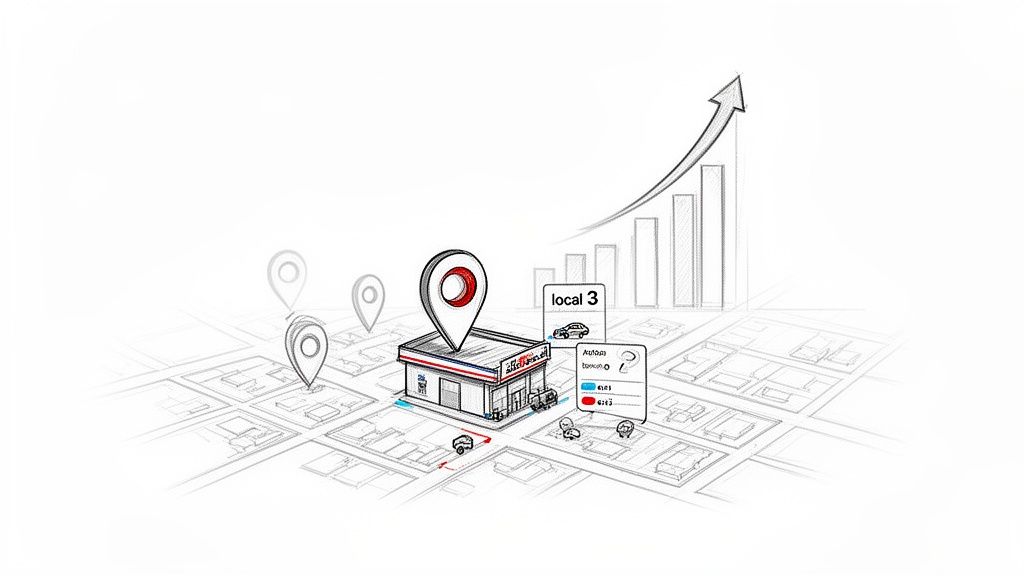
When someone searches for a local service, Google doesn't just give them a boring list of blue links. The first thing they see is the "local 3-pack"—that map with three shops highlighted right at the top. It shows the shop's name, address, phone number, and, most importantly, those star ratings.
This is the best spot to be on the entire internet for a local business.
Getting into that 3-pack means more phone calls and more appointments. It's that simple. Why? Because it’s a shortcut to trust and convenience. A potential customer instantly sees you're highly rated and nearby, and they can click to call you straight from the search results.
If you're not in the local 3-pack, you're handing business to your competitors. It’s the difference between a fully booked week and hearing crickets.
The numbers don't lie. Organic traffic from SEO consistently delivers the highest ROI for businesses in the automotive industry. Think about this: 68% of automotive buyers click on one of the first three results in Google. If you’re not there, you could be losing two out of every three potential customers who are actively looking for help.
You can get a deeper look into how all this works by exploring local SEO services specifically for auto repair shops.
Connecting SEO to Real-World Results
Good SEO for auto repair shops isn't about vanity metrics like "traffic." It's about putting money in the bank. Every single improvement you make to your online ranking is a direct investment in your shop's future.
- More Calls and Leads: Ranking higher puts you in front of more people who are ready to book a service.
- Higher Quality Leads: Someone searching for "Honda brake repair in Dallas" isn't just browsing. They have a problem and they're ready to pay someone to fix it.
- Builds Instant Trust: A professional-looking online presence, packed with positive reviews, builds credibility before you even pick up the phone.
At the end of the day, putting effort into your shop's online visibility is one of the most direct and measurable ways to grow your business. And when that new flood of calls is met with a professional and friendly voice on the other end, every SEO win turns directly into more booked jobs and a healthier bottom line.
Turn Your Google Business Profile Into a Customer Magnet
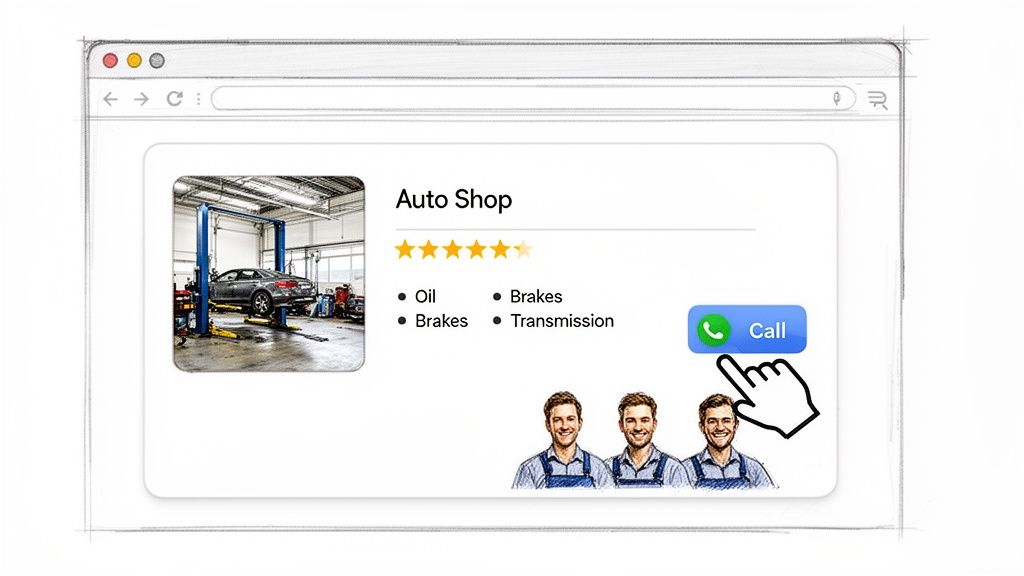
If your website is your shop’s home base, then your Google Business Profile (GBP) is your digital storefront. For most local customers, it's the very first impression they'll have of your business, showing up right at the top of Google Maps and local search results.
Leaving this profile half-finished is one of the biggest mistakes a shop can make. An incomplete listing quietly tells potential customers you might not be on top of the details. A fully built-out profile, on the other hand, builds instant trust and sends new leads straight to your phone.
Just picture it: a driver is stranded with a steaming engine. They aren't going to spend time clicking through ten different websites. They're going to pull up the local map, scan the reviews, and call the shop that looks the most professional and trustworthy. Your GBP is your audition for that call.
Nail The Foundational Details
Before anything else, you have to get the basics absolutely perfect. Inaccurate information is a surefire way to lose a customer and tank your local SEO.
Google's algorithm thrives on consistency. Make sure your shop's name, address, and phone number (NAP) are identical—down to the last comma—across your GBP, your website, and every other directory you're listed on.
Your business description is another valuable piece of real estate. Don't just cram it with a list of services. Tell a story. Are you a family-owned shop that's been serving the community for 30 years? Say that. Do you specialize in tricky European imports or heavy-duty trucks? Make it crystal clear. This is also the perfect place to naturally work in keywords like "brake repair in [Your City]" or "certified mechanics."
For a deeper dive, there are some great resources on optimizing your Google My Business profile.
Choose Your Categories Wisely
Selecting the right business categories is non-negotiable if you want to show up in relevant searches. Your primary category should almost always be "Auto repair shop," but you can't stop there. Google lets you add several secondary categories, and this is your chance to showcase your specialties.
Think about the services that bring in the most business and add categories for them. For example:
- Tire shop: If you do more than the occasional rotation.
- Brake shop: Absolutely essential if this is a core service.
- Oil change station: Helps you capture those routine maintenance searches.
- Transmission shop: A high-value specialty that people search for by name.
By selecting all relevant categories, you're giving Google a detailed map of your expertise, which dramatically increases the odds of you appearing when a customer has a specific need.
Use Every Feature At Your Disposal
An empty profile gets ignored. A complete one gets clicks. It's that simple. Google gives you a whole toolkit right inside your GBP dashboard, and using every feature signals to the algorithm that you're an active, engaged business that deserves a top spot.
Your GBP is a living profile, not a set-it-and-forget-it listing. The more actively you manage it by adding photos, posts, and services, the more Google will reward you with visibility in local search.
The rise of "near me" searches has completely changed the game. Google now heavily weighs profile completeness and proximity to the searcher. And with around 68% of automotive buyers clicking one of the first three local results, an unoptimized profile means you're invisible to the vast majority of your potential customers.
To make sure you're capturing that traffic, here’s a quick checklist to help you build a profile that works as hard as you do.
Google Business Profile Optimization Checklist
This table breaks down the key features you need to focus on. Filling out each section provides a comprehensive, trustworthy snapshot of your business that both customers and search engines will appreciate.
| GBP Feature | Optimization Action | Why It Matters for SEO |
|---|---|---|
| Services | Add every individual service you offer, like "Coolant Flush" or "Alternator Replacement," with brief descriptions. | This allows you to rank for very specific, high-intent searches when a customer knows exactly what they need. |
| Photos & Videos | Upload high-quality photos of your team, clean service bays, completed work, and your shop's exterior. A short video tour is even better. | Visuals build trust and show professionalism. Google’s algorithm prioritizes profiles with rich, fresh media content. |
| Google Posts | Create weekly posts about promotions, new diagnostic equipment, or seasonal car care tips. These appear directly in your profile. | This signals to Google that your business is active and provides fresh, relevant content for searchers to see. |
| Q&A Feature | Proactively add and answer your own FAQs. Think about common questions like, "Do you offer a warranty on your work?" or "Do I need an appointment for an oil change?" | This addresses customer concerns upfront, saves your staff time on the phone, and lets you control the narrative. |
By consistently managing these elements, you're not just checking boxes—you're actively building a powerful customer acquisition tool that works for your shop 24/7.
Optimize Your Website to Win Local Searches
While your Google Business Profile is the digital handshake that gets you noticed, your website is where you really build the relationship. It's your own corner of the internet, giving you total control over your brand’s story, the nitty-gritty details of your services, and how a customer goes from a quick search to a booked appointment.
Think of your GBP and website as a tag team. Your profile reels them in, and your website seals the deal.
For your site to actually pull its weight, it needs to be more than a fancy business card. It has to be built from the ground up to answer the exact questions your potential customers are punching into Google. This means getting way more specific than a generic "Services" page. You need a dedicated, detailed page for each core service you offer.
This is how you capture those incredibly specific, high-intent searches. A driver isn't just looking for an "auto shop." They're searching for "Honda Civic brake replacement in Phoenix" or "check engine light diagnostic near me." Creating individual pages for these services is precisely how you show up for those money-making keywords.
Structure Your Site Around Your Services
The auto shop websites that dominate local search are always organized logically around what customers actually need. A simple, flat, one-page site just can't keep up anymore. The goal is to create a clear hierarchy that makes it dead simple for both people and Google's crawlers to understand exactly what you're an expert in.
A winning structure usually looks something like this:
- Homepage: Your main hub. It should immediately tell visitors who you are, what you do, and where you're located.
- Service Pages: This is the core. Create dedicated pages for major services like Brake Repair, Oil Changes, Engine Diagnostics, and Transmission Services.
- Location Pages: If you have multiple shops, each one absolutely needs its own page with its specific address, phone number, and a bit of local flavor.
- About Us Page: Don't skip this! It's where you tell your story, introduce your technicians, and start building real trust.
- Contact Page: Make it incredibly easy for customers to find your address, phone number, and a contact form. No one should have to hunt for this.
By building out your site this way, you're creating more opportunities to rank for a much wider variety of search terms. Every new page is another hook in the water, just waiting to catch a customer with a specific problem.
Master On-Page SEO for Each Service
Once you have your site structure mapped out, it's time to get into the details and optimize each page. This is where on-page SEO comes in—it's all about fine-tuning the content and HTML of a page to scream to search engines exactly what it's about.
Think of on-page SEO like labeling your files correctly. If you have a page about brake repair, every single signal on that page—from the title to the images—should be shouting "brake repair" to Google.
Start with your page titles, which you'll also see called meta titles. This is the blue, clickable link that shows up in search results, and it has to be both compelling and packed with the right keywords.
| Good Title | Bad Title |
|---|---|
| Expert Brake Repair in Dallas TX | Your Shop Name | Services |
| Fast Oil Change Service in Atlanta | Book Now | Oil Change |
| Certified Transmission Repair | Your Shop Name | Transmissions |
See the difference? The good examples include the service, the location, and a reason to click, like a trust signal or a call to action. This one change can dramatically improve how many people click on your link. The meta description—that little blurb of text under the title—should also be keyword-rich and give them a reason to choose you, like mentioning "ASE-Certified mechanics" or "Same-day service available."
Build Local Authority with NAP Consistency
Google doesn't just look at your website. It scours the web for consistent signals that verify your business's legitimacy and location. The single most important signal here is your NAP (Name, Address, Phone number). This info has to be identical everywhere it appears online.
Even tiny inconsistencies, like using "St." on one directory and "Street" on another, can create confusion for search engines and tank your local rankings. It plants a seed of doubt about which information is the real deal.
First, make sure your NAP is correct and prominently displayed on your own website, usually in the header or footer of every single page. From there, you need to build local citations. These are simply mentions of your business on other websites, most often in online directories.
Here are a few essential directories every auto repair shop should be on:
- General Directories: Yelp, Yellow Pages, Better Business Bureau (BBB).
- Industry-Specific Directories: RepairPal, AutoMD, Openbay.
- Local Directories: Your local Chamber of Commerce or city-specific business listings.
Claiming and updating your profile on these sites creates a powerful web of consistent information that solidifies your shop's location and credibility in Google's eyes. It's not a flashy tactic, but this foundational work pays off by building a strong, trustworthy online presence that wins local searches over the long haul.
Build a 5-Star Reputation That Pulls in New Customers
In the auto repair business, trust is everything. It's the currency that keeps customers coming back. Online, that trust is measured in stars.
Customer reviews on Google, Yelp, and even Facebook are no longer just optional feedback; they're a massive signal to search engines. When you get a steady stream of positive reviews, you’re telling Google that your shop is a legitimate, high-quality business that real people actually trust. This isn't just a "nice-to-have"—it's a core piece of your SEO for auto repair shops that you simply can't ignore.
Put yourself in the customer's shoes. They search for "brake repair near me" and see two local shops on the map. One has a 4.9-star rating from 150 reviews. The other has a 3.2-star rating from 12. Which one are they calling? The choice is a no-brainer. Those stars are often the final push that turns a searcher into a paying customer.
Make It Easy for Happy Customers to Leave Reviews
Here's the thing: most of your happy customers aren't leaving reviews because they're unhappy. They're just busy. Once they drive away with their car running smoothly, reviewing your shop is the last thing on their mind. Your job is to make it ridiculously easy for them.
The single most effective way to do this is to text them a direct link to your Google review page right after you've finished the job. It's immediate, it's personal, and it takes them exactly where they need to go.
Try a simple message like this:
"Hi [Customer Name], this is [Your Name] from [Your Shop Name]. Thanks for coming in today! Would you mind taking 30 seconds to leave us a review on Google? Your feedback helps us a lot! [Direct Link to Google Review Page]"
This works because there's zero friction. No searching, no navigating, just a single tap.
Simply asking for reviews isn't enough. You have to make it dead simple for customers to act in the moment by sending them a direct link via text or email immediately after their service.
A few other tactics that work well:
- QR Codes: Put a QR code on your invoices or at the checkout counter that links straight to your review page.
- Email Follow-Ups: Add a big, can't-miss-it review link in your digital receipts or thank-you emails.
- In-Person Requests: When a customer is visibly thrilled with your work, a friendly, verbal ask from their favorite tech can go a long way.
Respond to Every Single Review—Good or Bad
Your job doesn't end when a review gets posted. You need to respond to all of them. This shows potential customers scrolling through your profile that you're an engaged owner who cares about the customer experience.
Positive reviews are the easy ones. A quick "Thank you so much for your business, we're glad we could help!" reinforces the good experience and makes the customer feel appreciated.
Negative reviews, on the other hand, are an opportunity. Yes, they sting, but a professional and calm response can turn a public complaint into a showcase of your shop's integrity. Never, ever get defensive. Acknowledge their issue, apologize that their experience wasn't up to par, and offer to make it right offline.
Here’s a great example of how to handle it:
"Hi [Customer Name], thank you for your feedback. We're very sorry to hear that your experience didn't meet your expectations. Our goal is always 100% satisfaction, and we'd like the opportunity to discuss this with you further. Please call me directly at [Your Phone Number] at your convenience."
This kind of response demonstrates accountability. Anyone reading it will see that even when something goes wrong, you're a professional who stands behind your work. This proactive reputation management builds incredible trust and, over time, will bring you more business.
Turn SEO Traffic Into Booked Appointments
You’ve done all the hard work. You’ve tweaked your Google profile, built out your service pages, and hustled for reviews. All of that effort funnels down to one critical moment: a potential customer, phone in hand, hitting that "call" button.
This is the moment of truth. And honestly, it’s where I see a ton of shops drop the ball. The most perfectly executed SEO for auto repair shops is completely worthless if that high-intent phone call goes to voicemail.
The Real-World Cost of a Missed Call
Think about it from the customer's perspective. A driver is stuck on the side of the road with a smoking engine. They frantically search "emergency auto repair near me" and your shop is the first result. They call. No answer.
Your techs are buried in a complex engine rebuild, and your service advisor is walking another customer through a big estimate. That stranded driver isn't leaving a message. They're hanging up and immediately calling the next shop on Google’s list.
You didn’t just lose a potential customer; you actively sent them to your competitor. Your entire SEO investment was just wasted.
Every unanswered call is more than a missed opportunity—it's straight-up lost revenue. The person calling your shop has a problem they are ready to pay to fix, right now. They’ve already picked you. Letting that call go unanswered is like telling a customer standing at your counter with a credit card to go somewhere else.
This whole problem gets way worse when you're busy. The more successful your shop is, the less time your team has for new calls. It’s a frustrating bottleneck where your own success starts to choke off new business.
For an auto repair shop, a ringing phone is the sound of your SEO strategy paying off. An unanswered phone is the sound of that investment going right down the drain.
This process really boils down to a simple cycle. Great work gets you great reviews, and that reputation is what makes the phone ring in the first place.
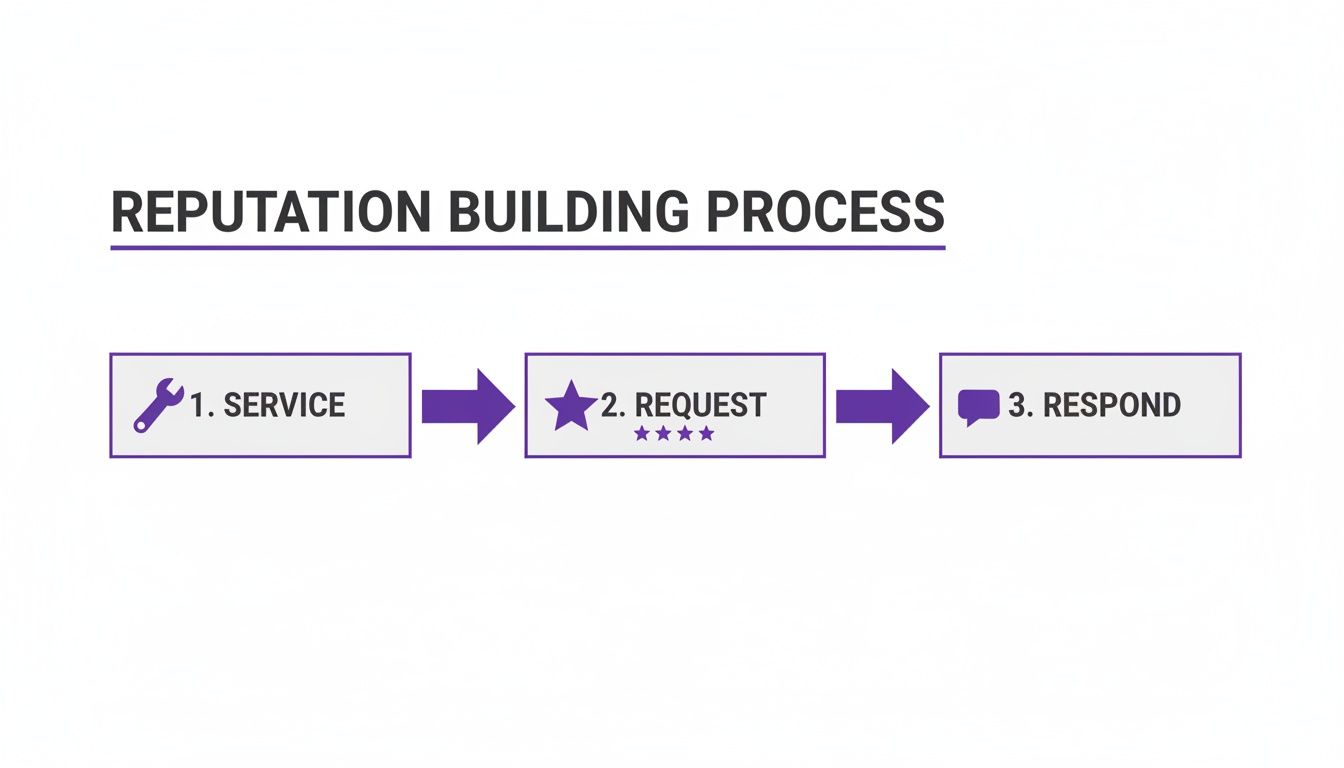
As the visual shows, it's a loop: deliver great service, ask for the review, and let your reputation bring in the next customer. But you have to be there to answer their call.
Building a System to Actually Capture Leads
If you're serious about getting a return on your marketing, you need a bulletproof system for capturing every single call. This doesn't mean yanking a tech off a brake job every time the phone chirps. It means having someone whose sole focus is turning that ringing phone into a scheduled appointment.
This is where a service like Phone Staffer can be a total game-changer for a busy shop. Their trained, remote Customer Service Representatives (CSRs) are dedicated to answering your calls, ensuring no lead ever falls through the cracks. They become a natural extension of your front desk, but their only job is to convert that inbound call into work on your schedule.
Here’s what that looks like in practice:
- Every Call Answered: A real, professional human answers instantly, building trust from the very first second.
- Smart Triage: They quickly figure out what the customer needs. Is it a routine oil change or a tricky electrical issue?
- Direct Scheduling: With access to your shop's calendar, they can book the appointment right then and there.
- Info Gathering: They collect the customer's name, vehicle details, and a description of the problem, so your service advisor is prepped and ready when the car arrives.
This kind of system turns your front desk from a point of friction into a powerful conversion tool. Your team in the shop can stay focused on delivering high-quality service, while your remote CSRs keep the pipeline full.
From Clicks to Customers: Closing the Loop
Let’s go back to that driver with the smoking engine. With a real lead capture process, their story has a much different ending.
They find your shop on Google and call. A friendly, professional CSR answers on the first ring. The CSR confirms you handle emergency diagnostics, gives them an idea of what to expect, and books an immediate tow-in. You just landed a high-value job, and that driver is now a loyal customer for life.
That’s how you get a true return on your SEO.
When you pair a strong online presence with an unbreakable system for answering the phone, you create a legitimate growth engine for your shop. You're not just getting more clicks; you're building a busier, more profitable business, one answered call at a time.
Common Questions About Auto Repair SEO
Jumping into SEO for your auto repair shop can feel a lot like trying to diagnose a tricky engine problem without the right scanner. You know it’s important, but it’s easy to get lost in the weeds. Let’s clear up some of the most common questions we hear from shop owners day in and day out.
How Long Does It Realistically Take to See Results?
This is always the first question, and the honest-to-goodness answer is: it takes patience. SEO is a marathon, not a sprint. While you might see some small wins from technical fixes in a few weeks, real, meaningful results—the kind that actually get your phone ringing more—typically start showing up in three to six months.
Think of it this way: you don't build a reputation as the best shop in town after one perfect brake job. It takes months, even years, of consistently great work. SEO is the same. Google needs to see you consistently putting in the effort—adding helpful content, earning positive reviews, and getting your name out there online—before it starts trusting you enough to send more searchers your way.
Do I Really Need a Blog for My Auto Repair Shop?
Yes, but don't panic. You don't need to become a professional writer. A "blog" is just a place on your website to post helpful articles that answer the questions your customers are already asking. It's your chance to prove you know your stuff and gives Google more reasons to show your site in search results.
Here are a few simple ideas that work every time:
- Seasonal Car Care: "Is Your Car's AC Ready for a Texas Summer? 5 Signs It Needs a Recharge."
- Troubleshooting Common Issues: "Why Is My Check Engine Light Flashing? (And What to Do About It)."
- Demystifying Services: "Wheel Alignment vs. Wheel Balancing: What's the Difference?"
Every one of these articles acts as another hook in the water, helping you rank for specific problems and solidifying your SEO for auto repair shops.
Is It Better to Use Google Ads or SEO?
This is a classic "should I rent or should I buy?" scenario. The smartest shops don't choose one; they use both because they solve different problems.
- Google Ads (PPC): This is like renting a billboard on the busiest highway in town. You pay, and you get immediate visibility at the very top of Google. It's fantastic for generating leads right now, especially for high-ticket services like transmission work.
- SEO: This is like buying the land and building your own shop. It takes more upfront work, but once you earn those top rankings, the traffic is yours. It's a long-term asset that builds incredible trust and authority.
A great strategy is to run Google Ads for those quick wins and to discover which search terms bring in the best customers. Meanwhile, your SEO efforts are humming along in the background, building a rock-solid foundation for future growth.
Can I Do SEO Myself?
You absolutely can. Many of the most important SEO tasks are well within your reach. Claiming and fleshing out your Google Business Profile, actively asking for reviews, and building out individual pages for each of your key services are all things a sharp owner can tackle. Just by following the playbook we've laid out, you'll be miles ahead of the competition.
That said, once you start to see success or if you're in a city with a ton of other shops, bringing in an agency that lives and breathes auto repair marketing can be a game-changer. It frees you up from the technical headaches so you can focus on what you're best at—turning wrenches and taking care of customers.
Ready to stop missing calls and start booking more of the high-intent leads your SEO efforts generate? Phone Staffer provides trained, remote CSRs who answer every call, qualify every lead, and schedule appointments directly on your calendar. Learn how we can help you convert more clicks into customers.